University of South Carolina
Scholar Commons
Theses and Dissertations
2017
Determination of Polarization Transfer Coefficients
and Hyperon Induced Polarization for Quasi–Free
Hyperon Photoproduction off the Bound Neutron
Colin Gleason
University of South Carolina
Follow this and additional works at:https://scholarcommons.sc.edu/etd
Part of thePhysics Commons
This Open Access Dissertation is brought to you by Scholar Commons. It has been accepted for inclusion in Theses and Dissertations by an authorized administrator of Scholar Commons. For more information, please [email protected].
Recommended Citation
Determination of Polarization Transfer Coefficients and Hyperon Induced Polarization for Quasi–Free Hyperon Photoproduction off
the Bound Neutron
by
Colin Gleason
Bachelor of Science Union College 2011
Submitted in Partial Fulfillment of the Requirements
for the Degree of Doctor of Philosophy in
Physics
College of Arts and Sciences
University of South Carolina
2017
Accepted by:
Yordanka Ilieva, Major Professor
Ralf Gothe, Committee Member
Matthias Schindler, Committee Member
Michael Vineyard, Committee Member
c
Copyright by Colin Gleason, 2017
Dedication
Acknowledgments
First, I need to thank Yordanka Ilieva, who has been a fantastic advisor during my
Ph.D. studies. When she took me on as a student, I had limited experience and
knowledge when it came to medium energy nuclear physics. Her guidance, help, and
most importantly patience has helped me learn so much about the field. Our many
discussions have taught me not only so much about the field, but how to be a better
researcher.
I would like to thank all the members of the Experimental Nuclear Physics Group
who have helped me with my work along the way. Steffen Strauch’s suggestions have
provided key insight into my analysis and his scrutiny of my work on a near weekly
basis has challenged me to look at my work in a new way. Nicholas Zachariou and
Tongtong Cao have spent countless hours helping and discussing my work with me
Much of this thesis is based off the many discussions we have had.
I would also like to thank everyone in the Experimental Nuclear Physics group at
South Carolina and the members of the g13 run group for all the help along the way.
Last, and certainly not least, I need to thank my wonderful fiancé Ellen Bryan.
Ellen and I met 6 months into my Ph.D. studies and she has been one of the few
constants in my life throughout the process. She has been supportive, understanding,
and patient. Thank you, Ellen. I can not express how much I love and appreciate
you.
Abstract
The spectrum of the excited nucleon (N∗) states provides key information on the
rel-evant degrees of freedom within the nucleon. The determination of the N∗ spectrum
requires an extensive set of high–quality experimental observables for a large
num-ber of nuclear reactions over a broad kinematic range. In particular, measurements
of polarization observables of strangeness photoproduction are of high importance as
many of the resonances that are predicted by quark models, but not observed in pion–
nucleon channels, are expected to couple strongly to kaon–hyperon (KY) channels.
While in the last decade a large body of polarization and cross–section data has been
published for strangeness photoproduction off the proton, data off the neutron are
very scarce. The goal of this dissertation is to determine the polarization observables
Cx, Cz, and P in the reaction~γd→K0Λ(~ p), where the deuteron is used as a neutron
target. The data was collected in the experiment E06-103 with the CEBAF Large
Acceptance Spectrometer (CLAS) at Thomas Jefferson National Accelerator Facility
(JLab) using a circularly-polarized photon beam and an unpolarized LD2 target. In
this thesis I discuss the analysis technique and show results of Cx, Cz, and P for
quasi–free photoproduction of K0Λ off the bound neutron for photon energies
be-tween 0.9–2.6 GeV and K0 center–of–mass angles, cosθCM
K0 , between−1 and 1. This
study is part of a larger program carried out at JLab to provide a nearly complete
Table of Contents
Dedication . . . iii
Acknowledgments . . . iv
Abstract . . . v
List of Tables . . . ix
List of Figures . . . xii
Chapter 1 Introduction . . . 1
1.1 Standard Model . . . 2
1.2 Quantum Chromodynamics . . . 3
1.3 Baryon Spectroscopy . . . 7
1.4 Hyperon Photoproduction . . . 14
1.5 Summary and Structure . . . 26
Chapter 2 Experiment . . . 28
2.1 g13 Experiment . . . 28
2.2 CEBAF . . . 29
2.3 Hall B . . . 30
3.1 Particle Identification . . . 40
3.2 Event Vertex . . . 44
3.3 Photon Selection . . . 45
3.4 Decay Vertex Reconstruction . . . 48
3.5 Reconstruction of theK0 and Λ . . . . 50
3.6 Missing Momentum . . . 54
Chapter 4 Observable Extraction Method . . . 56
4.1 Event Generator and Simulations . . . 58
4.2 Axis Conventions . . . 65
4.3 Maximum Likelihood Method . . . 65
4.4 Background Subtraction . . . 66
Chapter 5 Systematic Studies . . . 78
5.1 Instrumental Asymmetry . . . 79
5.2 Event–Selection Cuts . . . 85
5.3 Combinatorial Background . . . 108
5.4 Maximum Likelihood Extraction Method . . . 109
5.5 Background Subtraction . . . 122
5.6 Photon Polarization and Self–Analyzing Power of the Λ . . . 127
5.7 Summary . . . 128
Chapter 6 Results . . . 131
6.2 Photon Polarization . . . 132
6.3 Unprimed Coordinate System . . . 133
6.4 Primed Coordinate System . . . 139
6.5 Comparison withγp→K+Λ . . . . 141
6.6 Observables as a Function of the Neutron Momentum . . . 143
6.7 Discussion . . . 146
List of Tables
Table 1.1 The status of the N∗s. A * means evidence for the state is
poor, ** evidence is fair, *** evidence is very likely but more information is needed, and **** means the evidence is certain and the properties of the state have been explored. The table is
adapted from the PDG [47]. . . 8
Table 1.2 The differential cross section and the 15 polarization observables
forKY photoproduction. The left column shows the name of the
observables, the middle column shows the expression for the ob-servable in the transversity representation, and the right column lists the polarizations needed to extract the observable. Table
adapted from [4]. . . 20
Table 4.1 Physics channels generated in the event generator and processed
through the detector simulation. If desired, unstable final–state
particles can be decayed in the generator. . . 58
Table 5.1 Pull distribution parameters (µ, σ) for different cosθπ∗− bins.
The means and widths do not significantly differ from 0 and 1, respectively. This means no instrumental asymmetry within
specific cosθπ∗− ranges is present in the data. . . 82
Table 5.2 Pull distribution parameters (µ, σ) for different φ bins. The
means and widths do not significantly differ from 0 and 1,
respec-tively. This means no instrumental asymmetry within specificφ
ranges is present in the data. . . 83
Table 5.3 Pull Distribution parameters forpX bins. The means and widths
do not significantly differ from 0 and 1, respectively. This means no significant instrumental asymmetries are present within
spe-cific pX ranges. . . 83
Table 5.4 Relative pull–distribution fit parameters for the different proton
selection cuts. The means and widths of Cx, Cz, and P are
Table 5.5 Relative pull–distribution calculated parameters for the proton selection. The means are all consistent with 0. The widths do
not significantly differ from 1. . . 87
Table 5.6 Relative pull–distribution fit parameters for the π+ selection.
The means and widths of Cx, Cz, and P do not significantly
differ from 0 and 1, respectively. . . 88
Table 5.7 Relative pull–distribution calculated parameters for the π+
se-lection. The means of Cx, Cz, and P do not significantly differ
from 0 and the widths are close to 1. . . 88
Table 5.8 Relative pull–distribution fit parameters for the π− selection.
The means and the widths ofCx,Cz, and P pulls do not
signif-icantly differ from 0 and 1, respectively. . . 88
Table 5.9 Relative pull distributions for Cx (left), Cz (middle), and P
(right) from the π− selection. The means do not significantly
differ from 0 and the widths are close to 1. . . 89
Table 5.10 Relative pull-distribution fit parameters for the differentM(pπ−)
regions. The means and widths ofCx andCz are consistent with
0 and 1. The mean of P is more than 3 standard deviations from 0. 91
Table 5.11 Relative pull-distribution calculated parameters for theM(pπ−)
cut. The means of Cx and Cz are consistent with 0. The mean
of P is significantly different than 0. . . 92
Table 5.12 Calculated weighted mean of the difference ∆Obsfor theM(pπ−)
cut. . . 93
Table 5.13 Calculated mean of theσ2
sys for the M(pπ
−) cut. . . . 95
Table 5.14 The mean (µ±σµ), number of standard deviations of the mean
from 0 (N σµ), width (width±σwidth), and number of standard
deviations of the width from 1 (N σwidth) of the relative pull
distribution fit parameters for theM(π+π−) cut. From the fits,
the mean and width do not significantly deviate from 0 and 1,
respectively. . . 96
Table 5.15 Relative pull distribution calculated parameters for theM(π+π−)
cut. The means are all consistent with 0. The widths are all close
Table 5.16 Relative pull-distribution fit parameters for the fiducial cut. The
means and widths for Cx and Cz are consistent with 0 and 1,
respectively. The mean forP is ≈4σ from 0. . . 99
Table 5.17 Calculated relative pull-distribution parameters for the fiducial cut. 100
Table 5.18 Calculated weighted mean of the difference distribution, for the
fiducial cut. Only the weighted mean for P is significantly
dif-ferent from 0. . . 101
Table 5.19 Calculated mean of the σ2
sys for the fiducial cuts. The negative
values for the calculated means of all observables suggest no sig-nificant systematic uncertainties can be attributed to the fiducial
cuts. . . 102
Table 5.20 Relative pull–distribution fit parameters for the pX cut. The
means and widths do not significantly differ from 0 and 1, respectively.105
Table 5.21 Relative pull–distribution calculated parameters for the pX cut.
The means for Cx and P are consistent with 0, while the mean
of Cz is not. . . 105
Table 5.22 The calculated weighted mean of the difference distribution,
∆Obs for the pX cut. . . 106
Table 5.23 Calculated mean of the σ2
sys for the pX cut. The negative values
for Cx, Cz, and P suggest there is no systematic uncertainty
associated with the cut. . . 106
Table 5.24 Electron polarizations for each run in the g13a sample. A
de-scription of how the polarization was determined is given in [12]. . 128
Table 5.25 Summary of systematic uncertainties. The systematic error of
P is 0.013 and all values of this observable need to be reduced
by this amount. . . 129
Table 6.1 Average percentage of signal, polarized background, and
unpo-larized background for eachEγ bin. . . 132
Table 6.2 Fit parameters for each observable from Fig. 6.15. P is the
only observable having a slope consistent with 0. Cx has a slope
List of Figures
Figure 1.1 Elementary particles in the Standard Model that describes the
fundamental interactions between elementary particles. Matter consists of three elementary, or fundamental, types of particles: quarks, leptons, and force carriers. This image was taken from
Reference [2]. . . 2
Figure 1.2 The meson nonet. Particles with the same strangeness are
ranged horizontally and particles with the same charge are
ar-ranged diagonally. This image is taken from Reference [1]. . . 6
Figure 1.3 The baryon octet. Particles with the same strangeness are
ranged horizontally and particles with the same charge are
ar-ranged diagonally. Figure adapted from Reference [57]. . . 6
Figure 1.4 A simple schematic of the quark arrangement in constituent
quark models. Each of the three quarks interacts equally with
each other. . . 10
Figure 1.5 Predicted N∗ decays into N γ (white), N π(light grey), and
KΛ(black). States seen in N∗ → N π decays have an
addi-tional wider dark grey band. Weak or missing states have a wider light grey band. The Y–axis is the mass of the state in
MeV and the X–axis lists the spin and parity, JP, of the state.
This image was taken with permission from Reference [15]. . . 11
Figure 1.6 A simple schematic of the quark arrangement in a baryon in
diquark models. Excitations of the bound quark pair are sup-pressed, leading to fewer degrees of freedom than in CQMs, and
therefore to less predictedN∗s. . . 12
Figure 1.7 Predicted N∗ and ∆∗ spectrum (black lines) for the diquark
model of Reference [23] compared to the∗ ∗ ∗and ∗ ∗ ∗∗ states
from the 2008 PDG[6]. This image was taken with permission
Figure 1.8 PredictedN∗ (left) and ∆∗ (right) spectrum from Lattice QCD
calculations with the mass of the pion,mπ = 396 MeV. The X–
axis lists the spin–parity,JP, of the state (ex. 32+, 52−) and the
Y–axis shows the mass of the state. The width of each different
box is the uncertainty in the mass of the N∗. This image was
adapted from Reference [21]. . . 14
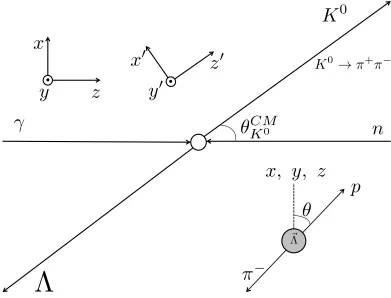
Figure 1.9 A schematic of the coordinate systems used in the analysis of
KY photoproduction. Two different coordinate systems are
used: the unprimed and primed. The unprimed coordinate
sys-tem has its z–axis aligned with the incoming photon
momen-tum, ˆz = ˆpγ. The y–axis, ˆy = ˆz×pˆK. The x–axis, ˆx = ˆy×zˆ.
In the primed coordinate system, thez0–axis is along the kaon
momentum ˆz= ˆpK. The y0–axis is defined as ˆy0 = ˆz0×pˆγ. The
x0–axis is thus ˆx0 = ˆy0 ×zˆ0. For both coordinate systems, the
reaction occurs in the x–z (x0–z0) plane. . . 15
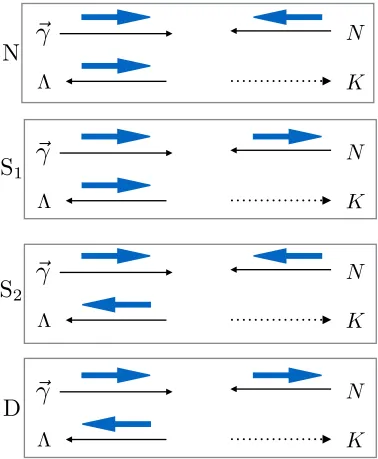
Figure 1.10 The four helicity amplitudes in pseudoscalar meson
photopro-duction. The label "N" corresponds to the no–spin flip
ampli-tude, "S1(2)" corresponds to the single spin flip amplitudes, and
"D" corresponds to the double spin flip amplitude. . . 19
Figure 1.11 Three mechanisms to photoproduce KY. A resonance, N∗ is
created in thes channel that then decays into the KY. In the
t (u) channel, a K∗ (Y∗) is exchanged. . . 21
Figure 1.12 Two example fits ((a) and (b)) of the cross section ofγp→K+Λ
from the Bonn–Gatchina group. The solid curves are the
re-sults of the fits, the dashed lines areP13(N(1900)32, N(1720)32)
contributions, the dotted lines are S11 (N(1535012, N(1650)12)
contributions, and the dashed–dotted line is thet–channel
con-tribution. This image was taken from Reference [8] . . . 22
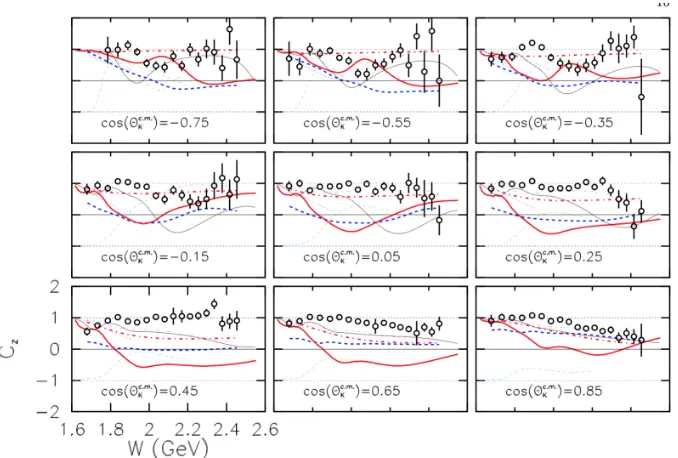
Figure 1.13 Cz as a function of the center–of–mass energy W for different
cosθCM
K bins. The open circles are the experimental values for
the observable. The different colored curves represent predic-tions from different hadronic models. The image was taken from
Figure 1.14 Ox as a function of the center–of–mass energy W for different
cosθCM
K bins. The black circles are the experimental values
for the observable. The red curves are predictions from ANL– Osaka [31], green colored curves from the 2014 Bonn–Gatchina group[29], and the blue curves are ref–fits including the present
data with and an additionalN∗32+andN∗52+added. This image
was taken from Reference [46] . . . 24
Figure 1.15 The red and black data points on both histograms are the two sets of Jefferson Lab data. The left panel shows the data points with Kaon–MAID models with two different sets of input pa-rameters [33]. The right panel shows the cross sections from
K+Λ superimposed on top of the K0Λ data. Also drawn are
two different PWA solutions from the Bonn–Gatchina group
for the K0Λ (green lines) and the 2014 solution for the K+Λ
data.This image was taken from [18]. . . 26
Figure 2.1 A schematic of CEBAF at the time the experiment took place.
One can see the 0.6 GeV linacs, the recirculating arcs, and the three experimental halls (Hall A, Hall B, and Hall C) at the
time of the experiment. This figure is taken from Reference [39] . 30
Figure 2.2 A schematic of the Hall–B beam line during the g13a
experi-ment. From left to right, along the beam direction one can see the Møller polarimeter, the radiator and the tagging spectrom-eter, the subsystems of the CLAS detector, the photon profile monitor, and the total absorption counter. Not shown is the photon collimator placed between the tagger and the CLAS.
Figure is from [39]. . . 30
Figure 2.3 A schematic of the photon tagger in Hall B. Electrons,
inci-dent from the left, that interacted with the radiator produced bremsstrahlung photons that continued in the original direc-tion of the incident electron beam. The electrons were bent by a dipole magnet at different angles based on their energy. A two-plane hodoscope detected these electrons, which allowed for energy and time measurements. This figure is taken from
Reference [53] . . . 33
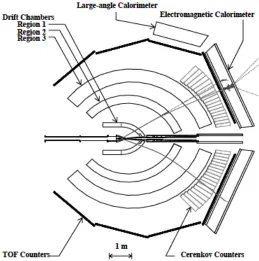
Figure 2.4 A schematic of the CLAS detector. Drift Chambers measure
particles’ trajectories and TOF Counters measure the time of
Figure 2.5 A cross section of the magnetic field vectors for the CLAS toroidal field in a plane perpendicular to the beam line. The locations of the coils are indicated by thick solid lines. One can see the field distortions in the areas close to the coils. This
image is taken from Reference [39]. . . 35
Figure 2.6 A schematic of the start counter in CLAS. One can see the six
identical sectors of four scintillators per sector. This image was
taken from Reference [51]. . . 36
Figure 2.7 A schematic of CLAS detector as seen from the perspective of
looking down the beam line. One can see how the CLAS is di-vided into six sectors by the main torus coils. The three regions of drift chambers are situated between these coils and track the trajectories of charged particles as they travel through the de-tector. The mini–torus is a magnet used in electro-production experiments. It was not used in g13, where the start counter
was placed in its location. This image is taken from Reference [39]. 37
Figure 2.8 One sector of the time–of–flight system. Each sector of 56
pad-dles was positioned such that each paddle covers different polar
angle. This image is taken from Reference [52]. . . 39
Figure 3.1 ∆β as a function of momentum for protons as measured by the
CLAS, i.e. without any corrections applied. One clearly sees
that true protons yield a distribution centered around ∆β of
zero. The leaf–like structures that seem to originate from the proton distribution at low momenta and to follow a different trend at higher momenta are due to true protons that have incorrect timing. A lot of background events, such as pions and kaons are not seen in this figure. This is due to the fact that
extra selection cuts, such as photon selection, K0 selection, Λ
selection, and missing mass cuts (all to be discussed) have been applied to the event sample in order to reduce the uncertainty of the proton PID cuts. The vertical black lines represent the
Figure 3.2 Projections and the Gaussian fit of the proton ∆βfor the 10 mo-mentum bins shown in Fig. 3.1. Even though extra cuts have been applied to the event sample to remove accidental back-ground, some background events remain. Those contribute to the non–Gaussian tails of the projections. In order to determine the widths of those nearly–Gaussian distributions by fits to a Gaussian function in a consistent manner, the fit ranges were
set to be [-0.025,0.025]. . . 42
Figure 3.3 Final ∆β cuts for the proton (red line). The red data points
represent the ±3σ points determined from the Gaussian fits in
Fig. 3.2. These points were then fit with a 4thorder polynomial
to determine the ∆β cut. . . 43
Figure 3.4 ∆β vs. pdistribution for theπ+. The red data points represent
the±3σ points determined from the Gaussian fits to the
differ-ent momdiffer-entum bins. These points were then fit with a 4thorder
polynomial to determine the final ∆β cut (red line). The small
structure at low momenta and positive delta beta is most likely
due to trueπ+s that decay before they reach the time–of–flight
detector. The daughter muon moves along a path that is
suffi-ciently close to the trajectory of the parent π+ so that a single
track is reconstructed. The momentum of the track however is
different from the momentum of the parentπ+. . . . 43
Figure 3.5 ∆β vs. p distribution for the π−. The red data points
repre-sent the ±3σ points determined from the Gaussian fits to the
different momentum bins. These points were then fit with a
4th order polynomial to determine the final ∆β cut (red line).
The small structures at low momenta and positive delta beta
are most likely due to true π−s that decay before they reach
the time–of–flight detector. The daughter muon moves along a path that is sufficiently close to the trajectory of the parent
π− so that a single track is reconstructed. The momentum of
the track however is different from the momentum of the parent
π−. This effect is typically observed for out bending pions, i.e.
π− in g13a. . . 44
Figure 3.6 The z component of the production vertex. Events were kept
if they originated within the target. . . 45
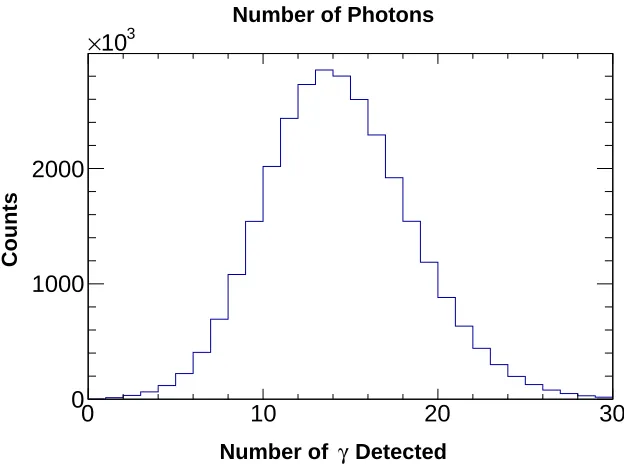
Figure 3.7 Number of photons detected per event in g13a. The photon
Figure 3.8 Coincidence time for all particles and the fastest particle in CLAS. The smaller peaks that are separated by 2 ns show the
structure of different electron beam bunches. . . 47
Figure 3.9 Number of photons yielding a coincidence time within ±1 ns
per event. Events with 2 or more photons within the time-coincidence cut were removed from further analysis since there is no reliable mechanism to identify which amongst them was
most likely the "good" photon. . . 48
Figure 3.10 The DOCA method used to reconstruct the decay vertices of
the K0 and Λ. The DOCA occurs along the line perpendicular
to each track (solid black line). The reconstructed decay vertex,
represented by the ?, is the bisector of the DOCA line. . . 50
Figure 3.11 M(π+π−) as a function of M(pπ−). The peak containing to
K0Λ events sits on top of a broad background. The background
is mostly due to γd → pπ+π−π−X events uncorrelated with
K0Λ production. . . 51
Figure 3.12 M(π+π−) distribution after all previous cuts are applied. The
peak was fit with a Gaussian and the vertical lines represent
±4σ cuts used to selectK0 events. . . . 52
Figure 3.13 M(pπ−) distribution after all previous cuts, includingK0
selec-tion, were applied. The peak was fit with a Gaussian and the
solid vertical lines represent ±4σ cuts used to select Λ events. . . 53
Figure 3.14 Distribution of K0ΛX events (where X = p) over the
specta-tor momentum, |p~X|. Events below 0.2 GeV/c form a sample
dominated by the quasi–free reaction. . . 54
Figure 4.1 MK0X as a function ofMX. Visually, the main peak centered at
MX =Mp and MK0X =MΛ contains the signal events. Higher
mass channels in MX and MK0X contain background channels
such as K0Σ0, K0Σ∗0, and K?(892)Λ photoproduction. The
arrows point to the general area of these different channels. . . 57
Figure 4.2 Fitting procedure and momentum correction example for the
proton. The data were binned in different z–vertex, φ, and θ
bins. For each bin, the ∆p vs. |~p| distribution was divided into
5 |~p| bins. For each p bin, ∆p was fit with a Gaussian. The
means for the momentum bins were then fit with an exponential
Figure 4.3 Momentum of theπ+ for the simulation scaled (red) to the data
(blue) for 100–MeV wide Eγ bins. . . 61
Figure 4.4 Momentum of theπ−from the Λ for the simulation scaled (red)
to the data (blue) for 100–MeV wideEγ bins. . . 62
Figure 4.5 Momentum of the proton for the simulation scaled (red) to the
data (blue) for 100–MeV wide Eγ bins. . . 63
Figure 4.6 Momentum of the π− from the K0 for the simulation scaled
(red) to the data (blue) for 100–MeV wideEγ bins. . . 63
Figure 4.7 cosθKCM0 for theK0Λ simulation scaled (red) to the data (blue)
for 100–MeV wideEγ bins. . . 64
Figure 4.8 The missing–mass, MX, of γd → K0Λ(X) with the selection
cuts described in Chapter 3 integrated over all kinematics. . . 67
Figure 4.9 A visualization of Eqs. 4.10, 4.11, 4.12, and 4.13 on MX. In
a given region ofMX, shown as the black lines at 0.9 and 0.98
GeV/c2, the total observable is extracted. . . . 69
Figure 4.10 An example fit and scaling of the non–resonant, unpolarized
γd → pπ+π−π−(p) simulated background to the data using
Equation 4.23. A double Gaussian is used to describe the signal
and a parameter from the fit,A3, is used to scale the unpolarized
background (magenta) to the data. . . 71
Figure 4.11 Example fits and scaling of the non–resonant, unpolarized
sim-ulation to the data for oneEγ bin. The red line is the total fit
to the data and the magenta histogram is the pπ+π−π− non–
resonant background scaled using A3 from Equation 4.23. . . 72
Figure 4.12 The χ2/NDF and scale factor (A3 in Eq. 4.23) for all the fits.
Theχ2/NDF is used as a check on the goodness of fit, whileA
3
provides the scale factor for thepπ+π−π− non–resonant background. 73
Figure 4.13 Total fit using Equation 4.24 (red line) to the data (blue points)
and scaling toMX integrated over all kinematics. The magenta
histogram is the scaled non–resonant background, the green
histogram is the scaledK0Σ0 distribution, and the black
Figure 4.14 Fits and scaling to MX for 2.1 < Eγ < 2.2 GeV. The red line
is the total fit to the data, the red histogram is the scaled
pπ−π+π− distribution, the green histogram is the scaled K0Σ0
distribution, and the black and violet histograms are the scaled higher mass channels. The black lines are drawn to show the
separation of the Regions. . . 76
Figure 4.15 The χ2/NDF and scale factor (A
4 in Eq. 4.24) for all the fits.
Generally speaking, theχ2/NDF from these fits are larger than
those seen in theM(pπ−) fits. This is likely due to the fact that
there are significantly more fit parameters in Equation 4.24 than there are in Equation 4.23. The small value for the scale factor suggests that there is enough statistics in the simulations to
accurately scale the background. . . 77
Figure 5.1 (Top) The instrumental asymmetry as a function of run
num-ber for pX <0.2 GeV/cintegrated over all kinematic variables.
(Bottom) The pull distribution fit with a Gaussian. The results suggest that there is no time–dependent instrumental
asymme-try in the g13a data set. . . 81
Figure 5.2 A as a function of φ (top row) for the pion (left) and
pro-ton (right) with their corresponding pull distributions (bottom row). The fits to the pull distributions show no significant
bi-ases or unaccounted for uncertainties in the data. . . 84
Figure 5.3 Relative pull distributions for Cx (left), Cz (middle), and P
(right) from the proton selection. From the parameters, no
significant systematic uncertainties are seen in Cx, Cz, or P. . . . 86
Figure 5.4 Relative pull distributions for Cx (left), Cz (middle), and P
(right) from the π+ selection. From the parameters, no
signifi-cant systematic uncertainties are seen in Cx, Cz, or P. . . 87
Figure 5.5 Relative pull distributions for Cx (left), Cz (middle), and P
(right) from the π− selection. From the parameters, no
signif-icant biases or systematic uncertainties are seen in Cx, Cz, or
P. . . 89
Figure 5.6 M(pπ−) distribution with lines representing ±4σ (black) and
±0.7σ (red), where σ is determined from the fit in Fig. 3.13.
To investigate the systematic uncertainties, a relative pull
Figure 5.7 Relative pull distributions for the two different regions inM(pπ−).
From the parameters, no significant biases are seen forCxorCz.
The mean for P is more than 3σ from 0, which suggests there
may be some systematic uncertainty caused by theM(pπ−)
se-lection. . . 91
Figure 5.8 Differences between the observables for the two different regions
inM(pπ−). When fit with a Gaussian, the means of Cx andCz
are consistent with 0. The mean of P is significantly different
than 0. . . 93
Figure 5.9 Distributions ofσ2
sys for the observables. The parameters of the
fit suggest there are no significant systematic uncertainties. . . 94
Figure 5.10 M(π+π−) distribution with lines representing±4σ (black) and
±0.7σ (red), where σ is determined from the fit shown in Fig.
3.12. The systematic uncertainty related to theM(π+π−)
selec-tion is studied through relative pull distribuselec-tions and differences
in observables between the two regions. . . 96
Figure 5.11 Relative pull distributions for Cx (left), Cz (middle), and P
(right) from the M(π+π−) selection. From the fit parameters,
no significant biases are seen. . . 97
Figure 5.12 Distribution of φ as a function of θ for a π− without (left)
and with (right) fiducial cuts applied. The fiducial cuts reject
particles that travel close to the sector edges. . . 98
Figure 5.13 Distribution of φ as a function of θ for the events removed by
the fiducial cuts for the p (top left), π+ (top right), and π−s
(bottom row). . . 99
Figure 5.14 Relative pull-distributions for Cx (left), Cz (middle), and P
(right) from applying the fiducial cuts. From the parameters,
no significant systematic uncertainties are seen inCxorCz. The
mean ofP is significantly different from 0, suggesting there may
be some systematic uncertainty. . . 100
Figure 5.15 Differences between the observables when using “good” and
“bad” samples. The means for Cx and Cz are consistent with
0, whereas the mean forP is ≈4σµ from 0. . . 101
Figure 5.16 Distribution of σsys2 for Cx (left), Cz (middle), and P (right) .
Figure 5.17 The correlation between "good" (estimated from events that pass the fiducial cuts) and "bad" (estimated from events where at least one particle fails the fiducial cut) observables. The parameters of the fits suggest there are no significant systematic
biases forCx andCz. Since the Y-intercept forP is inconsistent
with 0, while the slope is consistent with 1, the systematic bias
inP is a bias with the form µ+δ. . . 103
Figure 5.18 Event distribution over the magnitude of spectator momentum,
pX. The red line divides pX into two regions, Region 1 and
Region 2. . . 104
Figure 5.19 Relative pull distributions for Cx (left), Cz (middle), and P
(right) from the pX selection. From the parameters, no
signifi-cant systematic uncertainties are seen in Cx, Cz, or P. . . 105
Figure 5.20 Differences between the observables for the two different regions
inpX. When fit with a Gaussian, the means of the differences
are consistent with 0. . . 106
Figure 5.21 Distribution of σ2
sys for Cx (left), Cz (middle), and P (right) .
The means of the fits suggest there are no significant systematic
uncertainties. . . 107
Figure 5.22 Fits to MX for different cosθCMK0 in the highest Eγ bin. There
are multiple cosθCM
K0 in this Eγ bin where the fits are not able
to describe the data. . . 108
Figure 5.23 Generator flowchart for studying systematic effects originating
from the maximum likelihood extraction method. . . 109
Figure 5.24 Pull distributions for Cx =Cz =P = 0 for 1,000 experiments,
with 10,000 generated events in each experiment, fit with a Gaussian. The means and the widths of the pull distributions
do not significantly differ from 0 and 1, respectively. . . 111
Figure 5.25 Observable differences for Cx = Cz = P = 0 for 1,000
experi-ments with 10,000 generated events fit with a Gaussian. . . 111
Figure 5.26 Pull distributions forCx= 0.2,Cz = 0.8, andP = 0.5 for 1,000
experiments with 10,000 generated events fit with a Gaussian. The means and the widths of the distributions do not
Figure 5.27 Observable differences for Cx = 0.2, Cz = 0.8, P = 0.5 for
1,000 experiments with 10,000 generated events fit with a
Gaus-sian. . . 113
Figure 5.28 Pull distributions for random Cx, Cz, and P for 1,000
experi-ments with 10,000 generated events fit with a Gaussian. . . 114
Figure 5.29 Correlation plot for random Cx, Cz, and P for 1,000
exper-iments, with 10,000 generated events in each experiment, fit
with a Gaussian. . . 115
Figure 5.30 Calculated acceptance from Equation 5.8 for eachEγand cosθKCM0
bin. . . 116
Figure 5.31 Example of A(cosθy,cosθz) for 1.5 < Eγ < 1.6 GeV and 11
cosθKCM0 bins. We observe that the CLAS acceptance is non–
uniform over the proton direction cosines. . . 117
Figure 5.32 Pull distributions for random Cx, Cz, and P for 1,000
exper-iments, with 500,000 generated events in each experiment, fit
with a Gaussian. . . 118
Figure 5.33 Correlation plots for random Cx, Cz, and P for 1,000
exper-iments, with 500,000 generated events in each experiment, fit
with a Gaussian. . . 118
Figure 5.34 Distributions of the difference between the extracted and the
true values for random Cx, Cz, and P for 1,000 experiments,
with 500,000 generated events in each experiment, fit with a
Gaussian. Cx and Cz have means (µ) consistent with 0 and
have no bias. P has µ = 0.026±0.001 which shows that the
extracted values ofP are biased. . . 119
Figure 5.35 ∆Obs as a function of the true observable for random Cx, Cz,
and P for 1,000 experiments with 500,000 generated events fit
with a Gaussian. The slope for each,Cx, Cz,andP is consistent
with 0. This means any shift in ∆Obs does not depend on the
value of the observable. . . 120
Figure 5.36 Correlation plot for random Cx, Cz, and P for 1,000
exper-iments with 500,000 generated events in each experiment fit
with a Gaussian. Cx and Cz have slopes and Y–intercepts
con-sistent with 1 and 0, respectively. The constant for P is not
Figure 5.37 Normalized difference between the 0.97 and 0.99 GeV/c2
selec-tion cut for region 1. At low energies, there is a small difference between the number of events in region 1. At higher energies,
there are≈20% more events in region 1 for theMX separation
of 0.99 GeV/c2. . . . 123
Figure 5.38 Difference in observables when changing the MX range in the
background subtraction method for region 1. The observables
are fit with a Gaussian and the mean,µ, plus width, σ, added
in quadrature, are reported as systematic uncertainties. . . 124
Figure 5.39 ∆Cz when changing the ratios in the background subtraction
method for each kinematic bin. . . 125
Figure 5.40 Relative difference for Cx, Cz, and P for 25 and 50 MX bins.
All observables have relative differences of 10−3 or less and it
can be concluded that decreasing the number ofMX bins from
50 to 25 does not cause any systematic error in the observ-ables. The standard deviation of each distribution quantifies
the systematic uncertainty of the corresponding observable. . . 126
Figure 5.41 Relative difference for Cx, Cz, and P for 75 MX bins. All
ob-servables have relative differences of 10−3 or less and it can be
concluded that increasing the number of MX bins from 50 to
75 does not cause any systematic error in the observables. The standard deviation of each distribution quantifies the
system-atic uncertainty of the corresponding observable. . . 127
Figure 6.1 Eγ as a function of cosθKCM0 after selection cuts on M(pπ−),
M(π+π−), and p
X < 0.2 GeV/c. The black lines represent
the edges of the different kinematic bins. The background sub-traction and observable exsub-traction method were done for each
kinematic bin. . . 131
Figure 6.2 The ratio of photon polarization to the electron polarization
as a function of the ratio of photon energy to electron energy. The photon polarization was calculated using Eq. 5.10. The electron polarization was measured by the Møller polarimeter
in Hall B. . . 133
Figure 6.3 Cx as a function of cosθCMK0 for the 16 different Eγ bins. The
red and blue curves are the two Bonn–Gatchina soultions from
Figure 6.4 Cz as a function of cosθKCM0 for the 16 different Eγ bins. The
red and blue curves are the two Bonn–Gatchina soultions from
the cross–sections projected (not fit) ontoCz. . . 134
Figure 6.5 P as a function of cosθCM
K0 for the 16 differentEγ bins. The red
and blue curves are the two Bonn–Gatchina soultions from the
cross–sections projected (not fit) ontoP. . . 135
Figure 6.6 R=qC2
x +Cz2+P2as a function of cosθCMK0 for the 16 different
Eγ bins. The blue line is a constant fit to R for each Eγ bin.
The width of the line is the uncertainty of the fit. . . 136
Figure 6.7 Cx as a function of W =
q
m2
n+ 2mnEγ for the 14 different
cosθKCM0 bins. . . 137
Figure 6.8 Cz as a function of W =
q
m2
n+ 2mnEγ for the 14 different
cosθKCM0 bins. . . 138
Figure 6.9 P as a function of W = qm2
n+ 2mnEγ for the 14 different
cosθKCM0 bins. . . 138
Figure 6.10 Cx as a function of cosθKCM0 for the 16 different Eγ bins for
the primed coordinate system. The dashed lines correspond to Kaon–MAID solutions [33] for the observable and the solid line are model predictions from A. Waluyo [55]. The red and blue lines correspond to predictions with and without an extra
N(1900)32− state, respectively. . . 139
Figure 6.11 Cz as a function of cosθCMK0 for the 16 different Eγ bins for
the primed coordinate system. The dashed lines correspond to Kaon–MAID models [33] for the observable and the solid line are model predictions from A. Waluyo [55]. The red and
blue lines are predictions with and without an extraN(1900)32−
state, respectively. . . 140
Figure 6.12 P as a function of cosθKCM0 for the 16 different Eγ bins for the
primed coordinate system. The dashed lines are Kaon–MAID models [33] for the observable and the solid line are model pre-dictions from A. Waluyo [55]. The red and blue lines are
Figure 6.13 A comparison of Cx for γd→ K0Λ(p) (black) and γp→ K+Λ
(blue). Each cosθCM
K0 bin is drawn at the bin centroid as
op-posed to the bin average to match the free proton data. . . 142
Figure 6.14 A comparison of Cz for γd → K0Λ(p) (black) and γp → K+Λ
(blue). Each cosθCMK0 bin is drawn at the bin centroid as
op-posed to the bin average to match the free proton data. . . 142
Figure 6.15 Cx (blue), Cz (red), and P (green), integrated over all Eγ and
cosθKCM0 , as a function of the neutron momentum. Each
observ-able is fit with a first order polynomial. . . 144
Figure 6.16 Cx for 8Eγ as a function of the neutron momentum integrated
over all cosθCM
K0 . Each bin is fit with a line in the quasi–free
region (|pn|<0.2 GeV/c). . . 145
Figure 6.17 Cz for 8 Eγ as a function of the neutron momentum integrated
over all cosθCMK0 . Each bin is fit with a first order polynomial in
the quasi–free region (|pn|<0.2 GeV/c). The numbers in each
panel denote the % difference between the average value of the observable within the quasi–free range of neutron momentum
and the extrapolated value to a neutron momentum of zero. . . . 145
Figure 6.18 P for 8Eγ as a function of the neutron momentum integrated
over all cosθKCM0 . Each bin is fit with a first order polynomial
Chapter 1
Introduction
Visible matter is made up of atoms, which consist of particles called protons, neutrons,
and electrons. Protons and neutrons (known as nucleons) bind together to form the
nucleus where nearly all the mass of the atom is concentrated. The nucleons are made
up of even smaller particles, known as quarks and gluons. A simplistic picture of a
nucleon consists of three quarks that interact to give a nucleon its physical properties.
Along this line of thinking, summing the three quark masses (the gluons are massless)
should lead to the mass of the nucleon. However, this summation only accounts for
≈2% of the nucleon mass [47]. The rest of this mass emanates from the interactions
between quarks and gluons.
One of the main goals of nuclear physics is to understand how the nucleons come
into being and the fundamental interactions that lead to this. The Standard Model is
a theory that aims to describe the interactions between all elementary particles, such
as quarks, and the forces that mediate these interactions [27]. While there are still
questions that remain in the Standard Model, theories like Quantum Electrodynamics
(QED) and Quantum Chromodynamics (QCD) have done a fantastic job describing
the interactions that occur between elementary particles. QED describes how light
and matter interact with each other and served as a base for developing QCD. QCD
is the theory that currently describes the interactions between quarks and gluons.
It is able to describe how they interact at small distances, but not how they bind
1.1 Standard Model
The Standard Model states that matter consist of three elementary, or
fundamen-tal, types of particles: quarks, leptons, and mediators [27]. It describes how these
elementary particles interact with each other within three fundamental forces: the
strong, weak, and electromagentic. The only fundamental force the Standard Model
does not describe is the gravitational force.
Figure 1.1 lists the elementary particles in the Standard Model [2]. Matter is
broken down into two subgroups: fermions and bosons. The fermions have half–
F
O
R
C
E
C
A
R
R
IER
S
L
EPT
O
N
S
QUARKS
Figure 1.1: Elementary particles in the Standard Model that describes the fundamen-tal interactions between elementary particles. Matter consists of three elementary, or fundamental, types of particles: quarks, leptons, and force carriers. This image was taken from Reference [2].
integer spin and consist of six quarks and six leptons. The quarks and leptons are
split into three generations of matter based off the mass of the particles. The first
and lightest generation contains the up quark, down quark, electron, and electron
generation contains the charm quark, strange quark, muon, and muon neutrino. The
third and heaviest generation contains the top quark, bottom quark, tau, and tau
neutrino. The gauge bosons have integer spin and mediate the strong, weak, and
electromagnetic forces.
The leptons are classified according to their charge, electron number, muon
num-ber, and tau number. There are also 6 antileptons whose internal quantum numbers
have opposite sign, totaling 12 particles. Leptons can only interact via the
electro-magnetic, weak, and gravitational forces. Like the leptons, the quarks are classified
according to their charge and flavor. Additionally, there are six antiquarks that have
opposite charge and flavor. Quarks contain an additional property known as color
charge. With 3 color charges (red, green, blue) and 12 particles, there are a total of
36 quarks.
The gauge bosons mediate 3 of the 4 fundamental forces. The gluon mediates
the strong force, the photon the electromagnetic, and the W and Z bosons the weak.
The massless gluon can only interact with themselves or quarks as they are the
only particles that carry color charge. Photons, which are also massless, can only
interact with particles that carry electromagnetic charge. The massive W and Z
bosons mediate the weak interaction. Both leptons and quarks participate in the
weak interaction
The Higgs Boson, predicted in 1964, was the last particle predicted by the
Stan-dard Model to be discovered [30]. A particle consistent with the Higgs Boson was
discovered by the ATLAS and CMS Collaborations in 2012 [3, 16].
1.2 Quantum Chromodynamics
Quantum chromodynamics (QCD) is the theory of the strong interaction and it
de-scribes the interactions between quarks and gluons. As mentioned above, the three
b, there are 3 anticolor charges: antired (¯r), antigreen (¯g), and antiblue (¯b). Quarks
carry a single color charge, while gluons carry both a color and anticolor charge. Color
charge is analogous to the electric charge in Quantum Electrodynamics (QED).
How-ever, photons do not carry electromagnetic charge while gluons carry color charge.
The strength of the interaction in QCD is given by the strong coupling constant,
αS [27]. When αS is much smaller than 1, the interaction is weak and perturbation
theory can be used to solve QCD. WhenαS is on the order of 1, then the interaction
is strongly coupled and can not be solved using perturbation theory. For comparison,
the coupling constant in QED, the fine structure constant, α = 1
137 << 1, meaning
perturbation theory can be used to solve QED. In QCD,αSdepends on the separation
distance between the interacting particles [27]. At short interaction distances (high
energies), αS is small and approaches zero when the interaction distance approaches
zero. This phenomenon is known as asymptotic freedom, discovered independently by
Wilczeck and Gross [28] and Politzer[48]. At large interaction distances (low energies),
αS is on the order of 1, which leads to the phenomenon of color confinement. Color
confinement prohibits an individual color–charged particle (quark or gluon) from
being isolated as free particles. If one tries to separate one quark from another
quark, it becomes more energetically favorable to create a new pair of quarks.
The fundamental degrees of freedom for QCD are the quarks and gluons. Since
color confinement prevents quarks and gluons from being isolated, the fundamental
degrees of freedom of QCD can not be directly studied. One way to study QCD in
the confinement regime is to study the properties of hadrons, which are composite
particles made up of quarks and gluons that are bound by the strong force. Inside
of hadrons, like the proton and neutron, is what is referred to as a sea of quarks and
gluons. The particles in the sea are constantly interacting with each other and with
the valence quarks. Gluons spontaneously split into quark–antiquark pairs, which
and sea quarks that gives rise to the nucleon mass. A valence quark immersed in a
cloud of sea quarks and gluons has a large mass, when compared to a bare quark,
and is referred to as a constituent quark. Since confinement prevents the study of
the fundamental degrees of freedom in QCD at large distances, the effective degrees
of freedom, which are the constituent quarks and gluons, need to be studied.
1.2.1 Hadrons
Hadrons are divided into two subgroups: baryons and mesons. Baryons are particles
that consist of three constituent quarks (qqq), while mesons are particles that are
made up of a constituent quark–antiquark pair (qq¯). In addition to being made up
of a different number of constituent quarks, baryons have half–integer spin and are
fermions while the mesons have integer spin and are bosons.
Prior to the discovery of the strange quark, SU(2) symmetry was successful in
explaining the difference between the u and d quarks. Here, isospin is the
symme-try that explains the difference between the observed properties of the discovered
hadrons. As more hadrons were discovered, SU(2) symmetry could not explain the
long lifetimes of some of these newer particle states [25]. This led to describing the
hadrons with SU(3) symmetry, where 3 represents the three flavors of light quarks:
u, d, and s.
Figure 1.2 shows the pseudoscalar meson nonet, introduced by Murray Gell–Mann
in the Eightfold Way [25]. The Eightfold Way is a scheme used to order and classify
hadrons according to their strangeness and charge. The mesons are ordered via
properties determined from their constituent quarks. Only three quarks– (u, d, s)
were included by Gell–Mann when he proposed the Eightfold Way. Figure 1.3 shows
the corresponding baryon octet from the Eightfold Way. In Gell–Mann’s SU(3) group,
all three quarks have the same masses. However, it is known that the quarks do not
Figure 1.2: The meson nonet. Particles with the same strangeness are arranged horizontally and particles with the same charge are arranged diagonally. This image is taken from Reference [1].
T
T
T
TT
T
T
T
T
T
r
r
r
r
r
rr
r
n
p
⌅
⌅
0⌃
+⌃
⌃
0
⇤
s
= 0
s
=
1
s
=
2
q
=
1
q
= 0
q
= 1
Figure 1.3: The baryon octet. Particles with the same strangeness are arranged
horizontally and particles with the same charge are arranged diagonally. Figure
adapted from Reference [57].
having different masses. In addition to organizing the already discovered particles,
1.3 Baryon Spectroscopy
One way to study the effective degrees of freedom of QCD is to measure the excited
states of hadrons. In the early 1900’s, atomic spectroscopy was used to measure
excited states of the atom. In atomic spectroscopy, energy is absorbed by an atom,
causing an electron to move to a higher energy state. Some time later, the atom
will de–excite and typically emit a photon that corresponds to the energy between
the initial and final states. By measuring these emitted photons, the atomic orbital
structure was mapped out, leading to the modern understanding of the atom.
Hadron spectroscopy works in a similar manner. Adding energy to a hadron can
cause the constituent quarks to reform and the hadron will enter an excited state, also
called a resonance. Some time later, this excited state will decay by emitting some
combination of hadrons and photons. Ultimately, the goal of baryon spectroscopy is
to provide information about the effective degrees of freedom in the non–perturbative
regime of QCD. The rest of this work will focus on baryon spectroscopy, specifically
the excitation of nucleons.
The Particle Data Group (PDG) lists 15 established excited nucleon (N∗) states
below 3000 MeV [47]. The PDG assigns a * to **** rating to excited states. * means
evidence for the state is poor, ** evidence is fair, *** existence is very likely but
more information is needed, and **** ratiing means that the existence is certain and
the properties of the state have been explored. To move from *** to ****, the N∗
needs to be seen across multiple decay modes. Table 1.1 lists the overall status of
the N∗s and the rating for each decay channel. All states below 1800 MeV have an
overall rating of *** or better and were predominately seen in either N∗ → N π or
N∗ →N γ. Above 1800 MeV, there are many states that only have a ** or * rating. It
has been predicted that many of these higher–mass states have significant branching
Table 1.1: The status of the N∗s. A * means evidence for the state is poor, ** evidence is fair, *** evidence is very likely but more information is needed, and **** means the evidence is certain and the properties of the state have been explored. The table is adapted from the PDG [47].
Particle JP overall N γ N π N η N σ N ω ΛK ΣK N ρ ∆π
N1/2+ ****
N(1440)1/2+ **** **** **** *** * ***
N(1520)3/2− **** **** **** *** *** ***
N(1535)1/2− **** **** **** **** ** *
N(1650)1/2− **** **** **** *** *** ** ** ***
N(1675)5/2− **** **** **** * * * ***
N(1680)5/2+ **** **** **** * ** *** ***
N(1700)3/2− *** ** *** * * * * ***
N(1710)1/2+ **** **** **** *** ** **** ** * **
N(1720)3/2+ **** **** **** *** ** ** ** *
N(1860)5/2+ ** ** * *
N(1875)3/2− *** *** * ** *** ** ***
N(1880)1/2+ ** * * ** *
N(1895)1/2− ** ** * ** ** *
N(1900)3/2+ *** *** ** ** ** *** ** * **
N(1990)7/2+ ** ** ** *
N(2000)5/2+ ** ** * ** ** * **
N(2040)3/2+ * *
N(2060)5/2− ** ** ** * **
N(2100)1/2+ * *
N(2120)3/2− ** ** ** * *
N(2190)7/2− **** *** **** * ** *
N(2220)9/2+ **** ****
N(2250)9/2− **** ****
N(2300)1/2+ ** **
N(2570)5/2− ** **
N(2600)11/2− *** ***
N(2700)13/2+ ** **
The cross section of a resonance produced by a +b → N∗ has the shape of a
Breit–Wigner distribution,
σ(s) = σmax
m20Γ2
(s−m2
0)2+m20Γ2
, (1.1)
wheres= (˜pa+ ˜pb)2 is the center–of–mass energy squared, m0 is the mass of the
cross section that contains information about the spin of the incoming particles, a
and b, as well as the angular momentum of the N∗. The lifetime of the resonance is
inversely proportional to Γ. A short lifetime corresponds to a large width, whereas a
long lifetime corresponds to a small width. Generally speaking, the typical lifetime
of a nucleon or baryon resonance is 10−23s, meaning the widths of the resonances are
quite large (when compared to the excited states of a Hydrogen atom). This results
in a spectrum of broad and overlapping resonances when looking at the energy
de-pendence of the cross section of a +b → N∗. Therefore, in depth analyses, both
experimental and theoretical, need to be performed to extract the masses, spins, and
parities of the N∗s. Experimentalists collect data and extract observables and cross
sections by measuring the decay products of the N∗s. Theorists then use these
ob-servables to extract information about the states using partial wave analyses (PWA).
PWAs break the cross section into a series of partial waves and relate each partial–
wave to a corresponding angular momentum. Quark models and lattice QCD are also
used by theorists to predict the resonant spectrum.
1.3.1 Constituent Quark Models
Different models have been developed in an attempt to understand the interactions
of quarks and gluons inside of baryons. These models have different effective degrees
of freedom, symmetries, and dynamics that lead to a different number of predicted
excited states. Figure 1.4 shows the most general and simplest quark model, known
as constituent quark models. These postulate a baryon consisting of three valence
quarks. The baryon wave function, ψ, is given by,
ψ =ψcolorψspinψspaceψf lavor, (1.2)
whereψcolor is the color component,ψspin is the spin component, ψspace is the spatial
Figure 1.4: A simple schematic of the quark arrangement in constituent quark models. Each of the three quarks interacts equally with each other.
it is known that all hadrons must be in a colorless (a color singlet) antisymmetric
state. Since ψ has to be antisymmetric and ψcolor is antisymmetric for all baryons,
then ψspinψspaceψf lavor must be symmetric, as in the case of the ∆++
The full spectrum of baryons can be obtained by solving the wave equation of three
particles moving in a potential,H|ψi=E|ψi. The earliest constituent quark models
(CQMs) treated the three quark interaction as an harmonic oscillator potential [22],
H =X
j
p2j
2M +
1
2M ω
2X
i<j
(ri−rj)2, (1.3)
wherepj is the quark momentum andri−rj is the distance of separation between two
non–identical quarks. More recent CQMs, like those of Capstick and Isgur treat the
potential between quarks as arising from the exchange of gluons [14]. Depending on
the model, the forms of these potentials can change. A review of the different quark
models and their predictions for the spectrum of baryons can be found in Reference
[13].
Generally speaking, CQMs predict more excited states than have been
CQMs having the wrong degrees of freedom– that is more degrees of freedom than
actually present inside of baryons. On the other hand, there may not be enough data
available to observe these "missing" baryons. Up until the 2000’s, data predominately
consisted of measuring resonant decays into nucleon–pion final states. Capstick and
Roberts suggested that several of these "missing" states were likely to be observed in
channels decaying into strange particles, such asKΛ [15].
Figure 1.5 shows the predicted excited nucleon spectrum for N∗ decays into N γ
(white), N π(light grey), and KΛ(black) [15]. The Y–axis is the mass of the state
Figure 1.5: Predicted N∗ decays into N γ (white), N π(light grey), and KΛ(black).
States seen in N∗ → N π decays have an additional wider dark grey band. Weak or
missing states have a wider light grey band. The Y–axis is the mass of the state in
MeV and the X–axis lists the spin and parity,JP, of the state. This image was taken
with permission from Reference [15].
in MeV and the X–axis lists the spin and parity, JP, of the state.ww States seen in
N∗ →N π decays have an additional wider dark grey band. Weak or missing states
below 1800 MeV. At the time of this publication, the only state seen above 1800
MeV was the N72− state [15]. Many of these "missing" states, for example the state
around 1950 MeV with JP = 3
2 −
, are predicted to have significant branching ratios
for N∗ →KΛ.
1.3.2 Diquark Models
Other popular models, known as diquark models, treat the nucleon as a quark–diquark
pair. Figure 1.6 shows a simple schematic of the nucleon as modeled in a diquark
model. In these models, the spatial excitations within the diquark are suppressed,
Figure 1.6: A simple schematic of the quark arrangement in a baryon in diquark models. Excitations of the bound quark pair are suppressed, leading to fewer degrees
of freedom than in CQMs, and therefore to less predicted N∗s.
meaning they exist at energies much larger than the masses of the resonances to be
studied [23]. Since diquark models have the spatial excitations within the diquark
suppressed, they predict fewer excited states than in CQMs. A general overview of
diquark models can be found in Reference [13].
Figure 1.7 shows the predictedN∗ and ∆∗ spectrum (black lines) for the diquark
model of Reference [23] compared to the∗ ∗ ∗and∗ ∗ ∗∗states from the 2008 PDG[6].
Figure 1.7: Predicted N∗ and ∆∗ spectrum (black lines) for the diquark model of
Reference [23] compared to the ∗ ∗ ∗ and ∗ ∗ ∗∗ states from the 2008 PDG[6]. This
image was taken with permission from Reference [23].
states of the 2008 Particle Data Group for masses below 2000 MeV. Additionally, this
model does not predict any states yet to be observed.
1.3.3 Lattice QCD
Lattice QCD is a numerical tool used to solve QCD in the non–perturbative regime.
In very broad terms, Lattice QCD uses a finite number of points in space–time with
periodic boundary conditions to compute Green’s functions in quantum field theories
[24]. Physical results, like the prediction and calculation of the N∗ spectrum, are
then extrapolated to an infinite lattice size. Figure 1.8 shows the hadron spectrum as
computed in the recent work of Edwards, Dudek, Richards, and Wallace [21]. Overall,
this computation predicts a similar number of states as the CQMs and more than
diquark models. However, these calculations predict masses that are much higher
than experimental values. This is because the mass of the π (396 MeV in Fig. 1.8)
in the calculations is much larger than its physical value. What is perhaps more
Figure 1.8: Predicted N∗ (left) and ∆∗ (right) spectrum from Lattice QCD
calcula-tions with the mass of the pion, mπ = 396 MeV. The X–axis lists the spin–parity,JP,
of the state (ex. 32+, 52−) and the Y–axis shows the mass of the state. The width of
each different box is the uncertainty in the mass of the N∗. This image was adapted
from Reference [21].
N∗s. The lowest "band" is the lone resonance at≈0.7, the middle "band" can be seen
in the states predicted between 1.2–1.5, and the highest "band" occurs at and above
1.6. The predictions, and specifically these "bands" seen in the higher mass state,
share similar features with predictions from CQMs. Generally speaking, CQMs and
Lattice QCD predict a similar number of excited states. The similar number and
features of the predicted states suggest that the "missing" states exist, but have yet
to be seen in the experimental data.
1.4 Hyperon Photoproduction
1.4.1 Polarization Observables
As discussed in Section 1.3, in–depth analyses, both experimental and theoretical,
need to be performed to establish theN∗ spectrum. This section describes the
polar-ization observables used to extract information about the resonance spectrum. Due
to the broad and overlapping nature of theN∗ production cross section, cross sections
![Fig ur e1 .1lis t st hee le me nt a r ypa r t ic le sin t heSt a nda r d Mo de l [2 ]](https://thumb-us.123doks.com/thumbv2/123dok_us/8380383.1384611/28.612.136.478.284.537/fig-lis-hee-ypa-sin-hest-nda-mo.webp)