Nucleotide epi-chains and new nucleotide probability rules in long DNA sequences Sergey V. Petoukhov1
1-Mechanical Engineering Research Institute of Russian Academy of Sciences. Russia, 101990, Moscow, M. Kharitonievskiy pereulok, 4,
http://eng.imash.ru/, [email protected]
Comment: Some elements of this article were presented by the author in his keynote speeches at the following conferences: the International Belgrade Bioinformatics Conference 2018 (Belgrade, Serbia, 18-22 June, 2018, http://belbi.bg.ac.rs/); the Second International Conference “Artificial Intelligence, Medical
Engineering, Education” (Moscow, Russia, 6-8 October 2018,
http://www.ruscnconf.org/aimee2018/index.html); the First Congress of the International Society of Natural Medicine (Samorin, Slovak Republic, 12-14 October 2018, https://www.simn.info/congress-of-natural-medicine-2018/); the Second International Conference on Computer Science, Enginnering and Education Applications (Kiev, Ukraine, 27-28 January 2019, http://www.uacnconf.org/iccseea2019/index.html).
Abstract. One of creators of quantum mechanics P. Jordan in his work on quantum biology claimed that life's missing laws were the rules of chance and probability of the quantum world. The article presents author’s results of studying frequencies (or probabilities) of nucleotides on so-called epi-chains of long DNA sequences of various eukaryotic and prokaryotic genomes. DNA epi-chains are algorithmically constructed subsequencies of DNA nucleotide sequences. According to the algorithm of construction of any epi-chain of the order n, the epi-chain is such nucleotide subsequence, in which the numerations of adjacent nucleotides differ by natural number n (n = 1, 2, 3, 4,…). Correspondingly each epi-chain of order n ≥ 2 contains n times less nucleotides than the original DNA sequence. The presented results unexpectedly discover that in long single-stranded and double-stranded DNA of any tested genome its DNA epi-chains of different orders n (values n are not too large) have practically identical frequencies (or probabilities) of each kind of nucleotides. These data allow considering DNA as a regular rich set of epi-chains, which can play a certain role in genetic and epigenetic phenomena as the author belives. Appropriate rules of nucleotide frequencies on epi-chains of long DNA sequences are formulated for further their tests on a wider set of genomes. These results testify on existence of long-range coherence in long DNA and remind the Fröhlich's theory of long-range coherence in biological systems. The phenomenological data are discussed from different standpoints: the DNA double helices and helical antennas with circular polarizations of electromagnetic waves; relations with the Fröhlich's theory; numerical analysis of DNA epi-chains under binary representations of nucleotides. Results are useful for developing quantum and algebraic biology.
Keywords: DNA sequence, helix, nucleotide frequencies, DNA epi-chains, helical antennas, Fröhlich's theory, long-range coherence, epigenetics, quantum biology, binary representation.
Content
1. Introduction
2. The notion of DNA epi-chains of nucleotides
3. Nucleotide frequencies in DNA epi-chains of eukariotic genomes 4. Nucleotide frequencies in DNA epi-chains of prokaryotic genomes
5. The formulation of rules of nucleotide frequencies in long DNA epi-chains 6. Regarding frequencies of triplets in long DNA epi-chains of different orders 7. Resonances and some scientific analogies refered to DNA epi-chains
- 7.1. DNA epi-chains and helical and fractal antennas
- 7.2. DNA epi-chains and the Fröhlich's theory of long-range coherence in biological systems - 7.3. DNA epi-chains, epigenetics and transformations of DNA configurations
- 7.4. DNA double helix as a numerical tree of epi-chains with binary representations of their nucleotides 8. Some concluding remarks
Appendix 1. Nucleotide frequencies in DNA epi-chains of the genome of a house mouse Mus musculus
Appendix 2. Nucleotide frequencies in DNA epi-chains of the genome of a fruit fly Drosophila melanogaster
Appendix 3. Nucleotide frequencies in DNA epi-chains of the genome of a nematode Caenorhabditis elegans
Appendix 4. Nucleotide frequencies in DNA epi-chains of the genome of a plant Arabidopsis thaliana Acknowledgments
References
1. Introduction
One of creators of quantum mechanics P. Jordan, credited with the authoring the first work on quantum biology, postulated the following. The mechanisms of living organisms are associated with what he referred to as his ‘amplifier theory’, based on Bohr's notion of the ‘irreversible act of amplification’, required to bring the fuzzy quantum reality into sharp focus by ‘observing’ it [Jordan, 1932]. Jordan claimed that «life's missing laws were the rules of chance and probability (the indeterminism) of the quantum world that were somehow scaled up inside living organisms» [McFadden, Al-Khalili, 2018]. It is these laws of chance and probability, postulated by Jordan, that the author is looking for in his analysis of percentage (or probabilistic, or frequencies) characteristics of long DNA sequences of hydrogen bonds and nitrogenous bases [Petoukhov, 2018a,b, 2019a,b; Petoukhov, Petukhova, Svirin, 2018; Petoukhov, Svirin, 2012, 2018; Darvas, 2018]. Long DNA sequences are a very important and convenient for such computerized research of possible biological rules of frequenices (or percentages, or probabilities), which in Jordan's day was impossible. The main idea of all quantum mechanics is that everything in the world of appropriate objects is described only as probabilistic. Correspondingly the author has undertaken study of nucleotide frequencies (probabilities) in long DNA of many species on the basis of a new author's approach.
Regarding frequencies of nucleotides in DNA strands, the so-called Chargaff’s rules have been known since the middle of the last century [Chargaff, Lipshitz, Green,1952; Chargaff, 1971]. In DNA molecules, genetic information is written in very long sequential texts using only 4 letters: adenine A, cytosine C, guanine G, thymine T. For example, the human genome consists of several billion such letters. The first Chargaff’s rule holds that in double-stranded DNA the amount of guanine (G) is equal to the amount of cytosine (C) and the amount of adenine (A) is equal to the amount of thymine (T). This rule was theoretically confirmed by the double-helix model of the DNA [Watson, Crick, 1953].
The second Chargaff’s rule states that the same parity is approximately valid (%C ≈ %G and %A ≈
%T) for each of the two long DNA strands alone (the term “long” usually refers to DNA sequences containing ≥ 100000 nucleotides). According to [Albrecht-Buehler, 2006], this rule applies to the eukaryotic chromosomes, the bacterial chromosomes, the double stranded DNA viral genomes, and the archaeal chromosomes provided they are long enough. Some our works were also devoted to study frequencies of nucleotides and hydrogen bonds in long DNA sequences [Petoukhov, 2018a,b, 2019; Petoukhov, Petukhova, Svirin, 2018; Petoukhov, Svirin, 2018; Darvas, 2018].
This article presents, first of all, the author’s results of calculation of frequencies (or probabilities) of nucleotides located in algorithmically sparsed sequences inside long DNA of many eukaryotic and prokaryotic organisms. These numeric results testify in favor of existence of some general rules of nucleotide frequencies in long DNA sequences and moreover they lead to a new important notion of "DNA epi-chains” defined below. These rules of long DNA epi-chains belong to the field of quantum biology and they testify on existence of quantum-mechanical long-range coherence in long DNA and remind the Fröhlich's theory of quantum long-range coherence or collective quantum effects in biological systems. The presented results reveal new connections of organizational principles of the genetic system with formalisms of quantum mechanics and quantum informatics dealing with vectors of probabilities, unitary matrices, etc. Since quantum mechanics operates with notions of probabilities, the term “probabilities” is used in the title of the article though inside the article the author mainly uses similar terms “frequencies” and “percentages” as more familiar to a wide range of readers.
author believes that the described numeric rules of epi-chains are related to epigenetics and some other biological themes and model approaches, which are briefly discussed below.
2. The notion of DNA epi-chains of nucleotides
The DNA double helix is a long discrete polyatomic construction, whose parts are connected into the whole stabilized structure. In this construction, each of two complementary strands contains a discrete chain of nucleotides, which carry genetic information and are located along helix-like trajectorie (Fig. 1, left).
The article considers additional types of DNA nucleotide chains, which are termed as “single-stranded DNA epi-chains” and “double-“single-stranded DNA epi-chains” of different orders n (n = 1, 2, 3, 4, … are natural numbers). The attention paid to these types of nucleotide chains in DNA is caused by the author's results on the approximate equality of frequencies of nucleotides in these different chains.
In the described study, a chain of nucleotides, which continuously follow each other on one strand of DNA, will be called the single-stranded DNA chain of the first order. It is precisely these nucleotide epi-chains are used in the mentioned second Chargaff's rule. The consecutive nucleotides in a single-stranded DNA (that is in the single-stranded DNA epi-chain of the first order) can be sequentially numerated with the natural numbers 1, 2, 3, 4, 5, ..., starting with any randomly chosen nucleotide (Fig. 1, II). Below we will deal with numerated nucleotides, each of which carries conditionally its sequence number along the nucleotide sequence in a considered DNA strand.
In contrast to the traditional attention of researchers to two strands of the DNA double helix, this article focuses on epi-chains, the concept of which is new for molecular genetics. We will consider two following types of DNA nucleotide epi-chains: the first type is connected with single-stranded DNA whose epi-chains are termed conditionally «single-stranded epi-chains» (Fig. 1, II-VII); the second type is connected with double-stranded DNA whose epi-chains are termed «double-stranded epi-chains» (Fig. 2).
By definition, a nucleotide single-stranded epi-chain is such single-stranded DNA nucleotide sequence, in which the numerations of adjacent nucleotides differ by natural numbers n = 1, 2, 3, 4,..., where n defines the "order of epi-chains". For example single-stranded epi-chains of the second order are two nucleotide sequences N2/1 and N2/2 whose nucleotides have their sequence numbers differing by n = 2: the epi-chain N2/1 contains nucleotides with odd numerations 1, 3, 5, 7,… (Fig. 1, III) and the epi-chain N2/2 contains nucleotides with even numerations 2, 4, 6, 8, ... (Fig. 1, IV). By analogy, single-stranded DNA epi-chains of the third order are those three nucleotide sequences N3/1, N3/2 and N3/3, each of which has sequence numbers differing by n = 3: these single-stranded epi-chains contain nucleotides with numerations 1, 4, 7, 10, ... or 2, 5, 8, 11, ... or 3, 6, 9, 12, ... , respectively (Fig. 1, V-VII). Any single-stranded epi-chain of the first order coincides with the nucleotide sequence of the appropriate separate strand in the DNA double helix (in contrast to the case of double-stranded epi-chains defined below).
The nucleotide quantity (or density) on a single-stranded DNA epi-chain of n-th order (if n = 2, 3, 4, ....) is reduced by "n" times in comparison with the nucleotide quantity in the corresponding DNA strand (that is in the single-stranded epi-chain of the order n = 1). In other words, the DNA epi-chains are sparsed DNA strand in relation to its nucleotide sequence. The term "epi-chain" uses the Ancient Greek prefix epi- (ἐπι- "over, outside of, around"), which implies features that are "on top of" or "in addition to" the traditional DNA double helix. In any DNA strand, each nucleotide belongs to many epi-chains having different orders n. The used symbol N in the designation of DNA epi-chains corresponds to the first letter of the word “nucleotides”. In the symbolic designation Nn/m of single-stranded DNA epi-chains, the numerator "n" in the chain index indicates the order of the epi-chain, and the denominator "m" is the numeration of the first nucleotide of this epi-chain along the initial DNA strand (Fig. 1). For example, the symbol N3/2 refers to a single-stranded epi-chain of the third order with the first nucleotide having the number 2 in the nucleotide numeration along the corresponding DNA strand: 2-5-8-11-14-… (Fig. 1, VI).
I) II) III) IV)
Fig. 1. The schematic representation of DNA and a few epi-chains of nucleotides on the separate DNA strand. I) The DNA double helix (from https://ru.wikipedia.org/wiki/Дезоксирибонуклеиновая_кислота). II) A sequence N of numerated nucleotides of single-stranded DNA termed as a DNA code-chain; III-IV) Sequences N2/1 andN2/2 represent two single-stranded epi-chains of the second order regarding the same code-chain N; V-VII) Sequences N3/1, N3/2 and N3/3 represent three single-stranded epi-chains of the third order regarding the same code-chain N (explanations in the text). Black circles at helices represent conditionally nucleotides.
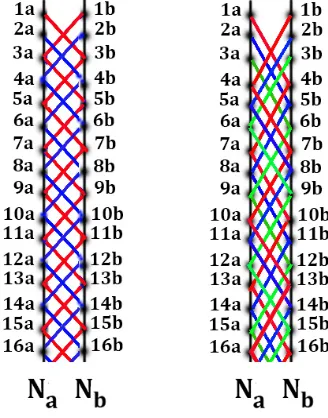
By definition, a double-stranded DNA epi-chain is a modified single-stranded epi-chain, in which every second nucleotide is replaced by its complementary belonged to the opposite DNA strand (systematic jumps from one DNA strand to another are realised) (Fig. 2). For example, under the replacement of every second nucleotide in the single-stranded epi-chains CGAATGCTAGG… by its complementary (C↔G and A↔T), the following double-stranded DNA epi-chain appears: CCATTCCAACG… . If two DNA strands are denoted by Na and Nb and their nucleotides are denoted by 1a-2a-3a-4a-… and 1b-2b-3b-4b-… respetively, than their double-stranded epi-chains of the first order contain, for example, the following sequences of nucleotides: 1a-2b-3a-4b-5a-6b-… . The index «a» in the symbol Na refers to nucleotide sequences of single-stranded DNA presented in the Genbank. A double-stranded epi-chain of the n-th order is denoted by the symbol Nn/ma where the numerator "n" in the index indicates the order of the epi-chain, and the denominator "ma" (or “mb”) is the numeration m of the first nucleotide of this epi-chain along the DNA strand Na (or Nb). For example the symbol N3/2b refers to a double-stranded DNA epi-chain of the third order with the first nucleotide having the number 2 in the nucleotide numeration along the DNA strand Nb: 2b-5a-8b-11a-14b-…. (Fig. 2, right). The symbol N1ab (or N1ba) refers to a double-stranded DNA epi-chain of the first order.
Fig. 2. The schematical representation of two separate DNA strands Na and Nb, which are parts of the DNA double helix, in a form of straight lines carrying numerated nucleotides. Left: the system of double-stranded DNA epi-chains of the second order is shown, which begin from nucleotides 1a and 1b (red lines) and from nucleotides 2a and 2b (blue lines). Right: the system of double-stranded DNA epi-chains of the third order is shown, which begin from nucleotides 1a and 1b (red lines), from nucleotides 2a and 2b (blue lines) and from 3a and 3b (green lines).
This article presents data of the author's analysis of frequencies of nucleotides A, T, C, and G in single-stranded DNA epi-chains and also in double-stranded DNA epi-chains of long DNA in a wide set of eukaryotic and prokaryotic genomes.
3. Nucleotide frequencies in epi-chains of complete sets of chromosomes
This Section (jointly with Appendixes 1-4) presents the author's study results that frequencies of nucleotides in epi-chains of the considered orders in long DNA sequences of eukariotic genomes unexpectedly turn out to be almost identical independently on strong content differences of these nucleotide chains. These frequencies (or percentages, or probabilities) of nucleotides A, T, C and G in the studied DNA sequence will be denoted by the symbols %A, %T, %C and %G, respectively.
Let us describe, first of all, data about the human genome with its 22 autosomes and 2 sex chromosomes. These 24 nuclear сhromosomes contain long DNA molecules, the lengths of texts in which lie in the range from 50 to 250 million letters approximately. These chromosomes differ greatly in their molecular dimensions, their arrangement of letters A, T, C and G, kinds and quantities of genes in them, cytogenetic bands (which shows biochemical specifity of different parts of chromosomes), etc. (Fig. 3).
Fig. 3. Human chromosomes (from https://www.ncbi.nlm.nih.gov/genome/51 )
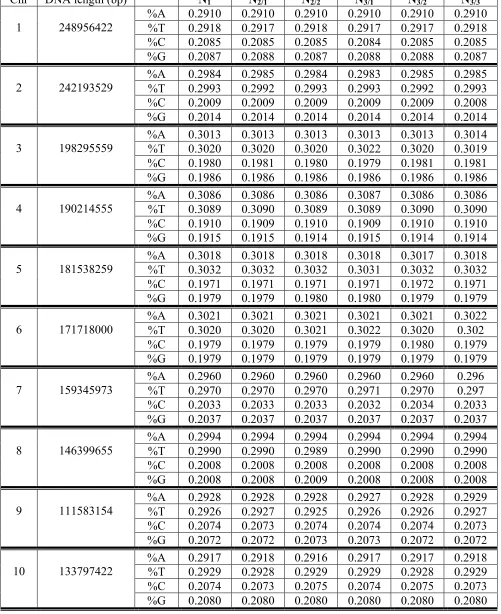
Table 1. Frequencies %A, %T, %C and %G of nucleotides A, T, C and G in single-stranded DNA chains of initial orders in all human nuclear chromosomes. Data relating single-stranded DNA epi-chains of the first order N1, the second order (N2/1, N2/2) and the third order (N3/1, N3/2, N3/3) are presented. Two left columns show ordinary symbols of chromosomes and their length. Initial data relating to these
chromosomes were accessed from
https://www.ncbi.nlm.nih.gov/genome/?term=Homo+sapiens+genome (the column RefSeq).
Chr DNA length (bp) N1 N2/1 N2/2 N3/1 N3/2 N3/3
1 248956422
%A 0.2910 0.2910 0.2910 0.2910 0.2910 0.2910 %T 0.2918 0.2917 0.2918 0.2917 0.2917 0.2918 %C 0.2085 0.2085 0.2085 0.2084 0.2085 0.2085 %G 0.2087 0.2088 0.2087 0.2088 0.2088 0.2087
2 242193529 %A %T 0.2984 0.2993 0.2985 0.2992 0.2984 0.2993 0.2983 0.2993 0.2985 0.2992 0.2985 0.2993 %C 0.2009 0.2009 0.2009 0.2009 0.2009 0.2008 %G 0.2014 0.2014 0.2014 0.2014 0.2014 0.2014
3 198295559
%A 0.3013 0.3013 0.3013 0.3013 0.3013 0.3014 %T 0.3020 0.3020 0.3020 0.3022 0.3020 0.3019 %C 0.1980 0.1981 0.1980 0.1979 0.1981 0.1981 %G 0.1986 0.1986 0.1986 0.1986 0.1986 0.1986
4 190214555
%A 0.3086 0.3086 0.3086 0.3087 0.3086 0.3086 %T 0.3089 0.3090 0.3089 0.3089 0.3090 0.3090 %C 0.1910 0.1909 0.1910 0.1909 0.1910 0.1910 %G 0.1915 0.1915 0.1914 0.1915 0.1914 0.1914
5 181538259 %A %T 0.3018 0.3032 0.3018 0.3032 0.3018 0.3032 0.3018 0.3031 0.3017 0.3032 0.3018 0.3032 %C 0.1971 0.1971 0.1971 0.1971 0.1972 0.1971 %G 0.1979 0.1979 0.1980 0.1980 0.1979 0.1979
6 171718000
%A 0.3021 0.3021 0.3021 0.3021 0.3021 0.3022 %T 0.3020 0.3020 0.3021 0.3022 0.3020 0.302 %C 0.1979 0.1979 0.1979 0.1979 0.1980 0.1979 %G 0.1979 0.1979 0.1979 0.1979 0.1979 0.1979
7 159345973
%A 0.2960 0.2960 0.2960 0.2960 0.2960 0.296 %T 0.2970 0.2970 0.2970 0.2971 0.2970 0.297 %C 0.2033 0.2033 0.2033 0.2032 0.2034 0.2033 %G 0.2037 0.2037 0.2037 0.2037 0.2037 0.2037
8 146399655
%A 0.2994 0.2994 0.2994 0.2994 0.2994 0.2994 %T 0.2990 0.2990 0.2989 0.2990 0.2990 0.2990 %C 0.2008 0.2008 0.2008 0.2008 0.2008 0.2008 %G 0.2008 0.2008 0.2009 0.2008 0.2008 0.2008
9 111583154
%A 0.2928 0.2928 0.2928 0.2927 0.2928 0.2929 %T 0.2926 0.2927 0.2925 0.2926 0.2926 0.2927 %C 0.2074 0.2073 0.2074 0.2074 0.2074 0.2073 %G 0.2072 0.2072 0.2073 0.2073 0.2072 0.2072
10 133797422
11 135086622
%A 0.2920 0.2920 0.2921 0.2920 0.2921 0.2920 %T 0.2926 0.2926 0.2926 0.2925 0.2926 0.2927 %C 0.2074 0.2074 0.2074 0.2074 0.2074 0.2073 %G 0.2080 0.2080 0.2080 0.2081 0.2079 0.2080
12 133275309
%A 0.2957 0.2957 0.2958 0.2958 0.2956 0.2958 %T 0.2966 0.2966 0.2966 0.2966 0.2967 0.2966 %C 0.2035 0.2035 0.2035 0.2035 0.2035 0.2035 %G 0.2042 0.2042 0.2041 0.2041 0.2042 0.2042
13 95789532
%A 0.3069 0.3068 0.3069 0.3069 0.3069 0.3068 %T 0.3079 0.3078 0.3079 0.3079 0.3079 0.3078 %C 0.1926 0.1927 0.1925 0.1926 0.1925 0.1927 %G 0.1926 0.1927 0.1926 0.1926 0.1926 0.1927
14 87316725
%A 0.2945 0.2944 0.2946 0.2946 0.2946 0.2944 %T 0.2970 0.2970 0.2970 0.2970 0.2970 0.2970 %C 0.2040 0.2041 0.2039 0.2040 0.2039 0.2040 %G 0.2045 0.2045 0.2045 0.2045 0.2045 0.2046
15 101991189 %A %T 0.2896 0.2901 0.2896 0.2901 0.2895 0.2901 0.2897 0.2900 0.2894 0.2902 0.2896 0.2900 %C 0.2097 0.2097 0.2098 0.2098 0.2097 0.2097 %G 0.2106 0.2106 0.2106 0.2105 0.2106 0.210
16 90338345
%A 0.2758 0.2757 0.2758 0.2758 0.2757 0.2758 %T 0.2784 0.2785 0.2783 0.2784 0.2784 0.2784 %C 0.2221 0.2222 0.2221 0.2221 0.2222 0.2222 %G 0.2237 0.2236 0.2238 0.2237 0.2237 0.2237
17 83257441
%A 0.2730 0.2730 0.2730 0.2730 0.2730 0.2730 %T 0.2738 0.2739 0.2737 0.2739 0.2738 0.2737 %C 0.2258 0.2257 0.2259 0.2258 0.2257 0.2259 %G 0.2273 0.2274 0.2273 0.2272 0.2274 0.2274
18 74792881 %A %T 0.3011 0.3014 0.3012 0.3013 0.3009 0.3014 0.3011 0.3014 0.3011 0.3013 0.3010 0.3014 %C 0.1987 0.1985 0.1988 0.1987 0.1987 0.1986 %G 0.1989 0.1989 0.1989 0.1988 0.1989 0.1990
19 58617616
%A 0.2591 0.2592 0.2590 0.2592 0.2591 0.2591 %T 0.2615 0.2615 0.2615 0.2616 0.2616 0.2613 %C 0.2388 0.2388 0.2388 0.2387 0.2388 0.2388 %G 0.2406 0.2405 0.2407 0.2405 0.2405 0.2408
20 59605541
%A 0.2778 0.2779 0.2777 0.2778 0.2777 0.2779 %T 0.2810 0.2808 0.2811 0.2810 0.2810 0.2809 %C 0.2201 0.2202 0.2200 0.2201 0.2201 0.2201 %G 0.2211 0.2212 0.2211 0.2211 0.2212 0.2211
21 33543332 %A %T 0.2964 0.2946 0.2964 0.2947 0.2965 0.2945 0.2963 0.2946 0.2964 0.2946 0.2966 0.2947 %C 0.2047 0.2046 0.2047 0.2046 0.2049 0.2044 %G 0.2043 0.2043 0.2043 0.2045 0.2041 0.2043
22 50818468
%A 0.2651 0.2651 0.2651 0.2651 0.2652 0.2651 %T 0.2648 0.2648 0.2648 0.2648 0.2647 0.2650 %C 0.2339 0.2339 0.2340 0.234 0.2341 0.2337 %G 0.2361 0.2362 0.2360 0.2362 0.2360 0.2362
%C 0.1971 0.1970 0.1971 0.1971 0.1971 0.1971 %G 0.1982 0.1982 0.1982 0.1982 0.1982 0.1982
Y 57227415 %A %T 0.2985 0.3012 0.2986 0.3013 0.2985 0.3011 0.2985 0.3013 0.2987 0.3011 0.2984 0.3012 %C 0.2001 0.2001 0.2001 0.2001 0.2001 0.2001 %G 0.2001 0.2000 0.2003 0.2001 0.2001 0.2003
It is surprising but for all 24 human chromosomes, each of rows of frequencies in Table 1 contains approximately the same value of frequencies of nucleotides in its 7 cells corresponding to the appropriate epi-chains N1, N2/1, N2/2, N3/1, N3/2, N3/3 in single-stranded DNA: small differences in the values of frequencies appear only in the fourth decimal place, though these epi-chains strongly differ by its length and by its nucleotide arrangement. It means that the single-stranded DNA epi-chains of the higher orders are practically copies (or duplicates) of nucleotide chains N1 of DNA strands regarding frequencies of nucleotides A, T, C and G. Different human chromosomes differ little from each other in terms of their nucleotide frequencies %A, %T, %C and %G in single-stranded DNA epi-chains. The analogue of the second Chargaff's rule for single-stranded DNA is executed in the epi-chains of the higher orders: %A ≈ %T and %C ≈ %G.
But what one can say about frequencies of nucleotides in single-stranded DNA epi-chains of significantly higher orders? Whether such equalities of probabilties also exist there? The author's study gives a positive answer on this question. Table 2 shows frequencies %A, %T, %C and %G in examples of single-stranded DNA epi-chains of the 10th order, the 50th order, the 100th order in the human chromosome № 1. Tabular data testify that in all shown epi-chains these frequencies have practically the same values like in the basic nucleotide sequence N1 of the single-stranded DNA. Other single-stranded epi-chains of the indicated orders n = 10, 50 and 100, which are not shown in the small Table 2, obey the same rule of approximate equality of nucleotide frequencies in epi-chains.
Table 2. Frequencies of nucleotides %A, %T, %C and %G in the human chromosome №1 for the
following examples of randomly selected epi-chains: N10/1 and N10/9 refer to two epi-chains of the 10th order; N50/1 and N50/49 – two epi-chains of the 50th order; N100/1 and N100/99 – two epi-chains of the 100th order. N1 refers to the basic nucleotide sequence of the DNA strand of this chromosome (by analogy with Table 1).
N1 N10/1 N10/9 N50/1 N50/49 N100/1 N100/99
%A 0.2910 0.2910 0.2911 0.2910 0.2915 0.2910 0.2915 %T 0.2918 0.2918 0.2919 0.2917 0.2916 0.2917 0.2920 %C 0.2085 0.2084 0.2084 0.2086 0.2085 0.2086 0.2080 %G 0.2087 0.2088 0.2087 0.2088 0.2085 0.2087 0.2086
But what situation exists in double-stranded DNA epi-chains of all human nuclear chromosomes? Table 3 gives answer on this question showing a very similar situation in double-stranded DNA epi-chains of all 24 human nuclear chromosomes from the standpoint of nucleotide frequencies %A, %T, %C and %G.
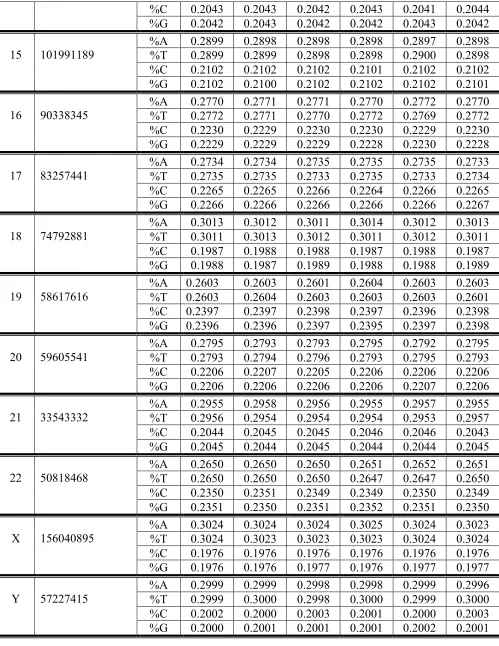
Table 3. Frequencies %A, %T, %C and %G of nucleotides A, T, C and G in double-stranded DNA chains of initial orders in all human nuclear chromosomes. Data relating double-stranded DNA epi-chains of the first order (N1ab), the second order (N2/1, N2/2) and the third order (N3/1, N3/2, N3/3) are presented. Two left columns show ordinary symbols of chromosomes and their length. Initial data relating to
these chromosomes were accessed from
https://www.ncbi.nlm.nih.gov/genome/?term=Homo+sapiens+genome (the column RefSeq).
Chr DNA length (bp) N1ab N2/1a N2/2a N3/1a N3/2a N3/3a
1 248956422
2 242193529
%A 0.2989 0.2989 0.2989 0.2990 0.2988 0.2989 %T 0.2988 0.2988 0.2988 0.2987 0.2989 0.2989 %C 0.2011 0.2011 0.2012 0.2012 0.2011 0.2010 %G 0.2012 0.2012 0.2011 0.2012 0.2012 0.2012
3 198295559
%A 0.3017 0.3017 0.3016 0.3017 0.3016 0.3016 %T 0.3017 0.3016 0.3017 0.3017 0.3016 0.3017 %C 0.1983 0.1984 0.1983 0.1982 0.1983 0.1984 %G 0.1983 0.1983 0.1983 0.1983 0.1984 0.1983
4 190214555
%A 0.3088 0.3088 0.3088 0.3088 0.3087 0.3087 %T 0.3088 0.3088 0.3087 0.3088 0.3088 0.3088 %C 0.1912 0.1912 0.1912 0.1912 0.1912 0.1911 %G 0.1913 0.1912 0.1912 0.1912 0.1912 0.1913
5 181538259
%A 0.3025 0.3025 0.3025 0.3024 0.3025 0.3025 %T 0.3025 0.3025 0.3025 0.3025 0.3025 0.3025 %C 0.1976 0.1975 0.1975 0.1976 0.1975 0.1975 %G 0.1975 0.1975 0.1975 0.1975 0.1976 0.1975
6 171718000 %A %T 0.3021 0.3021 0.3021 0.3021 0.3022 0.3020 0.3021 0.3021 0.3020 0.3020 0.3021 0.3021 %C 0.1979 0.1980 0.1979 0.1978 0.1980 0.1980 %G 0.1979 0.1979 0.1980 0.1979 0.1979 0.1979
7 159345973
%A 0.2965 0.2965 0.2965 0.2965 0.2964 0.2965 %T 0.2965 0.2965 0.2966 0.2966 0.2965 0.2965 %C 0.2035 0.2034 0.2035 0.2034 0.2035 0.2035 %G 0.2035 0.2035 0.2035 0.2035 0.2035 0.2035
8 146399655
%A 0.2992 0.2992 0.2991 0.2991 0.2992 0.2991 %T 0.2992 0.2993 0.2992 0.2993 0.2992 0.2992 %C 0.2008 0.2008 0.2009 0.2008 0.2008 0.2009 %G 0.2008 0.2008 0.2008 0.2008 0.2008 0.2007
9 111583154 %A %T 0.2927 0.2927 0.2927 0.2928 0.2926 0.2927 0.2926 0.2928 0.2927 0.2926 0.2929 0.2927 %C 0.2073 0.2072 0.2073 0.2073 0.2073 0.2072 %G 0.2073 0.2073 0.2074 0.2073 0.2074 0.2073
10 133797422
%A 0.2923 0.2923 0.2922 0.2924 0.2923 0.2924 %T 0.2922 0.2923 0.2923 0.2922 0.2922 0.2923 %C 0.2077 0.2077 0.2078 0.2077 0.2078 0.2076 %G 0.2077 0.2076 0.2077 0.2077 0.2078 0.2077
11 135086622
%A 0.2923 0.2922 0.2923 0.2923 0.2923 0.2922 %T 0.2923 0.2923 0.2924 0.2922 0.2924 0.2924 %C 0.2077 0.2077 0.2077 0.2077 0.2076 0.2077 %G 0.2077 0.2077 0.2077 0.2078 0.2077 0.2076
12 133275309 %A %T 0.2961 0.2962 0.2962 0.2961 0.2962 0.2962 0.2961 0.2963 0.2961 0.2961 0.2962 0.2962 %C 0.2038 0.2039 0.2038 0.2038 0.2039 0.2039 %G 0.2038 0.2038 0.2038 0.2038 0.2038 0.2038
13 95789532
%A 0.3074 0.3073 0.3074 0.3074 0.3074 0.3073 %T 0.3074 0.3073 0.3075 0.3074 0.3074 0.3073 %C 0.1926 0.1926 0.1925 0.1926 0.1926 0.1927 %G 0.1926 0.1927 0.1926 0.1926 0.1926 0.1926
%C 0.2043 0.2043 0.2042 0.2043 0.2041 0.2044 %G 0.2042 0.2043 0.2042 0.2042 0.2043 0.2042
15 101991189 %A %T 0.2899 0.2899 0.2898 0.2899 0.2898 0.2898 0.2898 0.2898 0.2897 0.2900 0.2898 0.2898 %C 0.2102 0.2102 0.2102 0.2101 0.2102 0.2102 %G 0.2102 0.2100 0.2102 0.2102 0.2102 0.2101
16 90338345 %A %T 0.2770 0.2772 0.2771 0.2771 0.2771 0.2770 0.2770 0.2772 0.2772 0.2769 0.2770 0.2772 %C 0.2230 0.2229 0.2230 0.2230 0.2229 0.2230 %G 0.2229 0.2229 0.2229 0.2228 0.2230 0.2228
17 83257441
%A 0.2734 0.2734 0.2735 0.2735 0.2735 0.2733 %T 0.2735 0.2735 0.2733 0.2735 0.2733 0.2734 %C 0.2265 0.2265 0.2266 0.2264 0.2266 0.2265 %G 0.2266 0.2266 0.2266 0.2266 0.2266 0.2267
18 74792881
%A 0.3013 0.3012 0.3011 0.3014 0.3012 0.3013 %T 0.3011 0.3013 0.3012 0.3011 0.3012 0.3011 %C 0.1987 0.1988 0.1988 0.1987 0.1988 0.1987 %G 0.1988 0.1987 0.1989 0.1988 0.1988 0.1989
19 58617616
%A 0.2603 0.2603 0.2601 0.2604 0.2603 0.2603 %T 0.2603 0.2604 0.2603 0.2603 0.2603 0.2601 %C 0.2397 0.2397 0.2398 0.2397 0.2396 0.2398 %G 0.2396 0.2396 0.2397 0.2395 0.2397 0.2398
20 59605541
%A 0.2795 0.2793 0.2793 0.2795 0.2792 0.2795 %T 0.2793 0.2794 0.2796 0.2793 0.2795 0.2793 %C 0.2206 0.2207 0.2205 0.2206 0.2206 0.2206 %G 0.2206 0.2206 0.2206 0.2206 0.2207 0.2206
21 33543332 %A %T 0.2955 0.2956 0.2958 0.2954 0.2956 0.2954 0.2955 0.2954 0.2957 0.2953 0.2955 0.2957 %C 0.2044 0.2045 0.2045 0.2046 0.2046 0.2043 %G 0.2045 0.2044 0.2045 0.2044 0.2044 0.2045
22 50818468 %A %T 0.2650 0.2650 0.2650 0.2650 0.2650 0.2650 0.2651 0.2647 0.2652 0.2647 0.2651 0.2650 %C 0.2350 0.2351 0.2349 0.2349 0.2350 0.2349 %G 0.2351 0.2350 0.2351 0.2352 0.2351 0.2350
X 156040895
%A 0.3024 0.3024 0.3024 0.3025 0.3024 0.3023 %T 0.3024 0.3023 0.3023 0.3023 0.3024 0.3024 %C 0.1976 0.1976 0.1976 0.1976 0.1976 0.1976 %G 0.1976 0.1976 0.1977 0.1976 0.1977 0.1977
Y 57227415
%A 0.2999 0.2999 0.2998 0.2998 0.2999 0.2996 %T 0.2999 0.3000 0.2998 0.3000 0.2999 0.3000 %C 0.2002 0.2000 0.2003 0.2001 0.2000 0.2003 %G 0.2000 0.2001 0.2001 0.2001 0.2002 0.2001
analogue of the second Chargaff's for epi-chains (%A ≈ %T and %C ≈ %G) is executed with higher level of accuracy in the case of double-stranded DNA chains than in the case of single-stranded DNA epi-chains (compare Table 1 and Table 3). Comparing Tables 1 and 3 shows that cases of single-stranded and double-stranded DNA epi-chains are approximately identical from the standpoint of their frequencies %A, %T, %C and %G.
But what one can say about frequencies of nucleotides in double-stranded DNA epi-chains of significantly higher orders? Whether such equalities of probabilties also exist there? Yes, this question has a positive answer. Table 4 shows frequencies %A, %T, %C and %G in examples of double-stranded DNA epi-chains of the 10th order, the 50th order, the 100th order in the human chromosome № 1. Tabular data testify that in all shown epi-chains these frequencies have practically the same values like in the not sparse nucleotide sequence N1ab of the first order. Other double-stranded epi-chains of the indicated orders n = 10, 50 and 100, which are not shown in this small Table 4, obey the same of approximate equality of nucleotide frequencies in their set. The cases of single-stranded and double-stranded DNA epi-chains are very similar from the standpoint of nucleotide frequencies %A, %T, %C and %G.
Table 4. Frequencies of nucleotides %A, %T, %C and %G in the human chromosome №1 for the
following examples of randomly selected double-stranded DNA epi-chains: N10/1a and N10/9a refer to two double-stranded epi-chains of the 10th order; N50/1a and N50/49a – two double-stranded epi-chains of the 50th order; N100/1a and N100/99a – two double-stranded epi-chains of the 100th order. N1ab refers to the double-stranded DNA epi-chain of the first order in this chromosome (by analogy with Tables 2 and 3).
N1ab N10/1a N10/9a N50/1a N50/49a N100/1a N100/99a
%A
0.2914
0.2914
0.2915
0.2914
0.2917
0.2918
0.2919
%T0.2914
0.2913
0.2915
0.2916
0.2913
0.2914
0.2915
%C0.2086
0.2087
0.2086
0.2085
0.2088
0.2082
0.2083
%G0.2086
0.2087
0.2085
0.2086
0.2082
0.2086
0.2082
Till now only nuclear chromosomes were under consideration in the article. But what about frequencies of nucleotides in epi-chains of mitochondrions, whose length much more shorter that length of nuclear chromosomes? Table 5 shows these frequencies for the human mitochondrion whose length is only 16569 bp.
Table 5. Frequencies %A, %T, %C and %G of nucleotides A, T, C and G in single-stranded DNA epi-chains of initial orders in the human mitochondrion. Data relating single-stranded epi-chains of the first order (N1), the second order (N2/1, N2/2) and the third order (N3/1, N3/2, N3/3) are presented. Initial data
relating to the human mitochondrion were accessed from
https://www.ncbi.nlm.nih.gov/nuccore/NC_012920.1.
DNA length (bp) N1 N2/1 N2/2 N3/1 N3/2 N3/3
16569
%A 0.3093 0.3095 0.3090 0.3147 0.3126 0.3006 %T 0.2471 0.2496 0.2446 0.2433 0.2486 0.2493 %C 0.3127 0.3087 0.3168 0.3111 0.3131 0.3140 %G 0.1309 0.1322 0.1296 0.1309 0.1257 0.1362
These tabular data testify that - in human mitochondrion - frequencies of its nucleotides in the not sparse single-stranded DNA epi-chain N1 and in other considered epi-chains are also approximately equal to each other but with a lower level of accuracy than in the case of nuclear chromosomes. In contrast to this, the second Chargaff's and its extensions for single-stranded DNA epi-chains are not executed at all in this short mitochondrion: %A differ significantly from %T and %C differ significantly from %G in all these chains.
shows that the second Chargaff's and its extensions for double-stranded DNA epi-chains are approximately executed in this short mitochondrion for all considered epi-chains: %A ≈ %T and %C ≈ %G.
Table 6. Frequencies %A, %T, %C and %G of nucleotides A, T, C and G in double-stranded DNA
epi-chains of initial orders in the human mitochondrion. Data relating double-stranded epi-chains of the first order ( N1ab), the second order (N2/1a, N2/2a) and the third order (N3/1a, N3/2a, N3/3a) are presented. Initial data
relating to the human mitochondrion were accessed from
https://www.ncbi.nlm.nih.gov/nuccore/NC_012920.1.
DNA length (bp) N1ab N2/1a N2/2a N3/1a N3/2a N3/3a
16569
%A
0.2770
0.2775
0.2766
0.2815
0.2823
0.2707
%T0.2793
0.2816
0.2770
0.2765
0.2789
0.2792
%C0.2192
0.2150
0.2244
0.2187
0.2275
0.2274
%G0.2245
0.2259
0.2220
0.2232
0.2113
0.2227
The author has received similar results of approximate equality of frequencies of nucleotides A, T, C and G in single-stranded and double-stranded DNA epi-chains of different orders in complete sets of nuclear chromosomes of a few model organisms, which are used long ago in the study of genetics, development and disease: a house mouse Mus musculus, a fruit fly Drosophila melanogaster, a nematode Caenorhabditis elegans and a plant Arabidopsis thaliana. Received data on frequencies in single-stranded and double- stranded DNA epi-chains of genomes of these eukariots are presented in Appendixes 1-4.
4. Nucleotide frequencies in DNA epi-chains of prokaryotic genomes
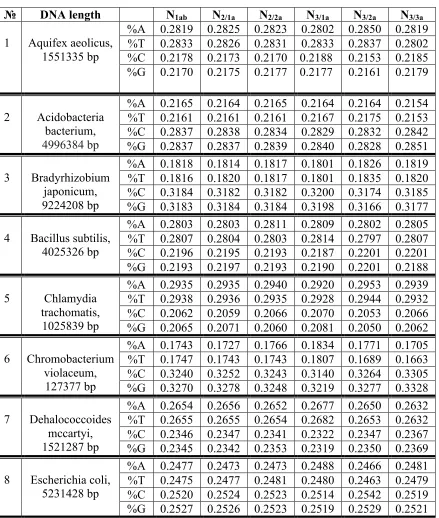
What one can say about nucleotide frequencies in epi-chains of prokaryotic genomes? This Section represents author's results testified that in prokariotic genomes the same situation relating these frequencies exists like in eukaryotic genomes (but with a slightly lower level of accuracy in equalities). Tables 7 and 8 show frequencies of nucleotides A, T, C and G in single-stranded and double-stranded DNA for all 19 genomes of bacteria and archaea from their full list in the article [Rapoport, Trifonov, 2012]. After these Tables, additional data on these genomes are given.
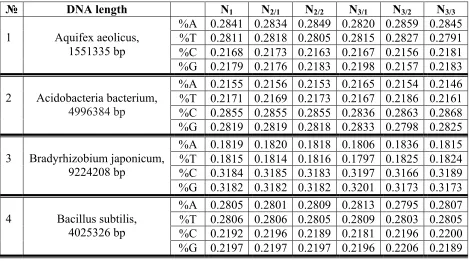
Table 7. Frequencies %A, %T, %C and %G of nucleotides A, T, C and G in single-stranded epi-chains of initial orders in 19 prokaryotic genomes. Data relating epi-epi-chains of the first order (N1), the second order (N2/1, N2/2) and the third order (N3/1, N3/2, N3/3) are presented.
№ DNA length N1 N2/1 N2/2 N3/1 N3/2 N3/3
1 Aquifex aeolicus, 1551335 bp
%A 0.2841 0.2834 0.2849 0.2820 0.2859 0.2845 %T 0.2811 0.2818 0.2805 0.2815 0.2827 0.2791 %C 0.2168 0.2173 0.2163 0.2167 0.2156 0.2181 %G 0.2179 0.2176 0.2183 0.2198 0.2157 0.2183
2 Acidobacteria bacterium, 4996384 bp
%A 0.2155 0.2156 0.2153 0.2165 0.2154 0.2146 %T 0.2171 0.2169 0.2173 0.2167 0.2186 0.2161 %C 0.2855 0.2855 0.2855 0.2836 0.2863 0.2868 %G 0.2819 0.2819 0.2818 0.2833 0.2798 0.2825
3 Bradyrhizobium japonicum, 9224208 bp
%A 0.1819 0.1820 0.1818 0.1806 0.1836 0.1815 %T 0.1815 0.1814 0.1816 0.1797 0.1825 0.1824 %C 0.3184 0.3185 0.3183 0.3197 0.3166 0.3189 %G 0.3182 0.3182 0.3182 0.3201 0.3173 0.3173
4 Bacillus subtilis, 4025326 bp
5 Chlamydia trachomatis, 1025839 bp
%A 0.2942 0.2939 0.2945 0.2927 0.2963 0.2936 %T 0.2930 0.2931 0.2930 0.2921 0.2935 0.2935 %C 0.2067 0.2066 0.2067 0.2074 0.2049 0.2077 %G 0.2061 0.2063 0.2058 0.2078 0.2053 0.2051
6 Chromobacterium violaceum, 127377 bp
%A 0.1670 0.1658 0.1682 0.1758 0.1651 0.1602 %T 0.1819 0.1812 0.1827 0.1883 0.1808 0.1766 %C 0.3049 0.3044 0.3055 0.3009 0.3112 0.3027 %G 0.3461 0.3486 0.3437 0.3350 0.3429 0.3606
7 Dehalococcoides mccartyi, 1521287 bp
%A 0.2664 0.2665 0.2663 0.2706 0.2617 0.2668 %T 0.2645 0.2647 0.2643 0.2653 0.2686 0.2596 %C 0.2338 0.2337 0.2339 0.2295 0.2376 0.2343 %G 0.2353 0.2351 0.2355 0.2346 0.2321 0.2394
8 Escherichia coli, 5231428 bp
%A 0.2480 0.2481 0.248 0.2479 0.2468 0.2494 %T 0.2472 0.2470 0.2474 0.2489 0.2461 0.2466 %C 0.2526 0.2523 0.2528 0.2519 0.2544 0.2515 %G 0.2522 0.2526 0.2518 0.2514 0.2527 0.2525
9 Flavobacterium psychrophilum, 2860382 bp
%A 0.3326 0.3326 0.3326 0.3335 0.3306 0.3338 %T 0.342 0.3416 0.3425 0.3411 0.3423 0.3427 %C 0.1640 0.1643 0.1637 0.1616 0.1665 0.1638 %G 0.1614 0.1615 0.1612 0.1638 0.1606 0.1597
10 Gloeobacter violaceus, 4659019 bp
%A 0.1906 0.1905 0.1907 0.1892 0.1925 0.1901 %T 0.1894 0.1899 0.1890 0.1881 0.1899 0.1903 %C 0.3101 0.3098 0.3104 0.312 0.3074 0.3108 %G 0.3099 0.3099 0.3099 0.3107 0.3103 0.3088
11 Helicobacter pylori, 1643831 bp
%A 0.3033 0.3034 0.3032 0.3033 0.3042 0.3022 %T 0.3048 0.3049 0.3048 0.3037 0.3028 0.3080 %C 0.1970 0.1969 0.1970 0.1989 0.1958 0.1962 %G 0.1949 0.1949 0.1950 0.1941 0.1972 0.1936
12 Methanosarcina acetivorans, 5751492 bp
%A 0.2848 0.2848 0.2848 0.2830 0.2851 0.2863 %T 0.2884 0.2881 0.2887 0.2890 0.2875 0.2887 %C 0.2136 0.2139 0.2132 0.2148 0.2133 0.2126 %G 0.2132 0.2132 0.2133 0.2132 0.2141 0.2124
13 Nanoarchaeum equitans, 490885 bp
%A 0.3422 0.3424 0.3420 0.3413 0.3423 0.3431 %T 0.3422 0.3419 0.3425 0.342 0.3413 0.3433 %C 0.1576 0.1581 0.1571 0.1593 0.1571 0.1563 %G 0.1580 0.1577 0.1583 0.1573 0.1594 0.1573
14 Syntrophus aciditrophicus, 3179300 bp
%A 0.2431 0.2431 0.2431 0.2441 0.2418 0.2433 %T 0.2423 0.2423 0.2424 0.2446 0.2413 0.2412 %C 0.2556 0.2556 0.2557 0.2546 0.2573 0.2551 %G 0.2590 0.2590 0.2589 0.2567 0.2597 0.2604
15 Streptomyces coelicolor, 8667507 bp
%A 0.1389 0.1386 0.1391 0.1366 0.1408 0.1392 %T 0.1400 0.1400 0.1399 0.1381 0.1414 0.1403 %C 0.3601 0.3600 0.3602 0.3614 0.3580 0.3609 %G 0.3611 0.3613 0.3608 0.3638 0.3598 0.3596
16 Sulfolobus solfataricus, 2727337 bp
%A 0.3181 0.3179 0.3184 0.3182 0.3185 0.3177 %T 0.3233 0.3231 0.3234 0.3225 0.3230 0.3243 %C 0.1798 0.1797 0.1799 0.1798 0.1782 0.1814 %G 0.1788 0.1793 0.1783 0.1795 0.1803 0.1765
1850823 bp %C 0.188 0.1877 0.1882 0.1882 0.1879 0.1877 %G 0.1919 0.1923 0.1915 0.1918 0.1934 0.1906
18 Thermotoga maritima, 1859582 bp
%A 0.2695 0.2700 0.2689 0.2703 0.2697 0.2684 %T 0.2678 0.2681 0.2675 0.2689 0.2694 0.2651 %C 0.2281 0.2277 0.2284 0.2271 0.2289 0.2282 %G 0.2347 0.2341 0.2352 0.2337 0.2320 0.2383
19 Thermus thermophilus, 2121526 bp
%A 0.1543 0.1543 0.1542 0.1515 0.1542 0.1571 %T 0.1557 0.1556 0.1558 0.1556 0.1529 0.1586 %C 0.3461 0.3458 0.3464 0.3490 0.3465 0.3428 %G 0.3439 0.3443 0.3435 0.3439 0.3464 0.3414
Table 8. Frequencies %A, %T, %C and %G of nucleotides A, T, C and G in double-stranded epi-chains of initial orders in 19 prokaryotic genomes. Data relating epi-epi-chains of the first order (N1ab), the second order (N2/1, N2/2) and the third order (N3/1, N3/2, N3/3) are presented.
№ DNA length N1ab N2/1a N2/2a N3/1a N3/2a N3/3a
1 Aquifex aeolicus, 1551335 bp
%A 0.2819 0.2825 0.2823 0.2802 0.2850 0.2819 %T 0.2833 0.2826 0.2831 0.2833 0.2837 0.2802 %C 0.2178 0.2173 0.2170 0.2188 0.2153 0.2185 %G 0.2170 0.2175 0.2177 0.2177 0.2161 0.2179
2 Acidobacteria bacterium, 4996384 bp
%A 0.2165 0.2164 0.2165 0.2164 0.2164 0.2154 %T 0.2161 0.2161 0.2161 0.2167 0.2175 0.2153 %C 0.2837 0.2838 0.2834 0.2829 0.2832 0.2842 %G 0.2837 0.2837 0.2839 0.2840 0.2828 0.2851
3 Bradyrhizobium japonicum, 9224208 bp
%A 0.1818 0.1814 0.1817 0.1801 0.1826 0.1819 %T 0.1816 0.1820 0.1817 0.1801 0.1835 0.1820 %C 0.3184 0.3182 0.3182 0.3200 0.3174 0.3185 %G 0.3183 0.3184 0.3184 0.3198 0.3166 0.3177
4 Bacillus subtilis, 4025326 bp
%A 0.2803 0.2803 0.2811 0.2809 0.2802 0.2805 %T 0.2807 0.2804 0.2803 0.2814 0.2797 0.2807 %C 0.2196 0.2195 0.2193 0.2187 0.2201 0.2201 %G 0.2193 0.2197 0.2193 0.2190 0.2201 0.2188
5 Chlamydia trachomatis, 1025839 bp
%A 0.2935 0.2935 0.2940 0.2920 0.2953 0.2939 %T 0.2938 0.2936 0.2935 0.2928 0.2944 0.2932 %C 0.2062 0.2059 0.2066 0.2070 0.2053 0.2066 %G 0.2065 0.2071 0.2060 0.2081 0.2050 0.2062
6 Chromobacterium violaceum,
127377 bp
%A 0.1743 0.1727 0.1766 0.1834 0.1771 0.1705 %T 0.1747 0.1743 0.1743 0.1807 0.1689 0.1663 %C 0.3240 0.3252 0.3243 0.3140 0.3264 0.3305 %G 0.3270 0.3278 0.3248 0.3219 0.3277 0.3328
7 Dehalococcoides mccartyi, 1521287 bp
%A 0.2654 0.2656 0.2652 0.2677 0.2650 0.2632 %T 0.2655 0.2655 0.2654 0.2682 0.2653 0.2632 %C 0.2346 0.2347 0.2341 0.2322 0.2347 0.2367 %G 0.2345 0.2342 0.2353 0.2319 0.2350 0.2369
8 Escherichia coli, 5231428 bp
9 Flavobacterium psychrophilum,
2860382 bp
%A 0.3375 0.3368 0.3385 0.3371 0.3355 0.3383 %T 0.3371 0.3374 0.3366 0.3376 0.3373 0.3383 %C 0.1627 0.1631 0.1624 0.1628 0.1633 0.1615 %G 0.1626 0.1626 0.1625 0.1625 0.1639 0.1620
10 Gloeobacter violaceus, 4659019 bp
%A 0.1898 0.1904 0.1897 0.1882 0.1913 0.1901 %T 0.1903 0.1898 0.1900 0.1891 0.1910 0.1903 %C 0.3099 0.3099 0.3103 0.3114 0.3092 0.3097 %G 0.3101 0.3097 0.3100 0.3113 0.3084 0.3099
11 Helicobacter pylori, 1643831 bp
%A 0.3041 0.3040 0.3041 0.3032 0.3032 0.3053 %T 0.3040 0.3042 0.3039 0.3039 0.3039 0.3050 %C 0.1959 0.1959 0.1961 0.1971 0.1966 0.1944 %G 0.1960 0.1959 0.1959 0.1959 0.1963 0.1954
12 Methanosarcina acetivorans, 5751492 bp
%A 0.2868 0.2865 0.2867 0.2862 0.2862 0.2877 %T 0.2864 0.2864 0.2868 0.2858 0.2865 0.2873 %C 0.2136 0.2132 0.2132 0.2143 0.2134 0.2125 %G 0.2132 0.2139 0.2133 0.2137 0.2140 0.2126
13 Nanoarchaeum equitans, 490885
bp
%A 0.3424 0.3419 0.3417 0.3422 0.3414 0.3430 %T 0.3420 0.3423 0.3429 0.3411 0.3421 0.3434 %C 0.1582 0.1571 0.1571 0.1585 0.1577 0.1574 %G 0.1574 0.1587 0.1583 0.1582 0.1585 0.1563
14 Syntrophus aciditrophicus,
3179300 bp
%A 0.2427 0.2429 0.2429 0.2447 0.2416 0.2424 %T 0.2427 0.2425 0.2426 0.2440 0.2414 0.2421 %C 0.2573 0.2576 0.2573 0.2557 0.2585 0.2576 %G 0.2573 0.2570 0.2572 0.2556 0.2584 0.2579
15 Streptomyces coelicolor, 8667507 bp
%A 0.1393 0.1393 0.1392 0.1370 0.1411 0.1397 %T 0.1395 0.1393 0.1398 0.1377 0.1411 0.1398 %C 0.3604 0.3611 0.3604 0.3625 0.3590 0.3600 %G 0.3608 0.3603 0.3606 0.3627 0.3587 0.3605
16 Sulfolobus solfataricus, 2727337 bp
%A 0.3207 0.3203 0.3207 0.3201 0.3207 0.3211 %T 0.3207 0.3207 0.3211 0.3206 0.3207 0.3209 %C 0.1790 0.1790 0.1794 0.1793 0.1795 0.1787 %G 0.1796 0.1800 0.1788 0.1800 0.1790 0.1793
17 Treponema denticola, 1850823 bp
%A 0.3101 0.3099 0.3105 0.3101 0.3094 0.3111 %T 0.3100 0.3101 0.3098 0.3099 0.3092 0.3106 %C 0.1896 0.1895 0.1899 0.1901 0.1914 0.1888 %G 0.1902 0.1906 0.1898 0.1899 0.1900 0.1985
18 Thermotoga maritima, 1859582 bp
%A 0.2688 0.2691 0.2684 0.2695 0.2697 0.2670 %T 0.2685 0.2690 0.2680 0.2697 0.2695 0.2665 %C 0.2315 0.2306 0.2327 0.2298 0.2302 0.2328 %G 0.2312 0.2312 0.2309 0.2310 0.2307 0.2337
19 Thermus
thermophilus, 2121526 bp
%A 0.1550 0.1552 0.1552 0.1537 0.1536 0.1580 %T 0.1549 0.1547 0.1549 0.1534 0.1535 0.1577 %C 0.3447 0.3448 0.3451 0.3459 0.3464 0.3416 %G 0.3454 0.3453 0.3449 0.3470 0.3465 0.3426
The following prokaryotic genomes are shown in Tables 7 and 8 under numbers 1-19: 1) Aquifex aeolicus VF5, complete genome, 1551335 bp, accession AE000657, version AE000657.1, https://www.ncbi.nlm.nih.gov/nuccore/AE000657.1?report=genbank ;
https://www.ncbi.nlm.nih.gov/nuccore/JHVA01000001.1?report=genbank;
3) Bradyrhizobium japonicum strain E109, complete genome,9224208 bp, accession CP010313, https://www.ncbi.nlm.nih.gov/nuccore/CP010313.1?report=genbank ;
4) Bacillus subtilis strain UD1022, complete genome, 4025326 bp, accession CP011534, https://www.ncbi.nlm.nih.gov/nuccore/CP011534.1?report=genbank;
5) Chlamydia trachomatis strain QH111L, complete genome, 1025839 bp, accession CP018052, https://www.ncbi.nlm.nih.gov/nuccore/CP018052.1?report=genbank;
6) Chromobacterium violaceum strain LK30 1, whole genome shotgun sequence,127377 bp, accession LDUX01000001 version LDUX01000001.1,
https://www.ncbi.nlm.nih.gov/nuccore/LDUX01000001.1?report=genbank;
7) Dehalococcoides mccartyi strain CG3, complete genome, NCBI Reference Sequence: NZ_CP013074.1, 1521287 bp, https://www.ncbi.nlm.nih.gov/nuccore/NZ_CP013074.1?report=genbank;
8) Escherichia coli CFT073, complete genome, GenBank: AE014075.1, 5231428 bp, https://www.ncbi.nlm.nih.gov/nuccore/AE014075.1?report=genbank;
9) Flavobacterium psychrophilum JIP02/86, complete genome, 2860382 bp, accession NC_009613, https://www.ncbi.nlm.nih.gov/nuccore/NC_009613.3;
10) Gloeobacter violaceus PCC 7421 DNA, complete genome, GenBank: BA000045.2, 4659019 bp, accession BA000045 AP006568-AP006583 version BA000045.2,
https://www.ncbi.nlm.nih.gov/nuccore/BA000045.2?report=genbank;
11) Helicobacter pilory, NCBI Reference Sequence: NC_000921.1, complete genome, 1643831 bp, accession NC_000921 NZ_AE001440-NZ_AE001571 version NC_000921.1,
https://www.ncbi.nlm.nih.gov/nuccore/NC_000921.1 ;
12) Methanosarcina acetivorans str. C2A, complete genome, 5751492 bp, accession AE010299 AE010656- AE011189 version AE010299.1,
https://www.ncbi.nlm.nih.gov/nuccore/AE01029;
13) Nanoarchaeum equitans Kin4-M, complete genome, 490885 bp, accession AE017199 AACL01000000 AACL01000001 version AE017199.1,
https://www.ncbi.nlm.nih.gov/nuccore/AE017199.1?report=genbank;
14) Syntrophus aciditrophicus SB, complete genome, 3179300 bp, accession CP000252, https://www.ncbi.nlm.nih.gov/nuccore/CP000252.1?report=genbank;
15) Streptomyces coelicolor A3(2) complete genome, 8667507 bp, accession AL645882, https://www.ncbi.nlm.nih.gov/nuccore/AL645882.2?report=genbank;
16) Sulfolobus solfataricus strain SULA, complete genome, 2727337 bp, accession CP011057, https://www.ncbi.nlm.nih.gov/nuccore/CP011057.1?report=genbank;
17) Treponema denticola SP33 supercont1.1, whole genome shotgun sequence, NCBI Reference Sequence: NZ_KB442453.1, 1850823 bp, accession NZ_KB442453 NZ_AGDZ01000000 version
NZ_KB442453.1, https://www.ncbi.nlm.nih.gov/nuccore/NZ_KB442453.1?report=genbank 18) Thermotoga maritima strain Tma200, complete genome, 1859582 bp, accession CP010967, https://www.ncbi.nlm.nih.gov/nuccore/CP010967.1?report=genbank;
19) Thermus thermophilus DNA, complete genome, strain: TMY, 2121526 bp, accession AP017920, https://www.ncbi.nlm.nih.gov/nuccore/AP017920.1?report=genbank.
Data in Tables 7 and 8 testify that, in the prokariotic genomes, frequencies of each of kinds of nucleotides A, T, C and G have practically constant values in all considered single-stranded and double-stranded DNA epi-chains. Corresponding frequencies of nucleotides in single-stranded and double-stranded DNA epi-chains are approximately the same. All this for the prokariotic genomes is similar to what was obtained for described eukariotic genomes.
5. The formulation of rules of nucleotide frequencies in DNA epi-chains
• The rule № 1: for each of eukariotic and prokariotic genomes, frequencies %A, %T, %C and %G of each kind of nucleotides A, T, C and G are approximately constant in all long single-stranded and double-stranded DNA epi-chains of n-orders (n = 1, 2, 3, 4, 5, …… but not extremely large);
• The rule № 2: for each of eukariotic and prokariotic genomes, in all its long single-stranded and double-stranded DNA epi-chains of n-orders, frequencies of nucleotides A and T are approximately equal (%A ≈ %T) and frequencies of nucleotides C and G are also approximately equal (%C ≈ %G) (this rule for long DNA epi-chains is analogous to the second Chargaff's rule for long DNA strands); • The rule № 3: for each of eukariotic and prokariotic genomes, its single-stranded and double-stranded DNA epi-chains of n-orders little differ each other from the standpoint of values of their nucleotide frequencies %A, %T, %C and %G;
• The rule № 4: in each of eukariotic genomes, all its nuclear chromosomes little differ each other from the standpoint of values of their nucleotide frequencies %A, %T, %C and %G in single-stranded and double-single-stranded DNA epi-chains.
Of course, at this stage of research, these rules are only candidates for the role of the universal genetic rules; further research of wider sets of genomes is needed to establish the degree of their universality. In the described study, the author met no one example of genomes with a violation of these rules till now. The question of the minimal length of long DNA sequences, from which value these rules of epi-chains begin to be true, is open and it needs additional study.
These rules belong to the field of quantum biology and support the Jordan's idea that «life's missing laws were the rules of chance and probability (the indeterminism) of the quantum world that were somehow scaled up inside living organisms» [McFadden, Al-Khalili, 2018]. These rules tell about probabilities (or frequencies), which is the main term in the language of quantum mechanics and quantum informatics.
The presented results demonstrate that long DNA sequences are not ramdom at all but they are regular constructions with their rich nets (or lattices) of epi-chains interrelated with each other. Integer numbers n = 1, 2, 3, 4,… play essential role in these regular constructions, which can be termed as harmonical in this relation. Long DNA sequences demonstrate themselves as quantum-mechanical entities, in which there is a long-range interaction among nucleotides regarding their arrangements.
The arrangement of nucleotides in long DNA is not at all arbitrary, but organized in such a way that the noted rules for nucleotide frequencies are implemented on its wide set of DNA epi-chains. This is directly related to the fundamental issue of the structural regularities in long DNA sequences, which are known today due to achivements of molecular biology. The modern situation in the theoretic field of genetic informatics, where many millions of nucleotide sequences are described, can be characterized by the following citation: “We are in the position of Johann Kepler when he first began looking for patterns in the volumes of data that Tycho Brahe had spent his life accumulating. We have the program that runs the cellular machinery, but we know very little about how to read it.” [Fickett & Burks, 1989].
6. Regarding frequencies of triplets in DNA epi-chains of different orders
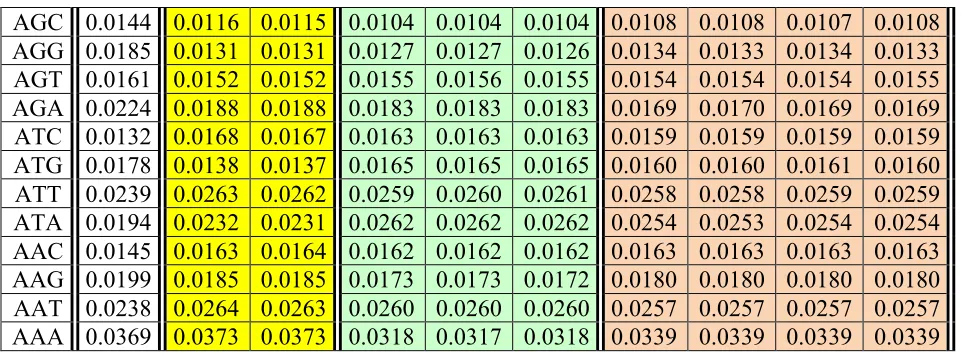
This Section presents some author’s results on studying frequencies of each of 64 triplets in long DNA epi-chains of various orders. These results testify in favor that, in relation to triplets, all epi-chains of each concrete order have practically identical frequencies of anindividual type, which can be used as an individual characteristic of the order of epi-chains (in contrast to the above described situation with frequencies of separate kinds of nucleotides, which are practically identical in epi-chains of different orders). Such differences in triplets frequencies allow additional speculating on participation of epi-chains of various orders in genetic processes.
Table 8 shows frequencies of each of 64 triplets in epi-chains of various orders in the human chromosome № 1.
Table 8. Frequencies of 64 triplets in single-stranded DNA epi-chains of the human chromosome
N1 N2/1 N2/2 N3/1 N3/2 N3/3 N4/1 N4/2 N4/3 N4/4
AGC 0.0144 0.0116 0.0115 0.0104 0.0104 0.0104 0.0108 0.0108 0.0107 0.0108 AGG 0.0185 0.0131 0.0131 0.0127 0.0127 0.0126 0.0134 0.0133 0.0134 0.0133 AGT 0.0161 0.0152 0.0152 0.0155 0.0156 0.0155 0.0154 0.0154 0.0154 0.0155 AGA 0.0224 0.0188 0.0188 0.0183 0.0183 0.0183 0.0169 0.0170 0.0169 0.0169 ATC 0.0132 0.0168 0.0167 0.0163 0.0163 0.0163 0.0159 0.0159 0.0159 0.0159 ATG 0.0178 0.0138 0.0137 0.0165 0.0165 0.0165 0.0160 0.0160 0.0161 0.0160 ATT 0.0239 0.0263 0.0262 0.0259 0.0260 0.0261 0.0258 0.0258 0.0259 0.0259 ATA 0.0194 0.0232 0.0231 0.0262 0.0262 0.0262 0.0254 0.0253 0.0254 0.0254 AAC 0.0145 0.0163 0.0164 0.0162 0.0162 0.0162 0.0163 0.0163 0.0163 0.0163 AAG 0.0199 0.0185 0.0185 0.0173 0.0173 0.0172 0.0180 0.0180 0.0180 0.0180 AAT 0.0238 0.0264 0.0263 0.0260 0.0260 0.0260 0.0257 0.0257 0.0257 0.0257 AAA 0.0369 0.0373 0.0373 0.0318 0.0317 0.0318 0.0339 0.0339 0.0339 0.0339
These tabular data show, for example, that frequencies P(CCC) of the triplet CCC are different in the single-stranded DNA epi-chains of various orders but practically identical in all epi-chains of the same order:
• In the epi-chain of the first order N1, P(CCC) = 0,0138;
• In both epi-chains of the second order N2/1 and N2/2, P(CCC) = 0,0122; • In all three epi-chains of the third order N3/1,N3/2 and N3/3, P(CCC) = 0,0138; • In all four epi-chains of the fourth order N4/1, N4/2, N4/3 and N4/4, P(CCC) = 0,0124.
Frequencies of all other triplets in Table 8 show a similar strong connection with orders of epi-chains; inside the considered epi-chains of the same order, these frequencies have only small fluctuations in the fourth decimal place.
But what a situation is realized in double-stranded DNA epi-chains of different orders for frequencies of 64 triplets? Corresponding data in Table 9 show that the case of double-stranded epi-chains has similar regularities for triplets frequencies like the case of single-stranded epi-chains (though values of frequencies of triplets differ in both cases).
Table 9. Frequencies of 64 triplets in double-stranded DNA epi-chains of the human chromosome
№1, which contains 248956422 bp. The cases of epi-chains of the first order (N1), the second order (N2/1, N2/2), the third order (N3/1,N3/2, N3/3) and the fourth order (N4/1, N4/2, N4/3, N4/4) are shown. All values are rounded to four decimal places. Epi-chains of each of orders are marked by an individual color. Initial data relating to the chromosome were accessed from https://www.ncbi.nlm.nih.gov/nuccore/NC_000001.11.
N1ab N2/1a N2/2a N3/1a N3/2a N3/3a N4/1a N4/2a N4/3a N4/4a
GCA 0.0173 0.0132 0.0132 0.0133 0.0132 0.0133 0.0133 0.0132 0.0132 0.0133 GGC 0.0077 0.0116 0.0116 0.0098 0.0098 0.0098 0.0107 0.0107 0.0107 0.0107 GGG 0.0025 0.0113 0.0113 0.0107 0.0107 0.0107 0.0117 0.0117 0.0116 0.0116 GGT 0.0083 0.0124 0.0124 0.0114 0.0113 0.0114 0.0116 0.0117 0.0116 0.0116 GGA 0.0086 0.0107 0.0107 0.0119 0.0119 0.0119 0.012 0.012 0.012 0.012 GTC 0.0153 0.0115 0.0115 0.0117 0.0117 0.0117 0.0109 0.0109 0.0109 0.0109 GTG 0.0176 0.0139 0.0139 0.0138 0.0138 0.0138 0.013 0.013 0.013 0.013 GTT 0.013 0.0159 0.0159 0.0156 0.0155 0.0155 0.0157 0.0156 0.0156 0.0156 GTA 0.0199 0.019 0.019 0.018 0.018 0.018 0.0177 0.0176 0.0177 0.0176 GAC 0.0153 0.0113 0.0113 0.0115 0.0116 0.0116 0.0109 0.0109 0.011 0.0109 GAG 0.0153 0.0113 0.0113 0.0127 0.0127 0.0127 0.0131 0.0131 0.0131 0.0131 GAT 0.0165 0.0163 0.0163 0.0162 0.0162 0.0162 0.0165 0.0165 0.0165 0.0165 GAA 0.0145 0.0143 0.0143 0.0165 0.0165 0.0165 0.0163 0.0164 0.0163 0.0164 TCC 0.0086 0.0108 0.0108 0.012 0.012 0.012 0.0121 0.012 0.0121 0.012 TCG 0.0154 0.0123 0.0123 0.012 0.012 0.012 0.0124 0.0124 0.0124 0.0124 TCT 0.0198 0.0146 0.0147 0.0172 0.0172 0.0171 0.017 0.017 0.017 0.0169 TCA 0.0178 0.0157 0.0156 0.0161 0.0161 0.0161 0.0153 0.0153 0.0153 0.0153 TGC 0.0172 0.0132 0.0132 0.0133 0.0133 0.0132 0.0132 0.0132 0.0132 0.0132 TGG 0.0084 0.0123 0.0123 0.0113 0.0113 0.0113 0.0116 0.0116 0.0116 0.0116 TGT 0.0223 0.0189 0.0189 0.0183 0.0183 0.0183 0.0169 0.017 0.017 0.017 TGA 0.0179 0.0155 0.0155 0.0159 0.016 0.016 0.0154 0.0154 0.0154 0.0154 TTC 0.0144 0.0143 0.0143 0.0166 0.0166 0.0166 0.0163 0.0163 0.0163 0.0163 TTG 0.013 0.0159 0.0159 0.0156 0.0157 0.0156 0.0156 0.0156 0.0156 0.0155 TTT 0.0194 0.0232 0.0231 0.0262 0.0263 0.0262 0.0254 0.0253 0.0254 0.0254 TTA 0.0219 0.026 0.026 0.0254 0.0254 0.0255 0.026 0.026 0.026 0.026 TAC 0.0198 0.0189 0.0189 0.0179 0.0178 0.0178 0.0177 0.0177 0.0177 0.0177 TAG 0.0167 0.0163 0.0163 0.0163 0.0162 0.0162 0.0164 0.0165 0.0165 0.0164 TAT 0.0371 0.0373 0.0374 0.0319 0.0319 0.032 0.034 0.034 0.034 0.034 TAA 0.0218 0.0261 0.0261 0.0255 0.0254 0.0255 0.026 0.026 0.026 0.0259 ACC 0.0084 0.0123 0.0123 0.0113 0.0113 0.0113 0.0116 0.0116 0.0116 0.0116 ACG 0.0172 0.0132 0.0132 0.0133 0.0132 0.0132 0.0132 0.0132 0.0132 0.0132 ACT 0.0179 0.0155 0.0156 0.0159 0.016 0.0159 0.0154 0.0154 0.0154 0.0154 ACA 0.0223 0.0189 0.019 0.0183 0.0183 0.0183 0.017 0.017 0.0169 0.017 AGC 0.0154 0.0123 0.0123 0.012 0.012 0.012 0.0124 0.0124 0.0124 0.0125 AGG 0.0086 0.0108 0.0108 0.012 0.012 0.012 0.0121 0.0121 0.0121 0.0121 AGT 0.0179 0.0157 0.0157 0.0161 0.0161 0.016 0.0153 0.0153 0.0153 0.0153 AGA 0.0198 0.0147 0.0146 0.0172 0.0171 0.0172 0.0169 0.017 0.0169 0.017 ATC 0.0166 0.0163 0.0163 0.0162 0.0162 0.0162 0.0164 0.0164 0.0165 0.0165 ATG 0.0198 0.0189 0.0189 0.0179 0.0179 0.0178 0.0177 0.0177 0.0177 0.0177 ATT 0.0218 0.0261 0.026 0.0255 0.0255 0.0255 0.026 0.026 0.0261 0.026 ATA 0.0371 0.0374 0.0374 0.032 0.032 0.032 0.034 0.034 0.0339 0.034 AAC 0.013 0.0159 0.0159 0.0156 0.0156 0.0156 0.0156 0.0155 0.0155 0.0156 AAG 0.0144 0.0143 0.0143 0.0166 0.0166 0.0166 0.0163 0.0163 0.0163 0.0163 AAT 0.0219 0.026 0.026 0.0254 0.0254 0.0254 0.0260 0.0261 0.0261 0.0261 AAA 0.0194 0.0231 0.0232 0.0262 0.0262 0.0262 0.0254 0.0254 0.0254 0.0254
7. Resonances and some scientific analogies refered to DNA epi-chains
every problem, under the most various forms, is this: that the interaction between two microscopic physical systems is controlled by a peculiar law of resonance» [Schrodinger, 1952, p.115]. Structures of molecular genetics are deeply connected with mathematical formalisms of the theory of resonances of vibrational systems having many degrees of freedom [Petoukhov, 2015a,b,c, 2016a; Petoukhov, Petukhova, 2017]. From the point of view of quantum mechanics, the interaction of molecules is based on the emission and absorption of photons with the participation of resonance correspondences. The energy state of parts of molecular-genetic systems depends on the emission and the absorption of photons, which are the force carriers for electromagnetic field (see some details in [Petoukhov, 2018b; Hu, Petoukhov, Petukhova, 2018]).
The creator of the theory of resonances in structural chemistry L. Pauling wrote about an important meaning of resonances in organization of living matter [Pauling, 1940]. Pauling's theory uses the fundamental principle of a minimal energy because – in resonant combining of parts into a single unit – each of members of the ensemble requires less energy for performing own work than when working individually. Of course, this fundamental principle can be used in many other cases of resonances in different systems as the physical base. The principle of energetic minimum in resonance processes has some correlations with the principle of relaxation in morphogenetic processes proposed in [Igamberdiev, 2012]. From the point of view of quantum mechanics, the interaction of molecules is based on the emission and the absorption of photons with the participation of resonance correspondences.
An organism during its life on genetic basis should solve algorithmic problems of two types: 1) informational, providing coordinated energy processes; 2) energetic, providing information processes.
Systems of resonances can be used as a common basis of such "two-faced" algorithms since resonances are associated both with oscillatory energy and with informatics of communications among objects. The notion “resonance” was introduced into quantum mechanics by W. Heisenberg in 1926 year in connection with analyzes of multi-body systems. He emphasized that in quantum mechanics the phenomenon of resonances has much more general character than in classical physics. In classic theory, two periodic oscillating systems come into their own resonance only in the case when a frequency of a separate sub-system doesn’t depend on energy of the system and when this frequency is approximately equal in both sub-systems. In quantum mechanics, two atomic systems come into their resonance only in the case when a frequency of absorption of one system coincides with a frequency of emitting another system, or vice versa [Heisenberg, 1926, §2]. Quantized electromagnetic field is represented as a set of oscillators. The book [Ji, 2017] contains new data about a role of resonances in biological structures.
Let us consider some possible approaches for analising and understanding a genetic role of DNA epi-chains taking into account analogies with known data from different branches of science.
- 7.1. DNA epi-chains and helical and fractal antennas
Fig. 4. Examples of technical helical antennas (photos are taken from web sites
https://ru.wikipedia.org/wiki/Спиральная_антеннаand https://en.wikipedia.org/wiki/Helical_antenna ).
Let us remind a few known facts about helical antennas, which can relate to the topic of DNA helices as possible helical antennas. Helical antennas are structurally insensitive to manufacturing errors in essential degree and they can operate in one of two principal modes - axial mode or normal mode. In the axial mode helical antenna functions as a directional antenna radiating a beam off the ends of the helix, along the antenna's axis (in this mode the diameter and pitch of the helix are comparable to a wavelength). It radiates circularly polarized radio waves, which distinguishes it from other antennas with directional radiation. In radio transmission, circular polarisation is often used where the relative orientation of the transmitting and receiving antennas cannot be easily controlled, such as in animal tracking and spacecraft communications (that is, for example, a spacecraft rotation does not influence on the communication). At present, intensive study of quantum polarization states is being conducted all over the world for successful mastering of quantum information technologies, especially in the field of quantum communication.
The direction of rotation of the circular polarization of the space receiving-transmitting antenna must coincide with the direction of rotation of the ground receiving and transmitting antenna operating from the space antenna. In space communication, polarization isolation is used, that is, antennas of opposite directions of rotation of polarization operate at the same frequency. In other words, regarding these helical antennas, the factor of chirality (left or right polarization) is very important for communication. But the problem of chirality (or biological dissymmetry) also quite important for molecular biological systems as known beginning from famous experiments by Louis Pasteur in 1848 (see for example [Darvas, 2007; Hargittai, Hargittai, 2003; Kizel, 1980]). Helical chiral biomolecules emit and absorb the electromagnetic waves of the corresponding circular polarization. This provides the opportunity for helical chiral biomolecules to exchange radio waves of the corresponding circular polarization selectively with helical biomolecules of the same kind of chirality. The author believes that the principle of the chiral stereochemical organisation of biomolecules in living nature is deeply related with the informational principle of communication among biomolecules on the basis of electromagnetic waves of appropriate circular polarization inside biological bodies. Existence of chirality in biomolecular structures and also in their electromagnetic waves of appropriate circular polarization are very significant for farmacology and some methods of physiotherapy. It should be added that many species have the useful informational ability to perceive the polarization light by their organs of sight (some birds, insects, etc.).
Here it should be recalled that not only DNA molecule has its helical configuration but many proteins have helical substructures, known as alpha helices. Moreover helices are termed long ago as
«curves of life» due to the multiple implementation of inherited helical structures and processes in living
bodies on various lines and levels of biological evolution [Cook, 1914; Petoukhov, Svirin, Khazina, 2015]. For example in the human body, helical structures are genetically inherited from generation to generation in muscles, heart, vessels, bones, tendons, ligaments, nerves, organ of hearing (cochlea ear), etc. Science reveals new and new facts about helices in biological structures. The recent work [Zabeo et al., 2018] describes a discovery of left-handed helices in tips of human spermatozoon tails; its authors speculate that these helical structures in particularly can «play a role in controlling the swimming direction of
spermatozoa» that is play a role of antennas for communication with environment.