ISSN(Online): 2319-8753 ISSN (Print): 2347-6710
I
nternational
J
ournal of
I
nnovative
R
esearch in
S
cience,
E
ngineering and
T
echnology
(A High Impact Factor, Monthly, Peer Reviewed Journal)
Visit: www.ijirset.com
Vol. 7, Special Issue 2, March 2018
E-Medical Application using QR code with
OTP generation
S.Balaji1, Dr.N.Pughazendi2, S.E.Praveenkumar3, V.Vishal4, R.Vignesh5
Assistant Professor, Department of Compuer Science and Engineering , Panimalar Engineering College, Chennai,
Tamil Nadu, India1,
Professor, Department of Compuer Science and Engineering , Panimalar Engineering College, , Chennai,
Tamil Nadu, India 2,
UG Scholar, Department of Compuer Science and Engineering , Panimalar Engineering College, , Chennai,
Tamil Nadu, India 3,4,5
ABSTRACT : There are some privacy issues to be consider when a hospital wants to share health and medical data. In this paper the medical and health related data shared between two sides one-part hospital management to treat as the admin part and then patient to treated as the user part. admin to upload the medical record in our cloud(Data and patient ID) then search the particular patient id the medical document reference id automatically convert to the QR code then just scan in user module then download the particular document. The user Registration module to include the OTP system. The main Advantage this project is more secure transaction between two sides, more flexible, easy access, paper free report.in existing system was RFID technology using this system not suitable for more sensible data storing and not compact for all sectors. RFID proves to be too expensive for many applications as compared to other tracking and identification methods, such as the simple barcode. It is difficult for an RFID reader to read the information in case the tags are installed in liquid or metal products. The problem here is that, liquid and metal surfaces tend to reflect radio waves
KEYWORDS: QR code , OTP. RFID, RFID Reader, medical documnet
I INTRODUCTION
Here we do the secure transaction between the patient and the hospital management system. The basic concept is that the paper less transaction between hospital and patient using the QR code generation with the otp. Here we store the information in digital.
QR code is an image of a matrix barcode that stores data in two dimensions. Data is presented as square dots with specific pattern in both horizontal and vertical dimensions. Specific imaging devices (QR scanners) can read this image and retrieve the stored data based on the pattern of square dots.this methods are simple and effficint authentication method, The number of people using smart phone increasing day to day. The sms based one-time password is very popular now a days where the patient provide an phone number.QR code is quick response code and it is the two dimentional bar code which can be read on devices such as mobile device,tablet,etc. The qr code is generated using the qr code generator
II. LITERATURE SURVEY
ISSN(Online): 2319-8753 ISSN (Print): 2347-6710
I
nternational
J
ournal of
I
nnovative
R
esearch in
S
cience,
E
ngineering and
T
echnology
(A High Impact Factor, Monthly, Peer Reviewed Journal)
Visit: www.ijirset.com
Vol. 7, Special Issue 2, March 2018
Facebook, Evernote, Qik, Mandeley, or Diigo, has transformed the unilateral relationship between users and content (O’Reilly, 2005) to a multilevel, many-to-many network of ties between individuals, content, locations or other individuals (LearnNC, 2009). In recent years, e-learning researchers have noticed that the progress of ubiquitous access technologies, such as “smart” cell phones, could be extended to learning and discovery as well. However, the current state of employing digital humanities in teaching is several steps behind the most innovative developments that have taken the Internet from passive desktop publishing to ‘social media’ or from text to 3D immersive virtual realities (Matei, 2009). In order to assist teachers and instructional designers in the implementation of “social media” into teaching, researchers of this paper first reviewed the literature that underlies the Designing Online Collaborative Location-Aware Platform for History Learning
HsinyiPeng etal[2] has given an Instructional Decision Making and Learning Assistant, They have conducted various studies on applying wireless communication and ubiquitous computing technologies to education, so that the technologies can provide learners and educators with more active and adaptive support. This study proposes a Ubiquitous Performance-support System (UPSS) that can facilitate the seamless use of powerful new technologies in the school setting. In order to help the readers visualize these novel technologies in practice, we present one case study of a butterfly-ecology training course facilitated by the UPSS. The aim behind the case study is to inform the design and the development of context-aware ubiquitous computing system and its learning materials. The research inquiry centers around three themes: (1) the critical features to the data-driven decision making of teachers, (2) the perceptions of teachers and students to the UPSS, and (3) implementation issues. The results of the two rounds of formative evaluation indicate positive effects of the UPSS regarding motivation, interactivity, and effectiveness. In addition, teachers’ attitudes and teachers’ pedagogical approaches toward UPSS use are two key factors in the successful implementation of teaching with such innovative technology. This study can be a useful reference for those who are interested in conducting studies applying context-aware ubiquitous computing to educational contexts. Finally, this study presents suggestions and implications for future research and system development.
M. C. Mayorga Toledano[3] has given an case study in the Actuarial Sciences degree for Learning objects for mobile devices and In this paper, the educative possibilities of Java midlets, which are small applications that can be stored in a mobile phone, are explored in several courses in the Actuarial Sciences degree of the University of Málaga. This project is carried out by a multidisciplinary group of teachers who have been developing learning resources in electronic format during the last six years. We follow a flexible blended strategy that includes the traditional classroom, e-learning and m-learning elements. Thus, the students can customize their learning processes using the contents and the way of access they are more comfortable with or consider more effective.
MandeepKaur etal[4] has given an Principles, Advantages, Limitations & Applications of RFID Technology,This paper gives an overview of the current state of radio frequency identification (RFID) technology. Aside from a brief introduction to the principles of the technology, major current and envisaged fields of application, as well as advantages, and limitations of use are discussed. Radio frequency identification (RFID) is a generic term that is used to describe a system that transmits the identity (in the form of a unique serial number) of an object or person wirelessly, using radio waves. It's grouped under the broad category of automatic identification technologies. RFID is increasingly used with biometric technologies for security. In this paper Basic Principles of RFID technology along with its types are discussed.
ISSN(Online): 2319-8753 ISSN (Print): 2347-6710
I
nternational
J
ournal of
I
nnovative
R
esearch in
S
cience,
E
ngineering and
T
echnology
(A High Impact Factor, Monthly, Peer Reviewed Journal)
Visit: www.ijirset.com
Vol. 7, Special Issue 2, March 2018
III. ARCHITECTURE DIAGRAM
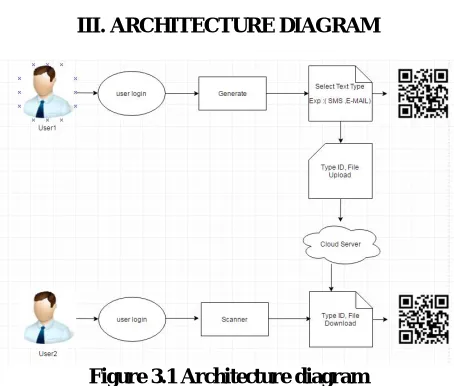
Figure 3.1 Architecture diagram
Here user1 is admin side and user 2 is patient. The user 1 uploading the file and user 2 downloading the file by scanning the qr code that is generated in the admin side.the otp is sent to that authorized user mobile number.after entering the otp the files will be downloaded automatically.
First the user want enter the details like patient id,name,address,phone number. For this phone number the otp will sent.after entering details we want to upload the files.after uploading we want to generate the qr code
One part is admin part and another one is patient part, the admin part get all details it will generate the qr code and generate the one time password and also uploads the files which is related to patient after generation of qr code which can be printed in paper or in will be shown in the desktop from that the user can scan that information. After scanning those information the otp will generated the number we have given , after otp generation the files that has been uploaded will be downloads automatically
IV. IMPLEMENTATION
Login
ISSN(Online): 2319-8753 ISSN (Print): 2347-6710
I
nternational
J
ournal of
I
nnovative
R
esearch in
S
cience,
E
ngineering and
T
echnology
(A High Impact Factor, Monthly, Peer Reviewed Journal)
Visit: www.ijirset.com
Vol. 7, Special Issue 2, March 2018
Database Creation
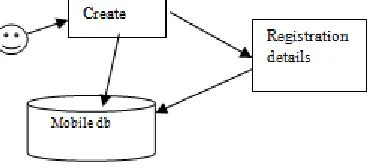
User email id or user name and password have been stored after registration. Android used MySql Database for storing and fetching user application details
QR Code Generator
This module Used to Generate the QR code for the User enter Key and additionally what kind of data liketxt, image, etc.QR code ever expire,there are two types of qr code they are static and dynamic.the static qr code is used when the page is static.and the dynamic used when we want to update the page frequenty.
Figure 4.3 QR code generation
Scanner
In, Additionally One type of application name as (Qdroid) used in this project .
ISSN(Online): 2319-8753 ISSN (Print): 2347-6710
I
nternational
J
ournal of
I
nnovative
R
esearch in
S
cience,
E
ngineering and
T
echnology
(A High Impact Factor, Monthly, Peer Reviewed Journal)
Visit: www.ijirset.com
Vol. 7, Special Issue 2, March 2018
Figure 4.4 scanner
File Upload
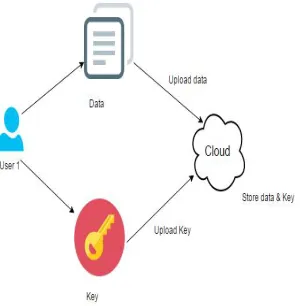
In this Module used to, The user 1 Knowing the key, and what kind of data to be upload from gallery to Server . Finally the data and key to uploaded to the Server.after uploading the files then the admin will generate the qr code.
Figure 4.5 File upload
File Download
ISSN(Online): 2319-8753 ISSN (Print): 2347-6710
I
nternational
J
ournal of
I
nnovative
R
esearch in
S
cience,
E
ngineering and
T
echnology
(A High Impact Factor, Monthly, Peer Reviewed Journal)
Visit: www.ijirset.com
Vol. 7, Special Issue 2, March 2018
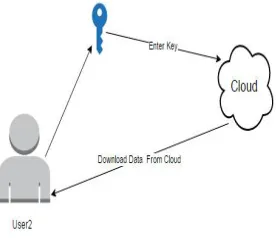
Figure 4.6 File download
V. RESULTS AND DISCUSSION
Now a days we want to share the medical related data in more secured fashion and we want to store it digitally.the problem that iwe have solved is the medical related data sharing between the two side one is hospital side and another one is patient part
VI. CONCLUSION
The paper less transaction between hospital and patient using the QR code generation with the otp. In this paper a new rich code called two level QR (2LQR) code is proposed. This 2LQR code has two levels: a public level and a private level. The public level can be read by any QR code reading application, while the private level needs a specific application with specific input information. This 2LQR code can be used for private message sharing or for authentication scenarios. The private level is created by replacing black modules with specific textured patterns. These textured patterns are considered as black modules by standard QR code reader. Thus the private level is invisible to standard QR code readers. In addition, the private level does not affect in anyway the reading process of the public level. In the future, we are going to develop an Advance learning system , which adopts the designed scheme to trace visitors’ trajectories in our campus. Besides, we are now going to apply the designed scheme to analyze sport postures. In the future, we are going to develop an Advance learning system , which adopts the designed scheme to trace visitor’s trajectories in our campus. Besides, we are now going to apply the designed scheme to analyze sport postures.
REFERENCES
[1] IEEE 10.1109/MWC.2014.6757895. Security and privacy in mobile social networks:challenges and solutions 2014
[2]Ubiquitous Performance-Support System as Mindtool: A Case Study of Instructional Decision Making and Learning Assistant. v12 n1 p107-120 2009
[3] M. C. MayorgaToledano,Learning objects for mobile devices: A case study in the Actuarial Sciences degree,march 2006
[4] Gwo-Jen Hwang, Chin-Chung Tsai and Stephen J.H. Yang ,Criteria, Strategies and Research Issues of Context-Aware Ubiquitous Learning Vol. 11, No. 2, Context-Aware and Ubiquitous Learning (April 2008)
ISSN(Online): 2319-8753 ISSN (Print): 2347-6710
I
nternational
J
ournal of
I
nnovative
R
esearch in
S
cience,
E
ngineering and
T
echnology
(A High Impact Factor, Monthly, Peer Reviewed Journal)
Visit: www.ijirset.com
Vol. 7, Special Issue 2, March 2018
[8] C. Baras and F. Cayre. 2D bar-codes for authentication: A security approach. In Signal Processing Conference (EUSIPCO), Proceedings of the 20th European, pages 1760–1766, 2012.
[9] T. V. Bui, N. K. Vu, T. T.P. Nguyen, I. Echizen, and T. D. Nguyen.Robust message hiding for QR code. In Intelligent Information Hiding and Multimedia Signal Processing (IIH-MSP), 2014 Tenth International Conference on, pages 520–523. IEEE, 2014.
[10] A. T. P. Ho, B. A. M. Hoang, W. Sawaya, and P. Bas. Document authentication using graphical codes: Reliable performance analysis and channel optimization. EURASIP Journal on Information Security, 2014(1):9, 2014.
[11] T. Langlotz and O. Bimber.Unsynchronized 4D barcodes. In Advances in Visual Computing, pages 363–374. Springer, 2007.
[12] C.-Y. Lin and S.-F.Chang.Distortion modeling and invariant extraction for digital image print-and-scan process.In Int. Symp.Multimedia Information Processing, 1999.
[13] P.-Y. Lin, Y.-H. Chen, E. J.-L. Lu, and P.-J. Chen. Secret hiding mechanism using QR barcode. In Signal-Image Technology & Internet- Based Systems (SITIS), 2013 International Conference on, pages 22–25. IEEE, 2013.
[14] Information Technology Automatic Identification and Data Cap-ture Techniques—Data Matrix Bar Code Symbology Specification, ISO/IEC Standard 16022:2006, 2006.
[15]Information Technology Automatic Identification and Data Capture Techniques Bar Code Symbology—QR Code, ISO / IEC Standard 18004 : 2000 , 2000.
[16] Z. Baharav and R. Kakarala, “Visually significant QR codes: Image blending and statistical analysis,” in Proc. IEEE Int. Conf. Multimedia Expo (ICME), Jul. 2013, pp. 1–6.
[17] C. Baras and F. Cayre, “2D bar-codes for authentication: A security approach,” in Proc. 20th Eur. Signal Process. Conf. (EUSIPCO), Aug. 2012, pp. 1760–1766.
[18] T. V. Bui, N. K. Vu, T. T. P. Nguyen, I. Echizen, and T. D. Nguyen, “Robust message hiding for QR code,” in Proc. IEEE 10th Int. Conf. Intell. Inf. Hiding Multimedia Signal Process. (IIH-MSP), Aug. 2014, pp. 520–523.
[19] A. T. P. Ho, B. A. M. Hoang, W. Sawaya, and P. Bas, “Document authentication using graphical codes: Reliable performance analysis and channel optimization,” EURASIP J. Inf. Secur., vol. 2014, no. 1, p. 9, 2014.
[20] T. Langlotz and O. Bimber, “Unsynchronized 4D barcodes,” in Proc. 3rd Int. Symp., ISVC 2007, Lake Tahoe, NV, USA, Nov. 26–28, 2007, pp. 363–374.
[21] C.-Y. Lin and S.-F. Chang, “Distortion modeling and invariant extraction for digital image print-and-scan process,” in Proc. Int. Symp. Multimedia Inf. Process., 1999, pp. 1–10.
[22] P.-Y. Lin, Y.-H. Chen, E. J.-L. Lu, and P.-J. Chen, “Secret hiding mechanism using QR barcode,” in Proc. IEEE Int. Conf. Signal-Image Technol. Internet-Based Syst. (SITIS), Dec. 2013, pp. 22–25.
[23] Information Technology Automatic Identification and Data Capture Technique EAN/UPC Bar Code Symbology Specification, ISO/IEC Standard 15420:2009, 2009.