ISSN(Online): 2320-9801 ISSN (Print) : 2320-9798
I
nternational
J
ournal of
I
nnovative
R
esearch in
C
omputer
and
C
ommunication
E
ngineering
(An ISO 3297: 2007 Certified Organization)
Vol. 4, Issue 10, October 2016
Large Graph Database for Subgraph
Matching with Set Similarity Using String
Metric Algorithm
Monali Vitthal Divekar, Prof. Shyam S. Gupta
MEStudent, Dept. of Computer Engineering, Savitribai Phule Pune University, Siddhant College of Engineering,
Sudumbare, Maval, Pune, India.
Asst. Professor, Dept. of Computer Engineering, Savitribai Phule Pune University, Siddhant College of Engineering,
Sudumbare, Maval, Pune, India.
ABSTRACT: In real lifestyles, interpersonal companies, Semantic internet and Natural techniques, social networks,
and biological networks, each vertex extra by and large than now not contains important information, which may also be displayed by way of an arrangement of tokens or components. In this paper, a subgraph matching with set similarity (SMS2) query over a large graph database, which retrieves subgraphs that are structurally isomorphic to the query graph, and during this time period it also satisfy the condition of vertex pair matching with the (dynamic) weighted set similarity. This paper designs a novel lattice-based index for data graph to efficiently process the SMS2 query, and lightweight signatures for both query and data vertices. We not only propose an efficient two-phase pruning strategy based on the index and signatures, which including set similarity pruning and structure-based pruning, and also utilizes the unique features of both (dynamic) weighted set similarity and graph topology, but also propose an efficient dominating-set-based subgraph matching algorithm direct by a dominating set selection algorithm to achieve better query performance. Extensive experiments on both real as well as synthetic datasets demonstrate that our method outperforms state of-the-art methods by order of magnitude.
KEYWORDS: subgraph matching, graph database, pruning strategy, vertex pair matching, weighted set similarity,
query processing, SMS2 query, dynamic set similarity, structurally isomorphic subgraph, synthetic datasets
I. INTRODUCTION
A cross section situated document looking software for knowledge, which makes use of SPARQL for knowledge shopping. In addition this know-how is used to acquire field linkage between searching keyword, in order that RDF will also be generated. Nonetheless this expertise is main with respective to keyword, however we enhances this knowledge by means of enforcing cluster based suggestion set of information. Graphs come up very naturally in many instances - examples are different from the web graph of records, to a social community graph of associates, to
road-map graphs of cities. Recently many years, field of graph mining has grown speedily, not best for the reason that
the quantity and the scale of graphs has been developing exponentially with billions of nodes and edges, but in addition on the grounds that wish to extract far more complicated understanding from our graphs (not simply review static homes, but infer structure and make correct predictions). These results in challenges on a few fronts proposing meaningful metrics to seize different notions of structure, designing algorithms that may calculate these metrics, and
ISSN(Online): 2320-9801 ISSN (Print) : 2320-9798
I
nternational
J
ournal of
I
nnovative
R
esearch in
C
omputer
and
C
ommunication
E
ngineering
(An ISO 3297: 2007 Certified Organization)
Vol. 4, Issue 10, October 2016
II. PROBLEM STATEMENT
Graph alignment algorithms introduce additional cost as they should firstly find candidate subgraphs of similar size from the large data graph. In addition, existing exact subgraph matching and graph alignment algorithms do not consider weighted set similarity on vertices, which will cause high post processing cost of set similarity computation.
Objective: we study subgraph similarity search on large probabilistic graph databases. Different from previous papers
assuming that edges in an uncertain graph are independent of each other, the uncertain graphs where edges’ occurrences are correlated. This result can be used to recommend RDF based information to User as a Clustered information set. Implementation of a cross section situated document looking software for knowledge, which makes use of SPARQL for knowledge shopping. cross section situated document looking software for knowledge, which makes use of SPARQL for knowledge shopping.
III. RELATED WORK
In [1] authors used During the online phase, a set of pruning techniques facilitated by the offline data structures are introduced and integrated together to greatly reduce the search space of SMS2 queries. Author uses Structured similarity and set similarity pruning techniques. Author uses design an efficient algorithm to perform subgraph matching based on the dominating set of query graph approach can effectively and efficiently answer the SMS2 queries in a large graph database.In [2] authors used developing reputation of graph databases has generated
interesting information administration issues, such as subgraph search, shortest-path question, reach ability verification,
and sample healthy. Amongst these, a pattern suit question is extra flexible compared to a subgraph search and extra
informative compared to a shortest-path or reach-ability query. On this paper, we handle sample fit problems over a
large information graph G. Chiefly, given a pattern graph (i.E., question Q), Author need to find all matches (in G)
which have the identical connections as those in Q. In order to shrink the hunt area enormously, Author first turn out to
be the vertices into features in a vector area by way of graph embedding tactics, coverting a pattern in shape query into
a distance-founded multi-manner become a member of obstacle over the modified vector space. Author additionally
endorses a couple of pruning approaches and join order decision process to approach become a member of processing
successfully. In [3] authors, previous paper problem is to find all patterns in a colossal data graph that suit a consumer
-given graph sample. Author suggests a new two-step R-join (reachability become a member of) algorithm with filter
step and fetch step situated on a cluster-established become a member of index with graph codes. Author keep in mind the filter step as an R-semijoin, and suggest a brand new optimization approach through interleaving joins with
R-semijoins. It carried out huge performance experiences, and confirm effectivity of our proposed new approaches. In [4]
authors used a novel indexing method that includes graph structural information in a hybrid index structure. This indexing technique attains high pruning power and the index size scales linearly with the database size. In addition, Author propose an innovative matching paradigm to query large graphs. This technique distinguishes nodes by their
importance in the graph structure. The matching algorithm firstly matches the important nodes of a query and then
progressively extends these matches. In [5] authors use a Torque seeks an identical set of proteins that are sequence-much like the query proteins and spana linked vicinity of the network, whilst permitting both insertions and deletions. The algorithm uses on the other hand dynamic programming and integer linear programming for the quest undertaking.
Author experiment Torque with queries from yeast, fly, and human, the place Author compare it to the Q Net
topology-founded process, and with queries from much less studied species, where best topology-free algorithms practice. Torque detects many extra suits than QNet, whilst in both circumstances giving results which are totally functionally coherent. In [6] authors use a novel approximate graph matching technique called SAGA (Substructure Index based
Approximate Graph Alignment). SAGA employs a flexible graph distance model to measure similarities between
ISSN(Online): 2320-9801 ISSN (Print) : 2320-9798
I
nternational
J
ournal of
I
nnovative
R
esearch in
C
omputer
and
C
ommunication
E
ngineering
(An ISO 3297: 2007 Certified Organization)
Vol. 4, Issue 10, October 2016
SPath, a graph query is processed and optimized past thetraditionalvertex-at-a-timetrendtoaextraefficientpath
-at-a-timeapproach experimental reports exhibit the effectiveness and scalability of SPath, which proves tobe a more functional and efficient indexing process in addressing graph queries on huge networks. In [8] authors use a novel algorithm that supports efficient subgraph matching for graphs deployed on a distributed reminiscence retailer. Rather of counting on tremendous-linear indices, Author use efficient graph exploration and gigantic parallel computing for query processing. Our experimental results reveal the feasibility of performing subgraph matching on internet-scale graph knowledge. In [9] author explores the notion of similarity headquartered on connectivity alone, and proposes a few algorithms to quantify it. Our metrics take abilities of the neighborhoods of the nodes within the quotation graph. Two versions of hyperlink founded similarity estimation between two nodes are described, one headquartered on the separate neighborhood neighborhoods of the nodes, and yet another situated on the joint nearby multiplied from both nodes at the same time. The algorithms are carried out and evaluated on a subgraph of the quotation graph of computer science in a retrieval context. In [10] DBpedia is a group effort to extract structured expertise from Wikipedia and to make this information available on the web. DBpedia enables you to ask sophisticated queries against datasets derived from Wikipedia and to hyperlink other datasets on the net to Wikipedia data. In [11] given a question string, also
represented as a set of tokens, a weighted string similarity question identifies all strings in the database whose similarity
to the question is better than a consumer designated threshold. Weighted string similarity queries are priceless in purposes like information cleaning and integration for locating approximate suits within the presence of typographical mistakes, a couple of formatting conventions, information transformation blunders, and so on. It show that this challenge has semantic properties that may be exploited to design index buildings that help very effective algorithms for query answering. In [12], algorithm for graph isomorphism and subgraph isomorphism suited to coping with enormous graphs is expanded here to curb its spatial complexity and to attain a greater performance on enormous graphs; its aspects are analyzed in element with targeted reference to time and memory necessities. The outcome of a testing carried out on a publicly to be had database of synthetically generated graphs and on graphs relative to an actual
utility dealing with technical drawings are awarded, confirming the effectiveness of the technique, especially when
working with colossal graphs.
IV. SYSTEM IMPLEMENTATION
A. EXISTING SYSTEM
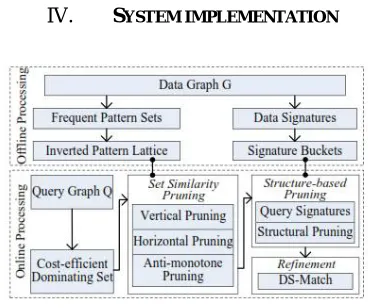
Fig. A. Framework for SMS2 Query Processing
This approach includes offline processing and online processing, as shown in above fig. A Offline processing: This construct a novel inverted pattern lattice to facilitate efficient pruning which is based on the set similarity. Since the dynamic weight of each element makes existing indices inefficient for answering SMS2 queries, the need is to design a novel index for SMS2 query. Motivated by the anti-monotone property of the lattice structure [1], then mine frequent patterns [13] from element sets of vertices in the data graph G, and organize them into a lattice. Also store data vertices in the inverted list for each frequent pattern P, if P is contained in the element sets of these vertices. The lattice together with the inverted lists is called inverted pattern lattice, which can greatly reduce the cost of dynamic weighted set similarity search. To support structure-based pruning, encode each query vertex and data vertex into a query signature and a data signature respectively by considering both the topology and set information, and hash all the data signatures
into signature buckets. Online processing: This propose finding a cost-efficient dominating set () of the query graph [1],
ISSN(Online): 2320-9801 ISSN (Print) : 2320-9798
I
nternational
J
ournal of
I
nnovative
R
esearch in
C
omputer
and
C
ommunication
E
ngineering
(An ISO 3297: 2007 Certified Organization)
Vol. 4, Issue 10, October 2016
query performances. Thus, a dominating set selection algorithm to select a cost-efficient dominating set DS (Q) of
query graph Q. The dominating-set-based subgraph matching is motivated by two observations: (1) finding candidates
in SMS2 queries are much more expensive than that in typical subgraph search, because set similarity calculation is
more costly than vertex label matching. As a result, the filtering cost can be reduced by searching dominating vertices
of V (Q) rather than all query vertices. (2)Some query vertices may have a large amount of candidate vertices, which leads to many of the unnecessary intermediate results during subgraph matching. Therefore, the subgraph matching
cost can also be reduced by decreasing the size of intermediate results. For each vertex u ∈ DS(Q), This propose a two
phase pruning strategy, including set similarity pruning and structure-based pruning. The set similarity pruning includes anti-monotone pruning, horizontal pruning, and vertical pruning, which are based on inverted pattern lattice. Based on the signature buckets, also the structure-based pruning technique by utilizing novel vertex signatures. After the pruning, This propose an efficient DS-Match subgraph matching algorithm to obtain subgraph matches of Q based on candidates of dominating vertices in DS(Q). DS-match utilizes topological relations between dominating vertices and non-dominating vertices to reduce the scale of intermediate results during subgraph matching, and therefore reduces the matching cost.
B. MODULAR OVERVIEW OF PROPOSED SYSTEM
i. Graph Similarity: There are two graphs on the same set of N nodes, but with possibly different sets of edges
(weighted or unweighted). The correspondence between the nodes of the two graphs (like the people in PC don’t vary across graphs) is already known. Graph similarity involves determining the degree of similarity between these two graphs (a number between 0 and 1).
ii. Subgraph Matching: Consider a series of T graphs, each of them over the same set of N nodes, but with
possibly different edges (weighted or unweighted). Assume that the correspondence between the nodes is already known. This matching involves identifying the coherent or well-connected subgraphs that appear in some or all of the T graphs.
iii. Pruning: A matching subgraph should have its vertices (element sets) similar to that in query graph Q as well
as preserve the same structure as Q. Thus, in this section, Author design lightweight signatures for both query
vertices and data vertices to further filter the candidates after set similarity pruning by considering the
structural information. We propose a two phase pruning strategy, including set similarity pruning and structure-based pruning. The set similarity pruning includes vertical pruning, horizontal pruning, and anti-monotone pruning, which are based on our proposed inverted pattern lattice. We also propose the structure-based pruning technique which is structure-based on the signature buckets by utilizing novel vertex signatures. After the pruning, we propose an efficient String metric Algorithm to obtain subgraph matches.
C. ALGORITHM OF PROPOSED SYSTEM
String metric Algorithm:
ISSN(Online): 2320-9801 ISSN (Print) : 2320-9798
I
nternational
J
ournal of
I
nnovative
R
esearch in
C
omputer
and
C
ommunication
E
ngineering
(An ISO 3297: 2007 Certified Organization)
Vol. 4, Issue 10, October 2016
V. EXPECTED RESULTS
However, a query graph is much less than the data graph in subgraph isomorphism problems, while the two graphs usually have similar size in graph alignment problems. To solve subgraph isomorphism problems, firstly graph alignment algorithms introduce additional cost as they should first find candidate subgraphs of similar size from the large data graph. In addition, existing exact graph alignment and subgraph matching algorithms do not consider weighted set similarity on vertices, which will cause high post processing cost of set similarity computation.
VI. CONCLUSION
In this paper, we study the problem of subgraph matching with set similarity, which also exists in a very large number of applications. To tackle this problem, we propose efficient pruning techniques by considering both vertex set similarity and graph topology. A novel inverted pattern lattice and structural signature buckets are designed to facilitate
the online pruning. Finally, we propose an efficient dominating- set based subgraph match algorithm to find subgraph
matches. Extensive experiments have been conducted to demonstrate the efficiency and effectiveness of our approaches compared to state-of-the-art subgraph matching methods.
VII. ACKNOWLEDGEMENT
The authors are thankful to researchers, publishers. For making the availability of their resources and publications. Teacher's guidance is equally responsible for this paper. We are also thankful to college authorities for providing us basic facilities and equipment which requires. Finally, we would like to extend heartfelt gratitude to
friends, family members for their support and encouragement.
REFERENCES
.
1. Liang Hong, Lei Zou, Xiang Lian, Philip S. Yu, “Subgraph Matching with Set Similarity in a Large Graph Database”, IEEE Transactions on
Knowledge and Data Engineering, (Volume:PP , Issue: 99 ),12 January 2015
2. L.Zou,L.Chen,andM.T.Ozsu,“Distance-join: Patternmatchquery inalargegraphdatabase”,PVLDB,vol. 2,no. 1,2009.
3. J.Cheng,J.X.Yu,B.Ding,P.S.Yu,andH.Wang,Fastgraphpattern matching, in Data Engineering, 2008. ICDE 2008. IEEE 24th
InternationalConferenceon. IEEE,2008,pp. 913922.
4. Y. Tian and J. M. Patel, Tale: A tool for approximate large graph matching,inICDE,2008.
5. S. Bruckner1, F. Huffner, R. M. Karp, R. Shamir, and R. Sharan, “Torque: topology-free querying of protein interaction networks,” Nucleic
Acids Research, vol. 37, no. suppl 2, pp. W106–W108, 2009.
6. Y. Tian, R. C. McEachin, C. Santos, D. J. States, and J. M. Patel, “Saga: a subgraph matching tool for biologicalgraphs,” Bioinformatics, vol.
23, no. 2, pp. 232–239, 2007.
7. P. Zhao and J. Han, “On graph query optimization in large networks,” PVLDB, vol. 3, no. 1-2, 2010.
8. Z. Sun, H. Wang, H. Wang, B. Shao, and J. Li, “Efficient subgraph matching on billion node graphs,” PVLDB, vol. 5, no. 9, 2012.
9. W. Lu, J. Janssen, E. Milios, N. Japkowicz, and Y. Zhang, “Node similarity in the citation graph,” Knowledge and Information Systems, vol.
11, no. 1, pp. 105–129, 2006.
10. S. Auer, C. Bizer, G. Kobilarov, J. Lehmann, and Z. Ives, “Dbpedia: A nucleus for a web of open data,” in ISWC, 2007.
11. M. Hadjieleftheriou and D. Srivastava, “Weighted set-based string similarity,” in IEEE Data Engineering Bulletin, 2010.
12. L. P. Cordella, P. Foggia, C. Sansone, and M. Vento, “A (sub)graph isomorphism algorithm for matching large graphs,” PAMI, vol. 26, no. 10,
2004.
BIOGRAPHY
Monali Vitthal Divekar is a ME Student in Dept. of Computer Engineering, Savitribai Phule Pune University,
Siddhant College of Enggineering, Sudumbare, Pune-412109, India.
Prof. Shyam S. Gupta is a Asst.Professor in Dept. of Computer Engineering, Savitribai Phule Pune University,