• No results found

Hardware JPEG Decompression

N/A
N/A
Protected

Academic year: 2020

Share "Hardware JPEG Decompression"

Copied!
137
0
0

Loading.... (view fulltext now)

Full text

(1)

Scholarship at UWindsor

Scholarship at UWindsor

Electronic Theses and Dissertations

Theses, Dissertations, and Major Papers

2013

Hardware JPEG Decompression

Hardware JPEG Decompression

Dan MacDonald

University of Windsor

Follow this and additional works at:

https://scholar.uwindsor.ca/etd

Recommended Citation

Recommended Citation

MacDonald, Dan, "Hardware JPEG Decompression" (2013). Electronic Theses and Dissertations. 4889.

https://scholar.uwindsor.ca/etd/4889

This online database contains the full-text of PhD dissertations and Masters’ theses of University of Windsor

students from 1954 forward. These documents are made available for personal study and research purposes only,

in accordance with the Canadian Copyright Act and the Creative Commons license—CC BY-NC-ND (Attribution,

Non-Commercial, No Derivative Works). Under this license, works must always be attributed to the copyright holder

(original author), cannot be used for any commercial purposes, and may not be altered. Any other use would

require the permission of the copyright holder. Students may inquire about withdrawing their dissertation and/or

thesis from this database. For additional inquiries, please contact the repository administrator via email

(2)

Hardware JPEG Decompression

by

Dan MacDonald

A Thesis

Submitted to the Faculty of Graduate Studies through the

Department of Electrical and Computer Engineering in Partial Fulfillment

of the Requirements for the Degree of Master of Applied Science at the

University of Windsor

(3)

All Rights Reserved. No Part of this document may be reproduced, stored or

oth-erwise retained in a retreival system or transmitted in any form, on any medium by

(4)

Hardware JPEG Decompression

by

Dan MacDonald

APPROVED BY:

Boubakeur Boufama

Computer Science

Huapeng Wu

Electrical and Computer Engineering

Roberto Muscedere, Advisor

Electrical and Computer Engineering

(5)

I hereby certify that I am the sole author of this thesis and that no part of this thesis

has been published or submitted for publication.

I certify that, to the best of my knowledge, my thesis does not infringe upon

any-ones copyright nor violate any proprietary rights and that any ideas, techniques,

quotations, or any other material from the work of other people included in my

the-sis, published or otherwise, are fully acknowledged in accordance with the standard

referencing practices. Furthermore, to the extent that I have included copyrighted

material that surpasses the bounds of fair dealing within the meaning of the Canada

Copyright Act, I certify that I have obtained a written permission from the copyright

owner(s) to include such material(s) in my thesis and have included copies of such

copyright clearances to my appendix.

I declare that this is a true copy of my thesis, including any final revisions, as

ap-proved by my thesis committee and the Graduate Studies office, and that this thesis

(6)

Abstract

Due to the ever increasing popularity of mobile devices, and the growing number of

pixels in digital photography, there becomes a strain on viewing one’s own photos.

Similar to Desktop PCs, a common trend occurring in the mobile market to

com-pensate for the increased computational requirements is faster and multi-processor

systems. The observation that the number of transistors in integrated circuits doubles

approximately every 18-24 months is known as Moore’s law. Some believe that this

trend, Moore’s law, is plateauing which enforces alternate methods to aid in

compu-tation.

This thesis explores supplementing the processor with a dedicated hardware

mod-ule to reduce its workload. This provides a software-hardware combination that can

be utilized when large and long computations are needed, such as in the decompression

of high pixel count JPEG images. The results show that this proposed architecture

(7)
(8)

Acknowledgments

I will always be grateful to my supervisor, Dr. Muscedere, for his vast knowledge,

advice, and for bringing this challenging project to my attention.

I’d also like to thank my other committee members, Dr. H. Wu and Dr. B.

Boufama, for their support in this research. Lastly, I’d like to thank my dog Maxx

(9)

Declaration of Originality

iv

Abstract

v

Dedication

vi

Acknowledgments

vii

List of Figures

xii

List of Tables

xiv

List of Abbreviations

xvi

1

Introduction

1

1.1

History of JPEG Images . . . .

2

1.2

Overview of Research, Motivation . . . .

3

1.3

Organization of Thesis . . . .

4

2

The JPEG Standard

6

(10)

CONTENTS

2.2

Quantization

. . . .

10

2.3

Huffman Encoding and Decoding . . . .

11

2.4

Field Programmable Gate Array . . . .

14

2.4.1

Soft Processor . . . .

14

2.5

Summary

. . . .

15

3

Existing Work in Hardware JPEG Algorithms

16

3.1

libjpeg . . . .

17

3.2

Inverse Discrete Cosine Transform (IDCT) . . . .

18

3.2.1

Distributed Arithmetic DCT . . . .

19

3.2.2

Loeffler Algorithm

. . . .

20

3.3

YCC to RGB Colour Space Conversion . . . .

22

3.3.1

Look Up Table . . . .

24

3.3.2

Shift and Add . . . .

25

3.3.3

Integer Based Transform . . . .

26

3.4

Summary

. . . .

27

4

Proposed Hybrid Architecture

28

4.1

Development Board Specs . . . .

29

4.2

Hardware Software Communication . . . .

30

4.2.1

Communication through DDR2 RAM . . . .

31

4.2.2

Communication through Hardware Registers . . . .

32

4.3

Hardware Design . . . .

33

4.3.1

IDCT

. . . .

33

(11)

4.4

Software Design . . . .

38

4.4.1

IDCT

. . . .

38

4.4.2

Colour Conversion

. . . .

40

4.5

Summary

. . . .

41

5

Results

43

5.1

Testing Setup and Procedure . . . .

43

5.2

Timing Results . . . .

46

5.2.1

Hardware Timing . . . .

49

5.3

Image Verification . . . .

50

5.4

Summary

. . . .

55

6

Conclusion and Recommendations

56

6.1

Recommendations . . . .

57

References

59

A Source Images

61

B Testing Scripts

63

C C Code

66

C.1 libjpeg modifications . . . .

66

C.2 ReadImage.c . . . .

74

(12)

CONTENTS

D.2 Colour Converter . . . .

95

E Huffman Decoding Example

105

E.1 Source Image . . . .

105

E.2 Huffman Table Extraction . . . .

108

E.3 Image Decoding . . . .

109

E.3.1

Block 1 - Luminance . . . .

109

E.3.2

Block 1 - Chrominance . . . .

110

E.3.3

Block 2 - Luminance . . . .

111

E.3.4

Block 2 - Chrominance . . . .

112

E.4 Finalizing . . . .

113

E.5 Huffman Tables . . . .

114

(13)

2.1

JPEG Compression Process [13] . . . .

7

2.2

JPEG Decompression Process [13] . . . .

7

2.3

Energy Compaction of the DCT . . . .

9

2.4

Zig Zag order of a DCT block [13] . . . .

9

2.5

Huffman Tree . . . .

13

3.1

Desktop JPEG Profiling . . . .

18

3.2

Loeffler Algorithm for 1D DCT . . . .

21

3.3

Loeffler Algorithm for 1D IDCT . . . .

22

3.4

Cb-Cr colour plane at a constant luma value . . . .

23

4.1

Layers of a GNU/Linux based embedded system . . . .

31

4.2

Dequantization and 2D-IDCT Hardware Design . . . .

35

4.3

YCC to RGB Hardware Design . . . .

38

4.4

IDCT array-register data compaction . . . .

39

4.5

3D image array . . . .

40

(14)

LIST OF FIGURES

5.1

Image Decompression Timing . . . .

48

5.2

Image Decompression Timing . . . .

49

5.3

Bookstore image byte offset histogram

. . . .

51

5.4

Dog image byte offset histogram . . . .

52

5.5

beach image byte offset histogram . . . .

53

A.1 Sample 20MP images . . . .

62

E.1 Sample image . . . .

106

E.2 HEX dump from sample image

. . . .

106

(15)

2.1

Example Huffman data . . . .

12

3.1

Butterfly[B], Rotator[R], and constant Multiplication Blocks for

Loef-fler’s Algorithm . . . .

21

3.2

Colour Space Look Up Table example . . . .

24

4.1

YCC - RGB constants . . . .

37

5.1

Test Image Dimensions . . . .

46

5.2

Bookstore Image Results . . . .

47

5.3

Dog Image Results . . . .

47

5.4

Beach Image Results . . . .

47

5.5

Hardware Only Timing per test image

. . . .

50

5.6

Test Image Verification . . . .

54

E.1 Huffman Decoding Results . . . .

113

E.2 Huffman Luminance (Y) DC table . . . .

114

E.3 Huffman Luminance (Y) AC table . . . .

115

(16)

LIST OF TABLES

E.5 Huffman Chrominance (Cb and Cr) AC table

. . . .

117

(17)
(18)

LIST OF ABBREVIATIONS

1D

1 Dimensional

2D

2 Dimensional

ASIC

Application Specific Integrated Circuit

CPU

Central Processing Unit

DCT

Discrete Cosine Transform

DSP

Digital Signal Processing

FDCT

Forward Discrete Cosine Transform

FPGA

Field Programmable Gate Array

HDL

Hardware Description Language

HW

Hardware

IDCT

Inverse Discrete Cosine Transform

JPEG

Joint Photographic Experts Group

LUT

Lookup Table

MP

Megapixel

px

pixels

RAM

Random Access Memory

RISC

Reduced Instruction Set Computer

SOC

System On Chip

SW

Software

RGB

Red Green Blue

VHDL

VHSIC Hardware Description Language

VHSIC

Very High Speed Integrated Circuit

(19)

Introduction

In recent years digital photography has taken leaps and bounds in the consumer

mar-ket. Along with improved sensors, functions, and touch screens, the pixel count of

the images are steadily increasing. At the time of writing this thesis, a consumer can

purchase a digital camera capable of taking a JPEG image of, 20 million pixels (20

MP). Additionally there has been an explosion with mobile devices such as smart

phones and tablets. The trend that the number of transistors in integrated circuits

doubles approximately every 18-24 months is known as Moore’s law [9]. Following

this trend, mobile processors are approaching the speed and multi-core architectures

of their desktop counterparts. A pocket sized computer has its advantages, but it

does face challenges when viewing the growing size of multi-media, especially digital

(20)

1. INTRODUCTION

By far the most popular form digital image in computing today is the JPEG

(Joint Photographic Experts Group) image. JPEG images are found in every digital

camera, photo editing suites, MPEG video, internet browsers, and video games to

name a few. As all of the photo albums, and every photo taken become digitized into

JPEGs, being able to comfortably view the images becomes necessary.

1.1

History of JPEG Images

Early in computing history a need for viewing digital images arose. However, with

limited memory and storage space, raw image data was not a feasible solution. In

1986 a committee, the Joint Photographic Experts Group (JPEG) [4], was formed

to create a standard for digitized images. The JPEG group worked to standardize

a method of coding still pictures, known as JPEGs. The JPEG standard outlines a

codec that defines how an image is compressed into a stream of bytes and

decom-pressed back into an image.

The JPEG standard was first publicly released in 1992, which was approved as

ITU-T Recommendation T.81 and in 1994 as ISO/IEC 10918-1. Two years later the

standard was updated to include rules and checks for software conformance. Several

parts of the standard have been added in the years since, which introduce features

such as the JPEG File Interchange Format(JFIF), that outlines the structure of the

(21)

The focus of the JPEG codec is to preserve as much data as possible while

com-pressing it into a much smaller file size. Due to this fact, JPEG images are considered

a lossy compression. By default they have a high degree of compression, with

min-imal perceptible loss in image quality but this can be adjusted. Adjustment of the

compressions ratio results in a tradeoff between data losses and file size. Higher

com-pression ratio have smaller file size, and vice versa. The JPEG standard provides

a framework for image compression and decompression, but depending on the

algo-rithms used determines the different types of JPEGs. A few types are progressive

sequential, lossless and baseline sequential. By far the most common type is Baseline

Sequential. The standard provides a simple and efficient algorithm which makes it

suitable for all digital cameras.

1.2

Overview of Research, Motivation

The accelerating popularity of mobile devices, and exploding pixel counts found in

consumer grade digital cameras have lead to an issue when attempting to view ones

own images. Many software applications have employed techniques when

display-ing larger images, such as computdisplay-ing display sized thumbnails. However

pre-computation of a digital photo album does not resolve the problem, nor are these

techniques future proof against large device screen sizes, resolution, and increasing

(22)

1. INTRODUCTION

The focus of this thesis is to present an alternative architecture to relieve

compu-tations from the CPU and therefore improve upon the delay mobile devices undergo

when accessing large JPEG images. Currently there are dedicated hardware modules

for audio and video playback, but nothing has been done for still images. This work

is implemented on an embedded FPGA Linux platform using a JPEG decoding

soft-ware library found in the majority of mobile devices.

This thesis demonstrates the capability of dedicated hardware to assist the CPU

in computational workloads. It primarily focuses on reducing delays from the

mathe-matically challenging two-dimensional inverse discrete cosine transform (IDCT), and

the colour conversion from the luminance, and chrominance channels to the red, green,

blue colour system frequently used in digital displays. It achieves improvements from

hardware and software optimizations.

1.3

Organization of Thesis

Chapter 1 begins with an introduction to JPEG images and the JPEG ISO Standard,

then continues with a brief introduction to digital photography and trends in the

mobile market. Chapter 2 elaborates on the JPEG standard, describing the necessary

steps used to compress and decompress raw data to and from a viewable image.

Chapter 3 discusses previous works which aid in specific algorithms used by the JPEG

standard. Chapter 4 proposes a new software-hardware hybrid architecture used to

(23)

timing results, and verification of the hybrid architecture. Chapter 6 concludes this

(24)

Chapter 2

The JPEG Standard

The JPEG standard for compression of still images [13], outlines the processes which

must be utilized to complete the JPEG compression or decompression. The standard

is comprised of 3 primary transformations which are reversible. In this chapter, the

methods and guidelines of the JPEG standard are reviewed, followed by a brief

in-troduction to Field Programmable Gate Arrays (FPGAs) and embedded systems.

The JPEG compression process consists of the Forward Discrete Cosine

Trans-form(FDCT), quantization of the DCT coefficients, and encoding the remaining

val-ues into binary representations as shown in Figure 2.1.

(25)

compres-Figure 2.1: JPEG Compression Process [13]

Figure 2.2: JPEG Decompression Process [13]

sion in the reverse and inverse order. Decoding the binary values, dequantization, and

the Inverse Discrete Cosine Transform(IDCT) to obtain the original image content as

shown in Figure 2.2.

2.1

Discrete Cosine Transform

The Forward Discrete Cosine Transform(FDCT) is commonly referred to as the

(26)

2. THE JPEG STANDARD

degree of compression with minimal losses. Equation 2.1 shows the 1 dimensional

DCT (1D-DCT) of length 8. In JPEG image processing, Figure 2.1, the DCT is

per-formed 2 dimensionally (2D-DCT) on 8x8 blocks as shown in Equation 2.2, in which

the 1D-DCT is applied to each row, followed by each column.

F

(

k

) =

α

(

k

)

7

X

x=0

f

(

x

) cos(

(2

x

+ 1)

16

)

α

(

k

) =

r

1

8

f or k

= 0

α

(

k

) =

1

2

otherwise

(2.1)

F

(

u, v

) =

1

4

C

(

u

)

C

(

v

)

7

X

x=0 7

X

y=0

f

(

x, y

) cos(

(2

x

+ 1)

16

) cos(

(2

y

+ 1)

16

)

C

(

u

)

, C

(

v

) =

1

2

f or u, v

= 0

C

(

u

)

, C

(

v

) = 1

otherwise

(2.2)

As a result the output of the 2D-DCT focuses its energy in the upper left corner

of the 8x8 block, causing most of the 8x8 block to be zero. Figure 2.3 illustrates the

energy compaction of one row of pixels. Encoding of the DCT block can then be

optimized with the zig-zag pattern in Figure 2.4. Thus the trailing zeros can further

(27)

Figure 2.3: Energy Compaction of the DCT

Figure 2.4: Zig Zag order of a DCT block [13]

In the JPEG decompression, Figure 2.2, process the Inverse Discrete Cosine

Trans-form (IDCT) is utilized to transTrans-form the dequantized Huffman coefficients back into

(28)

2. THE JPEG STANDARD

2D-DCT. Similar to the DCT, the IDCT is a row-column transformation.

f

(

x, y

) =

1

4

7

X

u=0 7

X

v=0

C

(

u

)

C

(

v

)

F

(

u, v

) cos(

(2

x

+ 1)

16

) cos(

(2

y

+ 1)

16

)

C

(

u

)

, C

(

v

) =

1

2

f or u, v

= 0

C

(

u

)

, C

(

v

) = 1

otherwise

(2.3)

2.2

Quantization

The quantization transformation shifts the output of the DCT down with integer

rounded division to increase the compression shown in Equation 2.4. Smaller

num-bers use fewer bits which achieves higher compression. The factor at which the DCT

coefficients are divided is determined by the quantization matrix. The quantization

matrix is a statistically determined matrix where the higher valued coefficients at the

top left of the matrix receive more scaling than the rest. This is due to the fact that

the output of the DCT focuses its energy at this corner. In most JPEGs the

quanti-zation matrices are not statistically determined for that particular image, instead a

generic set of tables based on the human vision system and trends from the DCT are

(29)

F

Q

(

u, v

) =

IntegerRound

(

F

(

u, v

)

Q

(

u, v

)

)

(2.4)

Dequantization is the reverse of quantization where the inputs to the IDCT are

multiplied by the same quantization matrix to scale up the coefficients to the original

intended value as shown in Equation 2.5.

F

Q0

(

u, v

) =

F

Q

(

u, v

)

Q

(

u, v

)

(2.5)

2.3

Huffman Encoding and Decoding

The final component of the JPEG compression/decompression process is entropy

en-coding/decoding. Encoding is the process of converting data from one format to

another for the purposes of speed, security or space saving. The purpose of entropy

encoding/decoding used in JPEG images is to compress the data without any losses.

The most common type of JPEG image is baseline sequential, which use Huffman

encoding/decoding [6]. Huffman encoding achieves lossless compression by allocating

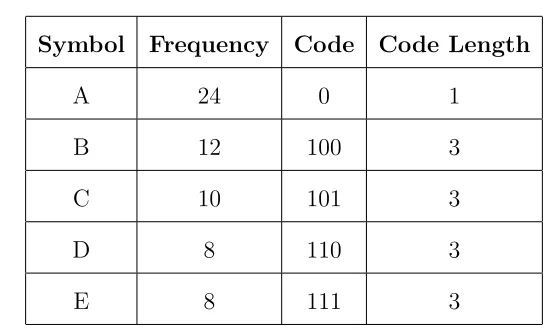
the most frequently used symbols with the fewest number of bits. The example data

(30)

2. THE JPEG STANDARD

Symbol

Frequency

Code

Code Length

A

24

0

1

B

12

100

3

C

10

101

3

D

8

110

3

E

8

111

3

Table 2.1: Example Huffman data

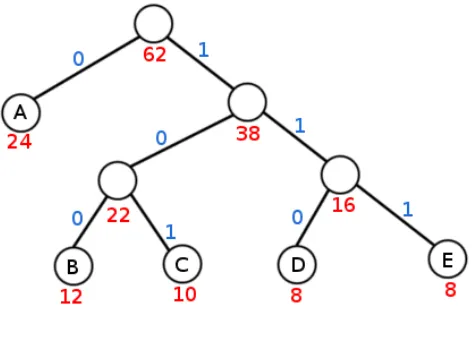
Based on the frequency of the symbol, a Huffman tree in Figure 2.5 is constructed.

Most frequently used symbols are near the top of the tree, and the less frequent are

at the bottom. A ”move” down the right branch of the tree represents a ”1”, and a

”move” down the left branch represents a ”0”

Eg: Symbol ’C’ is allocated the bits ”101”, while the most common symbol ’A’

(31)

Figure 2.5: Huffman Tree

Using this method the Huffman encoding creates a much smaller encoded bit

stream. Instead of building a Huffman tree each time, the JPEG image includes a

set of tables giving the bit to number translations. For decoding a set of 4 tables

are created. The tables are categorized by the colour channel, and frequency type:

Luminance DC, Luminance AC, Chrominance DC, and Chrominance AC. The two

Chrominance channels(Cb, Cr) share the AC and DC tables.

Huffman decoding is the reverse process of encoding. With the provided tables

and compressed bitstream the values can be perfectly reconstructed during JPEG

decompression. In many digital imaging devices such as digital cameras, the

Huff-man symbol calculations for that image are not calculated and a set of statistically

determined tables are used instead. Utilizing the default set of tables allows for faster

image compression, but can create a larger file size. In programs such as image

(32)

2. THE JPEG STANDARD

which result in a smaller file size, but more computation time.

2.4

Field Programmable Gate Array

A Field Programmable Gate Array (FPGA) is an integrated circuit designed to be

configurable after manufacture. Using design tools, an FPGA can be programmed to

generate the logic for virtually any hardware configuration. Unlike common CPU

ar-chitectures, since FPGAs are effectively programmable hardware it has the capability

to perform computations in parallel. This attribute greatly enhances speed over the

conventional methodology.

Many embedded systems, specifically those in mobile devices consist of a complete

system on chip (SOC). Additional hardware such as peripherals, are added either

in-ternally or exin-ternally. The use of FPGAs provide a flexible development platform

without the cost of a conventional SOC design. This work utilizes an FPGA which

models a SOC and its peripherals. The FPGA platform makes this work a suitable

platform and allows testing in real time.

2.4.1

Soft Processor

A soft processor is a microprocessor core that can be entirely implemented in using

logic synthesis. For FPGAs a soft processor design can mimic the Reduced Instruction

(33)

MicroB-laze processor [1] used in this work is a soft processor designed for Xilinx FPGAs. The

MicroBlaze is implemented entirely in the general-purpose memory and logic fabric

of Xilinx FPGAs.

2.5

Summary

This chapter discussed the methods outlined in the JPEG standard used to compress

and decompress JPEG image data, as well as gave an introduction to FPGAs in

em-bedded systems.

Due to the fact that the JPEG is highly complex, this research focuses on

opti-mizing individual components of the JPEG decompression process rather than the

entire algorithm. Utilizing the configurability of FPGAs a hardware architecture can

be designed to improve the software functions. This hybrid software-hardware

(34)

Chapter 3

Existing Work in Hardware JPEG

Algorithms

The JPEG ISO standard, described in Chapter 2, outlines the transforms that are

needed in order to compress and decompress JPEG images. It does not describe the

specific algorithms that need to be used to achieve the end product. There hasn’t

been much publicized work on the complete decompression of a JPEG, but there

has been some work in the individual algorithms used to decompress a JPEG image.

This chapter will begin with an introduction to libjpeg, the most commonly used

JPEG software library used in mobile systems, followed by the state of the art in the

(35)

3.1

libjpeg

There has been much work done in the software compression and decompression of

JPEG images. In 1986, shortly after the JPEG standard was created a group called

the Independent JPEG Group [7] (IJG) created the free open-source C library called

”libjpeg”. The library is multi-platform configurable, and follows all of the JPEG

ISO standards, and as such libjpeg is credited by the JPEG group to being a reliable

source to use in software applications. Due to its longevity and popularity libjpeg

has found itself as the primary JPEG encoder/decoder in mobile device applications,

as well as desktop applications. For this reason, this work uses the libjpeg ported for

the Xilinx MicroBlaze architecture as the starting point and control for testing.

Chapter 2 outlined the three primary steps used in compression and

decompres-sion, however these algorithms are not necessarily the most costly functions in the

digital domain. Therefore, the libjpeg library was profiled (a process of timing the

functions in software to find where the most significant bottlenecks reside) and

ex-amined.

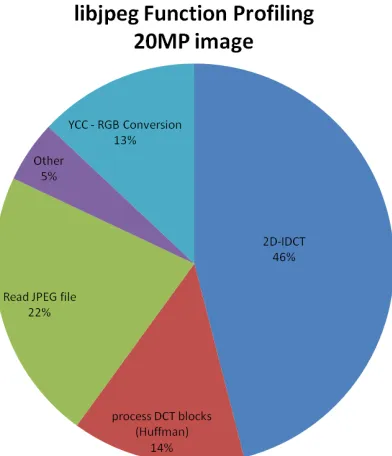
To acquire an approximate function benchmark a 20 MP image was profiled on

a desktop PC running a Pentium-4 3GHz processor, 32-bit GNU/Linux operating

system, and 2GB of RAM. The image was profiled 100 times and averaged to achieve

statistical accuracy. Figure 3.1 displays the profiling results.

(36)

3. EXISTING WORK IN HARDWARE JPEG ALGORITHMS

Figure 3.1: Desktop JPEG Profiling

colour space conversion, and the Huffman transform with 46%, 13%, and 14%

respec-tively. The focus of this work centres on optimizing the IDCT and colour conversion

to enhance the JPEG decompression time.

3.2

Inverse Discrete Cosine Transform (IDCT)

First introduced in Section 2.1 the IDCT is the Inverse of the Discrete Cosine

Trans-form which used to transTrans-form the output of raw dequantized Huffman coefficients.

For JPEG images the pixels are split into 8x8 blocks prior to applying the DCT. The

2D-IDCT consists of 16 1D-IDCTs over the 8 rows and 8 columns of the DCT blocks.

(37)

8x8 JPEG blocks.

f

(

x, y

) =

1

4

7

X

u=0 7

X

v=0

C

(

u

)

C

(

v

)

F

(

u, v

) cos(

(2

x

+ 1)

16

) cos(

(2

y

+ 1)

16

)

C

(

u

)

, C

(

v

) =

1

2

f or u, v

= 0

C

(

u

)

, C

(

v

) = 1

otherwise

(3.1)

The traditional IDCT in equation 3.1 shows the iterative multiplication process.

3.2.1

Distributed Arithmetic DCT

The Distributed Arithmetic DCT (DA-DCT) proposed by Pan [10] attempts to reduce

the complexity of the DCT by exploiting the binary representations of the 2D-DCT

matrix. The number of additions in this transform are reduced by a factor of 22.

On average 1 multiplication, 40 additions, and 16 binary shifts are required for each

DCT coefficient. Equations 3.2 - 3.6 illustrate how the transform is performed.

Y

=

A

X

=

A

1

A

2

· · ·

A

L

X

1

X

2

..

.

X

L

(3.2)

A

k

=

A

Mk

2

M

+

M−1

X

i=N

A

ik

2

i

where

A

ik

is 0 or 1

(38)

3. EXISTING WORK IN HARDWARE JPEG ALGORITHMS

Y

= 2

N

2

M−N

2

M−N−1

· · ·

2 1

|

{z

}

S

A

M

1

A

M2

· · ·

A

ML

A

M1 −1

A

M2 −1

· · ·

A

ML−1

..

.

..

.

· · ·

..

.

A

N1

A

N2

· · ·

A

NL

|

{z

}

B

X

1

X

2

..

.

X

L

|

{z

}

X

(3.4)

Let

C

=

B

X

=

C

M

C

M−1

· · ·

C

N

T

(3.5)

Y

=

S

C

(3.6)

The multiplicative complexity is significantly reduced at the cost of additions and

shift operations, however; the DA-DCT word length must be

9 in order to be

con-sidered indistinguishable from floating point, and it must be

16 to be numerically

equivalent.

3.2.2

Loeffler Algorithm

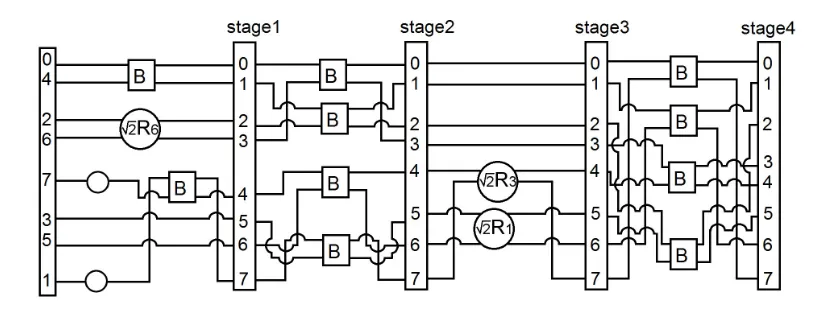
By far the most popular algorithm for the DCT is the The Loeffler Algorithm [8]

used in [12]. The Loeffler Algorithm takes a similar approach to the DCT as the

Fast Fourier Transform (FFT) takes to the Discrete Fourier Transform(DFT). The

Algorithm is mapped to a set of ”Butterfly” and ”Rotator” blocks. It reduces the

(39)

Figure 3.2: Loeffler Algorithm for 1D DCT

where

diagram

equation

O

0

I

1

O

1

O

0

=

I

0

+

I

1

O

1

=

I

0

I

1

O

0

I

1

O

1

O

0

=

I

0

k

cos(

16

) +

I

1

k

sin(

16

)

O

1

=

I

1

k

cos(

16

)

I

0

k

sin(

16

)

O

=

I

q

1 2

Table 3.1: Butterfly[B], Rotator[R], and constant Multiplication Blocks for Loeffler’s

Algorithm

Due to the reversibility of the DCT, the IDCT Loeffler algorithm is mapped out

(40)

3. EXISTING WORK IN HARDWARE JPEG ALGORITHMS

Figure 3.3: Loeffler Algorithm for 1D IDCT

Since the complexity of the algorithm significantly reduces the complexity of the

IDCT to fewer multiplications and additions, it makes this algorithm the most suitable

method for the JPEG process. Consequently, this is the current IDCT algorithm

implemented in the libjpeg library.

3.3

YCC to RGB Colour Space Conversion

The colour scheme of the JPEG standard is based on the Luminance and Chrominance

channels (YCC). The YCC colour scheme has minimal redundancy, unlike RGB,

which makes it suitable for JPEG images. ”Y” is the Luminance component and

”Cb” and ”Cr” are the blue-difference, and red-difference chroma components. Figure

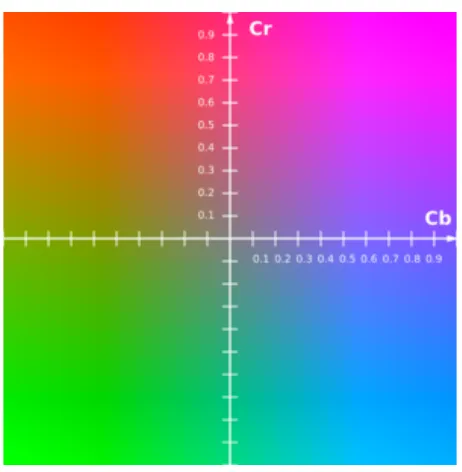
3.4 illustrates the chroma colour plane at a constant luma value.

Most displays use the Red-Green-Blue (RGB) colour scheme, so conversion

be-tween the two colour schemes is necessary. The colour space conversion is a simple

(41)

Figure 3.4: Cb-Cr colour plane at a constant luma value

has 3 colour channels, which have 4 multiplications and 4 additions. For example, a

20MP image has 60 million individual colour channels, which possibly has 80 million

multiplications, and 80 million additions.

R

=

Y

+ 1

.

402

(

Cr

128)

(3.7a)

B

=

Y

+ 1

.

772

(

Cb

128)

(3.7b)

(42)

3. EXISTING WORK IN HARDWARE JPEG ALGORITHMS

3.3.1

Look Up Table

The Look-up Table (LUT) method is one of the most efficient methods, especially

for embedded systems, for computing a large number of calculations for limited

mul-tiplications. Since the colour conversion utilizes constant multiplications, and the

chrominance colour channels are limited to 256 values many systems pre-compute

every possible value. These values are stored in a table to be referenced when needed.

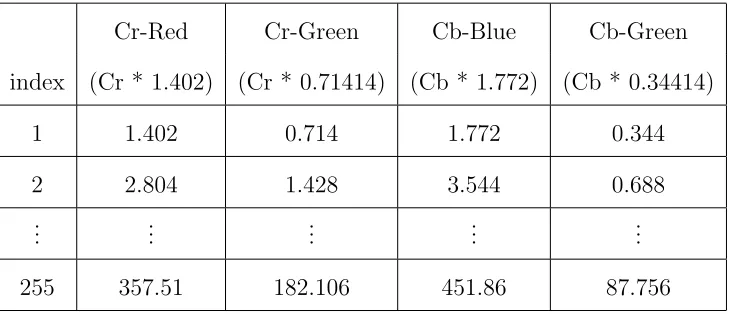
Typical YCbCr LUT implementation calculates the 4 base multiplications, Cr * 1.402,

Cr * 0.71414, Cb * 1.772 and Cb * 0.34414, and stores the values in tables. When

calculation is needed the Cr and Cb values are used as indices in these tables, and

additions are the only operation to calculate.

Cr-Red

Cr-Green

Cb-Blue

Cb-Green

index

(Cr * 1.402)

(Cr * 0.71414)

(Cb * 1.772)

(Cb * 0.34414)

1

1.402

0.714

1.772

0.344

2

2.804

1.428

3.544

0.688

..

.

..

.

..

.

..

.

..

.

255

357.51

182.106

451.86

87.756

Table 3.2: Colour Space Look Up Table example

libjpeg uses LUTs for the YCC to RGB conversion. The LUTs are computed once

and stored upon startup. This allows a table look up and addition to calculate the

colour conversion. The advantage of this method is speed, but the disadvantage is

(43)

Indexing and accessing large tables occupies time, but the amount of time isn’t

necessarily consistent. Data caching problems, such as cache misses can arise with

these large data sets. Most CPU caches use an n-way associative cache, which can

cause replacement issues with using many table lookups, found in JPEG colour

con-version. This can result in more cache misses and slower time, which is not ideal for

this work.

3.3.2

Shift and Add

To reduce on the cumbersome floating point multiplications needed for colour space

conversion Yang et al [14] proposed a Fast Algorithm for YCbCr to RGB. On Digital

Signal Processors (DSPs), floating point multiplications, multiplications by a

deci-mal number, are simplified with multiple shift and add operations. The more unique

the decimal value of the multiplicand, the more shifts and adds are required,

con-suming processor resources and time. Colour conversion algorithms contain unique

decimal values, and are typically carried out thousands to millions of times. Yang et

al proposed to reduce the complexity of the multiplications in colour conversion with

minimal quantification error while maintaining the image quality.

Their algorithm selects the most significant fixed-point shift and add operations

to take place of the floating point multiplication. As such, the processor has fewer

(44)

3. EXISTING WORK IN HARDWARE JPEG ALGORITHMS

R

=

Y

+

Cr

+

Cr

2 +

Cr

3 +

Cr

5

(3.8a)

B

=

Y

+

Cb

1 +

Cb

2 +

Cb

6

(3.8b)

G

=

Y

(

Cb

2+

Cb

4+

Cb

5)

(

Cr

1+

Cr

3+

Cr

4+

Cr

5) (3.8c)

The YCC to RGB conversion in Equation 3.8 proposed were tested with video

sequences comparing against floating point method. The maximum error observed

was 0.02% of all the images in the video. This method is ideal for YCC to RGB

approximation in JPEG applications, but the error in the colour may increase when

data propagates through the DCT.

3.3.3

Integer Based Transform

Pei et al [11] proposed a Reversible Integer Color Transform With Bit-Constraints to

optimize colour transforms. This method looks at redesigning the input coefficients

to floating point calculations completely. As a result the colour conversion transform

will be lossless, and can be implemented with only fixed-point operations.

The transformation process relies on the basis that most colour transformations

consist of 3x3 matrices. YCbCr, RGB, Karhunen-Loeve Average (KLA), and

In-tensity Hue Saturation (IHS) are all examples of 3x3 matrix colour schemes. The

process to generate the integer based transform involves normalizing the input

(45)

that approximate floating-point values. After the transformation is generated, using

the integer transform in forward and reverse applications becomes a simple set of

matrix operations.

Pei et al, tested this transform for RGB to YCbCr achieving 0.288% normalized

root mean square error. The advantage of this method eliminates all floating-point

operations, but the pre-computation and encoding of the colours this way is

neces-sary, and not applicable for JPEG applications.

3.4

Summary

This chapter presented several existing techniques that were developed to optimize

and accelerate the individual components of the JPEG process. As discussed some

of these techniques are more applicable to JPEG decompression than others. The

Loeffler algorithm, colour conversion LUTs, and the shift and add methods for YCC

to RGB conversion are the most advantageous procedures for JPEG implementation.

In the work presented herein, a novel hybrid architecture between software and

(46)

Chapter 4

Proposed Hybrid Architecture

This chapter illustrates the proposed hybrid software-hardware architecture used to

accelerate the time it takes to decompress a JPEG image with libjpeg. This hybrid

approach is applied to the IDCT and the colour conversion components of the JPEG

decompression scheme. This chapter describes the architecture and the reasoning in

each domain; hardware and software.

In the proposed design, the IDCT and colour conversion were implemented in

hardware to aid the software library in its most expensive operations. This novel

design incorporates the advantages of using parallelism in hardware along with a few

(47)

4.1

Development Board Specs

In order to emulate the conditions of a real world mobile device this work used an

em-bedded GNU/Linux variant on an FPGA. The FPGA development board used was a

Xilinx XUPV5-LX110T development board [3], which has the following specifications:

Xilinx Vertex

R

-5 XC5VLX110T FPGA

64-bit wide 256MB DDR2 small outline DIMM(SODIMM) module

On-board 32-bit ZBT synchronous SRAM and Intel P30 StrataFlash

10/100/1000 tri-speed Ethernet PHY

Programmable system clock generator

RS-232 port

JTAG programming interface

For this proposed architecture the development board is programmed with a 125

MHz MicroBlaze soft-core processor. The operating system is the GNU/Linux

vari-ant, Petalinux [2], which is targeted at FPGA-based embedded MicroBlaze and

Pow-erPC systems. Petalinux allows C /C++ application development and debugging

using its provided compilers. Included in the Petalinux kernel is a host of standard

(48)

4. PROPOSED HYBRID ARCHITECTURE

4.2

Hardware Software Communication

The desired goal of the hybrid architecture is to optimize software by moving the

expensive operations to dedicated hardware, but the communication link between

hardware and software is a vital component in and of itself. There are a few methods

available for interaction between the software and the hardware, each with their own

pros and cons.

With respect to memory in a memory managed Linux kernel, the privileges can

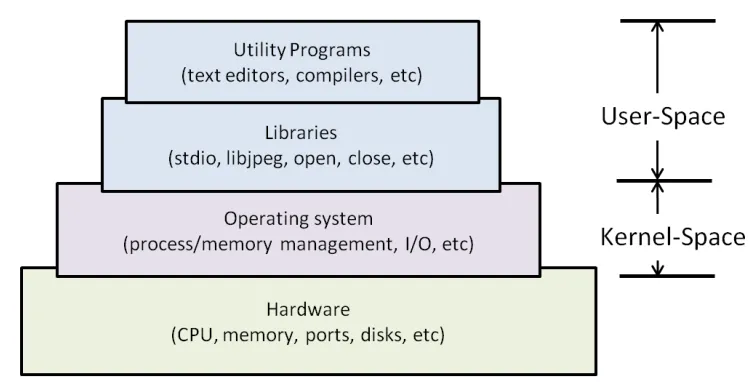
be envisioned as a set of layers as in Figure 4.1. The top most layer is the user-space.

This layer is what the typical user interacts with, here the compiled applications are

executed, and present the input and output. In this layer there exists a dynamic

amount of memory available, which are virtually indexed by the kernel. This

pro-tection prevents the user from corrupting any valuable memory locations. The next

layer down is the kernel. The kernel is the memory limited control centre. Device

drivers exist in the kernel which communicate between the user-space and kernel,

and between kernel and the physical memory or hardware. The bottom-most layer is

the hardware. The hardware is the physical aspect such as DDR2 RAM, hardware

registers, ports, and logic elements.

The kernel protection layer becomes an added bottleneck for the hardware

acceler-ation of software, especially for multiple transactions. As a result the careful

consid-eration of this communication is taken into account. There are two primary methods

of inter-system interaction; through DDR2 RAM, or through hardware mapped

(49)

Figure 4.1: Layers of a GNU/Linux based embedded system

4.2.1

Communication through DDR2 RAM

The first method for software-hardware communication can be done through the

system’s available DDR2 RAM. The user-space application requests access to a sector

of RAM from the memory driver, and receives a pointer that can be used to read and

write to the RAM.

On the hardware side, the logic must provide the control signals at the correct

timing to read and write to the RAM module. The control signals must be accurate

to transmit the data correctly. Unlike software, the hardware has full control over

how much data can be transmitted in one transaction. This advantage is through

what is called Burst reading and writing. For this transaction a multi-port memory

controller(MPMC) is available to the MicroBlaze processor. The MPMC supports

Burst reads and writes up to 32 32-bit words per transaction. This greatly speeds up

(50)

4. PROPOSED HYBRID ARCHITECTURE

Utilizing Burst reading and writing in a design is beneficial, however there is too

much data copying, which is too costly. Data is copied from software to RAM, from

RAM to hardware logic elements to operate on, and then back.

4.2.2

Communication through Hardware Registers

The alternative method for communication is directly through the hardwares memory

mapped registers, eliminating the need for additional RAM accesses. For software,

the data transfer is similar to the process with RAM. The software reads and writes

to a pointer allocated to it by the /dev/mem driver.

On the hardware side, the register which has been written to by software can

be directly operated on without needing any additional copying. Additionally, the

hardware has the ability to react immediately after a register has been written. This

provides an ”interrupt on change” type of interface eliminating the need for a ”start”

command.

Utilizing direct communication through registers is limited by the resources and

the property that these software accessible registers cannot be bidirectional, however

there is far less data copying than communication through RAM.

There are pros and cons for each method, but direct communication through

registers provides faster throughput. The register only process is simpler to use for

the hardware, faster, less copying of data, and it allows for concurrent processing

between software and hardware. Concurrent processing is achieved when the software

is writing to register ”n” while the hardware operates on registers ”n-1”, ”n-2”, ...,

(51)

4.3

Hardware Design

In this work the software layout must be considered when designing the hardware for

the 2D-IDCT and colour conversion. The most optimal hardware designs relieve as

much processing from the Software as possible. The input and output data structures

on the software level must remain the same, and any data manipulation must be done

on the hardware level.

4.3.1

IDCT

The 2D-IDCT hardware design relieves the software from three operations found in

libjpeg; dequantization, the 2D-IDCT, and range-limiting. Dequantization is the

multiplication of the IDCT input coefficients by the quantization matrix, scaling up

the coefficients back to the original post-DCT value. After dequantization, the

2D-IDCT is carried out. As mentioned in Chapter 2 and 3, the 2D-2D-IDCT transform is

separable into its rows and columns. In the JPEG architecture DCT blocks of 8x8

are used. Eight row 1D-IDCTs followed by eight column 1D-IDCTs are needed to

complete a full 2D-IDCT. The last step, range-limiting is a simple process to suppress

out of range corrupt values.

The separability of the rows and columns allows the hardware design of the

2D-IDCT to accept the input matrices, 2D-IDCT and quantization matrix, coefficients

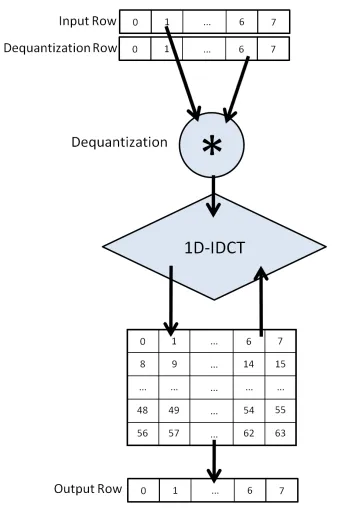
row-by-row. Upon receipt of an input and quantization row, the hardware IDCT module

immediately computes the simple multiplication for the dequantization. The

dequan-tized values are the input to the row 1D-IDCTs. The most efficient IDCT algorithm

(52)

4. PROPOSED HYBRID ARCHITECTURE

implementation. Since this algorithm not only uses fewer multiplications than the

standard IDCT algorithm, the multiplications are also in parallel which is ideal for

hardware implementation. Natively libjpeg uses integer based multiplication for its

IDCT. Floating point is possible, but is costly. To keep the accuracy found with

float-ing point the integer based IDCT shifts all of its multiplication factors up, performs

the calculation, and shifts the product back down. This process truncates its less

significant digits, but retains accuracy and speed in integer form. The 1D-IDCT

im-plementation in this hardware design utilizes the shift and multiply technique carried

through the entire 1D-IDCT.

Once a complete row has been written by software to the hardware registers, the

1D-IDCTs compute the row IDCTs. After all of the 8 rows have been written to

the hardware registers, the hardware module transposes the rows and computes the

8 column IDCTs for a full 2D-IDCT. The final step is range limiting the output.

Range limiting shifts and truncates the output to an 8 bit range of 0 to 255, and is

the data type libjpeg uses for these values. Data corruption in JPEG compression is

possible, so range limiting prevents out of range pixel values from wrapping around

(53)
(54)

4. PROPOSED HYBRID ARCHITECTURE

4.3.2

Colour Conversion

The colour conversion hardware design in this work relieves the software from three

operations found in libjpeg; YCC to RGB table pre-computation, YCC to RGB

conversion, and range limiting.

The majority of digital displays use the RGB colour scheme. As mentioned in

Chapter 3, libjpeg uses the YCC colour scheme to optimize storage capacity. The

con-version from YCC to RGB libjpeg utilizes a set of lookup tables for the Chrominance

components; Cr-red, Cb-blue, Cr-green, Cb-green, of each colour channel. LUTs are

the most efficient method, but the access speed can be inconsistent due to the

pos-sibility of cache misses. As the data set increases, the probability of a cache miss

increases as well. As a result, this is not a suitable method for this work.

The hardware design of the colour conversion in this work performs a straight YCC

to RGB calculation, eliminating the need for pre-computed table. This is possible

because the number of cycles hardware uses to perform a multiplication by the Cr-red,

Cb-blue, Cr-green, and Cb-green constants is fewer than the number of cycles used

in software to reference the look up tables. The multiplications by the constants in

Table 4.1 are performed using fixed point multiplication while retaining the accuracy

(55)

Colour Channel

Decimal Value

Binary Representation

Cr-red

1.402

10110011011101001

Cr-green

0.71414

01011011011010010

Cb-green

0.34414

00101100000011010

Cb-blue

1.772

11100010110100010

Table 4.1: YCC - RGB constants

The last optimization the hardware colour conversion makes is multi pixel

con-version. Since each colour channel, Y, Cb, Cr, R, G, and B, are 8 bits each and the

software accessible registers are 32 bits the hardware converts 4 pixels at once, filling

each register with 4 colour channels. The RGB output range-limited to 8 bit values

(56)

4. PROPOSED HYBRID ARCHITECTURE

Figure 4.3: YCC to RGB Hardware Design

4.4

Software Design

In this work, libjpeg was modified to utilize the hardware components. Since most

of the workload is being transferred into the hardware domain, all data copying was

carefully thought out and minimized. Minimizations are performed by maintaining

the layout of arrays, pointer manipulation and word size consistency.

4.4.1

IDCT

Libjpeg computes the IDCT using the Modified Loeffler algorithm. Pointers to the

(57)

matrix. The function dequantizes the coefficients by multiplication, performs the

IDCT, and range limits the output to 8 bits. These three processes were moved to

hardware.

For this architecture the software IDCT component’s functions are limited to

writ-ing rows to the hardware registers, and readwrit-ing rows from the registers. The software

writes in the quantization matrix and IDCT coefficients into the hardware registers

row by row. The same registers are used because the hardware can manipulate the

data faster than the software can change it. To maximize the data transfer from

software to hardware the rows are moved into the fewest amount of 32 bit registers as

possible. Casting the rows into integer pointers permits using 2 hardware register for

8 entries of the IDCT input, and 4 registers for 8 entries of the quantization matrix.

After computation in hardware, the software reads in the output registers row by row

from 2 hardware registers. Figure 4.4 illustrates the data compaction.

(58)

4. PROPOSED HYBRID ARCHITECTURE

4.4.2

Colour Conversion

Upon starting, libjpeg calculates all the possible chrominance combinations for the

conversion from YCC to RGB colour space. These calculations are stored in 4 tables:

Cr-red, Cb-blue, Cr-green, Cb-green. When called, the YCC-RGB colour conversion

function gets passed a 3 dimensional array which represents the deconstructed image

in the YCC colour channels. Figure 4.5 shows a visual representation of this image.

the x-y coordinates of the image represent the x-y coordinates of the source image,

where each layer represents the different colour channels of each pixel.

Figure 4.5: 3D image array

Each array of colour channels are passed in as 8 bit unsigned values. Natively,

32-bit CPU architectures function optimally with 32-32-bit words, additionally the software

accessible hardware registers are 32 bits. As a result in this architecture for the

colour conversion, a technique is used to cast a 32 bit integer pointer to the array

of 8 bit bytes. This allows the software to access 4 values of Y, Cb, or Cr with one

(59)

Figure 4.6: Colour Conversion array-register data compaction

Similarly, after conversion the RGB registers are read in the same manner. This

data compaction utilizes 3 registers for input, and 3 registers for output to transmit

24 colour channels. Using this technique the software loops through all the pixels

in the image, in 4 pixel increments, writing YCC and reading RGB without any

need for control registers. No control registers are required, due to the fact that

this conversion is very simple, and the hardware computes the conversion on 4 pixels

before the software can read it.

4.5

Summary

This chapter presents the techniques, and structure of the proposed software-hardware

(60)

li-4. PROPOSED HYBRID ARCHITECTURE

brary is accelerated with hardware components for the 2D-IDCT and YCC to RGB

colour conversion. Huffman decoding, the next logical step in JPEG decompression

acceleration, is outlined in Appendix E.

In the following chapter, this work is timed, and tested. The results show how fast

the decompression time has increased as well as the accuracy of the decompression

(61)

Results

This chapter presents the testing setup and procedures used to test the proposed

hardware accelerated components of libjpeg, as well as the timing analysis. The

con-clusions that may be derived from the results are described, and then compared to

the widely used software library, libjpeg.

5.1

Testing Setup and Procedure

Testing for this work was carried out on the Xilinx XUPV5-LX110T FPGA

devel-opment board. The board was loaded with the GNU/Linux variant, Petalinux. The

(62)

compo-5. RESULTS

nents. The hardware designed for the system includes the IDCT and colour conversion

modules. These modules are linked into the MicroBlaze design, and accessed through

input and output registers.

Petalinux includes the libjpeg source files which can be cross-compiled to run on

the target. This library is the base in which this work is built on. The Petalinux

kernel was configured for the Xilinx target hardware, MicroBlaze processor, and built

for a Memory Management Unit (MMU) system. Once the Hardware is downloaded

to the board, it is loaded with the Petalinux image. User built binaries can be loaded

into the image, but for the purposes of this work the binaries and test JPEG images

were executed through the network due to their size. Utilizing the network permits

for faster development, testing, and eliminates the need to build the large test JPEG

images from being built into the Petalinux flash image.

For this work, the necessary libjpeg files were modified and cross-compiled into a

static library. Shared library compilation is possible, however it requires the

Petal-inux to be rebuilt and downloaded to the target which is not a productive solution.

Upon generation of the static JPEG libray the main program files are cross-compiled

with the library into a binary suitable for the target.

On the FPGA target, the binary is run by providing the path to JPEG image.

Timing of the images is a difficult task. The work done in the areas of timing and

profiling software applications on a soft processor, is underdeveloped and not readily

(63)

The time function provides the real, user, and system time execution of a binary with

a resolution of 10 milliseconds. This work uses the user time which is presented in 5.2.

To verify the decompression of the images were accurate, a subjective test and

objective test were performed. After decompression, the raw RGB data was

writ-ten to the system’s frame-buffer, which is displayed on an attached monitor. Visual,

subjective inspection for artifacts, and similarity to the original was carried out on

the image. Objective verification was implemented by comparing the decompressed

and converted raw RGB values output from this work compared to the software only

output. The verification results are presented in 5.3.

Not all images are the same, but will posses the same decompression scheme. For

this work, 3 separate images with varying image metrics at 3 different pixel densities,

5 MP, 10 MP, and 20 MP were tested. To maintain statistical accuracy each image

was tested 100 times and averaged using the scripts in Appendix B and a

spread-sheet program. The three images, found in Appendix A, hereby referred to as the

bookstore, dog, and beach

images were the test images used in this work. The images

began at an approximate 20MP, and were scaled down to 10MP, and 5MP to observe

the versatility of this work. Each image was saved with no colour sub-sampling, and

no Huffman optimizations to emulate the ideal settings observed in digital cameras.

(64)

5. RESULTS

Image

Width(px)

Height(px)

Size(MP)

Size(MB)

2686

1862

5.0

1.5

bookstore

3799

2634

10.0

2.6

5400

3744

20.2

4.1

2560

1920

4.9

1.8

dog

3653

2740

10.01

3

5164

3873

20.0

4.8

2503

1998

5.0

1.8

beach

3540

2826

10.0

3.1

5040

4024

20.2

4.9

Table 5.1: Test Image Dimensions

5.2

Timing Results

After each image was tested and timed, it was compared to the software only

bench-mark. Comparing to the benchmark, the timing improvement (∆t), and percentage

of the benchmark was calculated (% SW) as shown in Tables 5.2, 5.3, and 5.4.

% of Software =

Hardware time(s)

Figure

Figure 2.1: JPEG Compression Process [13]
Figure 2.4: Zig Zag order of a DCT block [13]
Table 2.1: Example Huffman data
Figure 2.5: Huffman Tree
+7

References

Related documents

used by the JPEG inverse transform. Both are block transforms but use different block.. sizes; JPEG uses 8x8 blocks and JPEG-XR uses 4x4 blocks. The IPCT can exploit

Different type of transform techniques such as Discrete Hartley transform (DHT), Discrete Cosine Transform (DCT), Fast Fourier Transform (FFT) and their inverse are

Still the image compression technique based on 2-D discrete wavelet transform (DWT) has recently gained superiority above traditional JPEG based upon discrete

In JPEG the Quantised DCT coefficients are entropy coded using difference and run-length coding combined with Huffman coding. The DC component is coded separately from the AC

Here we are using JPEG compression which is lossy image compression technique that uses DCT (Discrete Cosine Transformation).In the application of multimedia image

Design and Synthesis of Digital Watermarking Chip Using Inverse Modified Discrete Cosine Transform (IMDCT) in.. Hardware Description Language

Discrete Cosine transform, Discrete wavelet transform using Haar wavelet and EZW wavelet, Fractal image compression using quad-tree partitioning was performed on the

Then the discrete cosine transform (DCT) is applied to nonoverlapping 8 x 8 pixel blocks in each component im­ age. Derived DCT coefficients are subjected to quantiza­ tion,