Protection of Multimedia Content in Cloud
Computing
Priyanka V. Padwal 1, Nilesh P. Sable 2
Research Scholar, Dept. of Computer Engineering, ICOER, Pune, India 1
Asst. Professor, Dept. of Computer Engineering, ICOER, Pune, India 2
ABSTRACT: Cloud computing is getting more popular in the field of computer science because of its reliability in storing and assessing data remotely. Cloud computing is an emerging computing paradigm in which resources of the computing infrastructure are provided as services of the internet. Cloud computing allows consumers and businesses to use applications without installation and access their personal files at any computer with internet access. It allows user to store large amount of data in cloud storage and use as and when required, from any part of the world, via any terminal equipment. Since cloud computing is rest on internet, security issues like privacy, data security, confidentiality, and authentication is encountered. we propose a new design for large-scale multimedia content protection systems. Our design leverages cloud infrastructures to provide cost efficiency, rapid deployment, scalability, and elasticity to accommodate varying workloads. The proposed system can be used to protect different multimedia content types, including 2-D videos, 3-D videos and images. The system can be deployed on private and/or public clouds. Our system has two novel components: (i) method to create signatures of videos and images, and (ii) distributed matching engine for multimedia objects. The signature method creates robust and representative signatures of videos and images that capture the depth signals in these videos and it is computationally efficient to compute and compare as well as it requires small storage. We implemented the proposed system and deployed it on two clouds: Amazon cloud and our private cloud.
KEYWORDS: detection video; depth signatures; 3-D video; video fingerprinting; cloud applications.
I. INTRODUCTION
because system have short response time to report illegal copies of multimedia content, especially for timely multimedia ,system gives a matching index (%) for copied video and images. Digital signature are generated by using the AES algorithm. Signature is based on the multimedia objects first 8 bit as well as last 8 bit or combination of both. Distributing copyrighted multimedia objects by uploading them to online hosting sites such as YouTube can result in significant loss of revenues for content creators. Systems needed to find illegal copies of multimedia objects are complex and large scale. In this paper, we presented a new design for multimedia content protection systems using signature creation. The system also showed that it outperforms the closest system in the literature in terms of accuracy and computational efficiency.
II.RELATED WORK
Number of studies showing the need of security in cloud computing especially for the multimedia content storage and the various proposed techniques to enhance security.
Rongxing et al [1] gives a new security and provenance proposal for data forensics and post examination in cloud computing. According to them their proposed system can provide the privacy and security on secret documents/files that are piled up in the cloud. It also provides secure authentication mechanism to control unauthorized user access, and provides track mechanism to resolves disputes of data. Their proposed secure provenance scheme is working on the bilinear pairing method.
La„Quata Sumter et al. [2] says: The rise in the scope of -cloud computing has brought fear about the Internet Security and the threat of security in cloud computing is continuously increasing .To assure users that there information is secure, safe not accessible to unauthorized people, they have proposed the design of a system that will capture the movement and processing of the information kept on the cloud.
Wenchao et al. [4] explores the security properties of secure data sharing among the applications hosted on clouds. They have proposed a new security platform for cloud computing, which is named as Declarative Secure Distributed Systems (DS2).
Soren et al [5] mentioned that benefits of clouds are shadowed with the security, safety and privacy .In this paper an approach has been presented for analyzing security at client side and server side. Amazon’s Elastic Compute Cloud (EC2) has been chosen for this assessment. They have implemented the security analysis model & weigh up it for realistic environments. Security assessment has been implemented in Python and weigh up was calculated on Amazon EC2.
Flavi and Roberto [6] stated that clouds are being targeted increasingly day by day. In this paper integrity protection problem in the clouds, sketches a novel Architecture and Transparent Cloud Protection System (TCPS) for improved security of cloud services has been discussed.
Wenwu Zhu et.al [8] presented the fundamental concept and a framework of multimedia cloud computing. They addressed multimedia cloud computing from multimedia-aware cloud and cloud-aware multimedia perspectives.
Tamleek Ali [10] proposed a framework for the use of cloud computing for secure dissemination of protected multimedia content as well as documents and rich media. They have leveraged the UCON model for enforcing fine-grained continuous usage control constraints on objects residing in the cloud.
Chun-Ting Huang [12] conduct a depth survey on recent multimedia storage security research activities in association with cloud computing. After an overview of the cloud storage system and its security problem, they focus on four hot research topics. They are data integrity, data confidentiality, access control, and data manipulation in the encrypted domain.
Neha Jain [13] presented a data security system in cloud computing using DES algorithm. N. Saravanan et.al [14] presented a data security system .
III.MATHEMATICAL MODEL
Let System is Z for describe Protection of Multimedia content with process illuminant estimation, The system have following elements in it.
Let Z is the Whole System Consist of:
Z = { S; E; X; Y; Fmain; DD; NDD; SWr; HWrg } Where,
E =the end of set where user can achieve result from hosting sites like YouTube. X = {I1; I2}
Where, X= the set having two inputs I1 and I2, I1 = used for uploading the video by Content owner , I2=Search Query
Y = {O1; O2}
Where Y is the set having two outputs O1 and O2 O1=search results
O2=Signature Violation Verification Fmain= Main Function
DD=Deterministic Data NDD=Non Deterministic Data
1. Compute 8 bit for Left and Right visual parts of image:
For visual parts of image I is computed at a specific pixel in the image which has location of .The result of this step is two sets of descriptors; one for left image and one for the right image.
2. Combine the left and right visual parts of images ( ) 3. Matching visual parts of images:
4. Compute image disparity:
5. Signature Generation:
The signature of uploaded image is
IV.SYSTEMDESIGNANDDETAILS
3.1 Problem Definition
Protecting Various Multimedia Contents such as video and image by signature creation and Multimedia copy detection using matching index.
3.2 Proposed Architecture and work
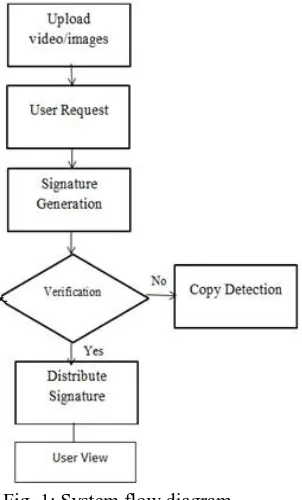
By using composite signature creation method the accuracy and copy detection rate for image/video is improved Below figure 1 introduce the proposed architecture for overcome the limitations of previous methods. A content protection system has three main parties: (i) content owners (e.g., Disney), (ii) hosting sites (e.g., YouTube), and (iii) service providers (e.g., Audible Magic). The first party is interested in protecting the copyright of some of its multimedia objects, by finding whether these objects or parts of them are posted on hosting sites (the second party). The third party is the entity that offers the copy finding service to content owners by checking hosting sites. In some cases the hosting sites offer the copy finding service to content owners. An example of this case is YouTube, which offers content protection services. And in other, less common, cases the content owners develop and operate their own protection systems. The proposed system has the following main components, as shown in Fig. 1:
1. Content Owner: View the video files and Images Uploading on online hosting sites such as YouTube.
2. Content Service Provider: CSP Create Signature from object downloaded from online sites which are called query signatures then uploads this signature to a common storage.
4. User: Downloads multimedia objects from various online hosting sites using the digital signature.
The Fig.1 shows data flow diagram of proposed system functions as: Content owners specify multimedia objects that they are interested in protecting. Then, the system creates signatures of these multimedia objects (called reference objects) and inserts (registers) them on online hosting sites such as YouTube. This can be one time process, or a continuous process where new objects are periodically added on hosting sites. The user (e.g., once a day) downloads recent objects (called query objects) from online hosting sites. It can modified downloaded video and again uploading same video on online hosting site then our system can compare reference signature and original signature for finding matching index to detect that copied video by using composite signature and achieve high accuracy in terms of detecting copied multimedia contents. Creation of composite signature for protecting Multimedia content i.e. videos and images. The signatures for a query object are created once the Crawl component finishes downloading that object and the object itself is removed.
Fig. 1: System flow diagram
Following four goals as the most important ones in multimedia content protection systems.
A. Computational Efficiency: The system should have short response time to report copies, especially for timely multimedia objects such as sports videos. In addition, since many multimedia objects are continually added to online hosting sites, which need to be checked against reference objects, the content protection system should be able to process many objects over a short period of time.
B. Scalability and Reliability: The system should scale (up and down) to different number of multimedia objects. Scaling up means adding more objects because of monitoring more online hosting sites, having more content owners using the system, and/or the occurrence of special events such as sports tournaments and release of new
movies. Conversely, it is also possible that the set of objects handled by the system shrinks, because, for example, some content owners may terminate their contracts for the protection service. Our approach to handle scalability is to design a distributed system that can utilize varying amounts of computing resources. With large-scale distributed systems.
C. Cost Efficiency: The system should minimize the cost of the needed computing infrastructure. Our approach to achieve this goal is to design our system to effectively utilize cloud computing infrastructures (public and/or private).
V.RESULT AND DISCUSSION
In this section V we introduce the input database of Images, input video files and practical results
.
Fig.2 Matching Index of Images.
Results of Practical Work
Practical work done for this is as shown in given below.
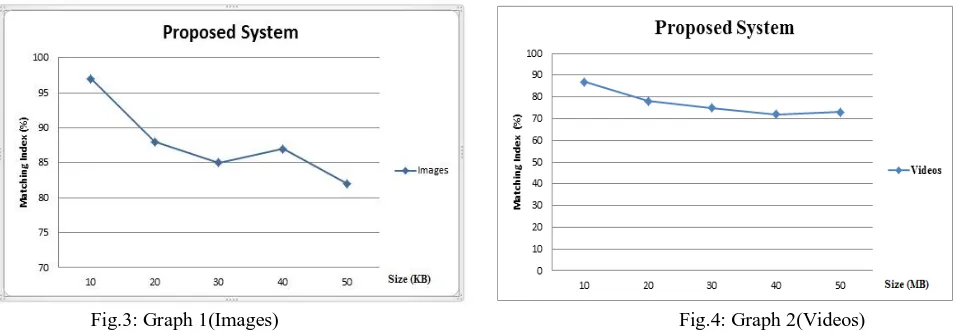
Fig.3: Graph 1(Images) Fig.4: Graph 2(Videos)
Fig 3 and 4 shows graphical representation of copy detection detection for images as well as video & also shows that composite signature creation method work for both images and videos. Composite signature creation method is used for finding matching index for video and images uploaded on online hosting sites. Graph 1 repesents images (kb) which is uploaded on online hosting sites and our proposed system gives matching index (%) of uploaded image if matching index is 100% then it is automatically deleted because it is totally copied image. Graph 2 repesents videos (mb) which is uploaded on online hosting sites and our proposed system gives matching index (%) of uploaded video if matching index is 100% then it is automatically deleted because it is totally copied video.
VI.CONCLUSION AND FUTURE WORK
precision it is secure to different multimedia content. We take the help of DES algorithm for creating the signature. Our Proposed system showed results that: there is necessary for designing secure signatures for 3-D videos since the current system used by the leading company in the industry fails to detect most modified copies, and our novel 3-D signature approach can cover this gap, because it is secure to different 2-D and 3-D video transformations.
In future we will provide protection of Multimedia content using Hadoop system. In addition, quickely identifying short video segments using composite signature schemes.
ACKNOWLEGMENT
We are glad to express our Sentiments of gratitude to all who rendered their valuable guidance to us. We would like to express our appreciation and thanks to Dr. Sachin Admane, Principal, Imperial College of Engineering & Research (ICOER). We are also thankful to our family and friends for their encouragement and support. We thank the anonymous reviewers for their comments.
REFERENCES
[1] Rongxing et al, ―Secure Provenance: The Essential Bread and Butter of Data Forensics in Cloud Computingǁ, ASIACCS„10, Beijing, China.. [2] R. La„Quata Sumter, ―Cloud Computing: Security Risk Classificationǁ, ACMSE 2010, Oxford, USA
[3] Lee, D. Patterson, A. Rabkin, I. Stoica, and M. Zaharia (2009, Feb. 10); “Above the clouds: A Berkeley view of cloud computing” EECS Dept., Univ. California, Berkeley, No. UCB/EECS-2009-28 .
[4] Wenchaoet al, ―Towards a Data-centric View of Cloud Securityǁ, CloudDB 2010, Toronto, Canada
[5] Soren Bleikertz et al, ―Security Audits of Multi-tier Virtual Infrastructures in Public Infrastructure Cloudsǁ, CCSW 2010, Chicago, USA. [6] Flavio Lombardi& Roberto Di Pietro, ―Transparent Security for Cloudǁ, SAC„10 March 22-26, 2010, Sierre, Switzerland.
[7] Sara Qaisar; “Cloud Computing :Network/Security Threats and Counter Measures, Interdisciplinary Journal of Contemporary Research In Business, Jan 2012,Vol 3, No 9.
[8] Wenwu Zhu, Chong Luo, Jianfeng Wang, and Shipeng Li; “Multimedia Cloud Computing” Digital Object Identifier 10.1109/MSP.2011.940269 Date of publication: 19 April 2011.
[9] Jiann-Liang Chen, Szu-Lin Wu, Yanuarius Teofilus Larosa, Pei-Jia Yang, and Yang-Fang Li; “IMS Cloud Computing Architecture for High- Quality Multimedia Applications” 978-1-4577-9538-2/11/$26.00 ©2011 IEEE.
[10] Tamleek Ali , Mohammad Nauman , Fazl-e-Hadi ,and Fahad bin Muhaya; “On Usage Control of Multimedia Content in and through Cloud Computing Paradigm”.
[11] Zhang Mian, Zhang Nong; “The Study of Multimedia Data Model Technology Based on Cloud Computing”; 2010 2nd International Conference on Signal Processing Systems (ICSPS).
[12] Chun-Ting Huang, Zhongyuan Qin, C.-C. Jay Kuo; “Multimedia Storage Security in Cloud Computing: An Overview” 978-1-4577-1434- 4/11/$26.00@2011IEEE.
[13] Neha Jain and Gurpreet Kaur; “Implementing DES Algorithm in Cloud for Data Security” VSRD-IJCSIT, Vol. 2 (4), 2012, 316-321. [14] N. Saravanan, A. Mahendiran, N. Venkata Subramanian;An Implementation of RSA Algorithm in Google Cloud using Cloud SQL” Research
Journal of Applied Sciences, Engineering and Technology 4(19): 3574-3579, October 01, 2012.
[15] M. Sudha, Dr.Bandaru Rama Krishna Rao; “A Comprehensive Approach to Ensure Secure Data Communication in Cloud Environment” International Journal of Computer Applications (0975 – 8887) Volume 12– No.8, December 2012.