ISSN(Online): 2320-9801
ISSN (Print): 2320-9798
I
nternational
J
ournal of
I
nnovative
R
esearch in
C
omputer
and
C
ommunication
E
ngineering
(An ISO 3297: 2007 Certified Organization)
Vol. 3, Issue 8, August 2015
Comparative Analysis on Data Replication
System in Clouds Based On Data Mining
Techniques
M.Amutha1, R.Sugumar2
Department of CSE, PRIST University, Vallam, Thanjavur, India1
Department of CSE, Velammal Institute of Technology, Panchetti, Chennai, India2
ABSTRACT: Cloud computing is a large-scale parallel and distributed computing system. It consists of a collection of inter-connected and virtualized computing resources that are managed to be one or more unified computing resources. The aim of the survey is an automated analysis or interpretation of ongoing events in data replication system in cloud. Totally, 40 papers are collected from standard publication IEEE. Each paper has various methods of data replication. The papers are categorized into four groups based on the replication process. According to the categorization based on replication process, the four groups are Survey on data replication systems, Different types of replication systems, Data placement on data replication systems and Fault tolerance on data replication systems. The performance of these published works is analyzed efficiently with the evaluation metrics such as Throughput, Execution time, Storage utilization, Replica number, Network usage, Replication cost, Recovery time and Hit ratio. Higher throughput value indicates that the proposed approach achieves better result. Thus our paper helps to develop novel technologies over the data replication system.
KEYWORDS: Throughput, Execution time, Storage utilization, Replica number, Network usage, Replication cost, Recovery time and Hit ratio.
I.INTRODUCTION
Cloud computing is an emerging practice that offers more flexibility in infrastructure and reduces cost than our traditional computing models. Cloud computing software frameworks manage cloud resources and provide scalable and fault tolerant computing utilities with globally uniform and hardware-transparent user interfaces [9]. The emergence of cloud computing technologies offers a new way to develop scientific workflow systems. Since late 2007 the concept of cloud computing was proposed and it has been utilized in many areas with some success. Cloud computing is deemed as the next generation of IT platforms that can deliver computing as a kind of utility [2]. Cloud computing is associated with the new paradigm for provisioning the computing infrastructure [20]. Cloud computing is the delivery of computing as a service rather than a product, whereby shared resources, software, and information are provided to computers and other devices as a utility (like the electricity grid) over a network (typically the Internet) [8]. Cloud Computing is a term used to describe both a platform and type of application. As a platform it supplies, configures and reconfigures servers, while the servers can be physical machines or virtual machines. On the other hand, Cloud Computing describes applications that are extended to be accessible through the internet and for this purpose large data centers and powerful servers are used to host the web applications and web services [7]. The main goal is to provide users with more flexible services in a transparent manner, cheaper, scalable, highly available and powerful computing resources [13].
ISSN(Online): 2320-9801
ISSN (Print): 2320-9798
I
nternational
J
ournal of
I
nnovative
R
esearch in
C
omputer
and
C
ommunication
E
ngineering
(An ISO 3297: 2007 Certified Organization)
Vol. 3, Issue 8, August 2015
internet data storage, scalability and computation [15]. Cloud computing is a large-scale parallel and distributed computing system. It consists of a collection of inter-connected and virtualized computing resources that are managed to be one or more unified computing resources. Further, the provided abstract, virtual resources, such as networks, servers, storage, applications and data, can be delivered as a service rather than a product. Services are delivered on demand to the end-users over high-speed Internet as three types of computing architecture, namely Software as a Service (SAAS), Platforms as a Service (PAAS) and Infrastructure as a service (IAAS). The main goal is to provide users with more flexible services in a transparent manner, cheaper, scalable, highly available and powerful computing resources [14].
It mainly focuses on analyzing massive data. In order to analyze the dynamic, real-time and online data, the whole data cloud system must be improved in order to enhance the access speed and reliability and safety and system’s load balance. Therefore, how to choose the replication strategy for data cloud is particular important. Creating replica is to reduce access latency and bandwidth consumption, in other words, it is to reduce the average job execution time and improve the usage of cloud resources [11]. File replication should provide fidelity of file consistency and unnecessary creation of replicas in various nodes, file replication should work in dynamic form that is it also allows peers to update, delete and provide consistent file in minimum partial tolerance [4]. It is well known that replication protocols perform differently depending on the workload characteristics. For instance, a read intensive partition may provide a higher throughput with a primary-backup scheme [12]. In Cloud computing, replication is used for reducing user waiting time, increasing data availability and minimizing cloud system bandwidth consumption by offering the user multiple replicas of a specific service on different nodes [16]. The replication mechanism is divided into three important subjects: which file should be replicated, when to perform replication, and where the new replicas should be placed. Usually, replication from the server to the client is triggered when the popularity of a file passes a threshold and the client site is chosen either randomly or by selecting the least loaded site [1] [5].
Data grids deal with a huge amount of data regularly. It is a fundamental challenge to ensure efficient accesses to such widely distributed data sets. Creating replicas to a suitable site by data replication strategy can increase the system performance. It shortens the data access time and reduces bandwidth consumption [8]. Replicating data chunks at multiple clouds situated at geographically different locations would also have an additional decrease in response time [19]. However, as data sources and data processors integrated in a service application may be distributed geographically and connected with long-latency networks, data integration and sharing often lead to time and bandwidth penalties, thereby affecting the performance of the service application. This issue becomes more serious in large-scale, data intensive applications where large amounts of data have to be transported frequently between data sources and consumers. Data replication offers a practical solution to this issue by maintaining replicated copies of data in sites near to data consumers so as to reduce the time and bandwidth consumption of data transportation [3]. In addition, data replication can also improve the service performance and availability of data sources. Multiple replicated sites reduce the overhead imposed on a single point, and if one replicated site is not available, users can have access to the copies on other nodes [10]. The network environment is changeable, that makes the same replica sites are not always the best choices to download data to reduce the transmission time [17].
II.OVERVIEW OF DATA REPLICATION SYSTEM
ISSN(Online): 2320-9801
ISSN (Print): 2320-9798
I
nternational
J
ournal of
I
nnovative
R
esearch in
C
omputer
and
C
ommunication
E
ngineering
(An ISO 3297: 2007 Certified Organization)
Vol. 3, Issue 8, August 2015
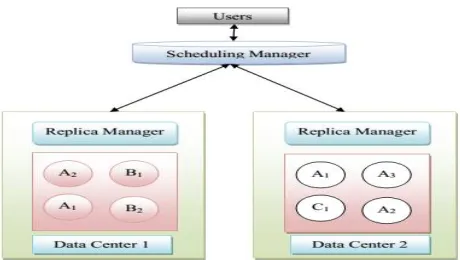
Fig. 1: Architecture of data replication system
Fig. 1 shows the architecture of the data replication system. The system architecture signifies the customers, scheduling manager, replica manager and data centers. Each and every main data centers are interlinked with each other and every single set of sub data centers are interlinked together with each other to be able to transfer your data from just one data center to one more. It isn't sure that every the data within the data center D1 could well be in your data center D2 and it isn't sure that the entire data within the sub data center SD1 of the main data center D1 is present in the sub data center SD2 of the main data center D1. In the event the user who uses your data center SD1 uses a data that's not within SD1 but that's present within SD2, your data center SD1 request a replica of the data to be able to SD2 as well as to its principal data center. Another event is that if a data within the data center SD1 is needed by more quantity of users and when a fresh user comes to use the identical data, user should wait to make use of that data. The task due to the end user is initial send for the scheduling manager. The scheduling manager then gives the path for the particular data center to gain access to the file. The path selection with the scheduling manager is based on the quantity of users’ runs on the data center to stop congestion.
III.RELATED WORKS
What we have set out through these columns is to effectively furnish a general assessment of data replication system with a helping hand from the several investigational contributions in the literary world. On the whole we have selected as many as 40 study reports from several prominent publications like IEEE. These reports, in turn, are classified into 4 groups based on the replication process: Survey on data replication systems, Different types of replication systems, Data placement on data replication systems and Fault tolerance on data replication systems.
A. SURVEY ON DATA REPLICATION SYSTEM
Tehmina Amjad et al. [21] have discussed different issues involved in data replication were identified and different replication techniques were studied to find out which attributes are addressed in a given technique and which were ignored. A tabular representation of all those parameters is presented to facilitate the future comparison of dynamic replication techniques. The paper also includes some discussion about future work in this direction by identifying some open research problems.
Mohammed A. AlZain [38] has surveyed the recent research related to single and multi-cloud security and addresses possible solutions. It was found that the research into the use of multi-cloud providers to maintain security has received less attention from the research community than has the use of single clouds. This work had aimed to promote the use of multi-clouds due to its ability to reduce security risks that affect the cloud computing user.
ISSN(Online): 2320-9801
ISSN (Print): 2320-9798
I
nternational
J
ournal of
I
nnovative
R
esearch in
C
omputer
and
C
ommunication
E
ngineering
(An ISO 3297: 2007 Certified Organization)
Vol. 3, Issue 8, August 2015
Optimistic replication techniques are different from traditional “pessimistic” ones. Instead of synchronous replica coordination, an optimistic algorithm propagates changes in the background, discovers conflicts after they happen and reaches agreement on the final contents incrementally. Yasushi Saito and Marc Shapiro [47] have explored the solution space for optimistic replication algorithms. They have identified the key challenges facing optimistic replication systems — ordering operations, detecting and resolving conflicts, propagating changes efficiently, and bounding replica divergence — and have provided a comprehensive survey of techniques developed for addressing these challenges. Cloud computing is a popular topic for blogging and white papers and has been featured in the title of workshops, conferences, and even magazines. Michael Armbrust et al. [59] goal in this article was to reduce that confusion by clarifying terms, providing simple figures to quantify comparisons between of cloud and conventional computing, and identifying the top technical and non-technical obstacles and opportunities of cloud computing.
B. DATA PLACEMENT TECHNIQUES FOR DATA REPLICATION
Dong Yuan et al. [24] have proposed a matrix based k-means clustering strategy for data placement in scientific cloud workflows. The strategy contains two algorithms that grouped the existing datasets in k data centers during the workflow build-time stage, and dynamically clusters newly generated datasets to the most appropriate data centers based on dependencies during the runtime stage. Simulations showed that the proposed algorithm can effectively reduce data movement during the workflow's execution.
Takahiro Hara and Sanjay K. Madria [28] have solved the lower data accessibility problem by replicating data items on mobile hosts. They have proposed three replica allocation methods assuming that each data item was not updated. In those three methods, they have taken into account the access frequency from mobile hosts to each data item and the status of the network connection. Then, they have extended the proposed methods by considering a periodic updates and integrating user profiles consisting of mobile users’ schedules, access behavior, and read/write patterns. They have also showed the results of simulation experiments regarding the performance evaluation of their proposed methods. Ming Lei et al. [33] have presented two new metrics to measure the system data availability. They have modeled the system availability problem assuming limited replica storage and transfer this to a classic optimal problem. They have presented four strategies for limited replica storage that maximize the data availability by minimizing the data missed rate (MinDmr), based on a file weight and prediction function. Their simulation process on the OptorSim have showed that proposed MinDmr algorithm have achieved better performance overall than others in term of data availability. Results have indicated the performance of MinDmr was always better than others with varying prediction functions, job schedulers and file access patterns, as far as the data missing rate was concerned.
Peter Gilbert et al. [49] have showed how a DTN-like messaging system can be readily built as a simple application on top of a peer-to-peer replication platform. In order to reduce delivery delays while retaining the desirable replication guarantees, they have then extended the replication substrate to permit pluggable DTN routing protocols. They have described the implementation of four representative DTN schemes as replication policies and evaluate these extensions with emulations driven by traces of e-mail messaging and vehicular mobility. They have concluded that DTNs and replication systems can benefit substantially from a cross fertilization of ideas.
Trust and security have prevented businesses from fully accepting cloud platforms. To protect clouds, providers must first secure virtualized datacenter resources, uphold user privacy, and preserve data integrity. Kai Hwang and Deyi Li [54] have suggested using a trust-overlay network over multiple data centers to implement a reputation system for establishing trust between service providers and data owners. Data coloring and software watermarking techniques protect shared data objects and massively distributed software modules. These techniques safeguard multi-way authentications, enable single sign-on in the cloud, and tighten access control for sensitive data in both public and private clouds.
ISSN(Online): 2320-9801
ISSN (Print): 2320-9798
I
nternational
J
ournal of
I
nnovative
R
esearch in
C
omputer
and
C
ommunication
E
ngineering
(An ISO 3297: 2007 Certified Organization)
Vol. 3, Issue 8, August 2015
C. FAULT TOLERANCE ON DATA REPLICATION
Ravi Jhawar et al. [42] have introduced an innovative, system-level, modular perspective on creating and managing fault tolerance in Clouds. They have proposed a comprehensive high-level approach to shading the implementation details of the fault tolerance techniques to application developers and users by means of a dedicated service layer. In particular, the service layer allows the user to specify and apply the desired level of fault tolerance, and does not require knowledge about the fault tolerance techniques that are available in the envisioned Cloud and their implementations. The cloud offers unprecedented access to computation. However, ensuring the privacy of that computation remains a significant challenge. Yuriy Brun and Nenad Medvidovic [44] have addressed the problem of distributing computation onto the cloud in a way that preserves the privacy of the computation’s data even from the cloud nodes themselves. The approach, called sTile, separates the computation into small sub computations and distributes them in a way that makes it prohibitively hard to reconstruct the data. They have evaluated sTile theoretically and empirically: First, they have proved that sTile systems preserve privacy. Second, they have done a prototype implementation on three different networks, including the globally-distributed Planet Lab testbed, in order to show that sTile was robust to network delay and efficient enough to significantly outperform existing privacy-preserving approaches.
Kehuan Zhang et al. [50] have presented a suite of new techniques that make such privacy-aware data-intensive computing possible. Their system was called Sedic, leverages the special features of MapReduce to automatically partition a computing job according to the security levels of the data it works on, and arranges the computation across a hybrid cloud. Specifically, they have modified MapReduce's distributed file system to strategically replicate data, moving sanitized data blocks to the public cloud. Over this data placement, map tasks were carefully scheduled to outsource as much workload to the public cloud as possible, given sensitive data always stay on the private cloud. In order to minimize inter-cloud communication, their approach also have automatically analyzed and transforms the reduction structure of a submitted job to aggregate the map outcomes within the public cloud before sending the result back to the private cloud for the final reduction. This also allows the users to interact with our system in the same way they work with MapReduce, and directly run their legacy code in the framework. They implemented Sedic on Hadoop and evaluated it using both real and synthesized computing jobs on a large-scale cloud test-bed. The study shows that our techniques effectively protect sensitive user data, offload a large amount of computation to the public cloud and also fully preserve the scalability of MapReduce.
To continuously support the QoS requirement of an application after data corruption, Jenn-Wei Lin et al. [51] have proposed two QoS-aware data replication (QADR) algorithms in cloud computing systems. The first algorithm adopts the intuitive idea of high-QoS first-replication (HQFR) to perform data replication. However, this greedy algorithm cannot minimize the data replication cost and the number of QoS-violated data replicas. To achieve these two minimum objectives, the second algorithm transformed the QADR problem into the well-known minimum-cost maximum-flow (MCMF) problem. By applying the existing MCMF algorithm to solve the QADR problem, the second algorithm can produce the optimal solution to the QADR problem in polynomial time, but it takes more computational time than the first algorithm. Moreover, it was known that a cloud computing system usually has a large number of nodes. They have also proposed node combination techniques to reduce the possibly large data replication time. Finally, simulation experiments were performed to demonstrate the effectiveness of the proposed algorithms in the data replication and recovery.
George V. Popescu and Christopher F. Codella [55] have presented Quality of Service (QoS) architecture for just-in-time data replication in network Virtual Environments. Quality of service was achieved by predicting the load and adapting to network traffic variations. Data was prefetched at the client based on network traffic estimates and viewpoint navigation prediction. QoS negotiation allows the server to control the network resources allocated per client. Experimental results have showed that QoS data replication can be implemented with reasonably small network and server overload.
D. DYNAMIC DATA REPLICATION TECHNIQUES
Mohammad Bsoul et al. [22] have proposed a dynamic replication strategy that was based on Fast Spread but superior
ISSN(Online): 2320-9801
ISSN (Print): 2320-9798
I
nternational
J
ournal of
I
nnovative
R
esearch in
C
omputer
and
C
ommunication
E
ngineering
(An ISO 3297: 2007 Certified Organization)
Vol. 3, Issue 8, August 2015
Zhe Wang et al. [23] have proposed a dynamic data replication strategy based on two ideas. The first one employs historical access records which were useful for picking up a file to replicate. The second one was a proactive deletion method, which was applied to control the replica number to reach an optimal balance between the read access time and the write update overhead. A unified cost model was used as a means to measure and compare the performance of our data replication algorithm and other existing.
Nazanin Saadat and Amir Masoud Rahmani [25] have proposed a new dynamic data replication algorithm named PDDRA that optimizes the traditional algorithms. The proposed algorithm was based on an assumption: members in a VO (Virtual Organization) had similar interests in files. Based on this assumption and also file access history, PDDRA predicts future needs of grid sites and pre-fetches a sequence of files to the requester grid site, so the next time that this site needs a file, it will be locally available. This will considerably reduce access latency, response time and bandwidth consumption. PDDRA consists of three phases: storing file access patterns, requesting a file and performing replication and pre-fetching and replacement. The algorithm was tested using a grid simulator, OptorSim developed by European Data Grid projects. The simulation results showed that the proposed algorithm has better performance in comparison with other algorithms in terms of job execution time, effective network usage, total number of replications, hit ratio and percentage of storage filled.
Najme Mansouri and Gholam Hosein Dastghaibyfard [26] have proposed a Dynamic Hierarchical Replication (DHR) algorithm that places replicas in appropriate sites i.e. best site that has the highest number of access for that particular replica. It also minimized access latency by selecting the best replica when various sites hold replicas. The proposed replica selection strategy selects the best replica location for the users’ running jobs by considering the replica requests that waiting in the storage and data transfer time. The simulated results with Optor Sim, i.e. European Data Grid simulator showed that DHR strategy gives better performance compared to the other algorithms and prevents unnecessary creation of replica which leads to efficient storage usage.
Ming-Chang Leea et al. [27] have proposed an adaptive data replication algorithm, called the Popular File Replicate First algorithm (PFRF for short), which had developed on a star-topology data grid with limited storage space based on aggregated information on previous file accesses. The PFRF periodically calculates file access popularity to track the variation of users’ access behaviors, and then replicates popular files to appropriate sites to adapt to the variation. Research had employed several types of file access behaviors, including Zipf-like, geometric, and uniform distributions, to evaluate PFRF. The simulation results have showed that PFRF can effectively improve average job turnaround time, bandwidth consumption for data delivery, and data availability as compared with those of the tested algorithms.
Chao-Tung Yang et al. [29] have proposed a dynamical maintenance service of replication to maintain the data in grid environment. Replicas were adjusted to the appropriate location for usage. The BHR algorithm was a strategy to maintain replica dynamically. We have pointed out a scenario that the BHR algorithm will cause a mistake when it operates. The above said mistake limits the speed of transferring file. They have proposed the Dynamic Maintenance Service which was aimed at overcoming the mistake proposed. The contributions of their proposed work are that the data grid environment provides more efficiency by using DMS algorithm. The experimental results have showed that the DMS algorithm was more efficient than other replication strategies.
Data Grid provides geographically distributed storage resources for large-scale data-intensive applications that generate large data sets. Because data was the important resource in data grids, an efficient management was needed to minimize the response time of applications. Replication was typically used in data grids to improve access time and to reduce the bandwidth consumption. Faouzi Ben Charrada et al. [30] have proposed a new replication strategy for dynamic data grids which takes into account the dynamicity of sites. Indeed, the dynamicity of sites was an important challenge in grids. Their strategy had helped to increase file availability, in order to improve the response time and to reduce the bandwidth consumption. They had evaluated their strategy through simulation using OptorSim. The results they have obtained appeared to be promising.
ISSN(Online): 2320-9801
ISSN (Print): 2320-9798
I
nternational
J
ournal of
I
nnovative
R
esearch in
C
omputer
and
C
ommunication
E
ngineering
(An ISO 3297: 2007 Certified Organization)
Vol. 3, Issue 8, August 2015
M. Zarina et al. [32] have proposed a model of replication strategy in federated data grid that was known as dynamic replication for federation (DRF). DRF have used the concept of a defined ‘network core area’ (NCA) as the designated search area of which a search was focused. However, the area known as NCA was not static and it was bound to change if data requested cannot be found. They also have highlighted how NCA was defined and reallocated if a search fails. Results from the analysis have showed that the DRF proposed was superior to Optimal Downloading Replication Strategy (ODRS) in terms of wide area network bandwidth requirement and in the average access latency data.
Wenhao LI et al. [34] have proposed a novel cost-effective dynamic data replication strategy which facilitates an incremental replication method to reduce the storage cost and meet the data reliability requirement at the same time. This replication strategy has worked very well especially for data which were only used temporarily and/or have a relatively low reliability requirement. The simulation have showed that their replication strategy for reliability can reduce the data storage cost in data centers substantially.
Ruay-Shiung Chang et al. [35] have proposed a dynamic data replication mechanism, which was called Latest Access Largest Weight (LALW). LALW selects a popular file for replication and calculates a suitable number of copies and grid sites for replication. By setting a different weight for each data access record, the importance of each record was differentiated. The data access records in the nearer past have higher weight. It has indicated that these records have higher value of references. In other words, the data access records in the long past have lower reference values. A Grid simulator OptorSim was used to evaluate the performance of this dynamic replication strategy. The simulation results have showed that LAHW had successfully increased the effective network usage. It means that the LALW replication strategy can find out a popular file and replicates it to a suitable site.
Weizhong Lu et al. [36] have proposed a new data replication method called Hierarchical Replication Model (HRM). This method selects mobile hosts as data replicas holders taking into account not only data access frequencies and network topology, but also link bandwidth and remaining amount of batteries of hosts. This method groups the network into three hierarchies to improve the data accessibility, and it speeds up the data transmission and increase the data accessing efficiency at the same time. Furthermore, simulation results had verified the effectiveness of this method. Zhendong Cheng et al. [37] have described ERMS, an elastic replication management system for HDFS. ERMS have provided an active/standby storage model for HDFS. It had utilized a complex event processing engine in order to distinguish real-time data types, and then had dynamically increased extra replicas for hot data, cleans up these extra replicas when the data cool down, and uses erasure codes for cold data. ERMS also had introduced a replica placement strategy for the extra replicas of hot data and erasure coding parities. The experiments had showed that ERMS effectively improved the reliability and performance of HDFS and had reduced the storage overhead.
The energy efficiency of the data centers storing this data was one of the biggest issues in data intensive computing. Since power was needed to transmit, store and cool the data, they had proposed to minimize the amount of data transmitted and stored by utilizing smart replication strategies that are data aware. Susan V. Vrbsky et al. [39] have presented a new data replication approach, called the sliding window replica strategy (SWIN) that was not only data aware, but was also energy efficient. They have measured the performance of SWIN and existing replica strategies on our Sage green cluster to study the power consumption of the strategies. Results from their study have implications beyond our cluster to the management of data in clouds.
Dharma Teja Nukarapu et al. [40] have proposed a data replication algorithm that not only has a provable theoretical performance guarantee, but also can be implemented in a distributed and practical manner. Specifically, they have designed a polynomial time centralized replication algorithm that had reduced the total data file access delay by at least half of that reduced by the optimal replication solution. Based on this centralized algorithm, they have also designed a distributed caching algorithm, which can be easily adopted in a distributed environment such as Data Grids. Extensive simulations were performed to validate the efficiency of our proposed algorithms. Using the proposed simulator, they have showed that the centralized replication algorithm performs comparably to the optimal algorithm and other intuitive heuristics under different network parameters. Using GridSim, a popular distributed Grid simulator, they had demonstrated that the distributed caching technique significantly outperformed an existing popular file caching technique in Data Grids, and it was more scalable and adaptive to the dynamic change of file access patterns in Data Grids.
ISSN(Online): 2320-9801
ISSN (Print): 2320-9798
I
nternational
J
ournal of
I
nnovative
R
esearch in
C
omputer
and
C
ommunication
E
ngineering
(An ISO 3297: 2007 Certified Organization)
Vol. 3, Issue 8, August 2015
up new avenues for research, they have analysed existing eager techniques using three key parameters. In the analysis, they have distinguished eight classes of eager replication protocols and, for each category, discuss its requirements, capabilities, and cost. The contribution was in showing when eager replication was feasible and in spelling out the different aspects a database replication protocol must account for.
The emerging edge services architecture promises to improve the availability and performance of Web services by replicating servers at geographically distributed sites. A key challenge in such systems was data replication and consistency, so that edge server code can manipulate shared data without suffering the availability and performance penalties that would be incurred by accessing a traditional centralized database. Lei Gao et al. [43] have used distributed object architecture to build an edge service data replication system for an e-commerce application, the TPC-W benchmark, which simulates an online bookstore. They have taken the advantage of application-specific semantics to design distributed objects that each manages a specific subset of shared information using simple and effective consistency models. Their experimental results showed that by slightly relaxing consistency within individual distributed objects, their application realizes both high availability and excellent performance. For example, in one experiment, they have foundthat object-based edge server system provides five times better response time over traditional centralized cluster architecture and a factor of nine improvements over an edge service system that distributes code but retains a centralized database.
Strong serializability avoids such problems, but it was very costly to implement. Khuzaima Daudjee and Kenneth Sale [45] have proposed a generalized form of strong serializability that was suitable for use with lazy replication. In addition to having many of the advantages of strong serializability, it can be implemented more efficiently. They have showed how generalized strong serializability can be implemented in a lazy replication system, and they have presented the results of a simulation study that quantifies the strengths and limitations of the approach.
The CAP theorem explores tradeoffs between consistency, availability, and partition tolerance, and concludes that a replicated service can have just two of these three properties. To prove CAP, Kenneth P. Birman et al. [48] have constructed a scenario in which a replicated service was forced to respond to conflicting requests during a wide-area network outage, as might occur if two different datacenters hosted replicas of some single service, and received updates at a time when the network link between them was down. The replicas respond without discovering the conflict, resulting in inconsistency that might confuse an end user.
Zhou Wei et al. [52] have showed how one can support strict ACID transactions without compromising the scalability property of the cloud for Web applications. First, they load data from the cloud storage system into the transactional layer. Second, they split the data across any number of LTMs, and replicate them only for fault tolerance. Web applications typically access only a few partitions in any of their transactions, which gave CloudTPS linear scalability. CloudTPS supports full ACID properties even in the presence of server failures and network partitions. Recovering from a failure only causes a temporary drop in throughput and a few aborted transactions. Recovering from a network partition, however, may possibly cause temporary unavailability of CloudTPS, as they have explicitly chosen to maintain strong consistency over high availability. Their memory management mechanism can prevent LTM memory overflow. They have expected typical Web applications to exhibit strong data locality so this mechanism only introduces minor performance overhead. Data partitioning also implies that transactions can only access data by primary key. Read-only transactions that require more complex data access can still be executed, but on a possibly outdated snapshot of the database.
Tim Ho and David Abramson [53] have discussed a GriddLeS Replication Service (GRS) which allows existing applications to access replicated data. Importantly, this was performed without any modification to the application. They have described the architecture of the GRS, which provides a set of IO routines for access to different replica management systems, and have illustrated our implementation which only currently supports the SRB from SDSC. This abstraction avoids code modification because the application does not need to have specific code for any particular replica systems. In addition, the GRS provides certain level of optimization by dynamically switching to a better server. This was done by monitoring the network condition using the Network Weather Service at runtime and forecasting which connection has better bandwidth. The server selection can occur at any time during program execution to tackle unreliable network connection. This improves fault tolerance and provides a reliable data input because the same piece of data is available in several servers. They have demonstrated that by changing the data server based on the network condition can increase the overall performance.
ISSN(Online): 2320-9801
ISSN (Print): 2320-9798
I
nternational
J
ournal of
I
nnovative
R
esearch in
C
omputer
and
C
ommunication
E
ngineering
(An ISO 3297: 2007 Certified Organization)
Vol. 3, Issue 8, August 2015
complete in nature. They therefore transform the multiple-location problem into several classical mathematical problems with different parameter settings, for which efficient approximation algorithms exist. Experimental results indicated that unlike single-location strategies our multiple-location schemes were efficient with respect to access latency and bandwidth consumption, especially when the requesters of a data set are distributed over a large scale of locations.
Optimizing the use of Grid resources is critical for users to effectively exploit a Data Grid. Data replication was considered a major technique for reducing data access cost to Grid jobs. William H. Bell et al. [57] have evaluated a novel replication strategy, based on an economic model that optimizes both the selection of replicas for running jobs and the dynamic creation of replicas in Grid sites. In their work, optimization agents were located on Grid sites and use an auction protocol for selecting the optimal replica of a data file and a prediction function to make informed decisions about local data replication. We evaluate our replication strategy with OptorSim, a Data Grid simulator developed by the authors. The experiments showed that the proposed strategy results in a notable improvement over traditional replication strategies in a Grid environment.
Mark Carman et al. [58] have proposed an approach which was based on the use of an economic model that includes the actors and the resources in the Grid. Optimization was obtained via interaction of the actors in the model, whose goals were maximizing the profits and minimizing the costs of data resource management. In the system, local optimization results in global optimization through emergent market place behavior. They have given an overview of the model and present part of the complex economic reasoning required to support the desired marketplace interaction model.
IV. RESULTS AND DISCUSSIONS
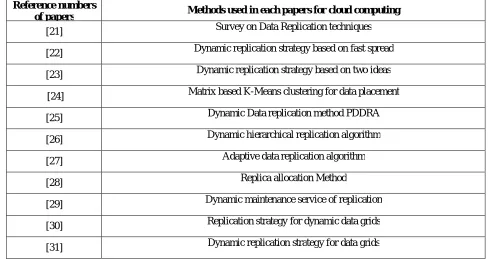
Data Replication in cloud computing has been evaluated using techniques in our survey papers. In order to evaluate the performance results, initially all the papers are categorized based on Throughput, Execution time, Storage utilization, Replica number, Network usage, Replication cost, Recovery time and Hit ratio. The experimentations of these review papers are carried out in every paper with different techniques which are used in every survey papers are given in the following table I. It helps us to analyze the results of every method with detailed evaluation.
Table 1: Various Techniques used in the survey papers Reference numbers
of papers Methods used in each papers for cloud computing
[21] Survey on Data Replication techniques
[22] Dynamic replication strategy based on fast spread
[23] Dynamic replication strategy based on two ideas
[24] Matrix based K-Means clustering for data placement
[25] Dynamic Data replication method PDDRA
[26] Dynamic hierarchical replication algorithm
[27] Adaptive data replication algorithm
[28] Replica allocation Method
[29] Dynamic maintenance service of replication
[30] Replication strategy for dynamic data grids
ISSN(Online): 2320-9801
ISSN (Print): 2320-9798
I
nternational
J
ournal of
I
nnovative
R
esearch in
C
omputer
and
C
ommunication
E
ngineering
(An ISO 3297: 2007 Certified Organization)
Vol. 3, Issue 8, August 2015
[32] Dynamic replication for federation
[33] Metrics for measuring system data availability
[34] Cost-Effective dynamic data replication strategy
[35] Dynamic data replication mechanism
[36] Hierarchical replication model
[37] Elastic Replication management system
[38] Survey on cloud security
[39] Sliding window replica strategy
[40] Polynomial time centralized replication algorithm
[41] Eager replication algorithm
[42] Fault tolerance management system
[43] Edge service data replication system
[44] Privacy preservation approach sTile
[45] Lazy replication algorithm
[46] Survey on dynamic replication strategies
[47] Survey on key challenges for optimistic replication systems
[48] CAP Theorem
[49] DTN-like messaging system to reduce the delivery delays in peer-to-peer replication system
[50] Sedic for privacy aware data intensive computing
[51] QOS aware data replication
[52] ACID Transactions data replication
[53] Grid less Replication service
[54] Trust overlay network over multiple data centers
[55] QOS architecture
[56] Dynamic multiple location replication
[57] Replication strategy based on economic model
[58] Approach based on economic model
ISSN(Online): 2320-9801
ISSN (Print): 2320-9798
I
nternational
J
ournal of
I
nnovative
R
esearch in
C
omputer
and
C
ommunication
E
ngineering
(An ISO 3297: 2007 Certified Organization)
Vol. 3, Issue 8, August 2015
[60] Federated cloud storage system
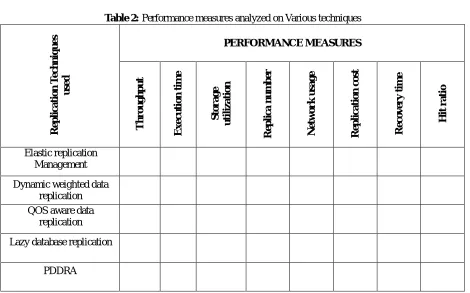
Table 2: Performance measures analyzed on Various techniques
R e p li c ati on T ec h n iq u e s u se d PERFORMANCE MEASURES Th rou gh p u t Exe c u ti on t im e S tor age u ti li z ati on R e p li c a n u mb e r N e tw or k u sage R e p li c ati on c os t R e c ov e r y t ime H it r a ti o Elastic replication
Management
Dynamic weighted data
replication
QOS aware data
replication
Lazy database replication
PDDRA
Table 1 shows the methods and algorithms that are used for the data replication in cloud computing. From the experimentation results of these reviewed papers, we have analyzed the performance of the various recognition systems. Some of the results of the experimentation with the evaluation values are shown below. In general, the following metrics such as Throughput, Execution time, Storage utilization, Replica number, Network usage, Replication cost, Recovery time and Hit ratio are used as the evaluation metrics in all data replication systems as given in Table 2. They are given in detail one by one with the comparison.
Effective Network Usage (ENU)
ENU is effectively the ratio of files transferred to files requested, so a low value indicates that the optimization strategy used is better at putting files in the right places. It ranges from 0 to 1.
remotefile localfile
ISSN(Online): 2320-9801
ISSN (Print): 2320-9798
I
nternational
J
ournal of
I
nnovative
R
esearch in
C
omputer
and
C
ommunication
E
ngineering
(An ISO 3297: 2007 Certified Organization)
Vol. 3, Issue 8, August 2015
Fig. 2: Network usage values for various existing works for data replication
From the above fig 2, we can observe that the various methods have different Network usage values. Some of the methods from the survey works are taken for our evaluation work. The methods with the reference papers are Dynamic weighted data replication and PDDRA methods with the network usage values 57 and 40 respectively. Overall, we observe that the dynamic data replication techniques facilitate good performance results.
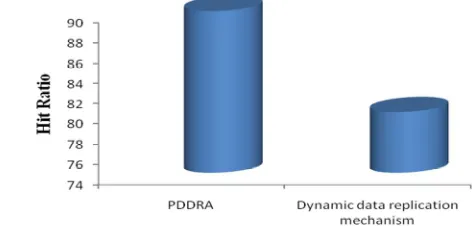
Hit ratio
Hit ratio is the ratio of Total number of Local File Accesses to all accesses containing Local File Accesses, Total number of Replications and Total number of Remote File Accesses.
Fig. 3: Hit ratio values for various existing works for data replication
From the above fig 3, we can observe that the various methods have different Hit ratio values. Some of the methods from the survey works are taken for our evaluation work. The methods with the reference papers are Dynamic weighted data replication and PDDRA methods with the hit ratio values 80 and 90 respectively. Overall, we observe that the dynamic data replication techniques facilitate good performance results.
Total number of replications
ISSN(Online): 2320-9801
ISSN (Print): 2320-9798
I
nternational
J
ournal of
I
nnovative
R
esearch in
C
omputer
and
C
ommunication
E
ngineering
(An ISO 3297: 2007 Certified Organization)
Vol. 3, Issue 8, August 2015
Fig. 4: Number of replications for various existing works for data replication
From the above fig 4, we can observe that the various methods have different number of replications. Some of the methods from the survey works are taken for our evaluation work. The methods with the reference papers are Elastic replication management and PDDRA methods with the replication number 7 and 3 respectively. Overall, we observe that the dynamic data replication techniques facilitate good performance results.
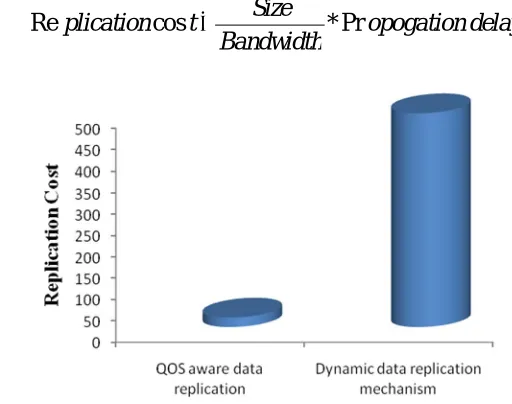
Replication cost
A replica with high replication cost is not a suitable candidate for replacement because if the grid site needs that replica in the future, it should pay a high cost for replicating it again, and this is not economical. Therefore, the RPV will be greater if Replication Cost of that replica is high.
time
delay
opogation
Bandwidth
Size
t
plication
cos
*
Pr
Re
Fig. 5: Replication cost values for various existing works for data replication
ISSN(Online): 2320-9801
ISSN (Print): 2320-9798
I
nternational
J
ournal of
I
nnovative
R
esearch in
C
omputer
and
C
ommunication
E
ngineering
(An ISO 3297: 2007 Certified Organization)
Vol. 3, Issue 8, August 2015
Execution Time
Execution time is the time taken for execution of the whole project. It will be calculated in seconds.
Fig. 6: Execution Time values for various existing works for data replication
From the above fig 6, we can observe that the various methods have different execution time. Some of the methods from the survey works are taken for our evaluation work. The methods with the reference papers are Elastic replication management, Dynamic weighted data replication, lazy database replication and PDDRA methods. Overall, we observe that the dynamic data replication techniques facilitate good performance results.
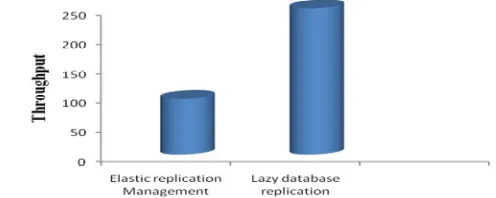
Throughput
Throughput refers to the performance of tasks by a computing service or device over a specific period. It measures the amount of completed work against time consumed and may be used to measure the performance of a process.
Fig. 7: Throughput values for various existing works for data replication
ISSN(Online): 2320-9801
ISSN (Print): 2320-9798
I
nternational
J
ournal of
I
nnovative
R
esearch in
C
omputer
and
C
ommunication
E
ngineering
(An ISO 3297: 2007 Certified Organization)
Vol. 3, Issue 8, August 2015
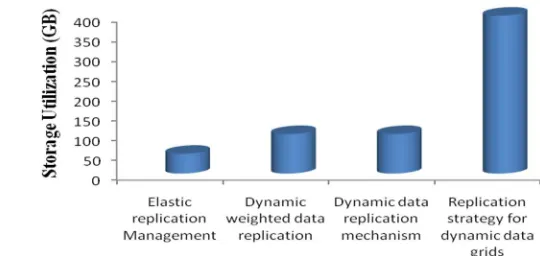
Storage Utilization
Storage Utilization is the amount of Giga Bytes utilized by the data in the cloud.
Fig. 8: Storage Utilization values for various existing works for data replication
From the above fig 8, we can observe that the various methods have different storage utilization values. Some of the methods from the survey works are taken for our evaluation work. The methods with the reference papers are Elastic replication management, Dynamic weighted data replication, and dynamic data replication mechanism and replication strategy for dynamic data grids. Overall, we observe that the dynamic data replication techniques facilitate good performance results.
V. CONCLUSION
Data replication is one of the popular tasks in cloud computing. In this paper, we have surveyed the topic of data replication. We have taken a total of 40 papers for our review work, in which the articles were taken from the standard publications. The overview of the data replication system in cloud computing is initially explained in a brief manner. After that we have categorized every paper under four groups based on the replication pattern. The performance of the data replication works has been extensively analyzed with the evaluation metrics – Throughput, Execution time, Storage utilization, Replica number, Network usage, Replication cost, Recovery time and Hit ratio. From this evaluation, we observe that some of the methods have provided efficient performance result. Even though the performance of these methods has yielded good quality results, today’s technology has been developing day by day, which calls for further improvement in the performance. So we have to update the new technologies every day. And we believe that a greater number of works will be developed in future by using our survey work.
REFERENCES
1. Ruay-Shiung Chang, Hui-Ping Chang and Yun-Ting Wang, “A Dynamic Weighted Data Replication Strategy in Data Grids”, In the proceedings of the 6th ACS/IEEE International Conference on Computer Systems and Applications, 2008.
2. Dong Yuan, Yun Yang, Xiao Liu and Jinjun Chen, “A Data Placement Strategy in Scientific Cloud Workflows”, Journal on Future Generation Computer Systems archive, Vol. 26, 2010.
3. H. Stockinger, “Database Replication in Worldwide Distributed Data Grids”, University of Vienna, 2001.
4. Priya Deshpande, Aniket Bhaise and Prasanna Joeg, “A Comparative analysis of Data Replication Strategies and Consistency Maintenance in Distributed File Systems”, International Journal of Recent Technology and Engineering (IJRTE), Vol. 2, 2013.
5. Ruay-Shiung Chang and Hui-Ping Chang, “A dynamic data replication strategy using access-weights in data grids”, Journal of Supercompute, 2008.
6. Vijaya -Kumar-C and Dr. G.A. Ramachandhra, ”Optimization of Large Data in Cloud computing using Replication Methods”, International Journal of Computer Science and Information Technologies, Vol. 5, No. 3, pp. 3034-3038, 2014.
7. Virendra Singh Kushwah and Aradhana Saxena, “A Security approach for Data Migration in Cloud Computing”, International Journal of Scientific and Research Publications, Vol. 3, 2013.
8. Dheresh Soni, Atish Mishra, Satyendra Singh Thakur and Nishant Chaurasia, “Applying Frequent Pattern Mining in Cloud Computing Environment”, International Journal of Advanced Computer Research, Vol. 1, No. 2, 2011.
ISSN(Online): 2320-9801
ISSN (Print): 2320-9798
I
nternational
J
ournal of
I
nnovative
R
esearch in
C
omputer
and
C
ommunication
E
ngineering
(An ISO 3297: 2007 Certified Organization)
Vol. 3, Issue 8, August 2015
10. Feng Dan and Tan Zhipeng, “Dynamic replication strategies for object storage systems”, In Proceeding of the 2006 international conference on Emerging Directions in Embedded and Ubiquitous Computing, pp. 53-61, 2006.
11. A. M. Isa, A. N. M. M. Rose, M. Mat Deris and M. Zarina, “Dynamic data replication strategy based on federation data grid systems”, In proceeding of the First international conference on Information computing and applications, pp. 25-32, 2010.
12. Itziar Arrieta-Salinas, Jose Enrique Armend ariz-Inigo and Joan Navarro, “Classic Replication Techniques on the Cloud”, In proceedings of the Seventh International Conference on Availability, Reliability and Security, 2012.
13. Naveen Dogra and Harpreet Kaur, “Cloud Computing Security: Issues and Concerns”, International Journal of Emerging Technology and Advanced Engineering, Vol. 3, pp. 268-273, 2013.
14. Rajkumar Buyyaa, Chee Shin Yeoa, Srikumar Venugopala, James Broberga, Ivona Brandicc, “Cloud computing and emerging IT platforms: Vision, hype, and reality for delivering computing as the 5th utility”, Future Generation Computer Systems, Vol. 25, No. 6, pp. 599–616, 2009.
15. Sunil Kaushik, Pranjal Mishra and Dr Ashish Bharadwaj, “Critical Evaluation of Cloud Computing for Transactional and Analytical Databases”, International Journal of Advanced Research in Computer Science and Software Engineering, Vol. 3, 2013.
16. Mohamed-K Hussein and Mohamed-H Mousa, “A Light-weight Data Replication for Cloud Data Centers Environment”, International Journal of Engineering and Innovative Technology (IJEIT), Vol. 1, No. 6, 2012.
17. Bakhta Meroufel and Ghalem Belalem, “Dynamic Replication Based on Availability and Popularity in the Presence of Failures”, Journal of Information Processing Systems, Vol.8, No.2, 2012.
18. Subeg Singh and Richa Sapra, “Secure Replication management in cloud storage”, International Journal of Emerging Trends and Technology in Computer Science, Vol. 3, 2014.
19. Veena Khandelwal, “Secure and Efficient Data Storage in Multi-clouds”, International Journal of Information and Computation Technology, Vol. 3, No. 9, pp. 977-984, 2013.
20. V.Nappinna lakshmi and N. Revathi, “Data Mining over Large Datasets using Hadoop in Cloud Environment”, International Journal of Computer Science & Communication Networks, Vol. 3, No. 2, pp. 73-78, 2013.
21. Tehmina Amjad, Muhammad Sher and Ali Daud, “A survey of dynamic replication strategies for improving data availability in data grids”, Future Generation Computer Systems, Vol. 28, pp. 337–349, 2012.
22. Mohammad Bsoul, Ahmad Al-Khasawneh, Yousef Kilani and Ibrahim Obeidat, “A threshold-based dynamic data replication strategy”, The Journal of Supercomputing, Vol. 60, No. 3, pp. 301-310, 2012.
23. Zhe Wang, Tao Li, Naixue Xiong and Yi Pan, “A novel dynamic network data replication scheme based on historical access record and proactive deletion”, The Journal of Supercomputing, Vol. 62, No. 1, pp. 227-250, 2012.
24. Dong Yuan, Yun Yang, Xiao Liu and Jinjun Chen, “A data placement strategy in scientific cloud workflows”, Future Generation Computer Systems, Vol. 26, No. 8, pp. 1200–1214, 2010.
25. Nazanin Saadat and Amir Masoud Rahmani, “PDDRA: A new pre-fetching based dynamic data replication algorithm in data grids”, Future Generation Computer Systems, Vol. 28, No. 4, pp. 666–681, 2012.
26. Najme Mansouri and Gholam Hosein Dastghaibyfard, “A dynamic replica management strategy in data grid”, Journal of Network and Computer Applications, Vol. 35, No. 4, pp. 1297–1303, 2012.
27. Ming-Chang Leea, Fang-Yie Leub and Ying-ping Chen, “PFRF: An adaptive data replication algorithm based on star-topology data grids”, Future Generation Computer Systems, Vol. 28, No. 7, pp. 1045–1057, 2012.
28. Takahiro Hara and Sanjay K. Madria, “Data Replication for Improving Data Accessibility in ADHOC Networks”, IEEE Transactions on Mobile Computing, Vol. 5, No. 11, 2006.
29. Chao-Tung Yang, Chun-Pin Fu and Chien-Jung Huang, “A Dynamic File Replication Strategy in Data Grids”, In proceedings of the IEEE International technical conference, pp. 1-5, 2007.
30. Faouzi Ben Charrada, Habib Ounelli and Hanène Chettaoui, “An Efficient Replication Strategy for Dynamic Data Grids”, In proceedings of IEEE International Conference on P2P, Parallel, Grid, Cloud and Internet Computing, 2010.
31. Gao Gai-Mei and Bai Shang-Wang, "Design and simulation of dynamic replication strategy for the data grid", In proceedings of the IEEE International Conference on Industrial control and electronic engineering, 2012.
32. M. Zarina, M. Mat Deris, A.N.M.M. Rose and A.M. Is, “Dynamic Data Replication Strategy Based on Federation Data Grid Systems”, In Proceedings of Springer first international conference on Information Computing and Applications, pp. 25-32, 2010.
33. Ming Lei, Susan V. Vrbsky and Xiaoyan Hong, “A Dynamic Data Grid Replication Strategy to Minimize the Data Missed”, In Proceedings of Third International Workshop on Networks for Grid Applications, 2006.
34. Wenhao LI, Yun Yang and Dong Yuan, “A Novel Cost-effective Dynamic Data Replication Strategy for Reliability in Cloud Data Centers”, In Proceedings of the Ninth IEEE International Conference on Dependable, Autonomic and Secure Computing, 2011.
35. Ruay-Shiung Chang, Hui-Ping Chang and Yun-Ting Wang,”A dynamic weighted data replication strategy in data grids, In proceedings of the 6th ACS/IEEE International Conference on Computer Systems and Applications, pp. 414-421, 2008.
36. Weizhong Lu, Yuanchun Zhou, Jianhui Li and Baoping Yan, “A Hierarchical Data Replication Method in Ad Hoc Networks”, In proceedings of the 2nd IEEE International Conference on Computer Engineering and Technology, vol. 7, pp. 23-27, 2010.
37. Zhendong Cheng, Zhongzhi Luan, You Meng, Yijing Xu, Depei Qian, Alain Roy, Ning Zhang and Gang Guan, “ERMS : An Elastic Replication Management System for HDFS”, In proceedings of IEEE International Conference on Cluster Computing Workshops, 2012. 38. Mohammed A. AlZain, Eric Pardede, Ben Soh and James A. Thom, “Cloud Computing Security: From Single to Multi-Clouds, In
proceedings of 45th IEEE Hawaii International Conference on System Sciences, 2012.
39. Susan V. Vrbsky, Ming Lei, Karl Smith and Jeff Byrd, “Data Replication and Power Consumption in Data Grids”, In proceedings of the 2nd IEEE International Conference on Cloud Computing Technology and Science, 2010.
40. Dharma Teja Nukarapu, Bin Tang, Liqiang Wang,Member and Shiyong Lu, “Data Replication in Data Intensive Scientific Applications with Performance Guarantee”, IEEE Transactions on Parallel and Distributed Systems, Vol. 22, No. 8, 2011.
ISSN(Online): 2320-9801
ISSN (Print): 2320-9798
I
nternational
J
ournal of
I
nnovative
R
esearch in
C
omputer
and
C
ommunication
E
ngineering
(An ISO 3297: 2007 Certified Organization)
Vol. 3, Issue 8, August 2015
42. Ravi Jhawar, Vincenzo Piuri, and Marco Santambrogio, “Fault Tolerance Management in Cloud Computing: A System-Level Perspective”, IEEE Systems Journal, Vol. 7, No. 2, pp. 288-297, 2013.
43. Lei Gao, Mike Dahlin, Amol Nayate, Jiandan Zheng, and Arun Iyengar, “Improving Availability and Performance with Application-Specific Data Replication”, IEEE Transactions on Knowledge and Data Engineering, Vol. 17, No. 1, 2005.
44. Yuriy Brun and Nenad Medvidovic, “Keeping Data Private while Computing in the Cloud”, In proceedings of IEEE Fifth International Conference on Cloud Computing, 2012.
45. Khuzaima Daudjee and Kenneth Sale, “Lazy Database Replication with Ordering Guarantees”, In Proceedings of the 20th IEEE International Conference on Data Engineering, 2004.
46. Da-Wei Sun, Gui-Ran Chang, Shang Gao, Li-Zhong Jin and Xing-Wei Wang, “Modeling a Dynamic Data Replication Strategy to Increase System Availability in Cloud Computing Environments”, Springer Journal of Computer Science and Technology, Vol. 27, No. 2, pp. 256–272, 2012.
47. Yasushi Saito and Marc Shapiro, “Optimistic Replication”, ACM Computing Surveys, Vol. 37, No. 1, pp. 42-81, 2005.
48. Kenneth P. Birman, Daniel A. Freedman, Qi Huang and Patrick Dowell, ”Overcoming CAP With Consistent Soft-State Replication”, IEEE Computer Society, 2012.
49. Peter Gilbert, Venugopalan Ramasubramanian, Patrick Stuedi and Doug Terry, “Peer-to-peer Data Replication Meets Delay Tolerant Networking”, In proceedings of the 31st IEEE International Conference on Distributed Computing Systems, 2011.
50. Kehuan Zhang, Xiaoyong Zhou, Yangyi Chen, XiaoFeng Wang and Yaoping Ruan, “Sedic: Privacy-Aware Data Intensive Computing on Hybrid Clouds”, In Proceedings of the 18th ACM conference on Computer and communications security, pp. 515-526, 2011.
51. Jenn-Wei Lin, Chien-Hung Chen and J. Morris Chang, “QoS-Aware Data Replication for Data-Intensive Applications in Cloud Computing Systems”, IEEE Transactions on Cloud Computing, Vol. 1, No. 1, 2013.
52. Zhou Wei, Guillaume Pierre and Chi-Hung Chi, “CloudTPS: Scalable Transactions for Web Applications in the Cloud”, IEEE Transactions on Services Computing, Special Issue on Cloud Computing, 2011.
53. Tim Ho and David Abramson, “The GriddLeS Data Replication Service”, In the Proceedings of the First IEEE International Conference on e-Science and Grid Computing, 2005.
54. Kai Hwang and Deyi Li, “Trusted Cloud Computing with Secure Resources and Data Coloring”, IEEE Computer Society, 2010. 55. George V. Popescu and Christopher F. Codella, “An Architecture for QoS Data Replication in Network Virtual Environments”, In
Proceedings of the IEEE Virtual Reality, 2002.
56. Xiaohua Dong, Ji Li, Zhongfu Wu, Dacheng Zhang and Jie Xu, “On Dynamic Replication Strategies in Data Service Grids”, In proceedings of the 11th IEEE International Symposium on Object Oriented Real-Time Distributed Computing, pp. 155 – 161, 2008. 57. William H. Bell, David G. Cameron, Ruben Carvajal-Schiaffino, A. Paul Millar, Kurt Stockinger and Floriano Zini, “Evaluation of an
Economy-Based File Replication Strategy for a Data Grid”, In Proceedings of the 3st IEEE International Symposium on Cluster Computing and the Grid, 2003.
58. Mark Carman, Floriano Zini, Luciano Serafini and Kurt Stockinger, “Towards an Economy-Based Optimization of File Access and Replication on a Data Grid”, In Proceedings of the 2nd IEEE/ACM International Symposium on Cluster Computing and the Grid, 2002. 59. Michael Armbrust, Armando Fox, Rean Griffith, Anthony D. Joseph, Randy Katz, Andy Konwinski, Gunho Lee, David Patterson, Ariel
Rabkin, Ion Stoica and Matei Zaharia, “A view of cloud computing”, Communications of the ACM, Vol. 53, No. 4, pp. 50-58, 2010. 60. David Bermbach, Markus Klems, Stefan Tai and Michael Menzel, “MetaStorage: A Federated Cloud Storage System to Manage
Consistency-Latency Tradeoffs”, In Proceedings of the 4th IEEE International Conference on Cloud Computing, 2011.
BIOGRAPHY
M. Amutha has received the B. E. degree from the Bharathidasan University, Trichy. She received the M.Tech degree from Punjabi University , Patiala. She is an Assistant Professor in Computer Science and Engineering at Nehru Institute of Engineering and Technology. Her specialization includes Computer Networks, Database Management and Systems, Data Mining,Android Application. She is a life time member of ISTE and CSI, IAENG.