• No results found

Selection framework for special children community knowledge sharing tool

N/A
N/A
Protected

Academic year: 2020

Share "Selection framework for special children community knowledge sharing tool"

Copied!
29
0
0

Loading.... (view fulltext now)

Full text

(1)

SELECTION FRAMEWORK FOR SPECIAL CHILDREN COMMUNITY

KNOWLEDGE SHARING TOOL

AIDA SUZANA BINTI SUKIAM

(2)

SELECTION FRAMEWORK FOR SPECIAL CHILDREN COMMUNITY

KNOWLEDGE SHARING TOOL

AIDA SUZANA BINTI SUKIAM

A thesis submitted in fulfillment of the requirements for

the award of the degree of Master of Science (Computer Science)

Faculty of Computer Science and Information Systems

UniversitiTeknologi Malaysia

(3)

iii

Dedicated to:

My loving and caring husband, Harmize Bin Ahmad.

My precious sons,

Muhammad Syakir Syahmi & Muhammad Za’im Zaqwan.

My parent, Sukiam Bin Sujak and Minah Binti Shukar.

My parents-in-law & all my brothers and sisters

Thank you for your prayers and understanding.

(4)

iv

ACKNOWLEDGEMENTS

Bismillahir-Rahmanir-Rahim…

All praises to Almighty Allah, the Most Merciful and the Most Benevolent for

granting me the strength and courage to persevere throughout this painfully wonderful

and fulfilling journey. I am most thankful to Him for His blessings in the completion

of this thesis. This thesis would not have been completed without the direct and

indirect help extended to me by the various parties who warrant special mention.

In particular, I wish to express my sincere appreciation to my supervisor

Associate Professor Dr. Azizah Abdul Rahman, for her commitment, valuable

guidance, patience, and comments in assisting me to complete this thesis. Without her

guidance this study would not have been possible. I am also thankful to Associate

Professor Wardah Zainal Abidin who has given me insightful comments in improving

this thesis. I am also indebted to Ministry of Science, Technology and Innovation

(MOSTI) for funding my Master study. My appreciation goes to my entire lab-mates

for being very understanding friends. I am also indebted to all the respondents who

have been very co-operative throughout my data collection and verification phase.

Finally, I would like to express my deepest gratitude and love for my family

especially my husband, parents, sons, brothers, sisters and in laws. Their patience,

understanding, and encouragement gave me strength and source of inspiration

throughout this battle. May Allah bless all of you. Aaminn... and Thank you.

(5)

v

ABSTRACT

The term Special Children (SC) is viewed as children who have learning

difficulties that make it harder for them to learn or access education as compared to

most children of their age. SC community consists of groups of people or organizations

who share the same passion for anything related to SC. The community is seeking

knowledge on ways to improve the abilities of the SC children. Knowledge

Sharing-Tools (KS-Sharing-Tools) have been identified as a medium for sharing and acquiring

knowledge that could improve the ability of SC through regular interaction among

members of the SC community. Web-based KS-Tools such as blogs, social network,

instant messaging and others provide users with unlimited access in terms of time and

space for the purpose of knowledge sharing. However, it was found that there is no

framework that is capable of identifying appropriate KS-Tools for SC community to

guide portal developers or practitioners. Thus, the main objective of this study is to

develop a KS-Tools Selection Framework (KSTSF) for SC community. The proposed

framework would systematically select suitable web-based KS-Tools for SC

community. The framework was developed based on a knowledge audit analysis and

KS-Tools capabilities. Data was collected through survey, interviews and document

analysis among SC community in the Southern Region of Malaysia. A KSTSF-Tool

was then developed and 10 KS-Tools were selected as appropriate tools for the SC

community. Based on the 10 tools, a prototype of “Portal Perkongsian Pengetahuan

Komuniti Kanak-kanak Istimiewa (3P3KI)” was developed to demonstrate the

practicality of the framework. The framework was also verified by portal developers

through KSTSF-Tool. The framework provides portal developers and knowledge

management practitioners a systematic process for selecting KS-Tools appropriate for

use by this SC community. Hence, it has been proven the KSTF-Tool has the capability

to automatically select the most appropriate tools needed to be part of the 3P3KI portal.

(6)

vi

ABSTRAK

Kanak-kanak Istimewa (

SC

) dilihat sebagai kanak-kanak yang mempunyai masalah

pembelajaran menyebabkan mereka sukar mempelajari atau akses pendidikan dibandingkan

dengan kebanyakan kanak-kanak sebaya yang lain. Komuniti SC terdiri daripada kumpulan

individu atau organisasi yang berkongsi minat yang sama terhadap perkara berkaitan

SC

.

Komuniti ini mencari pengetahuan sebagai wadah untuk meningkatkan keupayaan

SC

. Alatan

perkongsian pengetahuan (

KS-Tools

) dikenalpasti sebagai medium berkongsi dan

mendapatkan pengetahuan yang boleh meningkatkan kebolehan

SC

melalui interaksi biasa di

antara ahli komuniti SC.

KS-Tools

berasaskan web seperti blog, rangkaian sosial, mesej segera

dan sebagainya menyediakan akses yang tidak terhad dari segi masa dan ruang bertujuan untuk

perkongsian pengetahuan kepada pengguna. Walaubagaimanapun, didapati bahawa tiada

rangkakerja yang mampu mengenalpasti

KS-Tools

yang sesuai kepada komuniti SC untuk

dijadikan panduan kepada pengamal dan pembangun portal. Oleh itu, objektif utama kajian ini

adalah untuk membangunkan sebuah Rangkakerja Pemilihan Alatan Perkongsian Pengetahuan

(

KSTSF

) untuk komuniti SC. Rangkakerja yang dicadang akan memilih

KS-Tools

berasaskan

web yang sesuai untuk komuniti SC secara sistematik. Rangkakerja ini telah dibangun

berdasarkan analisa audit pengetahuan dan keupayaan alatan perkongsian pengetahuan. Data

telah dikumpul melalui soal selidik, temubual dan analisa dokumen di antara komuniti SC di

Wilayah Selatan Malaysia.

KSTSF-Tool

kemudiannya dibangunkan dan 10 alatan perkongsian

pengetahuan dipilih sebagai alatan yang sesuai untuk komuniti SC. Berdasarkan 10 alatan ini,

satu prototaip “Portal Perkongsian Pengetahuan Komuniti Kanak-kanak Istimwewa (3P3KI)

telah dibangun untuk mendemonstrasi tahap praktikal rangkakerja. Rangkakerja ini telah

disahkan oleh pembangun portal melalui

KSTSF-Tool

. Rangkakerja ini menyediakan proses

pemilihan

KS-Tools

yang sesuai digunakan oleh komuniti SC secara sistematik kepada

pengamal perkongsian pengetahuan dan pembangun portal. Oleh itu, telah terbukti bahawa

KSTSF-Tool berkeupayaan untuk memilih secara automatik alatan yang paling sesuai yang

diperlukan untuk menjadi sebahagian portal 3P3KI.

(7)

TABLE OF CONTENT

CHAPTER TITLE

PAGE

DECLARATION

ii

DEDICATION

iii

ACKNOWLEDGEMENTS

iv

ABSTRACT

v

ABSTRAK

vi

TABLE OF CONTENTS

vii

LIST OF TABLES

xi

LIST OF FIGURES

xiii

LIST OF ABBREVIATIONS

xv

LIST OF APPENDICES

xvi

1

INTRODUCTION

1.1

Overview

1.2

Background of the Problem

1.3

Statement of the Problem

1.4

Objectives of the Study

1.5

Scope of the Study

1.6

Significance of the Study

1.7

Chapter Summary

LITERATURE REVIEW

2.1

Overview

2.2 Related Concepts

2.2.1 Overview of Special Children

2.2.1.1 Children with Learning Disabilities

1

2

4

4

5

6

6

(8)

3

2.2.2

Knowledge Sharing

2.2.2.1 Concept of KS

2.2.2.1 KS Strategies

2.2.3

Conceptual View of Knowledge

Management

2.2.3.1 The People Core

2.2.3.2 The Content Core

2.2.3.3 The Technology Core

2.2.4

Community of Practice

2.2.5

Knowledge Audit

2.2.5.1 Knowledge Needs Analysis

2.2.5.2 Knowledge Inventory Analysis

2.2.5.3 Knowledge Flows Analysis

2.2.6

Web-based KS-Tools

2.2.6.1 Categorization of KS-Tools

2.2.7

Knowledge Characteristics (KC)

2.2.7.1 Nature of the Knowledge

2.2.7.2 Communication Needed by the

Knowledge

2.3 Analysis on Related Work: Tools Selection

Method

2.3.1

Framework Proposed by Aranda

2.3.2

Framework Proposed by Wenger

2.3.3

Discussion on Related Works

2.4 Chapter Summary

RESEARCH METHODOLOGY

3.1 Overview

3.2 Research Design and Procedure

3.2.1

Phase 1: Pre-Research

3.2.2

Phase 2: Draft an Initial Framework

3.2.3

Phase 3: Conduct Case Audit

3.2.4

Phase 4: Development of KS-Tools

Framework

(9)

4

3.2.6

Phase 6: Completion

3.3 Development of Research Instruments

3.3.1 Preliminary

Study

Instruments

3.3.2 K-Audit

Instruments

3.4 Chapter Summary

PRELIMINARY STUDY AND FRAMEWORK

DEVELOPMENT

4.1 Overview

4.2 Conceptual Model

4.3 Stakeholder Analysis

4.3.1 Working Definition of SC

4.3.2 Stakeholder Analysis Results

4.4 Preliminary Study Result

4.4.1 The Demographic Profiles of Respondents

4.4.2 Preliminary study with Identified CoPs

4.4.2.1 Questionnaires Findings (Parent

and Educator)

4.4.2.2 Preliminary Interviews

(Researcher and C&ME)

4.4.3 Preliminary

Interviews

(MGA

Representatives)

4.4.4 Reflections on Various Feedbacks

(Preliminary Study)

4.5 Framework

Development

4.5.1 Development of Initial Framework

4.5.1.1 People Component

4.5.1.2 Content Component

4.5.1.3 Technology Component

4.5.1.4 Reflections on Various

Feedbacks (Initial Framework)

4.5.2 K-Audit Result

4.5.3 Development of KS-Tools Framework

(KSTF)

4.5.3.1 KSTF- Context

(10)

5

6

4.5.3.2 KSTF- People Component

4.5.3.3 KSTF- Content Component

4.5.3.4 KSTF- Technology Component

4.6

Chapter Summary

DEVELOPMENT OF KSTF-TOOLS &

VERIFICATION OF THE FRAMEWORK

5.1 Overview

5.2

Development of KSTF-Tool

5.2.1 Modules

in

KSTF-Tool

5.2.1.1 About KSTF

5.2.1.2 Apply KSTF

5.2.1.3 View Applied KSTF

5.2.1.4 View KS-Tools Profile

5.2.1.5 Edit KS-Tools Profile

5.3

Verification of the KSTF

5.3.1 Verification through KSTF-Tool

5.3.2 Demonstration of 3P3KI Portal

5.4 Chapter Summary

CONCLUSIONS AND FUTURE WORK

6.1 Overview

6.2

Research Summary and Achievements

6.3

Research Contributions

6.3.1 Theoretical Contribution

6.3.2 Methodological Contribution

6.3.3 Practical Contribution

6.4 Research Limitations

6.5 Future Works

6.6 Concluding Remarks

(11)

LIST OF TABLES

TABLE NO.

TITLE

PAGE

2.1

Various Definition on Special Children

8

2.2

Various Type of LD

9

2.3

Definition of KS

11

2.4

Characteristics of Communities

20

2.5

Comparison Between CoP and Other Kinds of Groups

20

2.6

K-Needs Analysis Activities

24

2.7

K-Inventory Analysis Activities

25

2.8

K-Flows Analysis Activities

26

2.9

Tools Categorization Based on Time/Space Taxonomy

28

2.10

Tools Categorization Based on Identified Orientation

32

2.11

Short Description of Identified KS-Tools

34

2.12

Categorization in F-S Model

48

2.13

Steps in Wenger’s Method

53

2.14 Orientation

Worksheet

55

2.15

Tools Inventory Matrix

57

3.1

Operational Research Framework for Phase 1

66

3.2

Operational Research Framework for Phase 2

67

3.3

Operational Research Framework for Phase 3

69

3.4

Operational Research Framework for Phase 4

70

3.5

Operational Research Framework for Phase 5

71

3.6 K-Audit

Matrix

74

3.7

Subject of K-Audit Matrix

74

4.1

4.2

Organisation of Chapter 4

Respondents’ Feedbacks on SC Definition

(12)

4.3

Working Definition of Identified Cop

80

4.4

Respondents for Preliminary Study (November

2007-November 2008)

82

4.5

The Demographic Profiles of Respondent (S)

82

4.6

Difficulty Level in Knowledge Acquisition

84

4.7

Cause to the Difficulty in Knowledge Acquisition

84

4.8

Reason Not to Share

85

4.9

Required and Shared Knowledge (Cop: Parents)

85

4.10

Current and Preferred KS Mechanisms

86

4.11 Required

Knowledge

87

4.12

Suggestion on the Preferred Web-Based Tools

89

4.13

Issues, Problems and Current Practiced Face by Portal

Developers

90

4.14

Feedback and Revision Towards Preliminary Study Result

91

4.15

Description Sub-Component of Content in Initial

Framework

96

4.16

Feedback and Revision Towards Initial Framework

98

4.17

Characterize Identified Knowledge from K-Audit Matrix

101

4.18

The Knowledge Characteristics (KC)

103

4.19

Final KS-Tools Profile

107

4.20

Justification on KIV KS-Tools Profile

108

5.1

Organisation of Chapter 5

110

5.2

The Role of KSTF in the Development of KSTF-Tool

115

5.3

General Questions to Identify KC: Nature of the Knowledge

118

5.4

General Questions to Identify KC: Communication Needed

by the Knowledge

119

5.1

‘Find Similarities’ Step

123

5.2

Step II – Set “Level” at Knowledge Phase

124

5.3

Step III– Set “Level” at Process Phase

125

5.4

Step IV: Example of Set Final ‘Level’

126

5.5

Verification of KSTF (Overall)

129

5.6

Verification of KSTF (Step By Step)

130

5.7

Demonstration of 3P3KI Portal

132

(13)

LIST OF FIGURES

FIGURE NO.

TITLE

PAGE

1.1

Organization of Chapter 1

2

2.1

Literature Review Framework

7

2.2

Alignment Between Ks Elements and Conceptual View of

KM

15

2.3

Conceptual View of Knowledge Management

18

2.4

Knowledge Audit Process

23

2.5

Classification according to support functions

29

2.6

Categorization of KS-Tools Based on SECI Model

30

2.7

Community Tools Viewed in a Complex Landscape of

Activities

32

2.8

Phase to Define and Analyze Personal Preferences to

Choose Appropriate Technology in Virtual Teams

47

2.9

Stakeholder’s Information Form

47

2.10

Classification of Groupware Tools According to F-S Model

49

2.11

Choosing Set of Groupware Tools According to F-S Model

50

2.12

Iterative Process of Technique Selection and Application

52

2.13

An Interface that Shows the Suggestion for a Particular

Group of Stakeholders

53

2.14

Orientation Worksheet (Spider Diagram)

55

2.15

Community Tools Viewed in Complex Landscape of

Polarities

59

3.1

The Overall Operational Framework

65

4.1

Conceptual Model of the Framework Development

77

4.2 Stakeholder

Analysis

Matrix

80

4.3

Requirements and Related Issues of Researcher and C&ME

88

(14)

4.5

Interaction Between and Within Cop and MGA

95

4.6 KS

Process

96

4.7

The KS-Tools Framework (KSTF)

100

5.1

Transformation of the KSTF to the KSTSK (Automated

Version of KSTF)

112

5.2

Use Case of KSTSK

113

5.3

Interfaces of About KSTF Modules and Sub-Modules

113

5.4

Activity Diagram of ‘Apply KSTF’ Module

115

5.5

Step 1: Identify Context

116

5.6

Interfaces to Manage MGA (Step 2) and Cop (Step 3)

117

5.7

K-T Matching Process

120

5.8

Example of ‘Find Similarities’ Step

122

5.9 The

KSTF

Verification

Process

128

(15)

LIST OF ABBREVIATIONS

C&ME

-

Clinical & Medical Expert

CoP

-

Community of Practice

DFHD

-

Division of Family Health Development

MGA

-

Malaysian Government Agencies

KA

-

Knowledge Acquisition

KM

-

Knowledge Management

KC

-

Knowledge Characteristics

KS

-

Knowledge Sharing

KSTSF

-

Knowledge Sharing Tools Selection Framework

LD

-

Learning Disability

MOE

-

Ministry of Education

MOH

-

Ministry of Health

SC

-

Special Children

SE

-

Special Education

SED

-

Special Education Department

SWD

-

Social Welfare Department

(16)

LIST OF APPENDICES

APPENDIX TITLE

PAGE

A Example

of

Research

Instrument

151

B

Excerpt of K-Audit Result

161

(17)

CHAPTER 1

INTRODUCTION

1.1

Overview

(18)

2

1.7 Chapter Summary 1.6 Significance of the Study 1.5 Scopes of the Study 1.4 Objectives of the Study 1.3 Statement of the Problem 1.2 Background of the Problem 1.1 Overview

Section Description

The section introduces the chapter and gives an overview of the sections.

The section describes the background of the problems.

The section describes the problem statement of the research.

The section describes the objectives of the research.

The section describes the scope of the research.

The section describes the significance of the research based on its contributions.

The section describes the structure of the thesis and gives an overview of the whole research.
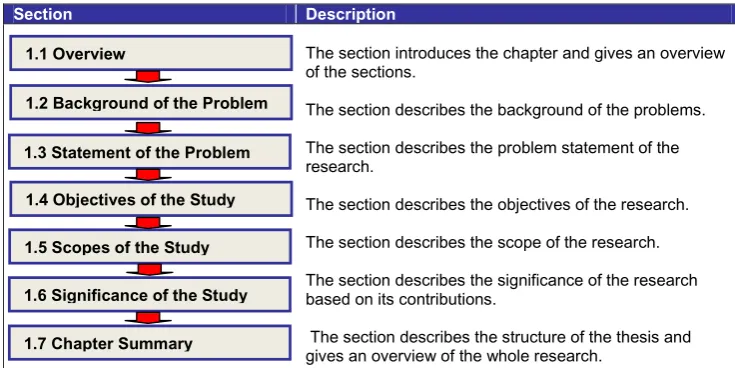
Figure 1.1 :

Organisation of Chapter 1

1.2

Background of the Problem

(19)

3

always hunger of knowledge in order to perform their daily activities as well as to

improve abilities of the children. Therefore, it is important to provide this

community with an appropriate KS-Platform that they can use to interact and

communicate with other members in SC community to share their knowledge and

experience.

The single KS Platform is integration of various KS-Tools. However, there

are many KS-Tools available and these tools keep evolving and changing (Wenger

et al., 2005). In fact, each tool has its own weaknesses and strengths since those

tools have different features and capabilities. The tool usefulness will relate back on

how and when it is relevant. This led to the selection process becomes difficult to

portal developer as well as to the community. In addition, there is no specific

selection process for community though there is for organization whereby involves

different requirements.

(20)

4

1.3

Statement of the Problem

Based on the problem background discussed earlier, it can be summarized

that KS platform SC community is important. However, there are difficulties in

choosing the right KS-Tools to be embedded in the knowledge sharing platform for

SC community. The problem statement for this study can be derived as “There is no

framework to guide portal developers or practitioners to select appropriate

KS-Tools for SC community”.

Therefore this study intends to answer the research questions related to this

study as identified below:

x

“How to select appropriate KS-Tools for the SC community?”

The main research question can be decomposed into several research

questions:

x

What are the knowledge characteristics influencing the KS-Tools

selection process for SC community.

x

How to characterize the capabilities of web-based KS-Tools.

1.4

Objectives of the Study

The main objective to be study is:

(21)

5

The sub-objectives that could be achieved are:

x

To identify the knowledge characteristics influencing the KS-Tools

selection process for SC community.

x

To characterize the capabilities of web-based KS-Tools based on

identified knowledge characteristics.

1.5

Scope of the Study

The scope of this study will cover the following aspects as follows:

(i)

This study focuses on special children community in Malaysia

context.

(ii)

The relevant target agencies that are being studied are the Social

Welfare Department (Ministry of Women, Family & Social

Development), the Division of Family Health Development

(Ministry of Health) and the Special Education Department (Ministry

of Education).

(iii)

Web-based KS-tools that have been studied only covered the

available tools being used during this study was conducted.

(iv)

The possible stakeholders that are being studied are Parent, Educator,

Researcher and Medical & Clinical Expert.

(22)

6

1.6

Significance of the study

This research is significant as it contributes to theory, practice and

methodology as follows:

x

The proposed framework not only identifies characteristics

considered in KS-Tools selection process but also identify how the

whole process should be conducted. The result from this study could

be used to support future research on Knowledge Management

especially in Knowledge Sharing.

x

Development of the KSTF could assist in the implementation of

knowledge sharing initiatives in the SC community. This study

provide insights into an area neglected by many researcher but very

important to a civil and caring society.

x

Development of the KSTF-Tool leads to systematic and quick

KS-Tools selection process. The identification of the criteria influencing

the KS-Tools Selection process could be utilized by other portal

developers or practitioners.

x

Allow portal developers and the community as a whole to have more

effective development of the technology. This allows the technology

being appropriated and utilized in a more effective way so that SC

community is able to gain maximum benefits from the technology.

x

Development of 3P3KI portal would expedite KS among SC

community and ultimately may enhance the abilities of SC.

1.7

Chapter Summary

(23)

144

REFERENCES

Al_Hawamdeh, S. and T. L.Hart (2002).

Information and Knowledge Society

.

Singapore, McGraw-Hill.

An, F., F. Qiao, et al. (2004). Knowledge Sharing and Web-Based

Knowledge-Sharing Platform. Proceedings of the E-Commerce Technology for Dynamic

E-Business, IEEE International Conference, IEEE Computer Society.

Aranda, G., A. Vizcaíno, et al. (2009a).

Analyzing Stakeholders’ Satisfaction When

Choosing Suitable Groupware Tools for Requirements Elicitation

Groupware: Design, Implementation, and Use

, Springer Berlin / Heidelberg.

5784: 222-230.

Aranda, G., A. Vizcaíno, et al. (2006).

Choosing Groupware Tools and Elicitation

Techniques According to Stakeholders’ Features Enterprise Information

Systems VII

, Springer Netherlands: 69-76.

Aranda, G., A. Vizcaíno, et al. (2007).

How to Choose Groupware Tools

Considering Stakeholders’ Preferences During Requirements Elicitation?

Groupware: Design, Implementation, and Use

, Springer Berlin / Heidelberg.

4715: 319-327.

Aranda, G. N., A. VizcaÃ-no, et al. (2009b).

A Requirement Elicitation Methodology

for Global Software Development Teams

. Software Applications: Concepts,

Methodologies, Tools, and Applications, IGI Global: 2102-2114.

Argote, L. and P. Ingram (2000). "Knowledge Transfer: A Basis for Competitive

Advantage in Firms."

Organizational Behavior and Human Decision

Processes

82: 150-169.

Argote, L., B. McEvily, et al. (2003). "Managing Knowledge in Organizations: An

Integrative Framework and Review of Emerging Themes "

Management

Science

(49 ): 571-582.

(24)

145

Baker W.E (1992).

The network organization in theory and practice

. Campbridge,

Harvard Business School Press.

Benjamins, V. R. (2001). Knowledge Management in Knowledge-Intensive

Organziations. Intelligent Software for the Network Economy, Intelligence

Software Component.

Borghoff, U. M. and J. H. Schlichter (2000).

Computer Supported Cooperative

Work:Introduction to Distributed Applications

. New York, Springer.

Borkman, T. (1976). "Experiential Knowledge: A New Concept for the Analysis of

Self-Help Groups "

Chicago Journals

50(3): 445-456.

Canadian Health Services Research Foundation (2005). Leveraging Knowledge:

Tools and Strategies for action. Report of the 7th CHSRF, Annual Invitation

Workshop. Montreal, Quebec.

Castro, J. L., J. J. Castro-Schez, et al. (1999). "Learning maximal structure rules in

fuzzy logic for knowledge acquisition in expert systems."

Fuzzy Sets and

Systems

101(3): 331-342.

Chatti, M. A., R. Klamma, et al. (2007). The Web 2.0 Driven SECI Model Based

Learning Process.

Advanced Learning Technologies, 2007. ICALT 2007.

Seventh IEEE International Conference o

, Niigata, IEEE Xplore

Cheung , C. F., M. L. Li, et al. (2004). "A Systematic Approach for Knowledge

Audit Analysis: Integration of Knowledge Inventory, Mapping and

Knowledge Flow Analysis."

Journal of Universal Computer Science

10(6):

674-682.

Cheung , C. F., M. L. Li, et al. (2007). "A systematic approach form knowledge

auditing: a case study in transportation sector."

Journal of Knowledge

Management

11(4): 140-158.

Ching-chih Chen (2004).

The Promise of International Digital Library Collaboration

for Innovative Use of Invaluable Resources

. In Human Information

Behaviour & Competences For Digital Libraries (Keynote in Proceedings of

the Libraries in the Digital Age). Dubrovnik and Mljet, Faculty of

Philosophy, University J.J. Strossmayer in Osijek, Croatia,

Rutgers University , New Brunswick, NJ, USA: 7-15.

(25)

146

culture, and technologies."

International Journal on Digital Libraries

(Special

Issue on EU-NSF Working Group Reports).

Chong, D. Y. Y. and W. B. Lee (2005). "Re-Thinking Knowledge Audit: Its Values

and Limitations in the Evaluation of Organizational and Cultural Asset."

Knowledge Management in Asia Pacific Conference

Chowdhury, N. (2003). "

Knowledge Audit: Overview and Sample Questionnaire

."

Retrieved 16 Jan, 2008.

Christensen, P. H. (2007). "Knowledge sharing: moving away from the obsession

with best practices."

Journal of Knowledge Management

11(1): 36 - 47.

Chua, A. (2003). "Knowledge sharing: a game people play."

Aslib Proceedings

5(3):

117 - 129.

Coleman, D. (1997).

Groupware:Collaborative Strategies for Corporate LANS and

Intranets

. Upper Saddle River, Prentice Hall.

Creswell, J. W. (2009).

RESEARCH DESIGN: Qualitative, Quantitative, and Mixed

Methods Approaches Third Edition

. California, SAGE Publications.

Dong, H., F. K. Hussain, et al. (2007). Contemporary Cultural Researches on

Knowledge Sharing.

Service Operations and Logistics, and Informatics,

2007. SOLI 2007. IEEE International Conference on

.

Friedman, A. L. and S. Miles (2006).

Stakeholders: Theory and Practice

. United

States, Oxford University Press.

Gannon-Leary, P. and E. Fontainha "Communities of Practice and Virtual Learning

Communities: Benefits, Barriers and Success Factors."

eLearning Papers,

No. 5, September 2007

.

Goh, S. C. (2002). "Managing effective knowledge transfer: an integrative

framework and some practice implications."

Journal of Knowledge

Management

6(1): 23 - 30.

Haisten, M. (2000). Critical Characteristics of Enterprise Portals, Information

Management Online.

Hannabuss, S. (2000). "Narrative knowledge: eliciting organisational knowledge

from storytelling."

Aslib Proceedings: New Information Perspectives

Vol 52:

402-414.

(26)

147

Hossain, L. and R. T. Wigand (2003). Understanding the virtual collaboration

through structuration Proceedings of the 4th Eropean Conference on

Knowledge Management: 475-484.

Hovland, I. (2005). Successful Communication: Toolkit for Researchers and Civil

Society Organisations. London, Overseas Developement Institute.

Huysman, M. (2004).

Design Requirements for Knowledge Sharing Tools: A Need

for Social Capital Analysis

. Social Capital and Information Technology. M.

Huysman and V. Wulf. Cambridge, MA; London, MIT Press. ix: 187-207.

Huysman, M. and D. D. Wit (2002).

Knowledge Sharing in Practice

. London,

Kluwer Academic Publishers.

Hylton, A. (2002). "

A KM Initiative is Unlikely to Succeed Without a Knowledge

Audit

."

Ipe, M. (2003). "Knowledge Sharing in Organizations: A Conceptual Framework."

Human Resource Development Review

2(4): 337-359.

Johnson, J. M. (2002).

In depth Interviewing

. Handbook of Interview Research:

Context and Method. C.A, Thousand Oak: 103-120.

Jones, M. C., M. Cline, et al. (2006). "Exploring knowledge sharing in ERP

implementation: an organizational culture framework."

Decision Support

Systems

41(2): 411-434.

Jorna, R. (2001). Knowledge Types and Organizational Forms in Knowledge

Management.

Proceedings of the Eight Intern. Symp. on the Management of

Corporate and Industrial Knowledge (ISMICK’01)

, Compiegne,

University Press of Compiegne.

Kock N (2000). "Benefits for virtual organizations from distributed groups."

Communications of the ACM

43(11): 107-112.

Lee, C. K. and S. Al_Hawamdeh (2002). "Factors impacting knowledge sharing."

Factors impacting knowledge sharing

1: 49-56.

Lesser, E. L. and M. A. Fontaine (2004). Overcoming Knowledge Barriers with

Communities of practice: Lessons learned through practical experience.

Knowledge Networks: innovation through communities of practice.

Liebowitz, J. and T. Beckman (1998). "Knowledge Organizations: What Every

Manager Should Know."

CRC Press, Boca Raton, FL

.

(27)

148

McDermott, R. (1999). "Why Information Technology Inspired but Cannot Deliver

Knowledge Management."

California Management Review

41(44).

McInerney, C. (2002). "Knowledge Management and the Dynamic Nature of

Knowledge."

Journal of the American Society for Information Science and

Technology

53(12): 1009-1018.

Medynskiy, Y. (2005). Implicit Links in Asynchronous Communication Spaces.

ACM Conference on Human Factors in Computing Systems (CHI 2005).

Portland, OR.

Ministry of Women, Family & Social Development, et al. (2007a). "

Official Website

of Social Welfare Department of Malaysia,

." Retrieved November, 2007,

From http://www.jkm.gov.my/.

Ministry of Women, Family and Community Development, et al. (2007b). RANG

UNDANG-UNDANG ORANG KURANG UPAYA 2007. Social Welfare

Department: 37.

Muehleisen, V. and H. Shimizu (2007). Creating a Community through

Asynchronous Communication: Blogging vs. E-mail. 11th Conference of

Pan-Pacific Association of Applied Liguistics. Kangwon National

Chuncheon, South Korea.

National Library for Health NHS. (2008). "

Knowledge Management Specialist

Library-Auditing knowledge

." From

http://www.library.nhs.uk/KnowledgeManagement/SearchResults.aspx?catID

=10397.

Nickols, F. (2010).

The Knowledge in Knowledge Management

. Knowledge

Management Yearbook, Distance Consulting LLC.

Nonaka, I. and H. Takeuchi (1995).

The Knowledge Creating Company

US, Oxford

University Press.

Perez-Soltero, A., M. Barcelo-Valenzuela, et al. (2006). KNOWLEDGE AUDIT

METHODOLOGY WITH EMPHASIS ON CORE PROCESSES. European

and Mediterranean Conference on Information Systems. Costa

Blanca,Alicante Spain, EMCIS: 1-10.

Polanyi, M. (1966).

The tacit dimension

. London:, Routledge.

(28)

149

Ryu, S., S. H. Ho, et al. (2003). "Knowledge sharing behavior of physicians in

hospitals."

Expert Systems with Applications

25(1): 113-122.

Sedera, D. (2007). Stakeholder View of Enterprise System Knowledge Mnagement

Process.

11th Pacific Asia COnference on Information Systems

, Auckland,

AIS.

Sharma, R. and N. Chowdhury (2007). "On the USe of a Diagnostic Tool for

Knowledge Audit."

Journal of Knowledge Management Practice

8(4).

Sharratt, M. and A. Usoro (2003). "Understanding Knowledge-Sharing in Online

Communities of Practice."

Electronic Journal of Knowledge Management

Vol 1(No 2): 187-96.

Smith, E. A. (2001). "The Role of Tacit and Explicit Knowledge in the Workplace."

Journal of Knowledge Management

5(4): 311-321.

Soekijad, M. and E. Andriessen (2003). "Conditions for Knowledge Sharing in

Competitive Alliances."

European Management Journal

21(5): 578-587.

Steven, K. S. (2004). Knowledge Sharing and Communication Tools for Dialogue

Issues on Productivity Of Water In Agriculture: Case Study Of Mkoji Sub

Catchment In Usangu Plains, Tanzania. Tanzania, Sokoine University of

Agriculture.

Storkerson, P. (2009). Experiential Knowledge, Knowing and Thinking. International

Conference 2009 of the DRS Special Interest Group on Experiential

Knowledge. K. Niedderer and L. Reilly. London Metropolitan University.

Szulanski, G. (1996). "Exploring Internal Stickiness: Impediments to the Transfer of

Best Practice Within the Firm."

Strategic Management Journal

Vol.

17((Winter Special Issue)): 27-43

Tiwana, A. (2000).

The Knowledge Management Toolkit

. Upper Saddle River,

Prentice Hall.

Tiwana, A. (2002).

The Knowledge Management Toolkit

. Upper Saddle River,

Prentice Hall.

Tsui, L., S. Ann Chapman, et al. (2006).

Strategies and Recommendations for

Researchers, Policymakers and Service Providers

. A Handbook on

Knowledge Sharing. Alberta, Community-University Partnership.

(29)

150

Van den Hooff, B. and H. Marleen (2009). "Managing knowledge sharing: Emergent

and engineering approaches."

Inf. Manage.

46(1): 1-8.

Van den Hooff, B., E. Wim, et al. (2003).

Knowledge sharing in knowledge

communities

. Communities and technologies, Kluwer, B.V.: 119-141.

Wenger, E. (2004a). "

Communities of practice: A brief introduction

." Retrieved

December 24, 2008, From http://www.ewenger.com/theory/.

Wenger, E., N. White, et al. (2005).

Technology for communities

. CEFRIO Book

Chapter. v5.2.

Wigand, R. T. (2004). "ICT Enabled Virtual Collaboration through Trust."

JCMC

10(1).

Wikipedia, c. (2008). "

Community of practice

." Retrieved November, 2007, From

http://en.wikipedia.org/w/index.php?title=Community_of_practice&oldid=19

0081904.

Willem, A. (2003). "The Role of Organisation Specific Integration Mechanisms in

Inter-Unit Knowledge Sharing."

Vlerick Leuven Gent Management School

.

Xia, M., Y. Huang, et al. (2007). Implicit Many-to-One Communication in Online

Communities.

The Third Communities and Technologies Conference

,

Michigan State University Springer.

Figure

Figure 1.1 :Organisation of Chapter 1

References

Related documents

Jacqueline Pata to Sec’y Zinke (Nov.. Interior consistently supported a clean Congressional fix to Carcieri. Interior also established a “bright-line test” that if the

The workload test utilized one Sun SPARC Enterprise T5120 server and four Sun Fire X4200 servers, all running the Solaris 10 OS and the Lighttpd Web server software version

Perdana menteri bukan main megahlah, Dia kata, “Sekarang perdana menteri, engkau pegi panggil lantik hulubalang baru, menteri baru semua.” Dalam tiga empat hari

1125, as amended, is without exception when it states that notwithstanding an appeal to the CTA, a taxpayer, in order to suspend the payment of his tax liabilities, is required

The leader’s problem (or upper level problem) is to define new prices (or pricing policy or tariff) so to maximize profit of the company, which is the difference between

As you may recall, last year Evanston voters approved a referendum question for electric aggregation and authorized the city to negotiate electricity supply rates for its residents

Manuel Günter and Torsten Braun: Extended Abstract: Internet Service Delivery Control with Mobile Agents, 2 nd International Symposium on Agent Systems and Applications / Mobile

b) the total amount payable by the underwriters in respect damages, costs and expenses arising out of all claims during the Period of Insurance consequent on or attributable to