Implementation Guidelines of the Walk-Through and Questionnaire
techniques in the usability testing of the Scrum method
Muhammad A. Khairuddin
Faculty of Comp. Science & Info. Technology Universiti Malaysia Sarawak
94300 Kota Samarahan, Sarawak, Malaysia. e-mail: [email protected]
Wan M.N. Wan Kadir Software Engineering Department Faculty of Comp. Science and Info. Systems
Universiti Teknologi Malaysia 81310 UTM Skudai, Johor, Malaysia
e-mail: [email protected]
ABSTRACT
A wrongly chosen software development method often leads to the increased development cost or possible failure of a project. Therefore, a software development method should be systematically evaluated in order to measure its suitability for a particular type of project settings. Recently, there is an increasing interest in using usability test to evaluate the usability of software products and processes. In this paper, we will investigate the guidelines on using two usability testing techniques namely Walk-Through and Questionnaire, which are chosen due to the minimum involvement of human subjects. We describe the recommended ways of creating the usability test materials, analyzing the collected data, and creating a report based on the usability test results. The test is carried out to evaluate the use of Scrum method in the Tabung Baitulmal Sarawak (TBS) web-based system. The results presented in this paper are expected to provide software engineers with a systematic guideline in performing Walk-Through and Questionnaire as their usability testing techniques.
KEYWORDS
Usability testing, agile methods, Scrum method, software process, walk-through technique, questionnaire.
1.0 Introduction
Currently, there are several methods to develop software. These methods are based on Software Development Life Cycle (SDLC), a concept model that has been used for years in project management. SDLC defines several phases in developing software, starts from requirement analysis until maintenance for completed project. There are some SDLC methodology that developed as a referral for the process involved, including waterfall model (one of the earlier SDLC method), Rapid Application Development (RAD), spiral model and others. There are also models that are combined in one hybrid methodology. Documentation is essential in every software development method and usually it is done parallel with the development. Some of these methods are appropriate only for certain projects, but the main factor for the project to be success depends on how the project follows the schedule.
There are several phases in SDLC that are use as guidance in developing software. These phases are: planning, analysis, design, implementation and maintenance of the system/software. SDLC traditional method, waterfall model is a structural development methodology where the moving factor from phase to another phase is done on
paper and we need an approval from projects’ sponsor before each phase ended. Once the sponsor agreed with the work that have been done in that phase, the phase ended and the developer will continue to the next phase. The main weakness in this method is the system design should be completed on paper before the implementation phase started. If there is any big changes in system design after the programmer receive the final document (for design phase), that’s mean the phase should start back again to the early phase and do the changes (We still need to get the approval again from the sponsor).
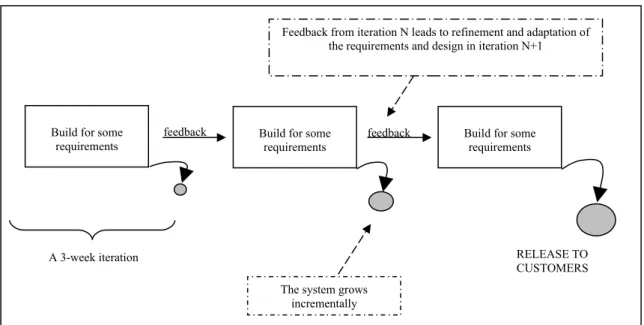
Build for some
requirements Build for some requirements
Build for some requirements
feedback feedback
A 3-week iteration RELEASE TO
CUSTOMERS
The system grows incrementally
Feedback from iteration N leads to refinement and adaptation of the requirements and design in iteration N+1
Figure 1: Iterative and incremental development
(Source: Agile & Iterative Development: A Manager’s Guide-Craig Larman)
In this paper, we have chosen Scrum, one of the methods varied from iteration and incremental development, to test its usability and to compare it with waterfall method by using Walk-Through and questionnaire technique.
2.0 Scrum method
Scrum is an agile method, iterative, incremental process for developing products and managing projects. [3] stated that Scrum is very different from traditional methodologies based on engineering disciplines, where a project is approached as a whole task rather than subsets, with progress marked at the time of project completion.
Since Scrum is one of a software development process, it has its own task documents and lifecycle. Scrum has three types of task documents. The first one is Product Backlog. Product Backlog is the master list of all functionality desired in the product. The second document is Sprint Backlog. It is the list of tasks that the Scrum Team is committing that they will complete in the current Sprint. Items on the Sprint Backlog are drawn from the Product Backlog by the team based on the priorities set by the Product Owner and the team's perception of the time it will take to complete the various features. The last document is Release Burndown Chart. This chart is for Scrum Team to tracks its progress against a release plan by updating a release burn-down chart at the end of each sprint.
For Scrum lifecycle, it is composed of four phase: Planning, Staging, Development, and Release.
Planning is the first phase in the lifecycle. It is where the vision and expectation of the project will be defined. Product Backlog starts to be written during this phase. The second phase is Staging. It is where additional requirements can be added and prioritization of items to work on the first iteration will be done. Those requirements should be enough to start first iteration. The next iteration also will start with Staging phase.
though Scrum Master is like a project manager to other development process, but in Scrum, Scrum Master does not have authority over Product Owner, over Scrum Team or over anybody. Scrum Master just responsible to guide Product Owner and Scrum Team to make sure Scrum process is used as it is described.
During the Sprint Planning Meeting, the Product Owner will describe the highest priority features to the team. The team asks enough questions during this meeting so that they can go off after the meeting and determine which tasks they will move from the Product Backlog to the Sprint Backlog. The Product Owner does not have to describe every item being tracked on the Product Backlog. Depending on the size of the backlog and the speed of the team it may be sufficient to describe only the high priority items, saving the discussion of lower priority items for the next Sprint Planning Meeting. Typically, the Scrum Team will typically provide guidance when they start to get further into the backlog list than they know could be done in the next sprint [9].
In the Sprint Planning Meeting, the Scrum Team and the Product Owner define a "Sprint Goal" together, which is a short description of what the sprint will try to achieve. The success of the sprint will be reviewed during the Sprint Review Meeting against the Sprint Goal. After the Sprint Planning Meeting, the Scrum Team meets separately to discuss what they heard and decide how much they can commit to during the coming Sprint. [9] indicated that in some cases there will be negotiation with the Product Owner after the meeting but it will always be up to the team to determine how much they can commit to completing.
In every Sprint, there is also Daily Scrum Meeting (also known as Daily Scrum). This meeting is held in order to make sure every team stays on track. The Daily Scrum is not used as a problem-solving or issue resolution meeting. Issues that are raised are taken offline and usually dealt with by the relevant sub-group immediately after the Daily Scrum. During the Daily Scrum, each team member provides answers to the following three questions [5]:
i. What have you done since the last Scrum?
ii. What will you do between now and the next Scrum?
iii. What is getting in the way (blocks) of meeting the iteration goals?
By focusing on what each person accomplished yesterday and will accomplish today, the team gains an excellent understanding of what work has been done and what work remains. According to [9], the Daily Scrum is not a status update meeting in which a boss is collecting information about who is behind schedule. Rather, it is a meeting in which team members make commitments to each other. For example, if a programmer stands up and says “Today I will finish the data storage module” everyone knows that in tomorrow's meeting he will say whether or not he did finish. This has the wonderful effect of helping a team realizes the significance of these commitments and that their commitments are to each other, not to some far-off customer or salesman.
The last phase is the Scrum lifecycle is the Release phase. Here, the product is ready to be delivered to the customer. Documentation of the product and training will also be provided.
Scrum is a good method to use for maintenance, because a new iteration can be done for each bug fixed or new feature added. The developers can go through the four stages to plan and execute the iteration. The daily meetings ensure that adequate progress is made throughout the iteration [8].
3.0 Usability Testing Techniques
Walk-through technique requires researcher to set up usability test situation with invited users. Then, the researcher and the invited users prepare mock-ups artefacts with realistic scenario and walk-through the test situation. While doing the walk-through, it is important for the participant to document any particular things happen in every step to keep a record of what is good and what needs improvement in the process/design. Usually, the main focus of the walk-through is to experience the test situation and to establish how easy to use the test subject.There are four things needed to do the walk-through:
i. a description of the test subject. ii. a description of the task the user is to
perform on the test subject.
iii. a complete, written list of the actions needed to complete the task with the given test subject.
iv. an indication of who the users are and what kind of experience and knowledge the evaluators can assume about them.
the participants and tell a believable story on its usability.
Questionnaires are sets of predefined questions arranged on a form and typically answered in a fixed sequence. The questionnaire is usually completed by the individual under study, but it is also possible for the questionnaire to be administered by a second party. There are essentially two types of questions: closed questions (respondents are asked to select an answer from a choice of alternatives) or open questions (the respondent is free to provide his own answer).
There are three basic types of questions:
a. Factual-type questionnaires
Such questions ask about public, observable information that it would be tedious or inconvenient to get any other way. For example, number of years that a respondent has been working with computers or what kind of education did the respondent gets. Or, how many times did the computer break down in a two-hour session, or how quickly did a user complete a certain task.
b. Opinion-type questions
These ask the respondent what they think about something or someone. There's no right or wrong answer, such as “will we vote for Mr A or Mr B?” An opinion survey does not concern itself with subtleties of thought in the respondent; it is concerned with finding out how popular someone or something is. Opinion questions direct the thought of the respondent outwards, towards people or artefacts in the world out there. Responses to opinion questions can be checked against actual behaviour of people, usually, in retrospect.
c. Attitude questions
Attitude questions focus the respondent's attention to inside themselves, to their internal response to events and situations in their lives. There are a lot of questionnaires consisting of attitude questions about experiences with Information Technology, the Internet, Multimedia and so on.
There are two types of format in questionnaire techniques. The first type is close-ended questionnaire and the other type is open-ended questionnaire. A closed-ended questionnaire is one that leaves no room for individual comments from the respondent. The respondent replies to a set of questions in terms of pre-set responses for
each question. These responses can then be coded as numbers.
An open-ended questionnaire requests the respondent to reply to the questions in their own words, maybe even to suggest topics to which replies may be given. The ultimate open-ended questionnaire is a 'critical incident' type of questionnaire in which respondents explain several good or bad experiences, and the circumstances which led up to them, and what happened after, all in their own words.
Walk-through technique is chosen for this project because it is suitable for evaluating a process where it allowed researcher and other participants to experience the Scrum process in developing web-based modules. The participants may give some comments on usability of Scrum based on their experience, and these comments become a reliable source for evaluating Scrum. Questionnaire is chosen because it is one of the easiest ways to gather information with lower cost.
4.0 Operational framework
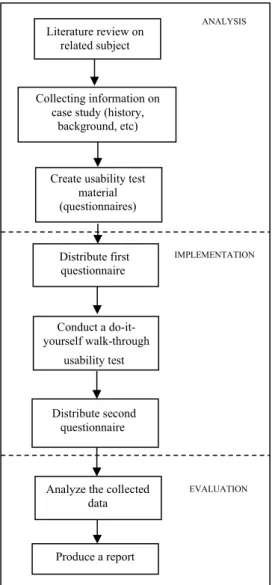
There are three main stages in this framework: Analysis, Implementation and Evaluation. Figure 2 shows the project operational framework that will be used in this study.
1. Analysis Stage
Analysis stage has three activities:
a. Literature review on related subject
The purpose of this activity is to produce a literature review on agile methods, Scrum methods, the case study (TBS web based system) and usability test methods.
b. Collecting information on case study
c. Create usability test material (questionnaires)
This activity is to create two questionnaires that can get information from the users about their knowledge and experience on developing software. The first questionnaire will ask more on the development of system module using current software development method. The second questionnaire will ask more on the development of system module using Scrum method. The results of these two questionnaires will be analyze and then compared to see which software development method is the best method.
2. Implementation Stage
Experiment will start from this stage. All documents, roles, practices will be observed and analyzed in the Evaluation Stage. Implementation stage has three activities:
a) Distribute pre-questionnaire
In this activity, we will distribute a questionnaire to the staffs that involved in the development of the current system module. The information from the questionnaire will contain the experience of the staffs while using the current software development method.
b) Conduct a walk-through usability test
To conduct this usability test method, a scenario have to be created but with the real end users. In this project, the scenario is the redevelopment of system modules and the users are developers and customers. This test will take about two and a half months to finish. All Scrum practices will be implemented during this test in order to get the experiences of using Scrum method.
c) Distribute post-questionnaire
In this activity, the questionnaire will be distributed to persons who involve in the redevelopment of system module using Scrum method.
This questionnaire is important in order to know what the users opinions and comments when developing a web-based system using Scrum. In this questionnaire, the users are expected to point out their true “feeling” when answering the question. All positive and negative comments on Scrum method are welcome.
Figure 2: Project operational framework
3. Evaluation Stage
Evaluation stage consists of two activities:
a) Analyze the collected data
The purpose of this activity is to analyze all Scrum task documents such as Product Backlog, Sprint
ANALYSIS
IMPLEMENTATION
EVALUATION
Literature review on related subject
Distribute first questionnaire Collecting information on
case study (history, background, etc)
Create usability test material (questionnaires)
Distribute second questionnaire
Analyze the collected data
Produce a report Conduct a do-it-yourself walk-through
Backlog, and Release Burndown Chart. The information from both of the questionnaires will also be analyzed. Comparison between current software development
method and Scrum method will be done base on those data.
Software development process (waterfall method) Planning Requirement
analysis Design ImplementationIntegration & MaintenanceOperation & Duration
(based on
milestone) 1 month 15 days 1 month 15 days on going
Personnel in
charge Project manager,
clients
Project leader, clients, system analyst
System architect, system analyst, project leader
System analyst, programmers
Testers
Documents
involves documentProposal
(including software development
plan)
Use case model, user interface, database design,
Gantt chart, test plan, test description
Function al design, technical design,
GUI design.
Implementatio
n model test plan, testTest cases, description,
manual
Degree of vitality of every document
High High High Medium Medium
Customer
involvement High High None None Medium
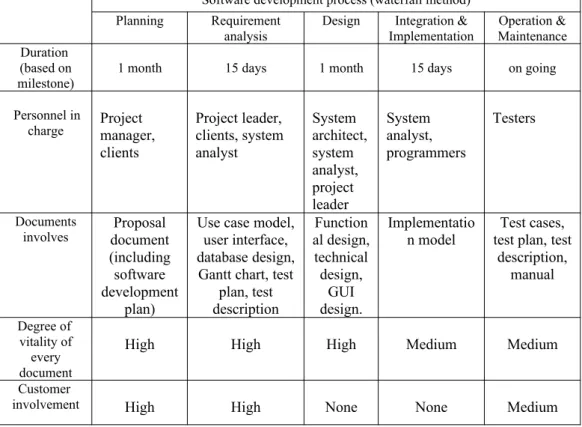
Table 1: Some of the information gathered from pre-questionnaire
b) Produce a report
All results that have been analyzed will be written in our next report.
5.0 Results
In order to get information from user on the experience when developing the current TBS modules, a set of pre-questionnaire was distributed to the involved developers and customers. This questionnaire contains questions related to developer and customer’s experiences in software development especially during the development of TBS web based system modules. Table 1 are the data that has been gathered based on first questionnaire feedbacks.
Based on Table 1, the software development process is divides into five categories in sequence; planning, requirement analysis, design, integration and implementation, and the last one are operation and maintenance. From the table, we could see that documentations are very important in the first two processes. High level indicates that without the documents, the
development of the project will have big problems because it will affect the next process. Medium level indicates that without the document, the development still can be run but there will be some difficulties in maintaining the system. Low level indicates that without the documents, the development of the project still can be run smoothly but with fewer difficulties. There are also the levels of customer involvement in every process. High level means without the customer involvement, the development cannot be run properly and will leads to the failure of the project. Medium means the development of the project still can be run without customer involve but with some difficulties. Low means the development of the project still can be run without customer involve but with fewer difficulties and none means there is no customer involve in the process.
At the moment we are continuing our research in two directions. First, we aim to finish implementing the rest of the operational framework. Second, we are analyzing the usability test results and compare it with the earlier result.
References
1. Alistair Cockburn (2003). People and Methodologies in Software Development. University of Oslo, Norway.
2. Alan S. Koch (2005). Agile Software
Development: Evaluating the methods for your organization. Artech House Publishers.
3. C. Mann and F. Maurer (2005). A Case Study on the Impact of Scrum on Overtime and Customer Satisfaction.
4. Conhango Limited (2005). What is Agile?.
http://www.scrum-master.com/index.asp. Browsed
on 10th February 2006.
5. C. Larman (2002). Applying UML and Patterns: An Introduction to Object-Oriented Analysis and Design and the Unified Process. 2nd Edition,
Prentice Hall.
6. C. Larman (2003). Agile & Iterative Development: A Manager’s Guide. Addison Wesley.
7. D. J. Mayhew (1999). The Usability Engineering Lifecycle. Morgan Kaufmann Publishers Inc., US.
8. D. Law (1988). Methods For Comparing Methods: Techniques in Software Development. 1st Edition,
NCC Publications.
9. Dumas, J. and Redish, J. (1999). A Practical Guide to Usability Testing. Portland, OR: Intellect.
10.F. Spiller (2005). Demystifying Usability: How many users should you test with in usability testing? (Latest Research).
http://experiencedynamics.blogs.com/site_search_
usability/2005/01/latest_research.html. Browsed
on 15th March 2006.
11.IEEE Computer Society Professional Practices Committee (2004). Guide to the Software Engineering Body of Knowledge (SWEBOK).
IEEE.
12.K. Erdil, E. Finn, K. Keating, J. Meattle, S. Park and D. Yoon (2003). Software Maintenance as Part of the Software Lifecycle.
13.K. Schwaber and M. Beedle (2001). Agile Software Development with Scrum. Prentice Hall.
14.Krueger, R. A. (1988). Focus groups: A practical guide for applied research. Newbury Park, CA: Sage Publications.
15.L. Williams and A. Cockburn (2003). Agile Software Development: It’s About Feedback and Change. IEEE Computer Society, 39-43.
16.Maria D. Lozano, F. Montero, and P. González (2003). A Usability and Accessibility Oriented Development Process. Computer Science Research Institute of Albacete.
17.M. Macleod (1994). Usability: Practical Methods for Testing and Improvement. National Physical Laboratory.
18.Mountain Goat Software (2005). The Scrum Development Process.
http://www.mountaingoatsoftware.com/scrum/.
Browsed on 12th February 2006.
19.Nielsen, J. (1989). Usability engineering at a discount. Amsterdam, The Netherlands: Elsevier Science Publishers, B.V.
20.P. Abrahamsson, Outi Salo, J. Ronkainen and J. Warsta (2002). Agile Software Development Methods : Review and Analysis. VTT Publications 478, ESPOO.
21.P. Kutschera and S. Schäfer (2002). Applying Agile Methods in Rapidly Changing Environments.
IBM Unternehmensberatung GmbH.
22.R. Braithwaite and Lee (2004). Scrum: One Person’s Perspective.
23.Robert B. Grady (1992) Practical Software Metrics For Project Management And Process Improvement. Hewlett-Packard Professional Books, Prentice Hall.
24.Rubin, J. (1994). Handbook of usability testing: How to plan, design, and conduct effective tests. John Wiley & and Sons, New York.
25.S. Laitinen (2006), Do usability expert evaluation and test provide novel and useful data for game development?. Jounal of Usabilities Study, Issue 2, Vol. 1, pages 64-75.
26.Tabung Baitulmal Sarawak (2005).
http://www.tabung-baitulmal-sarawak.org.my.
Browsed on 5th January 2006.
27.University Washington Library (2005). Usability Overview.
http://www.lib.washington.edu/usability/overview. html. Browsed on 5th March 2006.
28.V. Szalvay (2004). An Introduction to Agile Software Development. Danube Technologies, Inc.
Informatics, University of Manchester, United Kingdom: Ph.D. Thesis.
30.William W. Myers (2004). Agile Methodologies and Chaos Revisited. Information Builders Summit 2004 User Conference.