QUALITY OF SERVICE FOR VIDEO PACKET OVER PEER TO PEER NETWORK USING ACTIVE MEASUREMENT
MUHAMMAD AFFAN JONI
A project report submitted in partial fulfillment of the
requirements for the award of the degree of
Master of Engineering (Electrical – Electronics and Telecommunication)
Faculty of Electrical Engineering
Universiti Teknologi Malaysia
v
ABSTRACT
The purpose of this project is to see the performance of Peer-to-Peer (P2P)
network in Gnutella system. P2P are self-organizing networks that aggregate large
amount of heterogonous computers called nodes or peers. In P2P systems, peers can
communicate directly with each other for the sharing and exchanging of data, besides
the data exchange these peer nodes also share their communication and storage
resources. One of the P2P mostly used is Gnutella. Gnutella is feasibly and still
firmly established as the third-largest peer-to-peer network. This project will observe
the problem of real-time streaming of video packet over Gnutella system from a
single sender to a single receiver. This project concentrate on the development of an
optimum model using Gnutella system as well as evaluating of the quality adaptation
of the streaming mechanism. The simulation process was done using NS2 with 3
scenarios, which are using bandwith 512 kbps, 256 kbps, and 128 kbps. The
simulation result shows that to achieve the good quality of sending video packet is
using bigger bandwith. It is also shows that delay time will increase when the traffic
is full. In order to achieve the right bandwith to send the video packet over the
Gnutella system, it is depend on the frame rate, quantization and the resolution of the
vi
ABSTRAK
Penyelidikan ini adalah bertujuan untuk mengkaji prestasi rangkaian Peer to
Peer dalam sistem Gnutella. P2P adalah rangkaian pengurusan diri yang mempunyai jumlah kumpulan yang besar bagi computer yang berbeza dikenali sebagai nod atau
peers. Dalam sistem P2P, peers dapat berinteraksi secara terus diantara satu sama lain dalam penukaran data. Selain itu, ia juga dapat berkomunikasi dan berkongsi
sumber data. Salah satu sistem P2P yang sering digunakan ialah Gnutella. Gnutella
adalah bersesuaian dan masih membangun sebagai rangkaian P2P ketiga terbesar.
Masalah masa nyata bagi paket video dalam sebuah sistem Gnutella daripada
pengirim kepada penerima dapat diperhatikan. Penyelidikan ini memfokuskan
kepada pembangunan model optima menggunakan system Gnutella untuk menilai
adaptasi kualiti bagi mekasnisma rangkaian. Proses simulasi menggunakan NS2
dengan 3 scenario yang berbeza yaitu menggunakan bandwith 512 kbps, 256 kbps
dan 128 kbps. Keputusan menunjukkan bahawa kualiti yang bagus bagi
penghantaran paket video adalah menggunakan bandwith yang besar. Ini
menunjukkan bahawa masa tangguhan berkadar langsung dengan trafik. Beberapa
aspek iaitu kadar rangkaian, kuantiti dan resolusi paket video mempengaruhi
vii
TABLE OF CONTENTS
CHAPTER TITLE PAGE
DECLARATION DEDICATION
ACKNOWLEDGEMENTS ABSTRACT
ABSTRAK
TABLE OF CONTENTS LIST OF TABLES LIST OF FIGURES LIST OF GLOSSARY LIST OF SYMBOLS LIST OF APPENDIX
ii iv v vi vii vii x xi xiii xv xvi
1 INTRODUCTION
1.1 Background
1.2 Problem Statement
1.3 Objective
1.4 Project of Scope
1.5 Methodology
1.6 Organization of Project Report
1 1 2 3 3 4 5
2 LITERATURE REVIEW
2.1 Introduction
2.2 Peer to Peer (P2P) System
2.2.1 Characteristic and Three-Level Mode
6
6
6
viii
2.2.2 Advantages of Peer to Peer Networks
2.3 Quality of Service
2.3.1 Problem of QoS
2.3.2 Qos Performance Dimension
2.3.2.1 Network Availability
2.3.2.2 Bandwidth
2.3.2.2.1 Available Bandwidth
2.3.2.2.2 Guaranteed Bandwidth
2.3.2.3 Delay
2.3.2.4 Jitter
2.3.2.5 Loss
2.3.2.6 Emission Properties
2.3.2.7 Discard Priorities
2.3.3 QoS Mechanism
2.4 Technique of Network Measurement
2.4.1 Passive Measurement
2.4.1.1 Principles of Passive Measurement
2.4.1.2 Implementation
2.4.1.2.1 Software Based Measurement
2.4.1.2.2 Hardware Based Measurement
2.4.2 Active Measurement
2.4.2.1 Simple Network Management Protocol
(SNMP)
2.4.2.2 PING
2.4.2.3 Traceroute
2.4.2.4 One-Way Measurements
2.5 Gnutella
2.5.1 Gnutella Protocol
2.5.2 How Gnutella Works
2.5.3 Design of Gnutella
2.6 Queuing Theory
2.6.1 Little’s Formula
2.6.2 First in First Out In Peer to Peer
ix
3 PROJECT DESIGN
3.1 Introduction
3.2 Gnutella System Model
3.3 Gnutella Simulator in NS2
3.3.1 Architecture of Gnutella Simulator
3.3.2 Framework Component
3.3.3 Gnutellasim Component
3.3.4 Implementation Details
3.4 Configuration of The Network
3.5 Video Packet over Gnutella System
3.6 Active Measurement
3.7 Methodology 3.8 Summary 44 44 45 46 47 49 50 51 53 54 58 59 60
4 SIMULATION RESULT AND PERFORMANCE
ANALYSIS 4.1 Introduction
4.2 The Queue Simulation Result
4.3 The Delay Simulation Result
4.4 The RTT Simulation Result
4.5 Summary 62 62 63 66 68 70
5 CONCLUSION
5.1Conclusion
5.2Proposed Future Work
71
71
72
REFERENCES Appendices A - E
73
x
LIST OF TABLES
TABEL NO. TITLE PAGE
2.1
2.2
Description of Gnutella
Configuration of The Network
37
xvi
LIST OF APPENDIX
APPENDIX TITLE PAGE
A
B
C
D
E
Main Programming Code in NS2
ST File
Queue Programming Code in NS2
Delay Programming Code in NS2
Frequency of Queue Programming Code in NS2
76
82
88
90
CHAPTER 1
INTRODUCTION
1.1 Background
Content sharing between communities has revolutionized the Internet. During
the last few years. A new phenomenon had changed the Internet business model
especially for ISP (Internet Service Provider). Peer-to-Peer (P2P) systems have
gained tremendous intentions during these years. The P2P phenomenon is facilitating
information flow from and back to the end users. Unlike traditional distributed
systems based on pure client/server model, P2P networks are self organizing
networks that aggregate large amount of heterogeneous computers called nodes or
peers. In P2P systems, peers can communicate directly with each other for the
sharing and exchanging of data, besides this data exchange these peer nodes also
share their communication and storage resources. The characteristics of P2P systems
make them a better choice for multimedia content sharing/streaming over IP
networks. P2P systems are dynamic in nature where nodes can join and leave the
network frequently and that might not have a permanent IP address and observe
dynamic changes over the inter connection links. Virtual networks are built on the
top of these networks at the application level in which individual peers communicate
with each other and share both communication and storage resources, ideally directly
without using a dedicated server.
The main concept of P2P networking is that each peer is a client and a server
at the same time. P2P media sharing uses two basic concepts. In the ‘open after-
2
of the file from different participants, while the ‘play-while downloading’ mode
allows playing while downloading the content, which is commonly known as
streaming. The ‘play-while-downloading’ has many advantages over
‘open-after-downloading’ as it requires less memory and the client is not expected to wait for a
long time to finish download. In this thesis, we consider the Peer-to-Peer streaming
problem is defined as a content streaming from multiple senders to a single receiver
in the P2P network, i.e. a single receiver peer is receiving same content from
different peers present in the P2P network. Multiple sender peers are selected on the
fact that a single sending peer may not be able or willing to share an outbound
bandwidth of actual playback rate. Dynamic behavior of P2P systems is another
reason of selecting multiple sender peers for media sharing, as it is possible that any
sender peer sharing media can leave/crash without any prior notification (Mubashar
Mushtaq and Toufik Ahmed, 2006)
This project used one of the Peer to Peer that mostly used now, which is
Gnutella. Gnutella is a system in which individual can exchange files over the
Internet directly without going through a Web site in an arrangement which
sometimes described as peer-to-peer. Like Napster and similar Web sites, Gnutella is
often used as a way to download music or video files from or share them with other
Internet users and has been an object of great concern for the music publishing
industry. Unlike Napster, Gnutella is not a Web site, but an arrangement in which
you can see the files of a small number of other Gnutella users at a time, and they in
turn can see the files of others, in a kind of daisy-chain effect. Gnutella also allows
you to download any file type, whereas Napster is limited to MP3 music files.
1.2 Problem Statement
Various approaches have been demonstrated in the past in integrated
network. Peer-to-Peer (P2P) systems have gained tremendous intentions during these
years. The Peer-to-Peer (P2P) phenomenon is facilitating information flow from and
3
the sharing and exchanging of data. The characteristics of P2P systems make them a
better choice for multimedia content sharing/streaming over IP networks. For many
of these applications, it is important to observe the problem of real-time streaming of
video packet over Peer-to-Peer networks (P2P) from a single sender to a single
receiver.
In short, the problems presented by designing can be broken into: • Understanding the capability of peer to peer system
• Understanding the operation theory and modeling of peer to peer system for the Gnutella system
• Understanding the operation of active measurement
• Understanding the operation theory of Quality of Service especially in queue, delay and RTT.
1.3 Objective
The aim of this research is to describe the design and measurement of
Peer-to-Peer System for the Gnutella system using Active Measurement. To make things
clear, the objective of this research can be broken down into:
• To investigate the video packet transmission over Peer-to Peer networks (P2P) in Gnutella system using the active measurement
• To investigate the performance of Peer-to Peer (P2P) networks
1.4 Project of Scope
This research will analyze the performance of Peer-to-Peer networks for
4
simulated using NS2 v2.26 with Operating System Fedora core 2. The project will
focus on the Quality of Service which is using queue, delay and RTT.
In order to send the video packet in Gnutella system, the packet will send
under the UDP protocol which is using 3 scenarios in the networks.
1.5 Methodology
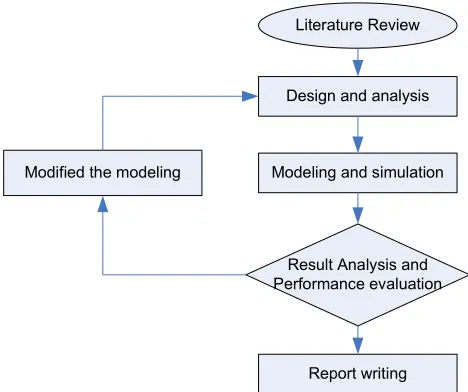
The methodology of this project will follow the next flow chart:
1. Through literature work and review on Quality of Service of peer-to-peer
performance.
2. Design and analysis the topology of the Gnutella system.
3. Modelling and run the simulation of the Gnutella system using NS2.26
with operating system Fedora core 2.
4. Performance analysis of the QoS networks video packet over Gnutella
networks using active measurement
5. Report writing
Figure 1.1 Flowchart of the methodology Literature Review
Design and analysis
Modeling and simulation Modified the modeling
5
1.6 Organization of Project Report
This project report consists of five chapters describing all the work done in
the project. The project report organization is generally described as follows.
The first chapter explain the introduction of the project and problem this
project try to solve which describe the motivation of this project. This chapter sets
the work flows according to the objectives and scope of project.
Chapter two will discuss the theories of Peer to Peer system, Quality of
Service, and the Active measurement.
Chapter three will present the steps on designing the Gnutella simulator, the
software used for design and simulation, the structure of the designed Gnutella, and
the measurement techniques.
Result and analysis are presented in chapter four to compare the performance
of the Gnutella system.
The last chapter highlights the overall conclusion of the project with future
work suggestion to improve QoS of the Peer to Peer network. The project is
summarized in this chapter to give general achievements and the future
REFERENCES
Altman, Eithan and Jimenez. Tania. NS Simulator for Beginners. Unive.de los
Andes. December 4 2003
Androutsellis, Theotokis Stephanos and Spinellis, Diomidis. A survey of peer-to-peer
content distribution technologies. ACM Computing Surveys. 36(4).335–371. December 2004.
Antonio, Fernando. Quality of Service In the Internet. DUP Science. 2004
Balliache, Leonardo. Differentiated Service on Linux HOWTO. http.//opalsoft.net/qos. 2003
Brownlee, Nevil and Lossley, Chris. Fundamentals of Internet Measurement. A
Tutorial. Keynote Systems. 2001
Carsten, Rossenhövel. Peer-to-Peer Filters. The Big Report. Internet Evolution.
March 2008
Chih-Heng Ke, Ce-Kuen Shieh, Wen-Shyang Hwang, Artur Ziviani. An Evaluation
Framework for More Realistic Simulations of MPEG Video Transmission. Journal of Information Science and Engineering (accepted) (SCI. EI)
Cisco. Internetworking Technologies Handbook. Cisco.
Claypool, Mark., Kinicki, Robert., Li, Mingzhe., Nichols, James. and Wu, Huahui.
Inferring Queue Sizes in Access Networks by Active Measurement. CS Department at Worcester Polytechnic Institute Worcester. MA. 01609. USA.
Cornelli, Fabrizio Choosing Reputable Servents in a P2P Network. Università di
Milano. Italy
Chun, Wang. Network Application Design Using TCP/IP Protocol In Windows.
Submitted in Partial Fulfillment of the Requirement for the Degree of Master
of Science in Computer and Information Sciences
Detlef, Schoder and Kai, Fischbach. Core Concepts in Peer-to-Peer (P2P)
May 2008 74
Engle, Marling and Khan, J. I.. Vulnerabilities of P2P systems and a critical look at
their solutions. May 2006
Fall, Kevin and Varadhan, Kannan. The ns Manual. UC Berkeley. LBL. USC/ISI.
and Xerox PARC. January 14. 2008
Forouzan, Behrouz. Data Communications and Networking. McGraw Hill. 2004
Gibson. Jerry D. The Communication Handbook. Southern Methodist University.
Texas. 2002
Geoff Huston, Telstra. Measuring IP Network Performance. The Internet Protocol
Journal - Volume 6, Number 1. 2003
Hardy. William C. QoS Measurement and Evaluation of Telecommunication Quality
of Service. John Wiley. 2001
Haseb, Maheen. Analysis of Packet Loss Probing in Packet Network. PhD Thesis.
Queen Mary University of London. 2006
He, M. Ammar, G. Riley. H. Raj and R. Fujimoto Q. A Framework for Packet-level
Simulation of Peer-to-Peer Systems. MASCOTS 2003 http.//hpds.ee.ncku.edu.tw/~smallko/ns2/Evalvid_in_NS2.htm
http.//searchnetworking.techtarget.com/sDefinition/0..sid7_gci1250602.00.html#
http.//www.cc.gatech.edu/computing/compass/gnutella/
http.//www.clip2.com. The Gnutella Protocol Specification
http.//www.isi.edu/nsnam/ns/
http.//www.kazaa.com
http.//www.pcmag.com/encyclopedia_term
http.//www.tech-faq.com/udp.shtml
ITU-T Study Group 2. Teletraffic Engineering Handbook
Khan, Javed I. and Wierzbicki, Adam. Foundation of Peer-to-Peer Computing.
Special Issue. Elsevier Journal of Computer Communication. (Ed). Volume
31. Issue 2. February 2008
Kulkarni. Amit B and Bush. Stephen F . Active Networks and Active Network
Management A Proactive Management Framework. Kluwer Academic Publisher. 2002
Minar, Nelson. Peer-to-Peer: Harnessing the Power of Disruptive T. O’Reilly. 2001
Moore, Rose. Analysis of Voice Over IP Traffic. Mathematics Department,
May 2008 75
Mushtaq, Mubashar and Ahmed, Toufik . Adaptive Packet Video Streaming Over
P2P Networks Using Active Measurements. LaBRI University of Bordeaux. 2006
Nader, F. Mir. Computer and Communication Networks. Prentice Hall. November
02. 2006
Nortelnetwork. Introduction to Quality of Service (QoS). nortel network. 2003
[email protected]. Tutorial for Network Simulator
Park, Kihong and Willinger, Walter. Self-Similar Network Traffic and Performance
Evaluation. John wiley and Sons. Inc.
Park, Kun I. Ph.D. QoS In Packet Networks. Springer. United States of America.
2005
Pitts, J.M. and Schormans, J.A.. Introduction to IP and ATM Design and
Performance. Wiley. December 2000
Raj, Himanshu. Packet-level Peer-to-Peer Simulation Framework and GnutellaSim.
College of Computing Georgia Institute of Technology. 2003
Ralf, Steinmetz and Klaus, Wehrle (Eds). Peer-to-Peer Systems and Applications.
Lecture Notes in Computer Science. Volume 3485. September 2005.
Ripeanu, I. Foster and A. Iamnitchi. Mapping the Gnutella Network. Properties of
Large-Scale Peer-to-Peer Systems and Implications for System Design. IEEE Internet Computing. 6(1). February 2002.
Schoder. Fischbach and Schmitt Core Concepts in Peer-to-Peer Networking.
University of Cologne. Germany. 2005
Shuman Ghosemajumder. Advanced Peer-Based Technology Business Models. MIT
Sloan School of Management. 2002.
Stallings. William . Data and Computer Communications. Pearson.2007
Stefan, Saroiu. P., Krishna Gummadi., Steven D., Gribble.A. Measurement Study of
Peer-to-Peer File Sharing Systems. Proceedings of Multimedia Computing and Networking 2002 (MMCN'02). San Jose. CA. January 2002.
Subramanian, Ramesh and Goodman. Brian D . Peer-to-Peer Computing. The
Evalution of Disruptive Technology. Idea Group Publishing. 2005 Worchester Polytecnic Institute. NS by Example. August 01. 2002
www.cisco.com
Zeinalipour, Demetris and Folias, Yazti Theodoros. A Quantitative Analysis of the