_____________________________________________________________________________________________________ 7(7): 598-603, 2015, Article no.BJMMR.2015.366
ISSN: 2231-0614
SCIENCEDOMAIN international www.sciencedomain.org
Maternal Practices Affecting Under-Five Mortality
in a Suburban Area of Jos, North-Central Nigeria
Esther Awazzi Envuladu
1*, Ize Anuoluwapo Osagie
2, Amina Mohammed
2,
John Collins
3, Elizabeth Onyi Okoh
2and Ayuba Ibrahim Zoakah
11Department of Community Medicine, University of Jos, Nigeria.
2
Department of Community Medicine, Jos University Teaching Hospital, Jos, Nigeria.
3
Department of Paediatrics, University of Jos, Nigeria.
Authors’ contributions
This work was carried out in collaboration between all authors. Author EAE designed the study, wrote the protocol and managed the literature search. Authors IAO, AM and EOO collected the data, author AIZ managed the data analysis and author JC handled the first draft of the manuscript. All the authors read and approved the final manuscript.
Article Information
DOI: 10.9734/BJMMR/2015/12937 Editor(s): (1) Dongbao Chen, Division of Maternal-Fetal Medicine, Perinatal Research Laboratories, Department of Obstetrics and Gynecology, University of California Irvine, Irvine, CA 92697, USA. Reviewers: (1) Anonymous, Brazil. (2) Anonymous, USA. (3) Anonymous, Nigeria. (4) Anonymous, Yemen. Complete Peer review History:http://www.sciencedomain.org/review-history.php?iid=947&id=12&aid=8417
Received 24th July 2014 Accepted 26th February 2015 Published 12th March 2015
ABSTRACT
Background: The report of the Population Reference Bureau (2011) which stated that 76 out of every 1,000 infants die every year due to preventable causes like malaria, diarrhea and vaccine preventable diseases in sub-Saharan Africa is worrisome. Whereas, in advanced countries, infant mortality rate has dropped significantly to only five out of every 1,000 live birth. This is what has prompted this study -to determine the predictors of under-five mortality in a suburban area in Jos Plateau State Nigeria.
Methods: The study was a community based cross-sectional survey in which households were selected by systematic sampling method from a randomly selected suburban community in Jos, Nigeria
Results: The percentage prevalence of reported under-five mortality was found to be 10.8% with the cause of death being reported as malaria (48.4%), diarrhea (38.7%), pneumonia (9.7%) and
unknown causes (3.2%), the positive predictors with significant under-five mortality were; high parity with odds of 3.3 times and p value of 0.001 in those with parity of 4-6 and about 16 times mortality with a p value of < 0.000 in those with parity greater than 6. Those who were not exclusively breastfed had 5.3 times the likelihood of mortality with a p value of 0.001 and mortality was 4 times higher in partially immunized children( p=0.027) and almost 12 times in those who were not immunized at all (p< 0.000)
Conclusion: Percentage prevalence of reported under-five mortality was found to be higher among those with higher parity, lack of exclusive breastfeeding and poor immunization status in this study.
Keywords: Maternal practices; under-5 mortality; and sub-urban area; Nigeria.
1. INTRODUCTION
Nigeria is one of the countries with the least success stories in the improvement of child survival in the past four decades despite the resources and effort put in by the Government [1]. The child mortality statistics reports of the World Health Organization in 2012 reveals that about 7.6 million children under the age of 5 die yearly and more than half of these early deaths are due to preventable or treatable conditions [2]. More worrisome is the report of the Population Reference Bureau of 2011 which stated that 76 out of every 1,000 infants die yearly due to preventable causes in sub-Saharan Africa whereas, in advanced countries, infant mortality rate has dropped significantly to only 5 out of every 1000 live birth [3].
Previous efforts to meet the Millennium Development Goals (MDGs) on the reduction of maternal and child mortality in Nigeria have shown only marginal reductions in the last 5years, making the MDGs targets of 2015 clearly unachievable using current strategies alone [4].
Some studies have identified major determinants of infant mortality to include age of mother, place of residence, prenatal consultation and delivery, mother’s education, place of residence, immediate environment, religion and work status [5].
This study aimed to determine the maternal factors and practices that are the most likely cause of death among children less than 5years of age in a suburban area of Jos, Nigeria.
2. METHODS
The study was a community based cross-sectional survey in which mothers of under-five in households were selected by systematic sampling method from a randomly selected suburban community in Jos, Plateau state
Nigeria with mothers of under-fives in the households being the study population.
The selected suburban community was Tudun Wada ward of Jos North Local government area, it is a community with mixed population of different settlers from different ethnic groups but majority are the Afizere people and most of them are traders with few civil servants. The estimated population is about 3,500 people and mothers of under-five from the households were about 960, which formed the sampling frame.
A sample size of 287 was calculated using the formula for a cross sectional study and a prevalence of under-five mortality of 125 per 1000 from the 2013 NDHS [6] was used for the calculation.
Data was collected using a semi structured interviewer administered verbal autopsy questionnaire adapted from the WHO verbal autopsy questionnaire to determine the probable cause of death of children under the age of five from the mothers. Information on the age, marital status, religion, educational level, employment status, parity and monthly earnings of the mothers and care givers and the practices of the mothers in relation to the ante-natal clinic (ANC) attendance, place of delivery, exclusive breastfeeding, immunization status of the index child were obtained. Questions were also asked to assess the nutritional value of the food given to the child at weaning, the source of drinking water and the availability of toilet facility and method of refuse disposal.
The study was conducted over a 4 months period, from December 2013 to March 2014.
after assuring them of confidentiality and the option of opting out from the study without penalty.
Three research assistants, 2 doctors and 1 community health extension worker (CHEW) previously trained on data collection assisted in data collection and the data collected was entered into and analysed with SPSS version 17 statistical software. Logistic Regression was calculated to ascertain the relationship between the practices of mothers as it relates to the care of the under-fives and under-five mortality and the results were presented in Tables.
3. RESULTS
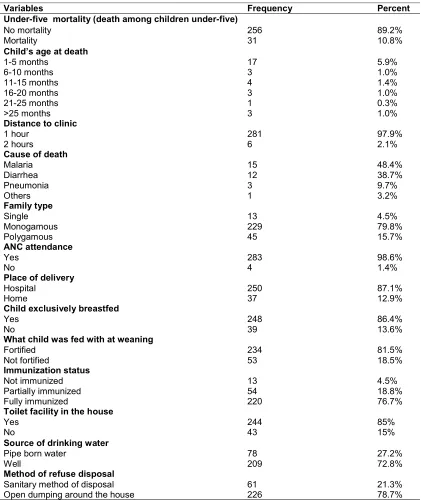
The mother’s were mostly married (94.4%) and Christians (76.7%) with secondary school education (70.8%). Only 33.1% were employed and 55.1% had their first delivery at the age of 10-19years and most had 1-3 children (Table 1). Among the respondents, 87.1% of them delivered in the hospital, 86.4% practiced exclusive breastfeeding, 81.5% weaned their children with diet fortified with protein and 76.7% of the children were fully immunized for age. Fifteen percent of the women lived in homes without toilet facility, 72.8% used well water as source of drinking water while 21.3% disposed refuse by open dumping around the house (Table 2).
The prevalence of reported under-five mortality was found to be 10.8% with the cause of death being reported as malaria (48.4%), diarrhea (38.7%), pneumonia (9.7%) and unknown causes (3.2%) (Table 2).
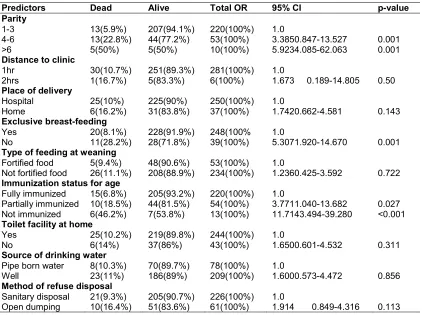
High parity was a positive predictor of mortality with 3.3 times likelihood of mortality in those with parity of 4-6 and about 16 times mortality in those with parity greater than 6 with a p-value of 0.001 and <0.001 respectively. Other predictors of under-five mortality with significant association were lack of exclusive breastfeeding (OR 5.3; p=0.001) and partial and complete absence of immunization (OR 4, p=0.027; OR 12, p<0.001 respectively). Two hours distance to the clinic had almost twice the odds of under-five mortality but was not statistically significant (p=0.50) and home delivery also had double the likelihood of under-five mortality but not statistically significant (p=0.143) (Table 3).
Lack of toilet facility showed a 1.67 times mortality in under-fives, the use of well water as source of drinking water had a 1.6 times mortality
and disposal of refuse by open dumping around the house had 1.9 times likelihood of under-five mortality but were not found to have any significant association with under-five mortality.
Table 1. Socio-demographic characteristics of mother’s of under-five children N=287
Variables Frequency Percent
Marital status Single Married Divorced Widow 9 271 5 2 3.1% 94.4% 1.7% 0.7% Religion Christian Islam 220 67 76.7% 23.3% Educational level None Primary Secondary Tertiary 8 38 203 38 2.8% 13.2% 70.8% 13.2% Employment status Employed Not employed 95 192 33.1% 66.9% Monthly income <5000 5000-20,000 21,000-50,000 51,000-100,000 200 54 30 3 69.7% 18.8% 10.5% 1%
Mother’s age at first delivery
10-19yrs 20-29yrs 30-39yrs 158 127 2 55.1% 44.2% 0.7% Parity 1-3 4-6 >6 220 57 10 76.7% 19.9% 3.5% 4. DISCUSSION
In this suburban area, it was seen that most of the women had their first delivery between the ages of 10-19 years and studies have shown that younger age at sexual debut is negatively associated with education and wealth [7]. Which is a factor affecting under-five mortality as reported in many studies.
of death for children was mostly preventable and mainly due to malaria, perinatal and early neonatal conditions, meningitis, pneumonia and diarrhea [10].
High parity, breastfeeding and weaning practices have been shown to have an effect on under-five mortality. These characteristics were examined
in this survey and it was not surprising to find that women with higher parity had a more reported likelihood of under-five mortality which was the same findings in Ghana [11], this may not be unconnected with the low socioeconomic constraints of large households leading to malnutrition, depressed immunity and death in some instances.
Table 2. Child’s characteristics and maternal practices
Variables Frequency Percent
Under-five mortality (death among children under-five)
No mortality 256 89.2%
Mortality 31 10.8%
Child’s age at death
1-5 months 6-10 months 11-15 months 16-20 months 21-25 months >25 months
17 3 4 3 1 3
5.9% 1.0% 1.4% 1.0% 0.3% 1.0%
Distance to clinic
1 hour 2 hours
281 6
97.9% 2.1%
Cause of death
Malaria Diarrhea Pneumonia Others
15 12 3 1
48.4% 38.7% 9.7% 3.2%
Family type
Single Monogamous Polygamous
13 229 45
4.5% 79.8% 15.7%
ANC attendance
Yes No
283 4
98.6% 1.4%
Place of delivery
Hospital Home
250 37
87.1% 12.9%
Child exclusively breastfed
Yes No
248 39
86.4% 13.6%
What child was fed with at weaning
Fortified Not fortified
234 53
81.5% 18.5%
Immunization status
Not immunized Partially immunized Fully immunized
13 54 220
4.5% 18.8% 76.7%
Toilet facility in the house
Yes No
244 43
85% 15%
Source of drinking water
Pipe born water Well
78 209
27.2% 72.8%
Method of refuse disposal
Sanitary method of disposal Open dumping around the house
61 226
Table 3. Predictors of under-five mortality
Predictors Dead Alive TotalOR 95% CI p-value
Parity
1-3 13(5.9%) 207(94.1%) 220(100%) 1.0
4-6 13(22.8%) 44(77.2%) 53(100%) 3.3850.847-13.527 0.001
>6 5(50%) 5(50%) 10(100%) 5.9234.085-62.063 0.001
Distance to clinic
1hr 30(10.7%) 251(89.3%) 281(100%) 1.0
2hrs 1(16.7%) 5(83.3%) 6(100%) 1.673 0.189-14.805 0.50
Place of delivery
Hospital 25(10%) 225(90%) 250(100%) 1.0
Home 6(16.2%) 31(83.8%) 37(100%) 1.7420.662-4.581 0.143
Exclusive breast-feeding
Yes 20(8.1%) 228(91.9%) 248(100% 1.0
No 11(28.2%) 28(71.8%) 39(100%) 5.3071.920-14.670 0.001
Type of feeding at weaning
Fortified food 5(9.4%) 48(90.6%) 53(100%) 1.0
Not fortified food 26(11.1%) 208(88.9%) 234(100%) 1.2360.425-3.592 0.722
Immunization status for age
Fully immunized 15(6.8%) 205(93.2%) 220(100%) 1.0
Partially immunized 10(18.5%) 44(81.5%) 54(100%) 3.7711.040-13.682 0.027
Not immunized 6(46.2%) 7(53.8%) 13(100%) 11.7143.494-39.280 <0.001
Toilet facility at home
Yes 25(10.2%) 219(89.8%) 244(100%) 1.0
No 6(14%) 37(86%) 43(100%) 1.6500.601-4.532 0.311
Source of drinking water
Pipe born water 8(10.3%) 70(89.7%) 78(100%) 1.0
Well 23(11%) 186(89%) 209(100%) 1.6000.573-4.472 0.856
Method of refuse disposal
Sanitary disposal 21(9.3%) 205(90.7%) 226(100%) 1.0
Open dumping 10(16.4%) 51(83.6%) 61(100%) 1.914 0.849-4.316 0.113
The result from this study did not show any significant association between the distance to the health facility and the place of delivery with under-five mortality which is consistent with the findings of the study conducted in Gambia which found no association between the distance to health facility and under-five mortality [12] even though their study was a rural urban comparison as oppose to this study which was conducted in a suburban community.
Studies have shown that early initiation and exclusive breastfeeding up to six months of age prevent deaths from pneumonia, diarrhoea and neonatal sepsis, while exclusive breastfeeding has been estimated to avert about 13% of all under-five deaths [13]. It was seen from this study that women who did not practice exclusive breastfeeding recorded a higher under-five death and it might have been due to depressed immunity, occurrence of diarrhea and probably malnutrition among the children.
The food items that were reported to be given to children during weaning was assessed by the
research team and those who gave plain pap or food not containing adequate nutrient were considered to be unfortified while those who had milk, groundnut or crayfish in addition to protein and cereal food were considered to be fortified food. It was however observed that there was no significant association with under-five mortality.
Immunization is an important factor related to under-five mortality and this was clearly demonstrated in this study and was consistent with another study, which showed an association between lack of immunization and child mortality [9]. This is not surprising following the evidence that immunization protects children from the childhood killer diseases which is why worldwide it is advocated that children should be fully immunized in order to be protected from the killer diseases [13].
However, findings from this study did not show any important relationship between lack of toilet facility and lack of portable drinking water with under-five mortality even though they are factors that are known to increase the prevalence of diarrhea due to contamination of water and food substances.
5. CONCLUSION
Under-five mortality is relatively high in this suburban area and factor such as lack of exclusive breastfeeding and immunization were found to have an important link with under-five mortality in addition to having a large family.
ACKNOWLEDGEMENTS
The authors sincerely appreciate the Network on Behavioural Research for Child Survival in Nigeria for the opportunity given to them to present this work in their meeting and the technical advice that was given which has improved the quality of the work.
COMPETING INTERESTS
Authors have declared that no competing interests exist.
REFERENCES
1. Godson MC, Nnamdi MJ. Environmental determinants of child mortality in Nigeria. JSD. 2012;5(1):65-75.
2. Adeyele IT, Ofoegbu DI. Infant and child mortality in Nigeria: An Impact Analysis. IJEPT. 2013;3(2):122-132.
3. Population Reference Bureau, World Population Data Sheet. (Washington D.C); 2011.
4. Millennium Development Goals. Nigeria MDGS report. 2013;29-33.
5. Akoto E, Tambashe BO. Socio-economic Inequalities in Infant Mortality among Urban and Rural Areas in Sub-Saharan Africa. 2000.
Available:www.demogr.mpg.de/paperLast Accessed on 17/5/2014.
6. Nigeria Demographic and Health survey (NDHS). Trends in early childhood mortality. 2013;119.
7. Remez L, Prada E, Singh S, Bixby L R, Bankole A. Ensuring a healthier tomorrow in Central America: Protecting the sexual and reproductive health of today's youth, New York: Guttmacher Institute; 2008. 8. Nigeria dem Sographic and health survey.
Infant and child mortality levels and trends. 2003;118.
9. Haroun HM, Mahfouz MS, Ibrahim KH. Level and determinants of infant and under-five mortality in wad-medani town, Sudan. J Family Community Med. 2007; 14(2):65–69.
10. United Nations Children’s Fund; WHO; WB; UN. Levels and trends in child mortality, 1990-2011 report. New York; 2012.
11. Fosu MO, NyarkoIr PR. The Effect of household characteristics on child mortality in Ghana. JBAH. 2013;3(17):52-58. 12. Rutherford ME, Dockerty JD, Jasseh M, et
al. Access to health care and mortality of children under 5 years of age in the Gambia: a case–control study. Bull World Health Organ.2009;87(3):216-224. 13. World Health organization. Global
under-five mortality trend, 1980-2011 and gap for achieving the MDG 4 target. Geneva; 2012.
14. World health organization. Combating waterborne disease at the household Level (Geneva, 2007).
Available:http://www.who.int/household_w ater/advocacy/combating_disease.pdf (Last Accessed on 17/5/2014)
© 2015 Envuladu et al.; This is an Open Access article distributed under the terms of the Creative Commons Attribution License (http://creativecommons.org/licenses/by/4.0), which permits unrestricted use, distribution, and reproduction in any medium, provided the original work is properly cited.
Peer-review history: