Secret Sharing and Secure Computing from Monotone Formulae
Ivan Bjerre Damg˚ard, Jonas K¨olker, Peter Bro Miltersen∗
Department of Computer Science, Aarhus University
Abstract
We present a construction of log-depth formulae for various threshold functions based on atomic threshold gates of constant size. From this, we build a new family of linear secret sharing schemes that are multiplicative, scale well as the number of players increases and allows to raise a shared value to the characteristic of the underlying field without interaction. Some of these schemes are in addition strongly multiplicative. Our formulas can also be used to construct multiparty protocols from protocols for a constant number of parties. In particular we implement black-box multiparty computation over non-Abelian groups in a way that is much simpler than previously known and we also show how to get a protocol in this setting that is efficient and actively secure against a constant fraction of corrupted parties, a long standing open problem. Finally, we show a negative result on usage of our scheme for pseudorandom secret sharing as defined by Cramer, Damg˚ard and Ishai.
1
Introduction
1.1 A new Construction of Monotone Boolean Formulae
It is well known that there exist log-depth formulae using and and or gates that compute the majority function, this was shown by Valiant [7] using a probabilistic method. In this paper we first present a variant of of Valiant’s construction that produces log-depth formulae for the majority function usingT(2,3) gates, whereT(k, m) denotes the Boolean function that outputs 1 if and only if at leastkof itsm inputs are 1. A slight extension of the argument shows that one can efficiently construct such a formula using a procedure that succeeds with overwhelming probability1.
The formulae we construct can be used to construct new secret sharing schemes and protocols, as we explain below. None of of these constructions would follow from Valiant’s original result. This is because the type of gate(s) used in the formula is important for the properties of the secret-sharing scheme or protocol we can build, and and/or gates do not gives us any of the properties we are after. We also note that existence ofsome formula for majority using T(2,3) gates follows from the work of Hirt and Maurer [6], however that result leads to exponential size formulae.
∗
An upcoming version of this paper will include Gil Cohen, Yuval Ishai, Ran Raz and Ron Rothblum as coauthors and will contain several additional results.
1
In the standard model for computing with Boolean formulae, it is trivial that a formula for computing majority can be used to compute other thresholds by setting some of the inputs to constant values. However, to be useful in our context, a formula cannot use constants. To get the more general results we describe below, we therefore need to extend the method for constructing formulae to other basic gates thanT(2,3). This extension is new to the best of our knowledge.
1.2 New Secret-Sharing Schemes
A secret sharing scheme can be thought of as a probabilistic algorithm that takes a secretschosen from a finite set and outputs a set of n shares of s. The scheme typically has a threshold t < n
such that any subset of the shares of size at most t contains no information on s, whereas scan be computed efficiently from any t+ 1 or more shares. A subset from which the secret can be computed is called qualified.
Secret sharing schemes are essential tools in multiparty computation (MPC) protocols. Here a set of nplayers wish to compute an agreed function on some inputs they each hold. We want the computation to be secure which roughly speaking means to ensure that the result is correct and that the result is the only new information released, even if up to t players are corrupted by an adversary. A standard approach to MPC is to secret share the inputs initially, give a share of each input to each player, and compute on the shares rather than the inputs. This leads to protocols secure against t corrupted players. The best known secret sharing schemes such as Shamir’s are defined over finite fields, which leads to protocols that securely compute arithmetic circuits over the field. For instance, most of the computation one needs to do AES encryption can be naturally described by arithmetic over the fieldF28.
In this paper, we construct a family of secret sharing schemes that have new useful properties. We first present the construction mentioned above of log-depth monotone formulae for the majority function, based on T(2,3)-gates. The construction is generalized to other basic gates, such as
T(2,4)-gates, where the function computed by the large formula is theT(0.232n, n) function. From these formulae, families of linear secret sharing schemes over any finite ring follow immediately from a variant of the construction of Benaloh and Leichter[2], and we can also get integer secret sharing schemes by a simple variant of the construction. If the formula we use computes theT(k, n) threshold function, then the qualified sets will be those that have at least kmembers. We also get some additional useful properties:
Efficiency: The schemes are efficient, i.e., the number of field elements each player receives when a secret is shared increases polynomially withn, the number of players.
Multiplicativity: The scheme based onT(2,3)-gates ismultiplicative, i.e., if two secretsa, bhave been shared, then players can locally compute c1, . . . , cn such that ab= Pirici, where the
ri are fixed and public. When using T(2,4)-gates, we get a strongly multiplicative scheme,
i.e., if t is the size of a maximal unqualified set, then the reconstruction of ab by linear combination can be done by any set of n−t players, i.e., the corrupted players cannot stop the computation.
Additive Reconstruction: The reconstruction of a secret takes place by simply adding the shares, and moreover, the ri’s from the definition of the (strongly) multiplicative property
The multiplication property is necessary for use of a secret-sharing scheme in MPC. Note that although we could also get secret sharing schemes from Valiant’s original formula construction, these schemes would not be multiplicative.
The additive reconstruction property comes in handy in MPC, as follows: Since the secret sharing schemes used are typically linear, secure addition and multiplication by constants can be done with only local operations, whereas multiplications require interaction. However, the mapping
x7→xp wherep is the characteristic of the field is special in that it is an additive homomorphism, we have (x+y)p =xp+yp. This now immediately implies that if x has been secret shared using one of our schemes, one can obtain shares inxp by only local operations, every player raises each field element he holds to power p. Note that this does not work for schemes where reconstruction requires a linear combination using arbitrary coefficients (except if we work over a prime field, but here raising to powerp is the identity).
In particular, the above means that using our schemes in characteristic 2, squaring is essentially for free.
Some known linear secret sharing schemes also have additive reconstruction, for instance so called replicated secret sharing (for details, see [3]). These are not efficient, however.
1.3 Black-Box Computation over Non-Abelian Groups
A related usage of monotone formulae in cryptography is to use them to build, not just secret sharing schemes, but multiparty computation protocols. This was suggested by Hirt and Maurer [6]. The idea is very similar to the way secret-sharing schemes are built: if the formula usesT(2, 3)-gates, then one starts from a 3 party protocol, secure against one corrupted player. If the protocol has certain nice properties (that we consider later in detail), then based on the formula, one can construct ann-party protocol wherenis the number of input bits to the formula. If we let subsets of players correspond to n-bit strings where a bit is set if the corresponding player is in the subset, then the protocol will be secure against corruption of those subsets that the formula rejects. If the formula has logarithmic depth, the resulting protocol will typically be efficient, i.e., run in time polynomial in n.
In [6], the goal was to compute Boolean or arithmetic circuits securely, and to have security, not just for so-called threshold adversaries, but for general adversary structures, where the sets the adversary may corrupt are not necessarily characterized by their size.
In this paper, we observe than even for the threshold case, the idea of using monotone formulae can be very useful, namely for the case of black-box secure computing over non-abelian finite groups. Here, the goal is to compute securely the product of some elements taken from a groupG, and the protocol must work by using only the group operation, taking inverses and random sampling from
G. This problem is complete for multiparty computation in general. This follows from a result by Barrington [1].
The black-box computing problem was considered in [5], where a passively secure protocol was obtained, secure against corruption oft < n/2 parties. The construction of the general protocol is highly non-trivial and uses some rather deep results on coloring of planar graphs.
does locally must be implemented by a secure protocol. The protocol from [5] only provides secure multiplication of secret-shared group elements, so we must construct new protocols for sampling random group elements and inverting a shared group element.
Our observation also opens the door to obtaining a protocol with active security, which was a main open problem in [5]. Active security was also considered very recently in [4], where an actively secure protocol for any so called Q3 adversary structure was presented. This is optimal as far as resilience is concerned, but in general the protocol is very inefficient: the complexity is polynomial in the size of the adversary structure which is usually exponential in the number of players. Building a protocol with complexity polynomial in the number of players with active security against a constant fraction of corrupted players was left as an open problem in [4].
In this paper we solve the problem by first building protocols for 12 players that is secure against 1 actively corrupted player. This can then be combined with a formula built from T(2,12) gates to get a polynomial timen-player protocol secure against active corruption of a constant fraction
≈ 0.017 of players. The threshold could be improved significantly if we could build a (set of) protocol(s) with the right properties for 4 players that is secure against 1 actively corrupted player, but so far we were not able to do this. Note that while the result from [4] implies a 4-player protocol for secure multiplication this is not enough by itself. In addition to the extra protocols for random sampling and inversion that we needed for the passive case, we now also need comparison and this must be all compatible with the secret sharing of group elements used by the multiplication. This can be done for the 12-player protocol we mentioned, but at the time of writing we do not yet know if can be done for the 4-player case.
1.4 A Negative Result for Share Conversion.
In the final part of the paper we consider the notion of pseudorandom secret sharing (PRSS) introduced in [3], which is a tool that allows players to generate consistent shares from some secret sharing scheme using only local computation, and where the secret is pseudorandom in the view of the adversary. In [3] a PRSS construction was proposed and a lower bound was shown demonstrating that PRSS cannot scale well with the number of players, if the target secret-sharing scheme is in a certain class. Our scheme from this paper is not in this class, and furthermore, it is based on so called replicated secret sharing which was the basis of the positive result on PRSS from [3]. It is therefore very natural to speculate that our scheme could be used to circumvent the lower bound. However, this turns out not to be the case, we show how to strengthen the bound from [3] to cover any secret-sharing scheme.
2
Formulae for the Majority Function
A 2-out-of-3 threshold gate is a function on 3 bits that outputs 1 if at least 2 of input bits are 1, and 0 otherwise. Now, the main result of this section is that first of all, formulas of 2-of-3 gates for the majority function of low height exist, and secondly that for sufficiently large height they are abundant. In both cases, the formulas have height O(logn), where n = 2m+ 1 is the number of input bits.
Consider full monotone formulas of height d, i.e. with Pd−1
i=0 3i (inner) threshold gates and 3d
majority function with good probability; from this, the two above results will follow.
Lemma 1. For some constantsaand band every d≥a+blog2k, consider full formulas of 2-of-3 gates of height d. For any bit string v, a randomly chosen such formula computes the majority function on v with probability exceeding 1−(12)2k.
Proof. LetF be such a randomly picked formula of heightdand letv∈ {0,1}nbe a fixed bit vector.
Let pd be the probability over the choice of F that F doesn’t compute the majority function on
input v; that is, pd:=P r(F(v)6=M AJ(v)).
We can express pd recursively:
p0 =P r(vi6=M AJ(v))≤
m
2m+ 1 = 1 2−
1 2n
and
pd+1=P r(T h23(F1(v), F2(v), F3(v))=6 M AJ(v)) =p3d−3p2d(1−pd) = 3p2d−2p3d,
for some formulas F1,F2 and F3, whereT hab is the a-of-bthreshold function.
Consider then the functionf(x) = 3x2−2x3 and the sequencep0, f(p0), f(f(p0)), . . .; this is the
probability thatF computes something wrong (i.e. not the majority function) and this probability quickly becomes small. More precisely, we want to show that limi→∞f(i)(p0) = 0, with a precise
analysis of the depth required to go below 2−k.
Observe first that f(x)−x has roots in{0,12,1} and so f has exactly that set of fixed points. Note also that the sequence starts in p0 ∈[0,12[, and that f(12 −ε) = 12 −32ε+ 2ε3. Let 0< γ < 32
and ε0 = (12(32 −γ))
1
2. Then for allε∈]0, ε0[ we have pd≤ 1
2 −ε⇒pd+1=f(pd)< 1 2 −γε.
By induction, this means that after d iterations off,f(d)(p0)< 21 −γd21n whenever γd21n < ε0
or equivalentlyd <logγ2ε0+ logγn, so letd0 := logγ2ε0+ logγn. Thenf(dd0e)(p0)≤ 12−ε0.
This is when we bound f by the chord through (12, f(12) = 12) with slope γ. Next, we want to bound f by the chord through (16, f(16) = 272) and (12,12), which has slope 2318. Note that when
1 6 <
1 2−ε <
1 2,f(
1
2−ε) = 1 2−
23
18ε, and so afterd1 := log2318 1
6ε0 iterations,f
(dd0+d1e)(p
0)≤ 16. After
kfurther steps, f(dd0+d1+ke) <(3·1
6)2
k
= (12)2k since pd+1 <3p2d.
So, choose a γ such that 1 < γ < 32 and compute ε0. Let a ≥ logγ2ε0 + log23 18
1 6ε0 and
b = 1 + logγ2. Then for everyd ≥a+blog2k the error probability is small, pd <(12)2
k
, and so
the probability that a formula of heightdcomputes the majority function is 1−pd>1−(12)2
k as claimed.
Corollary 1. For everyn, there is a monotone formula of heightd=da+blog2ne which computes the majority function, where a andb are as above.
Proof. A randomly chosen formula F of height d will compute the majority function on a fixed input v except with probability strictly less than 2−n. But there are only 2n possible values of v,
so the wrong formulas are sparse, relative to the inputs. Formally speaking,
P r(F =M AJn)≥1−
X
v
P r(F(v)6=M AJn(v)) = 1−2npd>1−2n2−n= 0.
Corollary 2. There is a probabilistic polynomial-time algorithm for emitting a formula of depth d=da+blog22ne which computes the majority function onnbits except with negligible probability.
Proof. The algorithm simply computes d and outputs a random formula F of height d. This computes the majority function except with probability 2−2n. Then
P r(F =M AJn)≥1−
X
v
P r(F(v)6=M AJn(v)) = 1−2npd>1−2n2−2n= 1−2−n,
and so the algorithm behaves as claimed.
For example, takingT h32(b1, b2, b3) to be the majority of three bits, one can straightforwardly
(somewhat laboriously) verify that the following formula computes the majority function on five bits. We claim without proof that no formula of smaller height computes the same function.
T h32(x1, T h32(x2, x3, x4), T h32(x1, T h32(x2, x3, x5), T h32(x2, x4, x5)))
3
A Linear Secret-Sharing Scheme based on
T
(k, m)
Formulae
A secret sharing schemeS is a probabilistic algorithm that takes as input a secret s(a bit string) and a security parameterk, and outputs a set ofsharesS1, . . . , Sn. We requirecorrectness, i.e., that
from certain subsets of the sharessis uniquely determined. Such sets are calledqualified, and the family of qualified sets is called theaccess structure. We will consider threshold-taccess structures that contain all sets of size larger thant. Finally, we require privacy: for any non-qualified setAof players, letDA(s) be the joint distribution of shares given toA whensis the secret. Then privacy
simply means that DA(s) is that same for anys.
A linear secret sharing scheme (LSS) is a scheme where the secret sis chosen from a finite ring
R, and where each shareSi is a tuple of ji elements inR,Si = (si,1, . . . , si,ti), the si,j’s are called
share components. The shares are computed from the secret s and some some random elements chosen from R. Furthermore, it must be the case that reconstruction of s can be done by taking an integer linear combination of the share components. We say the scheme ismultiplicative if the following properties holds.
Definition 1. A LSS S ismultiplicative if the following holds: suppose secrets aand b have been shared using S. Consider the shares of a and b, Ai = (ai,1, ..., ai,ti), Bi = (bi,1, ..., bi,ti) held by the
i’th player and letci,j =ai,jbi,j. The for a fixed set of integer coefficientsαi,j we have:
ab=
n
X
i=1
ti
X
j=1
αi,jci,j (1)
Let C be the set of indices of players in the complement of any unqualified set. The scheme is said to be strongly multiplicative if for any suchC, there exists coefficients βi,j such that
ab=X
i∈C ti
X
j=1
Put differently, onceaandbhave been shared, the shares can be locally converted to shares ofab
in a new LSSS0, and the set of all players is qualified inS0. If the scheme is strongly multiplicative,
the set of honest players is qualified in S0.
A simple example of a multiplicative LSS is the following schemeS2/3, producing 3 shares where any set of two shares is qualified: chooses1, s2uniformly at random fromR, and sets3 =s−s1−s2.
Then we set
S1= (s2, s3), S2= (s1, s3), S3 = (s1, s2).
This scheme is clearly a multiplicative LSS. One way to argue privacy is by considering the distri-bution seen by any non-qualified set, when the secret is 0, and show that this is the same as the one you get when the secret iss. This is trivial for S3, and for the other shares, for instanceS1, it
follows from the fact that we can change the secret from 0 to s leaving S1 the same by replacing
s1 by s1+s. This new choice has the same probability as the original one.
Given a Boolean formula F consisting of 2-out-of-3 threshold gates, we can construct a LSS
F(S2/3), as follows: we identify the input bits (b1, . . . , bn) of F with the shares that are to be
produced, and the share corresponding to an input bit bi contains one share component for each
position where F refers tob. The construction then works as follows:
Secret Sharing Scheme F(S2/3).
• IfF consists of a single gate we executeS2/3 on input secret s.
• Otherwise, we have that
F(b1, . . . , bn) =T2/3(F1(b1, . . . , bn), F2(b1, . . . , bn), F3(b1, . . . , bn)),
for formulas F1, F2, F3 and where T2/3 is the 2-out-of-3 Boolean threshold gate. Now first
execute S2/3 on input secret s, to get share components s1, s2, s3. Then execute F1(S2/3)
twice, on input secrets2 ands3. Similarly, executeF2(S2/3) ons1, s3 andF3(S2/3) on s1, s2.
Note also that we only define this secret sharing scheme for formulas that are full; that is, we require that the number of gates in a formula of height h is Ph−1
i=0 3h. This can of course be
generalized to non-full trees (formulas), but this more restricted definition is sufficient for the results in this paper, and it makes the proofs simpler.
Theorem 1. F(S2/3) is multiplicative, with all αi,j = 1.
Proof. Letaandb be given. We want to argue by induction on the height of the formula tree that the secret sharing scheme is multiplicative, with allαi,j = 1.
So let’s first consider what happens ifF is a single gate. Thena=a1+a2+a3andb=b1+b2+b3;
the first player receives share components (a2, a3, b2, b3), player 2 receives (a1, a3, b1, b3) and player
3 receives (a1, a2, b1, b2). Note that ab=P3i=1
P3
j=1aibj; we let (c1,1, c1,2, c1,3) = (a2b2, a2b3, a3b2).
Similarly, (c2,1, c2,2, c2,3) = (a3b3, a1b3, a3b1) and (c3,1, c3,2, c3,3) = (a1b1, a1b2, a2b1). Then clearly
each player ican computeci,1...3, and they sum up as desired: ab=Pi,j(1·ci,j).
Next, consider what happens if F consists of multiple gates. We still have a = a1+a2+a3
and b = b1+b2 +b3, with the same share tuples being given to each player, but now the share
components are themselves shared recursively.
Consider the ci,j defined above, e.g. c1,1...3 = (a2b2, a2b3, a3b2). Since F1 is used to reshare a2
shares given to player i one can compute c0i,(2,2),1, . . . , c0i,(2,2),t
i,(2,2) such that a2b2 =
P
i,jc0i,(2,2),j.
Similarly, one can write a2b3 =Pi,jci,0(2,3),j and vice versa for a3b2, and for the remaining players
and the share components of bothaand b.
But then we can letti=Pk,mti,(k,m), summing over all (k, m) where playeriresharesak,mand
bk,m. We also let c001,1...t1 be the concatenation of all the ci,(·,·),j-values summing up to a2b2, a2b3
and a3b2, respectively. Similarly for c002,1...t2 and c3,1...t3.
Then for all iwe haveP
jci,j =
P
jc
00
i,j, and thus ab=
Pn i=1
Pti
j=1(1·c
00
i,j), which was exactly
what we wanted to show.
Theorem 2. F(S2/3) is a correct and private LSS.
Proof. If F is just a single gate, thenF(S2/3) is equivalent toS2/3.
Otherwise, F(S2/3) =T2/3(F1, F2, F3) for some formulae F1,F2 and F3. We want to argue by
induction in the height of the formula tree that the scheme is correct.
Given a secret s= s1 +s2+s3, when we execute F1(S2/3) on s2 and s3 we get tuples S1,2 =
(s1,2,1, . . . , s1,2,n1,2) and S1,3 of share components; similarly, F2 and F3 yield Si,j for i = 2,3 and
j= 1,2,3, j6=i. Clearly the concatenation of these tuples is itself a tuple.
We know that sis a linear combination of the share components,s=λ1s1+λ2s2+λ3s3, since
F(S2/3) is a LISS—in fact, we know thatλi= 1 for alli. Similarly,s2 is shared by a LISS,F1(S2/3),
sos2=λ1,2,1s1,2,1+. . .+λ1,2,n1,2s1,2,n1,2, where once again all the λ’s are = 1 (recall thatF1(S) is
a LISS). Similarly fors1 and s3, so
s=λ1(λ2,1,1s2,1,1+. . .+λ2,1,n2,1s2,1,n2,1)
+λ2(λ1,2,1s1,2,1+. . .+λ1,2,n1,2s1,2,n1,2)
+λ3(λ1,3,1s1,3,1+. . .+λ1,3,n1,3s1,3,n1,3)
= (λ1λ2,1,1)s2,1,1+. . .+ (λ1λ2,1,n2,1)s2,1,n2,1
+ (λ2λ1,2,1)s1,2,1+. . .+ (λ2λ1,2,n1,2)s1,2,n1,2
+ (λ3λ1,3,1)s1,3,1+. . .+ (λ3λ1,3,n1,3)s1,3,n1,3
=s2,1,1+. . .+s2,1,n2,1
+s1,2,1+. . .+s1,2,n1,2
+s1,3,1+. . .+s1,3,n1,3
and thus sis not just a linear combination of share components, but a sum—i.e. all λ’s are = 1. (Note that we reconstructsby taking s1 from F2 ands2 and s3 from F1. This choice is arbitrary,
and we could reassemble s in eight distinct ways.) Finally, for privacy we use the same as before to rewrite F(S2/3) = T2/3(F1, F2, F3). Say F has height h, then the Fi have height h−1. From
each of the Fi, we can get 3 formulae of height h−2, etc. down to height 1. Let G be any of
these formulae, of height h0. We claim it holds that if numbers s, s+δ has been shared using
G(S2/3), where δ ∈ R, then any unqualified set will see the same distributions in the two cases. applying this result with G = F clearly implies privacy. We show the claim by induction on h0, whereh0 = 1 is clear from the argument we gave above forS2/3. For the induction step, recall that we are executing G(S2/3) = T2/3(G1, G2, G3) for formulae Gi of height h0 −1, and this works by
G2 and s1, s2 using G3. If set A is unqualified w.r.t. G, it can be qualified w.r.t to only one of
G1, G2, G3. If A is qualified w.r.t. G3, note that sharing s+δ instead of susing the same choices
of s1, s2 will lead to the same shares being produced by G3 while the secrets being shared by G1
and G2 change, butA will still see the same distribution by induction hypothesis. IfAis qualified
w.r.t. G2, the secret can changed to s+δ, while keepings1, s3 constant by changing s2 to s2+δ.
Since A is unqualified w.r.t. G1 and G3, this change will again lead to the same distribution of
shares by induction hypothesis. The case whereA is qualified w.r.t. G1 is similar.
This construction is a variant of the Benaloh-Leichter construction from [2], the difference is they would have used additive secret sharing to handle each gate in the formula. This would have given us shorter shares, but the scheme would not be multiplicative.
This construction generalizes trivially to any formula containing threshold gates and no con-stants, and the qualified sets will be those corresponding to inputs that the formula accepts.
Note that reconstruction in the schemes we build indeed takes place by simply adding shares, as promised in the introduction.
4
A strongly multiplicative secret sharing scheme
We have looked at a secret sharing scheme based on 2-out-of-3 threshold gates. We can think of those as the smallestQ2 gate: where the string of all ones can’t be written as the bitwise OR of two
inputs which both produce 0 as the output. Equivalently, the access structure of the corresponding secret sharing scheme isQ2.
We now want to study what happens when the primitive gates areQ3: when not even the OR of
three 0-yielding inputs is sufficient to cover all inputs. In particular, we look at (t+1)-out-of-(3t+1) threshold gates, i.e. 2-out-of-4, 3-out-of-7 and so forth.
Our first theorem will show that these compose well:
Theorem 3. Suppose we have a formulaF of gates, each of which areQ3. Then the formula itself
(over, say, k inputs) is also Q3.
Proof. We will show by induction on the height of the formula that if a triple of inputs which violate theQ3 condition exist for any formula of that height, then we arrive at a contradiction.
Suppose the formula has height 0, i.e. it takes a single input and outputs it. Then any three inputs which all yield zero as the output must all be zero. But then their OR is 0, and if their OR was also 1 (i.e. the inputs witness theQ3 violation) we would clearly have a contradiction.
Suppose next that the formula has height n+ 1 for some n ≥0, and that (x1, x2, x3) is given
withF(x1) =F(x2) =F(x3) = 0 and x1∨x2∨x3 = 1k, i.e. thexi’s violate theQ3 property of F.
By assumption all gates in F, including the root gate G, areQ3. Consider its input gates Gj
forj= 1, . . . , m. Lety1 be a string of bits of lengthm, where (yi)j =Gj(xi). That is, thej’th bit
of yi is 1 if and only if the input bits ofxi cause the j’th gate to output 1.
Clearly G(yi) must be 0 for allisinceF(xi) = 0. Since the top gate isQ3, the OR of all three
yi’s can’t be 1m. Let’s say the j’th bit of the OR is zero. That means that Gj(x1) = Gj(x2) =
Gj(x3) = 0, but since the OR of (x1, x2, x3) is all ones, the OR is one at all the bit positions which
(eventually) feed into Gj. That is, they witness that Gj is not Q3. But by induction that is a
Not only is the Q3 property preserved across composition, so is strong multiplicativity. Recall
from definition 1 that strong multiplicativity means that the complement of an unqualified set of players can compute the product of two secrets r·sas a linear combination of locally computable products of share components.
Theorem 4. Suppose we have a formula F of gates, each of whose secret sharing schemes are strongly multiplicative. Then the secret sharing scheme induced byF is strongly multiplicative.
Proof. We will prove this by induction in the height of F. If F has height one, it’s a single gate which is strongly multiplicative by assumption. If F has height k+ 1, let R be the complement of a set of corruptible players. Given the set of shares of sand r held by the players in R we can reconstruct sand r.
This means we can reconstruct a set of inputs to the root gate the complement of which is corruptible. Let us say the root gate distributes shares r1· · ·rd and s1· · ·sd to those recipients
(players or subformulae). Then, since the root gate is strongly multiplicative,rs=P
i,jλijrisj for
(only) those pairs of iand j where ri and rj are sent to the same recipient (player or other gate),
for some constantsλij.
Since each subformula has height at mostk we know by induction that they’re strongly multi-plicative, sorisj =Pa,bκab(ri)a(sj)b, that is, we can writerisj as a linear combination of the shares
ofri andsj, respectively, that are sent to the same subformula. Since we only look at inputs to the
root gate we can reconstruct, the sets of corrupted inputs to the subformulae are each contained in the adversary structures of each of those formulae.2
Thus, we can write rs as a linear combination of linear combinations of shares held by the players inR. But that’s a linear combination,P
i,j,a,b(λijκab)(ri)a(sj)b, of shares from R, which is
what we wanted to show the existence of.
Next, we want to show that similar to the 2-out-of-3 case, when we compose enough 2-out-of-4 gates, we approach computing a certain threshold function.
Lemma 2. Let t0 = 16(5−
√
13) and let T be the threshold function T hndnt
0e. For some integer `
which isO(logn)and every d≥`+k, consider full formulae of 2-of-4 gates of heightd. For any bit string v, a randomly chosen such formula computes the threshold function T on v with probability exceeding 1−(12)2k.
Proof. Let pd be the probability that such a formula F of depthddoesn’t compute T(v). We can
expresspd+1 recursively when d≥1. IfT(v) = 0 thenpd+1 is the probability thatF(v) = 1, which
happens when at least two inputs to the root gate are 16=T(v), i.e. when at least two inputs are themselves wrong, which happens with probability
p(pd) =
2 4
p2d(1−pd)2+
3 4
p3d(1−pd)1+
4 4
p4d(1−pd)0 =pd2·(3p2d−8pd+ 6).
This polynomial p in pd has four fixed points: {0, t0,1,16(5 +
√
13)}. Note that 16(5 +√13) ≈
1.434>1 and t0 ≈0.2324.
Note that sincet0 is irrational, bnt0c< nt0<dnt0e=bnt0c+ 1. Lett=bnt0c, and recall that
the threshold is t+ 1. In a formula of depth 0, the probability p0 of falsely outputting 1 is the
2
number of ones divided by the number of inputs, at most nt. We want to bound this away from
t0 by the inverse of a polynomial in n. Then we want to show that by increasing the depth of the
formula, thus repeatedly applying p to the error probability, we can reduce the error probability first linearly, then exponentially.
To bound nt away fromt0, we use continued fractions. Note that we havet0 = [0; 4,3]. That is,
t0 has quotients a0 = 0,a1 = 4 andai = 3 for i≥2. We define two recursive series:
h−2 = 0 h−1= 1 hn=anhn−1+hn−2 (2)
k−2 = 1 k−1= 0 kn=ankn−1+kn−2 (3)
For instance, h0 = 0, h1 = 3 and h2 = 10 while k0 = 1, k1 = 4 and k2 = 13. Some well-known
facts about continued fractions are that the series hi
ki approachest0, that each such convergent is a better approximation of t0 than any fraction with a smaller denominator, that the convergents
alternate between being greater and less thant0, and that
1
ki(ki+ki+1)
<
t0−
hi ki .
So consider nt. Note that 0< ki < ki+1 ≤4ki fori≥0: we directly observe it to hold fori= 0
and i= 1, and asai = 3 for i≥2 it holds by the recursive definition for those i as well. Letj be
minimal such thatkj ≥n, and note that kj ≤4n. Letibe j orj+ 1, such that hkii < t0, and note
thatki ≤16n. Also,ki(ki+ki+1)≤ki2+ki(4ki) = 5ki2 ≤5(16n)2 = 1280n2, and so
t0−
t
n ≥t0− hi ki =
t0−
hi ki > 1 ki(ki+ki+1)
≥ 1
1280n2.
Next, we want to find a constant c such that p(x) < 12x for x ≤ c. Note that t0 < 14, so if
0 < x ≤ t0 then x < 14. In that case, p(x) = 3x4 −8x3 + 6x2 < 6x2+ 3x2 ·(14)2 = 9916x2. Let
c= 12·16
99 < t0. If 0< x≤c thenp(x)< 99 16x
2≤c99 16x=
1 2
16 99
99 16x=
1 2x.
Consider the secant line through (c, p(c)) and (t0, p(t0)) = (t0, t0). This has slopem:= t0
−p(c)
t0−c ,
so let f(x) = t0 +m(x−t0) = t0 −m(t0 −x), such that the graph of f is the secant line. Note
thatp(c) = (3·84−8·83·99 + 6·82·992)/994 < c som >1. Also, f(x)≤p(x) whenc≤x≤t0;
f(x)< c when x < c; and f(t0−ε) =t0−m(t0−(t0−ε)) =t0−mε whenc≤t0−ε≤t0.
Look at the series nt, p(nt), p(p(nt)), . . . with xi = p(i)(nt). Recall that t0 −x0 > 12801n2 and
note that c ≤ xi ≤ t0 ⇒ t0 −xi = t0 −p(i)(nt) ≥ t0 −f(i)(nt) = mi(t0 − nt) > m
i
1280n2. This
means that if mi ≥ 1280n2·(t0−c) then t0−xi > t0 −c, that is, xi < c.3 This happens when
i≥logm(1280n2·(t0−c)) = 2 logmn+logm1280(t0−c). Letjbe minimal subject toxj < c, that is,
j=d2 logmn+ logm1280(t0−c)e. Thenp(xj+k+1)< 12xj+k fork≥0 sopj+k=p(j+k)(p0)<2−kc.
In the case of the majority function, negating the inputs negates the outputs (on an odd number of bits), which means that the bound on the probability of false positives also bounds the probability of false negatives. This is not the case for non-majority threshold functions, in particular not the 2-out-of-4 function, but we can reuse the overall ideas in the proof.
3At the smallest suchiwe go fromc≤t
0−ε≤t0 viaf(t0−ε) =t0−mεto¬(c≤t0−ε≤t0), i.e. t0−ε < c,
So, if T(v) = 1 then pd+1 is the probability that F(v) = 0, which happens when at most one
root gate input is 1, or equivalently at least three inputs are 06=T(v), i.e. wrong, which happens with probability
q(pd) =
3 4
p3d(1−pd)1+
4 4
p4d(1−pd)0=p3d(−3pd+ 4)
This polynomial in pd has four fixed points, {0,1, t1,16(1−
√
13)}, where t1 = 16(1 +
√
13). Note thatt0+t1 = 1, that t1≈0.7676 and that 16(1−
√
13)<0. Note thatp(x) = 1−q(1−x).
Once again, we first want to bound the error probability of a depth 0 formula, then amplify this bound by increasing the depth, which corresponds to repeatedly applyingqto the error probability. IfF has depth 0, the probability of falsely outputting zero onv is the number of zeroes divided by the number of bits. Recall that the threshold is dnt0e = t+ 1, thus v has at least this many
ones and at most n− dnt0e zeroes. Note that since t0 +t1 = 1, this equals n− dn(1−t1)e =
n−(n− bnt1c) =bnt1c.
Similar to earlier, we want to bound bnt1c
n away from t1. As a continued fraction,t1 = [0; 1,3],
having quotientsa0 = 0,a1= 1 andai = 3 fori≥2. We definehiandki recursively like before, but
of course with respect to this new series of quotients. Once again we see that 0≤ki ≤ki+1 ≤4ki
and in factki< ki+1 fori≥1. By the same argument as above, we get that nt1− bnt1c> 12801n2.
Note that q(x) = x3(−3x+ 4) < 4x3 whenever x > 0. Let b =
q
1
8. If 0 < x ≤ b then
q(x)<4·x2·x= 48x= 12x.
Consider the secant line through (b, q(b)) and (t1, q(t1)). This has slopes= q(t1t1)−−qB(B) and goes
through the point (t1, t1); recall thatt1is a fixed point ofq. Letg(x) =t1+s(x−t1) =t1−s(t1−x)
and note that the graph ofg is this secant line, and that g(t1−ε) =t1−s(t1−(t1−ε)) =t1−sε.
Note that q(12) = 165 < 12, and thatq(x)−x doesn’t change sign between two roots (two fixed points of q), thus q(x) < x when 0 < x < t1. In particular, q(b) < b and thus s > 1. Also,
q(x)≤g(x) whenever b≤x≤t1 and q(x)< b whenever 0≤x≤b.
Let r = bnt1c and consider, similar to before, the series r, g(r), g(g(r)), . . . , g(i)(r). Note that
r < nt1−1/1280n2 and thusg(i)(r)< si/1280n2. Letj0 be the smallest value such thatg(j)(r)≤b,
that is,j0 =d2 logsn+ logs1280(t1−b)e. For anyk≥0 we havepj0+k≤2−kb.
It’s obvious that F(v) can be unequal to T(v) iff F yields either a false negative or a false positive. The error probability is thus the sum of the probability of those two events. When the depthdofF exceeds bothjandj0, both error probabilities drop off by a factor two for each increase ofdby 1; thus the sum error probability does the same. Note thatj andj0 are both O(logn), and that in a constant number of depth increments we can diminish the error probability sufficiently to drown out any constants. Thus, there exists a number ` which is O(logn) such that the error probability of a formula of depthd≥` is at most (12)d−`, which is what we wanted to show.
5
Black-Box Computing over Finite Groups
5.1 The problem and a Solution for Three Players
The problem we want to solve is as follows: n players P1, ..., Pn hold as private input elements
is to compute the product h =h1h2· · ·hm securely, even if t < n/2 players are corrupted by an
adversary.
We will first consider semi-honest security where even corrupted players are assumed to follow the protocol. Therefore, a very simple definition of security suffices: we require correctness: all honest players output the correct value ofh, andprivacy: there exists an efficient simulator which, when given the input elements of players in corrupted set C as well as the output h, outputs a view that has the same distribution as the joint view of players in C when the actual protocol is executed.
The protocol and simulator must work by only black-box access to G, i.e., the only available operations are the group operation, computing the inverse and random sampling fromG.
A main ingredient in the solution is a protocol from [5] for three players which takes two group elements, each secret-shared in a suitable form, and outputs a secret-sharing of their product, which we describe shortly. Our idea is to use this protocol in the player emulation approach of Hirt and Maurer [6]. To do this, we will need some additional 3-player protocols which we return to below. From this, and our formulas for computing the majority function, we can build ann-player protocol that securely computes the product of two secret-shared group elements and returns the product in shared form.
Before describing our n-player protocol, we need to take a closer look at the 3-player protocol from [5] for multiplying two shared group elements: This protocol makes a distinction between left and right hand inputs and output, springing from the fact that the operation of the group might do so. To accommodate this, we need to share secrets in either left or right sharings.
To create a left sharing ofx, choosex1uniformly inGand letx2 :=x·x−11, such thatx1·x2 =x;
then send x1 to player 2 andx2 to player 1. To make a right sharing ofx, generatex1 and x2 the
same way, but send xi to playeri. Note that in neither case does player 3 have any share.
Also, “protocol”, in the singular, is a simplification: we actually need two protocols. They will take two sharings as their input—a left and a right—and output one sharing, either a left or a right.
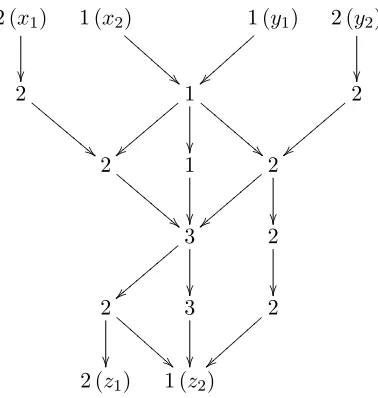
We now look at the structure of these protocols. See figure 1 for the protocol which yields a left output. We’ll explain in detail how it works and leave it to the reader to apply the same principles to the protocol yielding a right output. This is essentially an informal restatement of algorithm 2 from [5].
Each node is labeled with a player ID, the node’s owner. At each node, that node’s owner receives a sequence of inputs,g1, . . . , gm. That player computesg=g1·· · ··gmand setsg01·· · ··gk0 =g
wherekis the node’s outdegree and g01,· · · , g0k−1 are sampled uniformly. Then, the owner sendsgi0
to the owner of the i’th neighbour node, going from left (i= 1) to right (i=k). The inputs to the topmost nodes are the inputs to the protocol. All other inputs to nodes are group elements sent in this way. The outputs at the bottom row are the protocol outputs of the indicated players.
Thus, if a player owns both a node of outdegree one and its neighbour, that player multiplies the received values, then sends the product to himself. Sending to oneself can of course be optimized away, but the seemingly redundant nodes make the graph satisfy the formal structural precondition of the algorithm 2 referred to earlier.
For instance, at the topmost node of the central column of figure 1, player 1 receives x2 andy1,
computesg:=x2y1, samples (g1, g2), setsg3 =g2−1g
−1
1 g, then sendsg1to player 2,g2to himself and
g3to player 2. Observe that ifx=x1x2 andy=y1y2 thenxy=x1·(x2y1)·y2 = (x1g1)·(g2)·(g3y2),
2 (x1)
1 (x2)
! ! C C C C C C C
C 1 (y1)
}
}
|||||| ||
2 (y2)
2 " " D D D D D D D D D 1 } } zzzzzz zzz
DDDD!!
D D D D D 2 } } zzzzzz zzz 2 ! ! D D D D D D D D D 1 2 } } zzzzzz zzz 3 } } zzzzzz zzz 2 2
CCCC!!
C C C C 3 2 } } |||||| ||
2 (z1) 1 (z2)
Figure 1: Multiplication protocol (left output)
2 (x1)
1 (x2)
! ! C C C C C C C
C 1 (y1)
}
}
||||||
|| 2 (y2)
2 " " D D D D D D D D D 1 } } zzzzzz zzz
DDDD!!
D D D D D 2 } } zzzzzz zzz 2 ! ! D D D D D D D D D 1 2 } } zzzzzz zzz 3 2 } } |||||| ||
1 (z1) 2 (z2)
Figure 2: Multiplication protocol (right output)
Correctness, that is, equality at the top and bottom layers, follows as a direct corollary of this invariant. It also relates to security, in the following way: let c be any corrupt player. On every layer of the graph there’s a node not owned byc, i.e. there’s a uniformly random factor not known by c, so whatc knows appears uniformly random. Moreover, one can draw a path in the reflexive closure of the graph that is the tree of two-element multiplication protocols from any top-most input to some bottom-most output, stepping only on nodes hiding these uniformly random factors fromc. This means not only are the random factors hidden on their own layers, the adversary can’t pick them up indirectly. This is the intuition; a formal proof that this translates into a simulator is to be found in [5], see in particular definition 2 and 3 and lemma 1 and 2. The lemmas assume the two-element multiplication protocols to have certain properties, which we’ll establish here.
Let Land Rbe the protocol graphs, and let L↔ andR↔ be their undirected counterparts, i.e. their reflexive closures. Observe that that for any one corrupted player c there exists two indices
ix, iy ∈ {1,2} such that there is a path from xix tozix and from yiy to zix inL
↔, and fromx
ix to
ziy and fromyiy toziy inR
↔, such that none of these four paths contain any nodes owned byc.
The existence of a path from xi to zi (rather than zj, j 6= i) mean that L is x-preserving.
Similarly, the existence of a path fromyi tozi inR (for any c) means thatR is y-preserving. The
fact that for anyc, Land R use the same ix (though in different ways) and the sameiy (ditto) is
what [5] refers to ascompatibility. These three properties are the ones from which the existence of a simulator ultimately follows.
5.2 Construction of a Protocol for n Players
Following [6], we will build ann-party protocol for computing the producth1· · ·hm, where eachhi
is an input from one of thenplayers. We build the protocol based on a formulaF ofT(2,3)-gates, computing the majority function onninput bits. We know from the previous sections that such a formula of logarithmic depth exists.
players. The protocols allow 3 playersp1, p2, p3 to receive input in secret shared form, do operations
on shared values, send shared values securely to another group of 3 players, receive values from another group, and finally to make a shared value public. We maintain as invariant that every shared value held by the three players is stored in the form of a left sharing.
Input: To give an input x ∈ G to (p1, p2, p3), one creates a random left sharing x1, x2 of x and
sends x1 top2 and x2 top1.
Multiplication: the multiplication protocol takes two left sharings (x1, x2) and (y1, y2) as input.
It runs the right-output multiplication protocol4 on (y1, y2) and a default right sharing of e
(e.g. e1 = e2 = e), yielding a right sharing (y10, y20) of y1 ·y2. It then runs the left-output
multiplication protocol on (x1, x2) and (y10, y02), and gives the output of this as its own output.
Inversion: the inversion protocol takes a single left sharing (x1, x2) of x as its input; then each
player inverts their own element, so player 2 holdsx−11 and player 1 holds x−21. Since x−1 =
(x1x2)−1 =x−21x−11, what the players hold is a right sharing of the inverse: player 1 holds the
left part and player 2 the right part. So, the inversion protocol multiplies this right sharing with a default left sharing of e (e.g. e1 = e2 = e), and gives the output of the left-output
multiplication protocol as its own output.
Sample: to sample a uniformly random group element, players 1 and 2 each sample a group element (x2 andx1, respectively) uniformly at random, and output the left sharing (x1, x2).
Send/Receive: If virtual playerp is to send a valuex to virtual Supposep1,p2,p3 want to send
a shared value x to q1, q2, q3. Then p1 holds x2 and p2 holds x1 such that x1·x2 = x. To
emulate the send operation, p1 creates a left-sharing of x2 and p2 of x1; they each send the
shares toq1 andq2 as appropriate; thenq1, q2, q3 execute the Multiplication protocol to get a
left-sharing of x.
Output: To make a shared value public,p1, p2 broadcast their shares, and all players can locally
multiply shares to get the result.
To keep track in the following of the values the players hold, each such value is assigned a variable name. The value stored in variableX is usually calledx – to keep the description simple we will usually not change the value in a variable once it is created, instead we create a new variable. A variable X stored by player Pi will be referred to asPi.X, though if it is clear which player we
are referring to we sometime only write X. Likewise when Pi executes a multiplication, we will
write Pi.multiply.
A very important fact to note for later is the following: for each of the subprotocols above, we can describe the operations each player has to do as a straight-line program consisting of aconstant
number of operations. Furthermore, the only operations needed are: multiply in G, invert in G, sample fromG, and send/receive.
We now show how these protocols can be used together with our formula F to construct an
n-player protocol for computingh1·...·hm.
Consider the formula F and the T(2,3)-gate g0 computing the output of F. We think ofg0 as
the top-most gate and then number the gates consecutively starting from the top level. We assign
to the output wire of each gate gi a virtual player Pi, and we also assign each input wire to a real
player in the natural way according to the construction of the formula. Real players are assigned separate numbers.
Formally speaking, we will now execute the desired computation by giving the inputsh1, ..., hm
toP0, have him executeP0.multiply m−1 times and the output the result.
However, each virtual player will not do actually computation himself, instead he will be emu-lated by three other (virtual or real) players, using the protocols we described above.
Concretely, the virtual player Pi will be emulated by players Pj, Pk, Pl where these are the
players assigned to the input wires ofgi. Note that this means that the virtual players assigned to
input gates will be emulated by real players.
This leads naturally to a recursive specification of the operations we ask a virtual or real players to do, and procedures for giving input and getting results out. These are syntactically defined as follows:
• Pi.Input(Y, y), executed when another player or an external party wants to give input value
y to player Pi, to be stored in variableY.
• Pi.Output(X), returns the value in X.
• Pi.Sample(X),Pi samples a random group element and stores it in X;
• Pi.Invert(X, X−1),Pi inverts the value in X and stores it in X−1; and
• Pi.Multiply(X, Y, Z), Pi multiplies values in X and Y and stores the result in Z.
We show what the Inputand Send operations would look like as examples.
Pi.Input(Y, y)
1. IfPi is a real player, store y in variableY.
2. Otherwise, let Pj, Pk, Pl be the players emulatingPi. Then do the following:
(a) Create a random left sharingy1, y2 of y.
(b) ExecutePj.Input(Pj.Y, y2) andPk.Input(Pj.Y, y1).
Note the way of naming values above means that variable name Y refers to shares of the same actual values on all levels of the tree. The next procedure Pi.Send(Pu, Pi.X, Pu.Y) shows how to
send the value in variableX from playerPi to player Pv and place result in variable Y. Note that
sender and receiver are always on the same level in the formula so they are both virtual or both real.
Pi.Send(Pu, Pi.X, Pu.Y)
1. IfPi, Pu are real players, Pi sends the value of Pi.X toPu who stores it in variablePu.Y.
2. Otherwise, letPjPk, Plbe the players emulatingPi, and letPv, Pw, Ptbe the players emulating
Pu. Then do the following:
(a) Pj creates a left sharing of his value in X:
(b) Send shares toPv andPw: Pj.Send(Pv, Pj.Xj,2, Pv.Xj),Pj.Send(Pw, Pj.Xj,1, Pw.Xj).
(c) Pk creates a left sharing of his value inX:
Pk.Sample(Xk,1),Pk.Invert(Xk,1, Xk,−11),Pk.Multiply(Xk,−11, X, Xk,2).
(d) Send shares toPv andPw: Pk.Send(Pv, Pk.Xk,2, Pv.Xk), Pk.Send(Pw, Pk.Xk,1, Pw.Xk).
(e) Note that we now have a situation equivalent toPu holding variablesXj, Xk, and these
contain the shares inXthatPjandPkhold. We therefore execute: Pu.Multiply(Xk, Xj, Y).
The sample, inverse and multiply operations can be specified in exactly the same fashion. This is straightforward to derive from the specification of the three player protocols above, but very long and tedious, so the reader will be spared the details.
We can now finally define the n-player protocol which we call πF to emphasize that it is built
from the formula F:
Protocol πF
1. Fori= 1..m, the real player holding hi executesP0.Input(Hi, hi).
2. DoP0.Multiply(H1, H2, T2). Then, forj = 3..m, do P0.Multiply(Tj−1, Hj, Tj).
3. Do P0.Output(Tm), this causes real players to broadcast all their shares in Tm. Each real
player multiplies shares as appropriate and returns the result.
We now have
Theorem 5. Assume the formula F has logarithmic depth and computes the majority function on n inputs. Then the protocol πF runs in time polynomial in n and m, it always computes correct
results and there exists an efficient simulator S, such that if t < n/2 players are corrupted, then when given the corrupted players’ inputs and the output, S produces a transcript with the same distribution as seen by the adversary by running the protocol.
Proof. The running time is clear from the fact that F has logarithmic depth and that in each subprotocol we use for player emulation, each emulating player only executes a constant number of basic instructions. This means that the total number of operations done ism·cO(logn) for some constantc.
Correctness is clear from correctness of the subprotocols we use for player emulation. We therefore turn to describing the simulator S:
If at most one honest player provides input to the protocol, the adversary and simulator can know all the inputs. In this case the simulator computes the input of the honest player (if any), runs the protocol on all inputs, and outputs a trace of this protocol run. Clearly this has the same distribution as a normal protocol execution. Informally, the adversary already knew everything so the protocol messages don’t reveal any extra information.
Otherwise, the simulator works as follows: choose the neutral element as input for each honest player and run the protocol. Concretely, this means that the adversary plays for the corrupt players and the simulator plays for the honest ones following the protocol (but on dummy inputs). We stop this when we reach the output stage. In the output stage we construct and broadcast shares for the honest players leading to the correct result; below we describe how this is done.
Consider first the input phase. In it, the simulator generates a sharing of the neutral element for each honest player and sends the appropriate shares to the adversary. If the underlying formula has height one and a player receiving a share is corrupt, that share is uniformly random. If the formula is taller, at most one virtual player who gets a share is corrupt; that player sees a uniformly random value, and by induction the corrupt physical players who participate in emulating the honest virtual players see only uniformly random values. This doesn’t depend on the fact that element we’re sharing is the neutral element; in other words, both in the simulated case and the real case, the adversary sees uniformly random elements in the input phase.
To analyse the computation phase, we first need some terminology: LetstrAbe the
characteris-tic vector for the corrupted setAof real players, i.e.,strA is ann-bit string with 1’s corresponding
to players in A and 0’s elsewhere. We say that a virtual playerPi is corrupt if the sub-formula of
F below gate gi accepts strA. So P0 is always honest, and at most 1 of the players immediately
below (namely P1, P2, P3) is corrupt.
We now want to say that ifPiis corrupt, then the adversary knows the values of all variables held
by Pi. This will be the case if he knows enough shares held by real corrupt players to reconstruct
those values. But since our sharing among the three players emulatingPi only gives shares to the
first two players, the adversary does not necessarily learn the value (namely if the last two players are corrupt). For the sake of this argument, however, we will give those values to the adversary for free. It is clear that this does not give the adversary more information about any of the values shared initially. We want to show that his view is independent of the honest players’ inputs. We will show this even given the extra information, so the same is also true without it.
Now back to the computation phase. By inspection of the protocol, we see that the only time we execute a physical send operation between real players is in the (virtual) send and multiply operations. In both cases, a sender creates a fresh random multiplicative sharing of a group element and sends shares to two or three other players. If the sender is corrupt, the adversary already knows the value, so we will assume the sender is honest.
If at most one of the receivers is corrupt, the adversary sees nothing or a uniformly distributed group element.
Otherwise, if the send occurs as part of emulating a multiplication, the sender is one of the receivers, so the two other players may be corrupt. But then the virtual player we are emulating is corrupt, so the adversary already knows the values we are multiplying. Since the values sent only depends on those values, shares of them and fresh randomness, they are independent of the honest inputs.
The remaining case is if the send occurs to emulate one virtual player sending to another. In this case there are always two receivers, and if both are corrupt, the adversary learns the value sent, and we also know that the receiving virtual player is corrupt. Of course, if also the sending virtual player is corrupt, the adversary already knows the value sent, so we only need to consider the case where a virtual honest player sends to a corrupt one. This we can handle by reusing exactly the same argument as we just gave on the next higher level of the formula. This argument will stop when we reach the top-most group of three players since here there is no communication on a higher level between two different virtual players.
We conclude that everything the adversary sees in the input and computation phases is inde-pendent of the honest players’ input, so the simulation of those phases is perfect. In particular, the distribution of the adversary’s shares in the output is the same in simulation as in real life.
In the output phase, the players hold a sharing of the producth1·. . .·hm and reconstruct this value
by each player broadcasting their share. The simulator is to output messages which have the same distribution, given the global output and the shares the adversary already knows. This is sufficient by what we argued above.
Let us first analyse what the distribution is in the real world. Consider the root level: if a
shareholder (player 1 or 2) is corrupt, then since the output is known, the adversary can compute the value of the other share. Inductively, the same happens to the players who implement the honest shareholder: their “output” (share value) is now externally specified, and so if one is corrupt the other’s value is uniquely determined. If at any level both shareholders are honest, one share is chosen uniformly at random and the other is computed to match the output value (this is readily seen by examining the protocol).
What the simulator does is simply generate a sharing which has this distribution, by executing the algorithm which immediately follows from the above recursive description of the distribution. This is possible because the simulator knows the shares of corrupt players and the output.
6
An Approach to Obtaining Active Security
As mentioned earlier, an actively secure protocol for 4 players tolerating 1 actively corrupted player could be used together with our formulas built fromT(2,4)-gates to get ann-player protocol with active security against 16(5−√13)n players. At time of writing, however, we do not have such a 4-player protocol. On the other hand, we do know how to use the passive 3-player protocols as a “black-box” towards obtaining a 12-player protocol with security against 1 actively corrupted player.
Combining this with formulae built fromT(2,12)-gates will lead to ann-player polynomial-time protocol with security against a constant fraction of actively corrupted players, and this was not known to be possible before, for any constant fraction. Applying a similar analysis to formulas with T(2,12)-gates as we did earlier for T(2,4)-gates, we find that such formulas of logarithmic depth exist that compute a threshold function with threshold approximately 0.017n, so this is the number of actively corrupt players we can tolerate with this construction.
6.1 An Actively Secure Protocol for 12 Players
We now sketch the idea for building the 12-player protocol: we will call the players P1, .., P12.
We will let π denote the collection of 3-player protocols we have seen in the previous section, for multiplication, inverse, sampling etc.. on shared values.
In essence, we will execute 4 instances of π. These instances will be executed by the subsets
T1={P1, P2, P3}, T2={P4, P5, P6}, T3={P7, P8, P9} and T3 ={P10, P11, P12}, respectively. All 4
instances of π will be executed on the same inputand with thesame randomness. We obtain this by also dividing the players in sets in a different way, S0 ={P1, P4, P7, P10}, S1 ={P2, P5, P8, P11}
and S2 = {P3, P6, P9, P12}, and have players in each Si coordinate their actions. Note that this
makes sense because all players in S1, for instance, play the role of the first player inπ.
player in each setSi do the selection and broadcast his choice inside the set. Of course, this player
may be corrupt and may not do a random choice. The net effect of this is that π is executed in such a way that the one corrupt player it tolerates may not select his randomness with the correct distribution (but otherwise follows the protocol). However, the important observation is thatπ is secure even in this case, and in fact the same simulation will work to prove this.
We now execute all 4 instances of π in parallel. Since all inputs and randomness is the same, wheneverπinstructs a player to send a message, what we expect actually happens is that all players in some set Si sends the same message to a corresponding player in Sj. Of course, this may not
actually be true since a corrupt player is acting in one of the instances. Therefore the players inSj
compare what they have received and take majority decision. This ensures that all honest players are in a consistent state throughout, and we will therefore get correct results in the end.
6.2 Construction of a Protocol for n Players.
Finally, we need to consider whether the above 12-player protocol can be used with the player emu-lation approach we described earlier. More specifically, we need to check that the local computation a player is supposed to do can be emulated efficiently by a set of players (12 in our case).
First, we fix a way to represent values held by the player we are emulating. We derive this directly from the emulation of π, described in the previous subsection: to represent an element x
we make a left sharing (x1, x2) and givex1 to all players in S1 and x2 to all players in S2.
Now, to execute the 12-player protocol, a player needs to do multiplication, inversion, sampling and sending (to executeπ), and the only additional operation is to compare group elements.
To emulate the first 4 operations, we use the same idea as we used for constructing the 12-player protocol fromπ: the 12 emulating players run 4 instances of the emulated command fromπ, inside setsT1, ..., T4, and whenever something is sent (from set Si toSj), we compare the received values
inside the receiving set as described above.
To emulate the comparison, we assume that the two elements to compare,g1, g2are secret shared
among the 12 players in the way we just described. We now compute and open g−11g2 which can
be done by the operations we already have, and return “equal” if the result is the neutral element
eand “not equal” otherwise. Note that this is not actually a secure comparison: the result of the comparison is leaked and if the values are not equal, information about g1, g2 is leaked. However,
by the way in which comparisons are used in the 12-player protocol, this is actually sufficient: recall that whenever something is sent as part of the 4 instances of π that we execute, a player in the receiving set Si will compare what he received to what the others got. If all senders and receivers
were honest all comparisons will return equality (the adversary already knows this), and no further information is leaked. If the actively corrupted player was involved in sending or receiving, the adversary knows what the correct message is and how he (may have) modified it. Therefore again he knows when the comparison will return unequal and also knows both group elements that are compared.
The only other place where comparison is used is as part of the broadcast protocol that is used inside each setSi. This can be done a simple deterministic protocol, and it is easy to construct it
such that if all players are honest, then all comparisons return “equal”. If one player is corrupt, the adversary learns in any case what the broadcasted value is and can predict the result of all local comparisons.
players.
7
Local Conversion
A secret sharing scheme S is locally convertible to secret sharing scheme S0 if for any set of
shares (S1, . . . , Sn) of a secretscomputed according toS, there exist functionsf1, . . . , fnsuch that
(f1(S1), . . . , fn(Sn)) is a set of shares that consistently determinesaccording toS0. This notion was
introduced in [3]. We expand this definition to also cover conversion between sharings of members of different sets. IfSis a scheme for sharing secret values from a setA, andS0 fromB, we say there is a local coversion with respect to f:A→B if there exists functionsf1, . . . , fn such that for any
set of valuesS1, . . . , Sn forming a sharing of s∈A according to S, the values (f1(S1), . . . , fn(Sn))
form a sharing off(s)∈B. We can think of the narrower concept of local conversion as the special case where A=B and f is the identity function.
Consider now the scheme we defined earlier: F(S2/3) for a formulaF. Consider also the secret sharing schemeSR
2/3defined over a ringR, as follows: given the secrets∈R, chooses1, s2uniformly
at random in R and set s3 =s−s1−s2. Finally, give (s2, s3),(s1, s3),(s1, s2) to players 1, 2 and
3, respectively. When R=Zp this scheme is clearly a perfect secret sharing scheme where sets of
2 or more players are qualified.
On local conversion in general, it is known that shares in the replicated secret sharing scheme
(RSS) over any field K can be locally converted to any linear scheme overK. SZp
2/3 is actually RSS
for three players. RSS, however, is not efficient for a large number of players. It is also known that the Shamir scheme cannot be locally converted to RSS, but other than this, virtually nothing is known on local conversion. For our scheme, we have
Theorem 6. For any monotone formula F built from threshold gates and any two rings R andR0 between which there exists a ring homomorphism f:R → R0, the players can locally convert from the secret sharing scheme induced by F over R, to the scheme induced by F over R0 with respect to f. If F is multiplicative or strongly multiplicative, this is preserved through the conversion.
Proof. The local conversion consists of applying f to each individual share component. Recon-structing the secret is done by doing several additions. Since f is a homomorphism, f applied to each sum equals the sum off applied to the parts. Multiplicativity rests on a property of products which is similarly preserved by ring homomorphisms.
7.1 A more general lower bound
In [3], the concept of a generic conversion scheme forn players is defined, as follows:
Definition 2. A generic conversion scheme for secret sharing scheme S with access structure Γ
consists of a set of random variables R1, . . . , Rm, an assignment of a subset Bj of these to each
player Pj, and local conversion functions gj such that if each Pj applies gj to the variables in Bj,
we obtain values (s1, . . . , sn) forming consistent S-shares of some secrets. Furthermore, given the
information accessible to any unqualified set of Γ, the uncertainty of s is non-zero. Finally, for every Ri, there exists some qualified setA, such that the value of the secret sdetermined by shares
of players in Adepends on the value of Ri. More precisely: the uncertainty of s, given all variables
The last condition in the definition was not specified in the definition in [3], but was assumed in their proofs. It is clearly necessary to avoid redundant schemes: if a variableRimakes no difference
to any qualified set, it can be eliminated.
The interesting point about this concept is that a generic conversion scheme can be used to build so called pseudorandom secret sharing: by predistributing m keys to a pseudorandom function, players can locally generate values that are indistingusihable from the Ri’s, and then convert
these values to shares in a secret sharing scheme without communicating. Thus we have a way to generate random shared secrets with no communication. This is of course a very useful tool. Concrete constructions of this were given in [3], but they do not scale well with the number of players. Unfortunately, this cannot be avoided, due to a lower bound that was shown in [3] and which we strengthen here.
Note that neither S nor the conversion functions gj are assumed to be linear. Also note that
the convertibility requirement formulated above is weaker than the default requirement defined in [3]. However, we are about to look at negative results which are only made stronger this way. The following result is shown in [3]:
Proposition 1. For any generic conversion scheme for S where R1, . . . , Rm are independent and
S has the property that a qualified set of players can reconstruct not only the secret, but also the shares of all players, it holds that m is at least the number of maximal unqualified sets.
For a threshold secret sharing scheme where the threshold is a constant fraction ofn, the number of qualified sets grows exponentially with n, so this result rules out efficient generic conversion schemes in many cases. If we want to somehow circumvent this lower bound, it is clear that we should either consider cases where theRi are not independent, or cases whereS does not have the
property specified in the proposition. Since indeed our secret sharing schemesF(S2/3) do not have that property, one might hope that these schemes could lead to pseudorandom secret sharing with better complexity. This will not work, however. We show that the lower bound holds without the assumption onS:
Theorem 7. For any generic conversion scheme forS whereR1, . . . , Rm are independent, it holds
thatm is at least the number of maximal unqualified sets.
Proof. First, we claim that for any qualified set A, it must be the case that all variables Ri are
known to players inA.
Namely, assume this is not the case for some A, and consider some variable Rk which is not
given to any player in A. However, there must be some other qualified setA0 that does knowRk,
and where Rk is needed for A0 to determine the secret. LetRA
0
−k be the set of Ri’s known to A0,
except forRk, and letR−k be the set of all Ri exceptRk. Finally for each qualified Awe define a
random variableSA taking the value of the secret determined by players in A. The condition that
Rk is necessary for players in A0 meansH(SA0|RA 0
−k}>0. Since theRi are independent, we even
have H(SA0|R−k}>0.
On the other hand, the sharing computed by the players must consistently determine one secret
s. More precisely, the demand is that SA = SA0 always, and for any A, A0. Obviously, we have H(SA|R−k} = 0, but then we have a contradiction: since SA0 is not fixed given R−k, we cannot
have SA=SA0 with probability 1.
To finalize the proof, we will construct a secret sharing scheme S0 as follows: shares are defined