Detecting Facial Wrinkles based on Gabor Filter
using Geometric Constraints
Ashwini Jalindar Mawale1, Archana Chaugule2
1ME Computer Engineering DYPIET, Savitribai Phule Pune University, Pune, India 2Department of Computer Engineering DYPIET, Savitribai Phule Pune University, Pune, India
Abstract—Facial wrinkles play vital feature of old age human skin which might be merged in many image based applications associated with aging. A wrinkle on face is 3D feature of the skin and seem as refined to not continuities as well as no cracks in encompassing texture of the skin. Though, wrinkles on the facial will simply be detected by clarification/ achievement conditions in 2D pictures because of the precise for finding nature of skin deep properties and its texture on the surface. Existing approached present old age skin for image-based analysis supported the study of wrinkles as texture and not as curved is a not continuity / crack option. Our proposed system contains settled algorithmic supported image morphology and Gabor filters to advance outcome of wrinkles detection. The proposed system contains image Gabor filter bank and hessian filter to focus on the skillful curved is a not continuities in texture of skin caused by wrinkles. Main purpose of our proposed system is to improve detection rate and to minimize miss ratio. Experiments are conducted on sets of different images and results are compared with those of existing system. Experiments show that the proposed algorithm provides visually better results than existing system results.
Keywords: - wrinkles, morphology, curvilinear detection, Gabor feature.
I.
INTRODUCTIONRecently, face recognition is playing a vital role specifically in the field of commercial, banking, and social area. Human face has numerous features covered up in it, which is utilized to distinguish the person, age of the person, gender of the person. Face portrays characteristics like expression; personality of person, gender of the person, pose, and age etc. This has attracted concentration in recent years since image processing technologies give way to extensive applications in computer vision and graphic techniques. Age estimation by facial features is an interesting topic in recent years. Facial wrinkles play an important role in facial texture. Wrinkles play a vital role for creating application related to age estimation, facial expression detection, mood detection etc. It seems like very few attempts are available to detect wrinkles as curvilinear objects. When we see wrinkles at high-resolution it seems like wrinkles are represented as unique pattern and it is non-repetitive one. Wrinkles are always in continuous shape not like a series of disconnected curve parts. There are very few possibilities that wrinkles will intersect each other.
In this paper Section II discuss about literature survey. Section III discuss about implementation details, .Section IV represent dataset and expected result Section V talks about conclusions and presents future work.
II.
LITERATURE SURVEYK. Luu et al. [2] combined holistic facial and the local elements for deciding the age of the person in light of the qualities of human craniofacial improvement. They utilized combined components that generally arrange a face as youthful or adult. In the past studies the age gatherings are not organized appropriately Components are separated utilizing two procedures to be specific AAM and LTP. Active Appearance Model (AAM) straight encoding is utilized to create all-encompassing element and Local Ternary Patterns (LTP) is utilized to concentrate nearby elements.
N.Ramanathan et al. [3], proposed a twofold approach for displaying facial aging particularly in adults. In first part, author presented a shape change model which captures the sensitive deformations facial features with age. In second section, a image angle based texture change capacity to portray facial wrinkles and other skin relics frequently watched. Advantages offered by this model are facial growth statistics, account for gender-based and ethnicity-based facial growth patterns, account for weight loss/gain. Applications of the proposed facial aging model are face recognition and facial appearance prediction across aging. Facial hairs cannot be detected by facial aging model so it cannot address hair loss.
Y.H.Kwon et al. [4], presents a study of visual age classification from facial images. As per study input image is categorized into three groups such as babies, young, and senior human beings and finding on image is performed using skin wrinkle analysis and craniofacial development theory. Feature is determined from input images are categorized into two parts. Initial step features are eye, nose, mouth and chin. Measurement and detection of wrinkles using a wrinkle geography map is secondary step of feature analysis.
Nazre Batool et al. [5] a algorithm dependent upon those blending about composition introduction fields Also gabor Characteristics. Markov field demonstrating (MRF) may be used to recognizing wrinkles Furthermore different impurities in the near skin. Emulated Toward model built composition amalgamation may be used to square up the holes about unpredictable shapes.
structures starting with a images, What's more should drive An blanket from claiming wrinkle segments. In whatever case, their results need aid unequivocally depends with respect to upon the beginning condition, Furthermore neglects on identify mind boggling cases about wrinkles.
Batool et al. [7] presented a procedure should identify An discretionary state of wrinkles, to example, an situated for offering segments, the place each fragment may be specific by its introduction Also period. Similarly available a probability thickness from claiming wrinkle model which misuse geometric properties and neighborhood edge profile about wrinkles. Will improve the probability thickness of wrinkle model, Also available reversible jump markov chain monte carlo sampler for conceded rejection.
R. Stoica et al. [9] represented another methodology for the extraction of road from remotely detected images. Assumption made by the author is that road frame a small network and they that network utilizing line segmentation. Point processes capable toward make and distinguish thin network and sections must be associated, so as to shape a line-network. A Gibbs point process structure is utilized to write proposed probabilistic model. The solid application objective is guide calibration.
S. Chambon et al.[10], identify the problem of crack detection, in the surface of the French national roads, by analyzing optical images automatically. Paper gives a brief overview about image-processing methods for the crack detection of road. A twofold approach is used for the crack detection of road such that first contribution is a modern image-processing tool used to civil engineering. Another contribution is about detection of defect in surface.
III.
IMPLEMENTATION DETAILA.
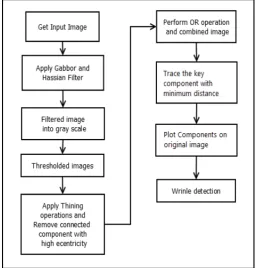
System OverviewThe following Fig 1 shows the architectural view of the proposed system. The description of the system is as follows: Our system is working in 3 phase
In 1st phase it is assumed that wrinkles cause high intensity gradient and appears as curve like structure. Key wrinkles site are detected with image morphology and high Gabor filter responses. This is done by thresholding and removing the blob-like regions using eccentricity property of connected component.
In 2nd phase it is assumed that winkles are continuous. The aim of this step is to track wrinkles curve from key wrinkles sites that are detected in above step and to remove intersecting and congesting component.
It is hard to distinguish light intensity gradients present because of very light wrinkles from those due to different (rough) skin texture/other factors.The purpose of this step is to reduce false positive value in binary image.
Fig. 1 System Architecture
Step 1:- Detection of key wrinkles
site:-i.
Take input image.ii.
Apply Gabor filter to input image.iii.
Apply Hessian filter to Gabor filter image.iv.
Convert resulting image into gray scale image.v.
Convert gray scale image into binary image by applying successive thresholding.vi.
Find eccentricity= E of component.vii.
If eccentricity E<0.98, remove that component.viii.
Apply binary dilation and OR operation.ix.
Combine images.Step 2:- Finding curve from key wrinkles site
i.
Visit each component from resulting images in step 1.ii.
If any neighboring component present then interconnect neighboring component.iii.
Else extend it from both the side.iv.
If component intersecting each other then remove that component.v.
By using image closing bridge connect component.vi.
Repeat step I till neighboring pixel is not present. vii. Remove isolated pixel.Step 3:-Final Resulting image
i.
Taking resulting image from above steps as input image.ii.
Perform OR operation.B.
Mathematical ModelSimple system is presented as, Let S be set of all variables
1)
Let S be set of system S= {M, G, I, K, O}2)
M is input set.= {M1, M2, M3, ……, Mn}.
Where, M1, M2, M3, ……, Mn is an input images.
3)
G = Gabor filterThe real Gabor filter kernel oriented at the angle is given by
Where,
σx1; σx2 = scale of the 2DGaussian envelope, f = frequency of the sinusoid,
γ= spatial aspect ratio which decide the elongation or the ellipticity of support of Gabor function.
4)
I is set of image feature given by Normalized maximum filter response.I= {I1, I2, I3,…….,In}.
Where I is a set of Feature Extractions and I1, I2, In are number of extracted features.
Normalized maximum filter response are given by
5)
K is set of key site wrinkle. K={K1,K2,K3,…..Kn}Where K is a set of Site Detection and K1, K2,..., Kn are number of detected site.
6)
O is set of final output. O = {O1, O2, O3, ……. , On }Where, O1, O2, O3,……., On is output image which contain the wrinkles curve with respect to M1, M2, M3, ……, Mn input image.
IV.
RESULT AND DISCUSSIONA Data Set
To implement the system described above, we used the images from internet and images from FG-NET aging dataset.
B Results
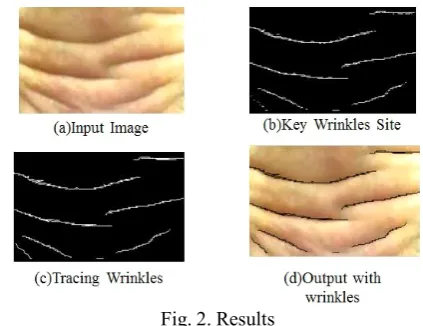
Key wrinkles site are detected with high Gabor filter responses and curvilinear shapes. Key site wrinkles are detected in first module. Here successive thresholing is applied to get binary image and resulting images are combined. Fig 2(a) is input image which is provided to our system. First module result are shown in Fig 2(b), which represent key wrinkles site. Wrinkles are continuous, due to this nature of wrinkles are traced that are obtaied in first module. Fig 2(c) shows the tracing wrinkles from the key wrinkles site. fig2(d) shows the final output, which contain the wrinkles, which are marked with black lines. In exsting system there was a problem of detecting the wrinkles due to presence of brown or dark spots. The proposed system will detect dark spots on the face to reduce the incorrect wrinkles detection results.
Fig. 2. Results C) Results Comparision
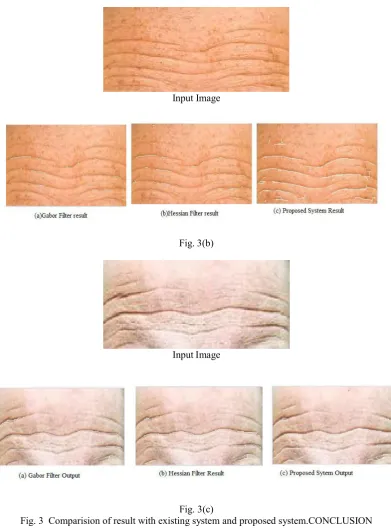
Fig. 3 shows the results based on Gabor Filter, Hessian Filter and proposed system. Experiments show that the proposed algorithm provides visually better results than existing system results. Where, localization results are improved and miss ratio is minimize.
Input Image
Input Image
Fig. 3(b)
Input Image
Fig. 3(c)
Fig. 3 Comparision of result with existing system and proposed system.CONCLUSION
In this paper, we have proposed technique based on Image morphology and Gabor filters to improve wrinkles localization outcomes. Here, we have concentrated on image features related with Gabor filter and hessian filter to underline fine discontinuities in facial texture rooted by morphology and wrinkles to integrate geometric limitation of wrinkle curves. In proposed system we increased detection ratio of wrinkles and reduces the false alarm ration. We conducted experiments on images downloaded from internet. The Experimental result shows that detection ratio of facial wrinkles are improved than existing system, reduces the false positive value that are caused due to brown/ dark spots and minimize the miss ratio.
REFERENCES
[1] Nazre Batool, Rama Chellappa, "Fast detection of facial wrinkles based on Gabor features using image morphology and geometric constraints", at ScienceDirect july 2014.
[2] Luu, Khoa, et al. "Combined local and holistic facial features for age-determination." Control Automation Robotics & Vision (ICARCV), 2010 11th International Conference on. IEEE, 2010.
[3] N.Ramanathan, R.Chellappa, “Modeling shape and textural variations in aging faces, in:FG,pp.1–8, 2008.
[4] Y. H. Kwon and N. da Vitoria Lobo, „„Age classification from facial images,‟‟ Comput. Vis. Image Understand., 74. 1 , pp. 1–21, 1999. [5] Batool, Nazre, and Rama Chellappa. “Detection and inpainting of
facial wrinkles using texture orientation fields and markov random field modeling," Image Processing, IEEE Transactions on 23.9, pp: 3773-3788, 2014.
Computer Vision–ECCV 2012. Workshops and Demonstrations Springer Berlin Heidelberg, 2012.
[7] Batool, Nazre, and Rama Chellappa. "A Markov point process model for wrinkles in human faces." Image Processing (ICIP), 2012 19th IEEE International Conference on. IEEE, 2012.
[8] Ng, Choon-Ching, et al. "Automatic Wrinkle Detection Using Hybrid Hessian Filter." Computer Vision--ACCV 2014. Springer International Publishing, pp: 609 -622, 2015.
[9] R. Stoica, X. Descombes, J. Zerubia, “A Gibbs point process for road extraction from remotely sensed images,” Int.J.Comput.Vis.57, pp:121–136, 2004.