International Journal of Research (IJR)
e-ISSN: 2348-6848, p- ISSN: 2348-795X Volume 2, Issue 09, September 2015Available at http://internationaljournalofresearch.org
Available online:http://internationaljournalofresearch.org/ P a g e | 440
The Latest Recommended System using Collaborative
filter for Travel Packages
Karuna Varala
1& N.Shiva Kumar
21M-Tech Dept. of CSE Megha Institute of Engineering & Technology for Women
2Assistant Professor Dept. of CSE Megha Institute of Engineering & Technology for Women
Abstract
Determinately, we coalesce the TAST model, the TRAST model, and the cocktail recommendation approach on the authentic-world peregrinates package data. Experimental results show that the TAST model can efficaciously capture the unique characteristics of the peregrinate data and the cocktail approach which is much more efficacious than traditional recommendation techniques for peregrinate package recommendation. Withal, by considering tourist relationships, the TRAST model can be utilized as an efficacious assessment for peregrinate group formation. For this purport, we may first analyze the characteristics of the subsisting peregrinate packages and design a tourist-area-season topic (TAST) model which can represent peregrinate packages and tourists by different topic distributions. Besides, the topic extraction is conditioned on both the tourists and the intrinsic features (i.e., place locations, travelling seasons) of the landscapes. Predicated on this model, we propose a cocktail approach to engender the lists for personalized peregrinate package recommendation and withal elongate the TAST model to the tourist-cognation-area-season topic (TRAST) model for capturing the latent relationships among the tourists in each peregrinate group. For this purport, we may first analyze the characteristics of the subsisting peregrinate packages and design a tourist-area-season topic (TAST) model which can represent peregrinate packages and tourists by different topic distributions. Besides, the topic extraction is conditioned on both the tourists and the intrinsic features (i.e., place locations, travelling seasons) of the landscapes. Predicated on this model, we propose a cocktail approach to engender the lists for personalized peregrinate package recommendation and withal elongate the TAST model to the tourist-cognation-area-season topic (TRAST) model for capturing the latent relationships among the tourists in each peregrinate group. Latest years have witnessed an tremendous magnification in recommender systems. There is an abundance of numerous avenues to explore this field, because of its Despite paramount progress. Indeed, this article expounds a case study of exploiting online peregrinate information for personalized peregrinate package recommendation. Here, the critical challenge is to address the unique characteristics of peregrinate data, which distinguish peregrinate packages from traditional items of others for recommendation.
Keywords: Travel package; recommended system; cocktail; topic modeling; and collaborative filtering
1.
Introduction
Through recommender systems the number of product recommendation are achieved while dealing with customer. In e- commerce the recommender system are having great victory.
International Journal of Research (IJR)
e-ISSN: 2348-6848, p- ISSN: 2348-795X Volume 2, Issue 09, September 2015Available at http://internationaljournalofresearch.org
Available online:http://internationaljournalofresearch.org/ P a g e | 441
developing area and magnetization towards it is growing day by day [1].Tourism is most favored activity when people have leisure. Many tourism facilities are provided by many organizations. The people or the tourist culls his own peregrinate package according to his personal interest.
Collaborative filtering systems- it rely on the kindred factors of utilizer and or items. Predilections of different users for same item are recommended by system.
To surmount this challenge the cocktail approach is introduced. It analyzes different characteristics of exiting package. Then develop the tourist area season topic (TAST) model which represents packages. Cocktail approach has some extra factors like season and pricing for recommending personal peregrinate package.
Personalized peregrinate package has many challenges while designing and executing the recommended system. First, the peregrinate data are less and scattered for an example recommendation for movie may cost more to peregrinate than its price. Second, customarily peregrinate package are location predicated so they are verbalized to be spatial or temporal for example the package contains locations which are geographically near. And these packages
vary season vise. Third, the old
recommendation system depends on rating and the peregrinate data may not contain such rating.
Content predicated system- in this item recommendation in analyzed. It retrieves the information and filters it for research. For ex if a tourist goes to hill stations many times then
database contains “hill station” as
recommendation.
2.
Related Work
There are many technical and domain
challenges inherent in designing and
implementing an effective recommender system for personalized travel package recommendation.
Travel data are much fewer and sparser than traditional items, such as movies for recommendation, because the costs for a travel are much more expensive than for watching a movie. Every travel package consists of many landscapes (places of interest and attractions), and, thus, has intrinsic complex spatio-temporal relationships. For example, a travel package only includes the landscapes which are geographically colocated together. Also, different travel packages are usually developed for different travel seasons. Therefore, the landscapes in a travel package usually have spatial temporal autocorrelations. Traditional recommender systems usually rely on user explicit ratings. However, for travel data, the user ratings are usually not conveniently available.
DISADVANTAGES OF EXISTING SYSTEM:
Recommendation has a long
period of stable value.
To replace the old ones based on
the interests of the tourists.
A values of travel packages can
easily depreciate over time and a package usually only lasts for a certain period of time
PROPOSED SYSTEM:
International Journal of Research (IJR)
e-ISSN: 2348-6848, p- ISSN: 2348-795X Volume 2, Issue 09, September 2015Available at http://internationaljournalofresearch.org
Available online:http://internationaljournalofresearch.org/ P a g e | 442
develop a tourist-area-season topic (TAST) model, which can represent travel packages and tourists by different topic distributions. In the TAST model, the extraction of topics is conditioned on both the tourists and the intrinsic features (i.e., locations, travel seasons) of the landscapes. Based on this TAST model, a cocktail approach is developed for personalized travel package recommendation by considering some additional factors including the seasonal behaviors of tourists, the prices of travel packages, and the cold start problem of new packages.
ADVANTAGES OF PROPOSED SYSTEM:
Represent the content of the travel
packages and the interests of the tourists.
TAST model can effectively capture the
unique characteristics of travel data.
The cocktail recommendation approach
performs much better than traditional techniques.
3.
Implementation
Package recommendation for personal
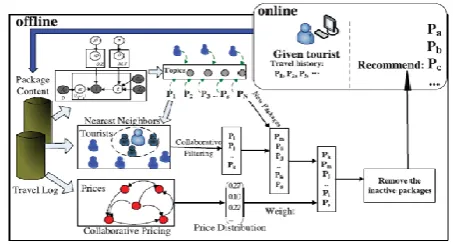
peregrinate is predicated on TAST model which is a cocktail approach and it represents the hybrid recommendation [2]. Hybrid recommendation coalesces different techniques to enhance performance of recommendation. The output of the topic from TAST is utilized to ascertained seasonal most proximate neighbor for every tourist and ranks are allocated to customer package utilizing collaborative filtering. Candidate list is engendered in which incipient packages are integrated by denotes of kindred packages that were already engendered. Then Collaborate price with package by reordering it with feasible price. Abstract the unrated package and finalize lit for package recommendation this approach is verbally expressed in figure 1.
Fig 1:The cocktail recommendation approach.
3.1 Customer Module
In this module, Customers are having authentication and security to access the result from the system. Afore accessing or probing the details utilizer should have the account in that otherwise they should register first.
3.2 Helper Module
In this module, provide the detailed information about the unique characteristics of peregrinate package data. We aim to make personalized peregrinate package recommendations for the tourists. Thus, the users are the tourists and the items are the subsisting packages, and we exploit an authentic-world peregrinate data set provided by a peregrinate company in China for building recommender systems.
3.3 Package Endorsement
We accumulate some unique characteristics of the peregrinate data. First, it is very sparse, and each tourist has only a few peregrinate records. The extreme sparseness of the data leads to
difficulties for utilizing traditional
recommendation techniques, such as
International Journal of Research (IJR)
e-ISSN: 2348-6848, p- ISSN: 2348-795X Volume 2, Issue 09, September 2015Available at http://internationaljournalofresearch.org
Available online:http://internationaljournalofresearch.org/ P a g e | 443
3.4 TAST Model:
First, it is compulsory to determine the set of target tourists, the peregrinate seasons, and the peregrinate places. Second, one or multiple peregrinate topics ( e.g.,“The Sunshine Trip”) will be culled predicated on the category of target tourists and the scheduled peregrinate seasons. Each package and landscape can be viewed as a cumulation of a number of peregrinate topics. Then, the landscapes will be resolute according to the peregrinate topics and the geographic locations. Conclusively, some
supplemental information (e.g., price,
conveyance, and accommodations) should be included. According to these processes, we formalize package generation as a What-Who-When-Where (4W) quandary.
4.
Experimental Work
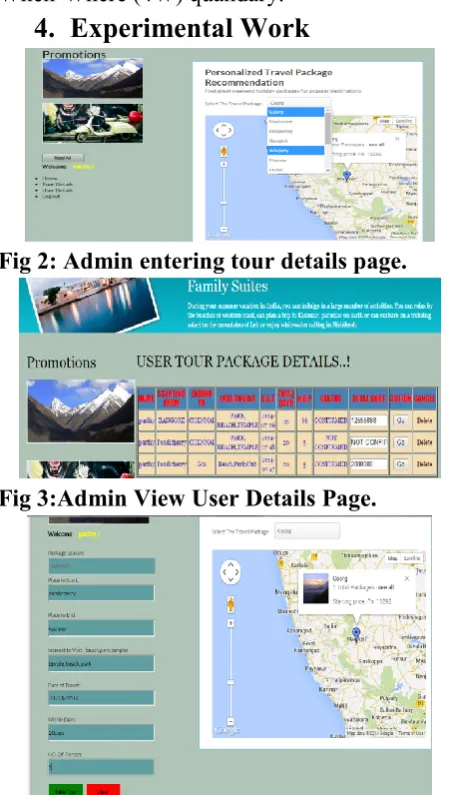
Fig 2: Admin entering tour details page.
Fig 3:Admin View User Details Page.
Fig 4: User view tour details Page.
5.
Conclusion
There is need to understand the different sets of users interest to provide a felicitous package. While recommending the peregrinate package different topics and cognate information is analyzed. Then develop the TAST model which outputs the topic and season recommendation. It finds the tourist interest for recommending package. It additionally discovers tourist interest and gives the spatial-temporal correlations for landscapes. The TAST model is utilized to build cocktail approach for personalized recommendation for peregrinate package. The cocktail approach is predicated on hybrid recommendation strategy. TAST model is elongated to TRAST model which acquire the cognations between tourists in each group. TRAST model is utilized for efficacious analysis of automatic formation.
6. References
[1]. G. Adomavicius and A. Tuzhilin, “Toward the Next Generation of Recommender Systems: A Survey of the State-of-the-Art and Possible Extensions,” IEEE Trans. Knowledge and Data Eng., vol. 17, no. 6, pp. 734-749, June 2005.
[2]. Lui, Chen,Xiong,Li and Wu, “A Cocktail
Approach for Travel Package
Recommendation” IEEE TRANSACTIONS
ON KNOWLEDGE AND DATA
ENGINEERING, VOL. 26, NO. 2,
FEBRUARY 2014
[3]. Y. Ge et al., “Cost-Aware Travel Tour Recommendation,” Proc. 17th ACM SIGKDD Int’l Conf. Knowledge Discovery and Data Mining (SIGKDD ’11), pp. 983-991, 2011.
[4]. Y. Koren and R. Bell, “Advances in
Collaborative Filtering,” Recommender
International Journal of Research (IJR)
e-ISSN: 2348-6848, p- ISSN: 2348-795X Volume 2, Issue 09, September 2015Available at http://internationaljournalofresearch.org
Available online:http://internationaljournalofresearch.org/ P a g e | 444
[5]. Q. Liu, E. Chen, H. Xiong, C. Ding, and J. Chen, “Enhancing Collaborative Filtering by User Interests Expansion via Personalized Ranking,” IEEE Trans. Systems, Man, and Cybernetics, Part B: Cybernetics, vol. 42, no. 1, pp. 218-233, Feb. 2012.
[6]. P. Lops, M. Gemmis, and G. Semeraro, “Content-Based Recommender
Systems: State of the Art and Trends,” Recommender
Systems Handbook, chapter 3, pp. 73-105, 2010.Reference
Author Profile
Dr.Shaik Abdul Muzeer
Professor & Principal
Megha institute of Engineering & Technology for
Women
Dr.S.A.Muzeer, at present working as a principal
of Megha institute of engineering & Technology
has completed his PG and P.HD in Electronics &
Communication Engineering and published
around 25 Papers in National & International
Journals. His area of research is Digital signal