LAC
: Practical Ring-LWE Based Public-Key
Encryption with Byte-Level Modulus
Xianhui Lu1,2, Yamin Liu1,2, Zhenfei Zhang3, Dingding Jia1,2, Haiyang Xue1,2, Jingnan He1,2, Bao Li1,2, Kunpeng Wang1,2
1. State Key Laboratory of Information Security,IIE, CAS. 2. School of Cyber Security, University of Chinese Academy of Sciences.
3. Algorand.
[email protected], [email protected], [email protected]
Abstract. We propose an instantiation of public key encryption scheme based on the ring learning with error problem, where the modulus is at a byte level and the noise is at a bit level, achieving one of the most compact lattice based schemes in the literature. The main technical chal-lenges are a) the decryption error rates increases and needs to be handled elegantly, and b) we cannot use the Number Theoretic Transform (NTT) technique to speed up the implementation. We overcome those limita-tions with some customized parameter sets and heavy error correction codes. We give a treatment of the concrete security of the proposed pa-rameter set, with regards to the recent advance in lattice based cryptanal-ysis. We present an optimized implementation taking advantage of our byte level modulus and bit level noise. In addition, a byte level modulus allows for high parallelization and the bit level noise avoids the modu-lus reduction during multiplication. Our result shows thatLACis more compact than most of the existing (Ring-)LWE based solutions, while achieving a similar level of efficiency, compared with popular solutions in this domain, such as Kyber.
1
Introduction
[52,48], Lyubashevsky, Peikert and Regev [49,50,60] resolved this problem by introducing an algebraic variant of LWE, namely, Ring-LWE; and showed that its security can be reduced to worst-case problems on ideal lattices. It is worth noting that in a concurrent and independent work, Stehl´e et al. [69] also pro-posed a special case of Ring-LWE over power-of-two cyclotomic polynomials; in [60], it was shown that Ring-LWE problem is hard for any ring with appropriate error distribution.
For almost all LWE based constructions, there exists an instantiation with Ring-LWE where the size of the public key and the ciphertext can be reduced by a factor ofn, wherenis the dimension of the polynomial ring. Depending on the choice of the ring, one may also carry out the ring multiplications inO(nlogn) by using the fast Fourier transform (FFT) or number theoretic transform (NTT). Due to its great security, utility and efficiency, Ring-LWE and its variants be-come the most popular building-blocks in the design of practical cryptosystems [15,8,7,16,43,66,9].
To date, the (Ring-)LWE based public key encryption schemes have arrived at a mature state that is almost ready for deployment, except for the afore-mentioned size problem. For the public key encryption schemes, they all follow a similar framework by Regev [63] and Lyubashevsky et al. [49]. For the key exchange protocols, one may use the reconciliation method, first put forth by Ding [30], and then refined by Peikert [58], to improve efficiency.
Subsequent works, such as [15,8,16,66,9], have contributed to a large portion of the NIST post-quantum cryptography standardization process (NIST-PQC) [55]. As one has seen from those work, further improvement of the bandwidth efficiency has become one of the main missions in the design of practical lattice based cryptographic schemes.
1.1 Our Contributions
Motivation. Before presenting our contributions, let us briefly present our motivation. For the sake of simplicity, we will use the ring R=Zq[x]/(xn+ 1) with a power-of-two n, a favorable choice by many Ring-LWE based schemes [32,8], to illustrate our idea, although we must remark that it is shown by Peikert et al.in [60] that Ring-LWE is hard for any ring of integers.
Intuitively, the hardness of Ring-LWE problem is mainly determined by the error rateα(the ratio of the noise magnitude to the modulusq) and the dimen-sionn. According to the concrete hardness analysis1in [6,8,5], suitable choices of the dimensionnare 29= 512 and 210= 1024. For these choices,q= 12289 is the smallest prime for whichq≡1 mod 2n. In other words, to enable the super efficient NTT multiplications, we have a constraint thatq is at least 12289. As a result, q= 12289 is one of the most widely used modulus for the Ring-LWE based schemes. Almost concurrent of this paper, in the design of Kyber [16], a smaller polynomial ring of degree n = 256 was used as the basic block of the
1
Module-LWE problem. NTT over this ring is possible with a smaller modulus
q = 7681. Recently, based on a new variant of the NTT technique [51], the modulusq= 3329 was used in the NIST-PQC second round version of Kyber,
From the view of cryptographic scheme design, this constraint is a bit arti-ficial, in that it is purely decided by NTT, and not regulated by any security requirement. To be more specific, the security level grows with the error rate, which is the ratio between the error and the modulus, rather than the modulus itself. Therefore, for the sake of space complexity, it makes sense to choose the modulus as small as possible, while keeping the ratio somewhat a constant to maintain a same security level.
In this paper, we investigate the above approach. We consider “byte” level modulus. Byte is the smallest data type that modern processors handle. It seems to be a sweet spot to balance performance, size and security. We also remark that for moduli that are significantly smaller than 256, the performance gain will be minimal (since processors will treat the data type as a byte anyway) while it becomes unfeasible to find error distributions that can maintain a same error/modulus ratio.
Parameter Derivation. There have been a sequence of work on the theoretical worst-case hardness of Ring-LWE problems [69,49,60,65]. However, they give no guidance on the choice of concrete parameters. Parameter derivation is an active research topic for lattice based cryptography, for both cryptography and crypt-analysis [22,59,4]. Arguably, most lattice based submissions to NIST-PQC follow a similar design [49,45,30,58], and a major differentiator among the schemes is the choices of parameters.
As mentioned earlier, we consider the family of “byte” level modulus that breaks the constraint of NTT modulus. Specifically, we consider three types of byte-level moduli, namely “power-of-two modulus”, “max-split modulus” and “min-split modulus”. We then select proper secret and error distribution to match the proposed modulus. Since the concrete security partially relies on the error rates, to be able to sample errors efficiently becomes crucial to the overall design. For provable security one requires discrete Gaussian samples; however, in practice it is sufficient to sample from distributions that are close enough to a Gaussian. We observe that centered binomial distribution with the standard deviation ofσ= 1/√2 is a sweet spot for security, correctness and efficiency.
To show the concrete security of our scheme, similar to other works in this field, we perform a concrete analysis of best known attacks, using both the popular and generic analysis such as BKZ with (quantum) sieving [6,8,5] and hybrid attacks [41,39], as well as dedicated attacks, such as the subfield attacks, hamming weight attacks [54] and pattern attacks [62].
is referred to as
LAC-v1 ={LAC-128-v1,LAC-192-v1,LAC-256-v1}.
In the second round of NIST-PQC, as well as the previous version of this paper [47], we proposed a second version of the parameter sets, addressing several potential risks arised during the first round evaluation and the second round evaluation [54]. Those are referred to as
LAC-v2 ={LAC-128-v2,LAC-192-v2,LAC-256-v2}.
The major change fromLAC-v1 to LAC-v2 is that the secrets and the noises are sampled from a fixed hamming weight binomial distribution; and consequently a weaker error correction code is adopted. It was observed that LAC-v1 may be vulnerable to side channel attacks [27] and high hamming weight attacks [54]. We moved toLAC-v2 to seal those leakage. We give a detailed analysis of those attacks in section 5.
For completeness we list bothLAC-v1/2 parameter sets in Appendix A. In this paper/revision, we introduce a third version of the parameter set
LAC-v3 ={LAC-light-v3a,LAC-128-v3a,LAC-192-v3a,LAC-256-v3a
LAC-light-v3b,LAC-128-v3b,LAC-192-v3b,LAC-256-v3b},
in accouting for new cryptanalysis results [29,28,27,25,62]. This revision sees two major changes. First, we present LAC-light-v3. This parameter is designed for embedded systems such as a Cortex M4 platform. It is a variant ofLAC-128-v3, with smaller noise and weaker error corrections. Second, for each level, we have two parameter sets, for example,LAC-128-v3a andLAC-128-v3b, corresponding to modulus 251 and 256, respectively.
It is worth noting that the underlying algorithms remain unchanged for all three versions ofLACparameter sets.
Error Corrections. In most lattice based schemes, dated back from one of the first lattice based encryption schemes, NTRU [40], there exists a (tunable) decryption error probability. One may choose a zero decryption error probability, at the cost of a larger modulus (and hence larger keys and ciphertexts); or a negligible one, with a moderate size modulus. See, for example [34], for a comparison of different error correction codes for lattice based cryptography. Our byte level modulus incurs a very high decryption error rate by design; and simple error correction techniques, such as D2 or D4 codes [8], do not work well in our use case.
The main drawback of a large block error correction code is the high computa-tion cost. To balance the time and space complexity, we choose the combinacomputa-tion of D2 and BCH. Briefly, the message is firstly encoded with the BCH code, then encoded with the D2 code. In the decryption algorithm, the code words will be corrected using D2-then-BCH method. In this approach, the error rate is sharply decreased by D2 already, and we only need to correct a small number of errors by using BCH. Since D2 is very efficient, the combination of D2 and a small number of BCH error correction is sufficient for our use case while remaining efficient.
We remark that our usage of heavy error correction mechanism has sparked fruitful discussions which lead to advancement of cryptanalysis in the field, for instance, see [29,28,27,25,62]. Looking ahead, our revisedLAC-v3 parameter sets are robust against all those attacks. We also note that, the choice of error cor-rection code will not affect the theoretical security of the scheme (see Section 4.4 for more details). Our scheme in principle supports any error correction code with required error correction ability.
Implementation. Recall that we have switched to a byte level modulus, we can no longer resort to NTT for efficient ring multiplications. Popular alternatives are Karatsuba/Toom-Cook algorithms, such as [11,23,26] and index based multi-plications algorithms, such as [9]. We adopt the index based solutions, combined with the following customized optimization for our parameters.
– Faster Multiplication. Our secrets are sampled from a centered binomial distribution with a fixed hamming weight. No less than 50% of the secrets are 0s. So the total number of the additive operations can be reduced by half. Meanwhile, the polynomial multiplication is carried out without invoking in-teger multiplications. The secrets lie in{−1,0,1}implies that the polynomial multiplication can be carried out with integer additions and subtractions. – Less Modulus Reduction. Since the modulus and the noise are both
very small, the intermediate value during the polynomial multiplication will always be smaller than 216. When the intermediate states are stored with uint16 t types, we only need to do a final mod operation, instead of for each addition.
– High Parallelism. We use uint8 t to store the coefficients of the poly-nomial. For a non-AVX computer, we use uint16 t to store intermediate variables during the execution. This achieves a 4-way parallelism with a 64 bits register. With AVX2, we achieve 16 and 32-way parallelism using mm256 madd epi16 and mm256 madd epi8 intrinsic, for LAC-v3a and LAC -v3b, respectively.
Constant time implementation. At a high level, for constant time implemen-tations of polynomial multiplication, we used a new form of representation of the secret vectors. Instead of storing the exact values of{−1,0,1}, we store the positions of 1s, followed by −1s. Then, the polynomial multiplication can be carried out by executing a constant number of of accumulations. In addition, since the secret vector has a fixed hamming weight, the number of iterations is also constant.
Compared with previous implementation, we also achieved a constant time BCH code forLAC-v3. Previously, making BCH constant time incurs a very high cost, in that the decoder will need to iteration forltimes, wherelis the maximum number of errors. This is possible forLAC-v3 because the are significantly smaller than that ofLAC-v1/v2.
Performance improvement. In terms of improvements, a brief comparison of the performance across three versions are listed in Table 12 (Appendix B). The main source of the improvement comes from:
– Accumulation based polynomial multiplication. Instead of using coefficients representation, we directly store the positions of 1 and −1 in the secret vector. Thus the polynomial multiplications can be carried out directly by accumulations.
– Higher parallelism and free modulus reduction with modulusq= 256. When
q= 256 the intermediate value are stored in uint8 tinstead of uint16 t, which supports 32-way parallelism based on AVX2 SIMD instructions. – LAC-light without BCH. The decoding algorithm of BCH code is one of
the most time consuming part in our scheme.LAC-light that achieves small decryption error rate, where D2 and parity check code is sufficient.
– AnAES-NIandSIMDbased pseudorandom generator. This was adopted from [16]. It improves the previous one (adopted from openssl) by 8 times.
1.2 Comparison.
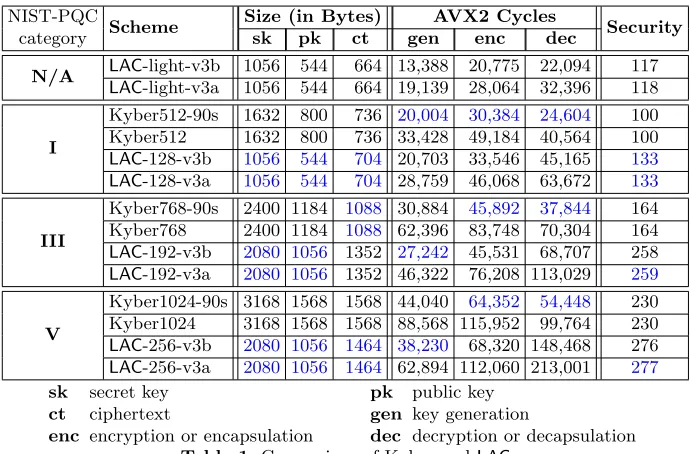
To highlight the compactness and efficiency of our scheme, we briefly compare the performance of our scheme with Kyber [16] (detailed comparison with other lattice based schemes can be found in section 6). We compare the chosen cipher-text secure version of the schemes. All these schemes uses BKZ with (quantum) sieving to estimate their security. Note that our estimation is independently confirmed in [4].
NIST-PQC
Scheme Size (in Bytes) AVX2 Cycles Security
category sk pk ct gen enc dec
N/A LAC-light-v3b 1056 544 664 13,388 20,775 22,094 117
LAC-light-v3a 1056 544 664 19,139 28,064 32,396 118
I
Kyber512-90s 1632 800 736 20,004 30,384 24,604 100 Kyber512 1632 800 736 33,428 49,184 40,564 100
LAC-128-v3b 1056 544 704 20,703 33,546 45,165 133
LAC-128-v3a 1056 544 704 28,759 46,068 63,672 133
III
Kyber768-90s 2400 1184 1088 30,884 45,892 37,844 164 Kyber768 2400 1184 1088 62,396 83,748 70,304 164
LAC-192-v3b 2080 1056 1352 27,242 45,531 68,707 258
LAC-192-v3a 2080 1056 1352 46,322 76,208 113,029 259
V
Kyber1024-90s 3168 1568 1568 44,040 64,352 54,448 230 Kyber1024 3168 1568 1568 88,568 115,952 99,764 230
LAC-256-v3b 2080 1056 1464 38,230 68,320 148,468 276
LAC-256-v3a 2080 1056 1464 62,894 112,060 213,001 277
sk secret key pk public key
ct ciphertext gen key generation
enc encryption or encapsulation dec decryption or decapsulation Table 1.Comparison of Kyber andLAC
1.3 Outline
In section 2 we recall basic definitions and notations. In section 3 we present our Ring-LWE based public key encryption scheme. In section 4 we describe the selection of parameters. In section 5 we give the security evaluation of our new scheme. In section 6 we discuss implementation issues of our scheme. Finally, we give the conclusion in section 7.
2
Preliminaries
In this section we first define several mathematical notations, the definitions of Ring-LWE and public key encryption schemes.
2.1 Basic Notations
Vectors are denoted by lower-case characters, such as~a.~atdenotes the transpo-sition of~a. Matrices are denoted by upper-case characters, such asA~.A~tdenotes the transposition ofA~. For anm-dimensional vector~a= (a0, a1, ..., am−1), itsl1 -norm is defined ask~ak1=Pi=0m−1|ai|; thel2-norm, also known as the Euclidean norm, is defined ask~ak2=
q
Pm−1
i=0 a 2
For a set S, x←$ S denotes that an element xis chosen from S uniformly at random. For a distribution D, x←$ D denotes that a random variablex is
sampled according toD. For a randomized algorithmA,y←$ A(x) denotes that
yis assigned randomly from the set of output ofAwith inputx; if the algorithm
Ais deterministic, we simplify it asy←A(x).
For an integerq ≥ 1, let Zq be the residue class ring modulo q, define the ring of integer polynomials moduloxn+ 1 asR:=
Z[x]/(xn+ 1) for an integer
n≥1, and the ringRq :=Zq[x]/(xn+ 1) denotes the polynomial ring modulo
xn+ 1 where the coefficients are from Zq.
2.2 Distributions and Random Sampling
The Uniform Distribution. The uniform distribution over a setX is defined asU(X). For example, the uniform distribution overRq isU(Rq).
The Centered Binomial Distribution. The idea to simulate a Gaussian distribution with binomial distribution was firstly introduced in [8], in order to mitigate the heavy cost of Gaussian sampling. LetΨσ be the centered binomial distribution with σ being the parameter of the distribution, where the corre-sponding standard variance is pσ
2. In the design of LAC we also use centered binomial distribution with parameters 1 and 12 (denoted as Ψ1 and Ψ1
2
respec-tively) as follows:
Definition 1 (Ψ1). Sample (a, b) ← {$ 0,1}2, and output a−b. It picks0 with probability 12, and ±1 with probability 14 according to the distribution Ψ1. The mean value ofΨ1 is0 and the variance is 12.
Definition 2 (Ψ1
2). Sample(a, b)
$
←Ψ1, and outputa∗b. It picks0 with prob-ability 34, and±1 with probability 18 according to the distribution Ψ1
2. The mean
value ofΨ1
2 is0 and the variance is
1 4.
We definen-ary centered binomial distribution with fixed Hamming weight, denoted as Ψh
n, where 0 < h < n/2 is even. For a random variable according to the distribution, its Hamming weight is fixed to the expectation h, and the numbers of both 1’s and−1’s areh/2, the number of 0 is n−h.
Random Sampling. Denote by Samp an abstract algorithm that samples a random variable according to a distribution with a given seed:
x←Samp(D;seed),
whereDis a distribution, andseedis the random seed used to samplex. For an
emptyseed=⊥, the process is randomized, and equivalent to x←$ D. When a
We extend the definition to a multiple dimension setting. We use
(x1, x2,· · · , xt)←Samp(D1, D2,· · · , Dt;seed)
to denote the process of sampling random variablesxi-s from distributionsDi-s for 1≤i≤t.
2.3 Learning with Errors (over Rings)
We refer the readers to [63,64,69,49,60] for a concrete background of the defini-tions and reducdefini-tions.
Definition 3 (Search LWE). Let n, m, q be positive integers, and χ~s, χ~e be (bounded) distributions over Z. Given (A,~b~ = A~~s+~e), recover the secret ~s,
whereA~ ←$ Zm×nq , the secret~s $
←χn~s and the error ~e←$ χm~e.
Definition 4 (Decisional LWE). Let n, m, q be positive integers, and χ~s, χ~e be (bounded) distributions overZ. Distinguish the two distributions of(A,~b~ )and
(A, ~~ u), where~b=A~~s+~eforA~ ←$ Zm×nq ,~s $
←χn ~ s,~e
$
←χm ~ e,~u
$
←Zmq .
Definition 5 (Search RLWE). Let n, q be positive integers, and χ~s, χ~e be (bounded) distributions overR. Given(~a,~b=~a~s+~e), recover the secret~s, where
~a← R$ q, the secret~s $
←χ~sand the error ~e $
←χ~e.
Definition 6 (Decisional RLWE).Letn, q be positive integers, andχ~s, χ~ebe (bounded) distributions overR. Distinguish two distributions of(~a,~b)and(~a, ~u),
where~b=~a~s+~efor~a← R$ q,~s $
←χ~s,~e $
←χ~e,~u $
← Rq.
2.4 Public Key Encryption
A public key encryption scheme PKE=(Gen,Enc,Dec) with message space M
consists of three polynomial-time algorithms.
– KG(l): A probabilistic polynomial-time key generation algorithm takes as input the security parameter l and outputs a public key pk and a private keysk. We write (pk, sk)←KG(l).
– Enc(pk, m): A probabilistic polynomial-time encryption algorithm takes as inputs a public keypk, a plaintextm and outputs a ciphertextc. We write
c←Epk(m).
– Dec(sk, c): A decryption algorithm takes as inputs a ciphertext c and a private keysk, and outputs a plaintextm. We writem←Dsk(c).
Adefined in the following is negligible in the security parameterl:
AdvccaA (l) =
Pr
b0=b:
(pk, sk)←Gen(l),
(m0, m1)← ADsk(·)(pk),
b← {R 0,1}, c∗←Epk(mb),
b0← ADsk(·)(pk, c∗).
−1 2 ,
whereAis restricted not to query Dsk(·) withc∗.
3
The
LAC
Scheme
In this section we describe our Ring-LWE based public key encryption scheme “LAC”.LACis a concrete instantiation of the Ring-LWE based scheme proposed in [49]. The main deviation at an algorithmic level is that the plaintext message is encoded with a large-block error correction code.
3.1 The Scheme
Notations. Letqbe the modulus. Define the polynomial ringRq =Zq/(xn+1). Define the message space M be {0,1}lm for a positive integer l
m, and the space of random seedsSbe{0,1}ls for a positive integerl
s. The integerslmand
lswill be specified afterwards.
We use then-ary centered binomial distribution with fixed hamming weight
Ψh
n, where the concrete choices of parameters will be given later.
Subroutines. In the subroutines dealing with the encoding and decoding of the error correction codes, ECCEnc,ECCDec, the conversion between a message
~
m∈ {0,1}lm and its encodingm~b ∈ {0,1}lv is provided, whereinl
v is a positive integer denoting the length of the encoding and depending on the specific choice of the parameter settings.
The algorithmLAC.KGrandomly generates a pair of public key and secret key (pk, sk).
Algorithm 1LAC.KG()
Ensure: A pair of public key and secret key (pk, sk). 1: seed~a
$ ← S
2: ~a←Samp(U(Rq);seed~a)∈Rq
3: ~s←$ Ψnh
4: ~e←$ Ψh n
5:~b←~a~s+~e∈Rq
The algorithm LAC.Enc on input pk and a message m~, encrypts m~ with the randomnessseed. In case thatseedis not given, the process is randomized. Otherwise, the encryption is deterministic for the same seed. The subroutine
ECCEncconverts the messagem~ into a codeword m~b.
Algorithm 2LAC.Enc(pk= (seeda~,~b), ~m∈ M;seed∈ S) Ensure: A ciphertext~c.
1: ~a←Samp(U(Rq);seed~a)∈Rq
2: m~b ←ECCEnc(m~)∈ {0,1}lv
3: (~r, ~e1, ~e2)←Samp(Ψnh, Ψnh, Ψnh;seed)
4: ~c1←~a~r+~e1∈Rq
5: ~c2←(~b~r)lv+~e2+bq2e ·mb~ ∈Zlqv 6: return ~c:= (~c1, ~c2)∈Rq×Zlqv
The algorithmLAC.Dec on input sk and a ciphertext~c, recovers the corre-sponding messagem~. The subroutineECCDecon input an encodingmb~, decoding
the codeword in it. Usually, a message m~ ∈ M is recovered. When there is a decryption error, the returned messagem /~ ∈ M.
Algorithm 3LAC.Dec(sk=~s, ~c= (~c1, ~c2)) Ensure: A plaintextm~.
1: ~u←~c1~s∈Rq
2: m~e←~c2−(~u)lv ∈Z
lv
q
3: fori= 0 tolv−1do
4: if q4 ≤m~ei< 34q then
5: m~bi←1
6: else 7: m~bi←0
8: end if 9: end for
10: m~ ←ECCDec(mb~) 11: return m~
3.2 Formal Security
4
Parameter Selection
Almost all lattice based key exchanges and public key encryptions, except for NTRU based ones, follow a similar framework from [30,58,15,7]. We have a set of theoretical results on the choice of rings, moduli, errors, etc [60,59,65] that ensure the framework stems from a provable secure design. However, those theoretical results do not give any guidance on selecting concrete parameters. Choosing parameters for (Ring-)LWE based schemes becomes one of a main research di-rection in subsequent works [15,7,59,16,43,66], and a main differentiator in most NIST-PQC submissions [55]. In this section, we present our choice of parameters, and give our design rational over common choices.
4.1 Modulus
Our first and foremost priority is to reduce the modulus. As mentioned earlier, the payload sizes are governed mainly by the dimension and the modulus. The choice of power-of-2 cyclotomic polynomial does not allow much freedom in the choice ofn. Hence we will work on reducing the modulus. Note that the modulus cannot be too small; it needs to be large enough to tolerant the errors during decryption. Prior to our work, a common choice wasq= 12289. We take a more aggressive approach by using “byte level modulus”.
A byte is the basic operating unit for most processors. Such a choice makes the public keys and ciphertexts compact, and is also optimal for implementations. The downside is that decryption errors increase when modulus is smaller. We will give more details in Section 4.3.
Depending on the structure of the polynomial ring, we consider three types of byte-level modulus.
– Power-of-Two Modulus:From the view of implementation, the most suit-able byte-level modulus isq= 256, for which the modulus operation can be efficiently realized by ignoring the carrier data. However, sinceq= 256 is not a prime,Z256[x]/(xn+ 1) does not yield a field for our choice ofn. Currently, it is unclear whether this algebraic structure will cause any weakness in the security.
– Max-Split Modulus:The reason for choosingq≡1 mod 2nis thatxn+1∈ Zq[x] can be completely factorized. For byte-level modulus, this is no longer the case. However, we notice that when q = 257, xn + 1 ∈
Z257[x] has maximum number of factors:
x512+ 1 = 128
Y
i=1
(x4+τi), x1024+ 1 = 128
Y
i=1
(x8+τi),
whereτi ∈Zq. We call this type of modulus “Max-Split Modulus”, for which
q= 251, which is the largest prime smaller than 28,xn+ 1∈
Z251[x] can be minimally factorized as:
xn+ 1 = (xn/2+ 91xn/4+ 250)(xn/2+ 160xn/4+ 250).
We call this type of modulus “Min-Split Modulus”, for which xn + 1 can only be factorized into two polynomials with the degree ofn/2.
It has been argued that less algebraic structure reduces the attacking surface [11]. For conservative purpose, and also for the sake of simplicity, we choose the min-split modulus q = 251 for the main version of our scheme submitted to NIST-PQC. Nonetheless, we do not see any weakness of the power-of-two mod-ulus or the max-split modmod-ulus. For different kinds of security and performance balance, in this paper, we also give an extended version of our scheme by using
q = 256. Recently, Lyubashevsky et al. [51] proposed new tricks that partially enable NTT for max-split rings. We leave the implementation ofq= 257 version of our scheme to future research.
4.2 The Errors and Secrets Distribution
There are two principles for the choice of the distribution for the error and secret vector of the poly-LWE problem. Firstly, the errors and the secrets must be large enough to guarantee the hardness of the poly-LWE problem. Secondly, the errors and the secrets must be small enough to guarantee the correctness of the de-cryption algorithm. In literatures, there are mainly two families of distributions that satisfy the average/worst case reduction theorem [63,49], namely, discrete Gaussian distribution [49,8] and centered binomial distribution [16]. Gaussian distribution consumes lots of entropy, is hard to implement in constant time, and is also vulnerable to memory based side channel attacks [19] when imple-mented with look-up tables [32]. Therefore, we opt to use the centered binomial distribution for our scheme.
In the implementation, as described in [8], a centered binomial distribution with the standard deviation ofpλ/2 can be generated asPλ
i=1(bi−ˆbi), where
bi,ˆbi∈ {0,1}are uniformly random bits. When a byte-level modulus is used, the error-modulus-ratio becomes large enough even for small error distributions. This allows us to use the simplest centered binomial distribution with λ= 1 as our basic error distribution. That is, in order to get a centered binomial distribution withλ= 1, each element of the error vector is generated byb−ˆb, whereb,ˆbare uniformly random bits. Then we can get the distributionΨ1: Pr[x= 0] = 1/2, Pr[x=±1] = 1/4. This, and its variants, are used inLAC-v1.
Looking ahead, to makeLAC-v2/v3 immune to high hamming weight attack in a more efficient manner, we usen-ary centered binomial distributionΨh
n with fixed Hamming weight h for the error and secret vectors (h/2 ones and h/2 minus ones). The implementation of fixed weight centered binomial distribution will be described in section 6.
4.3 Decryption Errors
As shown in the decryption algorithm, the message is recovered via two steps. First, the error correction code wordm~b is recovered from the ciphertext. Then,
the messagem~ is recovered from the code word. It is easy to verify that:
e
~
m=~c2−(~c1~s)lv
= (br~)lv +~e2+b
q
2em~b −(~c1~s)lv
= ((as~ +~e)~r)lv +~e2+b
q
2em~b −((ar~ +~e1)~s)lv
= (er~ −~e1~s)lv+~e2+b
q 2em~b
(1)
Let w~ = (er~ −~e1~s)lv +~e2, we have that the error rate of each mei is δ =
1−Pr[−bq4e< wi <b4qe]. If~s, ~e, ~r, ~e1, ~e2 are all randomly chosen from a small distribution with a standard deviation ofσand an expectation of 0, then accord-ing to the central limit theory, wi follows a distribution that is very close to a discrete Gaussian distribution with a standard deviation ofσ2√2nand an expec-tation of 0. Thus, the error rate for each bit can be approximated by the Gaussian error function as δ≈1−erf√ bq/4e
2(σ2√2n)
. For example, For n= 512, q = 251,
and a distribution of Ψ1 with a standard deviationσ= 1/
√
2, the error rate of each bit is estimated by:
δ≈1−erf
b251/4e √
2((1/√2)2√2×512)
≈2−13.95.
When D2 is used, one message bit will be encoded as two elements inm~e. As
a result, the error rate of the message bit isδ= 1−Pr[|wi|+|wj|<bq2e]. Thus the error rate of each message bit can be estimated asδ≈1−erf√ bq/2e
2(σ2√4n)
.
For the case ofn= 512, q= 251, the error rate of each message bit is:
δ≈1−erf
b251/2e
√
2((1/√2)2√4×512)
≈2−25.95.
Suppose that the error correction code can correctlterrors at most and the code word length is ln =lv, and assume the coefficients ofw~ are independent from each other, we have the decryption error rate for a messagem~:
∆≈
lv
X
j=lt+1
l
v
j
δj(1−δ)lv−j
Note that, as pointed out by D’Anvers [28], when single bit error rateδis too large, we can not assume that the coefficients of w~ are independent from each other. The theoretical dependence model and experiment results of D’Anvers show that the dependence mainly comes from the norm of~s, ~e, ~r, ~e1. This leads to the use of fix hamming weight distribution in LAC-v2 and LAC-v3. When
~
s, ~e, ~r, ~e1 are sample from this distribution, their norms are also fixed and the main source of dependence is removed. So we can assume that the coefficients ofw~ are independent from each other.
Based on the equations above, we can estimate the decryption error rate in the case of chosen plaintext attacks, in which the secrets and errors are all randomly selected according to the sampling algorithm. However, in the case of chosen ciphertext attacks, the adversary may choose noise vectors with special patterns to increase the correlation between the coefficients of w~. For example, Guo et al.[62] propose several patterns to increase the decryption error rate of LAC-v2. At the current stage, a comprehensive theoretical analysis of the dependence model seems impossible. Our solution in LAC-v3 is to decrease the decryption error rate further.
4.4 Error Correction Code
Our byte level modulus incurs a high decryption error rate by design. Trivial or light error correction methods such as D2 or D4 code [8] are not capable of handling such a situation. Heavy error correction methods ought to be used for our use case. In the field of code theory, there are many powerful codes such as BCH, Goppa, LDPC, Turbo and Polar. In principle, any code with enough error correcting capability can be used in our scheme. For the sake of simplicity and efficiency we choose BCH code for implementation.
Although BCH code with large enough error correction capability can de-crease the decryption error rate small enough, it will also bring high computa-tional cost (see section 6 for detailed computacomputa-tional cost). To solve this problem, in this paper we choose the combination of D2 and BCH code. That is, the plain-text is firstly encoded with the BCH code, then the code word is encoded with the D2 code. With the help of the high performance D2 code, the BCH only need to correct a small number of errors. Concrete parameters of BCH are described in the next subsection.
4.5 Recommended Parameter Set
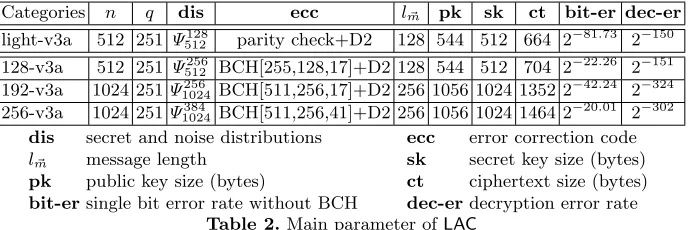
Categories n q dis ecc lm~ pk sk ct bit-er dec-er
light-v3a 512 251 Ψ128
512 parity check+D2 128 544 512 664 2
−81.73 2−150
128-v3a 512 251 Ψ512256 BCH[255,128,17]+D2 128 544 512 704 2−22.26 2−151 192-v3a 1024 251Ψ1024256 BCH[511,256,17]+D2 256 1056 1024 1352 2−42.24 2−324 256-v3a 1024 251Ψ1024384 BCH[511,256,41]+D2 256 1056 1024 1464 2−20.01 2−302
dis secret and noise distributions ecc error correction code
lm~ message length sk secret key size (bytes)
pk public key size (bytes) ct ciphertext size (bytes) bit-ersingle bit error rate without BCH dec-erdecryption error rate
Table 2.Main parameter ofLAC
The dimensionn, modulusqand the error distribution are selected to achieve high enough security levels according to the lattice reduction attacks and hybrid attacks (detailed analysis are in section 5).
The parameters of BCH “[lc, lm, ld]” are selected to achieve a small enough decryption error rate to defeat the high Hamming weight attacks [55] and pattern attacks [62]. Concretely, for LAC-128 and LAC-192, we choose ld = 17 which allows us to correct upto 8 bits of errors; forLAC-256 we chooseld = 41 which allows to correct upto 20 bits of errors.
Note that the error rate for each coefficient is estimated by a convolution of all the error terms. In order to minimize the size of the ciphertext, in our implementation the lower 4 bits for each coefficient in ~c2 are discarded. This brings an additional uniformly random (under Ring-LWE assumption) error over [−7,8].
A public key consists of a 32 bytes seed seed~a, and an n bytes vector ~b. A secret key is an n bytes vector. One may simply store a 32 bytes seed for the secret key to minimize storage, at a cost of slightly slower decryption. In the case where Fujisaki-Okamoto transformation is used to achieve chosen ciphertext security, a secret key also contains a copy of the corresponding public key, so that the decryption algorithm can re-encrypt to check the validity of the ciphertext. Thus the size of a secret key becomes 2n+ 32. Finally, a ciphertext contains both annbytes vector~c1, and lv bytes of~c2. ForLAC-light lv=lm+ 3×8, where 3 is the byte size of the redundant data of the parity check error correction code. ForLAC-128 and LAC-192 parameter set,lv=lm+ 8×8, where 8 is the size of the redundant data. ForLAC-256,lv =lm+ 21×8, where 21 is the size of the redundant data.
In Table 2, the modulus of LAC-v3a is q = 251, which keeps the same as
LAC-v1 andLAC-v2 . In addition, we also propose an alternative parameter set, named asLAC-v3b, withq= 256 instead of 251.The reminder of the parameters stays the same. Since the modulus is a little larger, the decryption error rate of
5
Concrete Security
We consider the best known generic attacks against Ring-LWE with our pa-rameters, which treat the Ring-LWE problems as plain LWE problems. Those attacks are well-known by the community; their costs (e.g. BKZ with (quantum) sieving2) are well understood. Since our secrets and errors are sparse, we also evaluate the cost of hybrid attacks [41,70,39].
We also consider dedicated attacks that target specific designs of our scheme, namely the subfield attacks, the high Hamming weight attacks and the pattern attacks. Those attacks are reported as comments to the Round 1/2 version of
LACsubmission to NIST-PQC.
5.1 Generic Attacks
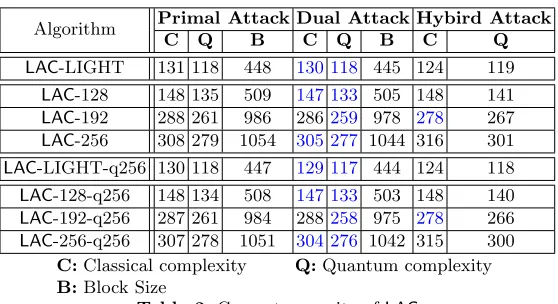
There are many generic algorithms to solve the LWE problem, see [6,68] for a survey of known techniques. It has been shown that lattice reduction attacks utilizing the BKZ algorithm [22] are more powerful than exhaustive search, com-binational and algebraic algorithms. For simplicity, following the analysis of [7], we focus primly on two embedding attacks that are commonly referred to as primal attack and dual attack. We also evaluate the cost for hybrid attacks. We summarize the security estimates in Table 3.
Algorithm Primal Attack Dual Attack Hybird Attack
C Q B C Q B C Q
LAC-LIGHT 131 118 448 130 118 445 124 119
LAC-128 148 135 509 147 133 505 148 141
LAC-192 288 261 986 286259 978 278 267
LAC-256 308 279 1054 305 277 1044 316 301
LAC-LIGHT-q256 130 118 447 129 117 444 124 118
LAC-128-q256 148 134 508 147 133 503 148 140
LAC-192-q256 287 261 984 288258 975 278 266
LAC-256-q256 307 278 1051 304 276 1042 315 300 C:Classical complexity Q:Quantum complexity B:Block Size
Table 3.Concrete security ofLAC
Primal Attack. In a primal attack, one builds a lattice with a unique-SVP
instance from the LWE samples; then, uses BKZ algorithm to recover this unique
shortest vector. In a nutshell, given an LWE instance (A,~b~ =A~~s+~e),A~ ∈Zm×n q , the target lattice of dimensiond=m+n+ 1 is constructed as
ΛA~={~x∈Zm+n+1: (A~|I~m| −~b)~x=~0 modq}.
It is easy to verify that, ~v = (~s, ~e,1) is the unique-SVPsolution when both ~s
and~eare reasonably short. For exmaple, as shown in [7], the attack is successful if and only if σ√b ≤δ2b−d−1×qm/d, whereσ is the standard deviation of the errors and secrets,δ= ((πb)1/bb/2πe)1/(2(b−1)).
BKZ algorithm progressively processes the lattice basis by calling polynomial times a subroutine, such as the (quantum) sieving algorithm, to solve the exact shortest vector problem for sub-lattices with dimension (i.e. blocksize) b. This method is known as BKZ-core-(Q)Sieving, and its complexity depends solely on the block dimensionbthat is required for the BKZ algorithm to find the unique
solution. According to [7], the best complexity of theSVPoracle isp3/2b+o(b)≈
20.292b for classical sieving algorithms, and p
13/9b+o(b) ≈20.265b for quantum sieving algorithms.
Dual Attack. In a dual attack, one firstly tries to build a dual lattice of the aforementioned primal lattice, and then uses the dual lattice to solve the deci-sional LWE problem. At a high level, given the LWE instance (A,~b~ =A~~s+~e),
~
A∈Zm×nq , the target lattice of dimensiond=m+nis constructed as
Λ⊥~
A ={(~x, ~y)∈Z m×
Zn :A~t~x=~y modq}.
Again, [7] showed that BKZ is capable of finding a vector~v = (~x, ~y) of length
l=δd−1qn/d, where the distance between~vt~band the uniform distribution will be bounded by= 4 exp (−2π2τ2) forτ=lσ/q. This breaks the decisional LWE problem with an advantage.
Similar to primal attacks, the concrete security of dual attack also depends on the complexity of BKZ algorithm. There is a slight caveat when BKZ-core-QSieving is used: the attacker is able to amplifyto 1/2 by repeating the sieving algorithm for R =max(1,1/(γ2)) times. This operation is almost free to the attacker, since sieving algorithm will produce γ = 20.2075b vectors which far exceed the required number of short vectors 1/2for repeating.
Hybrid Attack. At a high level, the hybrid attack takes the following steps.
– Firstly, one interprets the lattice basisB ∈Zn,n as a concatenation of two matricesB1,B2∈Z`,n×Zk,n, with` > n/2 and`+k=n. Note thatL(B1) spans a sublattice of dimension`.
– Then, one performs lattice reductions over this sublattice, to an extend that it allows for solving bounded distance decoding problem effectively.
– Lastly, one uses the reduced basis of L(B1) to solve the bounded distance decoding problem.
It is easily to see that, to get the best performance, one usually assumes the cost of lattice reductions is on the same order of guessing. What remains to be estimated is the individual cost for each step. There are a few subtlety on estimating the cost of the above procedure. To be more conservative, we make the following assumptions/decisions.
– In the estimation, the cost of solving CVP/BDD is often neglected; a good basis yields a polynomial time algorithm (for example, Babai’s algorithms), which may adds a few bits complexity in practice.
– We use BKZ with (quantum)-core sieving to estimate the cost of BKZ. This model counts the cost of a single SVP, and ignores the number of iterations. It is also a more conservative choice than BKZ with enumeration.
– We also assume that if basis is “good”, and if we have successfully guessed the correct combination, then, the probability of solving the CVP is exactly 1.
– To be more conservative on the searching side, we estimate the entropy in the guessing phase, and taking its square root (in accounting for Grover’s algorithm) as the cost of guessing. This results into a lower bound that isn’t achievable through classical MITM attacks. This also assumes vector additions incur a cost of 1.
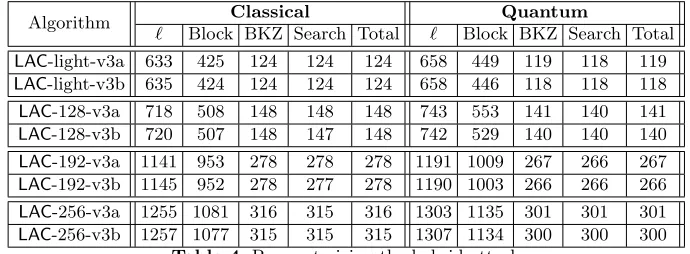
The details of the hybrid attack parameters can be found in Table 4. It was generated with the estimator [67].
Algorithm Classical Quantum
` Block BKZ Search Total ` Block BKZ Search Total
LAC-light-v3a 633 425 124 124 124 658 449 119 118 119
LAC-light-v3b 635 424 124 124 124 658 446 118 118 118
LAC-128-v3a 718 508 148 148 148 743 553 141 140 141
LAC-128-v3b 720 507 148 147 148 742 529 140 140 140
LAC-192-v3a 1141 953 278 278 278 1191 1009 267 266 267
LAC-192-v3b 1145 952 278 277 278 1190 1003 266 266 266
LAC-256-v3a 1255 1081 316 315 316 1303 1135 301 301 301
LAC-256-v3b 1257 1077 315 315 315 1307 1134 300 300 300 Table 4.Parameterizing the hybrid attacks
5.2 Dedicated Attacks
Subfield Attacks. The idea of exploiting subfields is known to the lattice community for years [10,3,13,44], and to use this idea to analyzeLACwas firstly proposed by Alperin-Sheriff [54] during the first round evaluation of NIST-PQC. Recall that xn+ 1 has two factors moduloq= 251:
xn+ 1 = (xn/2+ 91xn/4+ 250)(xn/2+ 160xn/4+ 250).
In other words, there exist two subfields defined by two polynomials~g and~h where~g=xn/2+ 91xn/4+ 250 and~h=xn/2+ 160xn/4+ 250.
Given (~a,~b=as~ +~e), one may recover (~s, ~e) by looking at the samples over the subfields. It may be sufficient to recover (~sg:=~smod~g, ~eg:=~emod~g) from (~amod~g,~bmod~g), and (~sh, ~eh, respectively). Next, it becomes straightforward to recover (~s, ~e) via Chinese remainder theorem.
Analysis. In the rest, we give a high level analysis of this attack. The key point of the attack is that by moving to the subfield, the lattice dimension is practically halved. Therefore, the BKZ complexity may be reduced for the new sub-lattices. Note that this is not necessarily always the case under core-(Q)Sieving model where only the cost of subroutine counts (while the number of iterations does not); and the cost of the subroutine depends only on the root Hermite factor. Nonetheless, to have a meaningful analysis, we assume that this is not an obsta-cle: the attacker may access an SVP oracle for BKZ subroutines solely for this attack.
We will show that the corresponding vectors in the subfields, (~sg, ~eg), will be larger than the Gaussian heuristic length. In other words, even if one was able to perform lattice reduction over the dimension-halved lattices, he will not be able to recover the desired vectors.
The attack reduces the dimension, in the meantime, the modulo operation increases the size of (~sg, ~eg) (similarly, (s~h, ~eh)). To be precise, when (~s, ~e) are small polynomials with the coefficients in {−1,0,1}, the coefficients of (~sg, ~eg) will lie in{0,±1,±2,±91}. Coefficients of±91 will be too large. Alperin-Sheriff also pointed out that by multiplying~sand~eby 11, all the coefficients of (~sg, ~eg) will be within the interval of [−25,25].
Let A~ = hA~g|~I|11×~bg
i
, where A~g is the matrix generated by ~ag, if ~z = [11×~sg|11×~eg| −1] is the shortest solution ofAz~ = 0 modq, we can recover~z with the primal attack. Note that, the dimension of a primal attack is reduced fromd= 2n+ 1 tod=n+ 1 via the subfield attack. SinceA~is a random matrix, theq-ary latticeΛ⊥q(A~) will behave as a random lattice [24], and therefore it is sufficient to use Gaussian heuristic to estimate the length of shortest vectors in this lattice:
λ1(Λ⊥q)≈q m/d
r
d
2πe.
On the other hand, we also need to estimate the length of~z. Central limit theory says that the length of~zapproximately follows a discrete Gaussian distri-bution. Our implementation shows that~zclosely follows a Gaussian distribution with a mean and deviation pair of (253.59,6.9) for LAC-128, (253.26,6.29) for
LAC-192 and (358.42,6.86) forLAC-2563.
It is easy to verify that, the length of~z will be larger than the solution of
~
Az= 0 modqexcept for negligible probability. Hence~zwill not be a short vector in this lattice. In other words, if one were to use subfield attack, and assuming that they have free access to SVP oracles simply for the sub-lattices, they will not be able to locate the vector.
To sum up, the subfield attack described above will not affect the security of
LACfor either original parameter sets or the revised version.
High Hamming Weight Attack. This is a chosen ciphertext attack that exploits the fact that the secrets and errors (~r, ~e1) in some ciphertexts (with certain probability) may have higher-than-usual Hamming weight. It is feasible if (~r, ~e1) are randomly selected fromΨ1orΨ1
2. It is easy to see that the decryption
error rate is influenced by the Hamming weight. Therefore, with enough number of random samples (and correspondingly, pre-computations), an attacker may obtain sufficient number of samples with higher Hamming weight secrets and errors. This may leak information on the secret key.
Analysis. It has been shown that chosen plaintext secure version of (Ring-)LWE based schemes suffer from an reaction attack [33]. To address this vulnerabil-ity, most schemes rely on Fujisaki-Okamoto transformation [35,36,42] to achieve chosen ciphertext security. We also adopt the same approach. Via this transfor-mation, the randomness vectors (~r, ~e1) are generated from the plaintext message by a pseudorandom generator. Thus the vectors (~r, ~e1) are randomly distributed from the view of the adversary.
In a comment toLAC in the Round1 estimation of NIST-PQC [55], Alperin-Sheriff pointed out that, for the LAC-256 parameter set, the probability that a pair of valid (~r, ~e1) with a Hamming weight of at least 1024 + 310 = 1334 is greater than
2048
1334
/22048≈2−143.
Therefore, with 2207 pre-computations (assuming each access to the pseu-dorandom generator incurs a cost of 1), the adversary will obtain 264 messages for which the corresponding (~r, ~e1) have Hamming weight exceeding 1334. It is worth noting that the adversary can only access the decryption oracle for 264 times in the security model of NIST-PQC. Next, for samples with such high
Hamming weights, the decryption error rate for each bit ofmei is expected at
δhigh≈1−erf
b251/4e √
2((1/√2)p(1024 + 310)/2048√2×1024)
!
≈2−5.9,
This yields a decryption error rate for the message m~:
∆high = 1023
X
j=55+1
1023
j
δhighj (1−δhigh)1023−j
≈2−44.4.
As a result, with 2207 pre-computations and 264 decryption oracle queries, the adversary can get about 219.6 decryption failures.
Counter measures. To prevent high hamming weigh attacks, we switch ton-ary centered binomial distribution with fixed Hamming weight. This makesLAC com-pletely immune from high Hamming weight attacks and their potential variants.
Pattern Attack. Recently, a new analysis result was proposed by Guoet al.. Its main idea is to find error vectors with special kind of patterns. In general, the adversary tries to find error vectors that contain consecutive “1”s or “−1”s. If this is the case, one can except a higher-then-normal decryption error rate. And as mentioned earlier, with enough decryption errors, the attacker will learn (partial) information about the secret key.
Concretely, the authors showed that, with the pre-computation cost of 2162 and online computation cost of 279, they can recover the private key ofLAC -256-v1 with a success probability of 2−64.
Analysis. There are mainly two reasons that LAC-256-v1 and LAC-256-v2 are vulnerable to pattern attacks. Firstly, we do not have multi-target protection in LAC-v1/2. That is, a pre-computation can be used to attack multiple public keys. This can be prevented easily by hashing the public key into the seed that instantiate the PRNG. Then, the adversary must compute errors for each public key; and cannot pre-process this task. The second reason is that the decryption error rate of LAC-256-v1 andLAC-256-v2 are non-negligible with regard to its security level.
Counter measures. To make LAC immune to decryption error based attacks, such as high Hamming attack and pattern attacks, we further decrease the av-erage case decryption error rate of LAC-v3 to negligible. In other words, for a security levell, the decryption error rate will be smaller than 2−l.
6
Implementations and Performance
– Random polynomial sampling; – Secret polynomial sampling; – Polynomial multiplication;
– Encoding/decoding of error correction code.
6.1 Random Polynomial Generation
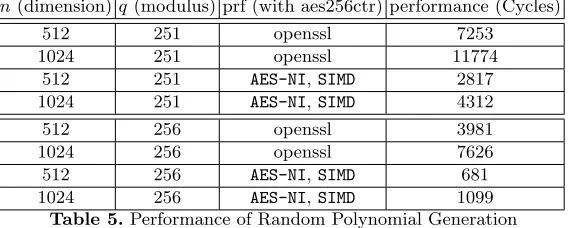
Forq= 256, we simply samplenrandom bytes, and cast it as~a∈Zq[x]/(xn+1). Forq= 251, we use rejection sampling based technique, and keep reading from the sampler until we have gatheredn integers that are small thanq. Note that the data associated with this subroutine are all public. Rejection sampling here does not affect the fact that the execution of the code is independent from secret information.
The performance of this subroutine is summarized in Table 5.
n(dimension)q(modulus) prf (with aes256ctr) performance (Cycles)
512 251 openssl 7253
1024 251 openssl 11774
512 251 AES-NI,SIMD 2817 1024 251 AES-NI,SIMD 4312
512 256 openssl 3981
1024 256 openssl 7626
512 256 AES-NI,SIMD 681
1024 256 AES-NI,SIMD 1099 Table 5.Performance of Random Polynomial Generation “prf”: the pseudo-random function used to generate the random bytes; “openssl”: the aes256ctr function from the openssl lib, used inLAC-v1/2;
“AES-NI,SIMD”:the aes256ctr function from [56], used inLAC-v3.
6.2 Secret and Error Polynomial Generation
A trivial idea to generate a polynomial fromΨnhis to randomly seth/2 positions to 1,h/2 positions to−1, and the restn−hpositions to 0. This method is not constant time, and can only be used during encryption.
Under the CCA security, the decryptor will need to re-encrypt the message. Therefore, it is desirable to have a constant time sampler that can be used by both encryption and decryption. Sampling in constant time fromΨh
n has already been implemented in [9,12]. Here, we use a permutation based solution that is both efficient and constant time.
The algorithm “gen r” outputs a polynomial~r∈Ψh
n as follows: 1. Init:Setri=ifori∈[0, n−1].
2. Permute:For i∈[0, n−1], generate a random si ∈[i, n−1], permute ri andrsi.
The intuition is that, gen r is a map from a fixed element to another element in the support ofΨh
n. For each positioni, an random indexrsi will be selected.
If we samplesi∈[i, n−1] randomly, then we get a shuffle ofi∈[0, n−1]. In the algorithm above, the trivial approach to generate si ∈ [i, n−1] is sample rejection. However, this will cause non-constant executing time. In our implementation, for the sake of constant time, we use a sightly different form of the above procedure as follows:
1. Init:Setri=ifori∈[0, n−1], andp= 0.
2. Permute:For i ∈[0, repeat], generate a random si ∈ [0, n−1], if si ≥ i, then permuterp andrsi, updatep=p+ 1, else permuterp andrp.
3. Output:Output the firsthpositions of~r.
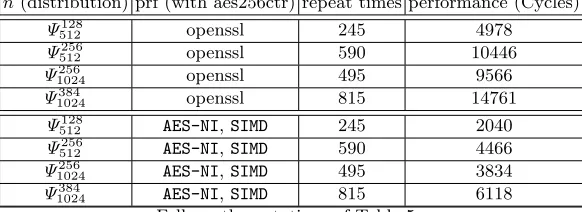
The second step will repeat enough times to guarantee that the firsth posi-tions of~r are permuted. For each security level l, we set the value “repeat” to make sure that Pr[p≥h]<2−l. The performance of this subroutine is described in Table 6.
n(distribution) prf (with aes256ctr) repeat times performance (Cycles)
Ψ512128 openssl 245 4978
Ψ512256 openssl 590 10446
Ψ1024256 openssl 495 9566
Ψ1024384 openssl 815 14761
Ψ128
512 AES-NI,SIMD 245 2040
Ψ256
512 AES-NI,SIMD 590 4466
Ψ1024256 AES-NI,SIMD 495 3834
Ψ1024384 AES-NI,SIMD 815 6118 Follows the notations of Table 5.
Table 6.Performance of Secret and Error Polynomial Generation
6.3 Polynomial Multiplication
We provide three types of polynomial multiplication targeting different use cases:
– ref: The reference implementation is the most general version that only re-quires 32bits registers. It can be executed on most of the personal computers or servers, and can be easily translated to embedded platforms such as Cor-tex M4.
– opt:The optimized implementation uses a 64bits variant. It packs four 16bits intermediate values. This implementation can be used in any 64bits plat-forms.
Now we are ready to describe our algorithm for polynomial multiplications, that is adopted in all three versions.
Given ~a and ~r, let ~v = h−a0,· · ·,−an−1, a0,· · ·, an−1i, according to the definition of Zq[x]/(xn+ 1), we can compute~b=ar~ as:
~b= n−1
X
i=0
(~v[n−i: 2∗n−i−1]·ri),
where~v[x:y] denote the vector of{vx,· · ·, vy}. Note that, in our schemeri ∈
{−1,0,1}, so the computation can be simplified as:
~b= X ri==1
~
v[n−i: 2∗n−i−1]− X
ri==−1
~
v[n−i: 2∗n−i−1].
Concretely, when ~r ∈ Ψh
n is in the form of position based representation (the firsth/2 positions stores the indexes thatri==1, the secondh/2 positions stores the indexes thatri ==−1) the ref version of our implementation works as follows:
1. Prepare~v:Set~v={−a0,· · · ,−an−1, a0,· · ·, an−1}.
2. Init accumulator:Initialize the intermediate accumulators:
~
sum one= 0,sum mone~ = 0,
wheresum one~ is the accumulator vector forri== 1 andsum mone~ is the accumulator for vectorri==−1.
3. Addition:Fori= 0 toi=h/2−1, compute:
~
sum one=sum one~ +~v[n−ri : 2∗n−ri−1],
~
sum mone=sum mone~ +~v[n−ri+h/2: 2∗n−ri+h/2−1].
4. Output:Output~b=sum one~ −sum mone~ modq.
Note that, when the intermediate accumulators are stored with uint16 t, we only need execute the modq operation for once in the last step, instead for each iteration during the third step.
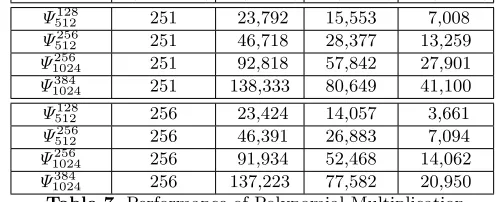
distributionq(modulus) ref(cycles) opt(cycles) avx(cycles)
Ψ128
512 251 23,792 15,553 7,008
Ψ256
512 251 46,718 28,377 13,259
Ψ256
1024 251 92,818 57,842 27,901
Ψ384
1024 251 138,333 80,649 41,100
Ψ512128 256 23,424 14,057 3,661
Ψ512256 256 46,391 26,883 7,094
Ψ1024256 256 91,934 52,468 14,062
Ψ1024384 256 137,223 77,582 20,950 Table 7.Performance of Polynomial Multiplication
6.4 Error Correction Code
LAC-v1/v2 uses a generic binary BCH encoding/decoding library [31]. This im-plementation is not constant time, and may lead to timing and memory attacks [27]. InLAC-v3, we used an constant time implementation, modified from [31]. We highlight our modifications as follows.
– Constant Looping Statements: There are three loops to compute the syndromes, error location polynomials and roots. In [31], the number of iterations in each loop may be reduced based on the input data, in order to improve efficiency. In our modification, these loops will iterate for the maximum value regardless of the input.
– Constant Branching Statements:We removed the branching statements and used the masking technique to control whether a particular value gets updated or not. In [31], within error location polynomial computation, two branching structures (“if”) are used to decide whether the intermediate sta-tus will be updated. We removed the branching statements and used masking a value to control the update of the status.
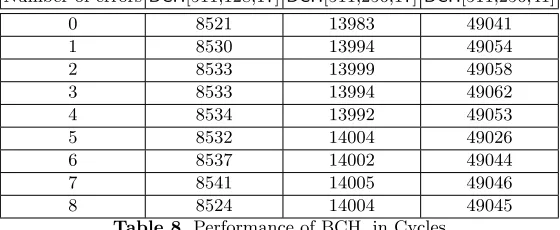
In [31], looking up tables are also frequently used. This may be vulnerable to cache attacks. Naive methods for constant time array access will decrease per-formance drastically. Our implementation unfortunately still uses a same lookup table. We leave the cache attacks resistant implementation to future research. The performance ofBCH[511,128,17],BCH[511,256,17] and BCH[511,256,41] for
Number of errorsBCH[511,128,17]BCH[511,256,17]BCH[511,256,41]
0 8521 13983 49041
1 8530 13994 49054
2 8533 13999 49058
3 8533 13994 49062
4 8534 13992 49053
5 8532 14004 49026
6 8537 14002 49044
7 8541 14005 49046
8 8524 14004 49045
Table 8.Performance of BCH, in Cycles
6.5 Performance
The performance of LAC-v3 is described in Table 9. where ref denotes the ref-erence version, opt denotes the optimized version over 64bits instruction, avx denotes the optimized version over AVX2 SIMD instructions. There main differ-ence among these three versions is their underlying polynomial multiplication. In the ref and opt version, openssl based pseudo-random function is used in the secret/noise polynomial generation. In the avx version, theAES-NI &SIMD based pseudo-random function is used the secret/noise polynomial generation. The performance results are tested on the ubuntu 18.04 operation system run-ning on the Intel Xeon(R)W-2123 @ 3.6GHz, memory 15.3GB, with Turbo Boost and Hyperthreading disabled.
Scheme ref (Cycles) opt (Cycles) avx (Cycles)
gen enc dec gen enc dec gen enc dec
light-v3a 51,049 74,328 90,024 39,712 57,111 66,017 19,139 28,064 32,396 128-v3a 88,765 143,740 193,355 65,663 104,660 137,344 28,759 46,068 63,672 192-v3a 149,212 234,636 320,457 110,839 175,077 238,633 46,322 76,208 113,029 256-v3a 231,417 410,739 618,689 151,312 261,869 403,563 62,894 112,060 213,001 light-v3b 50,465 74,963 90,839 35,311 51,694 59,897 13,388 20,775 22,094 128-v3b 87,696 145,173 194,307 60,293 98,334 120,958 20,703 33,546 45,165 192-v3b 141,331 227,948 313,432 101,010 163,770 222,955 27,242 45,531 68,707 256-v3b 213,731 381,269 574,613 133,323 240,771 381,833 38,230 68,320 148,468
Table 9.Performance of CCA SecureLAC
6.6 Comparison
Turbo Boost and Hyperthreading disabled. Parameters of the other 5 schemes are obtained from their Round-2 submission to NIST-PQC [56]. Note that Three-Bears stores seeds instead of the secret key to minimize the storage. As a trade-off it is computationally more costly decryption to regenerate the keys.
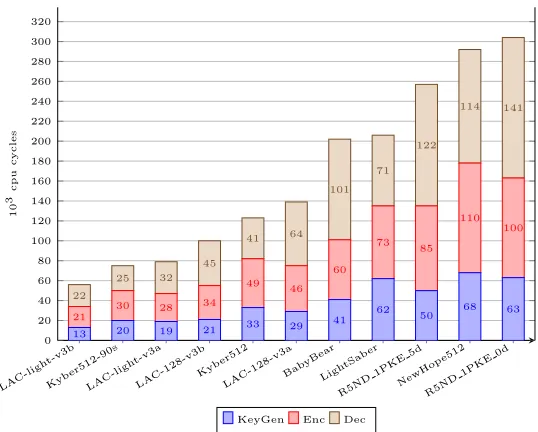
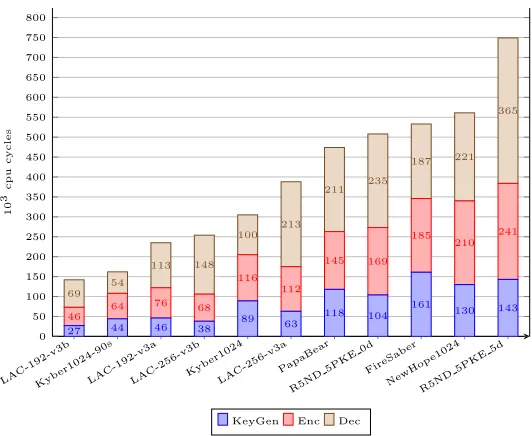
We also provide a performance comparison according to each security level in Fig 1, 2 and 3, for the ease of comparison. Note that, since the concrete security of LAC-192-v3a andLAC-192-v3b under the BKZ-core-(Q)Sieving modelmeets level 5, they are listed in both Fig 2 and 3.
NIST-PQC
Scheme Size (in Bytes) AVX210
3 Cycles
Q-Security
category sk pk ct gen enc dec
N/A LAC-light-v3b 1056 544 664 13 21 22 117
LAC-light-v3a 1056 544 664 19 28 32 118
I
NewHope512 1888 928 1120 68 110 114 101
LAC-128-v3b 1056 544 704 21 34 45 133
LAC-128-v3a 1056 544 704 29 46 64 133
Kyber512-90s 1632 800 736 20 30 25 100
Kyber512 1632 800 736 33 49 41 100
BabyBear 40 804 917 41 60 101 140
R5ND 1PKE 0d 708 676 756 65 100 141 118
R5ND 1PKE 5d 493 461 636 50 85 122 120
LightSaber 1568 672 736 62 73 71 114
III
LAC-192-v3b 2080 1056 1352 27 46 69 258
LAC-192-v3a 2080 1056 1352 46 76 113 259
Kyber768-90s 2400 1184 1088 31 46 38 164
Kyber768 2400 1184 1088 62 84 70 164
MamaBear 40 1194 1307 79 96 156 213
R5ND 3PKE 0d 1031 983 1119 88 138 192 180
R5ND 3PKE 5d 828 780 950 91 159 237 176
Saber 2304 992 1088 104 122 120 185
V
NewHope1024 3680 1824 2208 130 210 221 233
LAC-256-v3b 2080 1056 1464 38 68 148 276
LAC-256-v3a 2080 1056 1464 63 112 213 277 Kyber1024-90s 3168 1568 1568 44 64 54 230
Kyber1024 3168 1568 1568 89 116 100 230
PapaBear 40 1584 1697 118 145 211 285
R5ND 5PKE 0d 1413 1349 1525 104 169 235 246 R5ND 5PKE 5d 1042 978 1301 143 241 365 232
FireSaber 3040 1312 1472 161 185 187 257
Follows the notations of Table 1.
LAC-ligh t-v3b Kyb er512-90s LAC-ligh t-v3a LAC-128-v3b Kyb er512 LAC-128-v3a Bab yBear Ligh tSab er R5ND 1PKE 5d NewHop e512 R5ND 1PKE 0d 0 20 40 60 80 100 120 140 160 180 200 220 240 260 280 300 320 22 25 32 45 41 64 101 71 122 114 141 21
30 28 34
49 46 60
73 85 110
100
13 20 19 21
33 29 41 62
50 68 63
10
3
cpu
cycles
KeyGen Enc Dec
Fig. 1.Performance of 128-bits security level (AVX2 version)
Kyb er768-90s
LAC-192-v3b Kyb
er768
LAC-192-v3a MamaBear Sab er R5ND 3PKE 0d R5ND 3PKE 5d 0 50 100 150 200 250 300 350 400 450 500 38 69 70 113 156 120 192 237 46 46 84 76 96
122 138 159
31 27 62 46
79 104 88 91
10
3
cpu
cycles
KeyGen Enc Dec
LAC-192-v3bKyber1024-90sLAC-192-v3aLAC-256-v3bKyb er1024 LAC-256-v3a PapaBear R5ND 5PKE 0d FireSab er NewHop e1024 R5ND 5PKE 5d 0 50 100 150 200 250 300 350 400 450 500 550 600 650 700 750 800 69 54 113 148 100 213 211 235 187 221 365 46
64 76 68 116 112 145 169 185 210 241
27 44 46 38
89 63 118 104 161 130 143 10 3 cpu cycles
KeyGen Enc Dec
Fig. 3.Performance of 256-bits security level (AVX2 version)
7
Conclusion
Better instantiations and implementations of (Ring) LWE based PKE/KEX schemes have been a major topic for post-quantum cryptography community for the past years. Building on top of previous results, our work pushes the size limitation of post-quantum cryptography further. In parallel to rounding, mod-ular lattices and other proposal, our idea of byte size modulus plus large block error corrections provides a new approach to get compact and efficient lattice based public key encryption.
References
1. Shweta Agrawal, Dan Boneh, and Xavier Boyen. Efficient lattice (H)IBE in the standard model. In Advances in Cryptology - EUROCRYPT 2010, 29th Annual International Conference on the Theory and Applications of Cryptographic Tech-niques, Monaco / French Riviera, May 30 - June 3, 2010. Proceedings, pages 553– 572, 2010.
2. Shweta Agrawal, Dan Boneh, and Xavier Boyen. Lattice basis delegation in fixed dimension and shorter-ciphertext hierarchical IBE. In Advances in Cryptology -CRYPTO 2010, 30th Annual Cryptology Conference, Santa Barbara, CA, USA, August 15-19, 2010. Proceedings, pages 98–115, 2010.
Cryptology Conference, Santa Barbara, CA, USA, August 14-18, 2016, Proceed-ings, Part I, pages 153–178, 2016.
4. Martin R. Albrecht, Benjamin R. Curtis, Amit Deo, Alex Davidson, Rachel Player, Eamonn W. Postlethwaite, Fernando Virdia, and Thomas Wunderer. Estimate all the {LWE, NTRU}schemes! In Security and Cryptography for Networks - 11th International Conference, SCN 2018, Amalfi, Italy, September 5-7, 2018, Proceed-ings, pages 351–367, 2018.
5. Martin R. Albrecht, Florian G¨opfert, Fernando Virdia, and Thomas Wunderer. Re-visiting the expected cost of solving usvp and applications to LWE. InAdvances in Cryptology - ASIACRYPT 2017 - 23rd International Conference on the The-ory and Applications of Cryptology and Information Security, Hong Kong, China, December 3-7, 2017, Proceedings, Part I, pages 297–322, 2017.
6. Martin R. Albrecht, Rachel Player, and Sam Scott. On the concrete hardness of learning with errors. J. Mathematical Cryptology, 9(3):169–203, 2015.
7. Erdem Alkim, L´eo Ducas, Thomas P¨oppelmann, and Peter Schwabe. Newhope without reconciliation. IACR Cryptology ePrint Archive, 2016:1157, 2016. 8. Erdem Alkim, L´eo Ducas, Thomas P¨oppelmann, and Peter Schwabe.
Post-quantum key exchange - A new hope. In 25th USENIX Security Symposium, USENIX Security 16, Austin, TX, USA, August 10-12, 2016., pages 327–343, 2016. 9. Hayo Baan, Sauvik Bhattacharya, ´Oscar Garc´ıa-Morch´on, Ronald Rietman, Ludo Tolhuizen, Jose Luis Torre-Arce, and Zhenfei Zhang. Round2: KEM and PKE based on GLWR. IACR Cryptology ePrint Archive, 2017:1183, 2017.
10. Dan Bernstein. A subfield-logarithm attack against ideal lattices, 2014.
11. Daniel J. Bernstein, Chitchanok Chuengsatiansup, Tanja Lange, and Christine van Vredendaal. NTRU prime: Reducing attack surface at low cost. InSelected Areas in Cryptography - SAC 2017 - 24th International Conference, Ottawa, ON, Canada, August 16-18, 2017, Revised Selected Papers, pages 235–260, 2017.
12. Sauvik Bhattacharya, ´Oscar Garc´ıa-Morch´on, Thijs Laarhoven, Ronald Rietman, Markku-Juhani O. Saarinen, Ludo Tolhuizen, and Zhenfei Zhang. Round5: Com-pact and fast post-quantum public-key encryption. IACR Cryptology ePrint Archive, 2018:725, 2018.
13. Jean-Fran¸cois Biasse, Thomas Espitau, Pierre-Alain Fouque, Alexandre G´elin, and Paul Kirchner. Computing generator in cyclotomic integer rings - A subfield al-gorithm for the principal ideal problem inl|∆K|(12) and application to the
crypt-analysis of a FHE scheme. In Advances in Cryptology EUROCRYPT 2017 -36th Annual International Conference on the Theory and Applications of Crypto-graphic Techniques, Paris, France, April 30 - May 4, 2017, Proceedings, Part I, pages 60–88, 2017.
14. Joppe W. Bos, Craig Costello, L´eo Ducas, Ilya Mironov, Michael Naehrig, Valeria Nikolaenko, Ananth Raghunathan, and Douglas Stebila. Frodo: Take off the ring! practical, quantum-secure key exchange from LWE. In Proceedings of the 2016 ACM SIGSAC Conference on Computer and Communications Security, Vienna, Austria, October 24-28, 2016, pages 1006–1018, 2016.
15. Joppe W. Bos, Craig Costello, Michael Naehrig, and Douglas Stebila. Post-quantum key exchange for the TLS protocol from the ring learning with errors problem. In2015 IEEE Symposium on Security and Privacy, SP 2015, San Jose, CA, USA, May 17-21, 2015, pages 553–570, 2015.
17. Zvika Brakerski, Craig Gentry, and Vinod Vaikuntanathan. (leveled) fully homo-morphic encryption without bootstrapping. In Innovations in Theoretical Com-puter Science 2012, Cambridge, MA, USA, January 8-10, 2012, pages 309–325, 2012.
18. Zvika Brakerski and Vinod Vaikuntanathan. Efficient fully homomorphic encryp-tion from (standard) LWE. In IEEE 52nd Annual Symposium on Foundations of Computer Science, FOCS 2011, Palm Springs, CA, USA, October 22-25, 2011, pages 97–106, 2011.
19. Leon Groot Bruinderink, Andreas H¨ulsing, Tanja Lange, and Yuval Yarom. Flush, gauss, and reload - A cache attack on the BLISS lattice-based signature scheme. In
Cryptographic Hardware and Embedded Systems - CHES 2016 - 18th International Conference, Santa Barbara, CA, USA, August 17-19, 2016, Proceedings, pages 323–345, 2016.
20. David Cash, Dennis Hofheinz, Eike Kiltz, and Chris Peikert. Bonsai trees, or how to delegate a lattice basis. InAdvances in Cryptology - EUROCRYPT 2010, 29th Annual International Conference on the Theory and Applications of Cryptographic Techniques, Monaco / French Riviera, May 30 - June 3, 2010. Proceedings, pages 523–552, 2010.
21. Lily Chen, Stephen Jordan, Yi-Kai Liu, Dustin Moody, Rene Peralta, Ray Perlner, and Daniel Smith-Tone. Report on post-quantum cryptography. Technical report, NIST, 2016.
22. Yuanmi Chen and Phong Q. Nguyen. BKZ 2.0: Better lattice security estimates. InAdvances in Cryptology - ASIACRYPT 2011 - 17th International Conference on the Theory and Application of Cryptology and Information Security, Seoul, South Korea, December 4-8, 2011. Proceedings, pages 1–20, 2011.
23. Wei Dai, William Whyte, and Zhenfei Zhang. Optimizing polynomial convolution for ntruencrypt. IACR Cryptology ePrint Archive, 2018:229, 2018.
24. Oded Regev Daniele Micciancio. Lattice-based cryptography. Technical report, NYU, https://cims.nyu.edu/ regev/papers/pqc.pdf, 2008.
25. Jan-Pieter D’Anvers, Qian Guo, Thomas Johansson, Alexander Nilsson, Frederik Vercauteren, and Ingrid Verbauwhede. Decryption failure attacks on IND-CCA se-cure lattice-based schemes. InPublic-Key Cryptography - PKC 2019 - 22nd IACR International Conference on Practice and Theory of Public-Key Cryptography, Bei-jing, China, April 14-17, 2019, Proceedings, Part II, pages 565–598, 2019. 26. Jan-Pieter D’Anvers, Angshuman Karmakar, Sujoy Sinha Roy, and Frederik
Ver-cauteren. Saber: Module-lwr based key exchange, cpa-secure encryption and cca-secure KEM. In Progress in Cryptology - AFRICACRYPT 2018 - 10th Interna-tional Conference on Cryptology in Africa, Marrakesh, Morocco, May 7-9, 2018, Proceedings, pages 282–305, 2018.
27. Jan-Pieter D’Anvers, Marcel Tiepelt, Frederik Vercauteren, and Ingrid Ver-bauwhede. Timing attacks on error correcting codes in post-quantum secure schemes. Cryptology ePrint Archive, Report 2019/292, 2019. https://eprint. iacr.org/2019/292.
28. Jan-Pieter D’Anvers, Frederik Vercauteren, and Ingrid Verbauwhede. The im-pact of error dependencies on ring/mod-lwe/lwr based schemes. IACR Cryptology ePrint Archive, 2018:1172, 2018.
29. Jan-Pieter D’Anvers, Frederik Vercauteren, and Ingrid Verbauwhede. On the im-pact of decryption failures on the security of LWE/LWR based schemes. IACR Cryptology ePrint Archive, 2018:1089, 2018.