Chameleon: A Hybrid Secure Computation Framework
for Machine Learning Applications
M. Sadegh Riazi
UC San Diego [email protected]
Christian Weinert
TU Darmstadt, Germany [email protected]
Oleksandr Tkachenko
TU Darmstadt, Germany [email protected]
Ebrahim M. Songhori
UC San Diego [email protected]
Thomas Schneider
TU Darmstadt, Germany [email protected]
Farinaz Koushanfar
UC San Diego [email protected]
ABSTRACT
We present Chameleon, a novel hybrid (mixed-protocol) framework for secure function evaluation (SFE) which enables two parties to jointly compute a function without disclosing their private inputs. Chameleon combines the best aspects of generic SFE protocols with the ones that are based upon additive secret sharing. In particular, the framework performs linear operations in the ringZ2l using
additively secret shared values and nonlinear operations using Yao’s Garbled Circuits or the Goldreich-Micali-Wigderson protocol. Chameleon departs from the common assumption of additive or linear secret sharing models where three or more parties need to communicate in the online phase: the framework allows two parties with private inputs to communicate in the online phase under the assumption of a third node generating correlated randomness in an offline phase. Almost all of the heavy cryptographic operations are precomputed in an offline phase which substantially reduces the communication overhead. Chameleon is both scalable and signifi-cantly more efficient than the ABY framework (NDSS’15) it is based on. Our framework supports signed fixed-point numbers. In partic-ular, Chameleon’s vector dot product of signed fixed-point numbers improves the efficiency of mining and classification of encrypted data for algorithms based upon heavy matrix multiplications. Our evaluation of Chameleon on a 5 layer convolutional deep neural network shows 110x and 3.5x faster executions than Microsoft CryptoNets (ICML’16) and MiniONN (CCS’17), respectively.
CCS CONCEPTS
•Security and privacy→Privacy-preserving protocols;
KEYWORDS
Secure Function Evaluation; Privacy-Preserving Computation; Gar-bled Circuits; Secret Sharing; Deep Neural Networks; Machine Learning
1
INTRODUCTION
Secure Function Evaluation (SFE) is one of the great achievements of modern cryptography. It allows two or more parties to evaluate a function on their inputs without disclosing their inputs to each other; that is, all inputs are kept private by the respective owners. In fact, SFE emulates atrustedthird party which collects inputs from different parties and returns the result of the target function to all (or a specific set of) parties. There are many applications in privacy-preserving biometric authentication [17, 37, 38, 71, 76],
secure auctions [39], privacy-preserving machine learning [35], and data mining [59, 60, 69]. In 1986, Yao introduced ageneric protocol for SFE, called Yao’s Garbled Circuit (GC) protocol [83]. The Goldreich-Micali-Wigderson (GMW) protocol [42] is another SFE protocol that was introduced in 1987.
In theory, any function that can be represented as a Boolean circuit can securely be evaluated using GC or GMW protocols. However, GC and GMW can often be too slow and hence of limited practical value because they need several symmetric key operations for each gate in the circuit. During the past three decades, the great effort of the secure computation community has decreased the overhead of SFE protocols by several orders of magnitude. The innovations and optimizations span the full range from protocol-level to algorithm-protocol-level to engineering-protocol-level. As a result, several frameworks have been designed with the goal of efficiently realizing one (or multiple) SFE protocols. They vary by the online/offline run-time, the number of computing nodes (two-party or multi-party), online/offline communication, the set of supported instructions, and the programming language that describes the functionality. These frameworks accept the description of the function as either (i) their own customized languages [64, 67], (ii) high-level languages such asC/C++[46] orJava[48, 61], or (iii) Hardware Description Languages (HDLs) [32, 81].
A number of SFE compilers have been designed for translat-ing a program written in a high level language to a low-level code [43, 64, 67]. The low-level code is supported by other SFE frameworks that serve as a backbone for executing the crypto-graphic protocols. In addition to generic SFE protocols, additive/lin-ear secret sharing enables secure computation of linadditive/lin-ear operations such as multiplication, addition, and subtraction. In general, each framework introduces a set of trade-offs. The frameworks based on secret-sharing require three (or more) computing nodes which op-erate on distributed shares of variables in parallel and need multiple rounds of communication between nodes to compute an operation on shares of two secret values. The main idea behind Chameleon is to create a framework that combines the advantages of the previous secure computation methodologies.
One of the most efficient secure computation frameworks is Sharemind [18] which is based on additive secret sharing over the specific ringZ232. All operations are performed by three
the same adversary model in this paper. Securely computing each operation in Sharemind needs multiple communication rounds be-tween all three nodes which makes the framework relatively slow in the Internet setting. Computation based on additive shares in the ringZ2l enables very efficient and fast linear operations such
as Multiplication (MULT), Addition (ADD), and Subtraction (SUB). However, operations such as Comparison (CMP) and Equality test (EQ) are not as efficient andnon-linearoperations cannot easily be realized in the ringZ2l.
We introduce Chameleon, a fast, modular, and hybrid (mixed-protocol) secure two-party computation framework that utilizes GC, GMW, and additive secret sharing protocols and achieves unprece-dented performance both in terms of run-time and communication between parties. The analogy comes from the fact that similar to a chameleon that changes its color to match the color of the environ-ment, our framework allows changing the executing SFE protocol based on the run-time operation. The idea of a mixed-protocol solution was first introduced in [20] which combines GC with Ho-momorphic Encryption (HE). HE enables to perform MULT and ADD operations on encrypted values without actually knowing the unencrypted data.
The TASTY framework [43] enables automatic generation of protocols based on GC and HE. However, due to the high computa-tional cost of Homomorphic Encryption (HE) and costly conversion between HE and GC, they achieve only marginal improvement compared to the single protocol execution model [51].
Our framework Chameleon is based on ABY [34] which imple-ments a hybrid of additive SS, GMW, and GC for efficient realization of SFE. However, we overcome three major limitations, thereby improving efficiency, scalability, and practicality: First, ABY’s scal-ability is limited since it only supports combinational circuit de-scriptions, but most functionalities cannot be efficiently expressed in a combinational-only format [81]. Therefore, we add the ability to handle sequential circuits. In contrast to combinational circuit representation, sequential circuits are acyclicgraph of gates and allow for a more compact representation of the functionality. Sec-ond, the ABY model relies on oblivious transfers for precomputing arithmetic triples which we replace by more efficient protocols using a Semi-honest Third Party (STP). The STP can be a separate computing node or it can be implemented based on a smartcard [33] or Intel Software Guard Extensions (SGX [7]). Therefore, the online phase of Chameleon only involves two parties that have private inputs. Third, we extend ABY to handle signed fixed-point num-bers which is needed in many deep learning applications, but not provided by ABY and other state-of-the-art secure computation frameworks such as TASTY.
Chameleon supports 16, 32, and 64 bit signed fixed-point num-bers. The number of bits assigned to the fraction and integral part can also be tuned according to the application. The input programs to Chameleon can be described in the high-level languageC++. The framework itself is also written inC++which delivers fast execution. Chameleon provides a rich library of many non-linear functions such asexp, tanh, sigmoid,etc. In addition, the user can simply add any function description as a Boolean circuit or aC/C++program to our framework and use them seamlessly.
Machine Learning on Private Data Using Chameleon. Chameleon’s efficiency helps us to address a major problem in contemporary secure machine learning on private data. Matrix multiplication (or equivalently, vector dot product) is one of the most frequent and essential building blocks for many machine learning algorithms and applications. Therefore, in addition to scal-ability and efficiency described earlier, we design an efficient secure vector dot product protocol based on the Du-Atallah multiplication protocol [36] that has very fast execution and low communication between the two parties. We address secure Deep Learning (DL) which is a sophisticated task with an increasing attraction. We also provide the privacy-preserving classification based on Support Vector Machines (SVMs).
The fact that many pioneering technology companies have started to provide Machine Learning as a Service (MLaaS1,2,3) proves the importance of DL. Deep and Convolutional Neural Net-works (DNNs/CNNs) have attracted many machine learning practi-tioners due to their capabilities and high classification accuracy. In MLaaS, clients provide their inputs to the cloud servers and receive the corresponding results. However, the privacy of clients’ data is an important driving factor. To that end, Microsoft Research has announced CryptoNets [35]. CryptoNets is an HE-based methodol-ogy that allows secure evaluation (inference) of encrypted queries overalready trainedneural networks on the cloud servers. Queries from the clients can securely be classified by the trained neural net-work model on the cloud server without inferring any information about the query and the result. In §6.1, we show how Chameleon improves over CryptoNets and other previous works. In addition, we evaluate Chameleon for privacy-preserving classification based on Support Vector Machines (SVMs) in §6.2.
Our Contributions.In brief, we summarize our main contribu-tions as follows:
• We introduce Chameleon, a novel mixed SFE framework based on ABY [34] which brings benefits upon efficiency, scalability, and practicality by integrating sequential GCs, fixed-point arithmetic, as well as STP-based protocols for precomputing OTs and generating arithmetic and Boolean multiplication triples, and an optimized STP-based vector dot product protocol for vector/matrix multiplications. • We provide detailed performance evaluation results of
Chameleon compared to the state-of-the-art frameworks. Compared to ABY, Chameleon requires up to 321×and 256× less communication for generating arithmetic and Boolean multiplication triples, respectively.
• We give a proof-of-concept implementation and experimen-tal results on deep and convolutional neural networks. Com-paring to the state-of-the-art Microsoft CryptoNets [35], we achieve a 110x performance improvement. Comparing to the recent work of [62], we achieve a 3.5x performance improve-ment using a comparable configuration.
1Amazon AWS AI (https://aws.amazon.com/amazon-ai/)
2Google Cloud Machine Learning Engine (https://cloud.google.com/ml-engine/) 3Microsoft Azure Machine Learning Services (https://azure.microsoft.com/ services/machine-learning-services/)
2
PRELIMINARIES
In this section, we provide a concise overview of the basic protocols and concepts that we use in the paper. Intermediate values are kept as shares of a secret. In each protocol, secrets are represented differently. We denote a share of valuex, in secret typeT, and held by partyias⟨x⟩Ti .
2.1
Oblivious Transfer Protocol
Oblivious Transfer (OT) is a building block for secure computation protocols. The OT protocol allows a receiver partyRto obliviously select and receive a message from a set of messages that belong to a sender partyS, i.e., without lettingSknow what was the selected message. In 1-out-of-2 OT,Shas twol-bit messagesx0,x1 andRhas a bitbindicating the index of the desired message. After performing the protocol,Robtainsxbwithout learning anything aboutx1−b andS learns no information aboutb. We denoten parallel 1-out-of-2 OTs onl-bit messages asOTn
l .
The OT protocol requires costly public-key cryptography that as a result significantly degrades the performance of secure computa-tions. A number of methods have been proposed to extend a small number of OTs using less costly symmetric key cryptography and a constant number of communication rounds to a larger number of OTs [6, 13, 49]. Although the OT extension methods significantly reduce the cost compared to that of the original OT, the cost is still prohibitively large for complex secure computation that relies heav-ily on OT. However, with the presence of a semi-trusted third party, the parties can perform OT protocols with very low cryptographic computation as explained in §4.5.
2.2
Garbled Circuit Protocol
One of the most efficient solutions for generic secure two-party computation is Yao’s Garbled Circuit (GC) protocol [83] that re-quires only a constant number of communication rounds. In the GC protocol, two parties, Alice and Bob, wish to compute a function f(a,b)whereais Alice’s private input andbis Bob’s. The func-tionf(., .)has to be represented as a Boolean circuit consisting of two-input gates, e.g., AND, XOR. Alice randomly generates a k-bit binary stringRfor the garbling process wherekis a security parameter, usually set tok=128 [14]. For each wirewin the circuit, Alice generates and assigns twok-bit strings, calledlabels,Xw0 and Xw1 representing 0 and 1 Boolean values. Next, she encrypts the output labels of a gate using the two corresponding input labels as the encryption keys and creates a four-entry table calledgarbled tablefor each gate. The garbled table’s rows are shuffled according to the point-and-permute technique [68] where the four rows are permuted by using the Least Significant Bit (LSB) of the input labels as the permutation bits. Alice sends the garbled tables of all the gates in the circuit to Bob along with the labels corresponding to her inputa. Bob also obliviously receives the labels for his inputs from Alice through an OT. He then decrypts the garbled tables one by one to obtain the output labels. Finally, Bob achieves the final output labels of the circuit’s output bits and Alice has the mapping of the labels to 0 and 1 Boolean values. They can learn the output of the function by sharing this information.
2.3
GMW Protocol
The Goldreich-Micali-Wigderson (GMW) protocol is a simple and interactive secure multi-party computation protocol [41, 42]. In the two-party GMW protocol, Alice and Bob computef(a,b)using the secret-shared values, whereais Alice’s private input andbis Bob’s. Similar to the GC protocol, the functionf(., .)has to be represented as a Boolean circuit. In GMW, the Boolean value of a wire in the circuit is shared between the parties. Alice has⟨v⟩0Band Bob has ⟨v⟩B1 and the actual Boolean value isv =⟨v⟩B0 ⊕ ⟨v⟩B1. Since the XOR operation is associative, the XOR gates in the circuit can be evaluated locally and without any communication between the parties. The secure evaluation of AND gates requires interaction and communication between the parties. The communication for the AND gates in the same level of the circuit can be done in parallel. Suppose an AND gatex∧y=z(where∧is the AND operation) where Alice has shares⟨x⟩B0 and⟨y⟩B0, Bob has shares⟨x⟩B1 and ⟨y⟩1B, and they wish to obtain shares⟨z⟩B0 and⟨z⟩B1 respectively.
As shown in [34], the most efficient method for evaluating AND gates in the GMW protocol is based on Beaver’s multiplication triples [11]: Multiplication triples are random shared-secretsa,b, andcsuch that⟨c⟩B0 ⊕ ⟨c⟩B1 =(⟨a⟩B0 ⊕ ⟨a⟩B1)∧(⟨b⟩B0 ⊕ ⟨b⟩B1). The triples can be generated offline using OTs (cf. [78]) or by a semi-trusted third party (cf. §3.3). During the online phase, Alice and Bob use the triples to mask and exchange their inputs of the AND gate:⟨d⟩iB=⟨x⟩Bi ⊕ ⟨a⟩Bi and⟨e⟩Bi =⟨y⟩iB⊕ ⟨b⟩iB. After that, both can reconstructd=⟨d⟩B0 ⊕ ⟨d⟩B1 ande =⟨e⟩0B⊕ ⟨e⟩B1. This way, the output shares can be computed as⟨z⟩B0 =(d∧e)⊕(⟨b⟩B0 ∧d)⊕ (⟨a⟩B0 ∧e)⊕ ⟨c⟩B0 and⟨z⟩B1 =(⟨b⟩B1 ∧d)⊕(⟨a⟩B1 ∧e)⊕ ⟨c⟩1B.
2.4
Additive Secret Sharing
In this protocol, a value is shared between two parties such that the addition of two secrets yields the true value. All operations are performed in the ringZ2l(integers modulo 2l) where each number
is represented as anl-bit integer. A ring is a set of numbers which is closed under addition and multiplication.
In order to additively share a secretx, a random number within the ring is selected,r ∈RZ2l, and two shares are created as⟨x⟩A0 =r
and⟨x⟩A1 =x−rmod 2l. A party that wants to share a secret, sends one of the shares to the other party. To reconstruct a secret, one needs to only add two sharesx =⟨x⟩A0 +⟨x⟩A1 mod 2l.
Addition, subtraction, and multiplication by a public constant valueη(z=x◦η) can be done locally by the two parties without any communication; partyicomputes the share of the result as ⟨z⟩A
i =⟨x⟩Ai ◦ηmod 2l, where◦denotes any of the aforementioned three operations. Adding/subtracting two secrets (z=x+−y) also does not require any communication and can be realized as⟨z⟩A
i = ⟨x⟩A
i +− ⟨y⟩Ai mod 2l. Multiplying two secrets, however, requires one round of communication. Furthermore, the two parties need to have shares of precomputed Multiplication Triples (MTs). MTs refer to a set of three shared numbers such thatc=a×b. In the offline phase, partyireceives⟨a⟩Ai ,⟨b⟩Ai , and⟨c⟩Ai (see §4.4). By having shares of a MT, multiplication is performed as follows:
(1) Partyicomputes⟨e⟩Ai =⟨x⟩Ai − ⟨a⟩Ai and ⟨f⟩A
i =⟨y⟩Ai − ⟨b⟩Ai.
(2) Both parties communicate to reconstructeandf.
(3) Partyicomputes its share of multiplication as
⟨z⟩Ai =f × ⟨a⟩Ai +e× ⟨b⟩Ai +⟨c⟩Ai +i×e×f
For more complex operations, the function can be described as an Arithmetic circuit consisting of only addition and multiplication gates where in each step, a single gate is processed accordingly.
3
THE CHAMELEON FRAMEWORK
Chameleon comprises of anoffline phaseand anonline phase. The online phase is a two-party execution model that is run between two parties who wish to perform secure computation on their data. In the offline phase, a Semi-honest Third Party (STP) creates correlated randomnesstogether with random seeds and provides it to the two parties as suggested in [47]. We describe how the STP can be implemented in §3.3 and its role in §4.2.
The online phase consists of three execution environments: GC, GMW, and Additive Secret Sharing (A-SS). We have described the functionality of GC and GMW protocols in §2 and we detail our implementations of these protocols in §4.1. We implemented two dif-ferent protocols for the multiplication operation on additive shares: a protocol based on Multiplication Triples (MT) that we described in §2.4 and an optimized version of the Du-Atallah (DA) protocol [36] (§4.2). In §3.1, we explain how the online phase works. In order to support highly efficient secure computations, all operations that do not depend on the run-time variables are shifted to the offline phase. The only cryptographic operations in the online phase are the Advanced Encryption Standard (AES) operations that are used in GC for which dedicated hardware acceleration is available in many processors via the AES-NI instruction set.
The offline phase includes performing four different tasks: (i) precomputing all required OTs that are used in GC and type conver-sion protocols; providing a very fastencryption-freeonline phase for OT, (ii) precomputing Arithmetic Multiplication Triples (A-MT) used in the multiplication of additive secret shares, (iii) precom-puting Boolean Multiplication Triples (B-MT) used in the GMW protocol, and lastly, (iv) precomputing vector dot product shares (VDPS) used in the Du-Atallah protocol [36]. In order to reduce the communication in the offline phase from the STP to the two parties, we use the seed expansion technique [33] for generating A-MTs and B-MTs (§4.4). We also introduce a novel technique that reduces the communication for generating VDPSs (§4.2).
3.1
Chameleon Online Execution Flow
In this section, we provide a high-level description of the execution flow of the online phase. As discussed earlier, linear operations such as ADD, SUB, and MULT are executed in A-SS. The dot product of two vectors of sizenis also executed in A-SS which comprisesn MULTs andn−1 ADDs. Non-linear operations such as CMP, EQ, MUX and bitwise XOR, AND, OR operations are executed in the GMW or GC protocol depending on which one is more efficient. Recall that in order to execute a function using the GMW or GC protocol, the function has to be described as a Boolean circuit.
However, the most efficient Boolean circuit description of a given function is different from GMW to the GC protocol: In the GC pro-tocol, the computation and communication costs only depend on thetotal number of AND gates(NAND) in the circuit. Regardless of
the number of XOR gates, functionality, and depth of the circuit, GC executes in aconstantnumber of rounds. Communication is a linear function of the number of AND gates (2×k×NAND). Due to the Half-Gates optimization (cf. §4.1), computation is bounded by constructing the garbled tables (four fixed-key AES encryptions) and evaluating them (two fixed-key AES encryptions). The GMW protocol, on the other hand, has a different computation and com-munication model. It needs only bit-level AND and XOR operations for the computation but one round of communication is needed per layer of AND gates. Therefore, the most efficient representation of a function in the GMW protocol is the one that has minimum circuit depth; in other words, the minimum number of sequentially dependent layers of AND gates. As a result, when the network latency is high or the depth of the circuit is high, we use GC to execute non-linear functions, otherwise GMW will be utilized. The computation and communication costs for atomic operations are given in §5.
The program execution in Chameleon is described as different layers of operations where each layer is most efficiently realized in one of the execution environments. The execution starts from the first layer and the corresponding execution environment. Once all operations in the first layer are finished, Chameleon switches the underlying protocol and continues the process in the second execution environment. Changing the execution environment re-quires that the type (A,B, orY) of the shared secrets should be changed in order to enable the second protocol to continue the process. One necessary condition is that the cost of the share type translation must not be very high to not diminish the efficiency achieved by hybrid execution. For converting between the different sharing types, we use the methods from the ABY framework [34] which are based on highly efficient OT extensions.
Communication Rounds.The number of rounds that both parties need to communicate in Chameleon depends on the number of switches between execution environments and the depth of the circuits used in the GMW protocol. We want to emphasize that the number of communication rounds does not depend on the size of input data. Therefore, the network latency added to the execution time is quickly amortized over a high volume of input data.
3.2
Security Model
Chameleon is secure against honest-but-curious (HbC), a.k.a. semi-honest, adversaries. This is the standard security model in the literature and considers adversaries that follow the protocol but attempt to extract more information based on the data they re-ceive and process. Honest-but-curious is the security model for the great majority of prior art, e.g., Sharemind [18], ABY [34], and TinyGarble [81].
The Semi-honest Third Party (STP) can be either implemented using a physical entity, in a distributed manner using MPC among multiple non-colluding parties, using trusted hardware like hard-ware security modules or smartcards [33], or using trusted execu-tion environments like Intel SGX [7]. In case the STP is implemented as a separate physical computation node, our framework is secure against semi-honest adversaries with an honest majority. The lat-ter is identical to the security model considered in the Sharemind
framework [18]. In §7 we list further works based on similar as-sumptions. Please note that we introduce a new and more practical computationalmodel that is superior to Sharemind since only two primary parties are involved in the online execution. This results in a significantly faster run-time while better matching real-world requirements.
3.3
Semi-honest Third Party (STP)
In Chameleon, the STP is only involved in the offline (setup) phase in order to generate correlated randomness [47]. It is not involved in the online phase and thus does not receive any information about the two parties’ inputs nor the program being executed. The only exception is computing VDPS for the Du-Atallah protocol in which the STP needs to know the size of the vectors in each dot product beforehand. Since the security model in Chameleon is HbC with honest majority, some information can be revealed if the STP colludes with either party.
In order to prevent the STP from observing communication between the two parties and therefore being able to extract, e.g., their private inputs during OTs, one can simply add (authenticated) encryption to the communication channel. Likewise it is advised to encrypt communication between the STP and the two parties so they cannot reconstruct the opposite party’s private inputs from observed and received messages. While these measures do not result in real security against malicious adversaries, they significantly enhance the guarantees provided by the plain HbC model and therefore increase practical security against real-world threads.
4
CHAMELEON DESIGN AND
IMPLEMENTATION
In this section, we provide a detailed description of the different components of Chameleon. Chameleon is written inC++and ac-cepts the program written inC++. The implementation of the GC and GMW engines are covered in §4.1 and A-SS engine in §4.2. §4.3 illustrates how Chameleon supports signed fixed-point rep-resentation. The majority of cryptographic operations is shifted from the online phase to the offline phase. Thus, in §4.4, we de-scribe the process of generating Arithmetic/Boolean Multiplication Triples (A-MT/B-MT). §4.5 provides our STP-based implementation for fast Oblivious Transfer and finally the security justification of Chameleon is given in §4.6.
4.1
GC and GMW Engines
Chameleon’s implementation of the GC protocol is based on the methodology presented in [81]. Therefore, the input to the GC en-gine is the topologically sorted list of Boolean gates in the circuit as an.scdfile. We synthesized GC-optimized circuits and created the .scdfile for many primitive functions. A user can simply use these circuits by calling regular functions in theC++language. We include most recent optimizations for GC: Free XOR [52], fixed-key AES garbling [14], Half Gates [84], and sequential circuit garbling [81]. Our implementation of the GMW protocol is based on the ABY framework [34]. Therefore, the function description format of GMW is an.abyfile. All the circuits are depth-optimized as described in [32] to incur the least latency during the protocol execution.
Chameleon users can simply use these circuits by calling a function with proper inputs.
4.2
A-SS Engine
In Chameleon, linear operations, i.e., ADD, SUB, MULT, are per-formed using additive secret sharing in the ringZ2l. We discussed
in §2.4 how to perform a single MULT using a multiplication triple. However, there are other methods to perform a MULT: (i) The protocol of [16] has very low communication in the online phase. However, in contrast to our computation model, it requires STP interaction with the other two parties in the online phase. (ii) The Du-Atallah protocol [36] is another method to perform multiplica-tion on additive shared values which we describe next.
The Du-Atallah Multiplication Protocol [36]. In this proto-col, two partiesP0(holdingx) andP1(holdingy) together with a third partyP2can perform multiplicationz=x×y. At the end of this protocol,zis additively shared between allthreeparties. The protocol works as follows:
(1) P2randomly generatesa0,a1∈RZ2land sendsa0toP0and
a1toP1.
(2) P0computes(x+a0)and sends it toP1. Similarly,P1 com-putes(y+a1)and sends it toP0.
(3) P0,P1, andP2can compute their share as⟨z⟩A0 =−a0×(y+ a1),⟨z⟩A1 =y×(x+a0), and⟨z⟩A2 =a0×a1, respectively. It can be observed that the results are true additive shares ofz: ⟨z⟩A0 +⟨z⟩A1 +⟨z⟩A2 =z. Please note that this protocol computes shares of a multiplication of two numbers held by two parties in cleartext. In the general case, where bothx andyare additively shared between two parties (P0 holds⟨x⟩A0,⟨y⟩A0 andP1holds ⟨x⟩A1,⟨y⟩A1), the multiplication can be computed asz =x×y = (⟨x⟩A0 +⟨x⟩A1)×(⟨y⟩0A+⟨y⟩A1). The two terms⟨x⟩A0 × ⟨y⟩A0 and ⟨x⟩A1 × ⟨y⟩A1 can be computed locally byP0andP1, respectively.
Twoinstances of the Du-Atallah protocol are needed to compute shares of⟨x⟩A0 × ⟨y⟩A1 and⟨x⟩A1 × ⟨y⟩A0. Please note thatPi should not learn⟨x⟩A1−iand⟨y⟩A1−i, otherwise, secret valuesxand/oryare revealed toPi. At the end,P0has
⟨x⟩A0 × ⟨y⟩A0, D⟨x⟩A0 × ⟨y⟩A1EA
0, D
⟨x⟩A1 × ⟨y⟩A0EA
0 andP1has
⟨x⟩A1 × ⟨y⟩A1, D⟨x⟩A0 × ⟨y⟩A1EA
1, D
⟨x⟩A1 × ⟨y⟩A0EA
1
where⟨z⟩A0 and⟨z⟩A1 are the summation of each party’s share, re-spectively.
The Du-Atallah protocol is used in Sharemind [18] where there are three active computing nodes that are involved in the online phase, whereas, in Chameleon, the third party (STP) is only involved in the offline phase. This problem can be solved since the role ofP2 can be shifted to the offline phase as follows: (i) Step one of the Du-Attallah protocol can be computed in the offline phase for as many multiplications as needed. (ii) In addition,P2randomly generates anotherl-bit numbera2and computesa3 = (a0×a1)−a2.P2 sendsa2toP0anda3toP1in the offline phase. During the online phase, both parties additionally add their new shares (a2anda3) to their shared results:⟨z⟩A0,
new =⟨z⟩A0+a2and⟨z⟩A1,new =⟨z⟩A1+a3. This modification is perfectly secure sinceP0has received a true
Table 1: Summary of properties of the Du-Atallah multipli-cation protocol and the protocol based on Multiplimultipli-cation Triples in §2.4. (i,j) meansP0andP1have to performiandj multiplications in plaintext, respectively. Offline and online communications are expressed in number of bits. The size of online communication corresponds to data transmission in each direction.∗Initial sharing ofxis also considered.
Protocol # MULT ops Online Comm. Offline Comm. Rounds
Multiplication Triple (3,4) 2·l 3·l 2∗
Du-Atallah (1,2) l 2·l 1
random number andP1has receiveda3which is an additive share of(a0 ×a1). Sincea2 has uniform distribution, the probability distribution ofa3is also uniform [18] and as a result,P1cannot infer additional information.
Optimizing the Du-Atallah Protocol. As we will discuss in §6, in many cases, the computation model is such that one operand xis held in cleartext by one party, e.g.,P0, and the other operand yis shared among two parties;P0has⟨y⟩A0 andP1has⟨y⟩A1. This situation repeatedly arises when the intermediate result is multi-plied by one of the party’s inputs which is not shared. In this case, only one instance of the Du-Atallah protocol is needed to compute x× ⟨y⟩A1. As analyzed in this section, employing this variant of the Du-Atallah protocol is more efficient than the protocol based on MTs. Please note that in order to utilize MTs, both operands need to be shared among the two parties first, which, as we argue here, is inefficient and unnecessary. Table 1 summarizes the computa-tion and communicacomputa-tion costs for the Du-Atallah protocol and the protocol based on MTs (§2.4). As can be seen, online computation and communication are improved by factor 2x. Also the offline communication is improved by factor 3x. Unfortunately, using the Du-Atallah protocol in this format will reduce the efficiency of vector dot product computation in Chameleon. Please note that it is no longer possible to perform a complete dot product of two vectors by two parties only since the third share (⟨z⟩A2 =a0×a1) is shared between two parties (P0andP1). However, this problem can be fixed by a modification which we describe next.
Du-Atallah Protocol and Vector Dot Product. We further modify the optimized Du-Atallah protocol such that the complete vector dot product is efficiently processed. The idea is that instead of the STP additively sharing its shares, it first sums its shares and then sends the additively shared versions to the two parties. Consider vectors of sizen. The STP needs to generatendifferent a0anda1as a list for a single vector multiplication. We denote the it hmember of the list as [a
0]iand [a1]i. Our modification requires that the STP generates a singlel-bit valuea2and sends it toP0. The STP also computes
a3=
n−1 X
i=0
[a0]i×[a1]i−a2
and sends it toP1. We calla2anda3theVector Dot Product Shares or VDPS. This requires that the STP knows the size of the array in the offline phase. Since the functionality of the computation is not secret, we can calculate the size and number of all dot products
in the offline phase and ask for the corresponding random shares from the STP.
Reducing Communication. A straightforward implementa-tion of the offline phase of the Du-Atallah protocol requires that the STP sendsnrandom numbers of sizel([a0]i and [a1]i) toP0 andP1for a single dot product of vectors of size∼n. However, we suggest reducing the communication using a Pseudo Random Generator (PRG) for generating the random numbers as was pro-posed in [33]. Instead of sending the complete list of numbers to each party, the STP can create and send random PRG seeds for each string to the parties such that each party can create [a0]iand [a1]i locally using the PRG. For this purpose, we implement the PRG using Advanced Encryption Standard (AES), a low-cost block cipher, in counter mode (AES CTR-DRBG). Our implementation follows the description of the NIST Recommendation for DRBG [8]. From a 256-bit seed, AES CTR-DRBG can generate 263 indistin-guishable random bits. If more than 263bits are needed, the STP sends more seeds to the parties. The STP uses the same seeds in order to generatea2anda3for each dot product. Therefore, the communication is reduced fromn×lbits to sending a one-time 256-bit seed and anl-bit number per single dot product.
Performance evaluation. For an empirical performance eval-uation of our optimized VDP protocol, we refer the reader to §6.2: the evaluated SVM classification mainly consists of a VDP com-putation together with a negligible subtraction and comparison operation.
4.3
Supporting Signed Fixed-point Numbers
Chameleon supports Signed Fixed-point Numbers (SFN) in addition to integer operations. Supporting SFN requires that not only all three secure computation protocols (GC, GMW, and Additive SS) should support SFN but the secret translation protocols should be compatible as well. We note that the current version of the ABY framework only supports unsigned integer values. We have added an abstraction layer to the ABY framework such that it supports signed fixed-point numbers. The TinyGarble framework can support this type if the corresponding Boolean circuit is created and fed into the framework.
All additive secret sharing protocols only support unsigned inte-ger values. However, in this section, we describe how such protocols can be modified to supportsigned fixed-pointnumbers. Modification for supportingsigned integerscan be done by representing numbers in two’s complement format. Consider the ringZ2lwhich consists
of unsigned integer numbers{0,1,2, ...,2l−1−1,2l−1, ...,2l −1}. We can perform signed operations only byinterpretingthese num-bers differently as the two’s complement format:{0,1,2, ...,2l−1− 1,−2l−1, ...,−1}. By doing so, signed operations work seamlessly.
In order to support fixed-point precision, one solution is to inter-pret signed integers as signed fixed-point numbers. Each number is represented in two’s complement format with the Most Significant Bit (MSB) being the sign bit. There areαandβbits for integer and fraction parts, respectively. Therefore, the total number of bits is equal toγ=α+β+1. While this works perfectly for addition and subtraction, it cannot be used for multiplication. The reason is that when multiplying two numbers in a ring, the rightmost 2×βbits of the result now correspond to the fraction part instead ofβbits
andβbits from MSBs are overflown and discarded. Our solution to this problem is to perform all operations in the ringZ2lwhere
l=γ+βand after each multiplication, we shift the resultβbit to the right while replicating the sign bit forβMSBs.
In addition to the support of computation engines, share trans-lation protocols also work correctly. Share transtrans-lation from GC to GMW works fine as it operates on bit-level and is transparent to the number representation format. Share translation from GC/GMW to additive either happens using a subtraction circuit or OT. In the first case, the result is valid since subtraction of two signed fixed-point numbers in two’s complement format is identical to subtracting two unsigned integers. In the second case, OT is on bit-level and again transparent to the representation format. Finally, share translation from additive to GC/GMW is correct because it uses an addition circuit which is identical for unsigned integers and signed fixed-point numbers.
Floating Point Operations.The current version of Chameleon supports floating point operations by performing all computations in the GC protocol. Since our GC engine is based on TinyGarble, our performance result is identical to that of TinyGarble, hence, we do not report the experimental results of floating-point operations. A future direction of this work can be to break down the primitive floating point operations, e.g., ADD, MULT, SUB, etc. into smaller atomic operations based on integer values. Consequently, one can perform the linear operations in the ring and non-linear opera-tions in GC/GMW, providing a faster execution for floating-point operations.
Most methods for secure computation on floating and fixed point numbers proposed in the literature were realized in Shamir’s secret sharing scheme, e.g. [2, 26, 55, 73, 85], but some of them also in GC [73], GMW [32], and HE [63] based schemes. The quality of the algorithms varies from self-made to properly implemented IEEE 754 algorithms, such as in [32, 73]. The corresponding software implementations were done either in the frameworks Sharemind [18] and PICCO [85], or as standalone applications. For fixed-point arithmetics, Aliasgari et al. [2] proposed algorithms that outperform even integer arithmetic for certain operations. As a future direction of this work, we plan to integrate their methodology in Chameleon.
4.4
Generating Multiplication Triples
As we discussed in §2.4, each multiplication on additive secret shares requires an Arithmetic Multiplication Triple (A-MT) and one round of communication. Similarly, evaluating each AND gate in the GMW protocol requires a Boolean Multiplication Triple (B-MT) [33]. In the offline phase, we calculate the number of MTs (NA-MTand NB-MT). The STP precomputes all MTs needed and sends them to both parties. More precisely, to generate A-MTs, the STP uses a PRG to produce fivel-bit random numbers corresponding to a0,b0,c0,a1, andb1. We denote theit htriple with [.]i. Therefore, the STP completes MTs by computingc1’s as [c1]i =([a0]i+[a1]i)× ([b0]i+[b1]i)−[c0]i. Finally, the STP sends [a0]i,[b0]i, and [c0]i to the first party and [a1]i,[b1]i, and [c1]i to the second party for i=1,2, ...,NA-MT. Computing B-MTs is also very similar with the only differences that all numbers are 1-bit and [c1]i is calculated as [c1]i =([a0]i ⊕[a1]i)∧([b0]i ⊕[b1]i)⊕[c0]i.
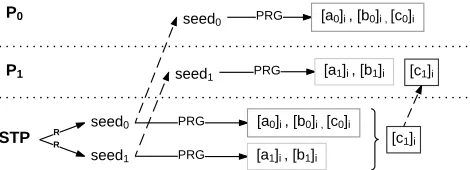
Reducing Communication. A basic implementation of pre-computing A-MTs and B-MTs requires communication of 3×l× NA-MTand 3×NB-MTbits from the STP to each party, respectively. However, similar to the idea of [33] presented in §4.2, we use a PRG to generate random strings from seeds locally by each party. To summarize the steps:
(1) STP generates two random seeds: seed0 for generating [a0]i,[b0]i, and [c0]iand seed1for [a1]i and [b1]i. (2) STP computes [c1]i =([a0]i+[a1]i)×([b0]i+[b1]i)−[c0]i
fori=1,2, ...,NA−MT.
(3) STP sends seed0to the first party and seed1together with the list of [c1]i to the second party.
After receiving the seeds, the parties locally generate their share of the triples using the same PRG. This method reduces the com-munication from 3×l×NA-MTto 256 and 256+l×NA-MTbits for the first and second parties, respectively. The STP follows a simi-lar process with the same two seeds to generate B-MTs. Figure 1 illustrate the seed expansion idea to generate MTs [33].
STP P1
P0
R seed0
seed1 R
seed0
seed1
PRG
PRG
[c1]i PRG
PRG
[a0]i , [b0]i , [c0]i
[a1]i , [b1]i [c1]i
[a0]i , [b0]i , [c0]i
[a1]i , [b1]i
Figure 1: Seed expansion process to precompute A-MTs/B-MTs with low communication.
4.5
Fast STP-aided Oblivious Transfer
Utilizing the idea of correlated randomness [47], we present an efficient and fast protocol for Oblivious Transfer that is aided by the Semi-honest Third Party (STP). Our protocol comprises a setup phase (performed by the STP) and an online phase (performed by the two parties). The protocol is described for one 1-out-of-2 OT. The process repeats for as many OTs as required. In the setup phase, the STP generates random masksq0,q1and a random bit r and sendsq0,q1to the sender andr,qr to the receiver. In the online phase, the two parties execute the online phase of Beaver’s OT precomputation protocol [12] described in Figure 2. Please note that all OTs in Chameleon including OTs used in GC and secret translation from GC/GMW to Additive are implemented as described above.
Reducing Communication. Similar to the idea discussed in §4.4, the STP does not actually need to send the list of(q0,q1)to the sender andrto the receiver. Instead, it generates two random seeds and sends them to the two parties. The STP only needs to send the full list ofqr to the receiver.
4.6
Security Justification
The security proof of Chameleon is based on the following propo-sitions: (i) the GC execution is secure since it is based on [81]. (ii) The security proof of GMW execution and share type translation
Sender Receiver Has: messagesq0,q1 Has: messageqrandr Input: messagesm0,m1 Input: choice bitb
Output: - Output:mb
b′
←− b′=r⊕b (s0,s1)=
(q0⊕m0,q1⊕m1)ifb′=0 (q0⊕m1,q1⊕m0)ifb′=1
(s0,s1)
−→ mb=sr⊕qr
Figure 2: Beaver’s OT precomputation protocol [12].
directly follows the one of [34]. (iii) All operations in A-SS are per-formed in the ringZ2l which is proven to be secure in [18]. Our
support for SFN only involves the utilization of a bigger ring and does not change the security guarantees, and finally (iv) our opti-mizations for reducing the communication between the STP and the two parties are secure as we use a PRG instantiation recommended by the NIST standard [8].
5
BENCHMARKS OF ATOMIC OPERATIONS
Evaluation Setup.We benchmark different atomic operations of Chameleon and compare them with three prior art frameworks: TinyGarble [81], ABY [34], and Sharemind [18]. The result for ABY is reported for three different scenarios: GC-only, GMW-only, and Additive SS-only. We run our experiments for a long term security parameter (128-bit security) on machines equipped with Intel Core i7-4790 CPUs @ 3.6 GHz and 16 GB of RAM. The CPUs support fast AES evaluations due to AES-NI. The STP is instantiated as a separate compute node running aC/C++implementation. The communication between the STP and its clients as well as between the clients is protected by TLS with client authentication. All parties run on different machines within the same Gigabit network.4
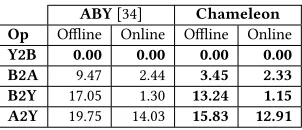
Atomic Operations.The detailed run-times and communica-tion for arithmetic and binary operacommunica-tions are shown in Table 2 and in Table 3, respectively. Table 4 additionally shows the run-times for conversions between different sharings.5All reported run-times are the average of 10 executions with less than 15% variance.
For TinyGarble, ABY, and Chameleon we ran the frameworks ourselves. Unlike TinyGarble and ABY, Sharemind lacks built-in atomic benchmarks and is a commercial product that requires con-tracting even for academic purposes. Thus, we give the results from the original paper [18] and justify why Chameleon performs better on equal hardware.
As can be seen, Chameleon outperforms all state-of-the-art frameworks. Run-times and communication for arithmetic op-erations in Chameleon are only given in A-SS since from the ABY results and Table 4 it follows that even for a single addition or
4We do not include WAN benchmarks of atomic operations for the following reason: Due to higher latency, GC-based circuit evaluation with constant rounds is preferred instead of GMW for binary operations. However, since the atomic bench-marks do not measure input sharing (for which GC uses STP-aided OT generation), no difference is visible to prior art.
5With exception of the B2A conversion, the requiredcommunicationof Chameleon for conversion operations equals ABY [34] since STP-aided OT generation, as required for B2Y and A2Y conversions, does not reduce the amount of communication (cf Table 5).
multiplication operation it is worthwhile to perform a protocol conversion. The remaining atomic operations for Chameleon are given in Boolean sharing where we observe major improvements over ABY due to our efficient B-MT precomputation.6Regarding conversion operations, the B2A performance in Chameleon benefits from reduced communication of fast STP-aided A-MTs (c.f §4.4). Likewise, the performance of the B2Y and A2Y conversion benefits from fast STP-aided OTs (cf. §4.5).
Although, the experimental setup of Sharemind is computation-ally weaker than ours, we emphasize that Chameleon is more effi-cient because of the following reasons: (i) To compute each MULT operation, Sharemind requires 6 instances of the Du-Atallah proto-col while our framework needs only 2. (ii) In Sharemind, bit-level operations such as XOR/AND require a bit-extraction protocol which is computationally expensive. Please note that these costs are not reported by [18] and hence are not reflected in Table 2. (iii) Operations such as CMP, EQ, and MUX can most efficiently be realized using GC/GMW protocols and as a result, Chameleon can perform these operations faster. The highlighted area for specific operations using ABY-A means that ABY does not perform those operations in additive SS. The highlighted area in Table 3 for Share-mind means that the corresponding information is not reported in the original paper.
The computation run-times for TinyGarble include base OTs, online OTs, garbling/evaluating, and data transmission. This is why the run-time for MULT is not significantly higher than other operations where they require orders of magnitude fewer gates. However, in Chameleon, we precompute all OTs which reduces the computation run-time. Note that the shown run-times and communication results for Chameleon represent the worst case, namely for the party that receives additional data from the STP besides the required seeds for OT and MT generation.7
Communication in the Setup (Offline) Phase. The commu-nication cost (number of bits) of the setup phase in Chameleon is compared to the ABY framework [34] in Table 5. To gener-ate a single B-MT, Chameleon requires only a constant-size data transmission to one party and 256×less communication to the other party compared to ABY. When generating a single A-MT, the required communication to the other party is reduced by factor 273×/289×/321×compared to ABY for a bitlength of 16/32/64, re-spectively. This is a significant enhancement since in most machine learning applications, the main bottleneck is the vector/matrix mul-tiplication which requires a large amount of A-MTs.
6
MACHINE LEARNING APPLICATIONS
Many applications can benefit from our framework. Here, we cover two important applications in greater detail due to the space con-straints. In particular, we show how Chameleon can be leveraged in Deep Learning (§6.1) and classification based on SVMs (§6.2).
6The benchmarking methodology inherited from ABY omits input sharing, which is why no improvement for GC-based operations is measurable compared to ABY.
7An improved implementation could equally distribute computation and commu-nication among the two parties by dividing the data sent by the STP evenly, thereby further reducing the runtimes.
Table 2: RUN-TIMES (in milliseconds unless stated otherwise) for different atomic operations and comparison with prior art. Each experiment is performed for 1,000 operations on 32-bit numbers in parallel. The detailed performance results for ABY [34] are provided for three different modes of operation: GC, GMW, and Additive. Minimum values marked in bold.
TinyGarble[81] ABY-GC[34] ABY-GMW[34] ABY-A[34] Sharemind[18] Chameleon
Op Online Offline Online Offline Online Offline Online Online Offline Online
ADD 1.57 s 11.71 2.73 25.78 4.73 0.00 0.00 1µs 0.00 0.00
MULT 2.31 s 423.82 112.29 174.52 14.25 10.46 0.59 17 4.24 0.13
XOR 0.00 0.00 0.00 0.00 0.00 1µs 0.00 0.00
AND 1.58 s 11.83 2.34 9.27 0.52 17 1.50 0.56
CMP 1.57 s 11.90 2.63 17.39 1.63 2.5 s 2.46 1.48
EQ 1.56 s 11.60 2.42 9.11 1.15 5 s 1.54 1.09
MUX 1.59 s 11.91 2.49 1.06 0.68 34 1.52 0.63
Table 3: COMMUNICATION (in kilobytes unless stated otherwise) for different atomic operations and comparison with prior art. Each experiment is performed for 1,000 operations on 32-bit numbers in parallel. The detailed performance results of the ABY framework [34] is provided for three modes of operation: GC, GMW, and Additive. Minimum values marked in bold.
TinyGarble[81] ABY-GC[34] ABY-GMW[34] ABY-A[34] Sharemind[18] Chameleon
Op Total Offline Online Offline Online Offline Online Total Offline Online
ADD 7936 992 0 3593 76 0 0 0 0 0
MULT 318 K 47649 0 37900 840 1280 16 192 8 16
XOR 0 0 0 0 0 0 0 0
AND 8192 1024 0 1028 16 192 12 8
CMP 8192 1024 0 2851 45 23 33
EQ 7936 992 0 995 16 8 12
MUX 8192 1024 0 33 8 384 8 4
Table 4: Run-Times (in milliseconds) for conversion opera-tions and comparison with prior art. Each experiment is per-formed for 1,000 operations on 32-bit numbers in parallel. Minimum values marked in bold.
ABY[34] Chameleon Op Offline Online Offline Online Y2B 0.00 0.00 0.00 0.00 B2A 9.47 2.44 3.45 2.33 B2Y 17.05 1.30 13.24 1.15 A2Y 19.75 14.03 15.83 12.91
Table 5: Communication (in bits) in the setup phase in Chameleon compared to prior art ABY [34].
ABY[34] Chameleon Improvement
OT 128 128
-B-MT 256 1 256×
A-MT (bitlengthℓ=16) 4,368 16 273× A-MT (bitlengthℓ=32) 9,248 32 289× A-MT (bitlengthℓ=64) 20,544 64 321×
6.1
Deep Learning
We evaluate our framework on Deep Neural Networks (DNNs) and a more sophisticated variant, Convolutional Deep Neural Networks (CNNs). Processing both CNNs and DNNs requires the support for signed fixed-point numbers. We compare our results with the state-of-the-art Microsoft CryptoNets [35], which is a customized solution for this purpose based on homomorphic encryption, as well as other recent solutions.
Deep Neural Networks.Deep learning is a very powerful method for modeling and classifying raw data that has gained a lot of attention in the past decade due to its superb accuracy. Deep Learning automatically learns complex features using arti-ficial neural networks. While there are many different DNNs and CNNs, they all share a similar structure. They are networks of multiple layers stacked on top of each other where the output of a layer is the input to the next layer. The input to DNNs is a fea-ture vector which we denote asx. The input is passed through the
intermediate layers (hidden layers). The output vector of theLt h layer is shown asx(L) wherexi(L) denotes theit h element. The
length of the vector can change after each layer. The length of the intermediate result vector at layerLis shown asNL=length(x(L)). A DNN is composed of a series of (i)Fully Connected (FC) layer: the outputx(L)is the matrix multiplication of input vectorx(L−1)and
a matrix weightW, that is,x(L)=x(L−1)·W. In general, the size
of the input and output of theFClayer is shown asFCNL−1×NL.
(ii)Activation layer (Act): which applies an activation functionf(.) on the input vector:x(L)
i =f(x (L−1)
i ). The activation function is usually Rectified Linear Unit (ReLu), Tangent-hyperbolic (Tanh), or Sigmoid functions [35, 79].
The input to a CNN is a picture represented as a matrixXwhere
each element corresponds to the value of each pixel. Pictures can have multiple color channels, e.g., RGB, in which case the picture is represented as a multidimensional matrix, a.k.a,tensor. CNNs are similar to DNNs but they can potentially have additional layers: (i)Convolution (C)layer which is essentially a weighted sum of “square region” of sizesqin the proceeding layer. To compute the next output, the multiplication window on the input matrix is moved by a specific number, called stride (st). The matrix weight is
Ker n el s
I n pu t I m age
3 1
4
5
Fi v e I m ages of Si ze
ReLu
Vect or of Si ze Reshape
ReLu(xi)
ReLu(xi) Vect or of Si ze ReLu(xi)
ReLu(xi)
ReLu arg max Ou t pu t L ab el
Vect or of Si ze
I n f er en ce L ab el Fu l l y Con n ect ed
Fu l l y Con n ect ed Act i vat i on L ayer Act i vat i on L ayer
Con v ol u t i on al L ayer I n pu t I m age
Cl i en t I n pu t Ser v er I n pu t s
FC w ei gh t s
FC w ei gh t s
Recon st . Ou t pu t GM W
A-SS
Ad d i t i v e Sh ar i n g I n pu t s A2GM W GM W 2A A-SS A2GM W GM W GM W 2A A-SS A2GC GC
Cl i en t Ou t pu t
2
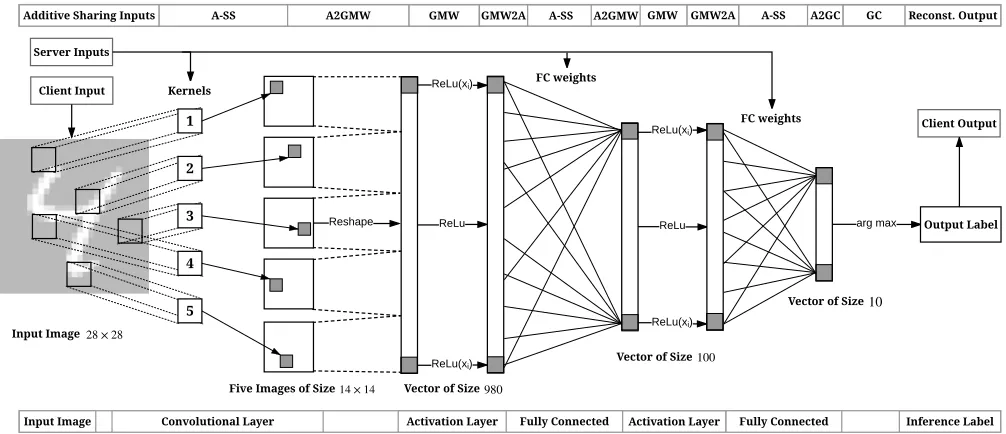
Figure 3: Architecture of our Convolutional Neural Network trained for the MNIST dataset. The upper bar illustrates which protocol is being executed at each phase of the CNN. The lower bar shows different layers of the CNN from the deep learning perspective.
calledkernel. There can beNmap(called map count) kernels in the convolution layer. (ii)Mean-polling (MeP)which is the average of each square region of the proceeding layer. (iii)Max-polling (MaP) is the maximum of each square region of the proceeding layer. The details of all layers are provided in Table 6.
Many giant technology companies such as Google, Microsoft, Facebook, and Apple have invested millions of dollars in accurately training neural networks to serve in different services. Clients that want to use these services currently need to reveal their inputs that may contain sensitive information to the cloud servers. Therefore, there is a special need to run a neural network (trained by the cloud server) on an input from another party (clients) while keeping both the network parameters and the input private to their respective owners. For this purpose, Microsoft has announced CryptoNets [35] that can process encrypted queries in neural networks using homo-morphic encryption. Next, we compare the performance result of Chameleon to CryptoNets and other more recent works.
Table 6: Different types of layers in DNNs and CNNs.
Layer Functionality
FC x(L) i =
PNL−1−1
j=0 W (L−1) i j ×x
(L−1) j Act x(L)
i =f(xL −1 i ) C x(L)
i j =P sq−1 a=0
Psq−1
b=0 W(L −1) ab ×xL
−1
(i·st+a)(j·st+b)
MeP x(L)
i j =Mean(xL −1
(i+a)(j+b)),a,b∈ {1,2, ...,sq} MaP x(L)
i j =Max(xL −1
(i+a)(j+b)),a,b∈ {1,2, ...,sq}
Comparison with Previous Works.A comparison of recent works is given in Table 7 and described next. We use the MNIST dataset [58] (same as Microsoft CryptoNets) containing 60,000 im-ages of hand-written digits. Each image is represented as 28×28
pixels with values between 0 and 255 in gray scale. We also train the same NN architecture using the Keras library [29] running on top of TensorFlow [1] using 50,000 images. We achieve a similar test ac-curacy of∼99% examined over 10,000 test images. The architecture of the trained CNN is depicted in Figure 3 and composed of (i)C layer with a kernel of size 5×5, stride 2, and map count of 5. (ii)Act layer with ReLu as the activation function. (iii) AFC980×100layer. (iv) Another ReLuActlayer, and (v) anotherFC100×10layer. The lower bar in Figure 3 shows the different layers of the CNN while the upper bar depicts the corresponding protocol that executes each part of the CNN.
The output of the last layer is a vector of ten numbers where each number represents the probability of the image being each digit (0-9). We extract the maximum value and output it as the classification result. The trained CNN is the server’s input and the client’s input is the image that is going to be classified. More precisely, the trained model consists of the kernels’ values and weights (matrices) of the FC layers. The output of the secure computation is the classification (inference) label.
The performance results are provided in Table 7 compared with Microsoft CryptoNets and most recent previous works. We re-port our run-time as Offline/Online/Total. As can be seen, our Chameleon framework is 110x faster compared to the customized solution based on homomorphic encryption of CryptoNets [35]. They have performed the experiments on a similar machine (Intel Xeon ES-1620 CPU @ 3.5 GHz with 16 GB of RAM). Please note that in CryptoNets [35], numbers are represented with 5 to 10 bit precision while in Chameleon, all numbers are represented as 64 bit numbers. While the precision does not considerably change the accuracy for the MNIST dataset, it might significantly reduce the accuracy results for other datasets. In addition, the CryptoNets
Table 7: Comparison of secure deep learning frameworks, their characteristics, and performance results in the LAN setting.
Framework Methodology and Pooling FunctionsNon-linear Activation Classification Timing (s) CommunicationMessage Size (MB) ClassificationAccuracy Offline Online Total Offline Online Total
Microsoft CryptoNets[35] Leveled HE ✗ - - 297.5 - - 372.2 98.95%
DeepSecure[75] GC ✓ - - 9.67 - - 791 99%
SecureML[66] Linearly HE, GC, SS ✗ 4.70 0.18 4.88 - - - 93.1% MiniONN(Sqr Act.) [62] Additively HE, GC, SS ✗ 0.90 0.14 1.04 3.8 12 15.8 97.6%
MiniONN(ReLu + Pooling) [62] Additively HE, GC, SS ✓ 3.58 5.74 9.32 20.9 636.6 657.5 99%
EzPC[28] GC, Additive SS ✓ - - 5.1 - - 501 99%
Chameleon (This Work) GC, GMW, Additive SS ✓ 1.34 1.36 2.70 7.8 5.1 12.9 99%
framework neither supports non-linear activation nor pooling func-tions. However, it is worth-mentioning that CryptoNets can process a batch of images of size 8,192 with no additional costs. Therefore, the CryptoNets framework can process up to 51,739 predictions per hour. Nonetheless, it is necessary that the system batches a large amount of images and processes them together. This, in turn, might reduce the throughput of the network significantly. A sim-ilar recent solution based on leveled homomorphic encryption is called CryptoDL [45]. In CryptoDL, several activation functions are approximated using low degree polynomials and mean-pooling is used as a replacement for max-pooling. The authors state up to 163,840 predictions per hour for the same batch size as in Cryp-toNets. Unfortunately, it remains unclear how CryptoDL performs for single instances that may occur when streaming inputs for real-time classification. Also note that in Chameleon one can implement and evaluate virtually any activation and pooling function.
The DeepSecure framework [75] is a GC-based framework for secure Deep Learning inference. They report a classification run-time of 9.67 s to classify images from the MNIST dataset using a CNN similar to CryptoNets. They utilize non-linear activation and pooling functions. Chameleon is 3.6x faster and requires 61x less communication compared to DeepSecure when running an identical CNN.
SecureML [66] is a framework for privacy-preserving machine learning. Similar to CryptoNets, SecureML focuses on linear activa-tion funcactiva-tions. The MiniONN [62] framework reduces the classifica-tion latency on an identical network from 4.88 s to 1.04 s using sim-ilar linear activation functions. MiniONN also supports non-linear activation functions and max-pooling. They report classification latency of 9.32 s while successfully classifying MNIST images with 99% accuracy. For a similar accuracy and network, Chameleon has 3.5x lower latency and requires 51x less communication.
For the evaluation of the very recent EzPC framework [28], the authors implement the CNN from MiniONN in a high-level lan-guage. The EzPC compiler translates this implementation to stan-dard ABY input while automatically inserting conversions between GC and A-SS. This results in a total run-time of 5.1 s for classifying one image. However, note that we require 39x less communication. Table 7 shows that the total run-time of the end-to-end execution of Chameleon for a single image is only 2.7 s. However, Chameleon can easily be scaled up to classify multiple images at the same time using a CNN with non-linear activation and pooling functions. For a batch size of 100, our framework requires only 0.21 s processing time and 12.9 MB communication per image providing up to 17,142
Table 8: Classification time (in seconds) of Chameleon for different batch sizes of the MNIST test image set in the WAN setting (100 Mbit/sbandwidth,100 msround-trip time).
Classification Time (s) Communication (MB) Batch Size Offline Online Total Offline Online Total
1 4.41 3.49 7.90 7.8 5.1 12.9
10 10.00 10.65 20.65 78.4 50.5 128.9 100 69.38 84.09 153.47 784.1 505.3 1289.4
predictions per hour in the LAN setting. Table 8 furthermore shows the required run-times and communication for different batch sizes when performing the classification task in a WAN setting where we restrict the bandwidth to 100 Mbit/s with a round-trip time of 100 ms.
Further Related Works.One of the earliest solutions for obliv-iously evaluating a neural network was proposed by Orlandi et al. [70]. They suggest adding fake neurons to the hidden layers in the original network and evaluating the network using HE. Cha-banne et al. [27] also approximate the ReLu non-linear activation function using low-degree polynomials and provide a normaliza-tion layer prior to the activanormaliza-tion layer. However, they do not report experimental results. Sadeghi and Schneider proposed to utilize universal circuits to securely evaluate neural networks and fully hide their structure [77]. Privacy-preserving classification of elec-trocardiogram (ECG) signals using neural networks has been ad-dressed in [10]. The recent work of Shokri and Shmatikov [79] is a Differential Privacy (DP) based approach for distributed train-ing of a Neural Network and they do not provide secure DNN or CNN inference. Due to the added noise in DP, any attempt to im-plement secure inference suffers from a significant reduction in accuracy of the prediction. Phong et al. [57] propose a mechanism for privacy-preserving deep learning based on additively homo-morphic encryption. They do not consider secure deep learning inference (classification). There are also limitations of deep learn-ing when an adversary can craft malicious inputs in the trainlearn-ing phase [72]. Moreover, deep learning can be used to break semantic image CAPTCHAs [80].
6.2
Support Vector Machines (SVMs)
One of the most frequently used classification tools in machine learning and data mining is the Support Vector Machine (SVM). An SVM is a supervised learning method in which the model is created based on labeled training data. The result of the training
phase is a non-probabilisticbinaryclassifier. The model can then be used to classify an input dataxwhich is ad-dimensional vector.
In Chameleon, we are interested in a scenario where the server holds an already trained SVM model and the user holds the query
x. Our goal is to classify the user’s query without disclosing the
user’s input to the server or the server’s model to the user. The training data, composed ofN d-dimensional vectors, can be viewed asNpoints in ad-dimensional space. Each pointiis labeled as eitheryi∈ {−1,1}, indicating which class the data point belongs to. If the two classes are linearly separable, a(d−1)-dimensional hyperplane that separates these two classes can be used to clas-sify future queries. A new query point can be labeled based on which side of the hyperplane it resides on. The hyperplane is called decision boundary. While there can be infinitely many such hyper-planes, a hyperplane is chosen that maximizes the margin between the two classes. That is, a hyperplane is chosen such that the dis-tance between the nearest point of each class to the hyperplane is maximized. Those training points that reside on the margin are calledsupport vectors. This hyperplane is chosen to achieve the highest classification accuracy. Figure 4 illustrates an example for a two-dimensional space. The optimal hyperplane can be represented using a vectorwand a distance from the originb. Therefore, the optimization task can be formulated as:
minimize∥w∥s.t.yi(w·xi−b)⩾1,i=1,2, ...,N The size of the margin equalsM= ∥w2∥. This approach is called
hard-margin SVM.
M
M a rg
in
w
b
Class -1 Class 1
Decis ion
Boun dry
Suppor t Vector s
Figure 4: Classification using Support Vector Machine (SVM).
An extension of the hard-margin SVM, called a soft-margin SVM, is used for scenarios where the two classes are not linearly separable. In this case, the hinge lost function is used to penalize if the training sample is residing on the wrong side of the classification boundary. As a result, the optimization task is modified to:
1 N
N
X
i=1
max(0,1−yi(w·xi−b))+λ∥w∥2
whereλis a parameter for the tradeoff between the size of the margin and the number of points that lie on the correct side of the boundary.
Table 9: Experimental results for classification using SVM models for different feature sizes.
Classification Time (ms) Communication (kB) Feature Size Offline Online Total Offline Online Total
10 8.91 0.97 9.88 3.2 3.3 6.5
100 9.49 0.99 10.48 3.9 4.7 8.7
1000 10.28 1.14 11.42 11.1 19.1 30.3
For both soft-margin and hard-margin SVMs, the performed classification task is similar. The output label of the user’s query is computed as:
label∈ {−1,1}=sign(w·x−b)
We run our experiments using the same setup described in §5. The results of the experiments are provided in Table 9 for feature vector sizes of 10, 100, and 1,000.
Comparison with Previous Works. Bos et al. [19] study privacy-preserving classification based on hyperplane decision, Naive Bayes, and decision trees using homomorphic encryption. For a credit approval dataset with 47 features, they report a run-time of 217 ms and 40 kB of communication, whereas, Chameleon can securely classify a query with 1,000 features in only 11.42 ms with 30.3 kB of communication. Rahulamathavan et al. [74] also design a solution based on homomorphic encryption for binary as well as multi-class classification based on SVMs. In the case of binary classification, for a dataset with 9 features, they report 7.71 s execu-tion time and 1.4 MB communication. In contrast, for the same task, Chameleon requires less than 10 ms execution time and 6.5 kB of communication. Laur et al. [56] provide privacy-preserving train-ing algorithms based on general kernel methods. They also study privacy-preserving classification based on SVMs but they do not report any benchmark results. Vaidya et al. [82] propose a method to train an SVM model where the training data is distributed among multiple parties. This scenario is different than ours where we are interested in the SVM-based classification. As a proof-of-concept, we have focused on SVM models for linear decision boundaries. However, Chameleon can be used for non-linear decision bound-aries as well.
7
RELATED WORK
Chameleon is essentially a two-party framework that uses a Semi-honest Third Party (STP) to generate correlated randomness in the offline phase. In the following, we review the use of third parties in secure computation as well as other secure two-party and multi-party computation frameworks.
Third Party-Based Secure Computation.Regarding the in-volvement of a third party in secure two-party computation, there have been several works that consider an outsourcing or server-aidedscenario, where the resources of one or moreuntrustedservers are employed to achieve sub-linear work in the circuit size of a func-tion, even workload distribufunc-tion, and output fairness. Realizing such a scenario can be done by either employing fully-homomorphic encryption (e.g., [5]) or extending Yao’s garbled circuit protocol (e.g., [50]). Another important motivation for server-aided SFE is to address the issue of low powered mobile devices, as done in
![Figure 2: Beaver’s OT precomputation protocol [12].](https://thumb-us.123doks.com/thumbv2/123dok_us/7957299.1320212/8.612.55.295.87.192/figure-beaver-s-ot-precomputation-protocol.webp)