Analysis of the Grid Connected Wind Energy
System using MATLAB/Simulink
Mohd Ilyas1, Yashpal Rana2, J.S.Khan3
PhD Scholar and Associate Professor, Dept. of EEE, Al-Falah University, Faridabad, Haryana, India1
PG Student [Power Systems], Dept. of EEE, Al-Falah University, Faridabad, Haryana, India2
Professor, Dept. of EEE,Al-Falah University, Faridabad, Haryana, India3
ABSTRACT: Renewable energy has become one of the most important and promising sources of energy generation in recent years which supply’s more transmission capacity and better means of maintaining system reliability and effiency. In the fast growing electricity supply industry and open access market for electricity worldwide, renewable sources are getting added into the grid system. The evolution of technology related to wind systems industry leaded to the development of a generation of variable speed wind turbines that present many advantages compared to the fixed speed wind turbines. This project consists of wind-turbine-driven PMSG, connected with the Grid power system. Permanent Magnet Synchronous Generator (PMSG) is being used due to its high efficiency. In this paper, Simulation of wind generation is being done with grid system.
KEYWORDS: -Modeling, PMSG, Wind Turbine, Inverter, SVPWM, MATLAB
I. INTRODUCTION
The electric power generation from non-conventional energy sources, such as wind, is increasingly attracting interest in recent years because of environmental problem and shortage of other energy source in the near future. Moreover increased and concentrated penetration of wind energy into electrical power systems has made the latter more valuable and dependent on the wind energy production [1]. The continuous trend of having high penetration of wind power, in recent years, has made it necessary to introduce new practices, viz grid systems are being examined to ensure that wind turbines would have more effiency for control of voltage and frequency and also to remain connected to the main network following voltage sag. Renewable energy sources not providing the enhanced greenhouse effect, particularly wind power generation, is becoming a vital component of the total grid power generation. wind turbine produces a continuous variable and stabilized output power during normal operations. The power changes and fluctuations are mainly caused by the effects like turbulence, wind shear, and tower-shadow and control system in the power system. So, whole network system is responsible for these floatation’s. The power quality problems can be checked with wind generation, transmission and distribution power networks, like voltage sag, swells, flickers, harmonics etc. Distribution network is being disturbed with the wind generator. One method is to use induction generator which is directly connected to the grid power system. The induction generator has great advantages of cost effectiveness and heftiness [2]. Permanent magnet synchronous generator (PMSG) is used for wind power generating system because of its many advantages such as better effiency, lower maintenance, and reliability. The PM machines have many advantages which include higher reliability, higher efficiency and energy yield, Lower maintenance cost.
II. WIND TURBINE MODELING
The wind turbine consists of classic three-bladed horizontal-axis , wind turbine system with the corresponding pitch controller. The output mechanical power is given by the equation [3]
Pm= Cp(β,λ) ρA/ 2(Vw)3 Where Pm = Turbine mechanical output power
Cp= Performance coefficient of turbine ρ= Air density (Kg/m3),
A= swept area of turbine
β= blade pitch angle
Vw= wind speed (m/s)
The power coefficient Cp is a nonlinear function of the blade pitch angle β and the tip-speed ratio λ as given by [3]
λ = ( Rωm/vw)
Where, ωm - Angular speed of the turbine rotor
R - Radius of the turbine blades
Figure 1 Simulink of Wind turbine Modeling
III. PITCH CONTROLLER
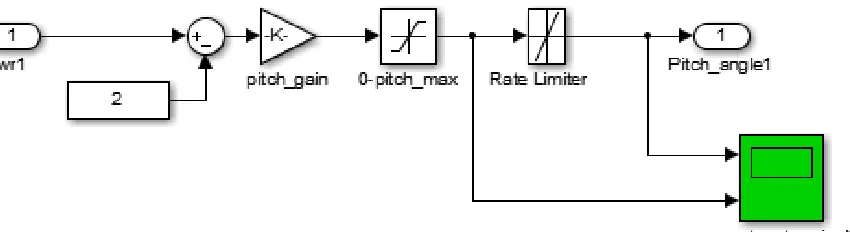
Pitch control system is for each blade in a turbine. Each pitch control system is a servo loop which will make the pitch follow a given reference as quickly as possible and with sufficient damping. The pitch controller is a non-linear controller which compensates for the dead band and the limitations in the proportional valve. When the wind velocities
are higher than rated, the maximum energy captured must be limited using pitch control by modifying β.
IV. TWO- MASSE MODEL
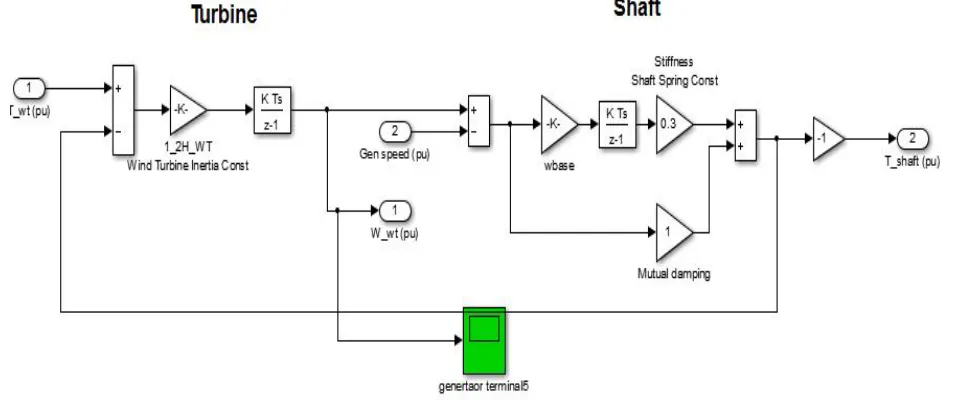
This Model shows the combination of wind turbine and shaft side. The differential equations are representing its mechanical dynamics which are given below
2Ht dwt /dt =Tm - Tsh
1/welb*dθtw/dt = wt - wr
2Hgdwr/dt = Tsh – Tg Where Ht = inertia constant of the turbine,
Hg= inertia Constant of the PMSG, θtw = shaft twist angle,
wt = Angular speed of the wind turbine in p.u.
wr = rotor speed of the PMSG in p.u.
welb = electrical base speed
The Shaft torque Tsh is
Tsh = Kshθtw +Dtdθtw/dt Where Ksh = shaft stiffness
Dt = damping coefficient.
The simulink model is shown below.
Figure 3 shows simulink model of two- masse Model
IV. Permanent Magnet Synchronous Machine
Figure 4 showing subsystems connected with PMSG.
V. SIMULINK MODEL OF WIND-GRID CONNECTED SYSTEM
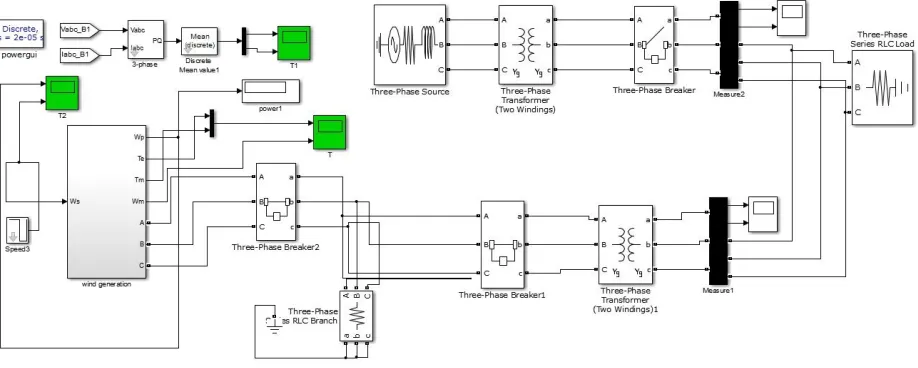
This is the Simulink diagram for wind turbine connected with the grid system.
Figure 5 Simulink Model of wind-Grid Connected system
VI. SIMULINK RESULTS
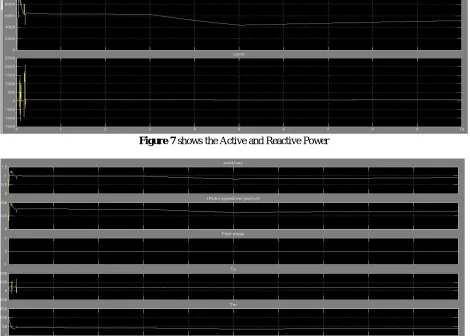
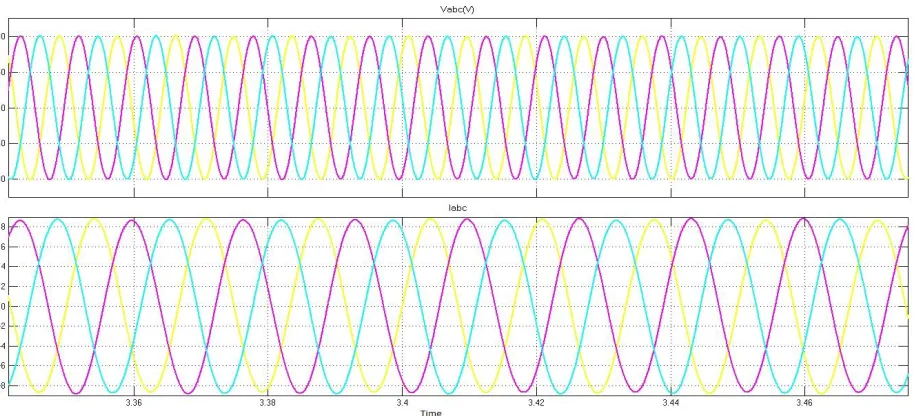
Figure 6 shows (1) phase voltages (2) line currents (3) RMS value of phase voltage (4) RMS value of phase currents (5) active power (6) rotor speed for wind speed 15 m/sec.
Figure 7 shows the Active and Reactive Power
Figure 9 shows waveform of constant voltage and current across the grid in constant wind speed 15m/s.
VII. CONCLUSION
In this paper, we have simulated wind energy system connected with the grid is being analyzed with the help of MATLAB/Simulink.. The wind speed, rotor speed and torque being controlled to provide the active and reactive power supply. The output of this model provides us balanced ac supply. The reactive power is controlled and regulated which is connected to the grid system, shown above in waveform.
REFERENCES
[1] C. N. Bhende, S. Mishra, Siva Ganesh Malla, “Permanent Magnet Synchronous Generator-Based Standalone Wind Energy Supply System” IEEE Transactions On Sustainable Energy, Vol. 2, No. 4, October 2011, pp 361 – 373
[2] W.Leonhard, Control of Electrical Drives, 2nd ed. Berlin, Germany: Springer-Verlag, 1996
[3] S. Venkatraj and G. Mohan, “Modeling of Wind Farms with Variable Speed Direct Driven Permanent Magnet Synchronous Generator Wind Turbine” International Journal of Research and Reviews in Electrical and Computer Engineering (IJRRECE), Vol 1, No 3, pp 982-990, September 2011
[4] Alejandro Rolan', Alvaro Luna, Gerardo Vazquez, Daniel Aguilar, “Modeling of a Variable Speed Wind Turbine with a Permanent Magnet Synchronous Generator” IEEE International Symposium on Industrial Electronics (ISlE 2009,) July 5-8, 2009, pp 734 – 739
[5] K. Vinoth Kumar, Prawin Angel Michael, Joseph P. John and Dr. S. Suresh Kumar “ Simulation and Comparison of SPWM and SVPWM Control for three phase inverter” ARPN Journal of Engineering and Applied Sciences, Vol. 5, No. 7, July 2010, pp 61 – 74
[6] D. Sandhya Rani , A.Appaprao, “A Space Vector PWM Scheme for Three level Inverters Based on Two-Level Space Vector PWM” International Journal Of Power System Operation and Energy Management (IJPSOEM) Volume-1, Issue-1, 2011, pp 6 – 10
[7] Aryuanto Soetedjo, Abraham Lomi, Widodo Puji Mulayanto, “Modeling of Wind Energy System with MPPT Control” International Conference on Electrical Engineering and Informatics, 17-19 July 2011, E4
[8] P.Tripura, Y.S.Kishore Babu, Y.R.Tagor, “Space Vector Pulse Width Modulation Schemes for Two-Level Voltage Source Inverter” ACEEE Int. J. on Control System and Instrumentation, Vol. 02, No. 03, October 2011 pp 34 – 38
[9] Chalasani Hari Krishna, J. Amarnath, and S Kamakshiah, “ A Simplified SVPWM Algorithm for Multilevel Inverter Fed DTC of Induction Motor Drive” International Journal of Engineering and Innovative Technology (IJEIT, Volume 1, Issue 4, April 2012, pp 61 – 67 [9] C.O. Omeje; D.B. Nnadi; and C.I. Odeh, “ Comparative Study of Space Vector Pulse – Width Modulation and Third Harmonic Injected Modulation on Industrial Drives” The Pacific journal of Science and Technology, Volume 13, No 1, May2012, pp 12 - 19
[10] Sachin Khajuria, Jaspreet Kaur, “ Implementation of pitch Control of Wind Turbine Using Simulink (MATLAB)”, International Journal of Advanced Research in Computer Engineering & Technology, Volume 1, Issue 4, June 2012, pp 196 – 200
BIOGRAPHY
MOHD. ILYAS was born on 2nd April 1976. He is an associate professor in department of electrical & electronics with Al-Falah University Faridabad, Haryana. He received his B.Tech in electrical engineering & M.Tech in electrical power system & management from Jamia Millia Islamia, New Delhi. Now he is pursuing PhD. from MD University, Rohtak. He has more than 14 years experience in teaching. He taught various subjects such as Power Electronics, Electrical measurement & Measuring Instrument, Electric Power Generation etc.He has published more than 15 papers in National & International Generals. He attended many national and international Seminars and conferences. He has guided number of B.Tech and M.Tech projects in his teaching career.