On some methods for constructing almost optimal
S-Boxes and their resilience against side-channel
attacks
Reynier Antonio de la Cruz Jim´enez
Institute of Cryptography, Havana University, Cuba.
Abstract
Substitution Boxes (S-Boxes) are crucial components in the design of many sym-metric ciphers. The security of these ciphers against linear, differential, algebraic cryptanalyses and side-channel attacks is then strongly dependent on the choice of the S-Boxes. To construct S-Boxes having good resistive properties both towards classical cryptanalysis as well side-channel attacks is not a trivial task. In this article we propose new methods for generating S-Boxes with strong cryptographic properties and therefore study the resilience of such S-Boxes against side-channel attacks in terms of its theoretical metrics and masking possibility.
Keywords: S-Box, permutations, hamming weight, nonlinearity, differ-ential uniformity, graph algebraic immunity, differdiffer-ential power analysis, transparency order, confusion coefficient, signal-to-noise ratio.
1
Introduction
(see,e.g. [2]), a Substitution-Permutation network (SPN) [43], or a Lai-Massey structure [55]. Cryptographic properties of S-Boxes deal with the application of several logical attacks on ciphers, namely linear attack [34], the differential attack [34], the higher order differential attack [37] and algebraic attack [16] (which is not yet efficient but represents some threat and should keep in mind by designers of next generation of block ciphers). For this reason S-Boxes must satisfy various criteria for providing high level of protection against such attacks.
Besides the linear, differential and algebraic attacks, today the most prominent attacks on the cryptographic algorithms are based on supervi-sion of physical processes in cryptographic device. In literature, this kind of attack has received the name of side-channel attacks (SCAs). Examples of such attacks are: Simple Power Analysis (SPA) [35], Differential Power Analysis (DPA) [35], Timing Analysis (TA) [36] , Correlation Power Analy-sis (CPA) [10], Mutual Information Attack (MIA)[18]. S-Boxes represent the most vulnerable part in an implementation when considering side-channel adversary and it is not a trivial task to construct S-Boxes having good re-sistive properties both towards classical cryptanalysis as well side-channel attacks.
The known methods for constructing S-Boxes can be divided into four main classes: algebraic constructions, pseudo-random generation, heuristic techniques and constructions from small to large S-Boxes. Each approach has its advantages and disadvantages respectively (see, e.g. [11, 30]). Mo-tivated by specialist’s work of Luxembourg’s university Alex Biryukov, L´eo Perrin and Aleksei Udovenko on cryptanalysis of the only known solution to the big APN problem [9] we propose (using the last approach) new con-structions for generating S-Boxes with strong cryptographic properties and therefore study their resilience against side-channel attacks in terms of its theoretical metrics and masking possibility.
S-Boxes with other from the perspective of conventional cryptanalysis and theoretical DPA metrics. The possibility of combine our S-Boxes with the masking countermeasure against SCAs is studied in Section 6. Our work is concluded in Section 7.
2
Basic definitions and notations
Let Vn be n-dimensional vector space over the field GF(2), by S(Vn) we
denote the symmetric group on set of 2n elements. The finite field of size 2n is denoted by GF(2n), where GF(2n)=GF(2)[ξ]/g(ξ), for some irreducible polynomial g(ξ) of degree n. We use the notation Z/2n for the ring of the integers modulo 2n. There are bijective mappings between Z/2n, Vn and
GF(2n) defined by the correspondences:
an−1 ·2n−1 +. . .+a0
↔ (an−1, . . . , a0) ↔
an−1 ·ξn−1 +. . .+ a0
.
Using these mapping in what follows we make no difference between vectors of Vn and the corresponding elements in and Z/2n and GF(2n).
Throughout the article, we shall use the following operations and nota-tions:
akb - concatenation of the vectors a, b of Vl, i.e. a vector from V2l ;
0 - the null vector of Vl ;
⊕ - bitwise eXclusive-OR. Addition in GF(2l);
< a, b > - the scalar product of vectors a = (al−1, . . . , a0), b = (bl−1, . . . , b0)
of Vl and is equal to < a, b >= al−1bl−1 ⊕. . .⊕a0b0;
gcd(a, b) - the greatest common divisor of integers a and b;
wH(a) - the Hamming weight of a binary vector a ∈ Vl, i.e. the number
of its nonzero coordinates;
⊗ - finite field multiplication ;
Λ◦Ψ - a composition of mappings, where Ψ is the first to operate;
Ψ−1 - the inverse transformation to some bijective mapping Ψ.
attacks. For this purpose, we consider an n-bit S-Box Φ as a vector of Boolean functions:
Φ = (fn−1, . . . , f0), fi :Vn → V1, i = 0,1, . . . n−1. (1)
For some fixed i = 0,1, . . . , n − 1, every Boolean function fi can be
written as a sum over V1 of distinct t-order products of its arguments,
0 ≤ t ≤ n−1; this is called the algebraic normal form of fi. Functions fi
are called coordinate Boolean functions of the S-Box Φ and it is well known that most of the desirable cryptographic properties of Φ can be defined in terms of their linear combinations (also-called S-Box component Boolean functions).
Definition 1. For each vector a ∈ Vn the The Walsh-Hadamard
trans-form Wf(a) of the n-variable Boolean function f is defined as
Wf(a) =
X
x∈Vn
(−1)f(x)⊕<a,x>. (2)
Definition 2. The nonlinearity N L(f) of the n-variable Boolean func-tion f is defined as
N L(f) = min
g∈An
wH(f ⊕g), (3)
where An is the set of all n-variable affine Boolean functions andwH(f⊕g)
is the Hamming weight of the n-variable Boolean function f ⊕ g. The nonlinearity N L(f) can be expressed as follows:
N L(f) = 2n−1 − 1
2a∈maxVn\{0}
|Wf(a)| (4)
Definition 3. For a, b ∈ Vn the Walsh transform WΦ(a, b) of an n-bit
S-Box Φ is defined as
WΦ(a, b) =
X
x∈Vn
(−1)<b,Φ(x)>⊕<a,x>. (5)
Definition 4. The nonlinearity of ann-bit S-Box Φ, denoted byN L(Φ), is defined as
N L(Φ) = min
a∈Vn\{0}
where N L(an−1fn−1 ⊕. . .⊕a0f0) is the nonlinearity of each of the
compo-nent Boolean functions excluding the zero one.
The nonlinearity N L(Φ) of an arbitrary n-bit S-Box Φ can be calculated as follows
N L(Φ) = 2n−1 − 1
2 ·a6=0,bmax∈Vn
|WΦ(a, b)|. (7)
From a cryptographic point of view S-Boxes with small values of Walsh coefficients offer better resistance against linear attacks.
Definition 5. The differential uniformity of ann-bit S-Box Φ, denoted by δΦ, is defined as
δΦ = max
a6=0,b∈Vn
δ(a, b), (8)
where δ(a, b) =|{x ∈ Vn|Φ(x⊕a)⊕Φ(x) = b}|.
The resistance offered by an S-Box against differential attacks is related by the highest value ofδ, for this reason S-Boxes must have a small value of δ-uniformity for a sufficient level of protection against this type of attacks. The algebraic degree of the Boolean functions f : Vn → V1, denoted by
degf, is the maximum order of the terms appearing in its algebraic normal form.
Definition 6. The minimum degree of an S-Box Φ, denoted by deg(Φ), is defined as
deg(Φ) = min
a∈Vn\{0}
{deg(an−1fn−1 ⊕. . .⊕a0f0)}. (9)
In general, S-Boxes should have high minimum degree because S-Boxes with low degree are susceptible to algebraic attack, higher-order differen-tial, interpolation, cube attacks etc.
Definition 7. The univariate polynomial representation of an n-bit S-Box Φ over GF(2n), is defined in a unique fashion as
Φ(X) =
2n−1
X
i=0
νiXi, νi ∈ GF(2n), (10)
where coefficients νi, i = 0, . . . ,2n−1 can be obtained from the n-bit S-Box
Definition 8. LetU be a non-empty subset ofV2n, then the annihilating
set of U is defined as {p ∈ GF(2)[z1, . . . , z2n]|p(U) = 0}.
Definition 9. The algebraic immunity of U is defined as
AI(U) = min
n
degp
06= p∈ GF(2)[z1, . . . , z2n], p(U) = 0 o
.
Definition 10. The graph algebraic immunity of n-bit S-Box Φ, de-noted by AIgr(Φ), is defined as
AIgr(Φ) = min n
degp
0 6= p ∈ GF(2)[z1, . . . , z2n], p(gr(Φ)) = 0 o
, (11)
where gr(Φ) = {(x,Φ(x))|x ∈ Vn} ⊆ V2n.
Thus we focus on the graph algebraic immunity of S-Box Φ and also on the parameter r(AIgr(Φ))
Φ referred to as the number of all the independent
equations in input and output values of the S-Box Φ, i.e., equations of the form p(x,Φ(x)) = 0 ∀x ∈ Vn.
Definition 11. An element a ∈ Vn is called a fixed point of an n-bit
S-Box Φ if Φ(a) = a.
Definition 12. Two n-bit S-Boxes Φ1 and Φ2 are affine/linear
equiva-lent if there exist a pair of invertible affine/linear permutation A1(x) and
A2(x), such that Φ1(x) = A2 ◦Φ2 ◦A1(x).
Definition 13. The Transparency Order of an S-Box Φ, denoted by
TO(Φ), is defined as
(12)
TO(Φ) = max
b∈Vn
|n−2wH(b)| −
1
22n −2n × X
a∈Vn\{0}
X
c∈Vn,wH(c)=1
(−1)<c,b>WΦ(x)⊕Φ(x⊕a)(0, c)
.
The smaller the transparency order metric, the higher is its resistance the S-Box Φ to DPA attacks.
Definition 14. The DPASignal-to-Noise Ratio of an S-Box Φ, denoted by SNR(DPA)(Φ), is defined as
SNR(DPA)(Φ) = n22n X
a∈Vn
Xn−1
i=0
Wfi(a)
4−1 2
where fi, i= 0, . . . ,7 are the coordinate Boolean functions of the S-Box Φ.
The SNR(DPA), proper to each S-Box Φ, fully characterizes the DPA
discrimination power. The lower the SNR(DPA) metric of Φ , the better resistance to DPA attacks.
Definition 15. The confusion coefficient of of an S-Box Φ, denoted by
CC(Φ), is defined as
CC(Φ) = σ2[κ] = σ2[κ(ki, kj)|∀i < j], (14)
where σ2[·] is the variance, κ denote the list [κ(ki, kj)|∀i < j], κ(ki, kj) =
Ep h
L(Φ(ki ⊕p)) −L(Φ(ki ⊕p))2 i
, ki and kj are the i-th and the j-the
value of the key, p - is some known plaintext, L represents the leakage function and E is the mean operator.
According to [45], the S-Box Φ with higher CC(Φ) metric leads to a higher resistance against SCAs.
3
General S-Box Design Criteria
Our goal is to find bijective S-Boxes that satisfy the following criteria (which in what follows are called almost optimal):
1. Absence of fixed points;
2. Maximum value of minimum degree ;
3. Maximum graph algebraic im-munity with the minimum num-ber of equations;
4. Minimum value of δ-uniformity
limited by parameter listed
above;
5. Maximum value of nonlinear-ity limited by parameter listed above.
For example,when n = 8 an almost optimal permutation Φ without
fixed points has:
• deg(Φ) = 7;
• AIgr(Φ) = 3 with r (3)
Φ = 441;
• δΦ ≤8;
Also, we concentrate on generating 8-bit almost optimal S-Boxes that have good values of transparency order property, SNR(DPA) and confusion coefficient respectively. By good values, we mean such values that are better than those found in currently used 8-bit S-Boxes. Although it is well known that, improving the aftermentioned metrics is a good defense strategy, we do recognize that this cannot be counted as a countermeasure (see, [14]). Thus, we are looking for 8-bit S-Boxes having good resistive properties both towards classical cryptanalysis as well side-channel attacks with some given level of masking.
3.1 Constructing almost optimal S-Boxes from smaller ones and finite field multiplication
Now, we present some methods for constructing S-Boxes having almost op-timal cryptographic properties using smaller ones and finite field multipli-cation. In cryptography, it is very common to build an S-Box from smaller ones, usually an 8-bit S-Box from variuos 4-bit S-Boxes. Several S-Boxes of block ciphers have been designed in this fashion (see, [4, 5, 21, 46, 51, 52]). In many cases, such a structure is used not only to allow an efficient im-plementation of the S-Box in software (hardware) or using a bit-sliced approach, but also to protect S-Boxes implemented in this way against SCAs. The implementation cost of our S-Boxes in hardware is outside the scope of this work. The main components that we need for constructing ours S-Boxes are described below
Let be n = 2k a natural number, where k ≥2. Choosing:
• The permutation polynomial (PP) Pd(x) =xd over GF(2k) (denoting
for the sake of simplicity I = P2k−2(x)) where d is a positive integer
such that gcd(d,2k −1) = 1, d 6= 1,2s and s < k;
• Non-bijective k-bit funtions ψ, ψ1, ψ2 which have no pre-image for 0;
• Arbitrary permutations h, h1, h2 ∈ S(Vk).
Construction of F
For the input value (lkr) ∈ V2k we
define the corresponding output value F(lkr) = (l1kr1) where,
l1 = Pd(l ⊗ψ1(r));
r1 = h(r)⊗ψ2(l1).
l r
ψ1
Pd ⊗
⊗
ψ2
h
l1 r1
Figure 1: High level structure of F
Construction of G
For the input value (lkr) ∈ V2k we
define the corresponding output value G(lkr) = (l1kr1) where,
l1 = h(l ⊗ψ(l⊗r));
r1 = I(r)⊗ψ(l⊗r).
l r
ψ I
⊗
⊗ ⊗
h
l1 r1
Figure 2: High level structure of G
Construction of H
For the input value (lkr) ∈ V2k we
define the corresponding output value H(lkr) = (l1kr1) where,
l1 =
h1(l), if r = 0;
Pd(l ⊗r), if r 6= 0;
r1 =
h2(r), if l1 = 0;
l1 ⊗ Pd(r), if l1 6= 0.
l r
⊗
Pd h1
Pd h2
⊗
l1 r1
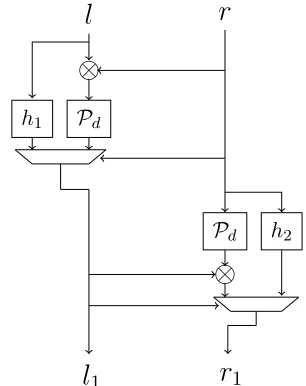
As shown in Figure 1, the construction of F is similar to a 2-round combination of a Misty-like and Feistel structure where the XORs have been replaced by finite field multiplications. Figure 2 shows us, that the construction of G share similarities with 1-round Lai-Massey structure re-placing in the latter the XORsby finite field multiplications. The high level structure of H is shown at Figure 3, as we can see, the construction of H represent a particular version of F which has some advantages over the latter (see, Section 4.1). The non-bijective k-bit functions ψ, ψi, i = 1,2
(which have no pre-image for 0) and the special nonlinear components of H where chosen in such a way to make all these structures invertible. Moreover, from the next constructions:
• F−1(l
1kr1) =lkr where r = h−1(r1⊗ I(ψ2(l1))), l = Pd(l1)⊗ I(ψ1(r));
• G−1(l
1kr1) = lkr where l = h−1(l1)⊗ I(ψ(h−1(l1)⊗ I(r1))),
r = I(r1 ⊗ I(ψ(h−1(l1)⊗ I(r1))));
• H−1(l
1kr1) =lkrwherer =
n h−1
2 (r1), ifl1 = 0;
l1⊗ Pd(r1),ifl1 6= 0; , l =
n h−1
1 (l1), ifr= 0; Pd(l1⊗r),ifr6= 0.
we can easy derive the bijectivity of the S-Boxes F,G,H which is a nec-essary design criteria for SPN ciphers and quite useful for Feistel and Lai-Massey ciphers.
4
Generating almost optimal 8-bit S-Boxes having
good theoretical
DPA
metrics
When n= 8, in correspondence with the suggested constructions ofF,G,H we need to construct; the 4-bit non-bijective functions ψ, ψi, i = 1,2 , the
4-bit permutations h, hi, i = 1,2 ∈ S(V4) and the PP Pd(x) = xd over
The main advantage offered by constructions of F,G and H is that its allows to perform a search based on random generation of 4-bit non-bijective functions and 4-bit permutations for finding almost optimal 8-bit S-Boxes having good theoretical DPAmetrics. For this purpose we propose the following generic algorithm:
Step 1. Select one of the three constructions F,G or H ; Step 2. In dependency of the selected construction, generate randomly the 4-bit components (ψ1, ψ2, h) or (ψ, h) or (h1, h2);
Step 3. For already generated 4-bit components, (ψ1, ψ2, h) or (ψ, h)
or (h1, h2) construct the S-Box;
Step 4. Test this permutation for all criteria 1-5. If the choosen substitution satisfies all of them except criterion 1 then go to Step 5. Otherwise repeat Step 2;
Step 5. Apply affine/linear equivalence to the obtained permutation in order to achieve the required property 1;
Step 6. Compute the parameters TO,SNR(DPA),CC for the S-Box obtained in the previous step. If
(TO < 7.860)&(SNR(DPA) < 9.600)&(CC > 0.111) then go to Step 7. Otherwise repeat Step 2;
Step 7. Output of the algorithm. A nonlinear bijective mapping with the desired properties.
Let us point out that the values of transparency order, SNR(DPA) and confusion coefficient specified in the step 6 of the previous algorithm were select in such a way to ensure that our S-Boxes have at least better theo-retical DPA metrics than the AES’s S-Box.
Our algorithm was implemented in SAGE [50] and has been applied to a large number of random 4-bit permutations and random non-bijective 4-bit functions (which have no pre-image for 0). As a result we have ob-tained affine nonequivalent almost optimal 8-bit permutations based on construction of F without fixed points with the following parameters
• minimum degree — 7;
• graph algebraic immunity — 3 (with 441 equations);
• 8 — uniform;
While the construction of G is able to produce almost optimal afine nonequivalent 8-bit S-Boxes without fixed points with
• minimum degree — 7;
• graph algebraic immunity — 3 (with 441 equations);
• 6 and 8 — uniform;
• nonlinearity in range of 100 up to a value of 104.
The best result have been achieved by the construction of H, which generate almost optimal affine nonequivalent 8-bit S-Boxes without fixed points having the parameters listed below
• minimum degree — 7;
• graph algebraic immunity — 3 (with 441 equations);
• 6 and 8 — uniform;
• nonlinearity in range of 100 up to a value of 108.
Some 8-bit permutations generated by constructions of F,G and H in correspondence with the previous algorithm have been listed in the ap-pendix section. These S-Boxes exhibit good theoretical DPA metrics.
4.1 Relations, advantages and disadvantages between and H
As stated in Section 3.1 the construction of H represent a version of F which has some advantages and disadvantages over F. In fact, directly from these constructions we can easy obtain that, when h = Pd, ψ1(z) =
ψ2(z) =
n c,ifz= 0;
z,ifz6= 0. , c ∈ GF(2
k)\{0}, the constructions of F and H are
the same, when in the latter h1(z) = Pd(z ⊗c), h2(z) = Pd(z)⊗ c. From
practical point of view the main difference between these structures comes from the cryptographic quality of the permutations that they produce. For
example, when n = 8 we have no found any S-Box generated by F with
graph algebraic immunity — 3 and nonlinearity more than 104 while the construction ofH does it, solving at the same time the open question raised in [32] about existence of such permutations. It shoult be noted that even
when the construction of H can be weak against SCAs due to the use
by H in GF(28). However, due to its multiplicative complexity (33 and 22 nonlinear field multiplications respetively) in GF(28) the issue of finding more efficient methods of masking for construction of H is left as future work.
5
Comparing our S-Boxes with other from the
per-spective of conventional cryptanalysis and
theoret-ical side-channel metrics
In Table 1 we show the cryptographic parameters on some classes of cur-rently 8-bit S-Boxes used in different modern block ciphers. As it can be seen the Scream S-Box highlight the best values of transparency order,
SNR(DPA) and confusion coefficient respectively. It should be noted that the Scream cipher was designed to be side-channel resistant with masking (see, [23]). However, this S-Box is not almost optimal with respect the chosen criteria decribed in Section 3. Only Kuznyechik and Belt (relaxing slightly the condition on the minimum degree) S-Boxes satisfies our design criteri. But even when these permutations have good theoretical DPA met-rics at the time of writing we have no found any dth-order (d > 1) masked version of aftermentioned S-Boxes in the public available literature. How-ever, in [38] was proposed a method of masking which can be applied to any SPN block cipher and therefore the whole Kuznyechik cipher can be protected using this approach or using the Cycloatomic or Parity-Split methods [13] for masking the Kuznyechik S-Box. The remainder S-Boxes compiled in this table can be masking using different methods described in [15, 21, 33, 46].
at-S-Boxes class/Cryptographic properties Bijection N L δ deg AIgrr(AIgr) TO SNR(DPA) CC
AES S-Box [43] Yes 112 4 7 2(39) 7.860 9.600 0.111
Belt S-Box [6] Yes 102 8 6 3(441) 7.833 8,318 0.169
Clefia S-BoxS0[52] Yes 100 10 6 3(441) 7.745 9.662 0.109
FOX S-Box [54] Yes 96 16 6 3(441) 7.788 9.342 0.121
Iceberg S-Box [51] Yes 96 8 7 3(441) 7.812 10.254 0.089
Khazad S-Box [4] Yes 96 8 7 3(441) 7.80 8.860 0.141
Kuznyechik S-Box [25] Yes 100 8 7 3(441) 7.835 9.571 0.112
Picaro S-Box [46] No 94 4 2 3(441) 7.843 8.557 0.147
Scream S-Box [23] Yes 96 8 6 3(441) 7.589 7.921 0.194
Zorro S-Box [21] Yes 96 10 6 3(441) 7.806 9.260 0.124
Table 1: Crytptographic parameters on some classes of currently used 8-bit S-Boxes
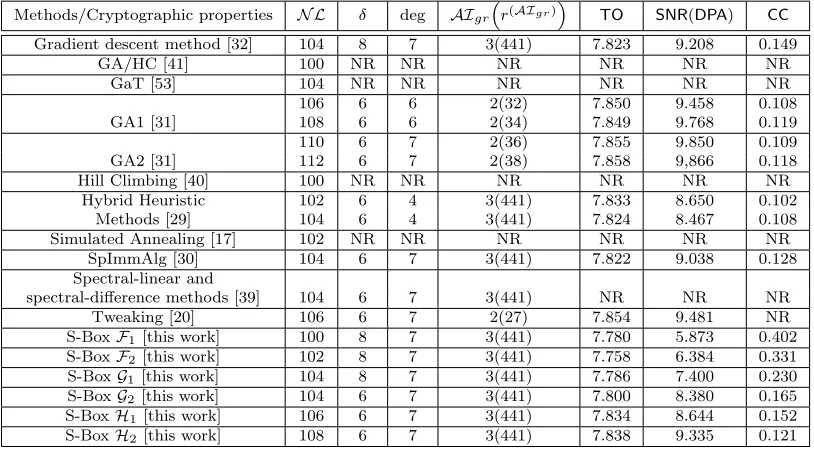
Methods/Cryptographic properties N L δ deg AIgr
r(AIgr) TO SNR(DPA) CC
Gradient descent method [32] 104 8 7 3(441) 7.823 9.208 0.149
GA/HC [41] 100 NR NR NR NR NR NR
GaT [53] 104 NR NR NR NR NR NR
106 6 6 2(32) 7.850 9.458 0.108 GA1 [31] 108 6 6 2(34) 7.849 9.768 0.119 110 6 7 2(36) 7.855 9.850 0.109 GA2 [31] 112 6 7 2(38) 7.858 9,866 0.118 Hill Climbing [40] 100 NR NR NR NR NR NR
Hybrid Heuristic 102 6 4 3(441) 7.833 8.650 0.102 Methods [29] 104 6 4 3(441) 7.824 8.467 0.108 Simulated Annealing [17] 102 NR NR NR NR NR NR
SpImmAlg [30] 104 6 7 3(441) 7.822 9.038 0.128 Spectral-linear and
spectral-difference methods [39] 104 6 7 3(441) NR NR NR Tweaking [20] 106 6 7 2(27) 7.854 9.481 NR S-BoxF1[this work] 100 8 7 3(441) 7.780 5.873 0.402
S-BoxF2[this work] 102 8 7 3(441) 7.758 6.384 0.331
S-BoxG1[this work] 104 8 7 3(441) 7.786 7.400 0.230
S-BoxG2[this work] 104 6 7 3(441) 7.800 8.380 0.165
S-BoxH1 [this work] 106 6 7 3(441) 7.834 8.644 0.152
S-BoxH2 [this work] 108 6 7 3(441) 7.838 9.335 0.121
Table 2: A comparison between the cryptographic properties of 8-bit permutations pro-duced by different modern generation methods (NR means “not reported”)
tacks in terms of graph algebraic immunity, transparency order, SNR(DPA) and confusion coefficient than other permutations while having comparable classical cryptographic properties.
6
Higher-Order Masking of 8-bit S-Boxes obtained
by construction of
F
and
G
coun-termeasure against SCAs. The principle of the so-called masking scheme is to randomly split every sensitive intermediate variable occurring in the computation intod+1 shares, whered is called the masking order and plays the role of a security parameter.
In connection with [13], to design a higher-order masking scheme for any n-bit S-Box Φ, we need to express it as a sequence of field multiplications and additions over GF(2n). This representation is based on four kinds of operations over GF(2n): additions, scalar multiplications, squares, and nonlinear multiplications. Masking is efficient for the three first kinds, the latter operations are linear (resp. affine) over Vn, and in this case the
masking overhead will solely correspond to d times the original operation complexity. In the case of nonlinear multiplications, the masking scheme is more expensive: it costs (d+ 1)2 field multiplications, 2d(d+ 1) XORs
and the generation of d(d+ 1)/2 random n-bit values. Masking an n-bit S-Box Φ processing can hence be done by masking every affine function and every nonlinear multiplication independently. We refers to [13] for a detailed explanation of how this can be done for each category. As defined in [13], the masking complexity of any n-bit S-Box Φ, denoted by MC(Φ), is the minimal number of nonlinear multiplications required to evaluate its polynomial representation over GF(2n). Denoting by Mn
k as the class
of exponents α such that Xα has a masking complexity equal to k we summarizes in Table 3 the results (obtained in [13]) for the cyclotomic classes Cα = {α·2j mod (15)|j = 0,1,2,3.} in M4k.
k Cyclotomic classes in M4
k
0 C0={0}, C1={1,2,4,8}
1 C3={3,6,12,9}, C5={5,10}
2 C7={7,11,13,14}
Table 3: Cyclotomic classes for n= 4 w.r.t. the masking complexityk.
bivariate functions over GF(24):
1. F3(lkr) =
l⊗ψ1(r) 14
r14⊗ψ2((l ⊗ψ1(r)) 14
⊕6,
2. G3(lkr) =
l ⊗ψ(l⊗r)
14
r14⊗ψ(l ⊗r)
⊕252,
where the 4-bit non-bijective functions ψ1, ψ2 and ψ (which have no
pre-image for 0) having the following polynomial representations ψ1(X) =
1+11X+6X2+3X3+12X4+12X6+6X8+X9+X12, ψ2(X) = 14+X+14X15
and ψ(X) = 4 + X + 13X2 + 11X3 + X14 were randomly generated. It can be easily checked that ψ1, ψ2 and ψ can be computed with 1,3 and
2 field multiplications respectively. We summarizes in Table 4, the values obtained for MC(F3) and MC(G3) and the look-up tables of these S-Boxes
and its cryptographic parameters are listed in the appendix section.
# nonl. multiplications # additions # squarings # random 4-bit values
UnmaskedF3 10 8 8 0
UnmaskedG3 9 3 4 0
dth-order maskedF3 10(d+ 1)2 (20d+ 8)(d+ 1) 8(d+1) 5d(d+1)
dth-order maskedG3 9(d+ 1)2 (18d+ 3)(d+ 1) 4(d+1) 92d(d+ 1)
Table 4: Number of operations
Taking into account that the number of field of multiplications for any 4-bit non-bijective function and any 4-bit permutation is lower bounded by 0 and upper bounded by 3,4 respectively (see, [13]), we obtain the following bounds for 8-bit S-Boxes produced by construction of F and G:
4≤ # nonl. mult. of F ≤ 15,5 ≤# nonl. mult. of G ≤ 12. (15)
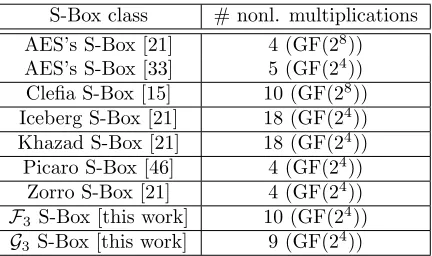
As we can see from (15), 8-bit S-Boxes with only 4 and 5 nonlinear mul-tiplications over GF(24) can be constructed using the schemes of F and G respectively, but our experiments have shown that these permutations are not almost optimal with respect to the chosen criteria.
S-Box class # nonl. multiplications AES’s S-Box [21] 4 (GF(28))
AES’s S-Box [33] 5 (GF(24))
Clefia S-Box [15] 10 (GF(28)) Iceberg S-Box [21] 18 (GF(24))
Khazad S-Box [21] 18 (GF(24)) Picaro S-Box [46] 4 (GF(24))
Zorro S-Box [21] 4 (GF(24))
F3S-Box [this work] 10 (GF(24))
G3S-Box [this work] 9 (GF(24))
Table 5: Comparison of 8-bit S-Boxes w.r.t. # nonl. multiplications.
at the cost of a worse number of nonlinear multiplications compared with the AES [33], Picaro [46] and Zorro S-Boxes [21].
7
Conclusion
In this work we have presented some new schemes based on the well-known Feistel and Lai-Massey structures for constructing S-Boxes of dimension n = 2k, k ≥ 2. The main cores of our constructions are: the inversion in GF(2k), the k-bit non-bijective functions (which have no pre-image for 0) and the k-bit permutations. Combining these components with the finite field multiplication, we provide new cryptographically strong 8-bit S-Boxes having good values of transparency order, SNR(DPA), confusion coefficient and acceptable masking complexity over GF(24) respectively. There are several questions (theoretical results, hardware and bit-sliced implementations, efficient methods of masking) about the constructions suggested in this work which are left as future work.
References
[1] Agievich S., Afonenko A.: Exponential s-boxes. Cryptology ePrint Archive, Report 2004/024, 2004. http://eprint.iacr.org/2004/024.
[2] Avanzi R. A Salad of Block Ciphers.: The State of the Art in
[3] Armknecht, F., Krause, M.: Constructing single and multioutput Boolean functions with maximal algebraic immunity. In: Bugliesi, M., Preneel, B., Sassone, V.,Wegener, I. (eds.) ICALP 2006, Part II. of LNCS, vol. 4052, pp. 180-191. Springer,Heidelberg (2006).
[4] Barreto, P., Rijmen, V.: The Khazad legacy-level block cipher. Prim-itive submitted to NESSIE (2000).
[5] Barreto, P., Rijmen, V.: The Whirlpool hashing function. In: First open NESSIE Workshop, Leuven, Belgium. Volume 13. (2000)
[6] Belarusian State University, National Research Center for Applied Problems of Mathematics and Informatics. ”Information technolo-gies. Data protection. Cryptographic algorithms for encryption and integrity control.”. State Standard of Republic of Belarus (STB 34.101.31-2011), 2011.
[7] Biryukov, A., De Canni`ere, C.: Block ciphers and systems of quadratic equations.In: Johansson, T. (ed.) FSE. 2003. of LNCS, vol. 2887, pp. 274-289. Springer, Heidelberg (2003)
[8] Biryukov, A., Perrin L., and Udovenko A.: Reverse engineering the S-Box of streebog, kuznyechik and STRIBOBr1. In Marc Fischlin and Jean-S´ebastien Coron, editors, Advances in Cryptology - EURO-CRYPT 2016, Part I, volume 9665 of LNCS, pages 372-402. Springer, Heidelberg, May 2016.
[9] Biryukov, A., Perrin L., and Udovenko A.: Cryptanalysis of a theorem: Decomposing the only known solution to the big APN problem. In Advances in Cryptology - CRYPTO 2016 - 36th Annual International Cryptology Conference, Santa Barbara, CA, USA, August 14-18, 2016, Proceedings, Part II,pages 93-122, 2016.
[11] Canteaut, A., Duval, S., Leurent, G.: Construction of Lightweight S-Boxes using Feistel and MISTY structures. In Dunkelman, O., Keliher, L., eds.: Selected Areas in Cryptography 2015. of LNCS. Springer International Publishing (2015).
[12] Carlet, C.: Vectorial Boolean functions for cryptography. Boolean Models and Methods in Mathematics, Computer Science, and En-gineering. Cambridge University Press, 2010.
[13] Carlet c Goubin L., Prouff E., Quisquater M., and Rivain M.: Higher-order masking schemes for s-boxes. In Anne Canteaut, editor, FSE, volume 7549 of LNCS, pages 366-384. Springer, 2012.
[14] Chakraborty K., Sarkar S., Maitra S., Mazumdar B. Mukhopadhyay D., Prouff E.: Redefining the transparency order. Cryptology ePrint Archive, Report 2014/367, 2014. http://eprint.iacr.org/2014/367.
[15] Coron J.S, Roy A., and Vivek S.: Fast evaluation of polynomials over binary finite fields and application to side-channel countermea-sures. CHES 2014 - 16th International Workshop, Busan, South Korea, September 23-26, 2014. Proceedings, pages 170-187, 2014.
[16] Courtois, N. T., and Pieprzyk, J.: Cryptanalysis of
Block Ciphers with Overdefined Systems of Equations,
http://eprint.iacr.org/2002/044/,2002.
[17] Clark J.A., Jacob J.L., and Stepney S.: The design of s-boxes by simu-lated annealing. New Generation Computing Archive, 23(3), Septem-ber 2005.
[18] Gierlichs B., Batina L., Tuyls P. , and Preneel B.: Mutual informa-tion analysis // Internainforma-tional Workshop Cryptographic Hardware and Embedded System , p. 426-442., 2008.
[19] Feistel H.: Cryptography and computer privacy. Scientific American, 228(5):15-23, 1973.
[21] G´erard, B., Grosso, V., Naya-Plasencia, M., Standaert, F.X.: Block ciphers that are easier to mask: how far can we go? In: Cryptographic Hardware and Embedded Systems-CHES 2013. Springer (2013) 383-399.
[22] Grosso V., Leurent G., Standaert, F.X., Varici K.: LS-designs: Bitslice encryption for efficient masked software implementations. In Carlos Cid and Christian Rechberger, editors, FSE 2014, volume 8540 of LNCS, p 18-37. Springer, Heidelberg, March 2015.
[23] Grosso V., Leurent G., Standaert, F.X., Varici K, Journault F.D.A., Gaspar L., and Kerckhof S.: SCREAM & iSCREAM Side-Channel Resistant Authenticated Encryption with Masking. Candidate for the CAESAR Competition. See also http://perso.uclouvain.be/fstandae/ SCREAM/, 2014.
[24] Goli´c J. Dj.: Fast low order approximation of cryptographic func-tions. In Advances in Cryptology EUROCRYPT’96, volume 1070 of of LNCS, p.p 268-282. Springer Verlag, 1996.
[25] GOST R 34.11-2012 Information technology. Cryptographic protection of information. Hash function. Moscow, Standartinform, 2012.
[26] Guilley S., Hoogvorst P. and Pacalet R.: Differential power analysis modeland some results. In CARDIS, pages 127-142, 2004.
[27] Hodgers P., Regazzoni F., Gilmore R., Moore C. , Oder T.: Safe Crypto. Secure Architectures of Future State-of-the-Art in Physical Side-Channel Attacks and Resistant Technologies Emerging cryptog-raphy. Report by European Commission.
[28] Hogenboom J.: Principal Component Analysis and Side-Channel At-tacks - Master Thesis.
[30] Ivanov G., Nikolov N., and Nikova S.: Cryptographically Strong S-Boxes Generated by Modified Immune Algorithm. Cryptography and Information Security in the Balkans Volume 9540 of the series of LNCS pp 31-42.
[31] Ivanov G, Nikolov N., and Nikova S.: Reversed genetic algorithms for generation of bijective S-Boxes with good cryptographic prop-erties. IACR Cryptology ePrint Archive (2014), Report 2014/801, http://eprint.iacr.org/2014/801.pdf.
[32] Kazymyrov O.V., Kazymyrova V.N., Oliynykov R.V.: A method for generation of high-nonlinear S-Boxes based on gradient descent, Math-ematical Aspects of Cryptography, 2014, Volume 5, Issue 2, pp. 71-78.
[33] Kim H., S. Hong, and J. Lim.: A fast and provably secure higher-order masking of AES s-box. In B. Preneel and T. Takagi, editors. CHES 2011 - 13th International Workshop, Nara, Japan. Proceedings, volume 6917 of LNCS. Springer, 2011,pages 95-107.
[34] Kim J.: Combined Differential, Linear and Related-Key Attacks on Block Ciphers and MAC Algorithms. IACR Cryptology ePrint Archive (2006), Report 2006/451,http://eprint.iacr.org/2006/451.pdf.
[35] P. Kocher, Jaffe J., and Jun B.: Introduction to
Dif-ferential Power Analysis and Related Attacks Technical
Report // Cryptography Research Inc., 1998. Available
athttp://www.cryptography.com/resources/whitepapers/DPA-technical.html
[36] Paul C. Kocher.: Timing attacks on implementations of
Diffie-Hellman,RSA, DSS and other systems // In Neal Koblitz, editor, Ad-vances in Cryptology - Proceedings of CRYPTO 1996, number 1109 in LNCS, 104-113. Springer-Verlag, 1996.
[38] Matveev, S. GOST 28147-89 masking against side channel attacks. In: Pre-proceedings of CTCrypt’14-Moscow, Russia.
[39] Menyachikhin A.: Spectral-linear and spectral-difference methods for generating cryptographically strong S-Boxes. In: Pre-proceedings of CTCrypt’16-Yaroslavl, Russia, 2016. p.232-252.
[40] Millan W.: How to improve the nonlinearity of bijective s-boxes. In Australian Conference on Information Security and Privacy 1998, vol-ume 1438, pages 181-192. Springer Verlag, 1998.
[41] Millan W., L. Burnett, G. Carter, A. Clark, and E. Dawson.: Evo-lutionary heuristics for finding cryptographically strong s-boxes. In ICICS’99, volume 1726 of of LNCS, pages 263-274. Springer, 1999.
[42] Millan W. L.: Low order approximation of cipher functions. In Cryp-tography: Policy and Algorithms Conference, Proceedings, volume 1029 of of LNCS, pp. 144-155. Springer Verlag, 1996.
[43] NIST. Advanced Encryption Standard. Federal Information Process-ing Standard (FIPS) 197,November 2001.
[44] Nyberg K.: Differentially uniform mappings for cryptography. In Helleseth, T. (ed.), Advances in Cryptology - EUROCRYPT’93, vol.765 of of LNCS, pp. 55-64. Springer Berlin Heidelberg, 1994.
[45] Picek S., K. Papagiannopoulos K., Ege B., Batina L., and Jakobovic D.:”Confused by confusion: Systematic evaluation of DPA resistance of various s-boxes”, in Progress in Cryptology - INDOCRYPT 2014 - 15th International Conference on Cryptology in India, New Delhi, India, December 14-17, 2014, Proceedings, ser.LNCS, W. Meier and D. Mukhopadhyay, Eds., vol. 8885. Springer,2014, pp. 374-390.
[47] Prouff E.: DPA Attacks and S-boxes. In FSE, pages 424-441, 2005.
[48] Leander G., Poschmann A.: On the classification of 4 bit S-Boxes. of LNCS, 2007, vol. 4547, pp. 159-176.
[49] Lidl, R., and Niederreiter, H.: Finite Fields,vol. 20 of Encyclopedia of Mathematics and its Applications. Cambridge University Press, 1997.
[50] Sage Mathematics Software (Version 8.1). (2018)
http://www.sagemath.org.
[51] Standaert, F.X., Piret, G., Rouvroy, G., Quisquater, J.J., Legat, J.D.: ICEBERG : An Involutional Cipher Efficient for Block Encryption in Reconfigurable Hardware. In Roy B., Meier W., eds. FSE. Volume 3017 of Lecture Notes in Computer Science. Springer Berlin Heidelberg (2004) 279-298.
[52] Shirai, T., Shibutani, K., Akishita, T., Moriai, S., Iwata, T.: The 128-bit blockcipher CLEFIA. In FSE, Springer (2007) 181-195
[53] Tesaˇr P.: A New Method for Generating High Non-linearity S-Boxes. Radioengineering - 2010. V. 19, NO. 1. - p. 23-26.
[54] Vaudenay S., Junod P.: Device and method for
encrypt-ing and decrypting a block of data. United States Patent
(20040247117), see also ”Fox, a New Family of Block Ciphers” http://crypto.junod.info/sac04a.pdf, 2004.
8
Appendix
8.1 Some S-Boxes generated by our constructions
S-BoxF1 S-BoxF2
N L(F1) = 100, δ(F1) = 8,deg(F1) = 7,AIgr(F1) = 3, r(3)F1= 441, N L(F2) = 102, δ(F2) = 8,deg(F2) = 7,AIgr(F1) = 3, r
(3)
F1= 441 TO(F1) = 7.780,SNR(DPA)(F1) = 5.873,CC(F1) = 0.402 TO(F2) = 7.758,SNR(DPA)(F2) = 6.384,CC(F2) = 0.331
f1 fa fd f9 f7 f8 f5 fe f2 f4 fc f0 f3 fb ff f6 a1 87 dc d6 15 dd e6 90 ee 8d 30 e4 ba 54 98 3e 41 e8 89 6f 6c 93 d4 c0 ef 5d c3 ea 6b 5a 9c ab c1 08 18 06 2f b3 b2 36 1e 13 9e d9 d2 4d 3b 05 31 52 28 eb 6e 75 26 c8 2e 60 73 c5 64 aa 46 a4 e1 a8 24 27 04 ad d3 47 0a 43 76 bc b8 50 a9 49 71 80 0e d7 8c cc e7 96 1f 10 9f d5 e2 85 19 3a 21 86 8b e3 1a 9a e0 97 69 16 37 de 34 33 45 99 91 00 2c 0f 0c b5 2b 3f 66 a7 70 b9 79 23 4b 44 51 17 12 df be da bb 48 03 8a b7 7d db 4f 38 3c 61 0b 1b e5 14 bf d0 42 0d 40 3d 4a d8 35 32 a3 d1 a0 5c 2d 6a 7e 62 cb 2a 88 57 7c b0 a5 a2 55 b1 1c 58 6d 8e ce 67 82 ed 53 cf 78 e9 83 94 59 81 1d 02 20 09 c7 b6 72 7f a6 bd b4 74 4e ac 4c 01 56 84 63 22 9d 9b 39 65 5f cd c4 ec 8f c2 95 11 5b 07 c6 29 7a 68 77 25 af 92 ca 7b ae c9 5e
cf c6 c2 c8 c0 c3 c5 cc c1 ce c9 c4 ca cd c7 cb ef f1 74 bd 56 7e 6d fd 88 64 fb 0b 43 46 4d 00 df 0a 1e 9b e1 47 84 8b 6b 40 4b 0d a7 9a a2 8e 3f 09 a9 4c 58 8d d3 a1 83 16 57 59 d9 b7 de 41 5f 3d d0 ea 97 87 fc f6 77 a5 e7 8c ab 82 ed 75 9f 5a 28 19 25 5e b4 67 b5 18 04 2c ee b6 85 e5 2f f3 11 54 e4 1c 53 5d 89 a3 f0 eb 13 3e 80 6c 0f 61 91 5b 24 79 63 51 95 60 d1 f5 3b 38 9d 20 1f 52 7c 49 0c dc f7 db d5 2b 4e ec e9 f8 08 e6 8f b3 a8 45 93 7d 2e ad d2 f2 96 f9 be 71 ae fe 7f b1 b8 6a 68 aa dd e8 33 15 9c 1d b9 31 d8 6e 6f 55 d4 2a 35 37 5c 73 3a 22 d6 86 23 8a bb 4a bf 30 da 14 e3 42 34 e2 1a 44 1b 39 d7 f4 99 2d 4f a0 29 e0 05 ac fa 62 69 98 9e 26 36 a6 0e 06 af 70 ba 94 78 50 27 7b 17 90 10 03 48 92 b2 21 ff 65 01 bc 3c 32 81 66 7a 02 07 12 a4 72 b0 0b
S-BoxG1 S-BoxG2
N L(G1) = 104, δ(G1) = 8,deg(G1) = 7,AIgr(G1) = 3, r(3)G1= 441, N L(G2) = 104, δ(G2) = 6,deg(G2) = 7,AIgr(G2) = 3, r
(3)
G2 = 441 TO(G1) = 7.786,SNR(DPA)(G1) = 7.400,CC(G1) = 0.23 TO(G2) = 7.80,SNR(DPA)(G2) = 8.38,CC(G2) = 0.165
d9 d3 dc df d2 db da d0 d5 de d8 dd d1 d7 d4 d6 19 6c 7f b5 a1 9f e5 5d ec 8c 51 1d ba 2f 9d 0f b9 85 7a 52 53 9a ef f1 e2 13 91 f5 b1 63 25 35 99 fe ce 03 fc 73 42 e6 95 c6 83 05 45 12 56 b3 e9 8f 9e 55 5c fa ea 32 9c 62 ca ff c2 be a2 1e 09 74 a7 b4 ae f4 e4 3b 7e 0e 97 4b cb 26 20 30 f9 47 c3 0c f2 6e 02 94 2e c7 54 8e 22 44 ee bc 39 86 66 01 58 71 21 7b 98 84 ab c4 48 68 a0 36 59 f7 93 5f f3 4f 4c 7c 92 65 ac cf c5 1c b7 e7 69 72 82 b2 aa 6b 1f ed 3d 0a 5a 11 bf 4a eb 5b 29 76 77 50 87 f6 4d 38 e0 80 ad c0 0d 27 a8 34 49 43 a6 a3 3e c8 16 5e 33 07 96 f8 b6 24 28 04 c9 4e cc 2c 37 90 3c 57 23 06 f0 17 67 46 e3 00 89 41 a5 2b 75 6d 15 e1 31 c1 88 1a 6a e8 bb b8 a9 14 9b 3a fb 7d 0b 78 2a 64 8d 8a 40 60 a4 1b 79 fd cd 2d 3f 61 08 70 af b0 8b 81 6f 10 bd 18
S-BoxF3 S-BoxG3
N L(F3) = 100, δ(F3) = 8,deg(F3) = 7,AIgr(F3) = 3, r(3)F3= 441, N L(G3) = 100, δ(G3) = 8,deg(G3) = 7,AIgr(G3) = 3, r
(3)
G2 = 441 TO(F3) = 7.773,SNR(DPA)(F3) = 6.509,CC(F3) = 0.316 TO(G3) = 7.753,SNR(DPA)(G3) = 6.629,CC(G2) = 0.302
1d 1f 1c 12 14 18 13 11 10 19 16 17 1a 15 1b 1e 5d 3f 3c 2c 5c ee 90 31 02 0f ce 70 af cc 64 cf 3d 0c 04 94 34 f5 52 0b 83 8c e5 22 dc e4 b0 ec cd e2 e3 03 c3 4c 87 e9 f8 f2 bc 37 92 b3 da b2 0d 84 80 50 00 69 33 8e ca c4 f9 93 74 f0 42 f4 bd 48 46 f6 b6 23 6b 40 ae a8 73 eb 88 76 51 78 ed f3 fa 8a ea a4 c8 ff 66 63 44 08 53 4a 77 43 ad d1 db bb ab 57 45 d3 79 71 97 65 e1 9b 0e 91 8d c0 c2 32 82 bf 0a c5 e7 e0 6f 5a 20 62 a3 60 9d 59 5f 7f 9f cb 24 56 30 39 8b d4 49 8f fc 89 4d a6 a1 61 41 9a be a2 d5 d6 2a fe c6 21 3b 26 6d b7 b8 e8 68 72 f1 b4 4b 47 d2 c1 07 d8 96 d7 fd 6a 67 c7 f7 d0 e6 6c b1 ba a0 86 3a a7 28 aa 2d 95 99 d9 29 81 7c 98 54 55 01 ac b5 09 ef 05 dd 7b 7e 4e de 38 a9 7a 2f 2b 58 b9 fb 5e 85 5b 7d 2e 25 a5 75 06 df 27 9c 9e 36 4f 6e 35 c9 3e
fc f8 fe f1 fd f6 f3 f7 f5 f4 f9 fb f2 ff f0 fa 2c 6e d1 8e 2d e7 a8 8b 61 68 1b 02 6b 4b 07 42 0c e5 0e 44 25 82 22 19 58 28 52 69 13 24 33 32 5c 3a c0 12 85 7d 45 80 ad 88 75 a2 35 5f 8a 08 1c 18 0d 03 a4 a3 81 91 3f 6d 86 53 26 04 93 0f 9c 4d 74 6f b4 a0 64 30 cd cf 99 36 3b 34 b6 eb ac 77 5d 3d 4e bd 9d 50 83 90 57 be 43 54 14 aa 7c ea b8 c3 00 c9 c2 23 0a da e2 7b 39 98 ca b0 8c 1e 4f 55 9a 5b 0b c1 11 84 c5 41 a1 2e 1a 1f 6c ee ed e3 b3 2b 1d 06 65 a6 d0 e6 5e ab 16 20 cc bf df 2f 7e c6 92 db 2a 3e 97 47 9b 7a 62 9f 3c 94 a5 95 c8 49 e4 37 78 48 5a 46 e8 d6 4a 79 4c ae 38 ce 51 a9 31 8f 9e b9 a7 de d8 c7 40 af ec 59 dd e1 d5 d9 d2 ba 72 56 66 8d 05 6a 29 09 bc d4 17 73 10 63 96 70 71 60 01 76 b2 e0 d7 c4 dc 89 87 cb b5 15 d3 e9 b1 ef b7 21 bb 27 7f 67
S-BoxH1 S-BoxH2
N L(H1) = 106, δ(H1) = 6,deg(H1) = 7,AIgr(H1) = 3, r (3)
H1= 441, N L(H2) = 108, δ(H2) = 6,deg(H2) = 7,AIgr(H2) = 3, r
(3)
H2= 441 TO(H1) = 7.834,SNR(DPA)(H1) = 8.644,CC(H1) = 0.152 TO(H2) = 7.838,SNR(DPA)(H2) = 9.335,CC(H2) = 0.121
1b d4 6b e6 a6 e4 96 59 29 94 69 19 2b d6 5b a4 47 88 d7 57 62 06 f6 f7 ff 31 c0 1e c1 6f 54 ae d0 0f db 7a 75 b9 12 18 83 5f d1 39 ce 51 cf aa af 58 23 cc f2 a8 93 1d 45 3c 9b 0b 42 bb ef 08 ea d5 6d 14 60 41 53 f8 2c 36 80 79 f5 27 b1 cd c9 d2 35 a5 f1 bf 4b 3d ec 9d 01 cb 16 1c 4a d8 64 32 04 33 e0 97 05 26 63 c2 55 81 48 20 d3 49 38 e9 07 7f 34 c4 b5 df e3 e8 8e 30 1f 7e de e5 f3 9a eb fd 73 fb e1 dd 5a 3f 90 9e b7 b4 c8 4c 02 6c 72 ac 24 87 e2 a7 7c 8a 0d 17 76 43 c6 ad b6 2f 9f 0a bd dc 6a a1 f0 da 8b 37 86 d9 4e fe 7d 0e b8 03 40 82 66 6e 15 78 13 ed 44 2d 2a f4 95 09 67 a2 70 b3 91 71 61 ca e7 4d 50 89 3a a9 21 8d c5 25 9c 5d bc 28 10 2e 7b b0 ba 0c 99 74 5e 92 84 a3 fc 11 65 00 f9 68 ab c7 fa c3 b2 52 8c 85 ee 3e 3b 1a a0 46 be 98 77 8f 5c 4f 56 22