Lattice-based Direct Anonymous Attestation (LDAA)
Nada EL Kassema, Liqun Chena, Rachid El Bansarkhanib, Ali El Kaafaranic, Jan Camenischd, Patrick Houghc, Paulo Martinse, Leonel Sousae
aUniversity of Surrey, UK bTU Darmstadt, Germany cUniversity of Oxford, UK
dDfinity, Switzerland
eINESC-ID, Instituto Superior T´ecnico, Universidade de Lisboa, Portugal
Abstract
The Cloud-Edges (CE) framework, wherein small groups of Internet of Things (IoT) devices are serviced by local edge devices, enables a more scalable solu-tion to IoT networks. The trustworthiness of the network may be ensured with Trusted Platform Modules (TPMs). This small hardware chip is capable of mea-suring and reporting a representation of the state of an IoT device. When con-necting to a network, the IoT platform might have its state signed by the TPM in an anonymous way to prove both its genuineness and secure state through the Direct Anonymous Attestation (DAA) protocol. Currently standardised DAA schemes have their security supported on the factoring and discrete log-arithm problems. Should a quantum-computer become available in the next few decades, these schemes will be broken. There is therefore a need to start developing a post-quantum DAA protocol. This paper presents a Lattice-based DAA (LDAA) scheme to meet this requirement. The security of this scheme is proved in the Universally Composable (UC) security model under the hardness assumptions of the Ring Inhomogeneous Short Integer Solution (Ring-ISIS) and Ring Learning With Errors (Ring-LWE) problems. Compared to the only other post-quantum DAA scheme available in related art, the storage requirements of the TPM are reduced twofold and the signature sizes 5 times. Moreover, exper-imental results show that the signing and verification operations are accelerated 1.1 and 2.0 times, respectively.
Keywords: Lattice based Cryptography, Direct Anonymous Attestation, Universally Composable Security Model
IThe research of Liqun Chen, Paulo Martins and Leonel Sousa was supported by European Union’s Horizon 2020 research and innovation programme under grant agreement No. 779391 (FutureTPM).
Email addresses: [email protected](Nada EL Kassem),
[email protected](Liqun Chen),[email protected] (Rachid El Bansarkhani),[email protected](Ali El Kaafarani),
1. Introduction
Internet of Things (IoT) devices are becoming increasingly common in our everyday lives and on industrial applications. Networks of sensors and actua-tors are being implemented in the general infrastructure to achieve better en-ergy efficiency; in production to obtain customised mass production; and in the automotive industry to improve safety, among others. Due to the always larger amounts of data produced by such sensors, the Cloud-assisted IoT (CoT) paradigm, wherein the sensors are connected to a central Cloud server, is suf-fering from scalability issues. In contrast, with the emerging Cloud-Edges (CE) technology, distributed edge devices, such as smart gateways and local PCs, offer cloud-like services to only a limited group of devices. These edge devices should ensure that IoT platforms connecting to the network are in a trustworthy state and do not constitute an hazard to the remaining nodes.
The Trusted Computing Group (TCG) is an industrial consortium that aims at the design of standards for trusted systems [1], including the Trusted Plat-form Module (TPM) [2] and the Trusted Network Connect (TNC) [3]. The TPM is a piece of security hardware that may be included on the motherboards of IoT devices [4]. When loading code, including bootloaders, BIOSs, etc., the binaries are measured and extended into the TPM Platform Configuration Reg-isters (PCRs). As a result, the PCRs contain a value that is representative of the current state of the system. When combined with the TNC, which is an architecture for network access control, the functionality offered by the TPM may be exploited to ensure that all devices connected to an edge IoT network are in a secure state [5].
In particular, the Direct Anonymous Attestation (DAA) is a protocol en-abling a TPM and a Host IoT device not only to authenticate themselves to a Verifying edge device and to prove that the Host is in a trustworthy state, but also to do so in a privacy-preserving manner. More concretely, the DAA provides the TPM with the ability to sign its register values in an anonymous way, whilst still convincing the Verifier that it possesses valid DAA credentials. Anonymity is particularly important in applications such as the automotive industry, wherein tracking of drivers should be prevented.
computational resources. Experimental results show that the storage require-ments of the TPM are reduced twofold and the size of the signatures 5 times when compared with [7]. The signing and verification operations are also ac-celerated 1.1 and 2.0 times. Furthermore, the security of our LDAA scheme is based on the hardness of the Ring-ISIS and Ring-LWE problems. As there is no known quantum algorithm that solves either of these problems, this provides a promising DAA scheme for the post-quantum age. We also prove the security of our L-DAA scheme in the Universal Composability (UC) model.
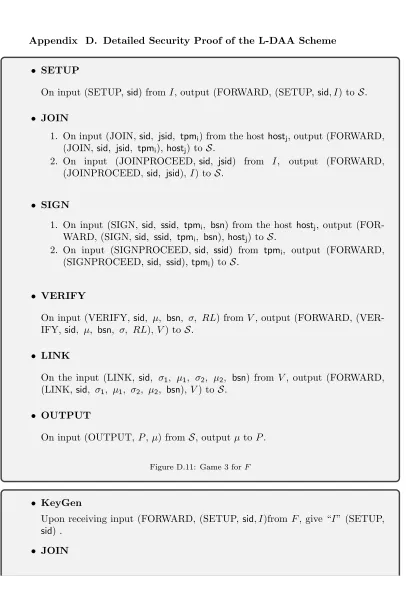
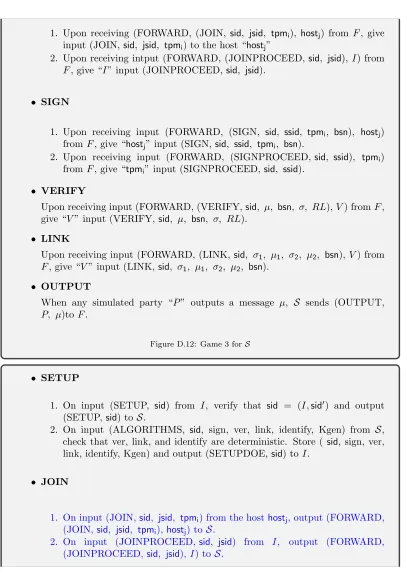
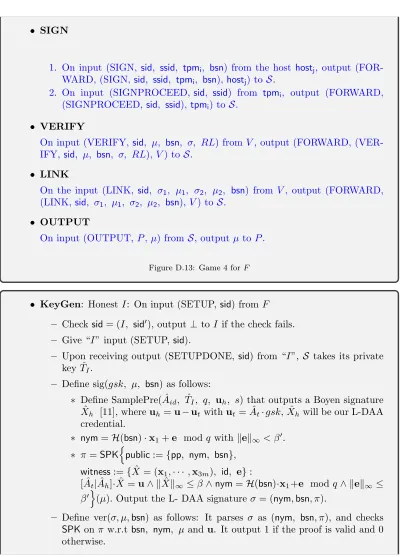
In Section 2, the backgrounds regarding the TPM and lattice-based cryp-tography are reviewed. Section 3 proposes novel post-quantum cryptographic primitives, and the new LDAA scheme is built supported on these primitives. Afterwards, in Section 4, the LDAA security model, supported in the UC frame-work, is defined. A sketched security proof for our L-DAA scheme, based on this security model, is presented in Section 5. Finally, we discuss the performance of the proposed scheme in comparison to related art in Section 6, evaluate it experimentally in Section 7 and conclude the paper in Section 8. Appendix A and Appendix B present the security analysis of the novel post-quantum cryp-tographic primitives. Appendix C discusses several functionalities necessary for our L-DAA security proof and a detailed security proof of the proposed L-DAA scheme is presented in Appendix D.
2. Background
In this section, the TPM functionality is reviewed, with a particular focus on the DAA protocol. Moreover, an overview of lattice-based cryptography is provided, namely in what regards commitments, signatures and zero-knowledge proofs-of-knowledge.
2.1. TPM and TNC
IoT Platform
Boot Loaders
UEFI Secure Boot
OS Loader
Kernel & Boot Drivers
Other Software
TPM
Platform Configuration Registers (PCRs)
Issuer
Edge device DAA credentials
DAA signature of PCRs
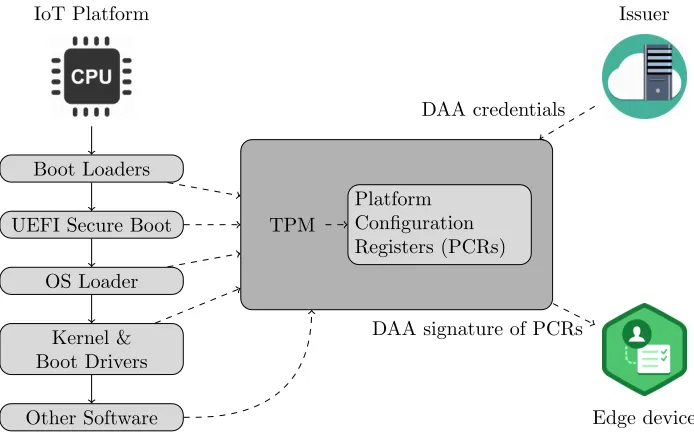
Figure 1: TPM-based attestation of an IoT system. As software is loaded, the TPM builds a representation of the platform state. When access is requested to an Edge network, a DAA signature of the PCRs is sent to the Edge device
an edge network, may require IoT devices to prove that they possess a genuine TPM platform and that they are in a trustworthy state before access to the network is granted [5]. This is achieved with the DAA protocol, as represented on the right-hand side of Figure 1.
the user-controlled linkability: two DAA signatures created by the same signer may or may not be linked from a verifier’s point of view. The linkability of DAA signatures is controlled by an input parameter called the basename. If a signer uses the same basename in two signatures, they are linked; otherwise they are not.
2.2. Lattice-based Cryptography
Throughout this paper polynomial ringsRq =Zq[x]/hxn+ 1iwill be used
to build cryptographic operations, whereZq represents the quotient ring Z/qZ and nis power of 2. Elements of a ∈ Rq are represented as polynomials a = a0+a1x+· · ·+an−1xn−1of degreen−1 with integer coefficients. acan also be represented as a vector (a0, a1, . . . , an−1)∈Zn, withkak∞denoting the infinity
norm ofa(kak∞= max0≤j≤n|aj|). Vectors of polynomials are represented as
ˆ
A= (a1, . . . ,am) wherem is some positive integer. kAˆk∞ is the infinity norm
of the vector of polynomials ˆA defined by kAˆk∞ = maxikaik∞. Finally, the
following notations are also used. [d] is the set{1, . . . , d}for a positive integer
d. B3n denotes the set of vectors u∈ {−1,0,1}3n having exactlyncoordinates
equal to−1,n coordinates equal to 0 andncoordinates equal to 1. β denotes a positive real norm bound andλrepresents a security parameter.
For a fixed ˆA, the inner-product product ˆA·Z,ˆ ∀Zˆ ∈ Rm
q generates a lattice L( ˆA) =nv|∃Z∈Rˆ m
q ˆ
A·Zˆ=vosatisfying Definition 1. Moreover, for a given u,
the latticeL⊥u( ˆA) is defined as
L⊥u( ˆA) = n
ˆ
Z ∈ Rmq |Aˆ·Zˆ =u o
.
The security of the proposed DAA scheme will be based on the problems char-acterised in Definitions 2 and 3. Furthermore, Gaussian distributed samples over lattices will be required, as per Definition 4.
Definition 1 (Lattices [8]). Let b1,b2,· · · ,bn be linearly independent vectors over Rm. Let B = [b1|b2| · · · |bn] ∈ Rm×n having these vectors as columns.
The lattice spanned byB is given by
L(B) =
( n
X
i=1
zibi:zi∈Z
)
The vectors b1,b2,· · ·,bn are called a basis of the lattice. The rank n of the lattice is defined to be the number of vectors inB. If n=m then the lattice L is said to be a full-rank lattice.
Definition 2 (The Ring Short Integer Solution Problem (Ring-SISn,m,q,β)
[9]). Given m uniformly random elements ai ∈ Rq defining a vector Aˆ =
(a1,a2, . . . ,am), find a nonzero vector of polynomialsZˆ= (z1,z2, . . . ,zm)∈ Rmq with kZˆk∞ ≤ β such that: Aˆ·Zˆ = Pi∈[m]ai·zi =0. The Ring
Inhomoge-neous Short Integer Solution (Ring-ISISn,m,q,β) problem asks to find Zˆ with
Definition 3(The Ring Learning With Error Problem (Ring-LWE) [10]). Let χbe an error distribution defined over R, we define the following:
Ring-LWE distribution: Choose a uniformly random ring element s←-Rq called the secret, and a distribution χ. The ring-LWE distribution As,χ over
Rq × Rq is sampled by choosing a ∈ Rq uniformly at random, choosing ran-domly the noisee←- χand outputting(a,b) = (a, s·a+e modq)∈ Rq× Rq.
Ring-LWE Problems: Letube uniformly sampled fromRq
1. The decision problem of Ring-LWE asks to distinguish between (a,b)←
As,χ and(a,u) for a uniformly sampled secrets←-Rq.
2. The search Ring-LWE problem asks to return the secret vector s ∈ Rq given a Ring-LWE sample (a,b) ← As,χ for a uniformly sampled secret
s←-Rq.
Definition 4 (Discrete Gaussian Distributions [10]). The discrete Gaussian distribution on a non empty setLwith parameters, denoted byDL,s, is the dis-tribution that assigns to eachx∈La probability proportional toexp(−π(kxk/s)2).
2.3. Boyen’s Signature Scheme
A DAA credential corresponds to a signature of the IoT platform identifier produced by the Issuer. Herein, signatures will be designed based on Boyen’s scheme. This scheme operates over a ring Rq, with m = O(logq), and can
sign any messageid∈ {0,1}`. The scheme includes the algorithms depicted in
Scheme 1. The security of the Boyen signature scheme is based on the hardness of the Ring-ISIS problem and is proved to be secure in the standard model. We refer to [11] for the security proof. The proof was improved later in [12] by using a new trapdoor and ring analogue. A modification to Boyen’s signature scheme will be proposed in Section 3 to support the issuing of DAA credentials. This modification will be proven to be secure in Appendix A.
2.4. Baum et al’s Commitment Scheme
Scheme 1: Boyen’s Signature Scheme
• KeyGen(1λ):
1. Generates a vector of polynomials ˆA∈ Rm
q together with a
trap-door ˆT. The trapdoor enables sampling vectors of polynomials following a discrete Gaussian distribution onL⊥v( ˆA|Aˆid) for any
v∈ Rq and ˆAid ∈ Rmq where|denotes concatenation [13].
2. Samples uniform random vectors of polynomials ˆAi ∈ Rmq for i∈(0,[`]).
3. Selects a uniform random syndrome u∈ Rq.
4. Outputs the secret key sk := ˆT and the public key pk := ( ˆA,Aˆ0,Aˆ1, . . . ,A`,ˆ u, q, β).
• Sign(sk, id∈ {0,1}`):
1. Generates a vector of polynomials ˆAid= [ ˆA|Aˆ0+
P`
i=1idi·Aˆi]∈
R2m q .
2. Using the secret key ˆT, samples ˆZ= (z1, . . . ,z2m)←-DL⊥ u( ˆAid),s, such that ˆAid·Zˆ≡u modqandkZˆk∞≤β.
3. Outputs the signature ˆZ= (z1, . . . ,z2m).
• Verify(pk, id, Zˆ): If ˆAid·Zˆ ≡u modqandkZˆk∞≤β are satisfied,
output 1, else 0.
Scheme 2: Baum et al’s Commitment Scheme
• C.KeyGen(k): Given a security parameter k, generates the system parameters (q, Rq, α, γ, Bˆ), whereq is a prime modulus defining
Rq, α and γ are positive numbers, and ˆB is a uniformly random
vector of polynomials inR(qd+1)×k, for some positive integerd.
• Commit ( ˆS): To commit to a message ˆS ∈ Rd
q, choose a uniformly
random vector of invertible polynomials ˆR ∈ D ⊆ Rk such that
kRˆk∞ ≤α. Compute C =COM( ˆS,Rˆ) := ˆBRˆ+ (0,Sˆ), and output
C.
• Open(C,S,ˆ R,ˆ p): A valid opening of a commitmentC is a 3-tuple: ˆ
S ∈ Rq, Rˆ ∈ Rk and an invertible polynomial p ∈ R such that
kpk∞≤γ. The verifier checks that
ˆ
2.5. ISIS Proof
DAA signatures will correspond to a zero-knowledge proof of a Boyen’s sig-nature. The techniques developed herein to achieve that can be seen as a gener-alisation of the scheme proposed by Ling et al [15] to prove the knowledge of a small vectorxwith||x||∞≤β such thatAx=ymodqfor a secretx∈Znq and
publicA∈Zm×nq ,y∈Zmq . Instead of arguing directly aboutx,xis decomposed
intok=dlog2βevectors of norm at most 1:
x=
k X
i=1 2i−1bi
In order to prevent the leakage of thebi, elements from{−1,0,1}are added
to the decomposed vectors, so the number of each of them is the same, producing xi= (b
i|ti) ∈B3n. Finally the matrix A is also extended with 2n 0columns A0= (A|02m×n) such that:
A0 k X
i=1
2i−1xi=y
The prover now commits to
c1 = COM
π0, . . . , πk−1, A0
Pk i=12i−
1r
i
c2 = COM(π0(r0), . . . , πk−1(rk−1))
c3 = COM π0(r0+x0), . . . , πk−1(rk−1+xk−1)
for randomr0, . . . ,rk−1←-Zq3nand uniformly random permutationsπ0, . . . , πk−1. Then, the verifier randomly chooses a challengei←-{1,2,3}and the prover re-vealscj∀j 6=i. Ifc2, c3are revealed, the prover will be convinced that thexiare indeed small. In the other two cases the verifier will be able to validate either the left or the right-hand side of
A0 k X
i=1
2i−1ri=A0 k X
i=1
2i−1(ri+xi)−y,
giving the verifier confidence that the prover knows a preimage of y. Since revealing all commitments would also reveal thex, the above described process has to be repeated several times.
3. Proposed Quantum-Resistant DAA Techniques
Scheme 3: Modified Boyen’s Signature Scheme
• KeyGen(1λ): samples one more uniform random vector of
polynomi-als ˆAt ∈ Rmq than KeyGen in Scheme 1 and outputs the secret key
sk:= ˆT and the public keypk:= ( ˆAt,A,ˆ Aˆ0,Aˆ1, . . . ,A`,ˆ u, q, β).
• Sign(sk, id∈ {0,1}`):
1. Samples a vector of polynomials ˆZt = (z1, . . . , zm) ←- DZmn,s such that kZˆtk∞≤β, and computes ˆAt·Zˆt≡ut modq.
2. Generates a vector of polynomials ˆAid= [ ˆA|Aˆ0+
P`
i=1idi·Aˆi]∈
R2m
q , as in the Boyen scheme.
3. Using the secret key ˆT, samples ˆZh = (zm+1. . . ,z3m) ←
-DL⊥
uh( ˆAid),s, with k ˆ
Zhk∞ ≤ β and such that ˆAid·Zˆh ≡ uh =
(u−ut) modq.
4. Outputs the signature ˆZ= [ ˆZt|Zhˆ ] = (z1, . . . ,z3m).
• Verify(pk, id, Zˆ): If [ ˆAt|Aidˆ ]·Zˆ ≡ u modq and kZˆk∞ ≤ β are
satisfied, output 1, else 0.
more random vector of polynomials ˆAt∈ Rq. Each signature is comprised of two
vectors of polynomials ˆZtand ˆZh of small norm such that [ ˆAt|Aˆid]·[ ˆZt|Zˆh] =u.
ˆ
Zt is held by the TPM and ˆZh by the Host. The security of this modified
Boyen signature scheme is based on the original Boyen signature scheme which is unforgeable under the hardness assumption of the SIS problem [11]. The unforgeability of the modified Boyen signature can be reduced to the existential unforgeability of the original Boyen signature scheme. A detailed analysis of the security of the modified scheme can be found in Appendix A.
In order to create a DAA signature, which is jointly signed by a TPM and its Host, we modify Scheme 2 to allow for two parties to commit a set of secret values jointly. This modification is reflected in Scheme 4 and is based on the additive homomorphism of the scheme. Let ˆSt ∈ Rlt
q and ˆSh ∈ Rlqh, for some
integersltandlh, respectively be the TPM and the Host’s inputs to be
concate-nated, andstandshin Rq be the TPM and the host’s corresponding inputs to
be added. With Scheme 4, the TPM and the Host are able to jointly commit to
the vectorst+sh|Stˆ|Shˆ
without one learning about the input values of the
Scheme 4: Modified Baum et al’s Commitment Scheme
To commit to a message ˆS= [(st+sh)|Stˆ|Shˆ ]∈ Rlqt+lh+1, the TPM and the
host share a uniformly random vector of polynomials ˆB in R(lt+lh+2)×k
q .
To commit to a message [st|Sˆt], the TPM:
• Chooses a uniformly random vector of invertible polynomials ˆRt∈ D such thatkRtˆ k∞≤αt for some small constantαt.
• ComputesCt=COM([st|Stˆ],Rtˆ ) := ˆBRtˆ +(0|st|Stˆ|ˆ0∈ Rlqh), outputs
Ct.
To commit to a message [sh|Shˆ ] the host:
• Chooses a uniformly random vector of invertible polynomials ˆRh∈ D such thatkRhˆ k∞≤αh for some small constantαh.
• ComputesCh=COM([sh|Sˆh],Rˆh) := ˆBRˆh+ (0|sh|ˆ0∈ Rlqt|Sˆh),
out-putsCh.
Now we haveC=Ct+Ch= ˆB( ˆRt+ ˆRh) + (0|st+sh|Sˆt|Sˆh) =COM([st+
sh|Sˆt|Sˆh], Rˆt+ ˆRh) =COM( ˆS,Rˆ), where ˆR= ˆRt+ ˆRhandkRˆk∞< αt+αh.
3.1. Proposed LDAA Scheme
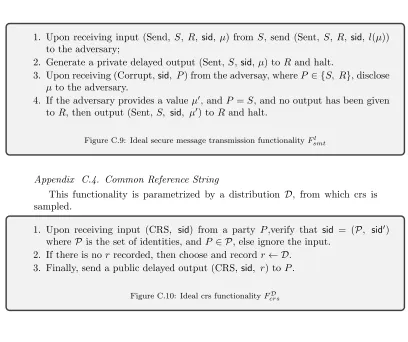
A DAA scheme supported on the above-described quantum-resistant cryp-tographic constructs is now proposed. The security of this scheme is based on the Ring-ISIS and Ring-LWE problems. Before proceeding with the description of the LDAA scheme, we define some standard functionalities that are used in the TPM technology, as specified in [16]. A detailed characterisation of these functionalities is presented in Appendix C of this paper.
• Fcais a common certificate authority functionality that is available to all
parties.
• FcrsD is a common reference string functionality that provides participants with all system parameters.
• Fauth∗ is a special authenticated communication functionality that
pro-vides an authenticated channel between the issuer and the TPM via the host.
• Fsmtl is a secure message transmission functionality that provides an au-thenticated and encrypted communication between the TPM and the host.
Scheme 5: LDAA Setup
• Fcrscreates the system parameters: sp= (λ, q, n, m,Rq, c, β, β0, `, η), whereλ, c and η are positive integer security parameters, β and β0
are positive real numbers such thatβ, β0 < q, and` is the length of a message to be signed with Boyen’s signature scheme.
• Upon input (SETUP,sid), wheresidis a unique session identifier, the Issuer first checks that sid= (I, sid0) for some sid0, then creates its key pair. The Issuer’s public key ispp = (sp,At,ˆ AIˆ ,Aˆ0,Aˆ1, ...,A`,ˆ u, H,H0,H1), where ˆAt,AˆI,Aˆi(i = 0,1, ..., `) ∈ Rmq , u ∈ Rq,
H:{0,1}∗→ Rq,H0:{0,1}∗→ {1,2,3}candH1:{0,1}∗→ {0,1}η be a collision resistant hash function. The Issuer’s private key is
ˆ
TI, which is the trapdoor of ˆAI and kTˆIk∞ ≤ ω, for some small
real number ω. The Issuer initialises the list of joining members (Members← ∅) and proves that his secret key is well formed by gen-erating a proof of knowledgeπI, and registers the key ( ˆTI, πI) with
Fca. Finally, it outputs (SETUPDONE,sid).
The Join process is a protocol running between the IssuerIand a platform, consisting of a TPMtpmiand a Hosthostj(with an identifierid). More than one
Join session be may run in parallel. A unique sub-session identifierjsidis used and this value is given to all parties. The issuerI checks that the TPM-Host is qualified to execute the trusted computing attestation service, then issues a credential enabling the platform to create attestations. Via the unique session identifier jsid, the issuer can differentiate between various Join sessions that are executed simultaneously. A Join session works in two distinct phases, Join request and Join proceed. During the Join request, described in Scheme 6, the TPM generates its private-key ˆXt and the corresponding public-keyut, along
with a a linking token nymI associated with the Issuer, and a proof that the
public-key and the token are well formed. The Issuer finalises the Join request phase by checking the validity of the proof and that the TPM-Host has not been provisioned before. The linking token enables the Issuer to ensure that no two TPMs hold the same private key in the Join proceed step. This prevents a signature from a TPM from tracing back to the signature of another TPM. Moreover, during Join proceed (see Scheme 7), the Issuer samples a small ˆXh
such that [ ˆAt|Aidˆ ]·[ ˆXt|Xhˆ ] =u. ˆXhis then transmitted to the Host.
After obtaining the credential from the Join process,tpmiandhostjcan sign a
messageµwith respect to a basenamebsn. We use a unique sub-session identifier
ssidto allow for multiple Sign sessions. Each session has two phases, Sign request and Sign proceed. While the first, described in Scheme 8, is mostly responsible for ensuring the TPM and the Host have compatible secret-key shares; in the second, described in Scheme 9, a zero-knowledge proof-of-knowledge of small
ˆ
Scheme 6: LDAA Join Request
• On input query (JOIN,sid, jsid, tpmi), the hosthostjforwards (JOIN, sid,jsid) toI, who replies by sending (sid, jsid, ρ, bsnI) back tohostj,
where ρ is a uniform random nonce ρ ←- {0,1}λ, and bsn
I is the
Issuer’s base name. This message is then forwarded totpmi.
• The TPM proceeds as follows:
1. It checks that no such entry exists in its storage.
2. It samples a private key: Xtˆ = (x1, . . . ,xm) ←- Rmq with the
conditionkXˆtk∞≤β, and stores its key as (sid, hostj, Xˆt, id).
3. It computes the corresponding public key ut= ˆAt·Xtˆ modq,
a link token nymI = H(bsnI)·x1 +eI modq for some error
eI ←- DZn,s0 such thatkeIk∞ < β0, and generates a signature
based proof:
πut =SPK
n
public:={sp, Aˆt, ut, bsnI, nymI},
witness:={Xtˆ = (x1, . . .,xm), eI}:
ut= ˆAt·Xtˆ modq ∧ kXtˆ k∞≤β ∧ nymI =H(bsnI)·x1+eI
modq ∧ keIk∞≤β0 o
(ρ).
4. It sends (nymI, id, ut, πut) to the issuerIvia the host by means ofFauth∗, i.e., it givesFauth∗an input (SEND, (nymI, πu
t),(sid,
tpmi, I), jsid, hostj).
• The host, upon receiving (APPEND, (nymI, πut),(sid,tpmi, I)) from
Fauth∗, forwards it to I by sending (APPEND, (nymI, πu
t),(sid,
tpmi, I)) toFauth∗ and keeps the state (jsid, ut, id).
• The Issuer, upon receiving (SENT, (nymI, πut),(sid,
tpmi, I), jsid, hostj) fromFauth∗, verifies the proofπu
Scheme 7: LDAA Join Proceed
• If the platform chooses to proceed with the Join session, the message (JOINPROCEED, sid, jsid) is sent to the issuer, who performs as follows:
1. It checks the record (jsid, nymI, id, tpmi, hostj, πut). For all
nym0I from the previous Join records, the issuer checks whether knymI−nym0Ik∞≤2β0holds; if yes, the issuer treats this session
as a rerun of the Join process; otherwise the issuer addstpmito
Members and goes to Step 2. If this is a rerun, the issuer will further check if ut =u0t; if not the issuer will abort; otherwise
the issuer will jump to Step 4 returning ˆXh = ˆXh0. Note that
this double check will make sure that any two DAA keys will not include the same x1value.
2. It calculates the vector of polynomials ˆAh= [ ˆAI|Aˆ0+P`i=1idi·
ˆ
Ai]∈ R2m q .
3. It samples, using the issuer’s private key ˆTI, a preimage ˆXh =
(xm+1, . . . ,x3m) of u−ut such that: ˆAh·Xhˆ =uh = u−ut
modqandkXhˆ k∞≤β.
4. It sends (sid, jsid, Xhˆ ) tohostj viaFauth∗.
• When the host receives the message (sid, jsid, Xhˆ ), it checks that the equations ˆAh ·Xhˆ = uh modq and u = ut +uh are
satis-fied with kXhˆ k∞ ≤ β. If the checks are correct, then hostj stores
Scheme 8: LDAA Sign Request
• Upon input (SIGN,sid, ssid, tpmi, bsn, µ),hostjlooks up the record
(sid, tpmi, id, ut, Xhˆ ), and sends the message (sid, ssid, bsn, µ) to
tpmi.
• The TPM then does the following:
1. It asks hostj for a permission to proceed.
2. It makes sure to have a Join record (sid, id, Xˆt, hostj).
3. It generates a sign entry (sid, ssid, bsn, µ) in its record. 4. Finally it outputs (SIGNPROCEED, sid, ssid, bsn, µ).
TPM and the Host respectively commit to random strings each showing that either ˆXtand ˆXhare small or that ˆAt·Xtˆ =utand ˆAh·Xhˆ =uh. Through the
additive homomorphism of Scheme 4, the addition of these commitments results on commitments to strings showing that either ˆXt|Xhˆ is small or that [ ˆAt|Aidˆ ]· [ ˆXt|Xhˆ ] = u. The opening of all the commitments would reveal the value of
ˆ
Xt|Xhˆ . Instead, this procedure is iterated multiple times, and at each iteration a subset of the commitments is revealed at random. The randomness is derived from the message to be signed. The prover, by checking that the expected properties are verified for each opening, is convinced that it is communicating with a genuine TPM/Host pair. This proof is described in a detailed manner in Section 3.2. In addition, anym tag is produced that is associated with the basenamebsn.
The verify algorithm, described in Scheme 10, allows anyone to check whether a signature σon a message µwith respect to a basename bsn is valid. More-over, the link algorithm, depicted in Scheme 11 allows anyone to check whether two signatures (σ, µ) and (σ0, µ0) that were generated for the same basename
bsn stem from the same TPM. This done by checking whether the difference between the twonym tags has a small norm.
3.2. The proofsθt, θh andπ
In this section, the computation of the θt, θh and π is described in detail.
The techniques employed herein can be seen as generalisations of those de-scribed in Section 2.5. While in the proof dede-scribed in Section 2.5 the ma-trix A was public, here the matrix [ ˆAt|Ahˆ ] depends on the secret identifier
id. We employ the techniques described in [17] of rewriting [ ˆAt|Ahˆ ]·[ ˆXt|Xhˆ ] as [ ˆAt|AIˆ |Aˆ0|Aˆ1|. . .|Alˆ]·[ ˆXt|Xhˆ 1|Xhˆ 2|id1Xhˆ 2|. . .|idlXhˆ 2], where ˆXh = [ ˆXh1 ∈ Rm
q |Xhˆ 2 ∈ R
m
q ], for a public [ ˆAt|AIˆ |Aˆ0|Aˆ1|. . .|Alˆ], and extending and ran-domisingidsuch that [15] is still applicable.
Scheme 9: LDAA Sign Proceed
• Whentpmigets permission to proceed forssid, the TPM proceeds as
follows:
1. It retrieves the records (sid, id, hostj, πut) and (sid, ssid, bsn, µ).
2. Depending on the input bsn, there are two cases: If bsn 6= ⊥, the tpm computes the tag nym = H(bsn)·x1+e modq, for an error term e←-DZn,s0 such thatkek∞< β0 and generates a
commitment as described in Subsection 2.4:
θt=COMnpublic:={sp, At,ˆ nym, bsn, H, ut},
witness:={Xˆt= (x1, . . . ,xm),e}:
{Aˆt·Xˆt=ut ∧ kXˆtk∞≤β} ∧ nym=
H(bsn)·x1+e ∧ kek∞≤β0 o
.
Ifbsn=⊥, thentpmisamples a random valuebsn← {0,1}λ, and
then follows the previous case. 3. tpmi sends (sid, ssid, θt, µ) tohostj.
4. Whenhostjreceives the message (sid, ssid, θt, µ), it checks that θt is valid, and subsequently generates a commitment again as described in Subsection 2.4:
θh=COMnpublic:={sp, Ah,ˆ uh, µ, θt},
witness:={Xˆh= (xm+1, . . . ,x3m), id}:
{Ahˆ ·Xhˆ =uh ∧ kXhˆ k∞≤β} o
.
The combination of these two commitments θt and θh as de-scribed in Subsection 2.4 follows the additive homomorphic property of the commitment scheme.
5. The TPM and Host run the standard Fiat-Shamir transforma-tion, and the result is a signature based proof (signed on the message µ):
π=SPKnpublic:={pp, nym, bsn},
witness:={Xˆ = (x1, . . . ,x3m), id, e}:
[ ˆAt|Aˆh]·Xˆ =u ∧ kXˆk∞≤β ∧ nym=H(bsn)·x1+e
modq ∧ kek∞≤β0 o
(µ).
The details of theθt,θhandπcomputation will be given below.
Scheme 10: LDAA Verify
• LetRLdenote a revocation list with all the rogue TPM’s secret keys. Upon input (VERIFY,sid, bsn, σ, µ, RL), the verifier proceeds as follows:
1. It parsesσas (nym, bsn, π), and checksSPKonπwith respect to bsn, nym, µandu, verifying the statement:
[ ˆAt|Ahˆ ]·Xˆ =u∧ kXˆk∞≤β ∧
nym=H(bsn)·x1+e modq∧ kek∞≤β0.
2. It checks that the secret key ˆXtthat was used to generatenym,
doesn’t belong to the revocation listRL. This is done by check-ing whether the followcheck-ing equation holds:
∀x1∈RL,kH(bsn)·x1−nymk∞≤β0.
3. If all checks passed, the verifier outputs (VERIFIED, ssid, 1), and (VERIFIED,ssid, 0) otherwise.
Scheme 11: LDAA Link
• Upon input (LINK, sid, σ, µ, σ0, µ0, bsn) the verifier follows the following steps:
1. Starting fromσ= (nym, bsn, π) andσ0 = (nym0, bsn, π0), the verifier verifiesσandσ0 individually.
2. If any of the signatures is invalid, the verifier outputs⊥. 3. Otherwise if knym −nym0k
∞ < 2β0, the verifier outputs 1
of elements inRq into matrix-vector products. More concretely, we construct
the matrices ¯Ai =rot(ai), as defined in [17], fori= (1,2, ...,(`+ 3)m), for all
polynomials ai in ˆAt, ˆAI, ˆA0, ..., ˆA`, respectively, and the vectors ¯xi whose
entries are the coefficients ofxi, fori= (1,2, . . . ,3m), for all polynomialsxi in
ˆ
Xtand ˆXh, respectively, such that the products ¯Aix¯i andaixi are isomorphic.
Furthermore, the following extensions are considered:
• id = {id1, ...,id`} ∈ {0,1}` is extended to id∗ ∈ B2` which is the set of
vectors in{0,1}2`of hamming weight`.
• A¯∗i = [ ¯Ai|0∈Zn×3n] fori= 1 toi= (3 +`)mand ¯A∗
i =0for (3 +l)m < i≤(3 + 2l)m.
• ¯x(2+i)m+j=id∗i ·¯x2m+j for 1≤i≤2`and 1≤j≤m.
Using techniques similar to those described in Section 2.5, the vectors ¯xi
ande are decomposed and extended into vectors of norm at most 1 such that ¯
xi = Pk
d=12d− 1¯xd
i[1 : n] and e = Pk
j=1e
j[1 : n]2j−1, where ¯xd
i[1 : n] and
ej[1 :n] correspond to the firstnentries of¯xd
i andej, respectively, and
{ej}k j=1,{¯x
j
1}
k j=1,{¯x
j
2}
k
j=1, . . . ,{¯x
j
(3+2l)m} k
j=1∈B3n,
i.e. they havenentries equal to−1,nentries equal to 0 andnentries equal to 1.
The extensions of the ¯Ai andidand the decompositions of the extensions of
thexi satisfy:
u= [ ˆAt|Ahˆ ]·Xˆ
= [ ˆAt|AˆI|Aˆ0+
` X
i=1
idi·Aˆi]·Xˆ
= 3m X
i=1 ¯
Ai·x¯i+ ` X
j=1 idj·
m X
i=1 ¯
Ai+(j+2)m·¯xi+2m
= 3m X
i=1 ¯
A∗i · k X
d=1 2d−1¯xdi
!
+ 2` X
j=1 id∗j ·
m X
i=1 ¯
A∗i+(j+2)m·
k X
d=1
2d−1x¯di+2m !
=
(3+2`)m X
i=1 ˆ
A∗i k X
d=1 2d−1¯xdi
!
The commitment algorithmCOMused to computeθtandθhis as explained
in Scheme 4. To produceθt, the TPM samples the vectors{rje←-Z3qn}kj=1 and {rji ←- Z3qn}
k
j=1 for i∈[m] and j ∈[k]; and the permutations{φj ←-S3n}kj=1 associated with ˆXt, and {ϕj ←- S3n}kj=1 for e. The following terms are also
calculated: D= [rot(H(bsn))|0]∈Zn×q 3n, v j i =x
j i+r
j
• Ct1=COM(
Pm i=1A¯∗i·(
Pk j=12j−
1rj i), D·(
Pk j=12j−
1rj
1)+[I|0]·(
Pk j=12j−
1rj e),
{φj}kj=1,{ϕj}kj=1).
• Ct2=COM({φj(rj1), . . . , φj(r
j m)}
k
j=1,{ϕj(r
j e)}
k j=1).
• Ct3=COM({φj(vj1), . . . , φj(vmj )}kj=1,{ϕj(vej)}kj=1).
In a similar fashion, the Host samples the vectors{rji ←-Z3n
q }kj=1fori−m∈ [(2 + 2`)m] and j ∈ [k], and rid∗ ←- Z2q`; and the permutations τ ←- S2` for id∗, {δj ←- S3n}kj=1 for ˆXh1 and {ψj ←- S3n}
k
j=1 for ˆXh2. It also computes vji =xji +rji andvid∗=id∗+rid∗. Thenθt= (Ch1,Ch2,Ch3) is computed:
• Ch1=COM(P (3+2`)m i=m+1 A¯
∗ i ·(
Pk j=12
j−1rj
i), τ,{δj}kj=1,{ψj}kj=1).
• Ch2=COM({δj(r j
m+1),· · ·, δj(r j
2m), ψj(r j
2m+1), . . . , ψj(r j
3m), ψj(r j
(τ(1)+2)m+1),
. . . , ψj(r j
(τ(1)+3)m), . . . , ψj(r j
(τ(2`)+2)m+1), . . . , ψj(r
j
(τ(2`)+3)m)} k
j=1, τ(rid∗)).
• Ch3=COM({δj(vjm+1), . . . , δj(v
j
2m), ψj(v j
2m+1), . . . , ψj(v
j
3m), ψj(v j
(τ(1)+2)m+1),
. . . , ψj(v j
(τ(1)+3)m), . . . , ψj(v j
(τ(2`)+2)m+1), . . . , ψj(v
j
(τ(2`)+3)m)} k
j=1, τ(vid∗)).
The proofπis computed using a strategy similar to Section 2.5, but where the commitments are produced using the homomorphic properties of Scheme 4. Since multiple iterations of the process described in Section 2.5 are necessary to achieve high soundness,tpmi hands out the commitments of the totalcrounds
tohostj. hostjthen adds its own commitments to those of the TPM, generating CM T= (C1,C2,C3) such that:
• C1 =COM(
Pm i=1A¯∗i ·(
Pk
j=12j−1r
j i) +
P(3+2`)m i=m+1 A¯∗i ·(
Pk
j=12j−1r
j i), D·
(Pkj=12j−1rj1) +[I|0]·(Pkj=12j−1rje), τ,{φj}kj=1,{δj}
k
j=1,{ψj}
k
j=1,{ϕj}
k j=1).
• C2=COM({φj(r
j
1), . . . , φj(r
j m), δj(r
j
m+1), . . . , δj(r
j
2m), ψj(r j
2m+1), . . . , ψj(r
j
3m), ψj(r
j
(τ(1)+2)m+1), . . . , ψj(r
j
(τ(1)+3)m), . . . ψj(r j
(τ(2`)+2)m+1), . . . , ψj(r
j
(τ(2`)+3)m)} k j=1, {ϕj(rje)}kj=1, τ(rid∗)).
• C3=COM({φj(v
j
1), . . . , φj(v
j m), δj(v
j
m+1), . . . , δj(v
j
2m), ψj(v j
2m+1), . . . , ψj(v
j
3m), ψj(v
j
(τ(1)+2)m+1), . . . ψj(v
j
(τ(1)+3)m), . . . , ψj(v j
(τ(2`)+2)m+1), . . . , ψj(v
j
(τ(2`)+3)m)} k j=1, {ϕj(vej)}kj=1, τ(vid∗)).
{CHj}cj=1=H0(µ,H1(Cj1)|H1(Cj2)|H1(Cj3)}
c
j=1,pp)∈ {1,2,3}
c.
For each challenge, the tpmi and the hostj combine the required values to
produce the following responses:
• if CH=1, C2 and C3 are revealed, corresponding to all the permuted
τ(id∗), τ(rid∗), {φj(xj i)}
k
j=1, {δj(x j i)}
k
j=1, {ψj(x j i)}
k
j=1, {ϕj(ej)}kj=1, {ϕj(rj
e)}kj=1, {φj(r
j
i)}kj=1,{δj(r
j
i)}kj=1 and {ψj(r
j i)}kj=1.
• if CH=2, C1 and C3 are revealed, corresponding to the permutations
τ,{φj}k
j=1,{δj}
k
j=1, {ψj}
k
j=1,{ϕj}
k
j=1and all thevvalues.
• ifCH=3,C1andC2are revealed, corresponding to all the permutations
τ,{φj}k
j=1,{δj}
k
j=1, {ψj}
k
j=1,{ϕj}
k
j=1and all thervalues.
Finallyhostj sends the proof to the verifier.
Depending on the prover’s inputs, the verifier can always check 2 out of 3 commitments. WhenCH=1, the verifier will be convinced that theejiand the ¯
xji were small. When CH=2or CH=3, the verifier will be able to validate either the left or the right-hand side of the following expressions:
(3+2`)m X
i=1 ˆ
A∗i k X
d=1
2d−1rdi =
(3+2`)m X
i=1 ˆ
A∗i k X
d=1
2d−1 x¯di +rdi
−u
D·
k X
d=1
2d−1rd1+ [I|0]·
k X
d=1
2d−1rde=
D·
k X
d=1
2d−1 ¯xd1+rd1
+ [I|0]·
k X
d=1
2d−1 rde+ed
−nym
4. Security Model of DAA
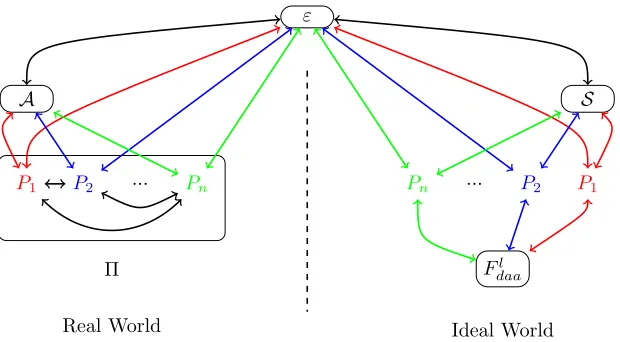
In this paper, we adapt the security model for DAA given by Camenish et al. in [16]. The security definition is given in the Universal Composability (UC) model, represented in Figure 2, with respect to an ideal functionalityFl
daa. In
UC, an environment εshould not be able to distinguish with a non-negligible probability between two worlds:
1. The real world, where each party Pi in the DAA protocol executes its assigned part of the protocol Π. The network is controlled by an adversary Athat communicates withε.
2. The ideal world, in which all parties forward their inputs to a trusted third party, called the ideal functionalityFl
daa, which internally performs all the
ε
A
P1 P2 ... Pn
Π
S
P1
P2
...
Pn
Fdaal
Real World Ideal World
Figure 2: Universal composability security model: the real and the ideal world executions are indistinguishable to the environmentε.
A protocol Π is said to securely realizeFl
daaif for every adversaryAperforming
an attack in the real world, there is an ideal world adversaryS that performs the same attack in the ideal world. More precisely, given a protocol Π, an ideal functionalityFldaa and an environmentε, we say that Π securely realises Fldaa
if the real world in which Π is used is as secure as the ideal world in whichFl daa
is used. In general, the security properties that a DAA scheme should enjoy are the following:
• Unforgeability This property requires that the issuer is honest and should hold even if the host is corrupt. If all the TPMs are honest, then no adver-sary can output a signature on a messageM with respect to a basename (bsn). On the other hand, if not all the TPMs are honest, saynTPMs are corrupt, the adversary can at most output n unlinkable signatures with respect to the same basename.
• Anonymity: This property requires that the entire platform (tpmi+hostj)
is honest and should hold even if the issuer is corrupt. Starting from two valid signatures with respect to two different basenames, the adversary cannot tell whether these signatures were produced by one or two different honest platforms.
• Non-frameability: This requires that the entire platform (tpmi+hostj) is
honest and should hold even if the issuer is corrupt. It ensures that no adversary can produce a signature that links to signatures generated by an honest platform.
Scheme 12: Ideal Setup
On the input(SETUP,sid) from the issuerI, Fl
daa does the following:
• Verify that (I, sid0) =sidand output (SETUP,sid) toS.
• SET Algorithms. Upon receiving the algorithms (Kgen, sig, ver, link, identify) from the simulatorS, it checks that (ver, link, identify) are deterministic [Check-I].
• Output (SETUPDONE,sid) toI.
the host are supposed to be honest. In [19] it is considered that the TPM may be corrupt and privacy must hold whenever the host is honest, regardless of the corruption state of the TPM. In order to achieve the best performance, we do not consider this case in this work and leave it for a future work.
4.1. The Ideal FunctionalityFl daa
The ideal functionality Fl
daa is now formally defined under the assumption
of static corruption, i.e., the adversary decides beforehand which parties are corrupt and informs Fl
daa about them. F l
daa has five interfaces (Setup, Join,
Sign, Verify, Link) described in Schemes 12, 13, 14, 15 and 16. Scheme 12 provides a functionality akin to Scheme 5; 13 to 6 and 7; 14 to 8 and 9; 15 to 10; and 16 to 11. In the UC model, several sessions of the protocol are allowed to run at the same time and each session will be given a global identifier sid
that consists of an issuer I and a unique string sid0, i.e. sid= (sid0,I). We also uniquely identify the Join and Sign sub-sessions with jsid and ssid. Fdaal
is parameterized by a leakage functionl :{0,1}∗ → {0,1}∗, which models the
information leakage that occurs in the communication between a hosthostjand a
TPMtpmi. We also define the following algorithms that are used in Schemes 12,
13, 14, 15 and 16:
• Kgen(1λ): A probabilistic algorithm that takes a security parameter λ
and generates keysgsk for honest TPMs.
• sig(gsk, µ, bsn): A probabilistic algorithm used for honest TPMs. On input of a keygsk, a messageµand a basenamebsn, it outputs a signature
σ.
• ver(σ, µ, bsn): A deterministic algorithm that is used in the VERIFY interface. On input of a signatureσ, a messageµand a basenamebsn, it outputsf = 1 if the signature is valid,f = 0 otherwise.
Scheme 13: Ideal Join
JOIN
1. JOIN REQUEST: On input (JOIN, sid, jsid, tpmi) from the host hostj to join the TPMtpmi, the ideal functionalityFdaal proceeds as
follows:
• Create a join session hjsid, tpmi, hostj, requesti.
• Output (JOINSTART,sid, jsid, tpmi, hostj) toS.
2. JOIN REQUEST DELIVERY: Proceed upon receiving delivery no-tification fromS.
• Update the session record to hjsid, tpmi, hostj, deliveryi.
• If I or tpmi is honest and htpmi, ?, ?iis already in Members,
output⊥[Check II].
• Output (JOINPROCEED,sid, jsid, tpmi) toI.
3. JOIN PROCEED:
• Upon receiving an approval from I, Fdaal updates the session record tohjsid, sid, tpmi, hostj,completei.
• Output (JOINCOMPLETE,sid, jsid) toS.
4. KEY GENERATION: On input (JOINCOMPLETE, sid, jsid, gsk) fromS.
• If both tpmiandhostj are honest, setgsk=⊥.
• Else, verify that the provided gsk is eligible by performing the following checks:
– If hostj is corrupt and tpmi is honest, then
CheckGskHonest(gsk)=1 [Check III].
– If tpmi is corrupt, then CheckGskCorrupt(gsk)=1 [Check
IV].
• Insert htpmi, hostj, gski into Members, and output (JOINED,
Scheme 14: Ideal Sign
1. SIGN REQUEST: On input (SIGN,sid, ssid, tpmi, µ, bsn) from the
hosthostj requesting a DAA signature by a TPMtpmion a message µ with respect to a basename bsn, the ideal functionality does the following:
• Abort ifIis honest and no entryhtpmi, hostj, ?iexists in Mem-bers.
• Else, create a sign sessionhssid, tpmi, hostj, µ, bsn, requesti.
• Output (SIGNSTART, sid, ssid, tpmi, hostj, l(µ,bsn)) toS.
2. SIGN REQUEST DELIVERY: On input (SIGNSTART, sid, ssid) from S, update the session to hssid, tpmi, hostj, µ, bsn, deliveredi. Fl
daa output (SIGNPROCEED,sid, ssid, µ,bsn) totpmi.
3. SIGN PROCEED: On input (SIGNPROCEED,sid, ssid) fromtpmi
• Update the recordshssid, tpmi, hostj, µ, bsn, deliveredi.
• Output (SIGNCOMPLETE, sid, ssid) toS.
4. SIGNATURE GENERATION: On the input (SIGNCOMPLETE,
sid, ssid, σ) fromS, if bothtpmiandhostjare honest then:
• Ignore the adversary’s signatureσ.
• If bsn 6=⊥, then retrieve gsk from the htpmi, bsn, gski ∈ Do-mainKeys.
• If bsn = ⊥ or no gsk was found, generate a fresh key gsk ←
Kgen(1λ).
• Check CheckGskHonest(gsk)=1 [Check V].
• Storehtpmi, bsn, gskiin DomainKeys.
• Generate the signatureσ←sig(gsk, µ, bsn).
• Check ver(σ, µ, bsn)=1 [Check VI].
• Check identify(σ, µ, bsn, gsk)=1 [Check VII].
• Check that there is no TPM other than tpmi with key gsk0 registered in Members or DomainKeys such that identify(σ, µ, bsn, gsk0)=1 [Check VIII].
• If tpmi is honest, then store hσ, µ, tpmi, bsni in Signed and
Scheme 15: Ideal Verify
• On input (VERIFY, sid, µ, bsn, σ, RL), from a partyV to check whether a given signatureσis a valid signature on a messageµwith respect to a basenamebsnand the revocation listRL, the ideal func-tionality does the following:
• Extract all pairs (gski, tpmi) from the DomainKeys and Members,
for which identify(σ, µ, bsn, gsk)=1. Setb= 0 if any of the following holds:
– More than one keygski was found [Check IX].
– I is honest and no pair (gski, tpmi) was found [Check X].
– An honest tpmi was found, but no entry h?, µ, tpmi, bsniwas
found in Signed [Check XI].
– There is a keygsk0∈RL, such that identify(σ, µ, bsn, gsk0)=1 and no pair (gsk, tpmi) for an honest tpmi was found [Check
XII].
• Ifb6= 0, setb←ver(σ, µ, bsn) [Check XIII].
• Add hσ, µ, bsn, RL, bi to VerResults, and output (VERIFIED,
sid, b) toV.
Scheme 16: Ideal Link
On input (LINK,sid, σ1, µ1, σ2, µ2, bsn), withbsn6=⊥, from a partyV
to check if the two signatures stem from the same signer or not. The ideal functionality deals with the request as follows:
• If at least one of the signatures (σ1, µ1, bsn) or (σ2, µ2, bsn) is not valid (verified via the VERIFY interface with RL 6= ∅), output ⊥ [Check XIV].
• For each gski in Members and DomainKeys, compute bi ← identify(σ1, µ1, bsn, gski) andb0i= identify(σ2, µ2, bsn, gski) then
set:
– f ←0 ifbi6=b0i for some i[Check XV].
– f ←1 ifbi=b0i = 1 for somei[Check XVI].
• identify(gsk, σ, µ, bsn): A deterministic algorithm that will be used to ensure consistency with the ideal functionalityFdaal ’s internal records. It outputs 1 if a keygsk was used to produce a signature σ, 0 otherwise.
The following functions are also used to check whether or not a TPM key is consistent with the internal records ofFl
daa:
1. CkeckGskHonest(gsk): If thetpmi is honest, and no signatures in Signed
or valid signatures in VerResults identify to be signed bygsk, thengskis eligible and the function returns 1, otherwise it returns 0.
2. CkeckGskCorrupt(gsk): If the tpmi is corrupt and @gsk0 6= gsk and (µ, σ, bsn) such that both keys identify to be the owners of the same signature σ, then gsk is eligible and the function returns 1, otherwise it returns 0.
5. Security Proof
In this section, we provide a sketch of the security proof. The detailed proof can be found in Appendix D. A sequence of games based on the model of Camenish et al. in [16] is presented, and it is shown that there exists no en-vironment εthat can distinguish the real world protocol Π with an adversary A, from the ideal worldFdaal with a simulator S. Starting with the real world protocol game, we change the protocol game by game in a computationally in-distinguishable way, finally ending with the ideal world protocol. The sequence of games is as follows:
Game 1 . The Real World Protocol.
Game 2 . Equivalent to Game 1.
An entity C is introduced. C receives all inputs from the honest parties and simulates the real world protocol for them.
Game 3 . Similar to Game 2 but with a different structure.
Cis split into two parts,FandS. Fbehaves as an ideal functionality. It receives all the inputs and forwards them toS, who simulates the real world protocol for honest parties and sends the output to F. F then forwards the outputs toε.
Game 4 . εwill notice no change from Game 3.
F now stores the algorithms for the issuer I in the setup interface and ensures that the structure of sidis correct for an honest I, and aborts if not. In caseI is corrupt,S extracts the secret key forI and proceeds in the setup interface on behalf ofI.
Game 5 . Same outcomes as Game 4.
Game 6 . In all cases F and S can interact to simulate the real world protocol.
The join interface ofF is now changed. F now stores in its records the members that have joined. If I is honest, F stores the secret key, extracted from S, for corrupt TPMs. S always has enough in-formation to simulate the real world protocol except when the issuer is the only honest party. In this case, S doesn’t know who initiated the join, so it can’t make a join query with F on the host’s behalf. Thus, to deal with this case,F can safely choose any corrupt host and put it into Members. The identities of hosts are only used to create signatures for platforms with an honest TPM or honest host, so one needn’t worry about fully corrupted platforms.
Game 7 . A distinguisher between Game 6 and 7 could solve Decision RLWE.
F now creates anonymous signatures for honest platforms by running the algorithms defined in the setup interface. Let us start by defin-ing Game 7.k.k0: in this gameF handles the firstk0 signing inputs of tpmk with algorithms and subsequent inputs are forwarded to S as before. We note that Game 7.0.0=Game 6. For increasing k0, Game 7.k.k0 will be at some stage equal to Game 7.k+ 1.0, this is because there can only be a polynomial number of signing queries to be processed. Therefore, for large enoughkandk0,F handles all the signing queries of all TPMs, and Game 7 is indistinguishable from Game7.k.k0. To prove that Game7.k.k0+ 1is indistinguishable from Game 7.k.k0, suppose there exists an environment that can distin-guish a signature of an honest party usingXˆt from a signature using a different Xˆ0
t, then the environment can solve the Decision Ring
-LWE Problem. Suppose that S is given tuples {(ai,bi)}k 0
i=1,(c,d), wherebi=ai·x1+ei for a uniform randomai andc∈ Rq, and it is challenged to decide if the pair(c,d) is chosen from a RingLW E distribution (for some secret x1) or uniform random. S proceeds in simulating the TPM without knowing the secretx1. S can answer all theHqueries, asS is controllingFcrs, onbsnjwithH(bsnj) =ajfor
j≤k0. Forj=k0+1,SsetsH(bsnk0+1) =c, otherwiseH(bsnj) =rj for some uniform randomrj andj > k0+ 1. Signing queries on be-half oftpmi fori < k are forwarded byF toS, which calls the real world protocol. For i > k, gsks are freshly sampled for each bsni. However, fortpmk andi≤k0, the simulator S sets nymi=bi, and for i = k0+ 1 it sets nym = d. For i > k0+ 1, S samples fresh
xi and generates nymi = H(bsni)·xi+ei, keeping track of all the generatednymisuch that it always output the samenymifor an asso-ciatedbsni. For each case, tpmk can provide a simulated proof. Any distinguisher between Game7.k.k0and Game7.k.k0+ 1can solve the Decision Ring-LWE Problem.
F now no longer informsS about the message and the basename that are being signed. If the whole platform is honest, then S can learn nothing about the messageµand the basenamebsn. Instead,S knows only the leakagel(µ,bsn). To simulate the real world,Schooses a pair
(µ0, bsn0)such thatl(µ0, bsn0)=l(µ, bsn).
Game 9 . Game 8 and Game 9 are indistinguishable.
IfI is honest, thenF now only allows platforms that joined to sign. An honest host will always check whether it joined with a TPM in the real world protocol, so there is no difference for honest hosts. Also an honest TPM only signs when it has joined with the host before. In the case that an honesttpmi performs a join protocol with a corrupt host
hostjand honest issuer, the simulator will make a join query withF, to ensure that tpmi andhostjare in Members.
Game 10 . Checks in Game 10 produce the same results as those of Game 9.
When storing a newgsk= ˆXt, F checks CheckGskCorrupt(gsk)=1 or CheckGskHonest(gsk)=1. These checks will always pass. Valid signatures always satisfy nym =H(bsn)·x1+e where kx1k∞ < β and kek∞ < β0. By the unique Short Vector Problem, there exists only one tuple(x1,e)such thatkx1k∞< β andkek∞< β0 for small enoughβ andβ0. Thus, CheckGskCorrupt(gsk) will always give the correct output. Also due to the large min-entropy of discrete Gaus-sians the probability that sampling a gsk Xˆt0 = ˆXt is negligible, thus with overwhelming probability there doesn’t exist a signature already using the samegsk= ˆXt, which implies that CheckGskHonest(gsk) will always give the correct output.
Game 11 .Game 11 produces the same results as Game 10 based on RLWE.
In this game, F checks that honestly generated signatures are valid. This is true as the sig algorithm always produces signatures pass-ing through the verification checks. Also those signatures satisfy
identify(gsk, σ, µ, bsn) = 1which is checked vianym. F also makes sure, using Members and DomainKeys, that honest users are not sharing the same secret key gsk. If there exists a key gsk = ˆXt in Members and DomainKeys such that knym− H(bsn)x1k∞ < β0, then this breaks the search Ring-LWE problem.
Game 12 . Valid signatures are associated with a singlegsk.
Check-IX is added to ensure that there are no multiple gsk values matching one signature. Since there exists only one pair (x1,eI) such thatkx1k∞< β andkeIk∞< β0, satisfyingnymI=H(bsn)·x1+eI, two differentgsks can’t share the samex1.
Game 13 .Game 13 is indistinguishable from Game 12 based on the hard-ness of the Ring-ISIS Search Problem.
To prevent accepting signatures that were issued by the use of join credentials not issued by an honest issuer, F adds a further check Check-X. This is due to the unforgeability of Boyen signatures.
Check-XI is added to F, preventing anyone from forging signatures using an honest TPM’sgsk and credential. In fact, if a valid signa-ture is given on a message that the TPM never signed, the proof could not have been simulated. It would extractx1, breaking the Ring-LWE problem.
Game 15 .Game 15 is indistinguishable from Game 14 based on the hard-ness of Ring-LWE.
Check-XII is added toF, ensuring that honest TPMs are not revoked. If a honest TPM is simulated by means of the Ring-LWE problem instance, if a proper key RL is found, it must be the secret key of the target instance. This is again equivalent to solving the search Ring-LWE problem.
Game 16 . F now includes all the functionalities ofFdaal . All the remaining checks of the ideal functionalityFl
daa that are re-lated to link queries are now included. Using the fact that if agsk matches one signature and not the other, Game 16 is indistinguish-able from Game 15.
6. Related Work
The DAA schemes used in the current TPM standards are based on either the factorisation problem in the RSA setting or the discrete logarithm problem in the Elliptic-Curve (EC) setting. The DAA protocol was firstly conceptualised in 2004 by Brickell, Camenisch, and Chen [20]. [20] proposed a scheme based on the difficulty of RSA that was standardised in TPM 1.2. Later, Brickell, Chen and Li proposed the first EC-DAA scheme based on symmetric pairings [21, 22]. Two EC-DAA schemes, based on asymmetric (Type 3) pairings, have later been proposed to improve the performance of [21, 22], and are supported by TPM 2.0 [23, 24, 25]. Since the factorisation and discrete logarithm problems are known to be vulnerable to quantum computer attacks [26], all the standardised DAA schemes will not be secure in the post-quantum computer age. Recently, El Bansarkhani and El Kaafarani [7] proposed the first post-quantum direct anonymous attestation scheme from lattice assumptions. However, the scheme requires massive storage and computation resources. Section 6.1 gives a brief overview of this scheme. Since [7] is the only post-quantum DAA scheme avail-able in related art, the following sections focus on the comparison between the scheme herein proposed and [7].
6.1. El Bansarkhani and El Kaafarani DAA Scheme [7]
The DAA scheme proposed in [7] works as follows. The Issuer’s public key consists of `+ 2 vectors in Rm
q , namely ˆAI, Aiˆ for i = 0,1,· · ·`, and 2
polynomialsu andb∈ Rq. During the join step, the TPM generates a small
secret ˆZ1 ∈ R2qm+1 such that [b|Aidˆ ]·[ ˆZ1] = ˜u modq. The TPM sends ˜u together with a proof of knowledgeπ1 to the issuer, who registers both ˜uand the corresponding TPM, and samples (using his secret key) a small credential
ˆ
Schemes This paper Scheme in [7]
TPM’s Secret key mn (2m+ 1)n
Credential 2mn 2mn
Issuer’s Secret Key m2n m2n
Signature cO(n)[km((2`+ 3) + 1)] 2ckmO(n)(2`+ 2) Verification key ((`+ 3)m+ 1)n ((`+ 2)m+ 2)n
Table 2: Keys and signature sizes in terms of the number of elements in Zq. Our main
contribution is reducing the TPM’s secret key size (less than half the size in [7]), as well as the signature size.
share. The TPM and the host secret-key shares together satisfy u= [b|Aidˆ ]· [ ˆZ1+ (0|Zˆ2)]. To create a signature, the TPM samples a small random vector
ˆ
T ∈ R2m
q , such that ˆT ·Aˆid modqis uniform, and shares it with the host. ˆT
is used to randomise signatures. Then, the TPM and the host independently compute π2 and π3, where π2 proves that u0 = [b|Aˆid]·[ ˆZ1+ (0|Tˆ)] and π3 proves thatu−u0 = ˆAid·( ˆZ2−Tˆ). Notice that, in [7], commitments are not hashed before being stored inπ2 orπ3. Finally, the host outputs the signature
σ= (π2, π3, u0, µ).
6.1.1. Size Comparison
In our LDAA scheme, the TPM’s secret key size is reduced tompolynomials inRq, instead of 2m+ 1 polynomials in [7]. Such a change significantly reduces
the TPM’s computation costs in the join and sign interfaces, as well as the TPM’s key and the signature sizes. For instance, in the proposed scheme, the LDAA signature includescresponses to the Fiat-Shamir challenges, where each response is comprised ofO(n)km(2`+ 2) elements in Zq provided by the host
andO(n)k(m0+1) provided by the TPM. In [7], the size of the response for each round is bounded byO(n)km(2`+ 2) elements inZq for both the host and the
TPM. Thus in our L-DAA scheme, the signature’s size has been significantly reduced especially for large`. Moreover, the hashing of the commitments inπ
further reduces the sizes of the signatures. The verification key set in [7] consists of the`+ 2 vectors of polynomials ˆAI, Aiˆ fori= 0,1,· · ·`and two polynomials uandb. In our L-DAA scheme, we add ˆAtto the verification key set resulting in `+ 2 vectors of polynomials in Rm
q , a vector of polynomials ˆAt ∈ R m q and
a polynomialu. Table 2 compares the space efficiency between the proposed LDAA scheme and the scheme presented in [7].
6.1.2. Computation Costs
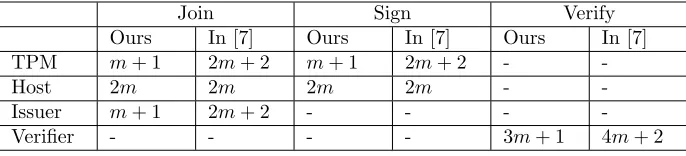
To generate the values to be committed for one round ofπut andθt in the join and sign interfaces of our LDAA scheme, the TPM has to perform at most
Join Sign Verify
Ours In [7] Ours In [7] Ours In [7]
TPM m+ 1 2m+ 2 m+ 1 2m+ 2 -
-Host 2m 2m 2m 2m -
-Issuer m+ 1 2m+ 2 - - -
-Verifier - - - - 3m+ 1 4m+ 2
Table 3: This table compares the computation costs for the generation of the values to be committed in both schemes, represented by the total number of polynomial multiplications inRq for each round of the signatures. The table shows that the computation costs in our
LDAA scheme are significantly reduced for the TPM during joining and signing, and for the issuer and the verifier.
for generating the values to be committed for each round of θh and π3 in the sign interfaces for both schemes. The Issuer verifies the responses for each round ofπut and π1 in both schemes in the join interface. Thus, the issuer’s compu-tation cost for each round is bounded bym+ 1 polynomial multiplications for our L-DAA scheme and 2m+ 2 in [7]. The verifier validates both the TPM and the host’s responses. Therefore, the verifier’s computation cost in our L-DAA scheme is 1 + 3mpolynomial multiplications. In [7], the verifier’s computation cost is 4m+ 2. All in all, the computational complexity for both the joining and the signing is approximately halved for the TPM, and verification is accelerated 4/3times, when the proposed scheme is compared to that of [7].
7. Experimental Results
In order to evaluate the proposed LDAA scheme, both the proposed scheme and [7] were described in C. Basic operations, such as the Number Theoretic Transform (NTT)-based multiplication overRq and the Issuer’s Gaussian
sam-pling, were implemented once and shared between the two schemes. The im-plementations made use of the following cryptographic parameters: n = 256,
q= 8380417, l = 32,m = 24 andβ = 256. Moreover, commitments based on Baum et al’s proposal were used for both cases. Since all entities, namely the TPM, the Issuer, the Host and the Verifier, were executed in the same platform, we have opted to run the experiments on an Intel i9 7900X CPU with 64GB running at 3.3 GHz operated by CentOS 7.5. The code was compiled with gcc 4.8.5 with the-Ofastand -march=nativeflags. The experimental results herein presented focus on the signing and on the verification operations since they are the most often executed, and mostly target at comparing the proposed scheme with [7].
Prop. [7] 0
20 40 60 80 100
Size
[kB]
TPM Host
Figure 3: Private-key material for the proposed scheme and [7]
Prop. w/ Hash0 Prop. w/o Hash [7] 500
1,000 1,500 2,000
Size
[MB]
Figure 4: Signature size for the proposed scheme with hashed commitments (Prop. w/ Hash), with regular commitments (Prop. w/o Hash) and [7]
the signature size of the proposed scheme is halved, when hashing is not consid-ered, in comparison to the scheme in [7]. This improvement is achieved through the exploitation of the modified Baum et al’s commitment scheme, enabling the construction of a single proof of knowledge that reflects the secret-key shared between the TPM and Host, instead of the two required by [7]. Moreover, by hashing commitments, the size of the proofs are themselves reduced, resulting in signatures that are 5 times smaller than [7].
While in Section 6.1.2 it was predicted that the TPM computation during signing would asymptotically be twice as fast with the proposed scheme than with [7], Fig. 5 shows that, in practice, other operations, such as the com-putation of the commitments, reduce the speed-up to 1.13. Nevertheless, the verification operation is significantly enhanced when comparing the proposed scheme with [7], as shown in Fig. 6. Since a single proof needs to be verified instead of two, speed-ups of 2.04 are achieved. Notice that in Figures 5 and 6 the execution times include the hashing of the commitments.
8. Conclusion and Future Work
Prop. [7] 0
50 100 150
Execution
Time
[s]
TPM Host
Figure 5: Signing performance for the proposed scheme and [7]
Prop. [7] 0
20 40 60 80 100 120
Execution
Time
[s]
Verifier
Figure 6: Verification performance for the pro-posed scheme and [7]
construction of commitments to values shared between the TPM and the Host. Building on this technique, we are then able to propose a lattice-based DAA scheme wherein the TPM and the Host interact to produce a single proof-of-knowledge about their shared secret-key. The proposed protocol is proved to be secure in the UC security model. Experimental results show that the resulting scheme reduces the storage requirements of the TPM twofold and the signature size 5 times. Moreover, the signing and verification operations are accelerated 1.1 and 2.0 times, respectively. Future work will focus on further optimising the proposed scheme, to make it even more suitable to hardware implementations and IoT applications.
References
[1] S. A. Rotondo, Trusted Computing Group, Springer US, Boston, MA, 2011, pp. 1331–1331. doi:10.1007/978-1-4419-5906-5_498.
URLhttps://doi.org/10.1007/978-1-4419-5906-5_498
[2] W. Arthur, D. Challener, A Practical Guide to TPM 2.0: Using the Trusted Platform Module in the New Age of Security, 1st Edition, Apress, Berkely, CA, USA, 2015.
[3] L. Lorenzin, A. Shah, Trusted network communica-tions, http://trustedcomputinggroup.org/work-groups/ trusted-network-communications/.
[4] Tpm from pcs to the iot, https://trustedcomputinggroup.org/ tpm-pcs-iot/, accessed: 2018-11-28 (mar 2017).
[6] Commercial National Security Algorithm Suite and Quantum Computing FAQ, Tech. rep., National Security Agency/Central Security Service (jan 2016).
URLhttps://cryptome.org/2016/01/CNSA-Suite-and-Quantum-Computing-FAQ.
[7] R. E. Bansarkhani, A. E. Kaafarani, Direct anonymous attestation from lattices, Cryptology ePrint Archive, Report 2017/1022, https://eprint. iacr.org/2017/1022 (2017).
[8] J. Hoffstein, J. Pipher, J. Silverman, An Introduction to Mathematical Cryptography, 1st Edition, Springer Publishing Company, Incorporated, Springer-Verlag New York, 2008.
[9] C. Peikert, A decade of lattice cryptography, Foundations and TrendsR in Theoretical Computer Science 10 (4) (2016) 283–424. doi:10.1561/ 0400000074.
URLhttp://dx.doi.org/10.1561/0400000074
[10] O. Regev, The learning with errors problem (invited survey). doi:10. 1109/CCC.2010.26.
[11] X. Boyen, Lattice mixing and vanishing trapdoors: A framework for fully secure short signatures and more, in: P. Q. Nguyen, D. Pointcheval (Eds.), Public Key Cryptography – PKC 2010, Springer Berlin Heidelberg, Berlin, Heidelberg, 2010, pp. 499–517.
[12] D. Micciancio, C. Peikert, Trapdoors for lattices: Simpler, tighter, faster, smaller, in: D. Pointcheval, T. Johansson (Eds.), Advances in Cryptology – EUROCRYPT 2012, Springer Berlin Heidelberg, Berlin, Heidelberg, 2012, pp. 700–718.
[13] R. W. F. Lai, H. K. F. Cheung, S. S. M. Chow, Trapdoors for ideal lat-tices with applications, in: D. Lin, M. Yung, J. Zhou (Eds.), Information Security and Cryptology, Springer International Publishing, Cham, 2015, pp. 239–256.
[14] C. Baum, I. Damg˚ard, V. Lyubashevsky, S. Oechsner, C. Peikert, Efficient commitments and zero-knowledge protocols from ring-sis with applications to lattice-based threshold cryptosystems, Cryptology ePrint Archive, Re-port 2016/997,https://eprint.iacr.org/2016/997(2016).
[15] S. Ling, K. Nguyen, D. Stehl´e, H. Wang, Improved zero-knowledge proofs of knowledge for the isis problem, and applications, in: K. Kurosawa, G. Hanaoka (Eds.), Public-Key Cryptography – PKC 2013, Springer Berlin Heidelberg, Berlin, Heidelberg, 2013, pp. 107–124.
[17] S. Ling, K. Nguyen, H. Wang, Group signatures from lattices: Simpler, tighter, shorter, ring-based, in: J. Katz (Ed.), Public-Key Cryptography – PKC 2015, Springer Berlin Heidelberg, Berlin, Heidelberg, 2015, pp. 427– 449.
[18] G. Poupard, J. Stern, Short proofs of knowledge for factoring, in: H. Imai, Y. Zheng (Eds.), Public Key Cryptography, Springer Berlin Heidelberg, Berlin, Heidelberg, 2000, pp. 147–166.
[19] J. Camenisch, L. Chen, M. Drijvers, A. Lehmann, D. Novick, R. Urian, One tpm to bind them all: Fixing tpm 2.0 for provably secure anonymous attestation, in: 2017 IEEE Symposium on Security and Privacy (SP), 2017, pp. 901–920. doi:10.1109/SP.2017.22.
[20] E. Brickell, J. Camenisch, L. Chen, Direct anonymous attestation, in: Proceedings of the 11th ACM Conference on Computer and Communi-cations Security, CCS ’04, ACM, New York, NY, USA, 2004, pp. 132–145.
doi:10.1145/1030083.1030103.
URLhttp://doi.acm.org/10.1145/1030083.1030103
[21] E. Brickell, L. Chen, J. Li, A new direct anonymous attestation scheme from bilinear maps, in: Proceedings of the 1st International Conference on Trusted Computing and Trust in Information Technologies: Trusted Com-puting - Challenges and Applications, Trust ’08, Springer-Verlag, Berlin, Heidelberg, 2008, pp. 166–178. doi:10.1007/978-3-540-68979-9_13.
URLhttp://dx.doi.org/10.1007/978-3-540-68979-9_13
[22] E. Brickell, L. Chen, J. Li, Simplified security notions of direct anony-mous attestation and a concrete scheme from pairings, International Journal of Information Security 8 (5) (2009) 315–330. doi:10.1007/ s10207-009-0076-3.
URLhttps://doi.org/10.1007/s10207-009-0076-3
[23] E. Brickell, J. Li, A pairing-based daa scheme further reducing tpm re-sources, in: Proceedings of the 3rd International Conference on Trust and Trustworthy Computing, TRUST’10, Springer-Verlag, Berlin, Heidelberg, 2010, pp. 181–195.
URLhttp://dl.acm.org/citation.cfm?id=1875652.1875665
[24] L. Chen, J. Li, Flexible and scalable digital signatures in tpm 2.0, in: Proceedings of the 2013 ACM SIGSAC Conference on Computer & Communications Security, CCS ’13, ACM, New York, NY, USA, 2013, pp. 37–48. doi:10.1145/2508859.2516729.
URLhttp://doi.acm.org/10.1145/2508859.2516729
16.
URLhttps://doi.org/10.1007%2F978-3-642-12510-2_16
[26] P. W. Shor, Polynomial-time algorithms for prime factorization and discrete logarithms on a quantum computer, SIAM J. on Computing (1997) 1484– 1509.
[27] D. Cash, D. Hofheinz, E. Kiltz, C. Peikert, Bonsai trees, or how to del-egate a lattice basis, J. Cryptol. 25 (4) (2012) 601–639. doi:10.1007/ s00145-011-9105-2.
![Table 2: Keys and signature sizes in terms of the number of elements in Zcontribution is reducing the TPM’s secret key size (less than half the size in [7]), as well asq.Our mainthe signature size.](https://thumb-us.123doks.com/thumbv2/123dok_us/7982506.1324146/29.612.139.471.124.199/table-signature-elements-zcontribution-reducing-secret-mainthe-signature.webp)

![Figure 5: Signing performance for the proposedscheme and [7]Figure 6: Verification performance for the pro-posed scheme and [7]](https://thumb-us.123doks.com/thumbv2/123dok_us/7982506.1324146/32.612.156.462.120.268/figure-signing-performance-proposedscheme-figure-verication-performance-scheme.webp)