Supersingular Isogeny Diffie–Hellman
Authenticated Key Exchange
Atsushi FUJIOKA1, Katsuyuki TAKASHIMA2, Shintaro TERADA3, and Kazuki YONEYAMA3
1 Kanagawa University, Kanagawa, Japan
2 Mitsubishi Electric, Kanagawa, Japan
3 Ibaraki University, Ibaraki, Japan
{17nm713n,kazuki.yoneyama.sec}@vc.ibaraki.ac.jp
Abstract. We propose two authenticated key exchange protocols from supersingular isogenies. Our protocols are the first post-quantum one-round Diffie–Hellman type authenticated key exchange ones in the fol-lowing points: one is secure under the quantum random oracle model and the other resists against maximum exposure where a non-trivial combi-nation of secret keys is revealed. The security of the former and the latter is proven under isogeny versions of the decisional and gap Diffie– Hellman assumptions, respectively. We also propose a new approach for invalidating the Galbraith–Vercauteren-type attack for the gap problem.
Keywords: One-round authenticated key exchange·Supersingular isogeny de-cisional Diffie–Hellman assumption · Degree-insensitive supersingular isogeny gap Diffie–Hellman assumption·CK model·CK+ model·Quantum adversary.
1
Introduction
All conventional cryptosystems from discrete logarithm and/or factorization in-tractability assumptions would be totally broken by the emergence of quantum computers, i.e., by Shor’s algorithm [28]. In the post-quantum era, it is impor-tant to confirm whether classical cryptographic techniques are still secure against quantum adversaries. Recently, strong security notions and constructions against quantum computers have been intensively studied (e.g., [3, 36, 35, 10, 1]). More-over, National Institute of Standards and Technology has initiated a process to standardize quantum-resistant public-key cryptographic algorithms [25], so, to study quantum-resistant cryptosystems is a hot research area.
Supersingular Isogeny Diffie–Hellman (SIDH). Computing a sequence of isogenies of elliptic curves is a new cryptographic basic operation in some applications. For example, a cryptographic hash function from expander graphs, proposed in [6], consists of computing an isogeny sequence, which is based on the hardness of constructing an isogeny between two (randomly chosen) isogenous curves. Diffie–Hellman (DH) type key exchange protocols based on isogenies are given by Rostovtsev and Stolbunov [27] and De Feo et al. [11], which were considered as candidates for post-quantum public-key primitives.
Childs et al. [7] considered the isogeny computation problem for ordinary elliptic curves, and obtained a subexponential-time quantum algorithm. In con-trast, the algorithm cannot be applied to the supersingular case (because of non-commutativity of endomorphism rings). Therefore, both applications above, i.e., hash function and key exchange, need to employ supersingular elliptic curves (and the graph consisting of them). In particular,supersingular isogeny Diffie– Hellman (SIDH) protocol proposed by De Feo et al. [11] has short public keys compared to other post-quantum candidates, and has been intensively studied for serving as a drop-in replacement to existing Internet protocols [9, 2, 8].
Very recently, Petit [26] proposed a mathematical attack for the security of SIDH, but also showed that the security is not affected by the attack if we use appropriate public parameters as is given in Sect. 3.
Authenticated Key Exchange. In an AKE protocol, two parties have own static public keys, exchange ephemeral public keys, and compute a session key based on the public keys and the related secret keys. AKE protocols achieve that honest parties can establish a session key, and any malicious party cannot guess the session key. The latter condition is formulated in an indistinguishability game.
Regarding to this security game, several models have been invented, and the Canetti–Krawczyk (CK) model was proposed to capture leakage of the ses-sion state [5]. After the proposal, several security requirements have been indi-cated such askey compromise impersonation(KCI),weak perfect forward secrecy (wPFS), andmaximal exposure attacks(MEX) (refer to [22] for KCI, wPFS, and MEX). The CK model has been integrated with KCI, wPFS, and MEX to the CK+model [13].
Recently, several SIDH AKE protocols have been proposed [15, 24, 23, 34]. Galbraith proposed a one-round4 protocol (SIDH TS2) in [15] based on the Unified Model DH protocol by Jeong, Katz, and Lee [19]. The protocol is CK-secure under a decisional problem in classical random oracle model (ROM).
Longa shows a two-round SIDH AKE protocol (AKE-SIDH-SIKE) which is CK+-secure from a KEM scheme [24]. However, it is based on a generic con-struction known already.
LeGrow, Jao, and Azarderakhsh defined a security model in which the ad-versary is allowed to make quantum queries, and proposed aquantumCK secure (qCK secure) protocol [23]. The protocol, we call it LJA, is secure in the quantum random oracle model (QROM) however it is two-round.
Xu et al. proposed a two-round protocol (AKESIDH-2) in [34], and the proto-col is CK+-secure under a decisional problem in classical random oracle model (ROM).
It is worth to note here that all the existing SIDH AKE protocols shown above onlyachieve two-pass protocols except the SIDH TS2 protocol. In a one-round protocol, two parties can simultaneously exchange their ephemeral keys, while in a two-pass one, a party has to wait for the ephemeral key from the other party. Moreover, a one-round AKE protocol has several advantages of efficiency, e.g., each party can pre-compute ephemeral keys in advance.
Supersingular Isogeny Gap DH Problem. Traditional DH AKE proto-cols have been constructed from several forms of DH assumptions, i.e., com-putational, decisional and gap DH assumptions, for attaining various trade-offs between security and efficiency. Recently, Galbraith and Vercauteren [17] and Thormarker [31] independently proposed attacks, called GV-type attack in this paper, on the supersingular isogeny computational DH (SI-CDH) problem with access to decision degree oracle, which determines whether two supersingular curves are isogenous of some specific degree or not. While the attack can be extended to someform of SI version of gap DH (SI-GDH) problem, still, there exist possible approaches to formulate a secureform of SI-GDH problem (and assumption) for which the above attack is ineffective. Therefore, it is impor-tant to find and establish such secure SI-GDH assumptions to rescue (a wide range of) SIDH-based AKE schemes on the gap assumptions. (For surveys on SIDH-related computational problems, refer to [17, 32].)
Contributions. We propose two one-round authenticated key exchange pro-tocols from supersingular isogenies: one is a protocol secure in the CK model with a quantum adversary under a supersingular isogeny version of the DDH as-sumption, and the other is a protocol secure in the CK+model with a classical adversary under a supersingular isogeny version of the gap DH assumption.
Table 1.Comparison of SIDH AKE protocols.
assumption model action proof SIDH TS2 [15] SI-CDH CK one-round4 ROM AKE-SIDH-SIKE [24] SI-DDH CK+ two-round ROM LJA [23] SI-DDH qCK two-round QROM AKESIDH-2 [34] SI-DDH CK+ two-round ROM
SIDH UM SI-DDH CK one-round QROM biclique SIDH di-SI-GDH CK+ one-round ROM
Notations. WhenAis a set,y∈RAdenotes that yis uniformly selected from
A. When A is a random variable,y ←RA denotes thaty is randomly selected fromAaccording to its distribution. We denote the finite field of orderqbyFq.
2
Security Models: CK-security and CK
+-security
This section outlines the CK and CK+ security definitions for two-pass PKI-based authenticated key exchange protocols. Note that, in ourpost-quantumCK and CK+models, all parties are modeled by probabilistic polynomial-time (ppt) Turing machines while the adversary is modeled by a polynomial time quantum machine. For further CK and CK+ details and explanations, see [22, 12]. It is worth to note here that the proposed protocols are one-round and thus, it is enough to describe the security model as for two-pass AKE because a two-pass model includes a one-round one.
We denote a party’s identity ˆA, ˆB, ˆC, . . ., where the ID space is IDS. A party honestly generates its own keys, static public and static secret ones, and the static public key is linked with the party’s identity in some systems like PKI.5 The maximum numbers of parties and sessions are polynomially bound in the security parameter.
We outline our models for a two-pass AKE protocol where parties, ˆAand ˆB, exchange ephemeral public keys, X and Y, i.e., ˆA sendsX to ˆB and ˆB sends
Y to ˆA, and thereafter derive a session key. The session key depends on the exchanged ephemeral keys, identifiers of the parties, the static keys, and the protocol instance that is used.
Keys. The public key owned by each party and its secret key are called static public key andstatic secret key, respectively. The one-time use session informa-tion exchanged in the protocol is calledephemeral public key as the information is generated from a temporary secret calledephemeral secret key.
Π ∈PRSis a protocol identifier in the protocol ID space,PRS. If ˆAis activated with (Π, I, ˆA, ˆB), then ˆA is the session initiator, otherwise it is the session responder. We say that ˆA is the owner (resp.peer) of session sidif the third (resp. fourth) coordinate ofsidis ˆA. After activation, session initiator ˆAcreates ephemeral public keyX and a new session identified with (Π, I, ˆA, ˆB,X,⊥), and sends (Π, R, ˆB, ˆA, X) to the session responder ˆB, who then prepares ephemeral public key Y and a new session identified with (Π, R, ˆB, ˆA,X,Y), computes the session key and sends (Π, I, ˆA, ˆB, X,Y) to ˆA. Upon receiving (Π,I, ˆA, ˆB, X, Y), ˆA updates the session identifier (Π,I, ˆA, ˆB, X, ⊥) with (Π,I, ˆA, ˆB,X,Y) and computes a session key for that session. We say that a session iscompleted if its owner computes a session key.
If ˆAis the initiator of a session, the session is identified viasid= (Π,I, ˆA, ˆ
B, X, ⊥) or sid= (Π, I, ˆA, ˆB, X, Y). If ˆB is the responder of a session, the session is identified viasid= (Π,R, ˆB, ˆA,X,Y). Thematching sessionof the session identified via (Π,I, ˆA, ˆB,X,Y) is a session with identifier (Π, R, ˆB,
ˆ
A,X,Y) and vice versa.
Adversary. AdversaryM is modeled as a probabilistic Turing machine that controls all communications including session activation. Activation is performed via a Send(message) query. The messagehas one of the following forms: (Π,
I, ˆA, ˆB), (Π, R, ˆA, ˆB, X), or (Π, I, ˆA, ˆB, X, Y). Each party submits its responses to adversary M, who decides the global delivery order.
The secret information of a party is not accessible to adversaryM; however, leakage of secret information is obtained via the following adversary queries.
– SessionKeyReveal(sid):Mobtains the session key for the session with session identifiersid, provided that the session is completed.
– SessionStateReveal(sid): M obtains the session state of the owner of ses-sionsid if the session is not completed (the session key is not established yet). The session state includes all ephemeral secret keys and intermediate computation results except for immediately erased information but does not include the static secret key.
– Corrupt( ˆA): The query allowsM to obtain all information of party ˆA. If a party, ˆA, is corrupted by aCorrupt( ˆA) query issued byM, then we call the party, ˆA,dishonest. If not, we call the partyhonest.
Definition 1 (Freshness). Let sid∗ be the session identifier of a completed session, owned by an honest party Aˆ with an honest peer Bˆ. If the matching session exists, then let sid∗ be the session identifier of the matching session of sid∗. Definesid∗ to be freshif none of the following conditions hold:
– MissuesSessionKeyReveal(sid∗), orSessionKeyReveal(sid∗)ifsid∗ exists.
– sid∗ exists andM makes either of the following queries
• SessionStateReveal(sid∗)orSessionStateReveal(sid∗),
– sid∗ does not exist andM makes the following query
Security Experiment. Initially, adversary M is given a set of honest par-ties, for whomMselects identifiers. Then the adversary makes any sequence of the queries described above. During the experiment, M makes a special query
Test(sid∗), where sid∗ is the session identifier of a fresh session, and is given with equal probability either the session key held bysid∗ or a random key; the query does not terminate the experiment. The experiment continues until M makes a guess whether the key is random or not. The adversarywins the game if the test session sid∗ is still fresh and if the guess by M was correct. The advantage of quantum adversaryMin the AKE experiment with AKE protocol
Π is defined as
AdvAKEΠ (M) = Pr[Mwins]−1 2.
Definition 2 (Post-quantum CK security). We say that an AKE protocol
Π is post-quantum secure in the CK model if the following conditions hold:
1. If two honest parties complete matching sessions, then, except with negligible probability, they both compute the same session key.
2. For any polynomial-time quantum adversaryM,AdvAKEΠ (M) is negligible in security parameterλfor the test sessionsid∗,
(a) ifsid∗ does not exist, or
(b) if sid∗ exists, and the static secret key of the owner of sid∗ and the static secret key of the owner ofsid∗ are given toM.
Definition 3 (Post-quantum CK+ security).We say that an AKE protocol
Π is post-quantum secure in the CK+ model if the following conditions hold: 1. If two honest parties complete matching sessions, then, except with negligible
probability, they both compute the same session key.
2. For any polynomial-time quantum adversaryM,AdvAKEΠ (M) is negligible in security parameterλfor the test sessionsid∗,
(a) if sid∗ does not exist, and the static secret key of the owner of sid∗ is given toM,
(b) ifsid∗ does not exist, and the ephemeral secret key of the owner ofsid∗ is given toM,
(c) if sid∗ exists, and the static secret key of the owner of sid∗ and the static secret key of the owner ofsid∗ are given toM,
(d) ifsid∗ exists, and the ephemeral secret key of the owner ofsid∗ and the ephemeral secret key of the owner ofsid∗ are given toM,
(e) if sid∗ exists, and the static secret key of the owner of sid∗ and the ephemeral secret key of the owner ofsid∗ are given toM, or
(f ) ifsid∗ exists, and the ephemeral secret key of the owner ofsid∗ and the static secret key of the owner ofsid∗ are given toM.
key of its choice at any point during the protocol as a variant of the CK(+) model in [22], we do not allow the re-registration of static public key (similar to the CK(+) model), and the initial public key is honestly generated and has been used until the end of the protocol. It is because that an active attack which Galbraith et al. [16] proposed for revealing static keys might be considered as an effective attack when we adopt the above flexible key re-registration.
3
Supersingular Isogeny Diffie–Hellman (SIDH)
We describe the SIDH protocol, whose implementation is investigated in de-tail in [9] and subsequently in [2, 21, 20, 4, 8]. The security is studied in [16, 26]. For making user secret keys short, we follow the description in the SIKE doc-ument [18], that is, the user key is given as just one scalar, e.g., kA ∈ Z/ℓeA
AZ. Refer to Appendix C for notations on elliptic curves.
3.1 Original (Concrete) Description of SIDH
For two small primesℓA, ℓB(e.g.,ℓA= 2, ℓB= 3), we choose a large primepsuch that p±1 =f ·ℓeA
Aℓ
eB
B for a smallf andℓ
eA
A ≈ℓ
eB
B = 2
Θ(λ), where λis a security parameter. Then, we also choose a random supersingular elliptic curve E over Fp2 with E(Fp2) ≃(Z/(p±1)Z)2 ⊇ (Z/ℓeAAZ)2⊕(Z/ℓeBBZ)2. We use isogenies,
ϕA and ϕB, with kernels of orders, ℓ
eA
A and ℓ
eB
B, respectively, and the following commutative diagram for the SIDH key exchange between Alice and Bob.
E ϕA
−−−−→ EA=E/⟨RA⟩
ϕB
y yϕAB
EB=E/⟨RB⟩
ϕBA
−−−−→ E/⟨RA, RB⟩
for kerϕA=⟨RA⟩ ⊂E[ℓeA
A], kerϕB=⟨RB⟩ ⊂E[ℓeB
B], kerϕBA =⟨ϕB(RA)⟩ ⊂EB[ℓeAA], kerϕAB =⟨ϕA(RB)⟩ ⊂EA[ℓeBB]. Below we first choose generatorsPA, QA, PB, QB such thatE[ℓ
eA
A] =⟨PA, QA⟩,
E[ℓeB
B ] = ⟨PB, QB⟩ and then set the random curve E/Fp2 and the above
gen-erators as public parameters, i.e., we define the generator as pksidh = (g = (E; PA, QA, PB, QB), e= (ℓA, ℓB, eA, eB))←R Gen
sidh
(1λ). Secret-key spaces for
Alice and Bob are given asSKA=Z/ℓ
eA
AZandSKB=Z/ℓ
eB
BZ, respectively. DH-type key exchange is given as below (Fig. 1). Here, since⟨ϕB(PA) +kAϕB(QA)⟩=
⟨ϕB(RA)⟩ = kerϕBA and ⟨ϕA(PB) +kBϕA(QB)⟩ = ⟨ϕA(RB)⟩ = kerϕAB hold, we have the equality of thej-invariantsKAlice=j(EB/kerϕBA) =j(E/⟨RA, RB⟩) =
j(EA/kerϕAB) =KBob, andK=KAlice=KBobis a shared key. Alice’s output in-cludesϕA(PB) andϕA(QB) as well asEA, and the security is based on the hardness of isogeny problem with the auxiliary inputs.
3.2 Crypto-friendly Description of SIDH
Alice
kA∈RSKA:
Alice′s secret key, RA=PA+kAQA,
ϕA:E→EA=E/⟨RA⟩,
RBA=ϕB(PA) +kAϕB(QA),
KAlice=j(EB/⟨RBA⟩).
EA, ϕA(PB), ϕA(QB)
−−−−−−−−−−−−→ ←−−−−−−−−−−−−
EB, ϕB(PA), ϕB(QA)
Bob
kB∈RSKB:
Bob′s secret key, RB=PB+kBQB,
ϕB:E→EB=E/⟨RB⟩,
RAB=ϕA(PB) +kBϕA(QB),
KBob=j(EA/⟨RAB⟩).
Fig. 1.Outline of SIDH Protocol (Original Description). We set
g= (E; PA, QA, PB, QB), a=kA, andb=kB.
Let the sets of supersingular curves and those with an auxiliary torsion basis be SSECp={supersingular elliptic curveE overFp2
withE(Fp2)≃(Z/(p±1)Z)2⊇(Z/ℓeAAZ)2⊕(Z/ℓeBBZ)2},
SSECp,A={(E;PB′, Q′B)|E∈SSECp,(PB′, Q′B) : basis ofE[ℓ
eB
B]}, SSECp,B={(E;PA′, Q′A)|E∈SSECp,(PA′, Q′A) : basis ofE[ℓ
eA
A]}. Thus, SIDH public keys ofAandBare given elements ofSSECp,AandSSECp,B, respectively. Then, we define
ga= (EA; ϕA(PB), ϕA(QB))∈SSECp,A,
whereRA=PA+kAQA, ϕA:E→EA=E/⟨RA⟩,
gb = (EB; ϕB(PA), ϕB(QA))∈SSECp,B,
whereRB=PB+kBQB, ϕB:E→EB=E/⟨RB⟩,
(
gb)a=j(EBA),
whereRBA=ϕB(PA) +kAϕB(QA), ϕBA:EB→EBA=EB/⟨RBA⟩, (ga)b=j(EAB),
whereRAB=ϕA(PB) +kBϕA(QB), ϕAB:EA→EAB=EA/⟨RAB⟩. We describe SIDH using this notation below (Fig. 2). Public parameters are
g= (E; PA, QA, PB, QB) and e= (ℓA, ℓB, eA, eB). Here, shared secret is given as
KAlice=(gb)a= (ga)b=KBob, which shows correctness of the SIDH protocol.
4
Post-Quantum Assumptions from SIDH
Alice
a∈RSKA: Alice′s secret key,
computega, KAlice=
(
gb)a.
ga −−−−−−−→ ←−−−−−−−
gb
Bob
b∈RSKB: Bob′s secret key,
computegb, KBob= (ga)
b .
Fig. 2.Outline of SIDH Protocol (Crypto-friendly Description).
Definition 4 (SI-CDH Assumption). Let S be a quantum machine adver-sary. Forpksidh = (g= (E; PA, QA, PB, QB), e= (ℓA, ℓB, eA, eB))←RGen
sidh
(1λ)
anda ∈R SKA, b∈RSKB,S receives ( pk
sidh
, ga, gb), and S outputsh∈F
p2.
If h= (ga)b
(= (gb)a),S wins. We define the advantage of S for the SI-CDH problem as AdvSI-CDHg,e (S) = Pr[S wins]. The SI-CDH assumption is: For any polynomial-time quantum machine adversary S, the advantage of S for the SI-CDH problem is negligible in security parameter λ.
Definition 5 (SI-DDH Assumption). Let S be a quantum machine adver-sary. Forpksidh = (g= (E; PA, QA, PB, QB), e= (ℓA, ℓB, eA, eB))←RGensidh(1λ) anda,r∈RSKA, b,s∈RSKB,S receives Xb forb∈R{0,1}, that is defined by
X0= (pksidh, ga, gb, (ga) b
) and X1= (pksidh, ga, gb, (gr) s
),
S outputs a guess bit b′. Ifb=b′,S wins. We define the advantage ofS for the SI-DDH problem asAdvSI-DDHg,e (S) = Pr[S wins]−1/2. The SI-DDH assumption is: For any polynomial-time quantum machine adversaryS, the advantage of S for the SI-DDH problem is negligible in security parameter λ.
Definition 6 (ds- and di-SI-GDH Assumption). Let S be a quantum ma-chine adversary. Forpksidh= (g= (E; PA, QA, PB, QB), e= (ℓA, ℓB, eA, eB))←R
Gensidh(1λ) and a ∈R SK
A, b ∈R SKB, S receives (pk
sidh
, g, ga, gb), and
S access SI-DDH oracle for any input X = (pksidh,(EA′;PAB′ , Q′AB), (EB′;PBA′ , QBA′ ), h′) where PAB′ , Q′AB (resp.PBA′ , Q′BA) are points in EA′(Fp2) (resp.EB′(Fp2))
andh′∈Fp2, and then outputs h∈Fp2. Ifh= (ga)
b
(=(gb)a),S wins. Accord-ing to the behavior of SI-DDH oracle, we have two types of SI-GDH problem, i.e.,
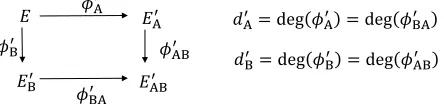
– degree-sensitive SI-GDH (ds-SI-GDH) problemThe ds-SI-DDH ora-cle answers true if there exist a supersingular elliptic curveEAB′ and isogenies (ϕ′A, ϕ′B, ϕ′AB, ϕBA′ )amongE, EA′, EB′, EAB′ which form a commutative diagram as in Fig. 3 such that
• degreed′A ofϕA′ (andϕ′BA) is equal toℓeA
A and degreed′B ofϕ′B (andϕ′AB) is equal to ℓeB
B and
– degree-insensitive SI-GDH (di-SI-GDH) problemThe di-SI-DDH or-acle answers true if there exist a supersingular elliptic curve EAB′ and iso-genies (ϕ′A, ϕ′B, ϕ′AB, ϕBA′ ) among E, E′A, E′B, E′AB which form a commutative diagram as in Fig. 3 such that
• degreed′A ofϕ′A (andϕ′BA) is a power ofℓA and degreed′B ofϕ′B (andϕ′AB) is a power of ℓBand
• PAB′ =ϕ′A(PB), Q′AB = ϕ′A(QB) and PBA′ = ϕ′B(PA), Q′BA = ϕ′B(QA) where points(PA, QA, PB, QB)are given in public keypk
sidh
, andh′=j(EAB′ ), and false otherwise. We call this case degree-insensitive SI-GDH (di-SI-GDH) problem.
We define the advantage of adversarySfor the ds–SI-GDH and di-SI-GDH prob-lems as Advds-SI-GDHg,e (S) = Pr[S wins]and Adv
di-SI-GDH
g,e (S) = Pr[S wins], re-spectively. The ds-SI-GDH (resp. di-SI-GDH) assumption is: For any polynomial-time quantum machine adversary S, the advantage of S for the ds-SI-GDH (resp. di-SI-GDH) problem is negligible in security parameterλ.
𝐸𝐸 𝜙𝜙A 𝐸𝐸A′ ′
𝐸𝐸B′ 𝐸𝐸AB′
𝜙𝜙B′
𝜙𝜙BA′
𝜙𝜙AB′
𝑑𝑑A′ = deg 𝜙𝜙A′ = deg𝜙𝜙BA′
𝑑𝑑B′ = deg𝜙𝜙B′ = deg𝜙𝜙AB′
Fig. 3.Commutative diagram for true instances of SI-DDH oracles, in which it holds that ker(ϕ′BA) =ϕ′B(ker(ϕ′A)) and ker(ϕ′AB) =ϕ′A(ker(ϕ′B)).
Proposition 1 (adapted from [17]). The ds-SI-GDH assumption does not hold, i.e., there exists a ppt adversary against the ds-SI-GDH problem.
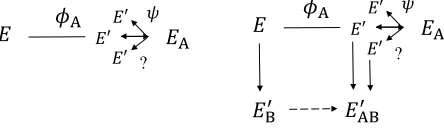
proof sketch. Very recently, Galbraith and Vercauteren proposed an attack on the SI-CDH problem with access to the decision degree (DD) oracle [17], which determines whether two supersingular curves are isogenous of some specific de-gree or not. As a basic building block, first, we describe an attack on the SI-CDH problem using the DD oracle. The input of the problem is (pksidh = (g= (E; PA, QA, PB, QB), e = (ℓA, ℓB, eA, eB)), EA, PAB, QAB), where ϕA : E →EA is anℓeA
A-isogeny, PAB =ϕA(PB), andQAB=ϕA(QB). The goal of the adversary S is to revealϕA. For that,S calculates integerusuch thatu·ℓA≡1 (modℓB), and then one ℓA-isogenyψ:EA→E′.S send
( ˜pksidh= (g, ˜e= (ℓA, ℓB, eA−1, eB), E′, u·ψ(PAB), u·ψ(QAB))
to the DD oracle. Here, we note that the exponent eA−1 is used instead of eA
for the implicitly definedℓA-power isogeny. That is, the oracle distinguishes the degree (or length) of the isogeny, in other words, whetherE′isℓeA−1
A -isogenous to
E orℓeA+1
Next, we extend the above strategy to solve the ds-SI-GDH problem. Namely, an ds-SI-GDH adversary obtains an input (pksidh= (g= (E; PA, QA, PB, QB),e= (ℓA, ℓB, eA, eB)), EA, PAB, QAB, . . .), where ϕA : E → EA is an ℓeAA-isogeny, PAB =
ϕA(PB), andQAB=ϕA(QB). The goal of the adversarySis to revealϕA. For that,
Scalculates oneℓA-isogenyψ:EA→E′as before. Moreover,Scalculates degree
ℓeB
B -isogeniesE → EB′ and E′ → EAB′ that makes commutative SIDH diagram (E, E′, EB′, EAB′ ). Then,S send
( ˜pksidh= (g, ˜e= (ℓA, ℓB, eA−1, eB), E′, EB′, . . . , j(EAB′ ))
to the ds-SI-DDH oracle and determine whetherψ is a backtracking step inϕA or not. See the right hand side of Fig. 4. From here on, repeating this procedure,
S can revealϕA. Also,S can computeEAB by usingEBandϕA, which solves the
ds-SI-GDH problem. ⊓⊔
𝐸𝐸
𝐸𝐸
A𝜙𝜙
A 𝜓𝜓?
𝐸𝐸𝐸 𝐸𝐸𝐸
𝐸𝐸𝐸
𝐸𝐸
𝜙𝜙
A 𝜓𝜓𝐸𝐸
A ?𝐸𝐸𝐸 𝐸𝐸𝐸
𝐸𝐸𝐸
𝐸𝐸
B′𝐸𝐸
AB′Fig. 4. Diagrams for the GV-type attack. The right (resp. left) hand side shows the strategy for the ds-SI-GDH problem (resp. the SI-CDH problem with access to the DD oracle). The attacker distinguishes which one of the eA+ 1 red ℓA-isogenies is
backtracking by using the ds-SI-DDH (resp. the DD) oracle.
As described in the above proof, to distinguish the degree of isogeny (or distance between two elliptic curves in the ℓA-isogeny graph) is crucial for the GV-type attack. Since the ability for the distinction is given by the ds-SI-DDH oracle, the GV-type attack adversaries have no advantages in the di-SI-GDH problem. Therefore, in contrast to the ds-SI-GDH problem, we may assume that the di-SI-GDH problem cannot be solved by any efficient adversaries, and can be used for the basis of the security of our biclique scheme.
Note that auxiliary pointsϕ′A(PB), ϕ′A(QB), ϕ′B(PA), ϕ′B(QA) in true instanceX for di-SI-DDH oracle impose some restrictions on implicitly defined isogenies
ϕ′A, ϕ′B (and ϕ′AB, ϕBA′ ) used in Fig. 3. However, since degrees d′A and d′B of ϕ′A
Lemma 3.2 and Theorem 3.3 in [32] also show some interesting connection between computational and decisional SIDH problems. However, we notice that answers of all the oracles (OE,1)ℓe,(OE,2)ℓeand (OE,3)ℓe (forℓe=ℓ1e1 orℓe22) are related to isogenies of degrees dividingℓe, which is defined by public parameters.
In particular, all the isogeny degrees have smaller or equal than ℓe. Our
di-SI-GDH problem is related to unbounded degrees which are just a power ofℓ. Thus, Lemma 3.2 and Theorem 3.3 in [32] are now unrelated with our situation, but, we think seeking relationships between the di-SI-GDH problem and the results in [32] is an interesting research direction.
5
Proposed SIDH UM Protocol
In this section, we propose the SIDH UM protocol, where it can be proved in the quantum random oracle model under the SI-DDH assumption.
Before describing the protocol, we explain that each party needs to have two static public keys. The public parameter,g, contains two parameters, (P1, Q1) and (P2, Q2). A party has a key on (P1, Q1) and the other key on (P2, Q2). Then, (P1, Q1) is used to generate the ephemeral public key of the initiator and (P2, Q2) is used to generate the ephemeral public key of the responder. When the role is exchanged, each party uses the other static key which is not used before.
This double construction in public parameter and static public keys gives resistance to reflection attacks. To the best of our knowledge, the previous re-searches of key exchange on supersingular isogenies have lacked this considera-tion.
5.1 Useful Techniques for Quantum Random Oracle Model
A problem on security proofs in the quantum random oracle model is how to generate random values for exponentially many positions in order to simulate outputs of the hash function. For a hash functionH :Dom→Rng, in the quan-tum random oracle model, the adversary poses a superposition|ϕ⟩=Σαx|x⟩and the oracle returns Σαx|H(x)⟩. If Rng is large for a quantum polynomial-time simulator, it is difficult to generate all random output values ofH to compute
Σαx|H(x)⟩. Zhandry [36] showed a solution with the notion ofk-wise indepen-dent function.
A weight assignment on a set X is a function D : X → R such that
Σx∈XD(x) = 1. A distribution onX is a weight-assignmentDsuch thatD(x)≥
0 for all x∈ X. Consider the set of functions H : X → Y for sets X and Y, denoted byHX,Y. We define the marginal weight assignmentDW ofDonHX,Y
where the weight of a functionHW:W → Y is equal to the sum of the weights of allH ∈HX,Y that agree with HW onW.
Definition 7 (k-wise equivalence). We call two weight assignmentsD1 and
D2 on HX,Y k-wise equivalent if for all W ⊆ X of sizek, the marginal weight
Definition 8 (k-wise independent function). We call a function f k-wise independent function iff isk-wise equivalent to a random function.
Lemma 1 (Theorem 3.1 in [36]). Let A be a quantum algorithm making q
quantum queries to an oracle H : X → Y. If we draw H from some weight assignment D, then for every z, the quantity PrH←D[AH() = z] is a linear
combination of the quantities PrH←D[H(xi) =ri∀i ∈1, . . . ,2q] for all possible
settings of the xi andri.
Lemma 2 (Theorem 6.1 in [36]). If there exists 2qi-wise independent
func-tion, then any quantum algorithmA makingqi quantum queries to random
or-acles Oi can be efficiently simulated by a quantum algorithm B, which has the
same output distribution, but makes no queries.
Hence, a quantum algorithmB can simulate quantum random oracles in a polynomial-time. We use this simulation technique to simulate outputs of the hash function in the security proof of the SIDH UM protocol.
On the other hand, the other problem on security proofs in the quantum random oracle model is how to insert intended random values as the outputs of corresponding oracle inputs. Zhandry [36] showed a solution with the notion of semi-constant distributionsSCω.
Definition 9 (Semi-constant distribution). DefineSCω, the semi-constant distribution, as the distribution over HX,Y resulting from the following process:
– First, pick a random elementy fromY.
– For eachx∈ X, do one of the following:
• With probabilityω, setH(x) =y. We callxa distinguished input toH.
• Otherwise, setH(x)to be a random element inY.
Lemma 3 (Corollary 4.3 in [36]). The distribution of outputs of a quantum algorithm makinghqueries to an oracle drawn fromSCω is at most a distance
3 8h
4ω2 away from the case when the oracle is drawn from the uniform distribu-tion.
We suppose that the simulation succeeds with probabilityϵif the adversary uses an inserted random value as the outputs of corresponding oracle inputs. If the probability that the adversary uses one of the points isω, then the sim-ulation succeeds with probability ϵω−38h4ω2. By choosingω to maximize the success probability, the simulation succeeds with probability O(ϵ2/h4). We use this simulation technique to insert a SI-DDH instance into the hash function in the security proof of the SIDH UM protocol.
5.2 Description of SIDH UM Protocol
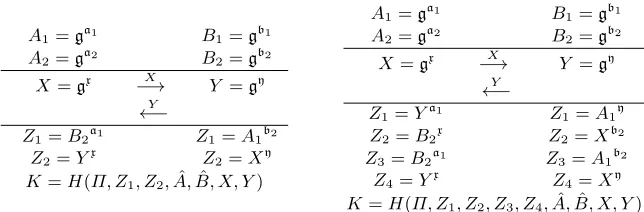
A1=ga1 B1=gb1
A2=ga2 B2=gb2
X=gx −→X Y =gy
Y
←−
Z1=B2a1 Z1=A1b2
Z2=Yx Z2=Xy K=H(Π, Z1, Z2,A,ˆB, X, Yˆ ) Fig. 5.Outline of SIDH UM Protocol.
A1=ga1 B1 =gb1
A2=ga2 B2 =gb2
X=gx −→X Y =gy
Y
←−
Z1=Ya1 Z1=A1y Z2=B2x Z2=Xb2
Z3 =B2a1 Z3=A1b2
Z4=Yx Z4=Xy K=H(Π, Z1, Z2, Z3, Z4,A,ˆ B, X, Yˆ ) Fig. 6.Outline of Biclique SIDH Protocol. biclique SIDH protocol. Let two secret-key spaces for initiators and responders be given asSK1=Z/ℓe11ZandSK2=Z/ℓe22Z, respectively.
User ˆAhas two static public keys,A1=ga1andA2=ga2, wherea1=kA,1∈R SK1,a2=kA,2∈R SK2, and a1 and a2 are ˆA’s static secret keys. User ˆB, also, has two static public keys, B1 =gb1 and B2 =gb2, where b1 =kB,1 ∈R SK1,
b2 =kB,2 ∈R SK2, and b1 and b2 are ˆB’s static secret keys. Here, ephemeral secret keys for ˆA and ˆB are given as
x=kX∈RSK1, and y=kY∈RSK2,
respectively. ˆA sends a ephemeral public keyX as X =gx to ˆB, ˆB sends back a ephemeral public keyY asY =gy to ˆA.
ˆ
AcomputesZ1=B2a1, andZ2=Yx, and then, obtains the session keyK as
K=H(Π, Z1, Z2,A,ˆ B, X, Yˆ ), whereH is a hash function. ˆ
B can computes the session key K as K = H(Π, Z1, Z2,A,ˆ B, X, Yˆ ) from
Z1=Ab12, andZ2=Xy.
It is clear that the session keys of both parties are equal (Fig. 5).
5.3 Security
Theorem 1. Suppose thatH is modeled as a quantum random oracle and that the SI-DDH assumption hold for (g,e). Then the SIDH UM protocol is a post-quantum CK-secure authenticated key exchange protocol in the post-quantum random oracle model.
In particular, for any AKE quantum adversaryMagainst the SIDH UM pro-tocol that runs in time at mostt, involves at mostnhonest parties and activates at mosts sessions, and makes at mosthqueries to the quantum random oracle and q SessionKeyRevealqueries, there exists an SI-DDH quantum adversary S such that
AdvSI-DDHg,e (S)≥ 2Adv AKE
SIDHUM(M)2
n2s2(8hq+ 3(h+q+ 1)4),
where S runs in time t plus time to perform O((n+s)λ) low-degree isogeny operations.
the SI-CDH assumption by using the reduction in Proposition 1. However, an additional reduction cost is necessary. It is not trivial to directly prove security under the SI-CDH assumption because of the no-cloning theorem. Specifically, in the reduction to the CK security, the SI-CDH solver wants to extract the an-swer of the SI-CDH problem from a random oracle query by the AKE adversary. However, the query is a quantum state, and the solver cannot record a copy of the input. Thus, this proof strategy does not work. Recently, Zhandry [37] introduced a technique to record quantum queries. How to apply this technique to the proof is an open problem.
6
Proposed Biclique SIDH Protocol
In this section, we propose the biclique SIDH protocol, where it can be proved in the random oracle model under the di-SI-GDH assumption.
It is worth to note here that the SIDH UM protocol is secure in the quantum random oracle model under the SI-DDH assumption, and therefore, the SIDH UM protocol is superior than the biclique SIDH protocol in the following points: the computational model of adversaries and the assumption relaying to the se-curity. However, the biclique SIDH protocol can be shown to be secure in the CK+ model, that is, the protocol resists against maximum exposure where a non-trivial combination of secret keys is revealed. This shows that the biclique SIDH protocol is superior than the SIDH UM protocol in this sense.
As our SIDH UM protocol in Sect. 5, the public parameter,g, contains two parameters, (P1, Q1) and (P2, Q2) in our biclique SIDH protocol. A party has a key on (P1, Q1) and the other key on (P2, Q2).
6.1 Description of Biclique SIDH Protocol
We give our biclique SIDH protocol using the notation in Sect. 3.2. Public param-eters areg= (E; P1, Q1, P2, Q2) ande= (ℓ1, ℓ2, e1, e2). We setΠ = BCSIDH, that is, the protocol ID is “BCSIDH.” Let two secret-key spaces for initiators and responders be given asSK1=Z/ℓe11ZandSK2=Z/ℓe22Z, respectively.
User ˆAhas two static public keys,A1=ga1andA2=ga2, wherea1=kA,1∈R SK1,a2=kA,2∈R SK2, and a1 and a2 are ˆA’s static secret keys. User ˆB, also, has two static public keys, B1 =gb1 and B2 =gb2, where b1 =kB,1 ∈R SK1,
b2 = kB,2 ∈R SK2, and b1 and b2 are ˆB’s static secret keys. Here, ephemeral secret keys for ˆA and ˆB are given as
x=kX∈RSK1, and y=kY∈RSK2,
respectively. ˆA sends an ephemeral public keyX asX =gx to ˆB, ˆB sends back an ephemeral public keyY asY =gy to ˆA.
ˆ
the session key K as K = H(Π, Z1, Z2, Z3, Z4,A,ˆ B, X, Yˆ ), whereH is a hash function.
ˆ
B can computes the session key K as K=H(Π, Z1, Z2, Z3, Z4,A,ˆ B, X, Yˆ ) fromZ1=A
y
1,Z2=Xb2,Z3=Ab12, andZ4=Xy.
It is clear that the session keys of both parties are equal (Fig. 6).
Charles et al. [6] proposed a hash function secure against quantum adversaries from the isogeny computation intractability. Hence, we can use the isogeny-based hash function in the real implementation for H, however, H is modeled as a random oracle in the security proof below.
6.2 Security
Theorem 2. Suppose that H is modeled as a random oracle and that the di-SI-GDH assumption hold for (g,e). Then the biclique SIDH protocol is a post-quantum CK+-secure authenticated key exchange protocol in the random oracle model.
In particular, for any AKE quantum adversaryMagainst the biclique SIDH protocol that runs in time at most t, involves at most n honest parties and activate at mosts sessions, and makes at mosthqueries to the random oracle, there exists a di-SI-GDH quantum adversaryS such that
Advdi-SI-GDHg,e (S)≥min { 1
sn,
1
n2, 1
s2 }
·AdvAKEBCSIDH(M),
where S runs in time t plus time to perform O((n+s)λ) low-degree isogeny operations and make O(h+s)queries to di-SI-DDH oracle.
As we consider a case where the security model is CK+, an adversary may access to a non-trivial combination of secret keys. However, it means that the adversary cannot access to the other combination of the secret key. Thus, the di-SI-GDH solver can embedded an instance to the public keys where secret key are not revealed. As we assume the random oracle model, the adversary has to make a query which contains the di-SI-GDH answer, and then, the theorem can be proved. Note here that the di-SI-DDH oracle is necessary to keep consistency between the answers by the di-SI-GDH solver on adversary’s questions.
7
Conclusion
We proposed two authenticated key exchange protocols from supersingular iso-genies: SIDH UM and biclique SIDH. We also discussed a new approach for invalidating the Galbraith–Vercauteren attack for the gap problem on the su-persingular isogeny Diffie–Hellman, and defined the di-SI-GDH assumption.
The SIDH UM protocol is secure in the CK and quantum random oracle models under the SI-DDH assumption. The biclique SIDH protocol is secure in the CK+ and random oracle models under the di-SI-GDH assumption.
Our protocols are the first post-quantum one-round Diffie–Hellman type au-thenticated key exchange ones in the following points: one is secure under the quantum random oracle model and the other resists against maximum exposure where a non-trivial combination of secret keys is revealed.
References
1. Ambainis, A., Rosmanis, A., Unruh, D.: Quantum attacks on classical proof sys-tems: The hardness of quantum rewinding. In: FOCS 2014. pp. 474–483 (2014) 2. Azarderakhsh, R., Jao, D., Kalach, K., Koziel, B., Leonardi, C.: Key compression
for isogeny-based cryptosystems. In: AsiaPKC 2016. pp. 1–10 (2016)
3. Boneh, D., Dagdelen, ¨O., Fischlin, M., Lehmann, A., Schaffner, C., Zhandry, M.: Random oracles in a quantum world. In: ASIACRYPT 2011. pp. 41–69 (2011) 4. Bos, J.W., Friedberger, S.: Fast arithmetic modulo 2x py ±1. In: ARITH 2017.
pp. 148–155 (2017)
5. Canetti, R., Krawczyk, H.: Analysis of key-exchange protocols and their use for building secure channels. In: EUROCRYPT 2001. pp. 453–474 (2001)
6. Charles, D., Lauter, K., Goren, E.: Cryptographic hash functions from expander graphs. J. Crypt.22(1), 93–113 (2009)
7. Childs, A., Jao, D., Soukharev, V.: Constructing elliptic curve isogenies in quantum subexponential time. J. Math. Crypt.8(1), 1–29 (2014)
8. Costello, C., Jao, D., Longa, P., Naehrig, M., Renes, J., Urbanik, D.: Efficient compression of SIDH public keys. In: EUROCRYPT 2017, I. pp. 679–706 (2017) 9. Costello, C., Longa, P., Naehrig, M.: Efficient algorithms for supersingular isogeny
Diffie-Hellman. In: CRYPTO 2016, Part I. pp. 572–601 (2016)
10. Dagdelen, ¨O., Fischlin, M., Gagliardoni, T.: The Fiat-Shamir transformation in a quantum world. In: ASIACRYPT 2013, Part II. pp. 62–81 (2013)
11. De Feo, L., Jao, D., Plˆut, J.: Towards quantum-resistant cryptosystems from su-persingular elliptic curve isogenies. J. Math. Crypt.8(3), 209–247 (2014)
12. Fujioka, A., Suzuki, K., Xagawa, K., Yoneyama, K.: Practical and post-quantum authenticated key exchange from one-way secure key encapsulation mechanism. In: ASIACCS 2013. pp. 83–94 (2013)
13. Fujioka, A., Suzuki, K., Xagawa, K., Yoneyama, K.: Strongly secure authenticated key exchange from factoring, codes, and lattices. Des. Codes Cryptography76(3), 469–504 (2015), a preliminary version appeared in PKC 2012 (2012)
14. Galbraith, S.: Mathematics of Public Key Cryptography. Cambridge Univ. Press (2012)
16. Galbraith, S.D., Petit, C., Shani, B., Ti, Y.B.: On the security of supersingular isogeny cryptosystems. In: ASIACRYPT 2016, Part I. pp. 63–91 (2016)
17. Galbraith, S.D., Vercauteren, F.: Computational problems in supersingular ellip-tic curve isogenies. IACR Cryptology ePrint Archive 2017, 774 (2017), http: //eprint.iacr.org/2017/774
18. Jao, D., Azarderakhsh, R., Campagna, M., Costello, C., Feo, L.D., Hess, B., Jalali, A., Koziel, B., LaMacchia, B., Longa, P., Naehrig, M., Renes, J., Soukharev, V., Ur-banik, D.: Supersingular Isogeny Key Encapsulation (SIKE). submission to NIST Post-Quantum Cryptography Standardization (2017)
19. Jeong, I., Katz, J., Lee, D.: One-round protocols for two-party authenticated key exchange. In: ACNS 2004. pp. 220–232 (2004)
20. Koziel, B., Azarderakhsh, R., Kermani, M.M., Jao, D.: Post-quantum cryptogra-phy on FPGA based on isogenies on elliptic curves. IEEE Trans. on Circuits and Systems64-I(1), 86–99 (2017)
21. Koziel, B., Jalali, A., Azarderakhsh, R., Jao, D., Kermani, M.M.: NEON-SIDH: efficient implementation of supersingular isogeny Diffie-Hellman key exchange pro-tocol on ARM. In: CANS 2016. pp. 88–103 (2016)
22. Krawczyk, H.: HMQV: A high-performance secure Diffie-Hellman protocol. In: CRYPTO 2005. pp. 546–566 (2005)
23. LeGrow, J., Jao, D., Azarderakhsh, R.: Modeling quantum-safe authenticated key establishment, and an isogeny-based protocol. IACR Cryptology ePrint Archive 2018, 282 (2018),http://eprint.iacr.org/2018/282
24. Longa, P.: A note on post-quantum authenticated key exchange from supersingular isogenies. IACR Cryptology ePrint Archive 2018, 267 (2018), http://eprint. iacr.org/2018/267
25. National Institute of Standards and Technology: Post-Quantum crypto standard-ization: Call for Proposals Announcement (December 2016), http://csrc.nist. gov/groups/ST/post-quantum-crypto/cfp-announce-dec2016.html
26. Petit, C.: Faster algorithms for isogeny problems using torsion point images. In: ASIACRYPT 2017, Part II. pp. 330–353 (2017)
27. Rostovtsev, A., Stolbunov, A.: Public-key cryptosystem based on isogenies. IACR Cryptology ePrint Archive2006, 145 (2006),http://eprint.iacr.org/2006/145
28. Shor, P.W.: Polynomial-time algorithms for prime factorization and discrete loga-rithms on a quantum computer. SIAM J. Comput.26(5), 1484–1509 (1997) 29. Silverman, J.: The Arithmetic of Elliptic Curves, GTM, vol. 106. Springer Verlag,
2nd edn. (2009)
30. Sutherland, A.: Identifying supersingular elliptic curves. LMS J. Comp. and Math. 15, 317–325 (2012)
31. Thormarker, E.: Post-Quantum Cryptography: Supersingular Isogeny Diffie– Hellman Key Exchange. Master’s thesis, Stockholm University (2017)
32. Urbanik, D., Jao, D.: SoK: The problem landscape of SIDH. In: APKC 2018. pp. 53–60 (2018)
33. V´elu, J.: Isog´enies entre courbes elliptiques. C.R. Acad. Sc. Paris, S´eries A.273, 238–241 (1971)
34. Xu, X., Xue, H., Wang, K., Tian, S., Liang, B., Yu, W.: Strongly secure authenti-cated key exchange from supersingular isogeny. IACR Cryptology ePrint Archive 2018, 760 (2018)
35. Zhandry, M.: How to construct quantum random functions. In: FOCS 2012. pp. 679–687 (2012)
37. Zhandry, M.: How to record quantum queries, and applications to quantum indif-ferentiability. IACR Cryptology ePrint Archive2018(2018)
A
Proof of Theorem 1
Since H is modeled as a quantum random oracle, adversary Mhas only three ways to distinguish a session key of the test session from a random string.
– Guessing attack:Mcorrectly guesses the session key.
– Key replication attack:Mcreates a session that is not matching to the test session, but has the same session key as the test session.
– Forging attack:M computes Z1 and Z2 used in the test session identified with (Π,I, ˆA, ˆB,X,Y), and queriesH with a superposition including (Π,
Z1, Z2, ˆA, ˆB,X,Y).
SinceH is a quantum random oracle, the probability of guessing the output of
H isO(1/2λ). Since non-matching sessions have different communicating parties or ephemeral public keys, key replication is equivalent to finding H-collision; therefore the probability of succeeding key replication isO(s2/2λ).
LetMbe the event thatM wins the security experiment with SIDHUM,H
be the event thatMsucceeds forging attack, andHthe complementary event of
H. Thus we have Pr[M|H] = 1
2, and therefore Adv AKE
SIDHUM(M) = Pr[M]−12 ≤ Pr[M∩H].
By the definition of freshness in the CK-model, there are two cases thatM chooses a test session.
– E1:Mchooses a test session without a matching session.
– E2:Mchooses a test session with a matching session, and reveals the static secret keys of both the owner of the test session and the owner of its matching session.
In each case, we will show how to construct an SI-DDH solver S. Solver S is given an SI-DDH instance (pksidh, U =gu, V =gv, W). Let Rbe an event that
M chooses a test session whose owner and peer are the same party, and letR
be its complement.
Whether a certain event took place or not is decided at the end of the ex-periment. In other words for each event analysis bellow it is assumed that the event conditions are satisfied upon the adversary termination.
Before analyzing the events, we note that the session state of a session in the SIDH UM protocol is equivalent to the ephemeral secret key in the session as no other information (except the static secret key) is necessary to compute the shared secrets and the session key.
sessionsid∗among sessions, activated byM, owned by ˆAand having intended peer ˆB.
When M activates sessions between honest peers, S follows the protocol description. SinceS knows static secret keys of at least one peer, it can respond all queries faithfully. The only exception is the session owned by ˆA with the intended peer ˆB becauseS does not know static secret keys of ˆAand ˆB. Then,
S sets W asZ1 in such sessions.
Also,S chooses random x∗ andζ∈ {0,1}λ as the ephemeral secret key and
the session key ofsid∗, respectively.ζ is inserted as the output ofH in the test sessionsid∗ (i.e., the session key).
S has difficulty in responding hash queries because he/she needs to return superpositions corresponding to random values for exponentially many positions (The domain ofH isPRS×F2p2×IDS
2×
SSECp,1×SSECp,2). We solve this problem by using Lemma 2. Specifically, since the number of queries toH made byM ishfor direct queries,qfor SessionKeyRevealqueries, and 1 for theTest
query, for a total of h+q+ 1 queries, a (h+q+ 1)-wise independent function is sufficient to simulate superposition of outputs. There is the other difficulty to correctly answer the SI-DDH problem becauseMusesζwith exponentially small probability if the position ofζis only the corresponding input. We can also solve this problem by using Lemma 3. Specifically, the simulator inserts ζ for inputs (pid,Z1,Z2, uid, uid′, epk, epk′)∈ X ⊂PRS×F2p2×IDS
2×SSEC
p,1×SSECp,2. The probability that a randomly chosen input is contained in X is ω. If M chooses (pid =Π,Z1=W,Z2=Y∗x, uid = ˆA, uid′= ˆB, epk, epk′)∈ X as the test session, thenS can use the distinguishing capacity of Mto distinguish the SI-DDH challenge.
We use the game hopping technique in the security proof. LetAdvAKESIDHUM(M,
Gamei) be the advantage of MinGamei.
– LetGame0be the standard attack game for the CK security. WhenMposes a superposition to quantum random oracleH, the superposition of output values corresponding to the input is returned toM. Then,AdvAKESIDHUM(M,
Game0) =AdvAKESIDHUM(M).
– Game1 is the same as Game0 except that the game halts if M poses
Test(sid) for sid ̸= sid∗. Since sid∗ is chosen from ns sessions, it holds thatAdvAKESIDHUM(M,Game1)≥ ns1AdvAKESIDHUM(M,Game0).
– Letω∈(0,1) be chosen later, and X be a subset ofPRS×F2
p2 ×IDS
2× SSECp,1×SSECp,2 where (pid,Z1,Z2, uid, uid′, epk, epk′)∈PRS×F2p2×
IDS2×SSECp,1×SSECp,2 is put in X with independent probability ω.
Game2 is the same as Game1 except that the game halts if (Π, W, Y∗x, ˆ
A, ˆB,X∗, Y∗)̸∈ X for the test sessionsid∗ = (Π, I, ˆA, ˆB, X∗,Y∗), M posesSessionKeyReveal(Π, I, uid, uid′, X′,Y′) such that (Π, Z1,Z2, uid, uid′,X′,Y′)∈ X, orMposesH(Π,Z1,Z2, uid, uid′,X′,Y′) such that (Π,
Z1, Z2, uid, uid′, X′,Y′)∈ X. We note that Y∗ is decided byM because sid∗ has no matching session, and M cannot poses SessionKeyReveal(Π,
ω(1−ωhq)·AdvAKESIDHUM(M,Game1)≥ωAdvAKESIDHUM(M,Game1)−ω2hq holds.
– Game3 is the same asGame2 except thatζ is set asH(pid, Z1, Z2, uid, uid′, epk, epk′) for all (pid, Z1, Z2, uid, uid′, epk, epk′)∈ X, and choose
H(pid,Z1,Z2, uid, uid′, epk, epk′) randomly for all other inputs. Now,H is distributed according toSCω. By Lemma 3, the output distribution ofMin
Game3is at most a distance 38(h+q+ 1)4ω2from that inGame2. Hence,
AdvAKESIDHUM(M, Game3) ≥ AdvAKESIDHUM(M,Game2)−38(h+q+ 1)4ω2 holds.
Finally, we estimateAdvAKESIDHUM(M, Game3) by AdvSI-DDHg,e (S) with the reduction to SI-DDH problem. For simplicity, we assume that S has quantum access to two random oraclesH1:PRS×F2p2×IDS
2×SSEC
p,1×SSECp,2→
{0,1}λ and H2 : PRS×F2p2 ×IDS
2×
SSECp,1×SSECp,2 → {0,1} where
H2 outputs 1 with probabilityω. Let X be the set of (pid, Z1, Z2, uid, uid′, epk, epk′) such thatH2(pid,Z1, Z2, uid, uid′, epk, epk′) = 1. We can see that the above conditions are equivalent to Game3. By Lemma 2,S can perfectly simulate H1 andH2 by using a (h+q+ 1)-wise independent function without oracle accesses.Sprepares Rlistwith entries of the form (pid, uid, uid′, epk, epk′, SK)∈PRS×IDS2×SSECp,1×SSECp,2× {0,1}λand Hlistwith entries of the form (pid,Z1, Z2, uid, uid′, epk, epk′, SK)∈PRS×F2p2×IDS
2×SSEC
p,1× SSECp,2×{0,1}λ, where pid is a string which gives a protocol identifier, and uid is a string which gives a user identifier, andS maintains two lists for consistent responses toHandSessionKeyRevealqueries. On input (pksidh, U, V, W),Sworks as follows:
– Choosex∗∈RSK1andζ∈R{0,1}λ, and setA1=U,B2=V, andX∗=gx
∗
insid∗. The remaining n−2 parties are assigned random static public and secret key pairs. Setsid∗= (Π,I, ˆA, ˆB,X∗,∗).
– Send(Π,I,A,ˆ Bˆ): SolverS selects uniformly random ephemeral secret keyx, computes ephemeral public keyX honestly, records (Π,I, ˆA, ˆB,X) in List Rlist, and returnsX.
– Send(Π,R,A,ˆ B, Xˆ ): S selects uniformly random ephemeral secret key y, computes ephemeral public keyY honestly, records (Π, R, ˆA, ˆB, X,Y) in List Rlist as completed, and returnsY.
– Send(Π,I,A,ˆ B, X, Yˆ ): If session (Π, I, ˆA, ˆB, X) is not recorded in List Rlist, S records session (Π, I, ˆA, ˆB, X, Y) in List Rlist as not completed. Otherwise,S records the session in List Rlist as completed.
– H(·):S simulates a random oracle such that
H(Π, Z1, Z2,A,ˆ B, X, Yˆ )
= {
ζ ifH2(Π, Z1, Z2,A,ˆ B, X, Yˆ ) = 1
H1(Π, Z1, Z2,A,ˆ B, X, Yˆ ) otherwise
– SessionKeyReveal(·): WhenMposes (Π,I, uid, uid′,X,Y) such thatH2(Π,
– SessionStateReveal(sid):S responds to the query faithfully.
– Corrupt( ˆC): If ˆC is queried before, S returns error. Otherwise, S responds to the query faithfully. Note thatCorrupt( ˆA) norCorrupt( ˆB) is never posed by the freshness condition.
– Test(sid): Ifsid̸=sid∗, thenSaborts with failure. Otherwise,S responds
ζto the query.
– If adversaryMoutputs guessγ,S outputsγ.
S may abort in the simulation ofSessionKeyRevealandTest. Also,S may fail if
MposesH(Π, Z1, Z2,uid,uid′, X, Y) such that (Π, Z1, Z2,uid,uid′, X, Y)∈ X. However, inGame3, these events do not occur because of the game hopping. In the case ofW = (gu)v, the simulation ofTestquery is the same as the real session key. In the case of W = (gr)s with random secret keysr ands, the simulation of Test query is the same as the random session key. Thus, AdvAKESIDHUM(M,
Game3) is
AdvAKESIDHUM(M,Game3) =AdvSI-DDHg,e (S). Therefore,AdvAKESIDHUM(M) is
AdvAKESIDHUM(M)≤ns
ω Adv
SI-DDH
g,e (S) +nsω (
hq+3
8(h+q+ 1) 4
)
.
The right side is minimized whenω= 4AdvAKESIDHUM(M)
ns(8hq+3(h+q+1)4).
E1∩R. S prepares n honest parties, selects an honest party ˆA and assigns its static public keys asA1=U andA2 =V. The proof is almost the same as in
E1∩R. The party ˆAis simulated as ˆB in E1∩R.
E2.S preparesnhonest parties, selects two honest parties ˆAand ˆB, and assigns random static public and secret key pairs for all parties (i.e., S knows a1 and
b2). S selects i ∈R {1, . . . , s}, and chooses i-th session sid∗ among sessions, activated byM, owned by ˆAand having intended peer ˆB.
When M activates sessions between honest peers, S follows the protocol description. SinceS knows static secret keys of at least one peer, it can respond all queries faithfully. In sid∗, S assigns ephemeral public keys X∗ = U and
Y∗=V of ˆAand ˆB, respectively. Then,SsetsW asZ2insid∗. Also,S chooses randomζ∈ {0,1}λ as the session key of sid∗.ζ is inserted as the output ofH
in the test sessionsid∗ (i.e., the session key).
We use the game hopping technique in the security proof. LetAdvAKESIDHUM(M,
Gamei) be the advantage of MinGamei.
– LetGame0be the standard attack game for the CK security. WhenMposes a superposition to quantum random oracleH, the superposition of output values corresponding to the input is returned toM. Then,AdvAKESIDHUM(M,
Game0) =AdvAKESIDHUM(M).
– Game1 is the same as the game, Game0, except that the game halts if
Mposes Test(sid) for sid̸=sid∗. Sincesid∗ is chosen fromns sessions,