Data–Driven Control Techniques for Renewable
Energy Conversion Systems: Wind Turbine and
Hydroelectric Plants
Silvio Simani∗, Stefano Alvisi and Mauro Venturini
1 2 3 4
5 6 7 8
9 10 11 12
13
14
Dipartimento di Ingegneria, Università degli Studi di Ferrara. Via Saragat 1E, Ferrara (FE) 44122, Italy. {silvio.simani,stefano.alvisi,mauro.ventunini}@unife.it
* Correspondingauthor.Correspondence:[email protected];Tel.:+39-0532-97-4844
Abstract: Theinterestontheuseofrenewableenergy resourcesisincreasing, especiallytowards wind and hydro powers, which should be efficientlyc onvertedi ntoe lectrice nergyv iasuitable technology tools. Tothis aim,data–drivencontroltechniquesrepresentviablestrategiesthatcan be employedfor thispurpose, duetothefeaturesofthese nonlineardynamicprocessesworking overawiderangeofoperatingconditions,drivenbystochasticinputs,excitationsanddisturbances. Someoftheconsideredmethods,suchasfuzzyandadaptiveself–tuningcontrollers,werealready verifiedonwindturbinesystems,andsimilaradvantagesmaythusderivefromtheirappropriate implementation and application to hydroelectricplants. These issuesrepresentthe keyfeatures of thework, whichprovides someguidelines onthe designand theapplication of these control strategies to theseenergy conversion systems. Theworking conditions of these systemswill be also takeninto account in order to highlightthe reliability and robustness characteristicsof the developedcontrolstrategies,especially interestingfor remoteand relativelyinaccessiblelocation ofmanyinstallations.
Keywords: Windturbinesystem;hydroelectricplantsimulator;model–basedcontrol;data–driven approach;self–tuningcontrol;robustnessandreliability
15
1. Introduction
16
The trend to reduce the use of fossil fuels, motivated by the need to meet greenhouse gas
17
emission limits, has driven much interest on renewable energy resources, in order also to cover global
18
energy requirements. Wind turbine systems, which now represent a mature technology, have had
19
much more development with respect to other energy conversion systems,e.g.for biomass, solar, and
20
hydropower [1]. In particular, hydroelectric plants present interesting energy conversion potentials,
21
with commonalities and contrast with respect to wind turbine installations [2–4].
22
One common aspect regarding the design of the renewable energy conversion system concerns
23
the conversion efficiency. However, as wind and hydraulic resources are free, the key point is
24
represented by the minimisation of the cost per kWh, also considering the lifetime of the deployments.
25
Moreover, by taking into account that the cost of control system technology (i.e. sensors, actuators,
26
computer, software) is relatively lower than the one of the renewable energy converter, the control
27
system should aim at increasing the energy conversion capacity of the given plant [5].
28
The paper focuses on the development and the comparison of control techniques applied
29
to a wind turbine system and a hydroelectric plant, by using a wind turbine benchmark and
30
a hydroelectric simulator, respectively. The former process was proposed for the purpose of
31
an international competition started in 2009 [6], whilst the latter system was developed by the
32
same authors but with different purpose [7]. In fact, these simulators represent high–fidelity
33
representations of realistic processes, developed for the validation and the verification of advanced
34
control techniques. More general investigations of these plants and their components are addressed in
35
[8] and [9], respectively, even if their structures were analysed for different purpose and applications.
36
With reference to wind turbine systems, can implement their regulation via ’passive’ control
37
methods, such as the plants with fixed–pitch, and stall control machines. These systems may not use
38
any pitch control mechanism or rely on simple rotational speed control [6]. On the other hand, wind
39
turbine rotors exploiting adjustable pitch systems are often exploited to overcome the limitations
40
due to the simple blade stall, and to improve the converted power [10]. Large wind turbines can
41
implement another control technique modifying the yaw angle, which is used to orient the rotor
42
towards the wind direction [10].
43
On the other hand, regarding hydroelectric plants, it is worth noting that a limited number of
44
works have addressed the application of advanced control techniques [11]. In fact, a high–fidelity
45
mathematical description of these processes can be difficult to be achieved in practice. Some
46
contributions took into account the elastic water effects, even if the nonlinear dynamics are linearised
47
around an operating condition. Moreover, other papers proposed different mathematical models
48
together with the strategies exploited to control these systems [12]. In the same way, linear and
49
nonlinear dynamic processes with different regulation strategies are also proposed [13]. In particular,
50
a fuzzy controller that needs for the proper design of the membership functions was proposed in [14].
51
On the other hand, the paper [12] developed an advanced controller combining four control schemes
52
that rely on adaptive, fuzzy and neural network regulators.
53
Finally, regarding joint wind–hydro deployments, some more recent works analysed the
54
problem of frequency control of isolated systems [15,16], which is not addressed in this paper.
55
After these consideration, the main contribution of the paper aims at providing some guidelines
56
on the design and the application of data–driven and self–tuning control strategies to two energy
57
conversion systems. Some of these techniques were already verified on wind turbine systems, and
58
important advantages may thus derive from the appropriate implementation of the same control
59
methods for hydroelectric plants. In fact, it seems that investigations related with both wind and
60
hydraulic energies present a reduced number of common aspects, thus leading to little exchange
61
and share of possible common points. This consideration is particularly valid with reference to
62
the more established wind area when compared to hydroelectric systems. Moreover, it analyses
63
the application of the different control solutions to these energy conversion systems. In particular,
64
the work introduces some kind of common rules for tuning the different controllers, for both wind
65
turbine and hydroelectric plants. Therefore, the paper shows that the parameters of these controllers
66
are obtained by exploiting the same tuning strategies. This represents the feature of this study. The
67
common parts and the working conditions of these energy conversion systems will be also taken into
68
account in order to highlight the reliability and robustness characteristics of the developed control
69
strategies.
70
Finally, the paper has the following structure. Section2summarises the simulation models used
71
for describing the accurate behaviour of the dynamic processes. In particular, similar functional
72
parts that characterise the processes under investigation will be highlighted, as they lead to similar
73
design rules, illustrated in Section3. To this aim, Section3summarises the design of the proposed
74
control techniques, taking into account the available tools. In Section 4, these control strategies
75
are implemented and compared, with respect to the achievable reliability and robustness features.
76
Section 5 ends the paper summarising the main achievements of the paper, and drawing some
77
concluding remarks.
78
2. Simulator Models and Reference Governors
79
This section recalls the basic structure and the common points of the simulators used for
80
describing the wind turbine and the hydroelectric processes considered in this paper.
81
This work considers a horizontal–axis wind turbine device, as nowadays it represents the most
82
common type of installation for large–scale deployments. Moreover, this three–bladed wind turbine
83
follows the principle that the wind power activates its blades, thus producing the rotation of the low
84
speed rotor shaft. This rotational speed required by the electric generator is increased via a gear–box
with a drive–train. More details on this simulator are available in [6]. The schematic diagram of
86
this benchmark that helps to recall its main variables and function blocks developed in the Simulink
87
environment is depicted in Fig.1, thus showing also its working principles.
88
Aerodynamic model Wind v(t)
Drive train
taero
wr t
r
b Generator
converter
wg
tg
wg
Pg
Pg
tr
br
Pitch system
b
Figure 1.Block diagram of the wind turbine simulator.
The wind turbine simulator has 2 controlled outputs,i.e. the generator rotational speedωg(t) 89
and its generated power Pg(t). The wind turbine model is controlled by means of two actuated 90
inputs,i.e. the generator torque τg(t)and the blade pitch angle β(t). The latter signal controls the 91
blade actuators, which are implemented by a hydraulic circuit [6].
92
Several other measurements are acquired from the wind turbine benchmark: the signalωr(t)
represents the rotor speed and τr(t)is the reference torque. Moreover, aerodynamic torque signal
τaero(t)is computed from the wind speedv(t), which is usually available with limited accuracy. On
the other hand, the aerodynamic torqueτaero(t)depends on the power coefficientCp, as shown by Eq.
(1):
τaero(t) = ρA Cp
(β(t),λ(t)) v3(t)
2ωr(t) (1)
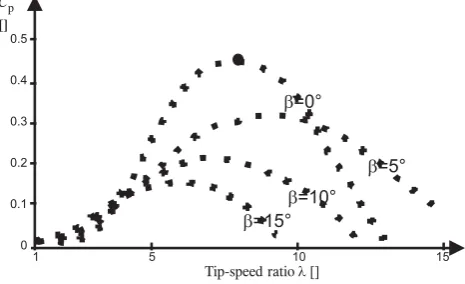
ρ being air density, Athe area swept by the turbine blades during their rotation, whilstλ(t)is the 93
tip–speed ratio of the blade. The nonlinear relations of Eq. (1) is represented in Figure2, which is
94
depicted for different values ofλ(t),v(t)andβ(t). 95
Tip-speed ratiol []
b=0°
b=5°
b=10°
b=15° 0.5
0.4
0.3
0.2
0.1
0
1 5 10 15
Cp
[]
Figure 2.Example of the power coefficient function.
It is worth noting the mathematical relation of Eq. (1) representing the driving force of the
96
wind turbine process, whose formulation will be similar for the hydroelectric plant, as shown in
97
the following.
98
The overall continuous–time representation of the wind turbine benchmark can be represented via Eq. (2):
˙
x(t) = fc(x(t),u(t))
y(t) = x(t)
withu(t) = [τr(t)β(t)]Tandy(t) =ωg(t)Pg(t)T. fc(·)is described by means of a continuous–time 99
nonlinear function that will be exploited for representing the complete dynamic behaviour of the
100
controlled process. Moreover, since this paper will analyse several data–driven control approaches,
101
this system will be used to acquire Nsampled data sequencesu(k) andy(k), withk = 1, 2, . . . N
102
from a realistic wind turbine plant [6].
103
Finally, the wind turbine simulator includes a control system that maintains the generator speed
104
ωg(t)at its nominal valueωnom=1551, 76rpm, and the generated powerPg(t)near to the rated power 105
Pr = 4.8MW. This is achieved by properly changing both βand τg, depending on the operating 106
conditions, which move the wind turbine system to the partial load to the full load working regions
107
(operating regions 2 and 3, respectively) [6].
108
On the other hand, the hydroelectric plant considered in this work consists of a high water head
109
and a long penstock, which includes also upstream and downstream surge tanks, with a Francis
110
hydraulic turbine [17], as recalled in Fig. 3. The hydroelectric simulator consists of a reservoir with
111
water levelHR, an upstream water tunnel with cross-section areaA1and lengthL1, an upstream surge
112
tank with cross–section areaA2and water levelH2of appropriate dimensions. A downstream surge
113
tank with cross–section area A4 and water level H4 follows, ending with a downstream tail water
114
tunnel of cross–section areaA5and lengthL5. Moreover, between the Francis hydraulic turbine and
115
the two surge tanks, there is a the penstock with cross–section areaA3and lengthL3. Finally, Fig. 3
116
highlights a tail water lake with levelHT. The levelsHRand HT of the reservoir and the lake water, 117
respectively, are assumed to be constants.
118
T HR
A , H2 2
A
A1 3
L1
A L5
5
A , H4 4 HT
Figure 3.Overall scheme of the hydroelectric process.
The mathematical description of the pure hydraulic system, which does not include the Francis
119
hydraulic turbine, can be found in [18,19]. This model was modified by the authors in order to
120
consider the the Francis turbine [7].
121
In the following, the complete model of the hydroelectric system is recalled, in terms of the variableh, which represents the water pressure relative deviation, whilstqis the flow rate relative deviation. More details can be found in [7]. Therefore, the overall model of the hydroelectric simulator is described by the relations of Eq. (3), which express the non–dimensional variables with respect to their relative deviations:
Q
Qr = 1+qt
H
Hr = 1+ht
n
nr = 1+x
G = 1+y
(3)
withqtis the turbine flow rate relative deviation,ht the turbine water pressure relative deviation,x 122
the turbine speed relative deviation, andythe wicket gate servomotor stroke relative deviation. In
123
particular, in Eq. (3), Hr = 400mrepresents the reservoir water level,Qr = 36.13m3/sis the water 124
flow rate,nr = 500rpmis the rated rotational speed. The hydraulic turbine power isPr =127.6MW 125
with efficiency rated valueηr =0.90. 126
plant. In particular, the non–dimensional water flow rate Q/Qr is expressed as a function of the
non–dimensional rotational speedn/nr, and represented by the second order polynomial of Eq. (4):
Q Qr
=G
" a1
n nr
2 +b1
n nr
+c1
#
= f1(n,G) (4)
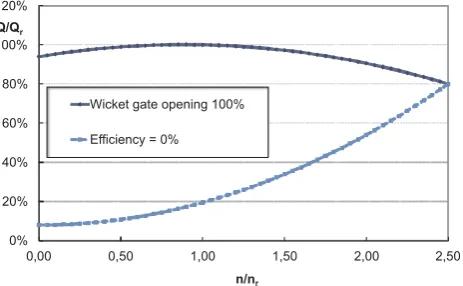
Moreover, the relation of Eq. (4) includes the wicked gate opening, described by the non–dimensional
127
parameterG, varying from 0 to 100%. Fig.4represents the curve derived forG=100%,i.e.fully open
128
wicked gate. Moreover, the curve atη =0% is also depicted, thus defining the operating conditions 129
of the Francis hydraulic turbine.
130
0% 20% 40% 60% 80% 100% 120%
0,00 0,50 1,00 1,50 2,00 2,50
Q/Qr
n/nr
Wicket gate opening 100%
Efficiency = 0%
Figure 4. Representation of the non–dimensional water flow rate Q/Qr with respect to the non–dimensional rotational speedn/nr.
The variables and parameters of the hydroelectric model were selected according to the work
131
[19] in order to represent a realistic hydroelectric plant simulator. Moreover, as for the wind turbine
132
benchmark, the signals that can be acquired from the actuator and sensors of the hydroelectric plant
133
are modelled as the sum of the actual variables and stochastic noises, as proposed in [7]. For this
134
benchmark, a standard PID regulator was proposed to compensate the hydraulic turbine speed
135
[19]. Due to its nonlinear characteristics, this solution may lead to unsatisfactory responses, with
136
high overshoot and long settling time, as highlighted in [19], since a gain scheduling of the PID
137
parameters would have been required. Thus, advanced control strategies that were already proposed
138
for the wind turbine benchmark and recalled in Section3 will be briefly summarised and applied
139
to the hydroelectric simulator, as shown in Section4. Extended simulations, comparisons, and the
140
sensitivity analysis of the proposed solutions represent one of the key points of this paper.
141
Finally, it is worth noting that some relations of the hydroelectric system have been linearised,
142
seee.g.the relations of Eq. (3). However, these simplified models has been considered for comparison
143
purpose, as the nonlinear parts of the processes under investigation are closer, as highlighted by Eqs.
144
(1) and (4).
145
3. Control Techniques for Energy Conversion Systems
146
This section recalls those data–driven and self–tuning control methodologies that will be
147
designed and compared when applied to the considered energy conversion benchmark and simulator.
148
In general, the control techniques proposed for the systems under investigation should lead to the
149
computation of the control law generating the input u(t) that allows to track the given reference
150
or set–pointr(t)for the controlled outputy(t). For example, the wind turbine system requires the
151
computation of the optimal rotational speed (ωrorωgfor the working regions 2 and 3, respectively). 152
Moreover, the reference torqueτr and the blade pitch controlβare exploited to obtain the needed 153
reference nr that is obtained for this plant, and the control of u and y allows to trackn according 155
to the desired valuenr. 156
The remainder of this section describes briefly several control schemes consisting of self–tuning,
157
data–driven, and Artificial Intelligence (AI) strategies, such as fuzzy logic and adaptive methods,
158
as well as Model Predictive Control (MPC) approach. First, with reference to the process output,
159
the desired transient or steady–state responses can be considered, as for the case of self–tuning PID
160
regulators summarised in Section3.0.1. On the other hand, if the frequency behaviour is taken into
161
account, the desired closed–loop poles can be fixed as roots of the closed–loop transfer function. This
162
represent the design approach used by the adaptive strategy considered in Section3.0.3. Moreover,
163
when robust performances are included, the minimisation of the sensitivity of the closed–loop system
164
with respect to the model–reality mismatch or external disturbances can be considered. This approach
165
is related for example to the fuzzy logic methodology reported in Section3.0.2. Some other strategies
166
provide solutions to this optimisation problem when it is defined at each time step, as for the
167
case of the Model Predictive Control (MPC) with disturbance decoupling considered in Section
168
3.0.4. The considered strategy integrates the advantages of the MPC solution with the disturbance
169
compensation feature.
170
Note that some of the control solutions were already proposed by the authors in particular for
171
the wind turbine and wind park installations [20].
172
3.0.1. Self–Tuning PID Control
173
Industrial processes commonly exploit closed–loop including standard PID controllers, due to their simple structure and parameter tuning [21]. The control law depends on the tracking errore(t) defined by the difference between the desired and the measured output signals,i.e. e(t) = r(t)− x(t). This signal is injected into the controlled process after proportional, integral and derivative computations. Therefore, the continuous–time control signalu(t)is generated by the PID regulator in the form of Eq. (5):
u(t) =Kpe(t) +Ki Z t
0 e
(τ)dτ+Kd
de(t)
dt (5)
with Kp, Ki, Kd being the PID proportional, integral, and derivative gains, respectively. The most 174
common strategy exploited for the computation of the optimal parameters of the PID governor uses
175
proper Ziegler–Nichols formulas [21]. However, with the development of relatively recent automatic
176
software routines, the PID optimal parameters can be easily determined by means of direct tuning
177
algorithms implemented for example in the Simulink environment. These strategies require the
178
definition of the controlled process as Simulink model, such that they balance the input–output
179
performances of the monitored system in terms of response time and stability margins (robustness)
180
[21]. In particular, the PID automatic tuning procedure implemented in the Simulink toolbox
181
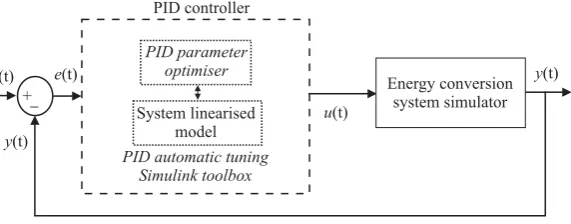
performs the computation of the linearised model of the energy conversion systems studied in this
182
paper. The logic scheme of this procedure is sketched in Fig.5.
183
+_
r(t)
u(t)
y(t)
e(t)
y(t)
PID parameter optimiser
System linearised model
PID automatic tuning Simulink toolbox
PID controller
Energy conversion system simulator
Note finally that the PID block in Fig. 5performs the computation of a linearised model of the
184
controlled system, if required. Therefore, the optimiser included in the PID block and implemented in
185
the Simulink environment derives of the PID parameters that minimise suitable performance indices,
186
as described in [21].
187
3.0.2. Data–Driven Fuzzy Control
188
Fuzzy Logic Control (FLC) solutions are often exploited when the dynamics of the monitored
189
process are uncertain and can present nonlinear characteristics. The design method proposed in this
190
work exploits the direct identification of rule–based Takagi–Sugeno (TS) fuzzy prototypes. Moreover,
191
the fuzzy model structure,i.e. the number of rules, the antecedents, the consequents and the fuzzy
192
membership functions can be estimated by means of the Adaptive Neuro–Fuzzy Inference System
193
(ANFIS) toolbox implemented in the Simulink environment [22].
194
The TS fuzzy prototype relies on a number of rulesRi, whose consequents are deterministic
functionsfi(·)in the form of Eq. (6):
Ri :IF x is AiTHEN ui= fi(x) (6)
where the indexi=1, 2, . . . ,Kdescribes the number of rulesK,xis the input vector containing the antecedent variables,i.e.the model inputs, whilstuirepresents the consequent output. The fuzzy set
Aidescribing the antecedents in thei–th rule is described by its (multivariable) membership function µAi(x) →[0, 1]. The relation fi(x)assumes the form of parametric affine model represented by the
i–th relation of Eq. (7):
ui =aTi x+bi (7)
with the vector ai and the scalarbi being the i–th submodel parameters. The vector x consists of 195
a proper number n of delayed samples of input and output signals acquired from the monitored
196
process. Therefore, the termaTi xis an Auto–Regressive eXogenous (ARX) parametric dynamic model
197
of ordern, andbia bias. 198
The outputuof the TS fuzzy prototype is computed as weighted average of all rule outputsui
in the form of Eq. (8):
u= ∑
K
i=1 µAi(x)yi(x) ∑K
i=1 µAi(x)
(8)
The estimation scheme implemented by the ANFIS tool follows the classic dynamic system
199
identification experiment. First, the structure of the TS fuzzy prototype is defined by selecting a
200
suitable ordern, the shape representing the membership functionsµAi, and the proper number of
201
clusters K. Therefore, the input–output data sequences acquired from the monitored system are
202
exploited by ANFIS for estimating the TS model parameters and its rulesRi after the selection of a 203
suitable error criterion. The optimal values of the controller parameters represented by the variables
204
aiandbiof (7) are thus estimated [23]. 205
The work proposes also a strategy different from ANFIS that can be exploited for the estimation
206
of the parameters of the fuzzy controller. This method relies on the Fuzzy Modelling and
207
Identification (FMID) toolbox designed in the Matlab and Simulink environments as described in
208
[24]. Again, the computation of the controller model is performed by estimating the rule–based
209
fuzzy system in the form of Eq. (8) from the input–output data acquired from the process under
210
investigation. In particular, the FMID tool uses the Gustafson–Kessel (GK) clustering method [24] to
211
perform a partition of input–output data into a proper numberKof regions where the local affine
212
relations of Eq. (7) are valid. Also in this case, the fuzzy controller model of Eq. (8) is computed
213
after the selection of the model ordernand the number of clustersK. The FMID toolbox derives the
214
variablesaiandbi, as well as the identification of the shape of the functionsµAi by minimising a given
215
metric [24].
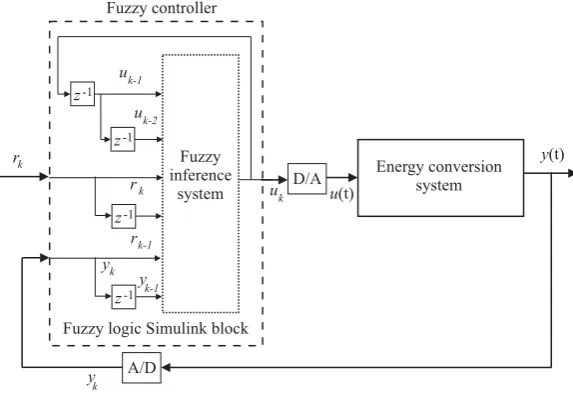
Note that the overall digital control scheme consisting of the discrete–time fuzzy regulator of Eq.
217
(8) and the controlled system includes also Digital–to–Analog (D/A) and Analog–to-Digital (A/D)
218
converters, as shown in Figure6.
219
r
u(t)
y(t) D/A
A/D
y
uk
k
Fuzzy inference
system
z-1
uk-2
k
z-1 k-1 Fuzzy controller
rk
z-1yk-1
r yk z-1 uk-1
Fuzzy logic Simulink block
Energy conversion system
Figure 6.Block diagram of the monitored system controlled by the fuzzy regulator.
With reference to Figure 6, note finally that the fuzzy controller block implemented in the
220
Simulink environment includes a suitable numbernof delayed samples of the signals acquired from
221
the monitored process. Moreover, the fuzzy inference system in Figure6implements the TS model of
222
Eq. (8). The delay n, the membership functionsµAi, and the number of clustersKare estimated by 223
the FMID and the ANFIS toolboxes, as described in [24].
224
3.0.3. Data–Driven Adaptive Control
225
The adaptive control technique proposed in this work relies on the recursive estimation of a 2–nd order discrete–time transfer functionG(z)with time–varying parameters described by Eq. (9):
G(z) = β1z −1+β
2z−2 1+α1z−1+α2z−2
(9)
whereαi and βi are identified on–line at each sampling timetk = k T, withk = 1, 2, . . . ,N, for N 226
samples, and T being the sampling interval. z−1 indicates the unit delay operator. A viable and
227
direct way for deriving the model parameters in Eq. (9) that is proposed in this work is based on the
228
Recursive Least–Square Method (RLSM) with directional forgetting factor, which was presented in
229
[25].
230
Once the parameters of the model of Eq. (9) have been derived, this paper proposes to compute the adaptive controller in the form of Eq. (10):
uk=q0ek+q1ek−1+q2ek−2+ (1−γ)uk−1+γuk−2 (10) with ek and uk represent the sampled values of the tracking errore(t) and the control signaluk at
the time tk, respectively. With reference to the description of Eq. (10), by following a modified
derived by solving a Diophantine equation. As described in [25], by considering the recursive 2–nd order model of Eq. (9), this technique leads to the relations of Eqs. (11):
q0 = β11 (d1+1−α1−γ)
γ = sr1
1 β2 α2
q1 = αβ22 − sr11
β1 β2 −
α1 α2 +1
q2 = sr11
(11)
where:
r1 = (b1+b2) a1b2b1−a2b21−b22
s1 = a2((b1+b2) (a1b2−a2b1) +b2 (b1d2−b2d1−b2))
(12)
Note that the design technique proposed in this work and represented by the relations of Eqs. (11) and (12) assumes that the behaviour of the overall closed–loop system can be approximated by a 2nd order transfer function with characteristic polynomial represented by Eq. (13):
D(s) =s2+2δ ωs+ω2 (13)
with δ and ω being the damping factor and natural frequency, respectively. s is the derivative
operator. Furthermore, ifδ≤1, the following relations are used [25]:
d1 = −2e−δ ωT cos
ωT
√ 1−δ2
d2 = e−2δ ωT
(14)
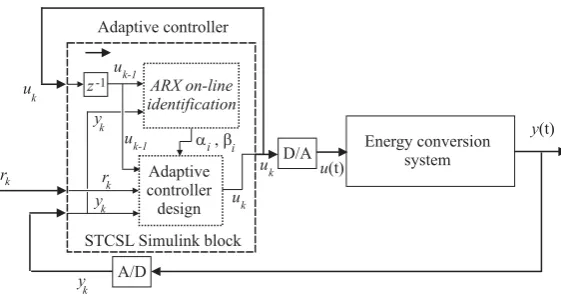
The on–line control law of Eq. (10) is used for the regulation of the continuous–time nonlinear system
231
by including D/A and A/D converters, as highlighted in the scheme of Figure7.
232
r u(t)
y(t) D/A
A/D
y
uk
k
z-1 uk-1
k
uk
Adaptive controller
Adaptive controller design
ARX on-line identification
yk rk
uk-1
uk yk
a b,
i i
STCSL Simulink block
Energy conversion system
Figure 7.Block diagram of the monitored system controlled by the adaptive regulator.
Note finally that the adaptive control sketched in Figure7is implemented via the Self–Tuning
233
Controller Simulink Library (STCSL) block in the Simulink environment. It includes the module
234
performing the on–line identification of the ARX model of Eq. (9), which is used for the adaptive
235
controller design in the form of Eq. (10) [25].
3.0.4. Model Predictive Control with Disturbance Decoupling
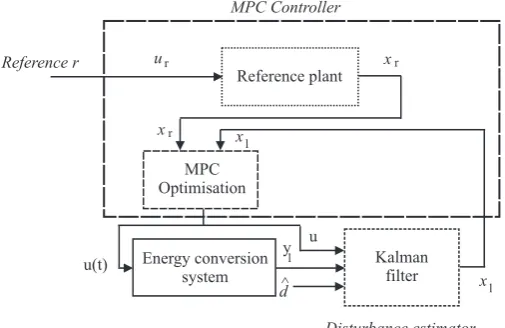
237
The general structure of the proposed Model Predictive Control (MPC) is illustrated in Figure
238
8, with the MPC managing objectives and constraints of the control inputs. The MPC works as a
239
standard MPC controller when the nominal plant is considered, and generates the reference inputs. In
240
the presence of disturbance or uncertainty effects, the considered solution provides the reconstruction
241
of the equivalent disturbance signal acting on the plant. This represent the key feature of this
242
structure, which compensates the disturbance effect and ’hide’ it to the overall system. In this way, it
243
decouples the disturbance effect from the nominal MPC design.
244
Reference plant
MPC Optimisation
Kalman filter y
l
xr
d^ u
u(t)
xl ur
xr x
l
Energy conversion system Reference r
Disturbance estimator MPC Controller
Figure 8.Block diagram of the disturbance compensated MPC scheme.
The overall scheme is thus represented aim by the MPC design with disturbance compensation, such that the compensated system has response very similar to the nominal system and the constraints are not violated. The fault compensation problem within the MPC framework is defined as follows. Given a state–space representation of the considered system affected by disturbance or uncertainty has the following form:
( ˙
xl = Alxl+Blu+Bdd+w
yl = Clxl+v
(15)
and its nominal reference model: ( ˙
xr = Alxr+Blur
yr = Clxr (16)
the disturbance compensation problem is solved by finding the control inpututhat minimises the cost function:
J=
Z t+Nc∆t
t
xl−xr 2
Q+
u˙
2
R
dτ (17)
given the reference inputur. 245
In Eq. (15) the matrices Al, Bl,Bd and Cl are of proper dimensions. The vector yl represents 246
the output measurements, xl is the state of the model with disturbance, whilst xr is the reference 247
state, andyrthe reference output, corresponding to the reference inputur of the nominal model. The 248
vectorswandvinclude the model mismatch and the measurement error, respectively. drepresents
249
the equivalent disturbance signal. In Eq. (17)tis the current time,∆tis the control interval, andNc 250
is the length of the control horizon. QandRare suitable weighting matrices. Note that the model of
251
Eq. (15) can be derived by nonlinear model linearisation or identification procedures, as suggested in
252
Sections3.0.1and3.0.3, respectively.
This work proposes to solve the problem in two steps: the reconstruction of the disturbanced, i.e. dˆ, provided by the disturbance estimation module, and the MPC tool. Due to the model–reality mismatch and the measurement error in (15), the Kalman filter (18) is used to provide the estimation of the state vectorxl, the outputylof the system affected by the estimated disturbance ˆd:
( ˙
xl = Alxl+Blu−Bldˆ+Kf (yl−Clxl)
yl = Clxl
(18)
whereKf is the Kalman filter gain. In this way, based on the estimations ˆdandxl, an MPC is designed,
which contains the reference model of Eq. (16) and the filtered system of Eq. (18), with ˆdprovided by the Kalman filter. Moreover, the MPC has the objective function:
Z t+Nc∆t
t
h
(xl−xr)T Q(xl−xr) +u˙TRu˙
i
dτ (19)
in whichxlandxrare the states of the filtered and the reference models, respectively. The integrated 254
MPC with the Kalman filter solves this general disturbance compensation problem, as long as the
255
estimations of both the state and the disturbance are correct. An illustration of the structure of the
256
fault compensated MPC is shown in Figure8.
257
The global estimation and control scheme is a nonlinear MPC problem with the nominal model
258
for the considered energy conversion systems of Eq. (15), the disturbance d with its estimator,
259
and the Kalman filter of Eq. (18) as prediction model. The local observability of the model of Eq.
260
(15) is essential for state estimation, which is easily verified. The implementation of the proposed
261
disturbance compensation strategy has been integrated into the MPC Toolbox of the Simulink
262
environment.
263
4. Simulation Results
264
The results obtained with the application of the developed control techniques are evaluated via the percent Normalised Sum of Squared Error (NSSE%) performance function in the form of Eq. (20):
NSSE%=100 v u u
t∑
N
k=1(rk−ok)2
∑N k=1r2k
(20)
withrkbeing the sampled reference or set–pointr(t), whilstokis the sampled continuous–time signal 265
representing the generic controlled outputy(t)of the process. In particular, this signal is represented
266
by the wind turbine generator angular velocityωg(t)in Eq. (2), and the hydraulic turbine rotational 267
speednin Eq. (3) for the hydroelectric plant.
268
Note that the wind turbine benchmark and the hydroelectric plant simulator of Section2allow
269
the generation of several input–output data sequences due to different wind speedv(t)effects and
270
hydraulic transient under variable loads, respectively. Moreover, in order to obtain comparable
271
working situations, the wind turbine benchmark has been operating from partial to full load
272
conditions (from region 2 to region 3). It is thus considered the similar maneuver of the hydroelectric
273
system operating from the start–up to full load working condition. After these considerations, Section
274
4.1summarises the results obtained from the wind turbine benchmark first. Then, the same control
275
techniques will be verified when applied to the hydroelectric simulator.
276
4.1. Control Technique Performances and Comparisons
277
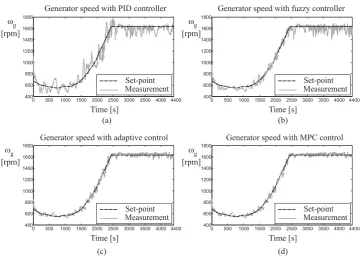
Figure9reports the results achieved with the control methodologies and the tools summarised
278
in Section3. In particular, Figure9depicts the wind turbine generator angular velocityωgwhen the 279
wind speedv(t)changes from 3m/sto 18m/sfor a simulation time of 4400s[6].
0 500 1000 1500 2000 2500 3000 3500 4000 400
600 800 1000 1200 1400 1600 1800
wg
Time [s] [rpm]
Generator speed with adaptive control
Measurement Set-point
4400 4000 500 1000 1500 2000 2500 3000 3500 4000 600
800 1000 1200 1400 1600 1800
wg
Time [s] [rpm]
Generator speed with MPC control
Measurement Set-point
4400 0 500 1000 1500 2000 2500 3000 3500 4000 400
600 800 1000 1200 1400 1600 1800
wg
Time [s] [rpm]
Generator speed with fuzzy controller
Measurement Set-point
4400 0 500 1000 1500 2000 2500 3000 3500 4000
400 600 800 1000 1200 1400 1600 1800
wg
Time [s] [rpm]
Generator speed with PID controller
Measurement Set-point
4400
(a) (b)
(d) (c)
Figure 9. Wind turbine controlled output compensated by (a) the self–tuning PID regulator, (b) the fuzzy controller, (c) the adaptive regulator, and (d) the MPC approach with disturbance decoupling.
In detail, with reference to the picture in Figure9(a), the parameters of the PID regulator of Eq.
281
(5) have been determined using the self–tuning tool available in the Simulink environment. They
282
were settled toKp=4.0234,Ki =1.0236,Kd=0.0127. The achieved performances are better than the 283
ones obtained with the baseline control laws proposed in [6].
284
Moreover, Figure9(b) shows the simulations achieved with the data–driven fuzzy identification
285
approach recalled in Section3.0.2. In particular, a sampling intervalT = 0.01shas been exploited,
286
and the TS fuzzy controller of Eq. (8) has been obtained for a numberK=3 of Gaussian membership
287
functions, and a numbern = 2 of delayed inputs and output. The antecedent vector in Eq. (7) is
288
thusx = [ek,ek−1,ek−2,uk−1,uk−2]. Both the data–driven FMID and ANFIS tools available in the
289
Matlab and Simulink environments provide also the optimal identification of the shapes of the fuzzy
290
membership functionsµAi of the fuzzy setsAiin Eq. (6).
291
On the other hand, the picture in Figure9(c) shows the capabilities of the adaptive controller of
292
Eq. (10). The time–varying parameters of this data–driven control technique summarised in Section
293
3.0.3have been computed on–line via the relations of Eqs. (11) with the damping factor and the
294
natural frequency variablesδ=ω=1 in Eq. (13). 295
Finally, the picture of Figure9(d) highlights the results achieved with the MPC technique with
296
disturbance decoupling recalled in Section3.0.4. The state–space model of the wind turbine nonlinear
297
system of Eq. (2) exploited for the design of the MPC and the Kalman filter for the estimation of the
298
disturbance has ordern = 5, with a prediction horizonNp = 10 and a control horizonNc = 2. The 299
weighting factors have been settled to wyk = 0.1 and wuk = 1, in order to reduce possible abrupt
300
changes of the control input. Note that, in this case, the MPC technique has led to the best results,
301
since it exploits a disturbance decoupling strategy, whilst its parameters have been iteratively adapted
302
in the Simulink environment in order to optimise the MPC cost function of Eq. (17), as addressed in
303
Section3.0.4.
304
The second test case regards the hydroelectric plant simulator, where the hydraulic system
305
with its turbine speed governor generates hydraulic transients due to the load changes. In order
306
to consider operating situations similar to the wind turbine benchmark, the capabilities of the
considered control techniques applied to the hydroelectric simulator have been evaluated during
308
the start–up to full load maneuver. Moreover, an increasing load torque has been imposed during the
309
start–up to full load phase, which is assumed to last 300sbecause of the large size of the considered
310
Francis turbine, and for a simulation of 900s.
311
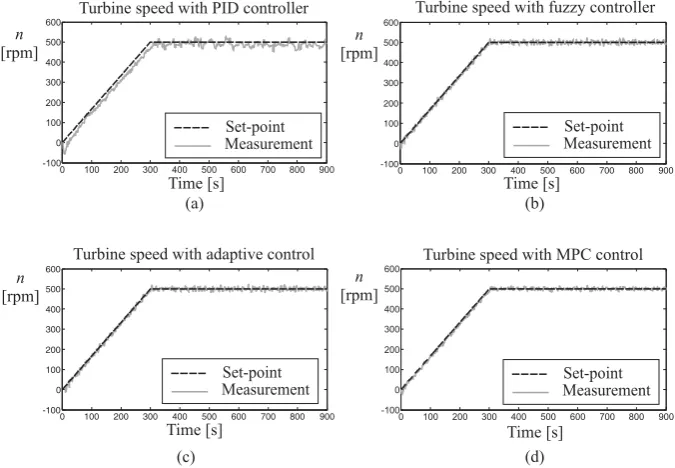
Under these assumptions, Figure 10summarises the results achieved with the application of
312
the control strategies recalled in Section3. In particular, for all cases, Figure10highlights that the
313
hydraulic turbine angular velocityn increases with the load torquemg0 during the start–up to full
314
working condition maneuver.
315
Time [s] Time [s]
Turbine speed with MPC control Turbine speed with adaptive control
Time [s] Time [s]
Turbine speed with PID controller Turbine speed with fuzzy controller
(a) (b)
(c) (d)
n
[rpm]
n
[rpm]
0 100 200 300 400 500 600 700 800 900 -100
0 100 200 300 400 500 600
MeasurementSet-point
0 100 200 300 400 500 600 700 800 900 -100
0 100 200 300 400 500 600
n
[rpm]
MeasurementSet-point
0 100 200 300 400 500 600 700 800 900 -100
0 100 200 300 400 500 600
n
[rpm]
Measurement Set-point
0 100 200 300 400 500 600 700 800 900 -100
0 100 200 300 400 500 600
MeasurementSet-point
Figure 10.Hydroelectric system with (a) the self–tuning PID regulator, (b) the fuzzy controller, (c) the adaptive regulator, and (d) the MPC approach with disturbance decoupling.
In more detail, Figure10(a) shows the performance of the PID regulator when its parameters are
316
determined via the self–tuning procedure recalled in Section3.0.1. Furthermore, Figure10(a) shows
317
that the PID governor with self–tuning capabilities is able to keep the hydraulic turbine rotational
318
speed errorn−nr null (r(t) =nr,i.e. the rotational speed constant) in steady–state conditions. 319
Figure10(b) reports the results concerning the TS fuzzy controller described by Eq. (8) in Section
320
3.0.2. This fuzzy controller was implemented for a sampling intervalT=0.1s, with a numberK=2 of
321
Gaussian membership functions, and a numbern=3 of delayed inputs and output. The antecedent
322
vector exploited by the relation of Eq. (7) is thus x = [ek,ek−1,ek−2,ek−3,uk−1,uk−2,uk−3,].
323
Moreover, as recalled in Section3.0.2, the data–driven FMID and ANFIS tools implemented in the
324
Simulink toolboxes are able to provide the estimates of the shapes of the membership functionsµAi
325
used in Eq. (8).
326
On the other hand, Figure10(c) reports the simulations obtained via the data–driven adaptive
327
controller of Eq. (10), whose time–varying parameters are computed by means of the relations of
328
Eqs. (11). The damping factor and the natural frequency parameters used in Eq. (13) were selected
329
asδ = ω = 1. The STCSL tool described in Section 3.0.3 implements this data–driven adaptive 330
technique using the on–line identification of the input–output model of Eq. (9) [25].
331
Finally, regarding the MPC technique with disturbance decoupling proposed in Section3.0.4,
332
Fig.10(d) reports the simulations obtained using a prediction horizonNp=10 and a control horizon 333
Nc = 2. Also in this case, the weighting parameters have been fixed towyk = 0.1 andwuk = 1, in
334
order to limit fast variations of the control input, as it will be remarked in the following. Furthermore,
the MPC design was performed using a linear state–space model for the nonlinear hydroelectric plant
336
simulator of ordern=6.
337
In order to provide a quantitative comparison of the tracking capabilities obtained by the
338
considered control techniques for the wind turbine benchmark, the first row in Table1summarises
339
the achieved results in terms ofNSSE% index.
340
Table 1.Performance of the considered control solutions.
Simulated Working Standard Self–tuning Fuzzy Adaptive MPC
system Condition PID PID PID PID Scheme
Wind From partial
turbine to full load 11.5% 7.3% 5.7% 4.1% 2.8%
Hydro From start–up
plant to full load 6.2% 4.9% 3.1% 1.8% 0.9%
In particular, the NSSE% values in the first row of Table1 highlight better capabilities of the
341
proposed fuzzy controllers with respect to the PID regulators with self–tuning feature. This is
342
motivated by the better flexibility and generalisation capabilities of the fuzzy tool, and in particular
343
the FMID toolbox proposed in [24]. A better behaviour is obtained by means of the adaptive solution,
344
due to its inherent adaptation mechanism, which allows to track the reference signal in the different
345
working conditions of the wind turbine process. However, the MPC technique with disturbance
346
decoupling has led to the best results, as reported in the first row of Table1, since is able to optimise
347
the overall control law over the operating conditions of the system, by taking into account future
348
operating situations of its behaviour. while compensating the disturbance effects.
349
On the other hand, the results achieved by the validation of the considered control techniques
350
to the hydroelectric plant simulator are summarised in the second row of Table1. In this case, the
351
values of the NSSE% function are evaluated for the considered conditions of varying load torque
352
mg0corresponding to the plant start–up to full load maneuver. According to these simulation results,
353
good properties of the proposed self–tuning PID regulator are obtained, and they are better than the
354
baseline PID governor with fixed gains developed in [19]. In fact, the self–tuning design feature of
355
the Simulink environment is able to limit the effect of high–gains for the proportional and the integral
356
contributions of the standard PID control law. On the other hand, the data–driven fuzzy regulator
357
has led to even better results, which are outperformed by the adaptive solution. However, also for the
358
case of the hydroelectric plant simulator, the best performances are obtained by means of the MPC
359
strategy with disturbance decoupling. Note that, with reference to Table1, the comparison should
360
be performed by considering theNSSE% values for a given plant. In fact, even if theNSSE% index
361
assumes quite similar values, it refers to control techniques implemented and applied to different
362
processes.
363
Finally, in order to highlight some further features of the considered, the controlled inputs
364
applied to the wind turbine system are depicted and compared in Figures11(a) and (c), whilst the one
365
feeding the hydroelectric plant in Figure11(b) and (d). For the sake of brevity, only the data–driven
366
fuzzy controller and the MPC with disturbance decoupling have been summarised here.
367
By considering these control inputs, with reference to the data–driven methodologies, and in
368
particular to the design of the fuzzy controllers, off–line optimisation strategies allow to reach quite
369
good results. However, control inputs are subjected to faster variations. Other control techniques can
370
take advantage of more complicated and not direct design methodologies, as highlighted by the MPC
371
scheme. In this case, due to the input constraint, its changes are reduced. This feature is attractive
372
for wind turbine systems, where variations of the control inputs must be limited. This represents
373
another important benefit of MPC with disturbance decoupling, which integrates the advantages of
374
the classic MPC scheme with disturbance compensation effects. Therefore, with reference to these two
Time [s] []
Time [s]
Hydroelectric plant input with fuzzy controller
(a) (b)
(d) (c)
20
2200 2450 2700 2950 3200 3450 3700 3950 4200 4400 Time [s]
b(t) [°]
0 500 1000 1500 2000 2500 3000 3500 4000 14
23 tr(t) [kNm]
WT reference torque with fuzzy controller and MPC
4400 17
26
11
8 0 5 10 15 20 25 30
Data-driven fuzzy regulator Disturbance decoupled MPC
Time [s]
WT blade pitch angle with fuzzy controller and MPC
Data-driven fuzzy regulator Disturbance decoupled MPC (Full load working region)
(Partial load working region)
0 100 200 300 400 500 600 700 800 900 0
0.2 0.4 0.6 0.8 1 1.2 1.4
0 100 200 300 400 500 600 700 800 900 0
0.2 0.4 0.6 0.8 1 1.2 1.4
Hydroelectric plant input with MPC controller
u [] u
Data-driven fuzzy regulator
Disturbance decoupled MPC (Startup to full load)
(Startup to full load)
Figure 11. Wind turbine (a), (c) and hydroelectric plant (b), (d) compensated by the fuzzy controller and the MPC approach with disturbance decoupling.
control methods, they can appear rather straightforward, even if further optimisation and estimation
376
strategies have to be applied.
377
4.2. Sensitivity Analysis
378
This section analyses the reliability and robustness properties of the developed controllers when
379
parameter variations and measurement errors are considered. This further investigation relies on
380
the Monte–Carlo tool, since the control behaviour and the tracking capabilities depend on both the
381
model–reality mismatch effects and the input–output uncertainty levels. Therefore, this analysis has
382
been implemented by describing the parameters of both the wind turbine system and hydroelectric
383
plant models as Gaussian stochastic processes with average values corresponding to the nominal ones
384
summarised in Table2for the wind turbine benchmark.
385
Table 2.Wind turbine benchmark parameters for the sensitivity analysis.
Variable R χ ωn Bdt Br
Nominal value 57.5m 0.6 106, 09 rpm 775.49N m s rad−1 7.11N m s rad−1
Variable Bg Kdt ηdt Jg Jr
Nominal value 45.6N m s rad−1 2.7·109N m rad−1 0.97 390kg m2 55·106kg m2
Moreover, Table2shows that these model parameters have standard deviations of±30% of the
386
corresponding nominal values [6].
387
On the other hand, Table 3 reports the hydroelectric simulator model variables with their
388
nominal values varied by±30% in order to develop the same Monte–Carlo analysis [7].
389
Therefore, the average values of NSSE% index have been thus evaluated by means of 1000
390
Monte–Carlo simulations. They have been reported in Tables4and5for the wind turbine benchmark
391
and the hydroelectric plant simulator, respectively.
Table 3.Hydroelectric simulator parameters for the sensitivity analysis.
Variable a b c Hf1 Hf3 Hf5 Ta
Nominal value -0.08 0.14 0.94 0.0481m 0.0481m 0.0047m 5.9s Variable Tc Ts2 Ts4 Tw1 Tw3 Tw5
Nominal value 20s 476.05s 5000s 3.22s 0.83s 0.1s
Table 4.Sensitivity analysis applied to the wind turbine benchmark.
Standard Self–tuning Fuzzy Adaptive MPC
PID PID PID PID Scheme
13.8% 9.2% 7.6% 5.3% 3.9%
Table 5.Sensitivity analysis applied to the hydroelectric plant simulator.
Standard Self–tuning Fuzzy Adaptive MPC
PID PID PID PID Scheme
9.1% 7.4% 5.6% 3.5% 2.2%
It is worth noting that the results summarised in Tables4 and 5 serve to verify and validate
393
the overall behaviour of the developed control techniques, when applied to the considered wind
394
turbine benchmark and hydroelectric plant simulator, respectively. In more detail, the values of the
395
NSSE% index highlights that when the mathematical description of the controlled dynamic processes
396
can be included in the control design phase, the MPC technique with disturbance decoupling still
397
yields to the best performances, even if an optimisation procedure is required. However, when
398
modelling errors are present, the off–line learning exploited by the data–driven fuzzy regulators
399
allows to achieve results better than model–based schemes. For example, this consideration is
400
valid for the PID controllers derived via the self–tuning procedure. On the other hand, fuzzy
401
controllers have led to interesting tracking capabilities. With reference to the data–driven adaptive
402
scheme, it takes advantage of its recursive features, since it is able to track possible variations of
403
the controlled systems, due to operation or model changes. However, it requires quite complicated
404
and not straightforward design procedures relying on data–driven recursive algorithms. Therefore,
405
fuzzy–based schemes use the learning accumulated from data–driven off–line simulations, but the
406
training stage can be computationally heavy. Finally, concerning the standard PID control strategy, it
407
is rather simple and straightforward. Obviously, the achievable performances are quite limited when
408
applied to nonlinear dynamic processes. Note that they were proposed as baseline control solutions
409
for the considered processes. It can be thus concluded that the proposed data–driven self–tuning
410
approaches seem to represent powerful techniques able to cope with uncertainty, disturbance and
411
variable working conditions. Note finally that the plant simulators, the control solutions, and the data
412
exploited for the analysis addressed in this paper are directly and freely available from the authors.
413
5. Conclusions
414
The work considered two renewable energy conversion systems, such as a wind turbine
415
benchmark and a hydroelectric plant simulator, together with the development of proper data–driven
416
control techniques. In particular, the three–bladed horizontal axis wind turbine benchmark
417
reported in this work consisted of simple models of the gear–box, the drive–train, and the electric
418
generator/converter. On the other hand, the hydroelectric plant simulator included a high water
419
head, a long penstock with upstream and downstream surge tanks, and a Francis hydraulic turbine.
Standard PID governors were earlier developed for these processes, which were rather simple and
421
straightforward, but with limited achievable performances. Therefore, the paper proposed different
422
control strategies mainly relying on data–driven approaches. Their performances were analysed
423
first. Then, the reliability and robustness of these solutions were also verified and validated with
424
respect to parameter variations of the plant models and measurement errors, via the Monte–Carlo
425
tool. The achieved results highlighted that data–driven approaches, such as the fuzzy regulators were
426
able to provide good tracking performances. However, they were easily outperformed by adaptive
427
and model predictive control schemes, representing data–driven solutions that require optimisation
428
stages, adaptation procedures and disturbance compensation methods. Future investigations will
429
consider the verification and the validation of the considered control techniques when applied to
430
higher fidelity simulators of energy conversion systems.
431
Sample Availability:The software codes for the proposed control strategies, the simulated benchmarks and the
432
generated data are available from the authors on demand in the Maltab and Simulink environments.
433
Acknowledgments:The research works have been supported by the FAR2018 local fund from the University of
434
Ferrara. On the other hand, the costs to publish in open access have been covered by the FIR2018 local fund from
435
the University of Ferrara.
436
Author Contributions: Silvio Simani conceived and designed the simulations. Silvio Simani analysed the
437
methodologies, the achieved results, and together with Stefano Alvisi and Mauro Venturini, wrote the paper.
438
Conflicts of Interest:The authors declare no conflicts of interest.
439
Bibliography
440
1. Tetu, A.; Ferri, F.; Kramer, M.B.; Todalshaug, J.H. Physical and Mathematical Modeling of a Wave Energy
441
Converter Equipped with a Negative Spring Mechanism for Phase Control.Energies2018,11, 2362. DOI:
442
10.3390/en11092362.
443
2. Hassan, M.; Balbaa, A.; Issa, H.H.; El-Amary, N.H. Asymptotic Output Tracked Artificial Immunity
444
Controller for Eco–Maximum Power Point Tracking of Wind Turbine Driven by Doubly Fed Induction
445
Generator. Energies2018,11, 2632. DOI: 10.3390/en11102632.
446
3. Fernendez-Guillamon, A.; Villena-Lapaz, J.; Vigueras-Rodriguez, A.; Garcia-Sanchez, T.; Molina-Garcia,
447
A. An Adaptive Frequency Strategy for Variable Speed Wind Turbines: Application to High Wind
448
Integration into Power Systems. Energies2018,11, 1436. DOI: 10.3390/en11061436.
449
4. Blanco-M., A.; Gibert, K.; Marti-Puig, P.; Cusido, J.; Sole-Casals, J. Identifying Health Status of Wind
450
Turbines by using Self Organizing Maps and Interpretation–Oriented Post–Processing Tools. Energies
451
2018,11, 723. DOI: 10.3390/en11040723.
452
5. World Energy Council., Ed.Cost of Energy Technologies; World Energy Perspective, World Energy Council:
453
London, UK, 2018. ISBN: 9780946121304. Available at:www.worldenergy.org.
454
6. Odgaard, P.F.; Stoustrup, J.; Kinnaert, M. Fault–Tolerant Control of Wind Turbines: A Benchmark
455
Model. IEEE Transactions on Control Systems Technology2013, 21, 1168–1182. ISSN: 1063–6536. DOI:
456
10.1109/TCST.2013.2259235.
457
7. Simani, S.; Alvisi, S.; Venturini, M. Fault Tolerant Control of a Simulated Hydroelectric System. Control
458
Engineering Practice2016,51, 13–25. DOI: http://dx.doi.org/10.1016/j.conengprac.2016.03.010.
459
8. Honrubia-Escribano, A.; Gomez-Lazaro, E.; Fortmann, J.; Sorensen, P.; Martin-Martinez, S. Generic
460
dynamic wind turbine models for power system stability analysis: A comprehensive review. Renewable
461
and Sustainable Energy Reviews2018,81, 1939–1952. DOI: 10.1016/j.rser.2017.06.005.
462
9. Singh, V.K.; Singal, S.K. Operation of hydro power plants–a review. Renewable and Sustainable Energy
463
Reviews2017,69, 610–619. DOI: 10.1016/j.rser.2016.11.169.
464
10. Bianchi, F.D.; Battista, H.D.; Mantz, R.J. Wind Turbine Control Systems: Principles, Modelling and Gain
465
Scheduling Design, 1st ed.; Advances in Industrial Control, Springer, 2007. ISBN: 1–84628–492–9.
466
11. Kishor, N.; Saini, R.; Singh, S. A review on hydropower plant models and control. Renewable and
467
Sustainable Energy Reviews2007,11, 776–796.
468
12. Hanmandlu, M.; Goyal, H. Proposing a new advanced control technique for micro hydro power plants.
469
International Journal of Electrical Power & Energy Systems2008,30, 272–282.
13. Kishor, N.; Singh, S.; Raghuvanshi, A. Dynamic simulations of hydro turbine and its state estimation
471
based LQ control. Energy Conversion and Management2006,47, 3119–3137.
472
14. Mahmoud, M.; Dutton, K.; Denman, M. Design and simulation of a nonlinear fuzzy controller for a
473
hydropower plant. Electric Power Systems Research2005,73, 87–99.
474
15. Sarasua, J.I.; Martinez-Lucas, G.; Platero, C.A.; Sanchez-Fernandez, J.A. Dual Frequency Regulation
475
in Pumping Mode in a Wind–Hydro Isolated System. Energies 2018, 11, 1996–1073. DOI:
476
10.3390/en11112865.
477
16. Martinez-Lucas, G.; Sarasua, J.I.; Sanchez-Fernandez, J.A. Eigen analysis of wind–hydro joint frequency
478
regulation in an isolated power system. International Journal of Electrical Power & Energy Systems2018,
479
103, 511–524. DOI: 10.1016/j.ijepes.2018.06.028.
480
17. Popescu, M.; Arsenie, D.; Vlase, P. Applied Hydraulic Transients: For Hydropower Plants and Pumping
481
Stations; CRC Press: Lisse, The Netherlands, 2003.
482
18. de Mello, F.P.; Koessler, R.J.; Agee, J.; Anderson, P.M.; Doudna, J.H.; Fish, J.H.; Hamm, P.A.L.; Kundur, P.;
483
Lee, D.C.; Rogers, J.; Taylor, C. Hydraulic turbine and turbine control models for system dynamic studies.
484
IEEE Transactions on Power Systems1992,7, 167–179. DOI: 10.1109/59.141700.
485
19. Fang, H.; Chen, L.; Dlakavu, N.; Shen, Z. Basic Modeling and Simulation Tool for Analysis of Hydraulic
486
Transients in Hydroelectric Power Plants. IEEE Trans. Energy Convers.2008,23, 424–434.
487
20. Simani, S.; Farsoni, S. Fault Diagnosis and Sustainable Control of Wind Turbines: Robust data–driven and
488
model–based strategies, 1st ed.; Mechanical Engineering, Butterworth–Heinemann – Elsevier: Oxford (UK),
489
2018. ISBN: 9780128129845.
490
21. Åström, K.J.; Hägglund, T. Advanced PID Control; ISA - The Instrumentation, Systems, and Automation
491
Society: Research Triangle Park, NC 27709, 2006. ISBN: 978–1–55617–942–6.
492
22. Jang, J.S.R. ANFIS: Adaptive–Network–based Fuzzy Inference System. IEEE Transactions on Systems,
493
Man., & Cybernetics1993,23, 665–684.
494
23. Jang, J.S.R.; Sun, C.T. Neuro–Fuzzy and Soft Computing: A Computational Approach to Learning and Machine
495
Intelligence, 1st ed.; Prentice Hall, 1997. ISBN: 9780132610667.
496
24. Babuška, R.Fuzzy Modeling for Control; Kluwer Academic Publishers: Boston, USA, 1998.
497
25. Bobál, V.; Böhm, J.; Fessl, J.; Machácek, J. Digital Self–Tuning Controllers: Algorithms, Implementation and
498
Applications, 1st ed.; Advanced Textbooks in Control and Signal Processing, Springer, 2005.