A Novel Method of Ship Detection in High-Resolution SAR Images
Based on GAN and HMRF Models
Meng Yang* and Chenchen Yi
Abstract—This research proposes a novel method based on generative adversarial network (GAN) and hidden Markov random field (HMRF) models, for use in large-scale high-resolution synthetic aperture radar (SAR) images. The method consists of three stages. In the first stage, a virtual target and a SAR image are generated by using the GAN model, according to the statistical and gray-level features of the original SAR image used in detection. In the second stage, the virtual target is embedded in the generated image. In the third stage, real targets are detected in the generated image by using the HMRF model. The experiment results show that the proposed algorithm based on GAN and HMRF models can be applied to ship detection in high-resolution SAR images, with high accuracy and processing speed.
1. INTRODUCTION
The automatic detection of ships from synthetic aperture radar (SAR) images is useful in many important applications such as sea traffic control, fishery management, ship search and rescue, and military applications. In particular, the improved resolution of SAR images and large amounts of SAR data currently available promote the development of new automatic ship detection tools.
Many algorithms have been developed for ship detection in SAR images. In [1] superpixels are used to define constant false alarm rate (CFAR) guard-bands and the background to achieve better target exclusion from the background band and reduce false detections. In [2], the high and low entropy scattering amplitudes are used to determine the difference between the ship and its background. The adaptive CFAR technique based on the high-entropy scattering amplitude detector is then used to detect ships in SAR images. In [3], a modified CFAR for detecting ships in SAR imagery based on the area-ratio-invariant feature group is proposed. In [4], a CFAR method for ship detection in SAR imagery based on adaptively truncated clutter statistics is presented. An automatic ship detection scheme based on a double-step CFAR detector and a superpixel-level method is proposed in [5]. In [6], the notch filter investigation is further extended to a hybrid-polarimetric SAR architecture for ship detection on the ocean surface.
Due to the non-adaptive processing window or various categories, sizes, and structures of targets, each of the above-mentioned methods of ship detection has its own strengths and weaknesses, which should be evaluated in relation to practical application scenarios. Additionally, the resolution of some SAR images is often adequate for extraction of detailed ship information. Feature-based ship detection methods can use more information about targets and produce robust results in different backgrounds.
The aim of this study is to show the benefits of an object-based representation suitable for ship extraction in SAR imagery, based on generative adversarial network (GAN) and hidden Markov random field (HMRF) models. The main contributions of the proposed method are the extension of the GAN method into object detection and the proposal of a novel framework for improved detection performance from the perspective of information fusion.
Received 25 January 2019, Accepted 28 March 2019, Scheduled 4 April 2019
* Corresponding author: Meng Yang ([email protected]).
2. SHIP DETECTION TECHNIQUE
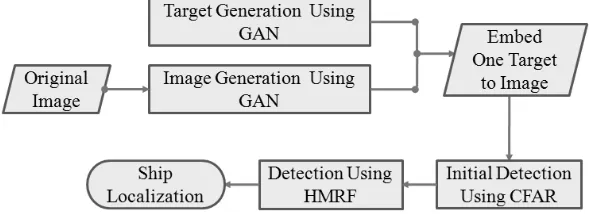
This research proposes a novel ship detection framework that combines GAN and HMRF models. The features of the proposed model are successively inputted into the multistage operators. The framework for the ship detection procedure is described in Fig. 1.
Figure 1. Framework of the proposed method for ship detection.
2.1. Image Generation Technique
The major problem for most adaptive threshold algorithms for ship detection in SAR images is how to determine an appropriate probability density function that can model background clutter well. In real-world applications, however, the accurate estimation of the clutter distribution in these approaches, such as in conventional CFAR detectors, is a challenge. In some cases, the transformation of images into suitable spaces results in a uniform statistical response; however the selection of the probability distribution remains a crucial issue. A GAN can learn data distributions, which does not require the specification of an output distribution [7].
In this work, the conventional GAN model is used to generate the SAR image. A GAN model consists of two players: the discriminator and the generator. The two compete against each other and eventually reach the Nash equilibrium. Given a random noise x with the prior Gamma distribution g(x), the generator Gtransforms it into the training data space as G(x;θg). Then, the discriminator
D(y;θd) outputs the probability that y belongs to the desired data set. Because the objectives of G
and D are adverse to each other, these two modules are trained alternately. The objective function J(D, G), of the classic GAN can be given by
min
G maxD J(D, G) = Ey[logD(y)] + Ex[log (1−D(G(x)))] (1)
The equilibrium is reached by updatingDby ascending the stochastic gradient and then updating the Gby descending its stochastic gradient.
2.2. Image Embedding Technique
In this subsection, an embedding method that fuses a generated target and a large-scale SAR image for detection is designed. One way to embed a target is by fusing region of background and target pixels. A target imageIt can be achieved by using the GAN method.
We define
Ig(i, j) =
It(i, j) (i, j)∈Ω
Ig(i, j) (i, j)∈/Ω (2)
where Ig denotes a large-scale image generated according to the original SAR image I by using the
GAN method.
2.3. Ship Detection Technique
Because of the high inhomogeneity of sea clutter in SAR images, these methods have high sensitivity and a high false-warning rate. To address this problem, the present work applies the GAN model to SAR image generation based on the Gamma distribution and uses a statistical classification approach for ship detection.
For the input SAR imageIg, the aim is to infer a configuration of labels Γ, where Γ (i, j)∈L and
L ={0,1} denote the set of indexes. Expectation maximization (EM) and HMRF [8] are applied for ship detection in the input SAR image Ig. To use the HMRF model for detection, an initial result is
first generated by using the CFAR algorithm.
The initial result provides the initial labels Γ for the maximum a posteriori (MAP) algorithm and the initial parameters Θ for the EM algorithm. According to the MAP criterion, the labeling Γ satisfies
Γ = arg max
Γ {
P(Ig|Γ,Θ )P(Γ)} (3)
The prior probability P(Γ) denotes a Gibbs distribution, and the joint likelihood probability is given by
P(Ig|Γ,Θ ) =
(i,j)
P(Ig(i, j)|Γ (i, j), θi,j) (4)
where P(Ig(i, j)|Γ (i, j), θi,j) denotes a Gaussian distribution with the parameter θi,j = (μi,j, σi,j).
Θ ={θi,j} denotes the parameter set, which can be obtained by using the EM algorithm.
3. RESULTS AND DISCUSSION 3.1. Experimental Results
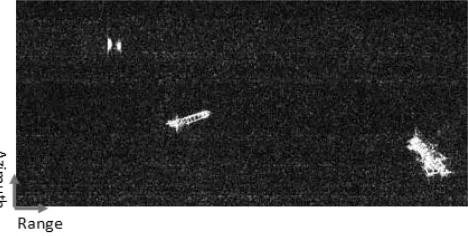
In this section, TerraSAR-X image data are used to test the proposed framework. The pixel resolution is 3.29 meters in the azimuth direction and 1.94 meters in the range direction. The polarization of the image is VV mode. Fig. 2 shows the TerraSAR-X image data, with the size of 183×402. Without loss of generality, it is used to assess the effectiveness of the proposed approach.
Figure 2. Original SAR image.
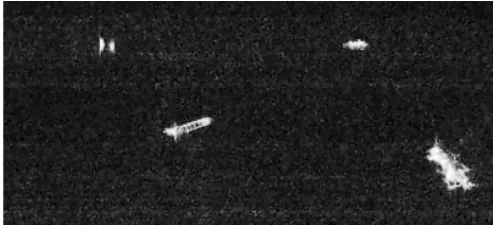
During the experiments, the square-shaped sliding window is set as 28×28 pixels. There are 183∗402 image patches, of which 40000 patches are used as the training dataset. By using the structure [100,512,784], three layers are obtained: the input layer 100, the two hidden layers 100∗512 and 512∗784, and the output layer. The number of epochs is 5000, and the learning rate is 0.0001. Fig. 3 shows the generated image. The result indicates that the GAN makes it easy to achieve an accurate reconstruction at the pixel level. At the top right corner of the image shown in Fig. 3 is one generated virtual target, which is used to reduce the false alarm probability, especially in the SAR image without targets.
Figure 3. SAR image generated by using the GAN. One generated virtual target is at the top right corner.
Figure 4. Initial result obtained with the Weibull-based CFAR detector.
selected as follows: the square-shaped sliding window 25×25 pixels, and the false alarm rate (FAR) Pf a = 10−6. Fig. 4 shows the initial result of the application of the CFAR method. Because of the non-adaptive processing window and the various categories, sizes and structures of targets, the conventional CFAR has limited performance (as shown in Fig. 4).
The initial result provides the initial labels (as shown in Fig. 4) for the MAP algorithm, and the initial parameters for the EM algorithm. The input SAR image (as shown in Fig. 3) is classified into two different classes by using the HMRF method. Fig. 5 shows the detection result obtained with the HMRF model.
Figure 5. Detection result obtained with the HMRF model.
Finally, the virtual target is removed from the HMRF-based result. Fig. 6 shows the final result of the use of the proposed framework.
3.2. Qualitative Discussion
Figure 6. Final detection result obtained with the proposed framework.
Figure 7. Detection result obtained with the Gamma-based CFAR detector.
by choosing design parameters, the square-shaped sliding window of 25×25 pixels, and the false alarm rate (FAR) Pf a = 10−6. In view of the difficulty of using local adaptive threshold algorithms for ship detection, such as CFAR detectors, this work aims to find new and better ways to detect ships in SAR images.
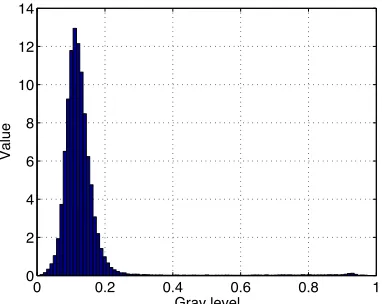
Figure 8 shows the histogram of the image data shown in Fig. 2. The nonhomogeneity of sea clutter in the intensity domain, usually makes it difficult to increase the accuracy of the HMRF model to a very high level, resulting in false alarms. As shown in Fig. 9, the statistical characteristics can be changed by using the GAN algorithm; thus, the HMRF method can achieve a better detection result.
0 0.2 0.4 0.6 0.8 1 0
2 4 6 8 10
Gray level
Value
Figure 8. Histogram of the image data shown in Fig. 2.
0 0.2 0.4 0.6 0.8 1 0
2 4 6 8 10 12 14
Gray level
Value
4. CONCLUSION
This research analyzes the problems in ship detection from the perspective of the information fusion between them. The GAN model is adopted to address the problem of non-homogeneity of sea clutter in the detection task. A statistical classification algorithm is used for target detection. The proposed approach can effectively reduce false alarms and provide good data utilization.
Moreover, it could guarantee the statistical properties of targets and clutter distributions in SAR images. The proposed framework can achieve a good performance for an inhomogeneous sea state and thus has considerable application value.
ACKNOWLEDGMENT
This study was supported in part by the National Natural Science Foundation of China (No. 61501152).
REFERENCES
1. Pappas, O., A. Achim, and D. Bull, “Superpixel-level CFAR detectors for ship detection in SAR imagery,” IEEE Geosci. Remote Sens. Lett., Vol. 15, No. 9, 1397–1401, 2018.
2. Gao, G., S. Gao, J. He, and G. Li, “Adaptive ship detection in hybrid-polarimetric SAR images based on the powerCentropy decomposition,” IEEE Trans. Geosci. Remote Sens., Vol. 56, No. 9, 5394–5407, 2018.
3. Leng, X., K. Ji, X. Xing, S. Zhou, and H. Zou, “Area ratio invariant feature group for ship detection in SAR imagery,”IEEE J. Sel. Topics Appl. Earth Observ. Remote Sens., Vol. 11, No. 7, 2376–2388, 2018.
4. Ai, J., X. Yang, J. Song, Z. Dong, L. Jia, and F. Zhou, “An adaptively truncated clutter-statistics-based two-parameter CFAR detector in SAR imagery,” IEEE J. Oceanic Eng., Vol. 43, No. 1, 267–279, 2018.
5. Li, T., Z. Liu, R. Xie, and L. Ran, “An improved superpixel-level CFAR detection method for ship targets in high-resolution SAR images,” IEEE J. Sel. Topics Appl. Earth Observ. Remote Sens., Vol. 11, No. 1, 184–194, 2018.
6. Gao, G., S. Gao, J. He, and G. Li, “Ship detection using compact polarimetric SAR based on the notch filter,” IEEE Trans. Geosci. Remote Sens., Vol. 56, No. 9, 5380–5393, 2018.
7. Zhan, Y., D. Hu, Y. Wang, and X. Yu, “Semisupervised hyperspectral image classification based on generative adversarial networks,” IEEE Geosci. Remote Sens. Lett., Vol. 15, No. 2, 212–216, 2018.
8. Ghamisi, P., J. Benediktsson, and M. Ulfarsson, “Spectral-spatial classification of hyperspectral images based on hidden markov random fields,”IEEE Trans. Geosci. Remote Sens., Vol. 52, No. 5, 2565–2574, 2016.