Available Online atwww.ijcsmc.com
International Journal of Computer Science and Mobile Computing
A Monthly Journal of Computer Science and Information Technology
ISSN 2320–088X
IJCSMC, Vol. 3, Issue. 11, November 2014, pg.633 – 642
RESEARCH ARTICLE
Improved Space Time Block Coding
Diversity Technique for Rayleigh Fading
Channel in Wireless Systems
Shifali Shoor
PG Student
Department of Electronics and Communication Engg. Punjab Institute of Technology, Kapurthala
PTU Main Campus
Avtar Singh Buttar
Associate Professor
Department of Electronics and Communication Engg. Punjab Institute of Technology, Kapurthala
PTU Main Campus
Abstract— Numerous diversity techniques are used to minimize BER in wireless systems. But, the most effective diversity technique is Space Diversity. Space diversity is utilization of Multiple antenna systems (Multiple Input, Multiple Output -MIMO), which gives a significant enhancement to data rate and channel capacity. Multiple antenna technology can also be used to increase the data rate (spatial multiplexing) instead of improving robustness. Space Diversity is used to overcome the effect of fading .In this paper, Receive diversity is used i.e. using single antenna at Transmitter side and multiple antennas at Receiver side. So, the impact of MIMO system over different modulation technique is analyzed and the performance of the system is evaluated as Bit Error Ratio.
Index Terms— Space time codes, Transmit diversity, Rayleigh fading channel, multipath channels, multiple antennas, wireless communication, MIMO
I.INTRODUCTION
scenario is to provide the better performance at the user end. Random noise, fading effects and Doppler shift destroy the signal strength in wireless channel. As a result, the Bit Error Ratio (BER) increases at the receiving end, which leads to lower the data rate. As conventional methods like using more bandwidth or higher order modulation types are limited, new methods of using the transmission channel have to be used. To maintain the required signal strength, various diversity techniques are used such as Time Diversity, Frequency Diversity, Space Diversity, Polarization Diversity and Angle Diversity[4][5][6][7][8][9][10].The most effective diversity technique is Space Diversity. Space diversity is utilization of Multiple antenna systems (Multiple Input, Multiple Output – MIMO), which gives a significant enhancement to data rate and channel capacity. Multiple antenna technology can also be used to increase the data rate (spatial multiplexing) instead of improving robustness.
Mostly, Space Diversity is used to overcome the effect of fading. In the Space Diversity technique, multiple copies of the signal are sent towards the receiver. The performance of space-time block codes depends on the type of modulation and the number of transmit and receive antennas used. Complex modulations give better bit-error-rate performance than real modulations and it is especially true when the number of transmit antennas is larger than two. This would give a better performance than the same space-time block code with real modulation of rate of one. However, space-time block code with real modulation would have better bandwidth efficiency performance than complex modulation. This is because space-time block codes with real modulation require transmitting less data than space time block codes with complex modulation. On the other hand, space-time block codes with larger number of transmit antennas always give better performance than space-time block codes with lower number of transmit antennas. Space-time coding can improve performance through an effect known as diversity. Diversity is a measure of the average number of channels fully utilized by each piece of information transmitted. The maximum diversity available to a space-time system is NtNr, which is the total number of channels between the transmitter and receiver. When adding new
antennas to a system, the receiver can use the extra channels to improve the probability of correctly identifying the true transmitted signal.
In this paper, an improved STBC technique is proposed and implemented on MIMO system Rayleigh Fading Channel .In this work QAM AND BPSK modulation technique is used. MIMO system using Alamouti STBC coding is done over different QAM modulation (8,16,32,64) and compare the results of STBC coding with BPSK modulation with different number of receiving and single transmitting antennas. The performance analysis for BER is done taking proposed approach QAM modulation technique with other existing PSK modulation technique. The simulation results show that the BER is decreases with increase the number of bits in QAM modulation. It is also observed that with increase in the number of antennas, the bit error rate decrease with approximately two times increase in the number of antennas.
This paper is organized as follows: Section II briefly describes the MIMO system model. Section III brief introduction to STBC and Rayleigh fading channel. Simulation results and discussion are provided in section IV and conclusion is given in section V.
II.MULTIPLE-INPUTMULTIPLE-OUTPUT
A. SYSTEM MODEL
Let us consider a point-to-point MIMO system with nt transmit and nr receive antennas. The block diagram is given in Fig 1,
Let hi,j be a complex number corresponding the channel gain between transmit antenna j and receive antenna i.
Figure 1.
MIMO model with nt transmit antennas and nr receive antennas
transmit antenna j and receive antenna i. If at a certain time instant the complex signals {s
1s
2, · · · ,S
nt} are
transmitted via n
ttransmit antennas, the received signal at antenna i can be expressed as:
(1)
where n
iis a noise term. Combining all receive signals in a vector y, (1) can be
easily expressed in matrix form
y = Hs + n. (2)
y is the n
r× 1 receive symbol vector, H is the n
r× n
tMIMO channel transfer matrix
(3)
s is the n
t× 1 transmit symbol vector and n is the n
r× 1 additive noise vector. Note that the system model
implicitly assumes a flat fading MIMO channel, i.e., channel coefficients are constant during the
transmission of several symbols.
III.SPACETIMEBLOCKCODING
Figure 2: Block diagram of STBC
Let us consider a space-time coded communication system with nt transmit antennas and nr receive antennas. The transmitted
data are encoded by a space-time encoder. At each time slot, a block of m.nt binary information symbols:
(4)
Ct is fed into the space-time encoder. The encoder maps the block of m binary data into nt modulation symbols from a signal set
of constellation M = 2m points. After serial-to-parallel conversion, the symbols:
(5)
The symbols are transmitted simultaneously during the slot t from nt transmit antennas. Symbol is
transmitted from antenna i and all transmitted symbols have the same duration of T sec. The vector in (5) is called a space-time symbol and by arranging the transmitted.
(6)
sequence in an array, a nt* N space-time codeword matrix can be defined. The ith row is the data
sequence transmitted form the i-th transmit antenna and the j-th column is the space-time symbol transmitted at time the received signal vector can be calculated as:
Y = HS +N. (7)
The MIMO channel matrix H corresponding to nt transmit antennas and nr receive antennas can be represented by an nr * nt
matrix:
(8) where the -th element, denoted by hj
i
, is the fading gain coefficient for the path from transmit antenna i to receive antenna j.
A. Alamouti Code
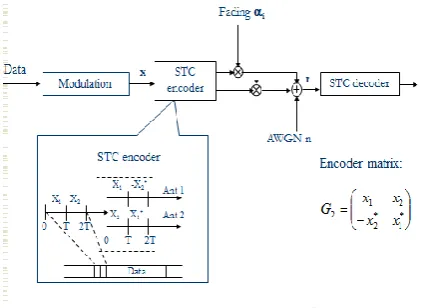
Alamouti system is one of the first space time coding schemes developed for the MIMO systems which take advantage out of the added diversity of the space direction. Therefore we do not need extra bandwidth or much time. We can use this diversity to get a better bit error rate. At the transmitter side, a block of two symbols is taken from the source data and sent to the modulator. Afterwards, the Alamouti space-time encoder takes the two modulated symbols, in this case x1 and x2 creates an encoding matrix
The Alamouti encoding matrix is as follows:
(9)
A block diagram of the Alamouti ST encoder is shown in Figure 3
Figure 3: Alamouti space –time encoder
The Alamouti STBC scheme which has 2 transmit and Nr receive antennas can deliver a diversity order of 2 Nr [2]. Also, since for space time codes the rate is defined as R=k/p (where k is the number of modulated symbols the encoder takes as input and p is the number of transmit antennas) for the Alamouti STBC the rate equals 1.
B. Alamouti STBC with Two Receive Antennas
Alamouti scheme can also be used for multiple antennas at the receiver to achieve receive diversity. Figure 4 shows STBC scheme with two transmit and two receive antennas. Two receive antennas as explained in [3] would increase the diversity gain in comparison to systems with one receive antenna.
Figure 4: Two Branches Transmit Diversity with Two Receive Antennas The received signals, and from two receive antennas, can be written as:
(10)
Two combined signals that are sent to the maximum likelihood detector, the combiner in Figure generates the following outputs
C. Steps of algorithm
Step I: Initiate the total number of bits and total number of antennas Step II: Generate the QAM sequence.
Step III: Transmit signal over Rayleigh channel add white Gaussian noise. Step IV: Compute STBC coding for QAM sequence.
Step V: Compute STBC coding for BPSK signal. Step VI: Compute the hard decision decoding.
Step VII: Calculate the BER by comparing the input and output signals.
IV.SIMULATION RESULTS AND DISCUSSIONS
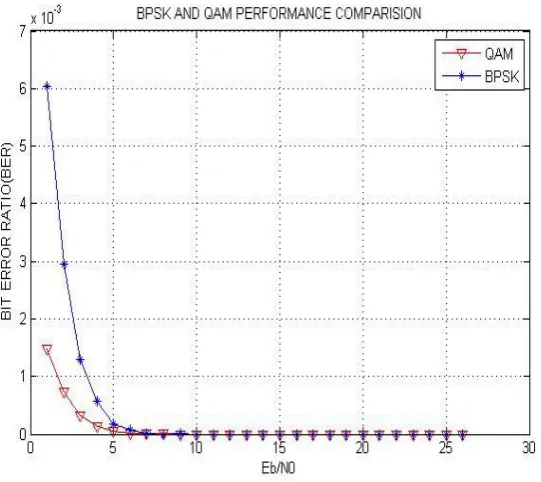
In this section we have evaluated performance of STBC-MIMO system with different modulation techniques in term of BER and SNR. The performance with various data length and different antennas is evaluated .The results shows that with the increase in number of receivers BER decreases. Finding shows that with the increase in constellation points the performance of system improved it is seen from the results that the BER in case of QAM is much lower than BPSK.
Table 1
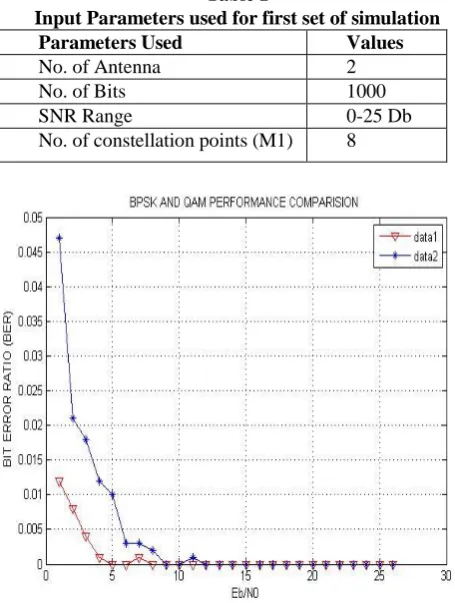
Input Parameters used for first set of simulation
Parameters Used Values
No. of Antenna 2
No. of Bits 1000
SNR Range 0-25 Db
No. of constellation points (M1) 8
Figure 5: BER vs SNR for 8QAM and BPSK modulation technique (1000 bits) with two antennas.
Figure 5 shows the BER comparison graph of the BPSK and 8 QAM using 2 antennas. From the graph it is clear that at 1db SNR, QAM has BER 0.0120 and BPSK has BER 0.0470.In case of QAM, BER approaches zero at 8db but BER becomes zero in case of BPSK at 9db.
Table 2
Input Parameters used for second set of simulation
Parameters Used Values
No. of Antenna 4
SNR Range 0-25 dB No. of constellation points (M1) 8
Figure 6: BER vs SNR for 8QAM and BPSK modulation technique (1000 bits) with four antennas
Figure 6, shows the BER comparison graph of the BPSK and 8 QAM using 4 antennas. From the graph it is clear that at 1db SNR, QAM has BER 0.0020 and BPSK has BER 0.0060. In case of QAM, BER approaches to zero at 2db but BER becomes zero in case of BPSK at 5db.
Table 3
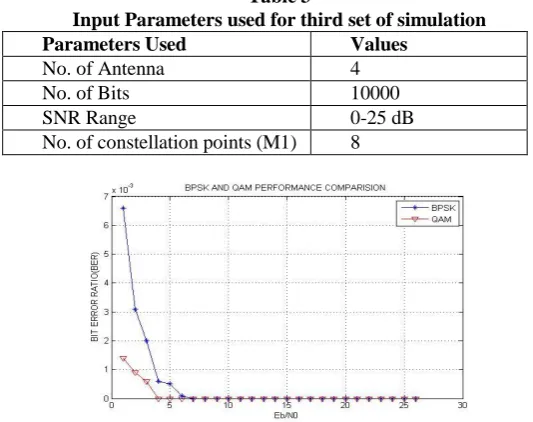
Input Parameters used for third set of simulation
Parameters Used Values
No. of Antenna 4
No. of Bits 10000
SNR Range 0-25 dB
No. of constellation points (M1) 8
Figure 7, shows the BER comparison graph of the BPSK and 8QAM using 4 antennas. From the graph it is clear that at 1db SNR, QAM has BER 0.0014 and BPSK has BER 0.0066. In case of QAM, BER approaches to zero at 4db but BER becomes zero in case of BPSK at 7db.
Table 4
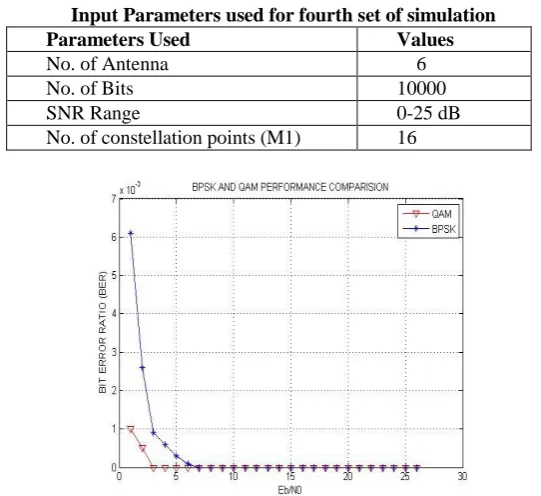
Input Parameters used for fourth set of simulation
Parameters Used Values
No. of Antenna 6
No. of Bits 10000
SNR Range 0-25 dB
No. of constellation points (M1) 16
Figure 8: BER vs SNR for 16QAM and BPSK modulation technique (10000bits) with six antennas
Figure 8 shows, shows the BER comparison graph of the BPSK and 16QAM using 4 antennas. From the graph it is clear that QAM performs better than BPSK. BER of QAM approaches to zero at 3db exponentially than BPSK.
Table 5
Input Parameters used for fifth set of simulation
Parameters Used Values
No. of Antenna 6
No. of Bits 1000000
SNR Range 0-25 dB
Figure 9: BER vs SNR for 16QAM and BPSK modulation technique (1000000bits) with six antennas
Figure 9, shows the BER comparison graph of the BPSK and 16QAM using 4 antennas. From the graph it is clear that QAM performs better than BPSK.
Table 6
Input Parameters used for sixth set of simulation
Parameters Used Values
No. of Antenna 4
No. of Bits 1000000
SNR Range 0-25 dB
No. of constellation points (M1) 64
Figure 10 shows the BER comparison graph of the BPSK and 64 QAM using 4 antennas. From the graph it is clear that QAM performs better than BPSK.
V.Conclusion
In this paper, the performance of MIMO systems are evaluated for Alamouti and STBC via both theoretical analysis and simulation results. In both scenarios, the use of QAM Modulation provides a significant performance improvement over the use of BPSK Modulation. Changing the order of QAM from 32 to 64 reduces the BER from 0.004 to 0.003. In this paper we have proposed the technique to improve the BER of MIMO wireless system over Rayleigh fading channels. From the observations from the simulation we can conclude that: The proposed technique performs better than BPSK technique. Multiple antenna technology can also be used to increase the data rate (spatial multiplexing) instead of improving robustness. With the increase in number of receive antennas, BER decreases Finding shows that with the increase in number of constellation points the performance of system is improved. Complex modulations give better bit-error-rate performance than real modulations and it is especially true when the number of transmit antennas is larger than two. Space-time coding can improve performance through an effect known as diversity.BER in case of QAM is much lower than BPSK.
R
EFERENCES[1] V. Tarokh, H. Jafarkhani, A.R. Calderbank, ”Space-time block coding for wireless communications: Performance results,” IEEE Journal
on Sel. Areas in Com., vol.17, no. 3, pp. 451-460, Mar. 1999.
[2] V. Tarokh, N. Seshadri, A. R. Calderbank, “Space-Time Codes for High Data Rate Wireless Communication: Performance Criterion and
Code Construction”, March 1998.
[3] S. Alamouti, "A Simple Transmit Diversity Technique for Wireless Communications," 1998.
[4] J.C. Guey, M. P. Fitz, M. R. Bell, and W.-Y. Kuo, “Signal design for transmitter diversity wireless communication systems over Rayleigh fading channels,” in Proc. IEEE VTC’96, Apr. 1996.
[5] A. Hiroike, F. Adachi, and N. Nakajima, “Combined effects of phase sweeping transmitter diversity and channel coding,” May 1992. [6] G. Raleigh and J. M. Cioffi, “Spatio-temporal coding for wireless communications,” 1996,
[7] C.-E. W. Sundberg and N. Seshadri, “Coded modulation for fading channels: An overview,” May 1993.
[8] V. Weerackody, “Diversity for direct-sequence spread spectrum system using multiple transmit antennas,” May 1993
[9] J. Winters, J. Salz, and R. D. Gitlin, “The impact of antenna diversity on the capacity of wireless communication systems,” Feb./Mar./Apr. 1994.
[10] N. Balaban and J. Salz, “Dual diversity combining and equalization in digital cellular mobile radio,” May 1991.