© 2016, IRJET | Impact Factor value: 4.45 | ISO 9001:2008 Certified Journal | Page 172
Modelling and Analysis of Single Circular Grooves Made On Dry Friction
Clutches
Namrata Ashok Narkhede
1, Prof. Dheeraj Varma
21Student of Mechanical Engineering, (CAD-CAM) 2 Head of Department, Mechanical Engineering, Padmashri. Dr. V.B Kolte College of Engineering, Malkapur, Dist Buldana.
Abstract:
We all know that clutch is a machine member and is generally used for to engage and disengage the transmission and change the gear it connect the two shafts that is driving shaft to the driven shaft that’s why if there is starting or stop the driven shaft there will be with or without the stopping of the driving shaft. So in this paper we are going to modelling and analyzed the single circular grooves which are made on the friction disc.And also will take the result of the torque transmission capacity which will be produce at the single circular grooves disc. Here we are going to analyze over ansys and will take the model in catiav5.
KEY WORDS: clutch, single circular grooves, torque, lining material etc.
1.
INTRODUCTION
Clutch is a machine part which is generally used in the vehicles that is in two wheeler four wheeler vehicles but here we are introducing for the four wheeler cars clutch. In this the clutch have been situated in between the gear box and the transmission system hence connect to the driving shaft to that of the driven shaft. There are generally the clutch have been classify in between four types i.e. single plate , multiplate clutch, centrifugal clutch and cone clutch. When there is the working of clutch take place there is a huge amount of heat dissipation take place and at that time the wear takes place and hence we choose the clutch plate like which should transfer the torque properly in the needed range and the less wear occurs at that time of transmission and the one issue will be there that at that time the heat which get occurs at that time should be transferred from the grooves made on that of the clutches hence it’s also very important that the which grooves are to be on that of the clutch disc or plate . Generally there are so
many types of grooves gets discovers that is spiral grooves, spiral circular grooves and double circular grooves, sunburst grooves etc. above which we are going to know the single circular grooves details like its torque transmission capacity. By analyzing the deformation, von misses stresses and heat flux. THE STANDARD TORQUE TRANSMITTING CAPACITY OF THE CLUTCH IS 69 Nm.
2.
LITERATURE SURVEY
Newcomb [1] who discovered the two typical torque-time variations were discussed and a comparison takes place when there is assumed that the torque is constant.
G. K. Gangwar, Madhulika tiwari, has research in "Modeling and Simulation in hydraulic Energy Saving System: An Overview" [12] stated that by using the flywheel technology or hydraulic accumulator the effective conservative energy can produce in the hybrid vehicle.
© 2016, IRJET | Impact Factor value: 4.45 | ISO 9001:2008 Certified Journal | Page 173 Karanjkar A. S., Barve P. C., Adhav R. B., Pandey M. D.,
Prof. Londhe B. C., Prof. Bhane A. B.[9], "Modeling and Simulation of Multi-Drive Clutch (ISSN 2347-6435(Online) Volume 4, Issue 4, April 2015) they have stated in this paper the design of clutch by combining the operation of the centrifugal action in the single plate clutch system of the transmission mechanism to overcome the wearing effect when there is the transmission of power from one shaft to that of the other shaft that is from driving shaft to the driven shaft.
P.Naga Karna, Tippa Bhimasankara Rao, [11] " Analysis of Friction Clutch plate using FEA", e-ISSN: 2278-067X, p-ISSN: 2278-800X, Volume 6, Issue 2 (March 2013), PP. 81-87 they have compared the two materials like aluminum and the steel of wet clutch plates by taking the observations of the stress distribution and the temperature distribution of the clutch plate by taking the dimensions of the plate in existence and also take models in the pro-e and the analysis have been taken by using the ansys.
3. MODEL MAKING IN CATIA V5
Models of grooved friction surface are designed in CatiaV5. Design specifications:
Inner radius of friction surface= 0.06 m o Outer radius of friction surface= 0.085 m Thickness of friction surface= 0.004 m Depth of groove cut= 0.002 m
Inner radius of supporting plate= 0.020m Outer radius of supporting plate=0.0825m Thickness of supporting plate = 0.001 m
4.
THE TWO DIMENSIONAL MODEL OF
SINGULE CIRCULAR GROOVES CLUTCH
PLATE
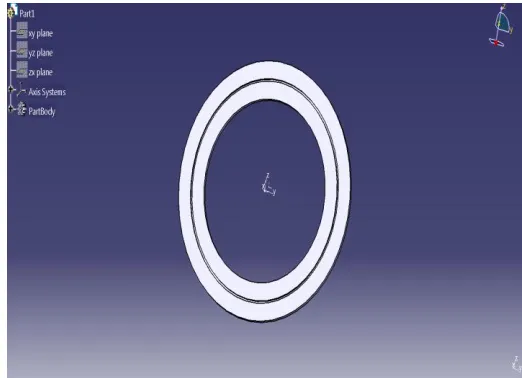
[image:2.612.340.556.82.264.2]Model of friction plate with Single Circular grooves is prepared in CATIA V5. The dimensions of this are as follows:
Fig 1. Friction plate with Single Circular grooves
[image:2.612.316.577.320.509.2]© 2016, IRJET | Impact Factor value: 4.45 | ISO 9001:2008 Certified Journal | Page 174
5.
ANALYSIS
OF
SINGLE
CIRCULAR
GROOVES MADE ON DRY FRICTION
CLUTCH PLATE
5.1 Thermal analysis of the clutch
[image:3.612.320.579.197.370.2]Fig 3. Application of pressure on friction plate
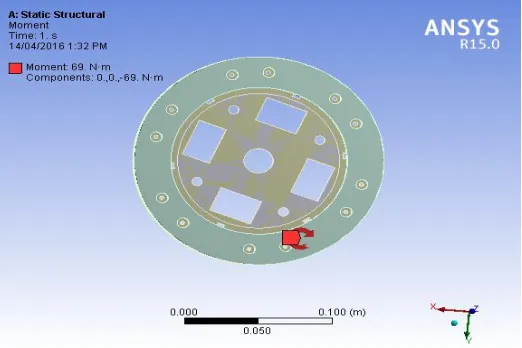
Fig 4. Application of torque on friction plate
Similarly boundary conditions and pressure, torque is applied on different models. Then results obtained from this analysis are further compared.
6.
RESULTS AND DISCUSSION
Analysis of above grooved friction surfaces are
listed in the groups. This analysis has given
following results:
6.1 Total deformation
Fig 6. Total deformation in friction plate with Single Circular grooves
The above model has given maximum deformation as 1.9013e-5 m. The maximum deformation is on friction
plate.
6.2 Von misses stresses
[image:3.612.38.299.391.565.2] [image:3.612.320.581.496.670.2]© 2016, IRJET | Impact Factor value: 4.45 | ISO 9001:2008 Certified Journal | Page 175
Fig 8. Von-misses stresses in friction plate with Single Circular grooves
The above model has given maximum Von-misses stresses as 1.3378e7 Pa. The maximum stress is on
[image:4.612.37.286.74.258.2]supporting plate.
Fig 9. Heat Flux in friction plate with Single Circular grooves
The above model has given maximum Heat Flux as 14503 W/m2.
The values of Total deformation, Von-misses Stress, Normal reaction force, Heat Flux can be compared as follows:
6.3
Comparison of Total deformation, von
misses stress and heat flux in grooved
designs
S r . N o .
Type of grooves
Von misses stress(Pa)
Deformation (m)
Heat flux (W/m2)
Normal reactio n force(N )
1 Single Circular groove
1.3378 e7 1.901 e-5 14503 2142.5
6.4 Calculation of Torque transmitting
capacity
Friction disc with Single Circular grooves T=2*0.2*2142.5*0.0725
T=62.131 Nm.
7.
CONCLUSION AND FUTURE SCOPE
Conclusion
From above observations, maximum torque that can be effectively transmitted with Single Circular groove pattern which is 10.43% more than that of 23o Inclined grooves. With extra
cooling effort this model is better to get maximum torque transmitting capacity.
Future scope
The above results can be tested by fabricating test model which will use torque sensor to measure torque transmitting capacity of single plate dry friction clutch.
8. REFERENCES
[image:4.612.37.288.358.555.2]© 2016, IRJET | Impact Factor value: 4.45 | ISO 9001:2008 Certified Journal | Page 176 2) Karanjkar A. S., Barve P. C., Adhav R. B., Pandey M.
D., Prof. Londhe B. C., Prof. Bhane A. B.[9(ISSN 2347-6435(Online) Volume 4, Issue 4, April 2015)
3) P.Naga Karna, Tippa Bhimasankara Rao, [11] " e-ISSN: 2278-067X, p-e-ISSN: 2278-800X, Volume 6, Issue 2 (March 2013), PP. 81-87
4) Shrikant V. Bhoyar, G.D. Mehta, J.P. Modak, [13] 14th July 2013, Tirupati, India, ISBN: 978-81-927147-9-0
NEWCOMB, T. P, “Calculation of Surface Temperatures Reached in Clutches When the Torque Varies with Time”, J. Mech. Engineering. Sci., 1961, 3, pp-340.
[1] Yong G. Lai , “Transient Effects On Heat Conduction In Sliding Bodies”, Numerical Heat
Transfer, Part A: Applications 33, pp. 583-597 (1998).
[2] E. A. Al-Bahkali& J. R. Barber, “Nonlinear Steady State Solution for a Thermo elastic Sliding System Using Finite Element Method”, J. Thermal Stresses 29, pp 153–168 (2006).
[4]Ganesh Raut, Anil Manjare, P Bhaskar “Analysis of Multidisc Clutch Using FEA” International Journal of Engineering Trends and Technology (IJETT) – Volume 6 Number 1- Dec 2013
[5]Oday I. Abdullah, Josef Schlattmann (AMEA) 121 Vol. 2, No. 1, 2012, ISSN 2167-6380 [6] B. Nivas. M.E1, M. Nithiyanandam. M.E 2, Design and Analysis of Clutch Plate Using Steel Material [En – Gjs400 -15steel]
6)G. K. Gangwar, Madhulika tiwari International Journal of Research in Aeronautical and Mechanical Engineering, Vol.1 Issue.8, December 2013
7) Karanjkar A. S., Barve P. C., Adhav R. B., Pandey M. D., Prof. Londhe B. C., Prof. Bhane A. B.[9(ISSN 2347-6435(Online) Volume 4, Issue 4, April 2015)
8) P.Naga Karna, Tippa Bhimasankara Rao, [11] " e-ISSN: 2278-067X, p-e-ISSN: 2278-800X, Volume 6, Issue 2 (March 2013), PP. 81-87
9) Shrikant V. Bhoyar, G.D. Mehta, J.P. Modak, [13] 14th July 2013, Tirupati, India, ISBN: 978-81-927147-9-0
Books:
[1] A Text book of Machine Design Eurasia Publishing
House (Pvt) Ltd, 2010 - R.S. Khurmi& J.K. Gupta
[2] PSG Design Data‖, KalaikathirAchchagam, 2003 [3] Norton L.R Machine Design – An integrated
Approach Pearson Education,2005
[4] Shigley , J.E Mechanical Engineering Design Mcgraw Hill 1985
[5] Boltzharol A Material Handling Hand book, The Ronald Press Company 1958
[6] Design Data Book [PSG]