BTG-based Machine Translation with Simple Reordering Model
using Structured Perceptron
Hao Wang
Graduate School of Information, Production and Systems,
Waseda University oko [email protected]
Yves Lepage
Graduate School of Information, Production and Systems,
Waseda University [email protected]
Abstract
In this paper, we present a novel statistical machine translation method which employs a BTG-based reordering model during decod-ing. BTG-based reordering models for pre-ordering have been widely explored, aiming to improve the standard phrase-based statisti-cal machine translation system. Less attention has been paid to incorporating such a ing model into decoding directly. Our reorder-ing model differs from previous models built using a syntactic parser or directly from anno-tated treebanks. Here, we train without using any syntactic information. The experiment re-sults on an English–Japanese translation task show that our BTG-based decoder achieves comparable or better performance than the more complex state-of-the-art SMT decoders.
1 Introduction
The phrase-based method (Koehn et al., 2003) and the syntax-based method (Yamada and Knight, 2001) are two of the representative methods in sta-tistical machine translation (SMT). On the one hand, in the phrase-based model, the lexical reordering model is a crucial component, but it is often be crit-icized, especially when translating a language pair with widely divergent syntax like English-Japanese, as the na¨ıve distance-based lexical reordering model does not work so well when applied to longer re-orderings. On the other hand, in syntax-based SMT method, word reordering is implicitly addressed by translation rules. The performance is thus directly subject to the parsing errors of the syntactic parser.
Syntax-based translation models are usually built from annotated treebanks to extract grammar rules for reordering (Genzel, 2010). Such reordering models are thus more difficult to train. Between these two models, some loose hierarchical structure models have been proposed: the hierarchical phrase-based model (Chiang, 2007) and or the Bracketing Transduction Grammar (BTG) based model (Wu, 1997). Compared with the hierarchical phrase-based model, the BTG model has many advantages like its simplicity. Also, its well-formed rules avoid ex-tracting a large number of rare or useless translation rules, as is the case of the hierarchical phrase-based model.
In recent proposals, phrase-based statistical ma-chine translation has been shown to improve when BTG-based preordering is applied as a preprocess-ing (DeNero and Uszkoreit, 2011; Neubig et al., 2012; Nakagawa, 2015). The idea behind preorder-ing is to reduce the structural complexity. It is preferable to apply the reordering operations in ad-vance rather than during decoding as this benefits the word alignment step.
In this paper, following (Xiong et al., 2008), we propose to incorporate the BTG-based reorder-ing model directly into the decodreorder-ing step of a BTG-based SMT system using a simple Structured Perceptron (Rosenblatt, 1958; Collins and Roark, 2004). The rest of the paper is organized as follows. Section 2 briefly introduces previous BTG-based re-ordering methods both for prere-ordering or determin-ing the reorderdetermin-ings durdetermin-ing decoddetermin-ing. Section 3 de-scribes the principal model used in BTG-based ma-chine translation. Section 4 gives the details of the
kyoto station was renamed as shichijo station
inverted straight
京都 駅 を
was renamed as shichijo station
七条 駅 に 改称
was renamed as
:
Ja: En:
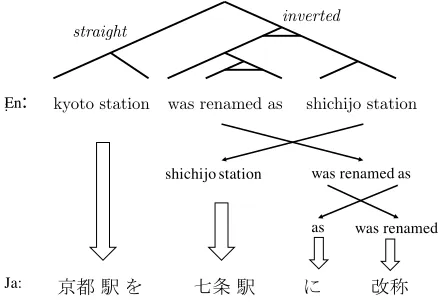
Figure 1: Example of translating a source sentence (En-glish) into Japanese while reordering at the same time us-ing a BTG tree.
proposed method and the model combination in the system construction. Section 5 reports the results of the experiment on an English-to-Japanese trans-lation task. We conclude in Section 7.
2 Using Linguistic Contexts for BTG-based Reordering
A common problem in the distortion reordering models (Tillmann, 2004; Koehn et al., 2005; Gal-ley and Manning, 2008) used in phrase-based SMT (PB-SMT) method is that they do not take contexts into account. Hence, we draw our attention on using linguistic-context information for reordering.
Bracketing Transduction Grammar (BTG) (Wu, 1997) is a binary and simplified synchronous context-free grammar with only one non-terminal symbol. It has three types for the right hand side of the rules γ: S–straight keeps the order of child nodes,I–inverted reverses the order, and T– terminalgenerates a terminal symbol.
X →γ =
[X1X2] straight < X1X2> inverted f /e terminal
(1)
whereX, X1, X2are non-terminal symbols andf /e
is a source/target phrase pair. BTG provides an easy and simple mechanism for modeling word permuta-tion across languages. Figure 1 illustrates this mech-anism.
There exists some solutions for BTG grammar in-duction, which typically focus on unsupervised
ap-proaches, like inside-outside algorithm (Pereira and Schabes, 1992) for probabilistic context-free gram-mar (PCFG), monolingual bracketing representation (Klein and Manning, 2002) or bilingual bracketing grammar induction (Wu, 1995). The common prob-lem is that these models suffer from a higher com-putational complexity.
Some supervised versions focus on supervised ap-proach, ranging from simple flat reordering model (Wu, 1997), maximum-entropy based model (Zens and Ney, 2006; Xiong et al., 2008) and Tree Kernel-based SVM (Zhang and Li, 2009). Other approaches, use pre-annotated treebanks to train a monolingual/synchronous parser (Collins and Roark, 2004; Genzel, 2010). In this case, the rules are learned directly from the treebank. The major-ity of works (Zhang and Gildea, 2005; Xiong et al., 2008) rely on syntactic parsers available in one of a source or target language.
via online training using simple structured Percep-tron algorithm. Differing from the mentioned meth-ods to pre-reorder the sentence before the phase of decoding, in this paper; we propose to build a re-ordering model directly for building a BTG-based decoder.
3 BTG-based Machine Translation
Given the three types of rules in Equation 1, we define a BTG derivation D as a sequence of inde-pendent operations d1, . . . , dK that apply
bracket-ing rules X → γ as each stage when parsing a
source-target sentence pair < f,e >. We write
D = [d1, . . . , dk, . . . , dK]. We can produce one
single BTG tree accordingly for one givenD. The
probability of a synchronous derivation (parse tree) under the framework of Probabilistic Synchronous Context Free Grammar (PSCFG) is computed as:
P(D) = ∏
d∈D
P(d:X →γ) (2)
whered:X → γ stands for the derivation with the grammar ruleX→γ. Given an input sentence pair <f,e >and the word alignmenta, the problem of
finding the best derivationD˜can be defined as: ˜
D= arg max
D
P(D|e,f,a) (3)
In the real case of machine translation, we do not know the word alignmentawhen training set is the
parallel corpus. In order to find the best translation ˜
efrom all translation candidates, we assume two
la-tent variablesa,Dwere required as following:
˜
e= arg max
e P(e|f) (4)
∝ arg max
e P(e,D,a|f) (5) ∝ arg max
e P(D|a,f,e)×P(a|f,e)×P(e)(6)
In Equation 6,P(e)is the language model anda,D
are latent variables that should be learnt from the training data. The generative story of Equation 6 is understood as follows: Once we found the hid-den word alignment a with an alignment model P(a|f,e)and the hidden derivationD using BTG-based reordering modelP(D|a,f,e), we can
trans-late the input source sentencefwith the target
trans-lation˜e.
kyoto station was renamed as shichijo station
kyoto station shichijo station as was renamed f:
f′:
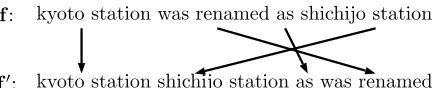
Figure 2: Example of preordering a source sentence given the target word order.
3.1 Training Alignment Model
There are two sub-models in Equation 6, one is the alignment model P(a|f,e)and the other one is the reordering model P(D|a,f,e). Since
state-of-the-art alignment methods yield high-quality word-to-word alignments, it is not necessary to design a new alignment model to obtain the intermediate variable
a. We use the standard method to get word-to-word
alignments.
3.2 Training Reordering Model
Recently, some research also showed that treating the parse tree as latent variables (Loehlin, 1998) can benefit the BTG tree inference but for preorder-ing (see Figure 2). The reorderpreorder-ing model is trained to maximize the conditional likelihood of trees that license the reorderings implied by observed word alignments in a given parallel corpus. For exam-ple, Neubig et al. (2012) proposed a BTG-based re-ordering model trained from word-aligned parallel text directly. With assuming that there is an under-lying derivationDthat producedf′, wheref′ is the
reordered source sentence given the corresponding target word orders under the constraints of BTGs.
f −−−−−−−−−−→preordering withD
a f
′ (7)
To learn such a reordering model, they handled the derivations D as a latent variable directly from
the source side linguistic contexts. The objective function in their work can be represented as:
˜
f′ = arg max
f′ Score(f
′,D|f) (8)
Since their model is based on reorderingsf′licensed by BTG derivationsD, notesD →f′, the objective
function also can be written as:
˜
D= arg max
Algorithm 1:Training the Reordering Model
Input :Training data{⟨e,f,a⟩}L0
Output:Feature weightsπforR
1 foreachiterationtdo
2 foreachexample⟨e,f,a⟩do
3 Dˆ = arg max
D R
(D|f);
4 D∗ = arg max
D∧Constraint(D,a,e,f)R
(D|f);
5 if D ̸ˆ =D∗ then
6 π ←π+R(D∗,f)− R( ˆD,f);
7 end
8 end
9 returnπ;
10 end
The training algorithm (see Algorithm 1) can be de-scribed briefly as following: The parser first pro-duces a system derivation Dˆ with the maximum model score givenf. If Dˆ is not licensed by BTG constraints also given(e,a), we consider the parser
entered a failure state and stop it. Anotheroracle derivationD∗ was also selected, which satisfied the
constraint of BTGs (notesConstraint(D,a,e,f) =
true). If the system derivation Dˆ and the
ora-cle derivationD∗are not equivalent, we update the
model weightsπtowardsD∗.
Like all structured prediction learning frame-works, the online Structured Perceptron is costly to train as training complexity is proportional to infer-ence, which is frequently non-linear in the length of example. To train the reordering model, we employ an in-house parser2which uses Batch Perceptron. It
is a modified and boosted version of the original top-down parser (Nakagawa, 2015), which allows us to train on the whole training set3.
4.2 Decoding
In decoding, we follow (Och and Ney, 2002; Chi-ang, 2007). That is, we remove the target side and use a more general linear model composition over
2https://github.com/wang-h/HieraParser
3We skip the sentences which cannot be parsed under the constraints of BTGs.
derivations:
˜
e= arg max
e P(e,D|f) (13)
∝ arg max
D→e ∏
iΦi(D)λi (14)
where eachΦiis a sub-model score function andλis
the corresponding weight. For each arbitrary score functionΦiwith a derivationD, we decompose it as
a chain of independent derivationsdwith BTG rules X →γ:
Φi(D) = ∏
d∈D
Φi(d:X →γ) (15)
Therefore, given an input sentence f = f1, . . . , fn,
notesfn
1, the task to translate an input source
sen-tence can be solved by finding the derivation with maximal score in Equation 14, which uniquely de-termines a target translationˆe(em
1 ) with this latent
derivationD.
The decoder needs to generate all derivations for each segment spanning fromfi tofj (0 ≤i < j ≤
n). Since our goal is to find the best derivation Dˆ
that covers the whole input sentence [f1, . . . , fn],
we employ a CKY-style decoder to generate the best derivationDˆ for each source sentence. This yields the best translationˆe(em1 ) at the same time.
4.2.1 The-LM -RMDecoder
The integration of a standard n-gram-based lan-guage model into a CKY-style decoder is not easy as in the standard phrase-based method (Koehn et al., 2003). Following (Chiang, 2007), we first intro-duce the -LM -RM model in which the reordering and language model are removed from the decoding model:
w(D) = ∏
i /∈{RM,LM}
Φi(D)λi (16)
Using the deductive proof system (Shieber et al., 1995; Goodman, 1999) to describe our-LM -RM de-coder, the inference rules are the following:
X→f /e
[X, p, q] :w (17)
X → ⟨X1, X2⟩: [X1, p, r] :w1 [X2, r+ 1, q] :w2
[X, p, q] :w1w2 (18)
X→[X1, X2] : [X1, p, r] :w1 [X2, r+ 1, q] :w2
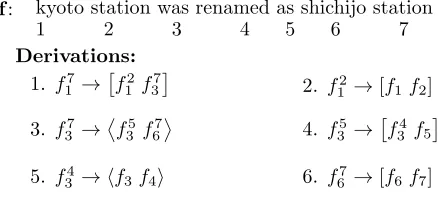
whereX → γ is the derivation rule,[X, p, q]is the subtree rooted in a non-terminalX (see Section 2), wis the model score defined in Equation 16. When all terms on the top line are true, the item on the bottom line is derived. The final goal for the decoder is[f,1, n], wheref is the whole source sentence.
During decoding, the -LM -RM decoder flexi-bly explores the derivation without taking reordering into account. This strategy is a simple way to build a CYK-style decoder, but the decoder requires very large beam size to find the true best translation. In-corporating theLMandRMmodel directly into the translation construction will improve efficiency.
4.2.2 The+LM +RMDecoder
The computational complexity of online strategy is reduced by using dynamic programming and in-corporating the language model and the reordering model into decoding. The similar method has been described in (Chiang, 2007). The decoder integrated with the n-gram language model is called: “+LM de-coder”. In our case, we also need to integrate the re-ordering model, so we call it “+LM +RMdecoder”. Given the inference rules described in Equations 17– 19, we describe the+LM +RMdecoding algorithm using Equations 20–23.
In our case, the reordering model affects comput-ing the language model score if the derivation re-quires to swap the target sub-charts. We can calcu-lateΦRM(X)by just taking the model score as the
product of two sub-chartsΦRM(X1)andΦRM(X2)
with current reordering scoreΦRM(X →γ). Since R is a log-linear expression, we compute the
re-ordering scoreR(X)for a given spanX : [X, p, q] that consists ofX1: [X1, p, r]andX2 : [X2, r+1, q]
with a grammar ruleX→γ as:
R(X) =R(X1) +R(X2) +P(X →γ) (24)
When we merge the chartX1 : [X1, p, r]withX2 :
[X2, r+ 1, q]using the ruleX → γ, we update the
total score for the composition model after applying each rule dynamically, we call this the+RM strat-egy. The BTG terminal rule (T : X → f /e) is
used to translate the source phrase f into the
tar-get phrase e while the straight and inverted rules
(S : X → [X1X2]andI : X →< X1X2 >) are
used to concatenate two neighbouring phrases with
astraightorinvertedorder as following:
eyx =
{
e1·e2, X→[X1X2]
e2·e1, X → ⟨X1X2⟩ (25)
where · stands for concatenation between strings. After having decided the word order on the target side, we compute the score in the language model, noted L(·)4. The language model score PLM(eyx)
depends on the preceding N − 1 words for any
eyx(|eyx| ≥ N,1 ≤ x < y ≤ m). It is computed
as:
PLM(eyx) = ∏
x≤z≤y
p(ˆez+N−1|ˆez. . .eˆz+N−2) (26)
The language model score function L(eyx) depends
on the rule typeγas follows:
L(eyx) =
PLM(eyx+1), |eyx|=|em1 |
0, |eyx|< N
PLM(eyx+N), otherwise
(27)
To determine whether we have the case|eyx|=|em1 |,
we assume that, if the span of X : [X, p, q]covers the entire source sentencef1n asX : [X,1, n], then
the target translationeyx should also cover the entire
target sentence. On the basis of +RM decoder, we add the+LMcomponent into the decoder and build a +LM+RM decoder for CYK-style bottom-up de-coding. cube pruning (Chiang, 2007) was also ap-plied to speedup the decoder.
4.2.3 Model Combination
HieraTrans is our newly-developed in-house BTG-based SMT translation platform. It adopts the constraints of BTG in both phrase translation and reordering. We combine the models in a log-liner manner as shown in Equation 14. The feature func-tions employed by HieraTrans are:
• Phrase-based translation models (TM): direct and inverse phrase translation probabilities, di-rect and inverse lexical translation probabili-ties.
• Language model (LM)
4For the case of start-of-the sentence and end of the sen-tence, we wrap the target sentence e(em
1 ) asˆe = ˆem1+h = ⟨s⟩N−1em
X→f /e
[X, p, q] :w[L(e)]λL (20)
X → ⟨X1, X2⟩: [expP(X → ⟨X1, X2⟩)]λR [X1, p, r] :w1 [X2, r+ 1, q] :w2
[X, p, q] :w1w2[expR(X)]λR[L(e2+e1)]λL
(21)
X→[X1, X2] : [expP(X →[X1, X2])]λR [X1, p, r] :w1[X2, r+ 1, q] :w2
[X, p, q] :w1w2[expR(X)]λR[L(e1+e2)]λL
(22)
X1 →f1/e1, X2→f2/e2 (23)
• Reordering models (RM):straightandinverted
scores combined within the log-linear frame-work.
• Penalties (PM): word penalty, phrase penalty, unknown word penalty.
The weights for each feature are tuned and estimated using the minimum error rate training (MERT) algo-rithm (Och, 2003).
5 Experiment
5.1 Experimental Setup
To evaluate our system, we conducted translation ex-periments on the KFTT Corpus (English–Japanese) and compared our system with baseline phrase-based (PB) and hierarchical phrase-phrase-based (HPB) SMT implementations in Moses5 (Koehn et al.,
2007). For each language, the training corpus is around 330,000 sentences. The development set contains nearly 1,235 sentences and nearly 1,160 sentences used for testing. We use the default train-ing set for traintrain-ing translation model, and traditional lexical (Koehn et al., 2005) reordering model or our proposed BTG-based reordering model, and also tar-get language model. We use the default tuning set for tuning the parameters and the default test set for evaluation.
For word alignment, we train word alignments in both directions with the default settings, i.e., the standard bootstrap for IBM model 4 alignment in
GIZA++ (15H53343). We then symmetrize the
word alignments usinggrow-diag-final-and(+gdfa) and the standard phrase extraction heuristic (Koehn et al., 2003) for all systems. In our experiment, the maximum length of phrases entered into phrase table
5http://www.statmt.org/moses/
is limited to 7, and we input only the top 20 trans-lation candidates. The language model storage of target language uses the implementation in KenLM (Heafield, 2011) which is trained and queried as a 5-gram model. For distortion model in phrase-based SMT baseline, we set the distortion limit to 6.
Word alignments used for training the reorder-ing model are the intersection of both asymmet-rical alignments in each mono-direction output by GIZA++6 (Och and Ney, 2003). For pos-tagging,
we make use of the Stanford Log-linear POS Tag-ger7 (Toutanova and Manning, 2000). To produce
word class tags for each source word, we use the implementation of (Liang, 2005)8of Brown’s
clus-tering algorithm (Brown et al., 1992). The size of the class tags is fixed to256.
For tuning, the optimal weights for each feature are estimated using the minimum error rate training (MERT) algorithm (Och, 2003) and parameter opti-mization with ZMERT9(Zaidan, 2009).
5.2 Experiment Results
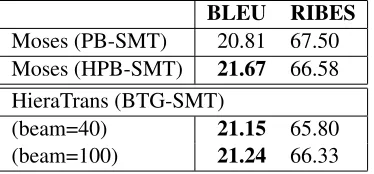
For evaluation of machine translation quality, stan-dard automatic evaluation metrics are used, like BLEU (Papineni et al., 2002) and RIBES (Isozaki et al., 2010) in all experiments. BLEU is used as the default standard metric, RIBES takes more word order into consideration. Table 1 shows the perfor-mance of MT systems on the KFTT test data, which are (1) Moses, trained using the phrase-based model (PB-SMT). (2) Moses, trained using the hierarchi-cal phrase-based model (HPB-SMT) and last one (3) HieraTrans, trained using the BTG-based model
BLEU RIBES
Moses (PB-SMT) 20.81 67.50 Moses (HPB-SMT) 21.67 66.58 HieraTrans (BTG-SMT)
(beam=40) 21.15 65.80 (beam=100) 21.24 66.33
Table 1: Results on phrase-based baseline system, hierar-chical phrase-based system and our BTG-based system. Bold scores indicate no statistically significant difference atp <0.05from the best system (Koehn, 2004).
(BTG-SMT).
5.3 Analysis
Compared with the PB-SMT, BTG-based SMT uses weak linguistic annotations on the source side which provides additional information for reordering. We found that this strategy does help tree structure con-struction and finding final translations. However, our BTG-based method underperformed the HPB-SMT method. Increasing the beam size will gain improvement slightly.
There are two explanations for the result: First, fi-nal machine translation performance is also related to the used tools, which is sensitive to parse errors, alignment errors or annotation errors. Inaccurate la-beling hurts the performance. Second, strict con-straints of BTGs makes the decoder difficult to find some discontinuous phrases (translations).
6 Conclusion
In this paper, we proposed a novel BTG-based translation approach using a BTG-based reordering model directly trained from the training data. Train-ing such a reorderTrain-ing model does not require any syntactic annotations, hence no use of treebanks or parsers. This approach provides an alternative to building a BTG-based machine translation system using syntactic information. We also made several improvements over (Xiong et al., 2008): First, we developed a novel BTG-based parser using Batch Perceptron. It allows training the reordering model on the whole training set. Second, we made the reordering model serve as a model which can be queried during decoding. We compared and vali-dated our method can achieve the comparable
per-formance with state-of-the-art SMT approaches. For further improvements, we will work on towards higher-speed decoder and make the decoder open available.
Acknowledgments
This work is supported in part by China Schol-arship Council (CSC) under the CSC Grant No.201406890026. We also thank the anonymous reviewers for their insightful comments.
References
Peter F Brown, Peter V Desouza, Robert L Mercer, Vin-cent J Della Pietra, and Jenifer C Lai. 1992. Class-based n-gram models of natural language. Computa-tional linguistics, 18(4):467–479.
David Chiang. 2007. Hierarchical phrase-based transla-tion.Computational Linguistics, 33(2):201–228. Michael Collins and Brian Roark. 2004. Incremental
parsing with the perceptron algorithm. In Proceed-ings of the 42nd Annual Meeting on Association for Computational Linguistics, page 111. Association for Computational Linguistics.
Michael Collins. 2002. Discriminative training meth-ods for hidden markov models: Theory and experi-ments with perceptron algorithms. InProceedings of the ACL-02 conference on Empirical methods in natu-ral language processing-Volume 10, pages 1–8. Asso-ciation for Computational Linguistics.
Koby Crammer, Ofer Dekel, Joseph Keshet, Shai Shalev-Shwartz, and Yoram Singer. 2006. Online passive-aggressive algorithms. Journal of Machine Learning Research, 7(Mar):551–585.
John DeNero and Jakob Uszkoreit. 2011. Inducing sen-tence structure from parallel corpora for reordering. In Proceedings of the Conference on Empirical Methods in Natural Language Processing, pages 193–203. As-sociation for Computational Linguistics.
Xiangyu Duan, Deyi Xiong, Hui Zhang, Min Zhang, and Haizhou Li. 2009. I2r’s machine translation system for iwslt 2009. InIWSLT, pages 50–54.
Michel Galley and Christopher D Manning. 2008. A simple and effective hierarchical phrase reordering model. InProceedings of the Conference on Empir-ical Methods in Natural Language Processing, pages 848–856. Association for Computational Linguistics. Dmitriy Genzel. 2010. Automatically learning
Computa-of the 14th International Joint Conference on Artificial Intelligence, volume 95, pages 1328–1335.
Dekai Wu. 1997. Stochastic inversion transduction grammars and bilingual parsing of parallel corpora. Computational Linguistics, 23(3):377–403.
Deyi Xiong, Min Zhang, Aiti Aw, and Haizhou Li. 2008. Linguistically annotated btg for statistical machine translation. InProceedings of the 22nd International Conference on Computational Linguistics-Volume 1, pages 1009–1016. Association for Computational Lin-guistics.
Kenji Yamada and Kevin Knight. 2001. A syntax-based statistical translation model. InProceedings of the 39th Annual Meeting on Association for Compu-tational Linguistics, pages 523–530. Association for Computational Linguistics.
Omar Zaidan. 2009. Z-mert: A fully configurable open source tool for minimum error rate training of machine translation systems. The Prague Bulletin of Mathe-matical Linguistics, 91:79–88.
Richard Zens and Hermann Ney. 2006. Discriminative reordering models for statistical machine translation. InProceedings of the Workshop on Statistical Machine Translation, pages 55–63. Association for Computa-tional Linguistics.
Hao Zhang and Daniel Gildea. 2005. Stochastic lexi-calized inversion transduction grammar for alignment. InProceedings of the 43rd Annual Meeting on Associ-ation for ComputAssoci-ational Linguistics, pages 475–482. Association for Computational Linguistics.