An Empirical Study on Sentiment Classification of Chinese Review using
Word Embedding
Yiou Lin Hang Lei Jia Wu Xiaoyu Li
School of Information and Software Engineering University of Electronic Science and Technology of China
Chengdu, China
[email protected] {hlei,jiawu, xiaoyuuestc}@uestc.edu.cn
Abstract
In this article, how word embeddings can be used as features in Chinese sentiment classi-fication is presented. Firstly, a Chinese opin-ion corpus is built with a millopin-ion comments from hotel review websites. Then the word embeddings which represent each comment are used as input in different machine learning methods for sentiment classification, includ-ing SVM, Logistic Regression, Convolutional Neural Network (CNN) and ensemble meth-ods. These methods get better performance compared with N-gram models using Naive Bayes (NB) and Maximum Entropy (ME). Finally, a combination of machine learning methods is proposed which presents an out-standing performance in precision, recall and F1 score. After selecting the most useful methods to construct the combinational model and testing over the corpus, the final F1 score is 0.920.
1 Introduction
Sentiment analysis or opinion mining is the com-putational study of people’s opinions, appraisals, attitudes, and emotions toward entities, individuals, issues, events, topics and their attributes (Liu and Zhang, 2012). The task of sentiment analysis is technically challenging and practically very use-ful. For example, businesses always want to find public or consumer opinions about their products and services. Consumers also need a sounding board rather than thinking alone while making de-cisions. With the development of Internet, opinion-ated texts from social media (e.g., reviews, blogs
and micro-blogs) are used frequently for decision making, which makes automated sentiment analysis techniques more and more important. Among those tasks of the sentiment analysis, the key one is to classify the polarity of given texts. Many works have been done in recent years to improve English sentiment polarity classification. There are two categories of such works. One is called “machine learning” which is firstly proposed to determine whether a review is positive or negative by using three machine learning methods, including NB, ME and SVM (Pang et al., 2002). The other category called “semantic orientation” is applied to classify words into various classes by giving a score to each word to evaluate the strength of sentiment. And an overall score is calculated to assign the review to a specific class (Turney, 2002).
Recently, researchers have tried to handle tasks of Natural Language Processing (NLP) with the help of deep learning approaches. Among those ap-proaches, a useful one called word2vec has attracted increasing interest. Word2vec translates words to vector representations (called word embeddings) ef-ficiently by using skip-gram algorithm (Mikolov et al., 2013a). It is also proposed that the induced vector representations capture meaningful syntactic and semantic regularities, for example, “King” -“Man” + “Woman” results in a vector very close to “Queen” (Mikolov et al., 2013b).
Besides, with the advancement of information technology, for the first time in Chinese history, a huge volume of Chinese opinionated data recorded in digital form is ready for analysis. Though Chi-nese language plays an important role in economic
258
globalization, there are few works have been done for Chinese sentiment analysis with huge databases. It inspires us to make an empirical study on Chinese sentiment with bigger databases than usual.
The remain of the article is organized as follows: Section 2 briefly describes related work. Section 3 describes details of the methods used in training procedure. Section 4 reports and discusses the results. Finally, we summarize our works in Section 5.
2 Related work
According to Liu and Zhang (2012), the sentiment analysis research mainly started from early 2000 by Turney (2002) and Pang et al. (2002). Turney (2002) firstly used a few semantically words (e.g., excellent and poor) to label other phrases with the hit counts by queries through search engines. Then, researchers had also proposed several custom tech-niques specifically for sentiment classification, e.g., the score function based on words in positive and negative reviews (Dave et al., 2003) and feature weighting schemes used to enhance classification accuracy (Paltoglou and Thelwall, 2010). Besides, the other situation of sentiment analysis is to rep-resent texts by vectors which indicate these words appear in the text but do not preserve word order. And a machine learning approach will be used for classification in the end. In such way, Pang et al. (2002) considered classifying documents according to standard machine learning techniques. In ad-dition, subsequent research used more features in learning, making the main task of sentiment clas-sification engineer an effective set of features (Pang and Lee, 2008).
However, compared to English sentiment analy-sis, there are relatively few investigations conducted on Chinese sentiment classification until 2005 (Ye et al., 2005). Li and Sun (2007) presented a study on comparison of different machine learning ap-proaches under different text representation schemes and feature weighting schemes. They found that SVM achieved the best performance. After that, Tan and Zhang (2008) found 6,000 or bigger for the size of features would be sufficient for Chinese sentiment analysis, and sentiment classifiers were severely dependent on domains or topics.
Nowadays, inspired by the availability of large text corpus and the success of deep learning approaches, some researchers (e.g., Collobert et al. (2011), Johnson and Zhang (2014)) deviated from traditional methods and tried to train neural networks such as Convolutional Neural Networks (CNN) for NLP tasks (e.g., named entity recognition and sentiment analysis). Among them, Xu and Sarikaya (2013) and Kalchbrenner et al. (2014) got some state-of-the-art performance. But the work of Collobert et al. (2011) was paid most attention for describing a unified architecture for NLP tasks which learned features by training a deep neural network even when being given very limited prior knowledge. These NLP tasks included part-of-speech tagging, chunking, named-entity recognition, language model learning and semantic role labeling.
3 Methodology
This section presents the methodology used in our experiment.
3.1 Feature selection methods
3.1.1 Sentiment lexicon and CHI
A sentiment lexicon accommodating sentiment words plays an important role in sentiment analysis. A combination of two Chinese sentiment lexicons (Hownet (Dong and Dong, 2006) and DLLEX (Xu et al., 2008)) is constructed, including 30406 words in total. After removing those words which do not appear in the corpus, 10444 sentiment words are pre-served. After several experiments, CHI (Galavotti et al., 2000) is chosen for information gain. Finally, 150 most valuable words are added into the new lexicon. At last, 10543 words are obtained as features.
3.1.2 Word2vec
Word2vec (Mikolov et al., 2013a) has gained kinds of traction today. As the name shows, it trans-lates words to vectors called word embeddings. That is to say, it gets the vector representations of words. Gensim1, a python tool is used to get word2vec module. The method of training word2vec model is unsupervised learning and 300 is set as the quantity
1
Summer of Code project, and has became the most efficient and useful tool for data mining and analysis in Python. With all default parameters, LinearSVC and SVC with linear kernel are used in our article.
3.3 Ensemble methods
Ensemble methods (Dietterich, 2000; Friedman, 2001; Ridgeway, 2007) are supervised learning algorithm which commonly combine multiple hypotheses to form a better one. There are two families of ensemble methods, averaging methods and boosting methods. In averaging methods, several estimators will be built to average their predictions. It is a kind of vote, namely, on average. The combined estimator is usually better than any of the fundamental estimators since its variance is reduced (e.g., Bagging methods and Forests of randomized trees). By contrast, in boosting methods, fundamental estimators are built sequentially and each one tries to reduce the bias of the combined estimator. The idea behind it is to combine several weak models to generate a more powerful ensemble model (e.g., AdaBoost and Gradient Tree Boosting).
The ensemble method modules are chosen from scikit-learn, including AdaBoost, Gradient Tree Boosting and Random Forests. For each Chinese review, the average value of word embeddings is used as the input.
3.4 CNN methods
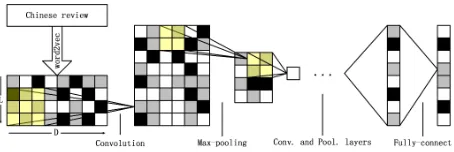
CNN is short for Convolutional Neural Networks. Its key module is to calculates the convolution be-tween input and output. Just as CNN used in com-puter vision, a matrix is needed, as the input of CNN. After several experiments, we set D = 60 as the dimension quantity of word embeddings for CNN. If there are L words in a sentence, combine their word embeddings together to construct a matrix of sizeL×Das shown in Figure 1.L= 60is set since fixed L is needed, and which means, only 60 words are preserved from the beginning of a review. On the other hand, if the length is less than 60, the matrix will be filled with used vectors from the beginning of the review by repeating them. At last, every review is represented by a matrix of size60×60.
Formally, in computer vision, given n images (Xl, l = 1, ..., n) of size r ×c, k kernels of size
Figure 1: Illustration of Convnets
a × b are set. For each kernel patches a small image(Xs) in the large image (Xl),K(kerneli, Xs)
is computed, where K() is the kernel function, giving us k × (r − a+ 1) × (c − b + 1) array of convolved features (more detail,see the tutorial3). Max-pooling is the key module to help training deeper model. It works like this: Expect that there is a60×60matrix. Let’s set pooling size10×10, then the60×60matrix will be divided into 36 small matrixes of size10×10. Just pick the biggest value in each small matrix and combine them together. At last a 6×6 matrix instead of 60 ×60 matrix is gotten. Extending the implementation 4 of the lenet5 (LeCun et al., 1998), the convolutional layer and max-pooling layer are merged as one layer. The structure of ConvNets used is shown in Table 2.
Layer Frame Kernel Kernel size Pool
1 60×60 40 5×5 2×1
2 28×56 50 5×5 2×1
3 12×52 50 5×5 2×1
4 4×48 − − −
Table 2: Parameters of CNN layers
With the fourth layer, a fully-connect sigmoidal layer is constructed to classify the output values. After experiments, there are some rules can be con-cluded:
• The quantity of the word embedding dimen-sions shall be more than 50.
• Do not use pooling between the dimensions of word embedding (thus, in Table 2, the size of pooling is 2×1).
• Adding more fully-connect sigmoidal layer dose not help in improving F1 score.
3
http://ufldl.stanford.edu/wiki/index.php 4
0.3 0.6 0.9 1.2 1.5 1.8 2.1 2.4 2.7 3.0 amount of reviews(10^3)
0.74 0.76 0.78 0.80 0.82 0.84 0.86 0.88 0.90
F1 score
best performance of LR best performance of NB worst performance of LR worst performance of NB
(a) The worst performance of NB is worse than the best performance of LR
0 20 40 60 80 100 120 140 160 180 amount of reviews(10^3)
0.74 0.76 0.78 0.80 0.82 0.84 0.86 0.88 0.90
F1 score
best performance of LR best performance of NB worst performance of LR worst performance of NB
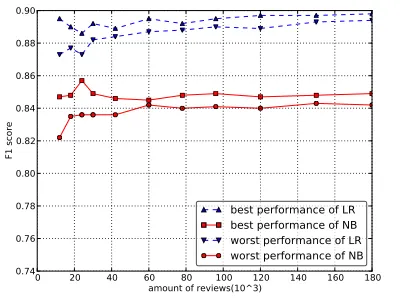
(b) The worst performance of NB is better than the best performance of LR
Figure 2: The performance curves with different amount of reviews.
4 Experiment results
4.1 Corpuses
Unlike English corpuses, Chinese corpuses are rel-atively small and usually focus on POS tagging (Mingqin et al., 2003), parsing (Xue et al., 2005) and translating (Xiao, 2010). In Chinese sentiment classification, the most popular corpus is ChnSen-tiCorp (Tan and Zhang, 2008) with 7,000 positive reviews and 3,000 negative reviews5. Since the amount of data collected by previous Chinese NLP researchers is too small for our work, we build a new corpus, MioChnCorp, with a million Chinese hotel reviews. The corpus is public and can be downloaded directly6. The reviews are crawled and filtrated from the website7which has coarse-grained rating (5-star scale) for each review. We give up the 3-star reviews which may be ambiguous, and mark the five-star and four-star reviews as positive and the rest as negative. Finally 908189 positive reviews and 101762 negative reviews are obtained. After word segmentation8being done, the sentiment classification process is executed.
Since ChnSentiCorp is small, the result may be unstable. Thus, Tan and Zhang (2008) gave the best performance and mean performance to evaluate a classification method. Zhai et al. (2011) tried to get
5
http://www.datatang.com/data/11936 6http://pan.baidu.com/s/1dDo9s8h 7
http://www.dianping.com/hotel 8
https://github.com/fxsjy/jieba
a believable result using the average value from 30 experiments. See Figure 2, Naive Bayes and Logis-tic Regression are used as classification methods to show the performance curves with different amount of reviews. The first sub-graph is tested on ChnSen-tiCorp, the second on is tested on MioChNCorp. Balanced corpuses are split into 3 equal-sized folds, two for training, the rest for testing. After repeating each experiment five times, the best performance and worst performance are marked. At last, two con-clusions can be made: Firstly, when the amount of reviews is less than 60,000, the performance will be improbable (the best performance of model minus worst performance is bigger than 0.01). Secondly, more data usually help to get better performance, but the performance will be finally stable when data are big enough (e.g., 120,000 reviews).
4.2 The performance measure
F1 score (also called F-measure) is a measurement of a test’s accuracy which combines recall and pre-cision as follows:
F1= 2·
P recision·Recall P recision+Recall
Recall= correct positive predictions amount positive example amount
P recision= correct positive predictions amount positive predictions amount
performance of classification method over the cor-pus
M acro F1 = P ostive F1 +N egative F1 2
in the rest of this article, F1 score means Macro F1 score.
4.3 Experimental design
Nine methods are designed to classify MioChnCorp using different features. NB and ME use 10543 words (the sentimental words and CHI words). LinearSVC use unigram and bigram. Five methods (SVC, LR, AdaBoost, Gradient Tree Boosting (GBT) and Random Forests (RF)) use the average vectors of word embeddings and CHI words (extending the dimension quantity to 450). CNN use the matrix constructed by word embeddings from words in a review as feature.
Though all of these models are effective, the combination of different machine learning methods is supposed to acquire better F1 score. There are two ways to combine those methods. First is vote, the idea is simple, “the minority is subordinate to the majority” (marked as Vote all ). The other way is to over-fit in the validate set. Add one more fold for validating into these tree folds. After training, nine models will be constructed. And each model gives one predication list for validating set. For each review, there are nine predications (e.g., [0 0 1 0 1 0 0 1 0 ], 0 means negative, 1 means positive). Using the predication vectors of validating reviews as input, and the labels of validating reviews as the Logistic Regression output, after training on validating set, the combination model (called LR all) is built to test on testing set. The Framework of LR all is shown in Algorithm 1.
4.4 Comparison and analysis
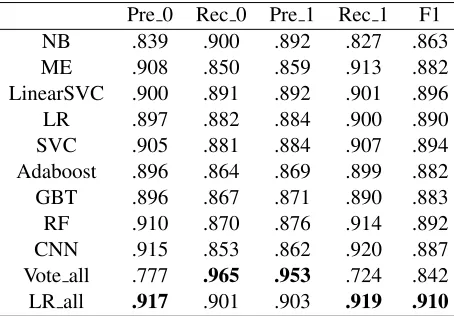
Table 3, Table 4 and Table 5 show the perfor-mance of different machine learning methods. Sub-jected to hardware recourse (RAM:8G, CPU:Intel I5, GPU:GTX960M), the experiments are explored over corpuses with tree size: 40,000, 80,000 and 120,000. Each corpus is divided into four folds which are equal in size, two for training, one for validating, the rest for testing.
Algorithm 1Framework of combination model
Input:
The experiment set of labelled samples: train set,validate setandtest set; nmachine learning classifiers (marked asCi, i= 1, ..., n) with default parameters Output:
For each classifierCi, train ontrain set;
1: Test onvalidate setbyCiand storing
predica-tion asvalidate list i;
2: Use logistic regression to predicate the label list of validate set by combination data of validate list i (i = 1, ..., n) and store the model asLR all;
3: For each classifier Ci, test over test set, and
storing the predication astest list i;
4: Usetest list ias input ofLR alland produce final predication oftest set, storing astest list
5: return Ci (i= 1, ..., n), LR all, test list;
There are nine methods to construct the LR all model, but not all of them make contribution. Weka Explorer9provides attribute selection module to choose most useful attributes to the target attribute (namely, the label list of validate set in our situation). Extracting the validate list i (0 <=i < n) used in Algorithm 1, and combining these nine prediction lists with the label list of validate set, totally, ten attributes will be gotten. With 10-fold cross-validation, CfsSubsetEval attribute evaluator and BestFisrt search Method, Weka selects five most valuable attributes (ME, SVC, LinearSVC, RF and CNN). It is reasonable because they are most outstanding machine learning models which represent their own feature selection methods. Considering the limit of hardware resource and running time, LR is used to instead of SVC and CNN is abandoned. The result is shown in Figure 3. To our surprise, even only four feature is chosen, the F1 score is not reduced.
The more reviews we use in model building, typically the better performance we get till the per-formance is stable. SVM (linearSVC and SVC with linear kernel) has best performance not only
9
Pre 0 Rec 0 Pre 1 Rec 1 F1
NB .843 .896 .889 .833 .864
ME .914 .850 .859 .910 .880
LinearSVC .898 .881 .883 .900 .890
LR .902 .879 .882 .905 .892
SVC .910 .878 .882 .913 .895
Adaboost .898 .867 .871 .902 .885
GBT .897 .866 .870 .890 .883
RF .910 .850 .860 .916 .883
CNN .905 .865 .870 .909 .887
Vote all .790 .955 .943 .747 .849
LR all .915 .893 .896 .917 .905
Table 3: Different performance over 40,000 reviews
Pre 0 Rec 0 Pre 1 Rec 1 F1
NB .836 .900 .892 .823 .862
ME .907 .853 .861 .913 .883
LinearSVC .895 .886 .887 .897 .891
LR .910 .876 .880 .913 .894
SVC .910 .876 .880 .914 .895
Adaboost .899 .866 .871 .903 .884
GBT .897 .868 .872 .901 .885
RF .910 .868 .874 .914 .891
CNN .904 .864 .869 .909 .886
Vote all .786 .957 .945 .739 .846
LR all .915 .895 .897 .912 .906
Table 4: Different performance over 80,000 reviews
Pre 0 Rec 0 Pre 1 Rec 1 F1
NB .839 .900 .892 .827 .863
ME .908 .850 .859 .913 .882
LinearSVC .900 .891 .892 .901 .896
LR .897 .882 .884 .900 .890
SVC .905 .881 .884 .907 .894
Adaboost .896 .864 .869 .899 .882
GBT .896 .867 .871 .890 .883
RF .910 .870 .876 .914 .892
CNN .915 .853 .862 .920 .887
Vote all .777 .965 .953 .724 .842
LR all .917 .901 .903 .919 .910
Table 5: Different performance over 120,000 reviews
in traditional bag of words models, but also in word embedding models. Three ensemble methods work similarly and bigger data help to improve their performance obviously. There may be three reasons why CNN works better than NB and ME, but does
2 4 6 8 10 12 14 16 18 20
amount of reviews(10^4) 0.85
0.86 0.87 0.88 0.89 0.90 0.91 0.92
F1 score
performance of LR_all performance of LinearSVC performance of RF performance of LR performance of ME
Figure 3: The performance curves of combination model and sub-models with different amount of reviews
not reach the expectant performance. Firstly, the amount of reviews is not big enough to train a deep learning model. Secondly, the architecture of the model may not be enough suitable as a language model. Finally, the features (word embeddings with 60 dimensions) for CNN is not accurate enough to present syntax and semantics in sentence. Vote all does not work well in improving performance, but has the highest negative recall and positive preci-sion. LR all has better performance than Vote all because the same weights chosen by Vote all make these sub-models are equally important.
5 Conclusion and Future Work
In this article, an empirical study of sentiment cate-gorization on Chinese hotel review is introduced. In order to conduct this experiment, a Chinese corpus, MioChnCorp10, with a million Chinese hotel re-views is collected. Using MioChnCorp, a word2vec model is trained to present distributed representa-tions of words and phrases in Chinese hotel domain. Then the experimental results indicate that the more data we use, the better performance we get. And 60,000 or larger size (e.g. 120,000) of reviews are sufficient in sentiment analysis of Chinese hotel review.
What’s more, we employ word embeddings as input features without any sentiment lexicons, and find such features perform well by using ensemble methods, LR, SVM and CNN. With respect to these learning methods, SVM works best. Though CNN
10
works not as good as expect, it still has better performance than NB and ME. The roles we used to construct the CNN model is introduce in Section 3.
Finally, a methodology, LR all is constructed to combine different machine learning methods and get an outstanding performance in precision, recall and F1 score of 0.920.
In the future, more work will be explored in building better CNN model for Chinese sentimental analysis and constructing combinational model in other tasks of NLP using word embedding.
6 Acknowledgements
The financial support for this work is provided by The Fundamental Research Funds for the Central Universities, No. ZYGX2014J065.
References
Steven Bird. 2006. Nltk: the natural language toolkit. In Proceedings of the COLING/ACL on Interactive presentation sessions, pages 69–72. Association for Computational Linguistics.
Ronan Collobert, Jason Weston, L´eon Bottou, Michael Karlen, Koray Kavukcuoglu, and Pavel Kuksa. 2011. Natural language processing (almost) from scratch.
The Journal of Machine Learning Research, 12:2493– 2537.
Corinna Cortes and Vladimir Vapnik. 1995. Support-vector networks. Machine learning, 20(3):273–297. Kushal Dave, Steve Lawrence, and David M Pennock.
2003. Mining the peanut gallery: Opinion extraction and semantic classification of product reviews. In
Proceedings of the 12th international conference on World Wide Web, pages 519–528. ACM.
Thomas G Dietterich. 2000. Ensemble methods in machine learning. InMultiple classifier systems, pages 1–15. Springer.
Zhendong Dong and Qiang Dong. 2006. HowNet and the Computation of Meaning. World Scientific. Jerome H Friedman. 2001. Greedy function
approximation: a gradient boosting machine. Annals of statistics, pages 1189–1232.
Luigi Galavotti, Fabrizio Sebastiani, and Maria Simi. 2000. Feature selection and negative evidence in automated text categorization. In Proceedings of KDD.
Edwin T Jaynes. 1957. Information theory and statistical mechanics. Physical review, 106(4):620.
Rie Johnson and Tong Zhang. 2014. Effective use of word order for text categorization with convolutional neural networks. arXiv preprint arXiv:1412.1058. Nal Kalchbrenner, Edward Grefenstette, and Phil
Blun-som. 2014. A convolutional neural network for modelling sentences.arXiv preprint arXiv:1404.2188. Yann LeCun, L´eon Bottou, Yoshua Bengio, and Patrick Haffner. 1998. Gradient-based learning applied to document recognition. Proceedings of the IEEE, 86(11):2278–2324.
Jun Li and Maosong Sun. 2007. Experimental study on sentiment classification of chinese review using machine learning techniques. In Natural Language Processing and Knowledge Engineering, 2007. NLP-KE 2007. International Conference on, pages 393– 400. IEEE.
Bing Liu and Lei Zhang. 2012. A survey of opinion mining and sentiment analysis. In Mining text data, pages 415–463. Springer.
Tomas Mikolov, Ilya Sutskever, Kai Chen, Greg S Corrado, and Jeff Dean. 2013a. Distributed representations of words and phrases and their compositionality. In Advances in neural information processing systems, pages 3111–3119.
Tomas Mikolov, Wen-tau Yih, and Geoffrey Zweig. 2013b. Linguistic regularities in continuous space word representations. In HLT-NAACL, pages 746– 751.
Li Mingqin, Li Juanzi, Dong Zhendong, Wang Zuoying, and Lu Dajin. 2003. Building a large chinese corpus annotated with semantic dependency. InProceedings of the second SIGHAN workshop on Chinese language processing-Volume 17, pages 84–91. Association for Computational Linguistics.
Georgios Paltoglou and Mike Thelwall. 2010. A study of information retrieval weighting schemes for sentiment analysis. InProceedings of the 48th Annual Meeting of the Association for Computational Linguistics, pages 1386–1395. Association for Computational Linguistics.
Bo Pang and Lillian Lee. 2008. Opinion mining and sentiment analysis. Foundations and trends in information retrieval, 2(1-2):1–135.
Bo Pang, Lillian Lee, and Shivakumar Vaithyanathan. 2002. Thumbs up?: sentiment classification using machine learning techniques. In Proceedings of the ACL-02 conference on Empirical methods in natural language processing-Volume 10, pages 79–86. Association for Computational Linguistics.
learning in python. The Journal of Machine Learning Research, 12:2825–2830.
Stephen Della Pietra, Vincent Della Pietra, and John Lafferty. 1997. Inducing features of random fields.
Pattern Analysis and Machine Intelligence, IEEE Transactions on, 19(4):380–393.
Greg Ridgeway. 2007. Generalized boosted models: A guide to the gbm package. Update, 1(1):2007. Songbo Tan and Jin Zhang. 2008. An empirical study
of sentiment analysis for chinese documents. Expert Systems with Applications, 34(4):2622–2629.
Peter D Turney. 2002. Thumbs up or thumbs down?: semantic orientation applied to unsupervised classification of reviews. In Proceedings of the 40th annual meeting on association for computational linguistics, pages 417–424. Association for Computa-tional Linguistics.
Richard Xiao. 2010. How different is translated chinese from native chinese? a corpus-based study of translation universals. International Journal of Corpus Linguistics, 15(1):5–35.
Puyang Xu and Ruhi Sarikaya. 2013. Convolutional neural network based triangular crf for joint intent detection and slot filling. In Automatic Speech Recognition and Understanding (ASRU), 2013 IEEE Workshop on, pages 78–83. IEEE.
LH Xu, HF Lin, and Jing Zhao. 2008. Construction and analysis of emotional corpus. Journal of Chinese information processing, 22(1):116–122.
Naiwen Xue, Fei Xia, Fu-Dong Chiou, and Marta Palmer. 2005. The penn chinese treebank: Phrase structure annotation of a large corpus. Natural language engineering, 11(02):207–238.
Qiang Ye, Bin Lin, and Yi-Jun Li. 2005. Sentiment classification for chinese reviews: A comparison between svm and semantic approaches. In Machine Learning and Cybernetics, 2005. Proceedings of 2005 International Conference on, volume 4, pages 2341– 2346. IEEE.