A Class Library for the Integration of NLP Tools:
Definition and implementation of an Abstract Data Type Collection for the
manipulation of SGML documents in a context of stand-off linguistic annotation
X. Artola, A. Díaz de Ilarraza, N. Ezeiza, K. Gojenola, G. Hernández, A. Soroa
Faculty of Computer Science
University of the Basque Country (UPV/EHU) 649 p.k., 20080 Donostia (The Basque Country)
Abstract
In this paper we present a program library conceived and implemented to represent and manipulate the information exchanged in the process of integration of NLP tools. It is currently used to integrate the tools developed for Basque processing during the last ten years at our research group. In our opinion, the program library is general enough to be used in similar processes of integration of NLP tools or in the design of new applications built on them. The program library constitutes a class library that provides the programmer with the elements s/he needs when manipulating SGML documents in a context of stand-off linguistic annotation, where linguistic analyses obtained at different phases (morphology, lemmatization, processing of multiword lexical units, surface syntax, and so on) are represented by well-defined typed features structures. Due to the complexity of the information to be exchanged among the different tools, feature structures (FS) are used to represent it. Feature structures provide us with a well-formalized basis for the exchange of linguistic information among the different text analysis tools. Feature structures are coded in SGML following the TEI’s DTD for Fs, and Feature-System Declarations (FSD) have been thoroughly specified. So, TEI-P3 conformant feature structures constitute the representation schema for the different documents that convey the information from one linguistic tool to the next in the language processing chain. The tools integrated so far are a lexical database, a tokenizer, a wide-coverage morphosyntactic analyzer, a general purpose tagger/lemmatizer and a shallow syntactic parser. The type of information contained in the documents exchanged among these tools has been analyzed and characterized using a set of Abstract Data Types.
1. Introduction
In this paper we present a program library conceived and implemented to represent and manipulate the information exchanged in the process of integration of NLP tools. It is currently being used to integrate the tools developed for Basque processing during the last ten years at our research group. In our opinion, the program library is general enough to be used in similar processes of integration of NLP tools or in the design of new applications built on them, given that feature structures are used to represent linguistic information.
The program library constitutes a class library that provides the programmer with the elements s/he needs when manipulating SGML documents in a context of stand-off linguistic annotation, where linguistic analyses obtained at different phases (morphology, lemmatization, processing of multiword lexical units, surface syntax, and so on) are represented by well-defined typed feature structures.
Due to the complexity of the information to be exchanged among the different tools, feature structures (FS) are used to represent it. Feature structures provide us with a well-formalized basis for the exchange of linguistic information among the different text analysis tools. Feature structures are coded in SGML following the TEI’s DTD for FSs, and Feature-System Declarations (FSD) have been thoroughly specified. So, TEI-P3 conformant feature structures constitute the representation schema for the different documents that convey the information from one linguistic tool to the next in the language processing chain.
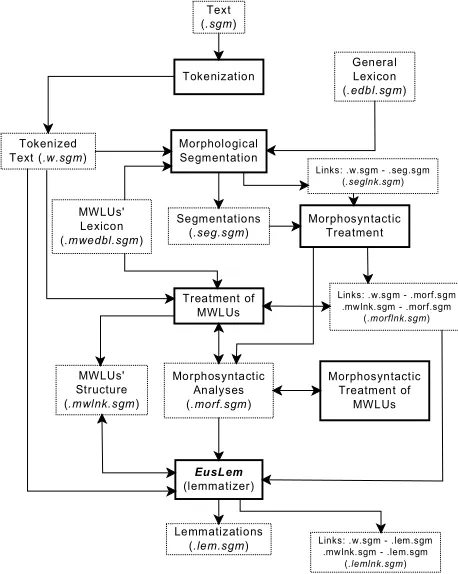
The tools integrated so far are:
1. EDBL, a lexical database, which at the moment contains more than 80,000 entries (Aldezabal et al., 2001).
2. A tokenizer that identifies tokens from the input text. 3. Morpheus, a wide-coverage morphosyntactic
analyzer for Basque (Alegria et al., 1996). It attaches to each input word form all its possible interpretations. The result is a set of possible morphosyntactic readings of a word in which each morpheme is associated with its corresponding features in the lexicon: category, subcategory, declension case, number, and definiteness, as well as its syntactic functions (Karlsson et al., 1995) and some semantic features. It is composed of several modules such as:
• A segmentizer, which splits up a word into its constituent morphemes.
• A morphosyntactic analyzer (Aduriz et al., 2000), whose goal is to group the morphological information associated with each morpheme obtaining the morphological information of the word form considered as a unit. This is an important step in our analysis process due to the agglutinative character of Basque.
• A recognizer of multiword lexical units (MWLUs), which performs the morphosyntactic analysis of multiword units present in the text (Aduriz et al., 1996).
4. EusLem, a general-purpose tagger/lemmatizer. (Ezeiza et al., 1998).
<tei.2> ...
<p>
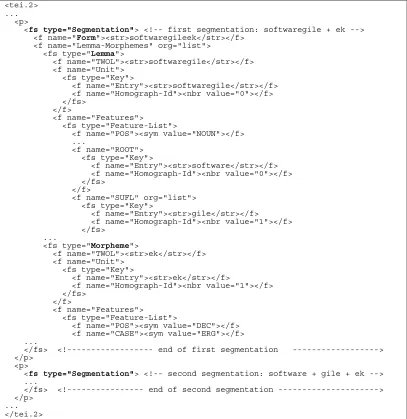
<fs type="Segmentation"> <!-- first segmentation: softwaregile + ek --> <f name="Form"><str>softwaregileek</str></f>
<f name="Lemma-Morphemes" org="list"> <fs type="Lemma">
<f name="TWOL"><str>softwaregile</str></f> <f name="Unit">
<fs type="Key">
<f name="Entry"><str>softwaregile</str></f> <f name="Homograph-Id"><nbr value="0"></f> </fs>
</f>
<f name="Features"> <fs type="Feature-List">
<f name="POS"><sym value="NOUN"></f> ...
<f name="ROOT"> <fs type="Key">
<f name="Entry"><str>software</str></f> <f name="Homograph-Id"><nbr value="0"></f> </fs>
</f>
<f name="SUFL" org="list"> <fs type="Key">
<f name="Entry"><str>gile</str></f> <f name="Homograph-Id"><nbr value="1"></f> </fs>
...
<fs type="Morpheme">
<f name="TWOL"><str>ek</str></f> <f name="Unit">
<fs type="Key">
<f name="Entry"><str>ek</str></f>
<f name="Homograph-Id"><nbr value="1"></f> </fs>
</f>
<f name="Features"> <fs type="Feature-List">
<f name="POS"><sym value="DEC"></f> <f name="CASE"><sym value="ERG"></f> ...
</fs> <!--- end of first segmentation ---> </p>
<p>
<fs type="Segmentation"> <!-- second segmentation: software + gile + ek --> ...
</fs> <!--- end of second segmentation ---> </p>
... </tei.2>
Figure 2. Multiple segmentations for softwaregileek.
.seglnk.sgm, .morflnk.sgm, .lemlnk.sgm contain the different links created as a result of the output of some of the tools described earlier. 5. Documents: collections of text elements
single and multiword, analyses, and links. We differentiate four different document types at the moment : A document containing a list of text elements (WSGMDoc), a document
containing a list of analysis (ASGMDoc), a document containing a list of links (LnkSGMDoc)and a document containing a list of multiword unit (MWSGMDoc).
<!-- output of EusLem (.lem.sgm): softwaregileek --> <tei.2>
... <p>
<fs id="IZE-ARR-1905" type="Lemmatization"> <f name="Form"><str>softwaregileek</str></f> <f name="Lemma"><str>softwaregile</str></f> <f name="Morphological-Features">
<fs type="TopLevel-Feature-List"> <f name="POS"><sym value="NOUN"></f> <f name="SUBCAT"><sym value="COMMON"></f> <f name="ANIM"><plus></f>
<f name="ROOT"><str>software</str></f> <f name="SUFL" org="list">
<str>gile</str> </f>
<f name="CASE"><sym value="ERG"></f> <f name="NUM"><sym value="P"></f> <f name="DET"><sym value=“DET”></f> <f name="SYNTFL" org="list">
<sym value="@SUBJ"> ...
</fs> </p> ... </tei.2>
Figure 3. Disambiguated output of the lemmatizer.
4. A repository of Abstract Data Types on
Feature Structures
In this section we present the library designed in order to facilitate the work with the FSs and related classes describing the linguistic information in our integrated system. The different elements used in it have been characterized as Abstract Data Types (ADT). As is well known, the theory underlying ADTs gives the user a way to describe which kind of values belong to a particular type, and to determine precisely the set of operations that can be performed on them.
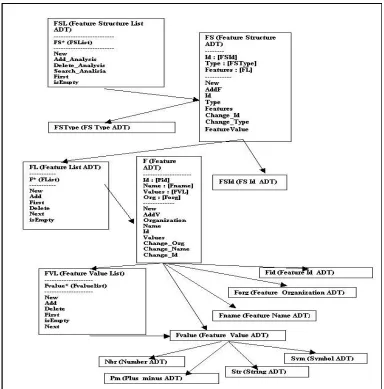
As a result of the analysis of the characteristics and structure of the different data used as input and output of the analysis tools, we have identified the different ADTs intervening, and we have consequently implemented several library modules to encapsulate them. The set of packages implemented provides internal representation and operations for the following types among others: FS, FSD, Link, MWLink, Feature, Value, FSId, FSList, FList, LList, and so on.
These packages offer the necessary operations the different tools need to perform their task when recognizing the input and producing their output.
These functions allow:
a) getting the necessary information from an SGML document containing tokens, links, multiword structure links or FSs;
b) producing with ease the corresponding output according to a well-defined SGML description.
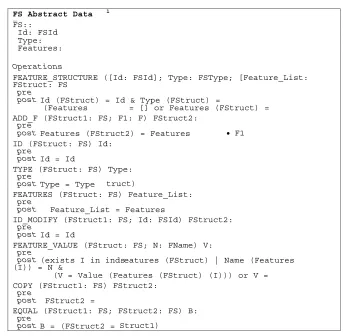
In Figure 5 we show a partial view on the specifications of the FS (feature structure) ADT. Values
of this type are represented by triples (Id, Type and Features). Each component of the triple is an attribute
whose value belongs to another ADT. So, the Id
component belongs to the FSId ADT, the Type
component to the FSType ADT, and, finally, the Features component to the FList (features list) ADT.
Each one of these ADTs has been specified elsewhere in the same way.
As can be seen in the figure, the operations defined in the FS ADT are the following:
• FEATURE_STRUCTURE (type’s constructor): builds up an FS object given the type and, optionally, an
identification and a feature list.
• ADD_F: adds a new feature to the feature structure.
• ID, TYPE and FEATURES: operations that give access to the feature structure attributes.
• EQUAL, COPY and so on: perform different actions on the feature structure. The first one examines two FSs saying whether they represent the same object;
COPY will reproduce an FS object to another FS.
The ADTs’ library has been implemented in C++, following an object-oriented methodology. For the implementation of the different operations we make use of the LT NSL system (McKelvie et al., 1997), a tool architecture for SGML-based processing of text corpora. The current release of the library works on Unix (Solaris 2.5).
Figure 5. Formal specification of the FS Abstract Data Type.
FS Abstract Data T
1
FS::
Id: FSId
Type: Features:
Operations
FEATURE_STRUCTURE ([Id: FSId]; Type: FSType; [Feature_List: FStruct: FS
pre
postId (FStruct) = Id & Type (FStruct) =
(Features = [] or Features (FStruct) = ADD_F (FStruct1: FS; F1: F) FStruct2:
pre
postFeatures (FStruct2) = Features • F1 ID (FStruct: FS) Id:
pre
postId = Id
TYPE (FStruct: FS) Type: pre
postType = Type truct)
FEATURES (FStruct: FS) Feature_List: pre
post Feature_List = Features
ID_MODIFY (FStruct1: FS; Id: FSId) FStruct2: pre
postId = Id
FEATURE_VALUE (FStruct: FS; N: FName) V: pre
post(exists I in indseatures (FStruct) | Name (Features
( )
(I)) = N &
(V = Value (Features (FStruct) (I))) or V = COPY (FStruct1: FS) FStruct2:
pre
post FStruct2 =
EQUAL (FStruct1: FS; FStruct2: FS) B: pre
Programming applied to Natural Language Processing held as part of EUROLAN'01 Summer School. Iasi (Romania).
Mckelvie, D., Brew, C., Thompson, H., 1997. Using SGML as a basis for Data-Intensive NLP. In Proc. ANLP'97. Washington (USA).
Sperberg-McQueen C.M., Burnard L., 1994. Guidelines for Electronic Text Encoding and Interchange. TEI P3 Text Encoding Initiative.
Simkins N.K., 1994. An Open Architecture for Language Engineering. In First Language Engineering Convention. Paris (France)
Thompson H., McKelvie D., Finch S., 1996. The Normalised SGML Library LT NSL version 1.4.6. Technical Report, Language Technology Group, University of Edinburgh. http://www.ltg.ed.ac.uk/software/lt nsl.html