1022
Distant Supervision for Sentiment Attitude Extraction
Nicolay Rusnachenko1, Natalia Loukachevitch1,2, Elena Tutubalina3,4 1Bauman Moscow State Technical University, Moscow, Russia
2Lomonosov Moscow State University, Moscow, Russia 3Kazan Federal University, Kazan, Russia
4 Samsung-PDMI Joint AI Center, PDMI RAS, St. Petersburg, Russia
[email protected], [email protected], [email protected]
Abstract
News articles often convey attitudes be-tween the mentioned subjects, which is es-sential for understanding the described sit-uation. In this paper, we describe a new approach to distant supervision for extract-ing sentiment attitudes between named en-tities mentioned in texts. Two factors (pair-based and frame-based) were used to automatically label an extensive news col-lection, dubbed as RuAttitudes. The latter became a basis for adaptation and train-ing convolutional architectures, includtrain-ing piecewise max pooling and full use of in-formation across different sentences. The results show that models, trained with RuAttitudes, outperform ones that were trained with only supervised learning ap-proach and achieve 13.4% increase in F1-score on RuSentRel collection.1
1 Introduction
Relation extraction nowadays remains one of the popular tasks in the natural language processing domain. The relation types to be extracted from texts may vary and result in different tasks: se-mantic classification of relations between a pair of common nominals (Hendrickx et al., 2009), source-target sentiment relation extraction (Ellis et al., 2014), opinion expression towards entities and events (Deng and Wiebe,2015a), attitude ex-traction between mentioned named entities ( Rus-nachenko and Loukachevitch,2018), etc.
Dealing with one of these tasks, the greatest dif-ficulty one encounters is the complexity of the sen-tence structure. As for analytical articles, the idea expressed by the author could be conveyed in dif-ferent variants, which is a feature of natural lan-guages.
1The code is available on https://github.com/ nicolay-r/attitudes-extraction-ds
When relation extraction is performed automat-ically using machine learning approaches, this complexity results in a lack of training exam-ples. One technique that helps to accomplish this task isdistant supervision(DS), initially proposed by (Mintz et al.,2009). It assumes to extract and label data by relying on assumptions based on a prepared knowledge base. Although many meth-ods have been proposed in such domains as sen-timent analysis and relation extraction (Turney, 2002;Zeng et al.,2015), the domain of sentiment attitude extraction remains understudied.
This paper describes a new approach to distant supervision for extracting sentiment attitudes be-tween named entities mentioned in texts. It is worth noting that DS faces the problem of wrong labels, which becomes a reason of noisy labeled data. To address the shortcomings of noisy label-ing, in this paper we exploit two primary sources of automatic annotation:
• Prior knowledge about current attitudes be-tween political entities (figures);
• Sentiment frames that define attitudes be-tween participants of a situation.
The obtained corpus annotated with attitudes was used to train convolutional neural networks (CNNs), adapted for relation extraction and full use of information across multiple sentences. Our key contributions in this work are two-fold:
• We propose a workflow of automatic sen-timent attitudes extraction, which exploits news title simplicity to perform annotation;
2 Related Work
The task of attitude recognition toward named en-tities or events, including opinion holder identifi-cation from full texts did not attract much atten-tion. In 2014, the TAC evaluation conference in Knowledge Base Population (KBP) track included so-called sentiment track (Ellis et al.,2014). The task was to find all the cases where a query en-tity (sentiment holder) holds a positive or negative sentiment about another entity (sentiment target). Thus, this task was formulated as a query-based retrieval of entity-sentiment from relevant docu-ments and focused only on query entities2.
MPQA 3.0 (Deng and Wiebe,2015b) is a cor-pus of analytical articles with annotated opinion expressions (towards entities and events). The annotation is sentence-based. For example, in the sentence «When the Imam issued the fatwa against Salman Rushdie for insulting the Prophet ...», Imam is negative to Salman Rushdie but is positive to the Prophet.
In paper (Choi et al.,2016), authors studied the approach to the recovery of the documents atti-tudes between subjects mentioned in the text. The approach considers such features as frequency of a named entity in the text, relatedness between enti-ties, direct-indirect speech, etc. The best quality of opinion extraction obtained in this work was only about 36% F-measure, which shows that the ne-cessity of improving extraction of attitudes at the document level is significant and this problem has not been sufficiently studied.
A corpus of analytical articles, obtained from authoritative foreign sources and translated into Russian has been invented in (Loukachevitch and Rusnachenko, 2018). The collected articles con-tain both the author’s opinion on the subject matter of the article and a large number of attitudes men-tioned between the participants of the described situations. Authors experiment with automatic at-titudes extraction within the developed corpus. In comparison with (Choi et al.,2016) where docu-ments much smaller and written in English, au-thors mentioned the closest F-measure and con-clude that the task still remains complicated.
Each attitude may be considered in terms of re-lated article context, or sentence. The sentence consists of words which could be gathered and treated as anembedding, where each word
repre-2https://tac.nist.gov/2014/KBP/
Sentiment/index.html
sents a feature vector. Convolving embedded sen-tence representation by a set of different filters, in paper (Zeng et al.,2014) authors implemented and trained the Convolutional Neural Network (CNN) model for the relation classification task. Being applied for the SemEval-2010 Task 8 (Hendrickx et al.,2009), the obtained model significantly out-performed the results of other participants.
This idea was developed further in terms of max-poolingoperation (Zeng et al.,2015). This is an operation, which is applied to the convolved by filters data and extracts the maximal values within each convolution. However, for the relation classi-fication task, original max-pooling reduces infor-mation extremely rapid and blurs significant rela-tion aspects. Authors proposed to treat each con-volution in parts. The division into parts depends on attitude entities: inner(between entities), and outer. This approach resulted in an advanced ar-chitecture model and was dubbed as “Piecewise Convolutional Neural Network” (PCNN).
3 Resources
This section describes resources (collections and lexicons) that were used for the dataset annotation.
3.1 RuSentRel Collection
In our experiments, we use the RuSentRel corpus3 consisted of analytical articles from Internet-portal
inosmi.ru (Loukachevitch and Rusnachenko, 2018) devoted to international relations. In this corpus, the manual annotation of the sentiment attitudes towards mentioned named entities had been carried out at the document level. The an-notation is subdivided into two subtypes:
• The author’s relation to mentioned named en-tities;
• The relation of subjects expressed as named entities to other named entities.
An analytical document can refer to an entity with several variants of naming (Vladimir Putin – Putin), synonyms (Russia – Russian Federation), or lemma variants generated from different word-forms. For correct inference of attitudes between named entities in the whole document, the corpus is provided with a list of variant names for the same entity found in the corpus.
3https://github.com/nicolay-r/
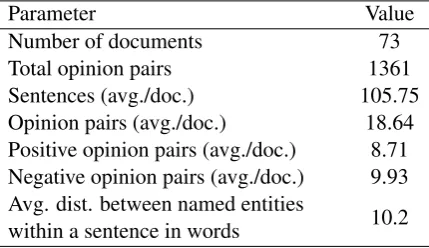
In this paper, we utilize RuSentRel corpus in experiments for the proposed approach. Table 1 describes the corpus statistics.
Parameter Value
Number of documents 73
Total opinion pairs 1361
Sentences (avg./doc.) 105.75 Opinion pairs (avg./doc.) 18.64 Positive opinion pairs (avg./doc.) 8.71 Negative opinion pairs (avg./doc.) 9.93 Avg. dist. between named entities
within a sentence in words 10.2
Table 1: Attitude statistics of RuSentRel-v1.1 cor-pus.
3.2 RuSentiFrames Lexicon
The RuSentiFrames4lexicon describes sentiments and connotations conveyed with a predicate in a verbal or nominal form (Rashkin et al., 2016; Klenner and Amsler,2016). The structure of the frames includes the set of predicate-specific roles and frame dimensions.
For role designation, the approach of PropBank (Palmer et al.,2005) is used. In this approach, in-dividual verb’s semantic arguments are numbered, beginning with zero. For a particular verb, Arg0 is generally the argument exhibiting features of a Prototypical Agent (Dowty,1991), while Arg1 is a Prototypical Patient or Theme.
In the main part of the frame, the following di-mensions are described:
• the attitude of the author of the text towards mentioned participants;
• positive or negative sentiment between par-ticipants;
• positive or negative effects to participants;
• positive or negative mental states of partici-pants related to the described situation.
All assertions are provided with the score of confidence, which currently has two values: 1, if this assertion is true almost always, or 0.7, the as-sertion is considered in default. We do not de-scribe assertions about neutral sentiment, effect or state of participants.
4https://github.com/nicolay-r/
RuSentiFrames/tree/v1.0
Type of lexical unit Number
Verbs 2 794
Nouns 822
Phrases 2 401
Other 49
Unique entries 6 036
Total entries 6 412
Table 2: Quantitative characteristics of the RuSen-tiFrames entries.
The created frames are associated not only with a single entry but with a "family" of related words and expressions, which have the same attitudes. The following lexical units can be associated with a sentiment frame: single words, idioms, light verb constructions, and some other multiword ex-pressions.
Currently, RuSentiFrames contains 277 frames with 6,412 associated frame entries. Table 2 shows the distribution of the RuSentiFrames en-tries according to parts of speech (POS) and other characteristics. Let us consider frame
"Одоб-рить"(Approve) presented in Example 1.
Example 1:Frame "Одобрить"(Approve) "roles": {"a0": "who approves",
"a1": "what is approved"} "polarity": {["a0", "a1", "pos", 1.0], ["a1", "a0", "pos", 0.7]}, "effect": {["a1", "pos", 1.0]},
"state": {["a0", "pos", 1.0], ["a1", "pos", 1.0]}
Nowadays, the lexicon is under development. For the proposed distant supervision approach, we utilize only the dimension of attitudes to-wards Prototypical Patient conveyed by Prototyp-ical Agent. Table3provides related statistics.
Effect Sentiment Number
A0→A1 pos 2 252
A0→A1 neg 2 802
Table 3: The distribution of RuSentiFrames text entries according to attitudes.
3.3 News Collection
Russian sites of world known news agencies pub-lished in 2017.
Each article is separated into the title and the contents. The collection statistics presented in Ta-ble4.
Parameter Value
Number of documents 2.8×10⁶ Sentences (avg./doc.) 13.24
Table 4: News collection statistics.
4 Automatic Forming of Training Collection for Sentiment Attitude Extraction
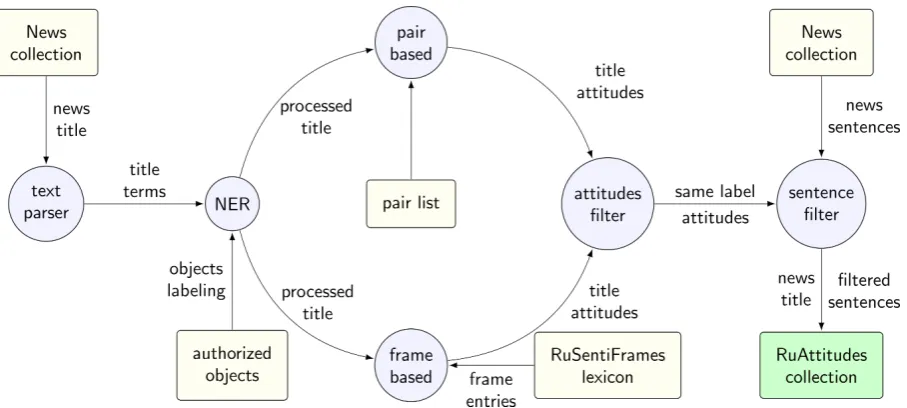
This section discusses two different methods of sentiment attitude annotation: pair-based, and frame-based. Both methods apply to the title as it provides the main idea of the article and usually has a relatively simple sentence structure. Figure1 illustrates the collection development flow. Fur-ther subsections describe the flow components in detail.
4.1 Text Processing and Named Entity Recognition
For attitude extraction, it is necessary to parse a text. This process involves the tokenization to demarcate text string into words and punctuation signs. Numbers and URL-links are considered as non-meaningful and masked.
Each attitude is based on a pair of named en-tities. For named entity recognition (NER, Fig-ure1), we utilize the following resources:
1. The pre-trained neural network model5, which is state-of-the-art for the Russian lan-guage (Burtsev et al.,2018);
2. The list of named entities from RuSentRel corpus, organized inauthorized objects.
The list of authorized objects is necessary to avoid accidental misses from the NER model.
The text of news articles may refer to an en-tity in several naming variants (Putin – Vladimir Putin), and synonyms (EU – Europe). To match named entity synonyms, in this paper we utilize both stemming6 and list of synonyms, provided along with the RuSentRel corpus.
5
https://github.com/deepmipt/ner 6https://tech.yandex.ru/mystem/
4.2 Pair-Based Annotation
This attitude annotation method utilizes the pre-assigned attitudes organized in alist of pairs (Fig-ure1).
Given a processed title with labeled named en-tities setE, we select pairs{hei, eji | ei, ej ∈E}, suitable for sentiment attitudes role. For relevant pairs filtering, the following restrictions should be met:
1. The presence of synonymous attitude in a given attitudes list;
2. All the entities appeared between pair end-ings should be authorized objects;
However, in a specific sentence, the supposed relation between countries can be false. For ex-ample, in the sentence “Зрители смогут
уви-деть показательные выступления спортсме-нов - чемпиоспортсме-нов России и Европы” (Specta-tors will be able to see demonstrations of athletes - champions of Russia and Europe), prior nega-tive relations between Russia and Europe are not mentioned. Therefore we need an additional fac-tor to provide the quality of the annotation, and the RuSentiFrames lexicon can be used as such a factor.
4.3 Frame-Based Annotation
This attitude annotation method utilizes frame en-tries from the RuSentiFrames lexicon. Given a processed title with labeled named entities setE, an entry pair withei, ej ∈E, whereeiappears be-foreej, considered as sentiment attitude when all the following criteria are met:
• All the frame entries betweenei andej have polarity;
• All the entities that appeared betweenei and
ej should be authorized.
We assign a positive sentiment score when all the polarities of inner frame entries have a posi-tive sentiment. Otherwise, it assigns the negaposi-tive sentiment score. We also consider frame entry po-larity asinverted, when it is used with “не” (not) particle.
4.4 Attitude Filtering
Figure 1: Training collection development flow
following sets: (i) with the same polarity and (ii) with different polarity according to both sources.
In the case of the non-empty set with the same polarity (SAME), at last step we utilize sentence filter (Figure 1). Given a set of processed news sentences, we select those which contain at least a single entity pair, presented in theSAMEset.
Corpus doc. level attitudes
texts count
titles and sentences Pair-Based 60 788 52 377 136 496 Frame-Based 55 566 43 383 104 205 Intersection 22 589 20 885 50 958 Different 7 929 7 435 17 939 SameRuAttitudes 14 660 13 450 33 019
Table 5: The statistics of automated annotation of texts and sentences.
Finally, the workflow (Figure 1) is applied to the news collection (Section 3.3), and we ob-tain the RuAttitudes7 dataset, automatically la-beled with sentiment attitudes between named en-tities. Table 5 provides statistics separately for each step. Evaluated accuracy of randomly se-lected sentences from different texts presented in Table6.
5 Convolutional Neural Networks for Attitude Classification
For automatic sentiment attitude classification, the following CNN-based architectures were used:
7https://github.com/nicolay-r/
RuAttitudes/tree/v1.0
Corpus Accuracy
Pair-Based 67.0
Frame-Based 62.5
RuAttitudes 89.0
Table 6: Accuracy of attitude annotation in the generated collections.
• Classic CNN (Zeng et al.,2014);
• Piecewise-CNN (Zeng et al.,2015);
To predict the attitude polarity, both models uti-lize sentences in the input. Given a context (a set of sentences) with a mentioned attitude in it, the output of models is the class label. Two different approaches to training were considered: single-sentence training and multi-single-sentence training.
5.1 Sentence Embedding
We usesentence embedding to present sentences in model input. This is a matrix with rows re-lated to words or token (for example, punctuation marks) embeddings.
For words, we look up for vectors in precom-puted and publicly available Word2Vec model8 based on news articles with window size of
w = 20. For tokens, we utilize a set of predefined types (size of 17), where each type is a randomly initialized vector of the same size as word vector.
Each word and token vectors have been addi-tionally expanded with the following features:
8http://rusvectores.org/static/models/
• Distance embedding (Rusnachenko and Loukachevitch, 2018) – is vectorized dis-tance in words from entitiesei andej of an entry pairhei, ejito a given word or token;
• Part-of-speech (POS) tags embedding; we use “unknown” tag in case of tokens.
For features, we use randomly initialized vectors. Table7provides parameter values of each embed-ding described above.
Type Parameters Values
POS vsize 5
Distance vsize 5
Tokens hsize, lti
17,103
Words hsize, lw, wi
147·103,103,20
Table 7: Embedding parameters, wherevsizeis the size of embedding vectors.
5.2 Single Sentence Training
This training process assumes to predict a senti-ment label by a single sentence. Given an attitude context, we consider that each sentence should be labeled with an attitude sentiment.
We utilize training process described in ( Rus-nachenko and Loukachevitch, 2018). The input organized in minibatches, which yieldsnbags.
Each bag has a set ofmsentences{s1, . . . , sm}, wheresj = hes, yiincludes sentence embedding
es and related label y ∈ Rc. The training
pro-cess is iterative, and iteration includes the follow-ing steps:
1. Composing a minibatch I = {b1, . . . , bn} wherebi={s1, . . . , sm};
2. Performing a forward propagation through the network; the result is a vector{ok}qk=1, whereok∈Rc, andq =n·m;
3. Computing cross entropy loss for output:
lk= c
X
j=1
logp(yi|ok,j;θ), k∈1. . . q (1)
4. Composing cost vector {costi}ni=1, where
costi = max
li·g . . . l(i+1)·g
is a maximal loss withini’th bag;
5. Usingcostto update hidden variables set;
5.3 Multiple Sentence Training
This training process assumes to predict a senti-ment label for sentences set. This process refers to a single sentence case described in Section5.2 with the following modifications:
• Each minibatch presented as a sequence of
n bags bi = hEs, yi, where Es is a set of embedded sentences (Section5.2);
• Result output vector {ol}nl=1 obtained by an application of max-pooling operation over separately convolved context sentences (Jiang et al.,2016);
6 Datasets and Experimential Setup
We consider the problem of sentiment attitudes classification as a two-class task at the document level. We conduct three different experiments us-ing the followus-ing datasets:
1. RA – RuAttitudes dataset, described in this paper (Section4);
2. RSR – RuSentRel based dataset with sentence-level attitude labeling (Section3.1);
3. RSR+RA – a combination of RSR and RA datasets;
By default, the RuSentRel dataset provides a document level attitude labeling. This labeling was used to complete RSR and therefore treat RuSentRel in the same format as RuAttitudes. We consider sentence-level attitudes as bidirectional pairs of named entities. We filter sentences from RuSentRel with sentiment pairs according to the following rule. For each sentence among the all documents we check, whether at least a single pair has the labeled attitude, presented in document at-titude annotation.
been based on news reports. This fact makes ex-periments with the RSR dataset significantly chal-lenging.
For models to be trained, we applynamed entity masking for pairs due to: (i) omit entity-related feature dependency, and (ii) prevent models from learning the distribution of the latter.
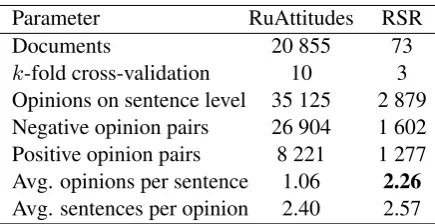
Parameter RuAttitudes RSR
Documents 20 855 73
k-fold cross-validation 10 3 Opinions on sentence level 35 125 2 879 Negative opinion pairs 26 904 1 602 Positive opinion pairs 8 221 1 277 Avg. opinions per sentence 1.06 2.26
Avg. sentences per opinion 2.40 2.57
Table 8: Comparison of RuAttitudes and RuSen-tRel based (RSR) datasets for experiments.
Description Parameters Values Minibatch hn, mi h8,3i
Optimiser hlr, ρ, i
0.1,0.95,10−6
Terms k 50
Window size w 3
Filters count c 300
Dropout ρ 0.9
Table 9: Predefined training parameters.
Table 9 illustrates model parameter values. Each minibatch has n bags. As for the sentence count per bag parameter, we select m = 3 to cover the average sentence count per opinion (Ta-ble8). To translate the labels onto the document level, we utilize average function across all the sentences (sentence sets) of a given attitude. All the sentences were limited bykwords, including tokens. Each word is considered in a lemmatized9 form. The convolutional window size and the fil-ters count were chosen according to (Zeng et al., 2015). We use theadadeltaoptimizer with param-eters according to (Zeiler,2012).
Several baselines were also added in experi-ments: baseline_neg– all pairs of named entities are labeled as negative;baseline_rand– pairs are labeled randomly according to the sentiment dis-tribution in the training collection;
We measure average values of accuracy every five epochs. The training process terminates if one of the following conditions are met: (i) average
9https://tech.yandex.ru/mystem/
epoch accuracy reaches 99%; (ii) the training error exceeds the prior related value (except RSR exper-iment). The latter exception is due to an unstable training process, that might be caused by the rela-tively small training set passed per a single epoch. For this task, we adopt macroaveraged (over documents): F1-score (F1P N), precision (πP N), and recall (ρP N).
7 Result Analysis and Discussion
Table 10 provides the results of both evaluated baselines and models for each dataset. For Ru-Attitudes dataset, where the negative class signifi-cantly exceeds positive, and most documents lack positive attitudes, both baselines show high values. For a certain model and related experiments α
andβ, letCα,β is a set of labeling contradictions of two experiments. All the pairs of contradictions could be then treated as correctly or wrongly la-beled by each experiment. We letCα,β∗ as a sub-set of contradictions whereβcorrects the errors of
α. This subset yields of only those pairs, where the sentiment class has been correctly defined in
β. Table11provides the comparison statistics be-tween RSR and RSR+RA experiments, separately for each model, where|L|is an opinion pairs count (Table1). While the contradiction represents34% of total opinion pairs, with an average61%of cor-rections and38%of wrong labeling, we can con-clude the average result error corrections are7% in case of RSR+RA experiment (Table10).
The contribution of RuAttitudes corpus in RSR+RA experiment could be considered in terms of frequencies of following entry typesE: nouns, verbs, frames. Due to the task considered as sen-timent attitudes classification, it is significant to separate statistics by positive and negative classes. To define a sentence class, we utilize sentiment of attitude that appears in it. We utilize semantic ori-entation (SO) function (Turney,2002) to reveal a discrepancy in entries between sentiment classes:
SO(e) =P M I(e, pos)−P M I(e, neg) (2)
whereP M I(e, c) is apointwise mutual informa-tionof entryeand sentiment classc. For each en-try type separately, we utilize Formula 2towards RuAttitudes to complete a set of entries, bounded with positive (SO(e)>0) and negative (SO(e)<
0) classes. We order these sets by descending of
RA RSR RSR+RA Models F1P N πP N ρP N F1P N πP N ρP N F1P N πP N ρP N
baseline-neg 0.83 0.78 0.89 0.39 0.31 0.54 0.39 0.31 0.54 baseline-rand 0.72 0.75 0.71 0.49 0.51 0.48 0.49 0.51 0.48
CNN 0.91 0.88 0.94 0.52 0.52 0.55 0.63 0.62 0.66
PCNN 0.93 0.91 0.96 0.59 0.58 0.61 0.67 0.66 0.69
MI-CNN 0.91 0.88 0.94 0.57 0.56 0.60 0.62 0.60 0.65
MI-PCNN 0.94 0.92 0.96 0.62 0.60 0.64 0.68 0.67 0.70
Table 10: Result of single sentence (CNN, PCNN) and multiple sentence (MI-CNN, MI-PCNN) trained models in following experiments: RA – RA results trained onRA; RSR – RSR results trained onRSR; RSR+RA –RSRresults trained onRSR+RA.
Model |C2,3| |L|/|C2,3| |C2∗,3|/|C2,3|
CNN 468 0.34 0.63
PCNN 428 0.31 0.62
MI-CNN 488 0.36 0.58
MI-PCNN 442 0.35 0.60
Table 11: Contradiction statistics between experi-ments RSR (2) and RSR+RA (3).
To assess how RuAttitudes effects on error cor-rections, we provide statistic of entries both ap-pears inC2∗,3 andRAck. For each entrye ∈ RAck
we calculatetf(e, C2∗,3)– is an averaged (among all models) normalized term frequency of entrye
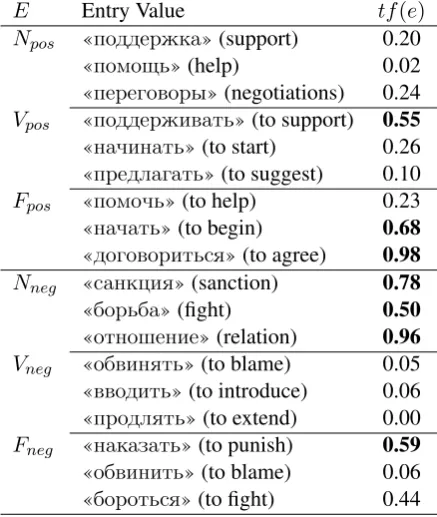
inC2∗,3. Table12lists three (k = 3) most distinc-tive entries by each entry type, where entries with
tf(e, C2∗,3) >0.5are bolded. It is possible to in-vestigate thatC2∗,3mostly saturated with positively bounded frames ofRAposk and negatively bounded nouns ofRAnegk .
Conclusion
This paper proposes an approach to the automatic development of a train collection for the sentiment attitude extraction task in the news domain. The combination of two different techniques was used to provide the double-check and keep labeled re-sults of the common intersection. The first pro-posed technique obtains contexts by a manually implemented list of pairs of named entities with sentiment scores. The other technique, on the con-trary, extracts relations from contexts using senti-ment frames. The latter became possible due to the assumption of title simplicity.
Sentiment attitude extraction was considered as a two-class classification task. This result analy-sis demonstrates the model classification improve-ments achieve 13.4%increase in F1P N when the
E Entry Value tf(e)
Npos «поддержка»(support) 0.20
«помощь»(help) 0.02
«переговоры»(negotiations) 0.24
Vpos «поддерживать»(to support) 0.55
«начинать»(to start) 0.26
«предлагать»(to suggest) 0.10
Fpos «помочь»(to help) 0.23
«начать»(to begin) 0.68
«договориться»(to agree) 0.98
Nneg «санкция»(sanction) 0.78
«борьба»(fight) 0.50
«отношение»(relation) 0.96
Vneg «обвинять»(to blame) 0.05
«вводить»(to introduce) 0.06
«продлять»(to extend) 0.00
Fneg «наказать»(to punish) 0.59
«обвинить»(to blame) 0.06
«бороться»(to fight) 0.44
Table 12: List of k = 3 most distinctive nouns (N), verbs (V), and frames (F) of RAck with re-lated frequencies inC2∗,3;E is an entry type.
latter being trained with the developed collection. In further work, we plan to address the short-comings in the following directions: to empha-size the difference between sentiment and non-sentiment relations and to reduce noisy labeling of the existed approach.
Acknowledgments
References
Mikhail Burtsev, Alexander Seliverstov, Rafael Airapetyan, Mikhail Arkhipov, Dilyara Baymurz-ina, Nickolay Bushkov, Olga Gureenkova, Taras Khakhulin, Yuri Kuratov, Denis Kuznetsov, et al. 2018. Deeppavlov: Open-source library for dia-logue systems. InProceedings of ACL 2018, System Demonstrations. pages 122–127.
Eunsol Choi, Hannah Rashkin, Luke Zettlemoyer, and Yejin Choi. 2016. Document-level sentiment infer-ence with social, faction, and discourse context. In Proceedings of the 54th Annual Meeting of the As-sociation for Computational Linguistics (Volume 1: Long Papers). volume 1, pages 333–343.
Lingjia Deng and Janyce Wiebe. 2015a. Mpqa 3.0: An entity/event-level sentiment corpus. In Proceed-ings of the 2015 Conference of the North Ameri-can Chapter of the Association for Computational Linguistics: Human Language Technologies. pages 1323–1328.
Lingjia Deng and Janyce Wiebe. 2015b. Mpqa 3.0: An entity/event-level sentiment corpus. Proceedings of the 2015 Conference of the North American Chap-ter of the Association for Computational Linguistics: Human Language Technologiespages 1323–1328.
David Dowty. 1991. Thematic proto-roles and argu-ment selection. language67(3):547–619.
Joe Ellis, Jeremy Getman, and Stephanie M Strassel. 2014. Overview of linguistic resources for the tac kbp 2014 evaluations: Planning, execution, and re-sults. In Proceedings of TAC KBP 2014 Work-shop, National Institute of Standards and Technol-ogy. pages 17–18.
Iris Hendrickx, Su Nam Kim, Zornitsa Kozareva, Preslav Nakov, Diarmuid Ó Séaghdha, Sebastian Padó, Marco Pennacchiotti, Lorenza Romano, and Stan Szpakowicz. 2009. Semeval-2010 task 8: Multi-way classification of semantic relations be-tween pairs of nominals. In Proceedings of the Workshop on Semantic Evaluations: Recent Achievements and Future Directions. Association for Computational Linguistics, pages 94–99.
Xiaotian Jiang, Quan Wang, Peng Li, and Bin Wang. 2016. Relation extraction with instance multi-label convolutional neural networks. InProceedings of COLING 2016, the 26th International Confer-ence on Computational Linguistics: Technical Pa-pers. pages 1471–1480.
Manfred Klenner and Michael Amsler. 2016. Sen-tiframes: A resource for verb-centered german sen-timent inference. In Proceedings of the Tenth In-ternational Conference on Language Resources and Evaluation (LREC 2016). pages 2888–2891.
Natalia Loukachevitch and Nicolay Rusnachenko. 2018. Extracting sentiment attitudes from analyti-cal texts. Proceedings of International Conference
on Computational Linguistics and Intellectual Tech-nologies Dialogue-2018 (arXiv:1808.08932) pages 459–468.
Mike Mintz, Steven Bills, Rion Snow, and Dan Ju-rafsky. 2009. Distant supervision for relation ex-traction without labeled data. In Proceedings of the Joint Conference of the 47th Annual Meeting of the ACL and the 4th International Joint Conference on Natural Language Processing of the AFNLP: Volume 2-Volume 2. Association for Computational Linguistics, pages 1003–1011.
Martha Palmer, Daniel Gildea, and Paul Kingsbury. 2005. The proposition bank: An annotated corpus of semantic roles. Computational linguistics31(1):71– 106.
Hannah Rashkin, Sameer Singh, and Yejin Choi. 2016. Connotation frames: A data-driven investigation. In Proceedings of the 54th Annual Meeting of the As-sociation for Computational Linguistics (Volume 1: Long Papers). pages 311–321.
Nicolay Rusnachenko and Natalia Loukachevitch. 2018. Neural network approach for extracting ag-gregated opinions from analytical articles. In In-ternational Conference on Data Analytics and Man-agement in Data Intensive Domains. Springer, pages 167–179.
Peter D Turney. 2002. Thumbs up or thumbs down?: semantic orientation applied to unsupervised classi-fication of reviews. InProceedings of the 40th an-nual meeting on association for computational lin-guistics. Association for Computational Linguistics, pages 417–424.
Matthew D Zeiler. 2012. Adadelta: an adaptive learn-ing rate method.arXiv preprint arXiv:1212.5701.
Daojian Zeng, Kang Liu, Yubo Chen, and Jun Zhao. 2015. Distant supervision for relation extraction via piecewise convolutional neural networks. In Pro-ceedings of the 2015 Conference on Empirical Meth-ods in Natural Language Processing. pages 1753– 1762.