Towards a methodology for automatic identification of hypernyms in the
definitions of large-scale dictionary
Inga Gheorghita
1,2, Jean-Marie Pierrel
1 1 ATILF, Université de Lorraine & CNRS, Nancy, France2 XILOPIX, 2 rue de Nancy, 88000 Épinal, France
[email protected], [email protected]
Abstract
The purpose of this paper is to identify automatically hypernyms for dictionary entries by exploring their definitions. In order to do this, we propose a weighting methodology that lets us assign to each lexeme a weight in a definition. This fact allows us to predict that lexemes with the highest weight are the closest hypernyms of the defined lexeme in the dictionary. The extracted semantic relation “is-a” is used for the automatic construction of a thesaurus for image indexing and retrieval. We conclude the paper by showing some experimental results to validate our method and by presenting our methodology of automatic thesaurus construction.
Keywords: hypernymy, dictionary, thesaurus
1.
Introduction
Linguistic resources such as dictionaries, computational lexicons, semantic taxonomies and thesauri are an important source of knowledge for natural language processing applications.
The information contained in linguistic resources, depending on their type, includes semantic relations (eg.
thrush is a kind of bird), text definitions (eg. the Oxford dictionary defines the “lion” as “a large tawny-colored cat that lives in prides”), examples on the usage domain, and so on. Unfortunately, not all of which provide structured information that can be used by applications of natural language processing (Harabagiu, Miller, & Moldovan, 1999). A human understands the meaning of a word just by reading its definition in the dictionary, but it's not the case for a computer system. The main cause is that the semantic information, such as definitions, contained in the lexical resources is not very explicit and is provided in the form of free text.
Even WordNet (Miller, 1995), one of the most popular lexicons for the English language, uses definitions to explain the meaning of ambiguous words. However, compared with other electronic dictionaries and thesauri, which represent only an electronic transcription of their paper version, WordNet contains explicit information in the form of semantic relations such as, meronymy and hypernymy.
Over the last several decades much research has been done on the automatic construction of resources from corpora (Hearst, 1992), (Yarowsky, 1992), in particular by creating hypernym hierarchies. Various techniques as Machine Learning (Snow, Jurafsky, & Ng, 2005), Hidden Markov Model (Ritter & Soderland, 2009) and resources as dictionaries (Nakamura & Nagao, 1988) and thesauri (Kennedy & Szpakowicz, 2007) are used for identification of hypernymy or other semantic relations in the text.
In this paper, we aim to make explicit the information that is implicitly contained in the definitions of “Trésor de la Langue Française informatisé”1 (TLFi) (Dendien &
1 Treasury of the French Language Computerized
Pierrel, 2003). We are interested in determining from a definition of TLFi the hypernymy relation that will be used for automatic construction of a thesaurus for image indexing and retrieval (Gheorghita, 2011). More precisely, we determine the possible hypernyms for a particular dictionary entry by exploring its definitions. In order to do this, we propose a weighting methodology that lets us assign to each lexeme the weight it has in a definition. This fact allows us to predict that the lexemes with the highest weight are the closest hypernyms of the defined lexeme in the dictionary.
2.
Hypernymy in lexical models
Hypernymy is a lexical function that for a term t
associates one or more other general terms. Logical definitions (or Aristotelian) are generally composed of a “genus” and “differentiae”. In most of the definitions of this type, the hypernymy is represented by the relation “is-a”. A is a hypernym of B if B is an A (a kind / type / kind of A) and if A is a classifier of B. This means that concept B is a specialization concept of A, and concept A
is a generalization concept of B. For example, « mammal » is a generalization of « lion, wolf».
In linguistic resources like thesauri, WordNet, lexical entries are linked to other lexical entries by semantic relationships, so in WordNet the entry for big would somehow represent that its antonym is small. In this type of lexical model the relations that a word has to others partly determine the word’s sense. In dictionaries, the meaning of lexemes is divided into several parts (Murphy, 2010). The information necessary for determining the semantic relations among words in dictionaries is contained in theirs definitions. Thus, we can determine the semantic relations between lexemes by a set of rules such as “A is the hyponym of B iff it has the same components as B, plus at least one more”.
Compared to WordNet, the TLFi defines the meaning of a word only by a definition. The single information that can disambiguate the meaning of an input of TLFi is the domain2 of definition. But only 31% of definitions have a domain. The definitions without a domain are assigned
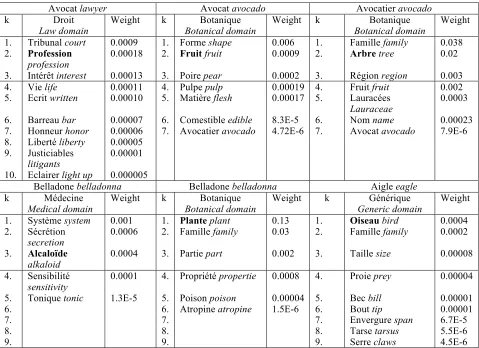
Avocat lawyer Avocat avocado Avocatier avocado
k Droit
Law domain Weight k Botanical domain Botanique Weight k Botanical domain Botanique Weight 1. Tribunal court 0.0009 1. Forme shape 0.006 1. Famille family 0.038 2. Profession
profession
0.00018 2. Fruit fruit 0.0009 2. Arbre tree 0.02
3. Intérêt interest 0.00013 3. Poire pear 0.0002 3. Région region 0.003 4. Vie life 0.00011 4. Pulpe pulp 0.00019 4. Fruit fruit 0.002 5. Ecrit written 0.00010 5. Matière flesh 0.00017 5. Lauracées
Lauraceae 0.0003
6. Barreau bar 0.00007 6. Comestible edible 8.3E-5 6. Nom name 0.00023 7. Honneur honor 0.00006 7. Avocatier avocado 4.72E-6 7. Avocat avocado 7.9E-6 8. Liberté liberty 0.00005
9. Justiciables
litigants 0.00001
10. Eclairer light up 0.000005
Belladone belladonna Belladone belladonna Aigle eagle
k Médecine
Medical domain
Weight k Botanique Botanical domain
Weight k Générique
Generic domain
Weight
1. Système system 0.001 1. Plante plant 0.13 1. Oiseau bird 0.0004 2. Sécrétion
secretion
0.0006 2. Famille family 0.03 2. Famille family 0.0002
3. Alcaloïde alkaloid
0.0004 3. Partie part 0.002 3. Taille size 0.00008
4. Sensibilité sensitivity
0.0001 4. Propriété propertie 0.0008 4. Proie prey 0.00004
5. Tonique tonic 1.3E-5 5. Poison poison 0.00004 5. Bec bill 0.00001
6. 6. Atropine atropine 1.5E-6 6. Bout tip 0.00001
7. 7. 7. Envergure span 6.7E-5
8. 8. 8. Tarse tarsus 5.5E-6
9. 9. 9. Serre claws 4.5E-6
Table 1: Example of possible hypernyms ranked by their weight in the definitions of dictionary entries
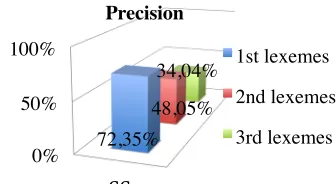
For the first three possible hypernyms, we obtained a high precision that decreases with the rank of the hypernym. It proves that the first lexemes with the highest weight represent the best possible hypernyms for a dictionary entry.
These experiments demonstrate that our weighting methodology estimates correctly the importance of lexeme in a definition and allows us to determine with a best precision the first three possible hypernyms for the defined lexeme.
5.
Exploitation of results
Extracted semantic relations from dictionary definitions are usually used to enrich existing taxonomies (Navigli & Velardi, 2008). Our aim is to use the hypernymy relations obtained from dictionary to construct a hierarchy of type “is-a”.
In this section we present the algorithm of automatic construction of thesaurus, which is based on our methodology of hypernyms identification. The idea of the algorithm is to create a thesaurus from the words by using their definitions of TLFi. The algorithm is based on two processes. The first process aims to transform words into the thesaurus nodes. The second process allows those nodes created from the first process to be hierarchized.
5.1 Creation of nodes of the thesaurus
The objective of this process is the transformation of words in the thesaurus nodes. This process involves two steps:
a) Extracting data from the TLFi for a given word X.
For each given word X we get from the TLFi a list of data composed of the domains of its definitions, lexemes with their weights and positions in the definitions of each domain.
b) Transformation of the data list of a given word X innodesof the thesaurus.
definitions of dictionary. We also plan to compare the extracted hypernyms with those already available in the existing thesauri or computational lexicons.
With the addition of some improvements such as the filtration of meta-language terms, we believe that this automatic method of identifying hypernyms will allow us to construct a truly hierarchical tree of type “is-a”.
7.
References
Barque, L., Nasr, A., & Polguère, A. (2010). From the Definitions of the Trésor de la Langue Française to a Semantic Database of the French Language.
Proceedings of the 14th EURALEX International Congress. Leeuwarden.
Dendien, J., & Pierrel, J.-M., (2003). Le Trésor de la Langue Française Informatisé: un exemple d’informatisation d’un dictionnaire de langue de reference.TAL (Traitement Automatique des Langues),
44(2), Hermès Sciences Edition, pp. 11--37. Paris. Gheorghita, I. (2011). Méthodologie de construction
automatique du thésaurus pour l'indexation et la recherche des images. TALN&RECITAL, 2, pp. 221--228. Montpellier.
Harabagiu, S., Miller, G. A., & Moldovan, D. (1999). WordNet 2 - A Morphologically and Semantically Enhanced Resource. Actes de SIGLEX’99, pp. 1--8. Hearst, M. A. (1992). Automatic acquisition of
hyponyms from large text corpora. Proc 14th Conference on Computational linguistics, pp. 539--545.
Kennedy, A., & Szpakowicz, S. (2007). Disambiguating hypernym relations for Roget's thesaurus. TSD’07 Proceedings of the 10th international conference on Text, speech and dialogue. Heidelberg : Springer-Verlag Berlin.
Miller, G. A. (1995). WordNet: A lexical Database.
Communications of the ACM.
Murphy, L. M. (2010). Lexical Meaning. Cambridge: University Press.
Nakamura, J., & Nagao, M. (1988). Extraction of semantic information from an ordinary en- glish dictionary and its evaluation. Proceedings of the 12th Conference on Computational linguistics, pp. 459--464. Morristown: Association for Computational Linguistics.
Navigli, R., & Velardi, P. (2008). From Glossaries to Ontologies: Extracting Semantic Structure from Textual Definitions. In Ontology Learning and Population: Bridging the Gap between Text and Knowledge (P. Buitelaar and P.Cimiano, Eds.), Series information for Frontiers in Artificial Intelligence and Applications, IOS Press, pp. 71--87.
Ritter, A., & Soderland, S. (2009). What Is This, Anyway: Automatic Hypernym Discovery.
Proceedings of the 2009 AAAI, pp. 88--93. Spring. Snow, R., Jurafsky, D., & Ng, A. Y. (2005). Learning
syntactic patterns for automatic hy-pernym discovery.
NIPS.
Spark Jones, K. (1972). A statistical interpretation of
term specificity and its application in retrieval.