Knowledge and Practices Regarding Blood Sample Collection
Procedures among House Officers and Nurses of Services
Hospital Lahore
Dr hassan jawad ; Dr aneela anwar ; Dr adil hussain ; Dr tauqir aslam
Abstract:
Background:
Work environments have peculiar health-related risks. Doctors and other healthcare workers
(HCWs) encounter work-related hazards
associated with their clinical and laboratory activities in the hospital. Blood and other effluents from infected patients may bear such pathogens as HIV, hepatitis B and hepatitis C virus, increasing the risk of transmission from such accidents as needle pricks and contacts with deep body fluids Objective: The objective of this study was to determine the knowledge and practices regarding blood sample collection among house officers and nurses working in Services Hospital Lahore.
Materi al and Methods:
Study Design : Cross sectional study
Study S ettin g and d uration :
Medical and surgical wards of Services institute of medical sciences, 6 months from April 2014 – October 2014.
Inclusi on cri teri a: Internees working in Services hospital medical and surgical ward and regular staff nurses working in Services hospital medical and surgical ward
Data Coll ecti on and analys is:75 internees and 75 staff nurses those fulfilling the inclusion criteria were selected for the study through simple random sampling. A detailed questionnaire regarding knowledge and practices about blood collection procedure was given all the information was collected in a structured questionnaire (attached). Data was entered and analyzed in SPSS ver: 16.0. Frequency tabulation
was done for nominal variables knowledge about blood sampling procedure and practices regarding blood sample. Cross tabulation was done for dependent variables like knowledge and practices among internees and staff nurses.
Results :A total of 150 nurses and internees (75 in each group) were interviewed regarding knowledge and practices about venues blood sampling during their ward duties. Mean age of nurses and house officers were 22.92 SD 3.514 and 24.03 SD .697. Knowledge among nurses and house officers showed that 79.1% of nurses and 73.2% of trainees knows that use of gloves is necessary, 77.6% of nursed and 78.9% of trainees knows that blood sample should be placed on inverters, 52.2% of nurses and 59.2% of trainees knows that the identity of patient should be asked every time before blood sampling. Practices among nurses and trainees showed that 73.8% of nurses and 52.3% of trainees introduce themselves to patient before blood sampling, 58.5 % of nurses and 73.8% of trainees checks the identity of patients. 38.5% of nurses and 72.3% of house internees wear necessary personal protective instrument.
Key words: Blood sampling, Nurses, House officers, Knowledge, Practices.
INTRODUCTION:
Work environments have peculiar health-related risks. Doctors and other healthcare workers (HCWs) encounter work-related hazards associated with their clinical and laboratory activities in the hospital. 1, 2 Blood and other effluents from infected patients may bear such pathogens as HIV, hepatitis B and hepatitis C virus, increasing the risk of transmission from such accidents as needle pricks and contacts with deep body fluids [3, 4]. A safe injection is one that is given using appropriate equipment; does not harm the recipient, does not expose the provider to any avoidable risk and does not result in any waste that is dangerous to other people (the community). 3, 4
Injection safety is an integral component of infection prevention and control; an element of standard precautions; key element of patient and healthcare worker safety; supported by infection prevention and control policies and procedures such as hand hygiene, housekeeping and waste management; a critical item of the continuous quality improvement (CQI) programme, managed by the healthcare team and specifically the infection prevention and control team in the health facilities.
Unsafe injection practices during blood sample collection are associated with risks such as: (a) Transmission of infections e.g. HBV, HCV and HIV; (b) Paralysis resulting from injection of a drug into a nerve resulting in weakness of the limb supplied by the nerve; (c) Adverse events following injections of which the most threatening is anaphylaxis (Sudden collapse of the circulatory system due to immunological response to the injected drug). The groups at risk
of these unsafe injection practices include: (a) Patients / clients especially immune-compromised individuals; (b) Healthcare workers especially doctors, nurses, laboratory scientist, laundry worker etc.; (c) Healthcare waste management personnel; (d) Communities through indiscriminate healthcare waste disposal; (e) Drug users.
The World Health Organization (WHO) estimates that 16 billion injections are administered annually in developing countries of which 90-95% is for therapeutic purpose. Approximately 5% of HIV, 40% of Hepatitis C and 32% of Hepatitis B virus infections are caused by unsafe and unnecessary injections worldwide 3, 4. According to a national cross-section survey conducted in August, 2004, disposable syringes and needles have been used almost exclusively since the 1980s in Nigeria. However a high percentage of the facilities were discovered not to always adhere to injection safety practices. The WHO defines healthcare waste as the total waste stream from a healthcare or research facility that includes both potential risk waste and non-risk waste materials.
Risks and hazards associated with healthcare waste include: needle stick injuries; transmission of infections or diseases; re-use of some types of waste (accidental or intentional); environmental pollution or degradation; exposure to radiation; fires and public nuisance (Offensive smells, unsightly debris). Eighty percent (80%) of healthcare waste is general waste or low risk waste, 20% can be dangerous and referred to as risk waste while 1% of risk waste is sharps waste
3, 4.
of injection safety and HCWM through training of healthcare workers will go a long way in minimizing/eliminating the above mentioned risks associated with unsafe injection practices and improper HCWM.
It has been observed that the highest prevalence of HIV-infected persons is found in developing countries and the highest needle prick injuries are also recorded in this region of the world 5. Injuries
from needle pricks are thought to be the commonest work-related hazard reported from a Nigerian teaching hospital6. The risk of acute hepatitis C infection in a health worker following a needle prick injury has been estimated to be from 1% to 5% 7. The available estimates suggest
that contracting hepatitis B infection due to a needle prick injury has a risk close to 100 times that of contracting HIV 8. Needle prick injuries are a common occurrence among health workers in Nigeria. It is estimated that more than 80% of workers in the health care sector will experience a needle prick injury at some point in their career9, and this is commoner amongst the surgeons, house officers and younger nurses10
Every day while caring for patients, nurses and doctors while collecting blood samples are at risk to exposure to blood borne pathogens potentially resulting in infections such as HIV or hepatitis B and C. These exposures, while preventable, are often accepted as being a part of the job. In the United States, needle stick injuries have begun to decrease from an estimated one million exposures per year in 1996 to 385,000 per year in 2000. This decline has resulted from the protections afforded by the Occupational Safety and Health Administration's (OSHA) Blood borne Pathogens Standard. Reasons for the success in decreasing needle stick and sharps injuries may be attributed to the elimination of needle recapping and the use of safer needle devices, sharps collection boxes, gloves and personal protective gear, and universal
precautions.11,12 The prevention of needle stick injuries has made slow progress over the past 20 years since the HIV epidemic drew attention to the deadly nature of health care work and to protection of health care worker health and safety.13 In Africa, where the AIDS virus originated and where the prevalence of the human immunodeficiency virus (HIV) among hospitalized patients is highest in the world, attention has been directed only recently at protecting health care workers. Nurses, especially those infected from a preventable exposure, have been at the forefront of advocacy for prevention. This article includes a review about the hazard of exposure to blood borne pathogens and epidemiology of occupational infection. The author discusses how to apply standard methods of occupational health and industry hygiene using the hierarchy of controls framework to prevent exposure to blood, and discusses evidence-based prevention and efficacy of particular control measures. Legislative progress and implementation of enforceable policy to protect health care workers is outlined.14
during deliveries and at surgeries. The provision of sharps containers and screening of transfused blood by the institutions studied was uniformly high. A high percentage (94.6%) of HCWs observed handwashing after handling patients. The use of barrier equipment was variable in the institutions studied. The intend to assess the knowledge of interness and staff nurses regarding collection procedure from blood samples which constitute a important safety aspect of not only the health care providers but also to the health care seekers.15,16
Our study will be based on the knowledge and practices of house officers and nurses, working in different medical and surgical wards of Services Hospital Lahore, regarding blood sample collection procedures. The research will include biodata and all the information relevant to our study.
OBJECTIVES:
The objective of this study was to determine the knowledge and practices regarding blood sample collection among house officers and nurses working in Services Hospital Lahore.
MATERIAL AND METHODS:
A Cross sectional study was conducted in Medical and Surgical wards of Services institute of medical sciences during April 2014 – October 2014. Sample size of 150 estimated from epi-info to estimate a proportion of physician to be interviewed for dietary counseling practices along with mother’s level of satisfaction with confidence level of 95%, acceptable difference of 0.08 and assumed proportion = 0.50 (50% have adequate knowledge and practices). We interviewd 75 internees and 75 staff nurses working in Services hospital Lahore.
75 internees and 75 staff nurses those fulfilling the inclusion criteria were selected for the study through simple random sampling. A detailed
questionnaire regarding knowledge and practices about blood collection procedure was given to each respondent. The variable of interest were knowledge about procedure of collecting blood, safety measures regarding blood sampling collection, knowledge about protective equipment during blood sampling collection and attitude regarding blood sampling collection procedure. Data was entered and analyzed in SPSS ver: 16.0. Frequency tabulation was done for nominal variables knowledge about blood sampling procedure and practices regarding blood sample. Cross tabulation was done for dependent variables like knowledge and practices among internees and staff nurses regarding procedure of collecting blood, safety measures regarding blood sampling collection, knowledge about protective equipment during blood sampling collection and attitude regarding blood sampling collection procedure.
RESULTS:
A total of 150 nurses and internees (75 in each group) were interviewed regarding knowledge and practices about venues blood sampling during their ward duties. Mean age of nurses were 22.92 SD 3.514 with minimum age of 18 and maximum of 32. Mean age of internees were 24.03 SD .697 with minimum age of 23 and maximum age of 25. (Table no: 1). Among nurses 100.0% were females and among internees 54.7% were male and 45.3% were females. (Table no: 2).
51.4% says that the test tube can be places in pocket or on counter. (Table no: 3).
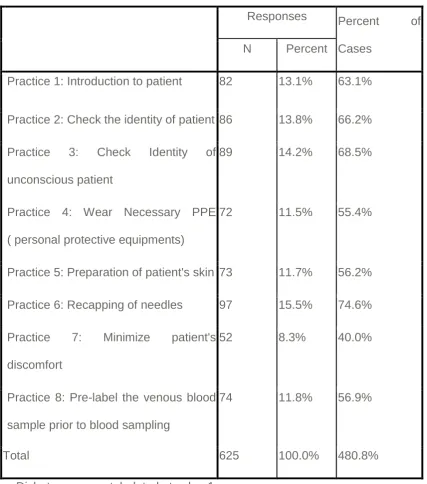
Over all practices showed that 63.1% introduce themselves to patient before blood sampling, 66.2 % checks the identity of patients. 68.5%t checks identity of unconscious patients before blood sampling, 55.4% wear necessary personal protective instrument, 56.2% prepare patient skin before blood sampling, 74.6% do recapping of needles, 40.0% minimize patients discomfort and 56.9% do a pre-labeling of blood sample prior to sampling. (Table no: 4).
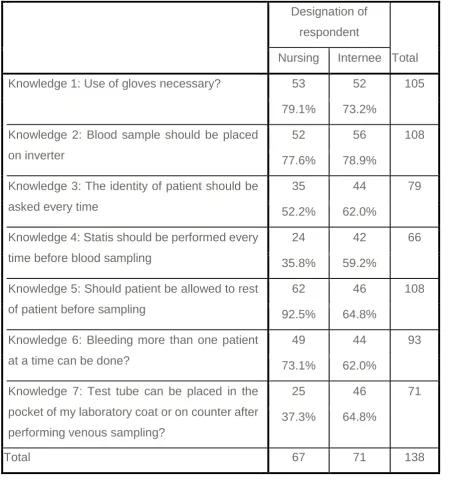
Knowledge among nurses showed that 79.1% knows that use of gloves is necessary, 77.6% knows that blood sample should be placed on inverters, 52.2% knows that the identity of patient should be asked every time before blood sampling, 35.8% knows that statis should be performed every time before blood sampling, 92.5% knows that patient should be allowed to rest before sampling, 73.1% says that bleeding more than once can be done, 37.3% says that the test tube can be places in pocket or on counter. (Table no: 5).
Knowledge among internees showed that 73.2% knows that use of gloves is necessary, 78.9% knows that blood sample should be placed on inverters, 62.0% knows that the identity of patient should be asked every time before blood sampling, 59.2% knows that statis should be performed every time before blood sampling, 64.8% knows that patient should be allowed to rest before sampling, 62.0% says that bleeding more than once can be done, 64.8% says that the test tube can be places in pocket or on counter. (Table no: 5).
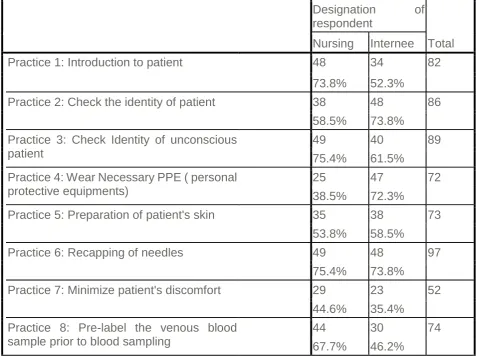
Practices among nurses showed that 73.8% introduce themselves to patient before blood sampling, 58.5 % checks the identity of patients. 75.4% checks identity of unconscious patients before blood sampling, 38.5% wear necessary
personal protective instrument, 53.8% prepare patient skin before blood sampling, 75.6% do recapping of needles, 44.6% minimize patients discomfort and 67.5% do a pre-labeling of blood sample prior to sampling. (Table no: 6).
Practices among internees showed that 52.3% introduce themselves to patient before blood sampling, 73.8 % checks the identity of patients. 61.5% checks identity of unconscious patients before blood sampling, 72.3% wear necessary personal protective instrument, 58.5% prepare patient skin before blood sampling, 73.8% do recapping of needles, 35.4% minimize patients discomfort and 46.2% do a pre-labeling of blood sample prior to sampling. (Table no: 6).
DISCUSSION:
Our findings are in line with previous studies, indicating that patient identification procedures in VBS require urgent attention. Although unacceptable, some of the results regarding patient identification may have logical explanations. Practices among nurses showed that 73.8% introduce themselves to patient before blood sampling, 58.5 % checks the identity of patients. 75.4% checks identity of unconscious patients before blood sampling, 38.5% wear necessary personal protective instrument, 53.8% prepare patient skin before blood sampling, 75.6% do recapping of needles, 44.6% minimize patients discomfort and 67.5% do a pre-labeling of blood sample prior to sampling. Practices among internees showed that 52.3% introduce themselves to patient before blood sampling, 73.8 % checks the identity of patients. 61.5% checks identity of unconscious patients before blood sampling, (Table no: 6).
Not asking the patient for name and identification number was more commonly reported in the psychiatric, intensive care and women’s health/pediatric wards, where patients more often have an impaired ability to communicate in some studies20,. Already knowing that the patient as the means of identification was also more commonly reported in the psychiatric wards, which may be due to the longer durations of stay among patients there. However, in the medical and surgical wards, almost all respondents reported not using wristbands for identification purposes. This is a serious error since samples are collected from patients with impaired consciousness in these wards. Although less likely to have such potentially tragic consequences as patient identification errors, errors during the actual sampling procedure are believed to be the most common type of preanalytical error21. For example, incorrect positioning of the patient before and during VBS and prolonged venous
stasis22 may have clinically significant effects on test results. This study suggests that both of these issues, as well as vertical storage of test tubes after sampling (for proper coagulation of serum samples), could all be improved in the wards surveyed. As the most remarkable finding, almost all respondents in the wards reported removing stasis after VBS24.
This study results also indicate that inversion of test tubes was not performed according to international recommendations78-80 and VBS instructions in the laboratory manual. However, some studies report that inappropriate test tube inversion does not introduce clinically important preanalytical error for coagulation and hematological testing, at least in healthy volunteers. In my study Knowledge among nurses showed that 79.1% knows that use of gloves is necessary, 77.6% knows that blood sample should be placed on inverters, 52.2% knows that the identity of patient should be asked every time before blood sampling, 35.8% knows that statis should be performed every time before blood sampling, and knowledge among internees showed that 73.2% knows that use of gloves is necessary, 78.9% knows that blood sample should be placed on inverters, 62.0% knows that the identity of patient should be asked every time before blood sampling,(Table no:5)
CONCLUSION: The study concluded that overall knowledge and practices among majority of staff nurses and house was good and practices among nurses and house officer’s lacks in checking identity, minimizing patient discomfort and wearing personal protective equipment.
REFERENCES: REFERENCES:
prevention and control: Facilitators' Guide, Abuja. 2007. Geneva. WHO.
[2] FGN. National policy on Injection Safety and HealthCare Waste Management. 2007. Abuja. FGN.
[3] Gerbending JL. Incidence and prevalence of human immunodeficiency virus, hepatitis B virus, hepatitis C virus and cytomegalovirus amongst health care personnel at risk of blood exposure: final report from a longitudinal study. J infect Dis. 1994; 170(6):1410-1417. PubMed | Google Scholar
[4] Ramos- Gomez F, Ellison J, Greenspan D, et al. Accidental exposure to blood and body fluids amongst health care workers in dental teaching clinics; a prospective study. J Am Dental Assoc. 1997; 1(28):1253-1261. PubMed | Google Scholar
[5] Pruss-Ustun A, Rapiti E, Hutin Y. Sharps injuries: global burden of disease from sharps injuries to health-care workers. 2003. Geneva, Switzerland. World Health Organization. PubMed | Google Scholar
[6] Orji EO, Fasuba OB, Onwudiegwu U, et al. Occupational health hazards among health care workers in an Obstetric and Gynecological unit of a Nigerian Teaching hospital. J Obstet Gynaecol. 2002; 22(1):75-78. PubMed | Google Scholar [7] Joint WHO/ILO Guidelines on health services and HIV/AIDS. June 2005. http://whqlibdoc.who.int/publications/2005/9221 175537_eng.pdf. Accessed 5th October 2012.
[8] Zarbo RJ, Jones BA, Friedberg RC,
Valenstein PN, Renner SW, Schifman RB, Walsh MK, Howanitz PJ. Q-tracks: a College of American Pathologists program of continuous laboratory monitoring and longitudinal tracking. Arch Pathol Lab Med 2002; 126: 1036–44.
[9] Renner SW, Howanitz PJ, Bachner P.
Wristband identification error reporting in 712 hospitals. A College of American Pathologists’
Q-Probes study of quality issues in transfusion practice. Arch Pathol Lab Med 1993; 117: 573–7. [10] Quillen K, Murphy K. Quality improvement to decrease specimen mislabelling in transfusion medicine. Arch Pathol Lab Med 2006; 130: 1196–98.
[11] Wilburn SQ. Needlestick and sharps injury prevention. Online J Issues Nurs. 2004 Sep 30;9(3):5.
[12] Sadoh WE, Fawole AO, Sadoh AE,
Oladimeji AO, Sotiloye OS. Practice of universal precautions among healthcare workers. J Natl Med Assoc. 2006 May;98(5):722-6.
[13] Perry J, Robinson ES, Jagger J. Nursing needle-stick and sharps-safety survey: getting to the point about preventable injuries. J Nurs 2004;34(4):43-7.
[14] Sadoh WE, Fawole AO, Sadoh AE,
Oladimeji AO, Sotiloye OS. Practice of universal precautions among healthcare workers. J Natl Med Assoc. 2006 May;98(5):722-6.
[15] Stein AD, Makarawo TP, Ahmad MFR. A
survey of doctors' and nurses' knowledge, attitudes and compliance with infection control guidelines in Birmingham teaching hospitals. J Hosp Infect. 2003 May;54(1):68–73.
[16] Danchaivijitr S, Tantiwatanapaiboon Y, Chokloikaew S, Tangtrakool T, Suttisanon L,
Chitreechuer L. Universal precautions:
knowledge, compliance and attitudes of doctors and nurses in Thailand. J Med Assoc Thai. 2005 Jul;78 Suppl 2:S112-7.
[17] Chuang J, Sadler MA, Witt DM. Impact of
[19] Papp AC, Hatzakis H, Bracey A, Wu KK. ARIC hemostasis study-I. Development of a blood collection and processing system suitable for multicenter hemostatic studies. Thromb Haemost 1989; 61: 15–19.
[20] Timms JF, Arslan-Low E, Gentry-Maharaj
A, Luo Z, T’Jampens D, Podust VN, Ford J, Fung ET, Gammerman A, Jacobs I, Menon U. Preanalytic influence of sample handling on SELDI-TOF serum protein profiles. Clin Chem 2007; 53: 645– 56.
[21] Kristensen GB, Nerhus K, Thue G,
Sandberg S. Results and feasibility of an external quality assessment scheme for self-monitoring of blood glucose. Clin Chem 2006; 52: 1311– 17
[22] Madeo M, Jackson T, Williams C. Simple measures to reduce the rate of contamination of blood cultures in accident and emergency. Emerg Med J 2005; 22: 810–11.
[23] Howanitz PJ, Renner SW, Walsh MK.
Continuous wristband monitoring over 2 years decreases identification errors: a College of American Pathologists Q-Tracks Study. Arch Pathol Lab Med 2002; 126: 809–15.
[24] Zarbo RJ, Jones BA, Friedberg RC,
RESULTS AND MAIN FINDINGS:Table no: 1 $Knowledge Frequencies (Multiple
Response Yes Frequencies)
Responses Percent of
Cases
N Percent
Knowledge 1: Use of gloves necessary? 105 16.7% 76.1%
Knowledge 2: Blood sample should be placed on inverter 108 17.1% 78.3%
Knowledge 3: The identity of patient should be asked every
time
79 12.5% 57.2%
Knowledge 4: Statis should be performed every time before
blood sampling
66 10.5% 47.8%
Knowledge 5: Should patient be allowed to rest before
sampling
108 17.1% 78.3%
Knowledge 6: Bleeding more than one patient at a time can
be done?
93 14.8% 67.4%
Knowledge 7: Test tube be placed in the pocket of my
laboratory coat or on counter after performing venous
sampling?
71 11.3% 51.4%
Total 630 100.0% 456.5%
Table no: 2 Practices Frequencies (Multiple Response Yes Frequencies)
Responses Percent of
Cases
N Percent
Practice 1: Introduction to patient 82 13.1% 63.1%
Practice 2: Check the identity of patient 86 13.8% 66.2%
Practice 3: Check Identity of
unconscious patient
89 14.2% 68.5%
Practice 4: Wear Necessary PPE
( personal protective equipments)
72 11.5% 55.4%
Practice 5: Preparation of patient's skin 73 11.7% 56.2%
Practice 6: Recapping of needles 97 15.5% 74.6%
Practice 7: Minimize patient's
discomfort
52 8.3% 40.0%
Practice 8: Pre-label the venous blood
sample prior to blood sampling
74 11.8% 56.9%
Total 625 100.0% 480.8%
Table no: 3 Knowledge*designation Cross tabulation (Multiple Response Yes
Frequencies)
Designation of
respondent
Total
Nursing Internee
Knowledge 1: Use of gloves necessary? 53 52 105
79.1% 73.2%
Knowledge 2: Blood sample should be placed
on inverter
52 56 108
77.6% 78.9%
Knowledge 3: The identity of patient should be
asked every time
35 44 79
52.2% 62.0%
Knowledge 4: Statis should be performed every
time before blood sampling
24 42 66
35.8% 59.2%
Knowledge 5: Should patient be allowed to rest
of patient before sampling
62 46 108
92.5% 64.8%
Knowledge 6: Bleeding more than one patient
at a time can be done?
49 44 93
73.1% 62.0%
Knowledge 7: Test tube can be placed in the
pocket of my laboratory coat or on counter after
performing venous sampling?
25 46 71
37.3% 64.8%
Table no: 4 Practices*designation Cross tabulation (Multiple Response Yes Frequencies)
Designation of
respondent
Total
Nursing Internee
Practice 1: Introduction to patient 48 34 82
73.8% 52.3%
Practice 2: Check the identity of patient 38 48 86
58.5% 73.8%
Practice 3: Check Identity of unconscious patient
49 40 89
75.4% 61.5%
Practice 4: Wear Necessary PPE ( personal protective equipments)
25 47 72
38.5% 72.3%
Practice 5: Preparation of patient's skin 35 38 73
53.8% 58.5%
Practice 6: Recapping of needles 49 48 97
75.4% 73.8%
Practice 7: Minimize patient's discomfort 29 23 52
44.6% 35.4%
Practice 8: Pre-label the venous blood sample prior to blood sampling
44 30 74