Differential Factors: Improved Attacks on
SERPENT
Cihangir Tezcan? and Ferruh ¨Ozbudak
Department of Mathematics and Institute of Applied Mathematics Middle East Technical University, Ankara, Turkey
Abstract. A differential attack tries to capture the round keys corre-sponding to the S-boxes activated by a differential. In this work, we show that for a fixed output difference of an S-box, it may not be pos-sible to distinguish the guessed keys that have a specific difference. We introduce these differences as differential factors. Existence of differential factors can reduce the time complexity of differential attacks and as an example we show that the 10, 11, and 12-round differential-linear attacks of Dunkelmanet al.on Serpentcan actually be performed with time complexities reduced by a factor of 4, 4, and 8, respectively.
Keywords :S-box, differential factor,Serpent, differential-linear attack
1
Introduction
Confusion layer of cryptographic algorithms mostly consists of substitution boxes (S-boxes) and in order to provide better security against known attacks, S-boxes are selected depending on their cryptographic properties: Low non-linear and dif-ferential uniformity [30] provide resistance against linear and difdif-ferential crypt-analysis, respectively; high algebraic degree and branch number provides resis-tance against algebraic [14] and cube [16] attacks; lack of undisturbed bits [37] provides resistance against truncated [20], impossible [2], and improbable [36] differential cryptanalysis. Moreover, recently it was shown in [9] that additive shares can be used in threshold implementations to provide resistance against side-channel attacks like differential power analysis [21] and the number of shares affects the performance.
In this work, we show that a fixed S-box output differenceµmay remain in-variant when the possible input pairs are XORed with someλ. We define suchλ
as a differential factor for the output differenceµand we show that such a prop-erty of an S-box can significantly reduce the attacked key space in a differential attack which results in an attack with reduced time complexity. Our analysis of S-boxes that are used in cryptographic algorithms show that differential fac-tors are observed mostly in small S-boxes. We observed that 73% of all possible
?
bijective 3×3 S-boxes contain differential factors. Moreover, 4×4 S-boxes of DES [28], GOST [39], LBLOCK [41], LED[18], LUFFA [12], NOEKEON [15],
Piccolo [35],Present[11], RECTANGLE [42], SARMAL [40], SERPENT [1], spongent[10] and Twofish [33] contain differential factors.
Lightweight cryptography has become very vital with the emerging needs in sensitive applications like RFID (Radio-frequency identification) systems and sensor networks. For these types of special purposes, there is a strong demand in designing secure lightweight cryptographic modules. Since most of such light-weight algorithms have a hardware oriented design, they use small S-boxes. Thus, differential factors pose a threat to lightweight block ciphers. We indicate the importance of this new S-box criteria on cryptanalysis by reducing the time complexities of the 10, 11, and 12-round differential-linear attacks of Dunkel-man et al. on Serpent by a factor of 4, 4, and 8, respectively. By changing the differential, we further modify these attacks to marginally reduce the data complexity. We compare our improved attacks on Serpent with the previous ones in Table 1.
2
S-box Evaluation
S-boxes are commonly used as non-linear components for symmetric cryptosys-tems and hash functions. Properties of S-boxes provide resistance against many cryptanalytic techniques.
Differential Uniformity
Definition 1. For a mappingS:F2n →Fm2, and all∆i∈Fn2 and∆o∈Fm2, let
tbe the number of elementsxthat satisfyS(x⊕∆i) =S(x)⊕∆o. Thent/|2n|is
the differential probability of the characteristicS(∆i→∆o). The table that lists
alltvalues for everyi, o∈X is called the Difference Distribution Table (DDT).
The maximum value in a DDT, excluding the zero difference case, is called differential uniformity. S-box designers aim to minimize differential uniformity since differential cryptanalysis [8] uses characteristics with high differential prob-ability.
Non-linear Uniformity
Definition 2. For a mappingS:Fn2 →Fm2 , and alla∈Fn2 andb∈Fm2 , let the numbers Lf(a, b)be defined as
Lf(a, b) :=|#{x∈F2n|a·x=b·S(x)} −2
n−1|
wherea·bdenotes the parity of the bit-wise product ofaandb. ThenS is called
non-linearlyl-uniformifLf(a, b)≤l for alla andbwith b6= 0.
Table 1: Summary of attacks on Serpent. Note that it is claimed in [27] that the multidimensional linear attacks of [29] may not work as claimed depending on the linear hull effect. If the claims are correct, then our use of differential factors in the attacks of [17] becomes the best attacks for this cipher.
En - Encryptions, MA - Memory Accesses, B - bytes, CP - Chosen Plaintexts, KP - Known Plaintexts.
#Rounds Attack Type Key Size Data Time Memory Advantage Success Reference 6 Meet-in-the-middle 256 512 KP 2247En 2246B - - [22] 6 Differential All 283CP 290En 240B - - [22] 6 Differential All 271CP 2103En 275B - - [22] 6 Differential 192, 256 241CP 2163En 245B 124 - [22] 7 Differential 256 2122CP 2248En 2126B 128 - [22] 7 Improbable All 2116.85CP 2117.57En 2113B 112 99.9% [38] 7 Differential All 284CP 285MA 256B - - [4] 10 Rectangle 192, 256 2126.3CP 2173.8MA 2131.8B 80 - [6] 10 Boomerang 192, 256 2126.3AC 2173.8MA 289B 80 - [6] 10 Differential-Linear All 2101.2CP 2115.2En 240B 40 84% [17]
10 Differential-Linear All 2101.2CP 2113.2En 240B 38 84% Sect. 4.4 10 Differential-Linear All 2100.55CP 2116.55En 240B 42 84% Appx. B
11 Linear 256 2118KP 2214MA 285B 140 78.5% [3] 11 Multidimensional Lineara All 2116KP 2107.5En 2108B 48 78.5% [29] 11 Multidimensional Linearb All 2118KP 2109.5En 2104B 44 78.5% [29] 11 Nonlinear 192, 256 2120.36KP 2139.63MA 2133.17B 118 78.5% [27] 11 Filtered Nonlinear 192, 256 2114.55KP 2155.76MA 2146.59B 132 78.5% [27] 11 Differential-Linear 192, 256 2121.8CP 2135.7MA 276B 48 84% [17]
11 Differential-Linear 192, 256 2121.8CP 2133.7MA 276B 46 84% Sect. 4.4 11 Differential-Linear 192, 256 2121.15CP 2137.05MA 276B 50 84% Appx. B
12 Multidimensional Linearc 256 2116KP 2237.5En 2125B 174 78.5% [29] 12 Differential-Linear 256 2123.5CP 2249.4En 2128.5B 160 84% [17]
12 Differential-Linear 256 2123.5CP 2246.4En 2128.5B 157 84% Sect. 4.4
a In [27], it is claimed that the correct data complexity of this attack is 2125.81 KP and the time complexity is 2101.44 En +2114.13MA.
bIn [27], it is claimed that the correct data complexity of this attack is 2127.78 KP and the time complexity is 297.41En +2110.10 MA.
cIn [27], it is claimed that the correct data complexity of this attack is≥2125.81 KP and the time complexity is 2229.44 En +2242.13MA.
Branch Number
Definition 3. [32] The branch number of ann×n S-box is
BN =min
a,b6=a(wt(a⊕b) +wt(S(a)⊕S(b))),
wherea, b∈X andwt(a)is the Hamming weight of the bit vector a.
For a bijective S-box, the branch number is at least 2 and this property of S-boxes is closely related to algebraic [14] and cube attacks [16].
dur-ing the computation of the hardware implementation of a cryptographic algo-rithm. For instance, differential power analysis (DPA) [21] exploits the corre-lation between the instantaneous power consumption of a device and the in-termediate results of a cryptographic algorithm. One countermeasure against side-channel attacks is threshold implementation in which a variable is split into additive shares. Bilginet al.analyzed the number of shares of S-boxes by catego-rizing all 3×3 and 4×4 S-boxes using affine equivalence classes and investigated the cost of this kind of protection in [9].
Undisturbed Bits Recently in [37], undisturbed bits are introduced as prob-ability 1 truncated differentials for S-boxes. A 13-round improbable differential attack on Present that uses undisturbed bits is provided in [37] and it was shown that the attack reduces to 7 rounds when the S-box is replaced with a similar one that lacks undisturbed bits. Moreover, it is shown that every bijec-tive 3×3 S-box contains undisturbed bits and a list of ciphers were provided in [37] whose 4×4 S-boxes contain undisturbed bits. S-boxes with undisturbed bits should be avoided to increase security against truncated, impossible, and improbable differential cryptanalysis.
3
Differential Factors
A differential attack on block ciphers tries to capture the round keys correspond-ing to the S-boxes activated by a differential. However, output difference of the S-box operation may be invariant when the round key is XORed with some specific value. Such a case would prevent the attacker from fully capturing the round key. This observation is similar to thelinear factors of block ciphers but here we are focusing on the S-box instead of some rounds of the cipher and we focus on key differences.
Definition 4 ([13]). A block cipher is said to have a linear factor if, for all plaintexts and keys, there is a fixed non-empty set of key bits whose simultaneous complementation leaves the XOR sum of a fixed non-empty set of ciphertext bits unchanged.
In order to have a similar property for S-boxes in the concept of differential cryptanalysis, we define the differential factors as follows:
Definition 5. Let S be a function fromFn
2 toFm2. For allx, y∈Fn2 that satisfy
S(x)⊕S(y) = µ, if we also have S(x⊕λ)⊕S(y⊕λ) = µ, then we say that the S-box has a differential factorλ for the output differenceµ. (i.e.µ remains invariant for λ).
undisturbed bits of its S-box and the inverse of it. In the following theorem, we prove that the number of differential factors of an S-box is the same with the number of differential factors of its inverse. Moreover, it also provides the differential factors of the inverse S-box when we know the differential factors of the S-box. Hence, there is no need to check the differential factors of the inverse of S-boxes.
Theorem 1. If a bijective S-box S has a differential factor λ for an output difference µ, thenS−1 has a differential factor µfor the output difference λ.
Proof. Let us assume that S has a differential factorλfor an output difference
µ. If S−1(c
1)⊕S−1(c2) = λ for some c1 and c2, then we need to show that
S−1(c
1⊕µ)⊕S−1(c2⊕µ) =λ.
Letc1⊕µ=S(p1) for somep1, then we haveS(S−1(c1)⊕λ)⊕S(p1⊕λ) =µ
sinceλis a differential factor of S forµ. Thus, we have
S−1(c
1⊕µ)⊕S−1(c2⊕µ) =S−1(S(p1))⊕S−1(S(S−1(c1)⊕λ)⊕µ)
=p1⊕S−1(S(p1⊕λ))
=p1⊕p1⊕λ
=λ
u t
Theorem 2. If λ1 and λ2 are differential factors for an output difference µ, then λ1⊕λ2 is also a differential factor for the output difference µ. i.e. All differential factorsλi forµform a vector space.
Proof. We are going to use the following change of variables: x0 =x⊕λ1 and
y0=y⊕λ1. For all (x, y) pairs satisfyingS(x)⊕S(y) =µ, we haveS(x⊕λ1)⊕
S(y⊕λ1) =µandS(x⊕λ2)⊕S(y⊕λ2) =µ. Thus, we have
S(x⊕λ1⊕λ2)⊕S(y⊕λ1⊕λ2) =S(x0⊕λ2)⊕S(y0⊕λ2) =µ
u t
In this section we used two variablesxandy since they are directly linked to the input pairs in differential cryptanalysis. However, same definition and theorems can be given using a single variable for bijective S-boxes and we provide them in Appendix A.
3.1 Differential Factors and Cryptanalysis
We start by recalling the definition of advantage.
Theorem 3. In a block cipher let an S-boxS contain a differential factor λfor an output differenceµand the partial round keykis XORed with the input ofS. If an input pair provides the output difference µunder a partial subkey k, then the same output difference is observed under the partial subkeyk⊕λ. Therefore, during a differential attack involving the guess of a partial subkey corresponding to the output difference µ, the advantage of the cryptanalyst is reduced by 1 bit and the time complexity of this key guess step is halved.
Proof. In a differential attack for any key k, k and k⊕λ would get the same number of hits since λ is a differential factor. Hence the attacker cannot dis-tinguish half of the guessed keys with the other half. Therefore during the key guessing step, the attacker does not need to guess half of the keys. Thus, the
time complexity of this step is halved. ut
Corollary 1. During a differential attack involving the guess of a partial subkey corresponding to the output difference µ of an S-box that has a vector space of differential factors of dimension r for µ, the advantage of the cryptanalyst is reduced by r bits and the time complexity of the key guess step is reduced by a factor of2r.
Proof. Follows directly from Theorem 2 and Theorem 3. ut
3.2 Relating Differential Factors to Other Properties of S-boxes
Since we are considering non-zeroµ and λ, a 3×3 S-box can contain at most 7·7 = 49 differential factors. In such a case, an S-box provides no security at all. In [37], it was shown that every bijective 3×3 S-box contains undisturbed bits. However, this is not the case for differential factors. Among the 8! = 40320 different bijective 3×3 S-boxes, we observed that 10752 of them do not contain any differential factor. Moreover, 18816 of them contain 9, 9408 of them contain 25, and 1344 of them contain 49 differential factors.
We further observed that the 3×3 S-boxes that do not have any differential factor also have 6 undisturbed bits, which is the smallest number of undisturbed bits a 3×3 S-box can have. Thus, for the case of 3×3 S-boxes, it is enough to check differential factors.
In our literature search we found 102 unique 4×4 S-boxes that are used in block ciphers and hash functions and observed that 40 of them have 74 differ-ential factors in total, without counting the differdiffer-ential factors of their inverses. These are the S-boxes of DES, GOST, LBLOCK, LED, LUFFA, NOEKEON,
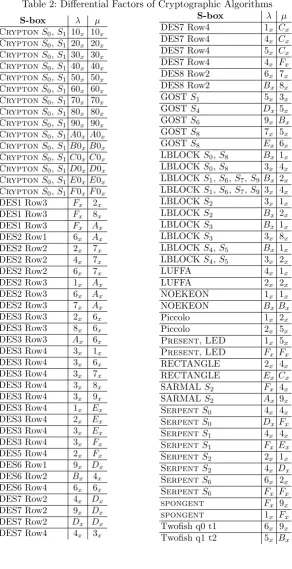
Piccolo,Present, RECTANGLE, SARMAL,Serpent,spongentand Twofish and they are provided in Table 2.
Conjecture 1. A differential 4-uniform 4×4 S-boxS has a differential factor for the output difference µ if and only if the µ-th column of the DDT table of S
consists of only zeros and fours.
The only 8×8 S-boxes we found with differential factors are the two S-boxes of the initial version of the Crypton cipher [24]. They contain 15 differential factors each and they are provided in Table 2. These S-boxes are replaced in the revised version of theCryptoncipher [25] and the new S-boxes do not contain any differential factors.
4
Improved Differential-Linear Attacks on SERPENT
4.1 SERPENT
Serpent was designed by Anderson, Biham and Knudsen in 1998. It was sub-mitted to the AES contest and came second after Rijndael. It has a block size of 128 bits and accepts any key size of length 0 to 256 bits. It is a 32-round SPN, where each round consists of key mixing, a layer of S-boxes and a linear transformation.
The 128-bit input value before roundiis denoted by ˆBi,i∈ {0, . . . ,31}. Each ˆ
Bi is composed of four 32-bit words X0, X1, X2, X3 where X0 is the leftmost
word.
Three round operations are specified as follows:
1. Key Mixing: At each round Ri, a 128-bit subkey Ki is XORed with the current intermediate data ˆBi.
2. S-boxes: At each round,Ri uses a single S-boxSj, wherei≡j (mod 8) and
i∈ {0, . . . ,31}, 32 times in parallel. In this paper, we use the bitsliced version of Serpent. For example, in the first round the first copy of S0 takes the
least significant bits fromX0, X1, X2, X3and returns the output to the same
bits. Thus, we obtain 32 4-bit slices referred as bi’s, where i ∈ {0, . . . ,31} andb0 is the right most slice.
3. Linear Transformation: The four 32-bit words X0, X1, X2, X3 are linearly
mixed by the following linear operations:
X0 :=X0≪13
X2 :=X2≪3
X1 :=X1⊕X0⊕X2
X3 :=X3⊕X2⊕(X03)
X1 :=X1≪1
X3 :=X3≪7
X0 :=X0⊕X1⊕X3
X2 :=X2⊕X3⊕(X17)
X0 :=X0≪5
X2 :=X2≪22
ˆ
Bi+1:=X0, X1, X2, X3
Table 2: Differential Factors of Cryptographic Algorithms
S-box λ µ
CryptonS0,S1 10x 10x CryptonS0,S1 20x 20x CryptonS0,S1 30x 30x CryptonS0,S1 40x 40x CryptonS0,S1 50x 50x CryptonS0,S1 60x 60x CryptonS0,S1 70x 70x CryptonS0,S1 80x 80x CryptonS0,S1 90x 90x CryptonS0,S1A0x A0x CryptonS0,S1B0xB0x CryptonS0,S1C0xC0x CryptonS0,S1D0xD0x CryptonS0,S1E0xE0x CryptonS0,S1F0x F0x
DES1 Row3 Fx 2x
DES1 Row3 Fx 8x
DES1 Row3 Fx Ax
DES2 Row1 6x Ax
DES2 Row2 2x 7x
DES2 Row2 4x 7x
DES2 Row2 6x 7x
DES2 Row3 1x Ax
DES2 Row3 6x Ax
DES2 Row3 7x Ax
DES3 Row3 2x 6x
DES3 Row3 8x 6x
DES3 Row3 Ax 6x
DES3 Row4 3x 1x
DES3 Row4 3x 6x
DES3 Row4 3x 7x
DES3 Row4 3x 8x
DES3 Row4 3x 9x
DES3 Row4 1x Ex
DES3 Row4 2x Ex
DES3 Row4 3x Ex
DES3 Row4 3x Fx
DES5 Row4 2x Fx
DES6 Row1 9x Dx
DES6 Row2 Bx 4x
DES6 Row4 6x 6x
DES7 Row2 4x Dx
DES7 Row2 9x Dx
DES7 Row2 Dx Dx
DES7 Row4 4x 3x
S-box λ µ
DES7 Row4 1x Cx
DES7 Row4 4x Cx
DES7 Row4 5x Cx
DES7 Row4 4x Fx
DES8 Row2 6x 7x
DES8 Row2 Bx 8x
GOSTS1 5x 3x
GOSTS4 Dx 5x
GOSTS6 9x Bx
GOSTS8 7x 5x
GOSTS8 Ex 6x
LBLOCKS0,S8 Bx 1x LBLOCKS0,S8 3x 4x LBLOCKS1,S6,S7,S9Bx 2x LBLOCKS1,S6,S7,S9 3x 4x
LBLOCKS2 3x 1x
LBLOCKS2 Bx 2x
LBLOCKS3 Bx 1x
LBLOCKS3 3x 8x
LBLOCKS4,S5 Bx 1x LBLOCKS4,S5 3x 2x
LUFFA 4x 1x
LUFFA 2x 2x
NOEKEON 1x 1x
NOEKEON Bx Bx
Piccolo 1x 2x
Piccolo 2x 5x
Present,LED 1x 5x Present,LED Fx Fx
RECTANGLE 2x 4x
RECTANGLE Ex Cx
SARMALS2 Fx 4x
SARMALS2 Ax 9x
SerpentS0 4x 4x SerpentS0 Dx Fx SerpentS1 4x 4x SerpentS1 Fx Ex SerpentS2 2x 1x SerpentS2 4x Dx SerpentS6 6x 2x SerpentS6 Fx Fx spongent Fx 9x
spongent 1x Fx
32-roundSerpentcipher may be described by the following equations:
ˆ
B0 :=P Bˆi+1:=Ri( ˆBi), i∈ {0, . . . ,31} C := ˆB32
where
Ri(X) =LT( ˆSi(X⊕Ki)), i∈ {0, . . . ,30}
R31(X) = ˆS31(X⊕K31)⊕K32
and ˆSi is the application of the S-box S(i(mod8)) 32 times in parallel, andLT
is the linear transformation.
The key scheduling algorithm ofSerpenttakes a 256-bit key as an input. If the key is shorter, then it is padded by a single bit of 1 and the remaining part is padded by bits of 0 up to 256 bits. By using an affine recurrence, the 256-bit key is used to construct 132prekeys having length of 32 bits. The S-boxes are used to produce 32-bit keywords from prekeys. The round keys are obtained by combining these keywords.
4.2 Differential-Linear Cryptanalysis
In 1994, Langford and Hellman combined differential cryptanalysis with lin-ear cryptanalysis and introduced differential-linlin-ear cryptanalysis [23]. They sug-gested using a truncated differential with probability 1 and concatenating a linear approximation with biasq(i.e. probability 1/2 +q) where the output difference of the differential should contain zero differences in the places where input bits masked in the linear approximation. This way one can construct differential-linear distinguishers and the data complexity of the distinguisher isO(q−4)
cho-sen plaintexts. The exact number depends on the success probability and the number of possible subkeys.
Moreover, Biham, Dunkelman and Keller showed that it is possible to con-struct a differential-linear distinguisher where the differential holds with proba-bility p <1 and introduced enhanced differential-linear cryptanalysis [5]. They also showed that the attack is still applicable if the XOR of the masked bits of the differential is 1. In the enhanced method, the data complexity becomes
O(p−2q−4) chosen plaintexts.
4.3 Differential-Linear Attacks on SERPENT
In [7] a differential-linear attack on 11-roundSerpent-192 andSerpent-256 is presented. The attack combines the 3-round differential
∆: 00000000000000000000000040050000→0??00?000?000000000?00?0??0??0?0
that has a probability ofp= 2−7 with the 6-round linear approximation
Λ: 20060040000001001000000000000000→00001000000000005000010000100001
The first attack on 10-roundSerpent-128 is also presented in [7] which is obtained by removing the last round of this linear approximation. The data and time complexities of these attacks are reduced in [17] by using the following improvements:
1. Better analysis of the bias of the differential-linear approximation, 2. Better analysis of the success probability,
3. Changing the output mask.
Moreover in [17], these reduced complexities are used to extend the 11-round attack and obtain the first 12-round attack on Serpent-256. In the following section we further improve these differential-linear attacks by using the differen-tial factors of Serpent’s S-boxesS0 andS1.
4.4 Improved Differential-Linear Attacks using Differential Factors
The differential-linear attacks of [7, 17] start at round 1 and the 3-round differ-ential activates 5 S-boxes in this round. Two of the output differences of these activated S-boxes are 4xandExwhich have differential factors as shown in Table 2. The authors guess every possible 20 subkey bits corresponding to these five S-boxes but the attacker can only obtain 18-bit advantage for this subkey due to Theorem 3 and there is no need to try half of the subkeys corresponding to these two S-boxes having differential factors. Thus, the advantage of the differential-linear attacks on 10, 11, and 12 rounds of Serpentare actually 38, 46, and 158 bits instead of 40, 48, and 160 bits, respectively. And again by Theorem 3, the same attacks can be performed with time complexities reduced by a factor of 4. Moreover, the 12-round attack of [17] adds one more round to the top of the differential which affects every S-box at round 0 except the S-boxes 2, 3, 19, and 23 and guesses the 112 bits of the subkey corresponding to these active S-boxes. However, by using the undisturbed bits ofSerpent, we observed that the output difference of the S-box 8 is exactly 4x. Sinceµ= 4xalso has a differential factor forS0, the attacker’s advantage reduces to 157 bits and the time complexity of
the attack further reduces by a factor of 2. Table 3 summarizes this 12-round attack and highlights the differential factors and the undisturbed bits that are used to reduce the time complexity.
We also observed that by replacing the 3-round differential with a more probable one, we can perform these attacks with less data complexity and capture four more subkey bits with a time complexity increased by a factor of 23.35. These modified attacks are provided in Appendix B.
5
Conclusion
Table 3: 12-round differential-linear attack of [17]. Output differences µ that contain differential factors, which are 4xandExforS1and 4xforS0, are shown
in bold. Undisturbed bits are shown in italic.
Input
X0: ???? ???? 0??? 0??? ???? ???? ???? 00?? X1: ???? ???? 0??? 0??? ???? ???? ???? 00?? X2: ???? ???? 0??? 0??? ???? ???1 ???? 00?? X3: ???? ???? 0??? 0??? ???? ???? ???? 00??
S0
X0: ??0? 00?0 0000 0?00 00?0 0000 00?? 00?? X1: ??0? ???? 00?0 0??? 0??? ???0 0?00 0000 X2: 000? 00?? 0??0 0?00 ??00 ?001 0?00 0000 X3: ?0?? ?0?? 00?? 0??? ??0? 0??0 ?001 0000
LT
X0: ?000 0000 0000 0??0 0?00 ?000 0000 0000 X1: ?000 0000 0000 0??0 0?00 ?000 0000 0000 X2: ?000 0000 0000 0??0 0?00 ?000 0000 0000 X3: ?000 0000 0000 01?0 0?00 1000 0000 0000
S1
X0: 0000 0000 0000 0100 0000 0000 0000 0000 X1: 1000 0000 0000 0010 0100 0000 0000 0000 X2: 0000 0000 0000 0000 0100 1000 0000 0000 X3: 0000 0000 0000 0010 0100 0000 0000 0000
LT
X0: 0000 0000 0000 0000 0000 0000 0001 0000 X1: 0000 0000 0000 0000 0000 0000 0000 0000 X2: 0000 0000 0000 0000 0000 0000 1001 0000 X3: 0000 0000 0000 0000 0000 0000 0000 0000 9-Round Differential-Linear Characteristic ∆◦Λ
Last Round
We show that differential factors may reduce the attacked key space in differen-tial cryptanalysis and its variants which results in an attack with reduced time complexity. As an example, we show that the differential factors of Serpent’s S-boxes are overlooked in Dunkelmanet al.’s differential-linear attacks on Ser-pent and the attacked round keys cannot be fully recovered in these attacks. We reduce the time complexities of these attacks by using the differential factors and provide the best differential-linear attacks on this cipher.
References
1. Biham, E., Anderson, R.J., Knudsen, L.R.: Serpent: A new block cipher proposal. In: Vaudenay, S. (ed.) FSE. Lecture Notes in Computer Science, vol. 1372, pp. 222–238. Springer (1998)
3. Biham, E., Dunkelman, O., Keller, N.: Linear cryptanalysis of reduced round Ser-pent. In: Matsui, M. (ed.) FSE. Lecture Notes in Computer Science, vol. 2355, pp. 16–27. Springer (2001)
4. Biham, E., Dunkelman, O., Keller, N.: The rectangle attack - rectangling the Ser-pent. In: Pfitzmann, B. (ed.) EUROCRYPT. Lecture Notes in Computer Science, vol. 2045, pp. 340–357. Springer (2001)
5. Biham, E., Dunkelman, O., Keller, N.: Enhancing differential-linear cryptanalysis. In: Zheng [43], pp. 254–266
6. Biham, E., Dunkelman, O., Keller, N.: New results on boomerang and rectangle attacks. In: Daemen, J., Rijmen, V. (eds.) FSE. Lecture Notes in Computer Science, vol. 2365, pp. 1–16. Springer (2002)
7. Biham, E., Dunkelman, O., Keller, N.: Differential-linear cryptanalysis of Serpent. In: Johansson, T. (ed.) FSE. Lecture Notes in Computer Science, vol. 2887, pp. 9–21. Springer (2003)
8. Biham, E., Shamir, A.: Differential Cryptanalysis of DES-like Cryptosystems. J. Cryptology 4(1), 3–72 (1991)
9. Bilgin, B., Nikova, S., Nikov, V., Rijmen, V., St¨utz, G.: Threshold implementations of all 3x3 and 4x4 S-boxes. In: Prouff, E., Schaumont, P. (eds.) CHES. Lecture Notes in Computer Science, vol. 7428, pp. 76–91. Springer (2012)
10. Bogdanov, A., Knezevic, M., Leander, G., Toz, D., Varici, K., Verbauwhede, I.: spongent: A lightweight hash function. In: Preneel and Takagi [31], pp. 312–325 11. Bogdanov, A., Knudsen, L.R., Leander, G., Paar, C., Poschmann, A., Robshaw,
M.J.B., Seurin, Y., Vikkelsoe, C.: PRESENT: An ultra-lightweight block cipher. In: Paillier, P., Verbauwhede, I. (eds.) CHES. Lecture Notes in Computer Science, vol. 4727, pp. 450–466. Springer (2007)
12. Canniere, C.D., Sato, H., Watanabe, D.: Hash function Luffa: Specification. Sub-mission to NIST (Round 2) (2009)
13. Chaum, D., Evertse, J.H.: Crytanalysis of DES with a reduced number of rounds: Sequences of linear factors in block ciphers. In: Williams, H.C. (ed.) CRYPTO. Lecture Notes in Computer Science, vol. 218, pp. 192–211. Springer (1985) 14. Courtois, N., Pieprzyk, J.: Cryptanalysis of block ciphers with overdefined systems
of equations. In: Zheng [43], pp. 267–287
15. Daemen, J., Peeters, M., Assche, G.V., Rijmen, V.: Nessie proposal: NOEKEON. NESSIE proposal, 27 October 2000.
16. Dinur, I., Shamir, A.: Cube attacks on tweakable black box polynomials. In: Joux, A. (ed.) EUROCRYPT. Lecture Notes in Computer Science, vol. 5479, pp. 278– 299. Springer (2009)
17. Dunkelman, O., Indesteege, S., Keller, N.: A differential-linear attack on 12-round Serpent. In: Chowdhury, D.R., Rijmen, V., Das, A. (eds.) INDOCRYPT. Lecture Notes in Computer Science, vol. 5365, pp. 308–321. Springer (2008)
18. Guo, J., Peyrin, T., Poschmann, A., Robshaw, M.J.B.: The led block cipher. In: Preneel and Takagi [31], pp. 326–341
19. Helleseth, T. (ed.): Advances in Cryptology - EUROCRYPT ’93, Workshop on the Theory and Application of of Cryptographic Techniques, Lofthus, Norway, May 23-27, 1993, Proceedings, Lecture Notes in Computer Science, vol. 765. Springer (1994)
20. Knudsen, L.R.: Truncated and higher order differentials. In: Preneel, B. (ed.) FSE. Lecture Notes in Computer Science, vol. 1008, pp. 196–211. Springer (1994) 21. Kocher, P.C., Jaffe, J., Jun, B.: Differential power analysis. In: Wiener, M.J. (ed.)
22. Kohno, T., Kelsey, J., Schneier, B.: Preliminary cryptanalysis of reduced-round Serpent. In: AES Candidate Conference. pp. 195–211 (2000)
23. Langford, S.K., Hellman, M.E.: Differential-linear cryptanalysis. In: Desmedt, Y. (ed.) CRYPTO. Lecture Notes in Computer Science, vol. 839, pp. 17–25. Springer (1994)
24. Lim, C.H.: Crypton: A new 128-bit block cipher - specification and analysis (1998) 25. Lim, C.H.: A revised version of crypton - crypton v1.0. In: Knudsen, L.R. (ed.)
FSE. Lecture Notes in Computer Science, vol. 1636, pp. 31–45. Springer (1999) 26. Matsui, M.: Linear cryptoanalysis method for DES cipher. In: Helleseth [19], pp.
386–397
27. McLaughlin, J., Clark, J.A.: Filtered nonlinear cryptanalysis of reduced-round ser-pent, and the wrong-key randomization hypothesis. In: Stam, M. (ed.) IMA Int. Conf. Lecture Notes in Computer Science, vol. 8308, pp. 120–140. Springer (2013) 28. National Bureau of Standards: Data Encryption Standard. FIPS PUB 46. Na-tional Bureau of Standards, U.S. Department of Commerce, Washington D.C., (15 January 1977)
29. Nguyen, P.H., Wu, H., Wang, H.: Improving the algorithm 2 in multidimensional linear cryptanalysis. In: Parampalli, U., Hawkes, P. (eds.) ACISP. Lecture Notes in Computer Science, vol. 6812, pp. 61–74. Springer (2011)
30. Nyberg, K.: Differentially uniform mappings for cryptography. In: Helleseth [19], pp. 55–64
31. Preneel, B., Takagi, T. (eds.): Cryptographic Hardware and Embedded Systems -CHES 2011 - 13th International Workshop, Nara, Japan, September 28 - October 1, 2011. Proceedings, Lecture Notes in Computer Science, vol. 6917. Springer (2011) 32. Saarinen, M.J.O.: Cryptographic analysis of all 4×4 s-boxes. In: Miri, A., Vaude-nay, S. (eds.) Selected Areas in Cryptography. Lecture Notes in Computer Science, vol. 7118, pp. 118–133. Springer (2011)
33. Schneier, B., Kelsey, J., Whiting, D., Wagner, D., Hall, C., Ferguson, N.: Twofish: A 128-bit block cipher. In: First Advanced Encryption Standard (AES) Conference (1998)
34. Sel¸cuk, A.A.: On probability of success in linear and differential cryptanalysis. J. Cryptology 21(1), 131–147 (2008)
35. Shibutani, K., Isobe, T., Hiwatari, H., Mitsuda, A., Akishita, T., Shirai, T.: Piccolo: An ultra-lightweight blockcipher. In: Preneel and Takagi [31], pp. 342–357 36. Tezcan, C.: The improbable differential attack: Cryptanalysis of reduced round
CLEFIA. In: Gong, G., Gupta, K.C. (eds.) INDOCRYPT. Lecture Notes in Com-puter Science, vol. 6498, pp. 197–209. Springer (2010)
37. Tezcan, C.: Improbable differential attacks on PRESENT using undisturbed bits. Journal of Computational and Applied Mathematics 259, Part B(0), 503 – 511 (2014)
38. Tezcan, C., Ta¸skın, H.K., Demircio˘glu, M.: Improbable differential attacks on SER-PENT using undisturbed bits. In: SIN (2014)
39. V. Dolmatov (Ed.): GOST 28147-89: Encryption, decryption, and message authen-tication code (MAC) algorithms. In: Internet Engineering Task Force RFC 5830 (March 2010)
40. Varici, K., ¨Ozen, O., C¸ elebi Kocair: Sarmal: Sha-3 proposal. Submission to NIST (2008)
42. Zhang, W., Bao, Z., Lin, D., Rijmen, V., Yang, B., Verbauwhede, I.: Rectangle: A bit-slice ultra-lightweight block cipher suitable for multiple platforms. IACR Cryptology ePrint Archive 2014, 84 (2014)
43. Zheng, Y. (ed.): Advances in Cryptology - ASIACRYPT 2002, 8th International Conference on the Theory and Application of Cryptology and Information Security, Queenstown, New Zealand, December 1-5, 2002, Proceedings, Lecture Notes in Computer Science, vol. 2501. Springer (2002)
A
Equivalent Definitions with only One Variable
When defining differential factors in Section 3, we used two variables xand y
since they are directly linked to the input pairs in differential cryptanalysis. One can observe that the same definition and theorems of Section 3 for bijective S-boxes can be given by using a single variable. We provide them as follows.
Definition 7. S has a differential factorλfor the output difference µif
S−1(S(x)⊕µ)⊕λ=S−1(S(x⊕λ)⊕µ)
for allx.
Proposition 1. Definition 5 is equivalent to Definition 7.
Proof. Since S(x)⊕S(y) =µ, we have y =S−1(S(x)⊕µ). Similarly,y⊕λ=
S−1(S(x⊕λ)⊕µ) sinceS(x⊕λ)⊕S(y⊕λ) =µ. XORing both equations gives
λ=S−1(S(x)⊕µ)⊕S−1(S(x⊕λ)⊕µ) and we are done. ut
Definition 8. S has a differential factorλfor the output difference µ if
S(S−1(x)⊕λ)⊕µ=S(S−1(x⊕µ)⊕λ)
for allx.
Proposition 2. Definition 5 is equivalent to Definition 8.
Proof. Lety=S(x). Then the Definition 7 becomes
S−1(y⊕µ)⊕λ=S−1(S(S−1(y)⊕λ)⊕µ)
for ally. Applying theS operation on both sides of the equation gives
S(S−1(y⊕µ)⊕λ) =S(S−1(y)⊕λ)⊕µ
for ally and we are done. ut
Thus, Propositions 1 and 2 prove the Theorem 1.
Proposition 3. If λ1 and λ2 are differential factors for an output difference
Proof. We have
S−1(S(x)⊕µ)⊕λ1=S−1(S(x⊕λ1)⊕µ)
for allx, by Definition 7. And we have
S−1(S(x⊕λ1)⊕µ)⊕λ2=S−1(S(x⊕λ1+λ2)⊕µ)
sinceλ2 is a differential factor. Thus, we get
S−1(S(x)⊕µ)⊕λ2⊕λ2=S−1(S(x⊕λ1⊕λ2)⊕µ)
for allxand we are done. ut
B
3-Round Differentials with Higher Probability
The rounds of the 3-round differential used in the differential-linear attacks of [7, 17] have probabilities 2−5, 2−1, and 1 but the authors observed experimen-tally that this differential has probability 2−7 instead of 2−6. We observed that there are 3-round differentials of Serpent with probability 2−5 that can be combined with the same linear approximations. The rounds of these differential have probabilities 2−5, 1, and 1 and for this reason, the theoretical and
practi-cal probabilities of these differentials are the same. However, these differentials activate six S-boxes at the first round of the attack instead of five. So replacing the original differential with one of them results in capturing four more subkey bits but time complexity of the attacks also increases by a factor of 24.
Since the data complexity of a differential-linear attack is ofO(p−2q−4) and
replacing the differential result inp= 2−5instead of 2−7, one would expect the
modified attacks to have data and time complexities reduced by a factor of 24.
However, experiment results show that the gain in the modified attacks is at most a factor of (2−0.32)2. This is because the transition between the original
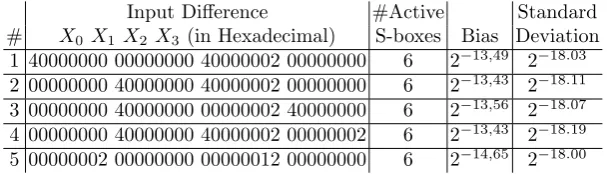
differential and the linear approximation is far better than expected. For in-stance, when the original 3-round differential is combined with a 1-round linear approximation of bias 2−5, Dunkelmanet al.experimentally verified that the 4-round differential-linear path has bias 2−13.75, instead of 2·2−7·(2−5)2= 2−16. We performed similar experiments on five different 3-round differentials with probability 2−5 using 234pairs and the results are summarized in Table 4.
We replace the original differential with the second one from Table 4 and obtain new 10, and 11 round differential-linear attacks. This change provides a 4-round bias of 2−13,43 instead of 2−13.75. Thus the data and time complexity
gain in the modified attack is a factor of (2−0.32)2. This differential activates
six S-boxes instead of five so we capture four more subkey bits and the time complexity is multiplied by 24. We summarize this modified attack in Table 5.
Table 4: 4-Round biases for 3-round differentials with probability 2−5 and
1-round linear approximation with bias 2−5.
Input Difference #Active Standard
# X0 X1X2X3(in Hexadecimal) S-boxes Bias Deviation
1 40000000 00000000 40000002 00000000 6 2−13,49 2−18.03 2 00000000 40000000 40000002 00000000 6 2−13,43 2−18.11
3 00000000 40000000 00000002 40000000 6 2−13,56 2−18.07 4 00000000 40000000 40000002 00000002 6 2−13,43 2−18.19
5 00000002 00000000 00000012 00000000 6 2−14,65 2−18.00
Table 5: 11-Round differential-linear attack with a 3-round differential of prob-ability 2−5. Output differences µ = 4x and µ = Ex that contain differential factors forS1 are shown in bold. Undisturbed bits are shown in italic.
Input
X0: 0??0 0000 0000 00?0 0000 ?00? 00?0 0000
X1: 0??0 0000 0000 00?0 0000 ?00? 00?0 0000
X2: 0??0 0000 0000 00?0 0000 ?00? 00?0 0000
X3: 0??0 0000 0000 0010 0000 ?00? 0010 0000
S1
X0: 0000 0000 0000 0010 0000 00000000 0000
X1: 0110 0000 0000 0000 0000 10010000 0000
X2: 0000 0000 0000 0000 0000 00010010 0000
X3: 0000 0000 0000 0000 0000 10010000 0000
LT
X0: 0000 0000 0000 0000 0000 0000 0000 0000
←
−
−
−
−
−
−
−
−
−
−−
p= 2−5
X1: 0100 0000 0000 0000 0000 0000 0000 0000
X2: 0100 0000 0000 0000 0000 0000 0000 0010
X3: 0000 0000 0000 0000 0000 0000 0000 0000
S2
X0: 0000 0000 0000 0000 0000 0000 0000 0000
X1: 0000 0000 0000 0000 0000 0000 0000 0010
X2: 0100 0000 0000 0000 0000 0000 0000 0000
X3: 0000 0000 0000 0000 0000 0000 0000 0010
LT
X0: 0000 0000 0000 0000 0000 0000 0000 0000
X1: 0000 0000 0000 0000 0000 0000 0000 0000
X2: 0000 0000 1000 0000 0000 0000 0000 0000
X3: 0000 0000 0000 0000 0000 0000 0000 0000
S3
X0: 0000 0000 ?000 0000 0000 0000 0000 0000
X1: 0000 0000 ?000 0000 0000 0000 0000 0000
X2: 0000 0000 ?000 0000 0000 0000 0000 0000
X3: 0000 0000 ?000 0000 0000 0000 0000 0000
LT
X0: 00?0 0000 0000 ?000 0000 0??0 0?00 ?00?
X1: 0000 ?00? 0000 0000 0000 0000 00?0 0000
X2: 0000 0000 ?0?? 000? 0000 0000 000? 0?00
X3: 0?00 0000 0000 0000 0?00 0000 0000 00?0
S4
X0: 0??0 ?00? ?0?? ?00? 0?00 0??0 0??? ????
X1: 0??0 ?00? ?0?? ?00? 0?00 0??0 0??? ????
X2: 0??0 ?00? ?0?? ?00? 0?00 0??0 0??? ????
X3: 0??0 ?00? ?0?? ?00? 0?00 0??0 0??? ????
6-Round Linear ApproximationΛ
![Table 1: Summary of attacks on Serpent. Note that it is claimed in [27] thatthe multidimensional linear attacks of [29] may not work as claimed dependingon the linear hull effect](https://thumb-us.123doks.com/thumbv2/123dok_us/7905166.1312466/3.595.137.479.207.416/summary-attacks-serpent-claimed-thatthe-multidimensional-attacks-dependingon.webp)
![Table 3: 12-round differential-linear attack of [17]. Output differences µcontain differential factors, which are 4 thatx and Ex for S1 and 4x for S0, are shownin bold](https://thumb-us.123doks.com/thumbv2/123dok_us/7905166.1312466/11.595.177.437.170.453/table-dierential-output-dierences-ucontain-dierential-factors-shownin.webp)