Controlling Variable Speed Wind Turbines
Which Have Doubly Fed Induction Generator
by Using of Internal Model Control Method
Reza Emadifar1, Sajjad Tohidi2, Mojtaba Eldoromi3
M.Sc, Dept. of Electrical and Computer Engineering, University of Tabriz, Tabriz, Iran1, 3
Assistant Professor, Dept. of Electrical and Computer Engineering, University of Tabriz, Tabriz, Iran2
ABSTRACT: Doubly Fed Induction Generators (DFIG) are as the main generators which are used in the power generation systems of wind energy in Variable Speed-Constant Frequency (VSCF). Wind turbine model and dynamic mathematic model of DFIG have been presented in this article. Rotor currents control in internal loop and rotation speed in external loop have been accomplished according to the methods of Internal Model Control (IMC). A sample of Doubly Fed Induction Generators of VSCF with nominal capacity of 1.5 MW has been simulated in MATLAB software. The simulation results indicate quick dynamic response of system in different conditions and performance in hyper-synchronous and sub-synchronous speed.
KEYWORDS: Doubly fed induction generator, Sub-synchronous speed, Hyper-synchronous speed, Variable speed, Constant frequency, Simulink.
I.INTRODUCTION
In recent years, wind power generation systems of variable speed-constant frequency connected to the network have had significant progress. Existence of wind power generation system in power network has prepared important context for scientist’s research of this domain [1, 2]. In comparison with wind turbines which have constant speed- constant frequency, using of wind turbines with variable speed- constant frequency and Doubly Fed Induction Generator has many advantages. Some of them are optimal performance in variable speed, separated control of active and reactive power, reduction of mechanical tensions and noise, improvement of power quality and using of power transformer with nominal power between 25-30 percent of the total power of the system [3]-[7]. Doubly Fed Induction Generators of a system with high rank are non-linear and have powerful relation between their different components. Search in the field of dynamic mathematic model, controlling methods of connection to the network and dynamic performance at the time of voltage collapse have been studied in the references [8] to [10]. In this article, the form of stator and rotor voltage waves, rotor currents and speed in different conditions such as performance in hyper-synchronous and sub-synchronous speeds have been analysed. In [11] study presents an overview and literature survey over past few decades on the different problems associated due to penetration of WT-DFIG in the power system and control aspects of DFIG. Also the dynamic behaviour for a DFIG Wind Energy Conversion system with fuzzy controller is simulated for different fault conditions and the results are compared to that of the system with PI Controllers in [12]. In a new case, the performance of DFIG is analyzed during the operation of sub-synchronous and super-synchronous generating modes using MATLAB/SIMULINK in [13].
Principles of wind turbines with variable speed-constant frequency which have Doubly Fed Induction Generators have been studied and accurate mathematical model of Doubly Fed Induction Generator with considering important details has been simulated. Also controlling has been accomplished according to the stator flux direction. Internal model control in the speed and currents control loops has been used. In order to simulate and do the analyses, a wind turbine system model with nominal capacity of 1.5 Megawatt has been used. Simulation has been done in MATLAB/Simulink software and simulation results indicate confirmation of theoretical analyses and effectiveness of control methods.
II.PERFORMANCE PRINCIPLES OF DOUBLY FED INDUCTION GENERATORS OF VSCF
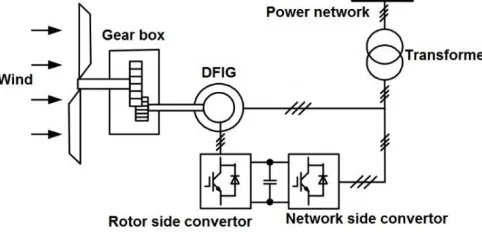
Wind turbines with variable speed-constant frequency which have Doubly Fed Induction Generator in a comprehensive look include wind turbine, gearbox for adjusting the speed, Doubly Fed Induction Generator rotor-side transformers and network-side transformers, transformer connected to the network and transmission line connected to the network. Diagram of a sample of wind turbine with doubly fed induction generator has been indicated in the Fig. 1.
Fig. 1 Diagram of a sample of VSCF DFIG
When electric motor is stable in the performance conditions, the rotational fields of stator and rotor are rotating with synchronous speed. Therefore, the equation between rotational magnetic field of rotor and stator can be expressed as follows:
= + (1)
Equation No. (1) Can be rewritten in the form of equation (2):
60 + = (2)
In above equations, n1 is the magnetic fieldspeed of stator, n2 is the magnetic field speed of rotor to stator, nr is rotor
speed, P indicates the number of poles, f1 and f2 indicate in order stator currents frequency and rotor currents
frequency.
With changes of wind speed, the stator output frequency will remain constant so that VSCF functionality to be obtained. When DFIG is in super- synchronous mode, f2 is larger than zero. Network provides AC stimulation of low
frequency of positive succession and needed power for stimulation transformers. If f2 is smaller than zero, network will
create AC stimulation of low frequency of negative succession by stimulation transformers. In hyper-synchronous mode, slip is negative and in sub-synchronous mode, slip is positive.
III.DYNAMIC MATHEMATICAL MODEL
1. Wind turbine model
Wind turbine is the most important part of process of transforming energy in the power generation system of wind energy. Wind turbine is used for transforming the kinetic energy of wind to electric energy. Wind turbine output is influenced by wind input power. Therefore for safety, the stability and reliable performance should be planned. According to Betz theory, the power of wind turbine is as follows:
=1
2 (3)
Cp is the coefficient of wind turbine power, is the air density, S indicates sweep surface of turbine and v is the wind
speed. The power coefficient of wind turbine is a function of deviation angle of blade (β) and the tip speed ratio (λ). We define λ as follows:
λ= (4)
In equation (4), is the mechanical angle of wind turbine blades and R is the radius of wind turbine blade. The numerical method for calculating the power coefficient of wind turbine (Cp) is in the form of equation (5) [14].
( , ) = 0.73 151−0.58 −0.002 . −13.2
.
In equation (5), λi is defined as follows:
= 1
−0.02 +
0.003
+ 1 (6)
For reaching to the maximum power coefficient, there is always an optimal tip speed ratio (λopt) that can be determined
with regard to the amounts of deviation angle of blade (β).
Output torque of wind turbine is proposed as an important parameter in calculations that its amount can be calculated as follows:
= (7)
2. Dynamic mathematical model of DFIG
Doubly Fed Induction Generator can be divided into two important parts of stator and rotor. Stator-side follows generator rules and rotor-side follows motor rules of electric machines. In other words, the positive direction of currents in stator has been considered in generator form and in rotor it has been considered in motor form. Voltage equations and stator and rotor flux in the reference frame of d-q are expressed as follows:
=− − +
=− − − (8)
= + −
= + + (9)
= + ( − ) = −
= + − = − (10)
= + ( − ) = −
= + − = − (11)
With change of flux equations to voltage, voltage-current equations in the reference frame of d-q are obtained as follows:
=
− − −
− − −
−
− −
+ −
+
(12)
Electromagnetic torque is also expressed as follows:
− = −3
2 − = (13)
In above equations, Rs and Rr are armature winding resistors of stator and rotor, , , و , are in order insider
inductances of stator and rotor, reciprocal inductance and leaky inductance of rotor and stator. , , , are in order the voltages of d and p axes of stator and rotor. , , , are in order the currents of d and p axes of stator and rotor and , , , are in order the fluxes of d and p axes of stator and rotor. is the synchronous speed, is rotor speed and = − is the slip speed. P in above matrix is the differential operator. Above equations indicate full mathematical model of DFIG.
IV.APPLICATION OF INTERNAL MODEL CONTROL (IMC) IN DFIG
currents and the external loop controller of speed and indicates that the accomplished simulation from the controlling view is stable.
1. Application of IMC in currents loop
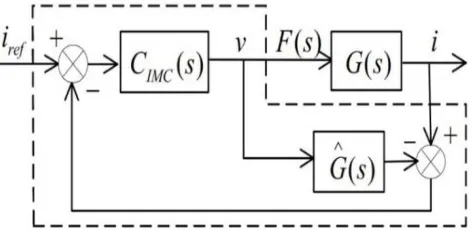
IMC controlling diagram of rotor current loop of wind power generation system of DFIG has been indicated in the Fig. (2):
Fig. 2IMC controlling diagram of rotor currents loop of wind power generation system of DFIG
In the Fig.2, ( )is the controller transformer function, G(s) is the controlled system, iref is the control system input,
i is the output currents of system, G(s) is the internal model of controlled system and F(s) is the systematic equivalent transformer function which has been drawn in dotted form. For selecting the currents transformer function for ( ) , controller designing has high importance. A designing method is as follows [15]:
( ) =
+ G (s) (14)
that n and α are determining for designing ( ). α is in the form of α= . The closed loop transformer function is as follows:
( ) = ( ) ( )
1 + ( ) ( )− ( ) (15)
If ( ) = ( ), equation (15) will be simplified as follows:
( ) =
+ (16)
With similar method, F(s) can be obtained in the following form:
( ) = ( )
1− ( )G(s) (17)
Designing IMC with above method has slow dynamic response. For solving this problem, a feed forward feedback is used. By exerting this feedback, improved system diagram of IMC has been indicated in the Fig. 3.
The transformer function of this system is as follows:
( ) = ( )
1 + ( )[ ( ) + ]= +
1
( ) + (18)
For a first degree system by selecting = − , the above transformer function will be as follows:
( ) =
( + ) (19)
By doing it, the disturbances effect can be reduced. The transformer function of rotor currents loop will be as follows:
( ) =
́ + =
1
+ =
1
+ + (20)
For the first degree system, n=1, it is enough that currents controller to be designed in the form of a PI controller and equation (21):
( ) = G (s) = ( + + ) = + (21)
that and are in order proportional and integral interests. By selecting = − , two interests will be in the forms of = and =α .
2. IMC application in the speed loop
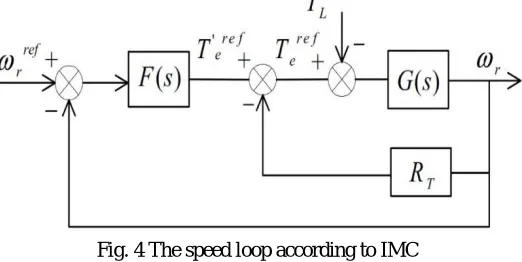
With regard to the generator torque equation and assuming that the internal loop of currents is quicker than external loop of controllable speed, will be considered as disturbance in electromagnetic torque. In the Fig. (4), the speed loop has been indicated according to IMC.
Fig. 4 The speed loop according to IMC
With regard to the Fig. 4, the transformer function of G ( ) can be calculated as follows:
G ( ) = =
+ ( + ) + (22)
that = can be simplified as follows:
( ) =
2 ( + ) (23)
With regard to the equation (23), the torque disturbance effect has been reduced. Therefore for simplifying the equations, the disturbance can be withdrawn. In these conditions, the transformer function will be obtained as follows:
( ) = = 1
+ (24)
Using of IMC rule for a first degree system obtains the speed controller as follows:
( ) = ( ) = 2 + = + (25)
V. RESULT AND DISCUSSION
In this part, simulation of a real system is considered. Wind turbine parameters with variable speed- constant frequency in the simulation are as follows:
Table 1- real system features
Quantity Size Sign
Nominal power of generator, DFIG 1.5 MW
Nominal voltage 690 V V
Frequency 50 Hz f
Stator resistor 0.023 p.u. Stator inductance 0.18 p.u. Rotor resistor 0.016 p.u. Rotor inductance 0.16 p.u. Reciprocal inductance 2.9 p.u.
Poles number 6 p
Inertia invariable of wind turbine 0.685 s H
Wind speed 11 m/s v
This wind turbine has been connected to a transmission line with length of 30 Km. The simulated model of system in Simulink part of MATLAB software is in the form of Fig. 5.
Fig. 5 Simulink model of simulated system
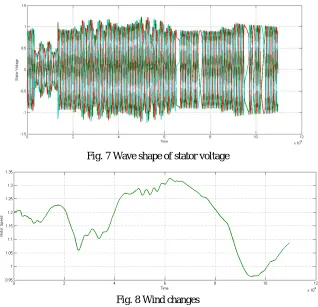
120%rotor speed of synchronous speed has been regulated in p.u. at the time of launch, and after 0.05s it is placed in the torque control situation. The voltage wave of stator and rotor voltage and also the wind speed changes have been brought in the Fig. s 6 to 8.
Fig. 7 Wave shape of stator voltage
Fig. 8 Wind changes
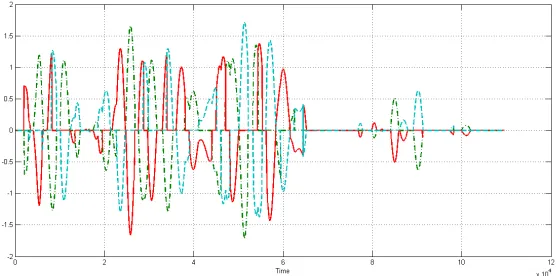
When rotor speed changes from sub-synchronous to synchronous and hyper-synchronous speed, rotor current frequency changes with turbine speed. Wind turbine with variable speed- constant frequency which has Doubly Fed Induction Generator has been connected to 25-Kv bus-bar by 30-Km transmission line. Bus-bar voltage and currents of 25 kV have been indicated in the Fig. 9.
Fig. 9Bus-bar voltage and currents of 25 kV
During the simulation process, analysis of the waves form and comparing it with numerical analyses can lead to design and select the amounts correctly.
VI.CONCLUSION
simulated on a real system. The effect of proper designing of controllers, IMC and its effects on currents loops and speed were studied. The effects of methods which have been implemented on the system were also considered in final simulation. It was indicated that the presented model due to the quick dynamic response in different speeds can be used for analysing and designing the wind turbine connected to the network.
REFERENCES
[1] Zavadil, R., Miller, N., Ellis A, A., and Muljadi, E., “Making connections: wind generation facilities,” IEEE Power and Energy Magazine, vol. 3, no. 6, pp. 26-37, 2005.
[2] Hughes, F. , Anaya-Lara, O. , Jenkins, N. , and Strbac, G. , “Control of DFIG-based wind generation for power network support,” IEEE Transactions on Power Systems, vol. 20, no. 4, pp. 1958-1966, 2005.
[3] Xu, L. , and Cartwright, P. , “Direct active and reactive power control of DFIG for wind energy generation,” IEEE Transactions on Energy Conversion, vol. 21, no. 3, pp. 750-758, 2006.
[4] Luis, M., Francisco, J., and José, R., “Aggregated dynamic model for wind farms with doubly fed induction generator wind turbines,” Renewable Energy, vol. 33, no. 1, pp. 129-140, 2008.
[5] Muller, S.,Deicke, M., and De Doncker, R. W., “Doubly fed induction generator systems for wind turbines,” IEEE Industry Applications Magazine, vol. 8, no. 3, pp. 26-33, 2002.
[6] Zhi, D. , and Xu, L., “Direct power control of DFIG with constant switching frequency and improved transient performance,” IEEE Transactions on Energy Conversion, Vol. 22, No. 1, pp. 110-118, 2007.
[7] Lei, Y. , Mullane, A. , Lightbody, G. , and Yacamini, R. , “Modeling of the wind turbine with a doubly fed induction generator for grid integration studies,” IEEE Transactions on Energy Conversion, vol. 21, No. 1, pp. 257-264, 2006.
[8] Ekanayake, J. B. , Holdsworth, L. , and Jenkins, N., “Comparison of 5th order and 3rd order machine models for doubly fed induction generator (DFIG) wind turbines,” Electric Power Systems Research, vol. 67, no. 3, pp. 207-215, 2003.
[9] Yin, M., Li, G., Zhou, M., “Analysis and comparison of dynamic models for the doubly fed induction generator wind turbine,” Automation of Electric Power Systems, vol. 30, no. 13, pp. 22-27, 2006.
[10] Tapia, A., Tapia, G.,Ostolaza, J.X. and Saenz, J. R. , “Modeling and control of a wind turbine driven doubly fed induction generator,” IEEE Transactions on Energy Conversion, vol. 18, no. 2, pp. 194-204, 2003.
[11] Lather, J.S. , Dhillon, S.S., and Marwaha, S., “Moderncontrolaspectsindoublyfedinductiongeneratorbasedpowersystems: A review” , International Journal of Advanced Research in Electrical, Electronics and Instrumentation Engineering, Vol. 2, no 6, pp. 2149-2161, 2013. [12] Dhayanidhi, N., Muralidharan, D., “Dynamic Behavior of DFIG Wind Energy Conversion System under Various Faults”, International Journal
of Advanced Research in Electrical, Electronics and Instrumentation Engineering, Vol. 3, no 1, pp. 6489-6496, 2014.
[13] Rajeswari, R., “Control of doubly fed induction generator based wind energy conversion system” , International Journal of Advanced Research in Electrical, Electronics and Instrumentation Engineering, Vol. 3, no 2, pp. 381-389, 2014.
[14] Slootweg, J. G., Polinder, H., and Kling, W. L., “Representing wind turbine electrical generating systems in fundamental frequency simulations,” IEEE Transactions on Energy Conversion, vol. 18, no. 4, pp. 516-524, 2003.
[15] Harnefors, L., and Nee, H., “Model-Based Current Control of AC Machines using the Internal Model Control Method,” IEEE Transactions on Industry Applications, vol. 34, no. 1, pp. 133-141, 1998.
BIOGRAPHY
Reza Emadifar was born in Ajabshir, Iran, in 1991. He received the B.Sc. degree in electrical engineering from Shahid Rajaee Teacher Training University, Tehran, Iran, in 2013 and the M.Sc. degree in electrical engineering from University of Tabriz, Iran, His research interests include electrical machine design and modelling, finite-element analysis.
Dr. Sajjad Tohidi was born in Meshkinshahr, Iran, in 1984. He received the B.Sc. degrees, from Iran University of science and technology, and the M.Sc. and Ph.D. degree in Electrical engineering from sharif university of technology, Iran. He is currently faculty member in University of Tabriz. His research interests include power systems dynamics, electrical machines and wind power generation.