Advances in Medical Education and Practice
Dovepress
O r i g i n A L r E s E A r c h
open access to scientific and medical research
Open Access Full Text Article
interprofessional resource centre: a knowledge
translation strategy
christine Patterson1,2
Julie Vohra1
David Price3
gladys Peachey1
heather Arthur1,4
Patricia Ellis1
rob Mariani5
Paul Dymel5
Ellen spencer5
Kevin Timms5
Ellis Westwood5
1school of nursing, Faculty of health
sciences, McMaster University, hamilton, On, canada; 2Ontario
Primary health care nurse Practitioner Program, McMaster University, hamilton, On, canada;
3Department of Family Medicine,
McMaster University, hamilton, On, canada; 4heart and stroke Foundation
of Ontario/Michael g. Degroote Endowed chair in cardiovascular nursing research, McMaster University, hamilton, On, canada;
5Ascentum, Ottawa, On, canada
correspondence: christine Patterson McMaster University, Faculty of health sciences, school of nursing, hsc-2J21B, 1200 Main st. West, hamilton, On L8n 3Z5, canada Tel +1 905 525 9140 ext 22304 Fax +1 905 570 0667 Email [email protected]
Abstract: The Interprofessional Resource Centre (IRC) was based on an extensive literature search and a provincial consultative process that involved administrators, health care providers, educators, preceptors, and alternative and complementary health care providers from different disciplines. Information from the literature review was synthesized into a logic model that served as a preliminary outline for the IRC to be further developed during the stakeholder consultation. The findings from the literature were triangulated with the opinions of different groups of key stakeholders who participated in three different methods of data collection: 1) a large-scale deliberative survey, 2) an in-person dialogue, and 3) targeted questionnaires. The result of this process was an online tool that presents information on what needs to be considered when planning interprofessional practice and education within an organization with the purpose of: 1) building capacity within agencies for interprofessional, collaborative practice; 2) providing preceptors with educational strategies to develop interprofessional competencies in their students; 3) promoting the use of technology as a strategy for knowledge transfer within the agencies and between educational institutions; and 4) developing an evaluation plan to measure interprofes-sional practice and education.
Keywords: interprofessional teams, health care delivery, change
Introduction
Health Force Ontario is a provincial strategy to ensure access to the right number and mix of health care professionals in Ontario, with a particular focus on interpro-fessional care.1 Transition to an interprofessional culture of care requires carefully
planned strategies based on an understanding of the determinants and processes that influence interprofessional education and practice.2,3 In the document entitled
“I nterprofessional Care: a Blueprint for Action in Ontario”, one of the strategies for advancing interprofessional care was through the use of e-health strategies.1
Based on this recommendation, Health Force Ontario funded the development of the Interprofessional Resource Centre (IRC).
In general, a resource center is an online tool that supports action by providing easy access to necessary information and is organized in such a way that it follows the process of meeting a particular purpose. The IRC is unique among other online tools in that it is a stepwise approach to supporting an organization’s effort in advancing interprofessional practice and education. The overarching framework that guided the content development of the IRC was the five stages of organizational innovation as defined by Rogers in 2003.4 Based on the key concepts within the framework, the IRC
presents information on what needs to be considered when planning interprofessional
Advances in Medical Education and Practice downloaded from https://www.dovepress.com/ by 118.70.13.36 on 19-Aug-2020
For personal use only.
Number of times this article has been viewed
This article was published in the following Dove Press journal: Advances in Medical Education and Practice
Dovepress
Patterson et al
practice and education within an organization with the purpose of: 1) building capacity within agencies for inter-professional, collaborative practice; 2) providing preceptors with educational strategies to develop interprofessional com-petencies in their students; 3) promoting the use of technol-ogy as a strategy for knowledge transfer within the agencies and between educational institutions; and 4) developing an evaluation plan to measure interprofessional practice and education.
The internet is a knowledge transfer agent. The advantages of Web-delivered resources are cost- effectiveness, flexibility, and convenience, which are essential outcomes in busy clinical agencies. Providers involved in interprofes-sional collaborative initiatives can access the IRC content repeatedly and at their convenience. The content can be downloadable and referred to as needed. Because the critical issue of time availability limits providers’ ability to engage in time-consuming searches, a focused approach to content synthesis in user-friendly formats streamlines knowledge transfer. Utilization of the internet also provides the oppor-tunity to develop resource centers within a reasonable cost, once the infrastructure and process have been established.
This paper describes the developmental process of an online IRC to report interprofessional key stakeholders’ opinions on content and format and demonstrates that through this participatory approach to development the IRC reflects the reality of the clinical environment. The IRC assists administrators, preceptors, and health care provid-ers in primary health care agencies to develop supportive environments for interprofessional practice and education through information that is immediately available to them and their students. It allows for deliberate planning based on stakeholder needs. The IRC was developed using inclusive consensus-based methods.
Developmental process of the IRC
Literature review
To guide the development of the IRC, a preliminary review of the literature was completed. Information from primary quantitative and qualitative studies, reviews, and gray lit-erature (eg, discussion documents, research reports, and government documents) was included in the review. Health electronic databases were searched, including: Medline, CINAHL, and EMBase, as well as business databases such as Business Source Complete and General Business File. Additionally, internet searches were conducted using search strategy keywords to identify gray literature. The reference
lists of relevant papers were also reviewed as another source for identifying relevant information.
Information from the literature review was synthesized into a logic model that served as a preliminary outline for the IRC to be further developed during the stakeholder consultation. The following were identified as key focus areas for primary health care organizations implementing interprofessional practice and education: education and professional development, organizational learning capacity, legislative/regulatory issues, communications/marketing, and practice environment. Under each of these areas, activities were identified as important for successful change.2,3,5–25
It was these activities that helped shape the content of the IRC in the beginning stages of development. Within each of the steps, targeted literature reviews were completed to continue to expand on the content of the website.
The consultative process
The three key groups of stakeholders identified for this project included 1) health care providers from various d isciplines, 2) administrators and educators, and 3) preceptors and complementary/alternative medicine (CAM) providers. The recruitment strategy required seeking out known, as well as unknown, key stakeholders in the province of Ontario. T herefore, participants were recruited through key individu-als or chief executive officers of stakeholder organizations for the completion of consultative surveys. The contacts were asked to support the recruitment process within their organization or with other providers or educators within their networks or communities. This recruitment approach identi-fied a broad community of individuals who were interested in and/or champions of interprofessional practice and education. Such breadth of representation could not have been achieved through a more traditional recruitment process.
Methods of data collection
The three different methods of data collection were designed to reach different groups of key stakeholders; these methods were: 1) a large-scale deliberative survey, 2) an in-person dialogue, and 3) targeted questionnaires.
Large-scale deliberative survey
The large-scale deliberative survey was designed to reach out to our key stakeholder groups: health care providers from various disciplines, administrators, and educators. The approach was a shift away from traditional surveying to one based on a more deliberate approach. To accomplish
Advances in Medical Education and Practice downloaded from https://www.dovepress.com/ by 118.70.13.36 on 19-Aug-2020
Dovepress interprofessional resource centre
this, the survey included information to consider that would help the respondent better understand both the subject matter and the rationale for the questions being posed. The objective of the survey was to identify gaps and priorities for the proposed IRC framework, as well as to increase under-standing of how the IRC will be used and what supporting tools are desired.
Based on a literature review, the authors created outlines of the key areas for inclusion in the survey. Briefly, the sur-vey asked participants to rate the significance of challenges to interprofessional practice, such as preparing for change, building teams, engaging in dialogue, developing networks and partnerships, and evaluating progress. Participants were also asked to rate the significance of challenges to interpro-fessional care environments, such as developing strategic plans, conducting environmental scans, managing change for redesigning the practice environment, and identifying organizational processes needing change. Finally, they were asked to rate the significance of challenges to interprofes-sional education, including preparing for preceptorship and providing interprofessional education.
in-person dialogue
The in-person dialogue session was designed to bring together a group of administrators from across the province to explore ideas about interprofessional practice and care in a small group format. Diverse perspectives from representatives with dif-fering demographics (including setting size, geography, and scope of practice) created the setting for a rich dialogue. The objective of the in-person session was to explore what inter-professional care means and looks like in their settings, what knowledge resources are needed to build capacity for interpro-fessional care in community agencies, and how a Web-based resource center could support planning for change.
Targeted survey questionnaires
The third element was targeted survey questionnaires for both educators/preceptors and CAM providers. It was important to consider CAM providers as members of the interprofes-sional team and to ensure that the IRC reflected the required integration strategies of this role within the agency.11 The
National Center for Complementary and Alternative Medicine refers to the combining of mainstream medical therapies and CAM as integrative medicine.26 Therefore, the creation of
integrative health care teams will result in redefining roles and a change in how services are delivered.11 Based on this
knowledge, the inclusion of content on how to work with
CAM providers provides a valuable dimension to the IRC. The experience of integration could then pass to students as CAM providers relate their unique perspective of the chal-lenge created in coordinating “interparadigm” teams.11
The questionnaires were shorter than the deliberative survey and did not include the same level of context-setting information. For the preceptor survey, participants were asked to rate important factors for achieving interprofes-sionality, list the key consideration for successful interpro-fessional preceptorship programs, and rate the importance of evaluation themes. The CAM survey asked respondents to 1) elaborate on the meaning of interprofessional practice from a professional, practice, and organizational perspective; 2) describe an ideal interprofessional partnership; 3) rate key challenges to overcome (including working with administra-tors and other health care providers, attitudes and lack of knowledge, coordinating care, patient health surveillance, and liability concerns); and 4) list the key consideration for success.
Analysis of the data
The approach to data analysis for the stakeholder consulta-tion data was to examine frequencies of quantitative data. The results were used to generate an outline for content development for the IRC.
Results
Demographics
Respondents represented all geographic regions of Ontario. A variety of health care providers participated in the survey, eg, dieticians (19.1%), nutritionists (15.5%), administra-tors (21.1%), massage therapists (13.5%), nurses (11.2%), pharmacists (4%), occupational therapists (2.2%), physi-cians (2.2%), physiotherapists (1.6%), and social workers (1.3%). They worked in a variety of interprofessional teams within family health teams and community health centers. Respondents worked at various levels of team functioning, from multidisciplinary (n = 89) to transdisciplinary (n = 69), with half stating that their team was interdisciplinary (n = 222). The majority of the participants had been involved in interprofessional practice and education.
Deliberative survey
There were 445 responses to the deliberative survey. Of the 445 participants who started the survey, 91 of them did not continue after completion of the demographic information. The completion rate for the survey was 61% (n = 273).
Advances in Medical Education and Practice downloaded from https://www.dovepress.com/ by 118.70.13.36 on 19-Aug-2020
Dovepress
Patterson et al
The profile of participants with respect to health professions, setting, and geographical location did not change after the ini-tial dropout or at the completion of the survey. The number of responses for each item varies as respondents only answered questions that were applicable to their current situation.
challenges to becoming interprofessional
interprofessional practice
When asked about the challenges they face regarding interprofessional practice, on a scale of 1 (smaller chal-lenge) to 5 (bigger chalchal-lenge), the respondents indicated the following as 4 or 5. Some of the more significant chal-lenges to interprofessional practice involve not only the systemic factors of having political will and appropriate leadership but team-focused issues such as the ability to collectively make decisions, communicate, and evaluate success (Table 1).
care environments
When asked about the challenges they face regarding care environments, on a scale of 1 (smaller challenge) to 5 (bigger
Table 1 challenges to interprofessional practice
Item Frequency Percent
Political will and buy-in by those in power positions (n = 354)
210 59.3
Leadership to build interprofessional champions to sustain interprofessional practice in the agency (n = 353)
206 58.4
Knowledge of group dynamics that results in shared leadership and an integrated, comprehensive approach to patient care (n = 353)
167 47.3
Understanding the scope of practice of other health professionals (n = 355)
147 41.4
Developing trust when working alongside other health professions (n = 356)
161 45.2
Understanding the impact of team-based collaboration on patient outcomes (n = 351)
124 35.3
Productive communication among team members (n = 354)
207 48.6
Managing conflicts that may arise between members of interprofessional care teams (n = 353)
148 42.0
collective decision-making (n = 354) 181 51.1 Understanding of the legal, professional,
and regulatory guidelines and standards of different providers (n = 353)
169 47.8
Practice considerations when working with complementary/alternative providers (n = 350)
153 43.7
Planning time for informal and formal interactions (n = 354)
227 64.1
Evaluation indicators to measure success (n = 353)
219 62.0
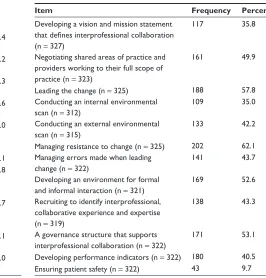
Table 2 challenges to care environments
Item Frequency Percent
Developing a vision and mission statement that defines interprofessional collaboration (n = 327)
117 35.8
negotiating shared areas of practice and providers working to their full scope of practice (n = 323)
161 49.9
Leading the change (n = 325) 188 57.8 conducting an internal environmental
scan (n = 312)
109 35.0
conducting an external environmental scan (n = 315)
133 42.2
Managing resistance to change (n = 325) 202 62.1 Managing errors made when leading
change (n = 322)
141 43.7
Developing an environment for formal and informal interaction (n = 321)
169 52.6
recruiting to identify interprofessional, collaborative experience and expertise (n = 319)
138 43.3
A governance structure that supports interprofessional collaboration (n = 322)
171 53.1
Developing performance indicators (n = 322) 180 40.5 Ensuring patient safety (n = 322) 43 9.7
challenge), the respondents indicated the following as 4 or 5. Participants reported that success starts with creating the vision, managing the change, and recruiting interprofessional expertise (Table 2).
interprofessional education
When asked about the challenges they face regarding inter-professional education, on a scale of 1 (smaller challenge) to 5 (bigger challenge), the respondents indicated the fol-lowing as 4 or 5. The important challenges in delivering interprofessional education were centered on supportive preceptorship through information on teaching strategies for interprofessional competencies and success indicators that measure them (Table 3).
The challenges faced by participants were used to direct development of the IRC. The content needed to address the various challenges was woven throughout the website, and through the use of navigators the user is directed to various parts of the IRC with related information.
in-person sessions analysis
During the in-person sessions, responses were gathered from 14 participants who represented family health team admin-istrators from a variety of geographic locations in Ontario as well as an urban, a suburban, and a rural mix. When respondents were asked about the most significant challenge in promoting interprofessional, collaborative practice in
Advances in Medical Education and Practice downloaded from https://www.dovepress.com/ by 118.70.13.36 on 19-Aug-2020
Dovepress interprofessional resource centre
their organization, the top responses were understanding the scope of practice (28.6%, n = 4), physician buy-in (21.4%, n = 3), sharing power/common goals (21.4%, n = 3), and agreement on the meaning of interprofessional (14.3%, n = 2). When respondents were asked about the least significant chal-lenge in promoting interprofessional, collaborative practice in their organization, the top responses were training of students (50.0%, n = 7), physical space/multiple sites (14.3%, n = 2), resolving disagreements (14.3%, n = 2), and knowing when to be collaborative (14.3%, n = 2).
Targeted survey analysis
cAM providers
There were 10 responses to the targeted survey for comple-mentary/alternative medicine. Respondents represented various geographic locations of Ontario, urban and rural, but were concentrated around the Greater Toronto area. Types of CAM practices included homeopathy, naturopathy, and natural therapies.
When respondents were asked to rate the significance of challenges to becoming part of an interprofessional team in primary health care agencies, the highest rated (90% of respondents rated as quite significant or very significant) challenges were:
• Working with administrators to develop an organiza-tional vision that supports freedom of choice and the use of CAM
• Working with stakeholders, administrators, and practi-tioners on the definition of CAM and how it fulfills the agency’s policies and procedures
• Working with other health care providers to expand the delivery care model and how providers work beyond the current medical model
• Agreeing on the level of medical science needed to support the use of CAM in treatment plans
• Establishing clinical expectations for reporting and accountability
• Establishing networks with other providers in an interprofessional team, such as physicians, physiothera-pists, and nurse practitioners
• Being able to refer to other members of an interpro-fessional team.
Preceptors
There were 35 responses to the targeted survey for preceptors. Respondents represented all geographic regions of Ontario, a mixture of urban (n = 14) and rural (n = 16), as well as those working in a variety of interprofessional teams, including local health integration networks, family health teams, and community health centers. Representatives from colleges and universities were also included.
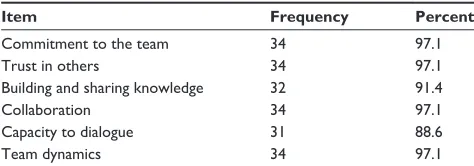
When asked to rate the importance of each topic for achieving interprofessionality, at least 85.7% of respondents indicated the following topics as quite to very significant: trust, commitment, collaboration, communication, and teamwork (Table 4).
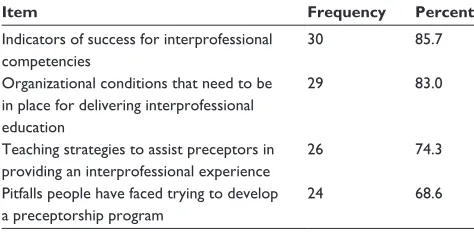
Respondents (n = 31) were asked to rate the importance of providing information under the four topics for interpro-fessional practice. Of the four potential areas, participants reported that content on how to achieve a supportive orga-nizational environment for successful interprofessional education is significant and reaffirmed the need for appro-priate success indicators for interprofessional competencies. Frequency denotes the number of respondents that rated the item as important or very important (Table 5).
Using the findings from the three stakeholder consultation activities, the IRC was created. The respondents’ level of experience, challenges, and priorities regarding interprofes-sional practice guided the content development for the IRC so that the website responds to all of the issues identified in the stakeholder consultation.
The IRC was designed, based on the results of this study, as a step-by-step approach to support an organization’s
Table 3 challenges to interprofessional education
Item Frequency Percent
selecting preceptors to deliver interprofessional educational experiences to students (n = 297)
113 38.0
Developing the strategy for entry of students into the agency (n = 294)
92 31.3
Developing teaching strategies for the interprofessional education competencies (n = 296)
124 41.8
identifying success indicators for the interprofessional education competencies (n = 295)
139 47.2
giving feedback to students (n = 295) 51 17.3
Teaching online (n = 283) 99 35.0
Evaluating preceptorship programs (n = 285) 96 33.7
Table 4 Achieving interprofessionality
Item Frequency Percent
commitment to the team 34 97.1
Trust in others 34 97.1
Building and sharing knowledge 32 91.4
collaboration 34 97.1
capacity to dialogue 31 88.6
Team dynamics 34 97.1
Advances in Medical Education and Practice downloaded from https://www.dovepress.com/ by 118.70.13.36 on 19-Aug-2020
Dovepress
Patterson et al
effort in advancing interprofessional practice and educa-tion (www.interprofessionalresourcecentre.ca). From the home page, users can view an introduction clip that provides an overview of the information available on the website. They can also browse through the following six key areas: 1) preparing a supportive environment, 2) committing to organizational cham-pions, 3) examining patient care services, 4) interprofessional change, 5) developing preceptorship, and 6) evaluation.
Discussion
Primary health care agencies are now required to move toward interprofessional care.1 Interprofessional care is dependent on
a supportive environment, interprofessional practice matched to the type of service required, and the education of future providers. It is essential that service providers moving to an interprofessional model collaborate in planning for the change.2–4 Organizations that comprise the team’s broader
network of care should be consulted/included to ensure that they are able to partner effectively with the team to optimize patient care.
How does the IRC support planning and implementation? First, the IRC provides easy access to information that has been synthesized from the literature and knowledge users. The information can be used for adopting and diffusing the innovation. In this case, the innovation is interprofessional practice and education in primary health care agencies. It starts with the initial step of preparing supportive environ-ments. At this point, administrators and providers consider how important interprofessional practice and education are to promoting the organization’s goals and what information needs to be collected to plan for these initiatives. As users consider adoption of interprofessional practice, they reflect on the types of challenges for leadership and stakeholders. Three administrative challenges were identified: assessing the environment, creating buy-in, and building vision.14,17,22,23
There is particular emphasis on scanning the external and internal environments to determine internal and external
opportunities and threats, determining the leadership required to move forward, and strategizing the complexities of implementing the change.
As administrators and providers move into the implemen-tation phase, information is outlined in a stepwise process that leads the users to examine their patient care services for the purpose of coming to some consensus on the level of teamwork required to meet the objectives. Through question-ing and reflection, the team can identify where they are with respect to their functioning and where they would like to go. An objective analysis of the needs of the community guides this process and allows for a match of identified needs to the requirements of interprofessional care. The team is supported in change through a detailed account of how to develop their own personal interprofessional strategy. Finally, an implemen-tation evaluation plan assists administrators and providers to assess the level at which the interprofessional initiatives have become integrated into the culture of the organization.
Acknowledgments
The authors acknowledge administrators, providers, precep-tors, and faculty from family health teams, community health centers, professional organizations, and educational institu-tions in Ontario who participated and generously gave their input. We would also like to thank Health Force Ontario for the support that made this project possible.
Disclosure
The authors report no conflicts of interest in this work.
References
1. Health Force Ontario. Interprofessional Care: a Blueprint for Action in Ontario. Ontario, Canada: Government of Ontario; 2007.
2. D’Amour D, Oandasan I. Interprofessionality as the field of interprofes-sional practice and interprofesinterprofes-sional education: an emerging concept.
J Interprof Care. 2005;19(Suppl 1):8–20.
3. D’Amour D, Ferrada-Videla M, San Martin Rodriguez L, Beaulieu MD. The conceptual basis for interprofessional collaboration: core concepts and theoretical frameworks. J Interprof Care. 2005;19(Suppl 1): 116–131.
4. Rogers E. Diffusion of Innovations. 5th ed. New York, NY: Free Press; 2003.
5. Barker KK, Bosco C, Oandasan IF. Factors in implementing interprofes-sional education and collaborative practice initiatives: findings from key informant interviews. J Interprof Care. 2005;19(2):166–176.
6. Bruhn JG, Chesney AP. Diagnosing the health of the organizations. In: Hein EC, editor. Contemporary Leadership Behavior. Philadelphia, PA: Lippincott-Raven; 1998.
7. Canadian Nurse Practitioner Initiative. Implementation and Evaluation Toolkit for Nurse Practitioners in Canada. 2006. Available from: http:// www.cnpi.ca/documents/pdf/Toolkit_Implementation_ Evaluation_NP_e. pdf. Accessed January 15, 2008.
8. Claire L, Gordon MF, Marshall M, Wilson F, Hunt T. Interprofessional capability: a developing framework for interprofessional education.
Nurse Educ Pract. 2005;5:230–237.
Table 5 important information for interprofessional practice
Item Frequency Percent
indicators of success for interprofessional competencies
30 85.7
Organizational conditions that need to be in place for delivering interprofessional education
29 83.0
Teaching strategies to assist preceptors in providing an interprofessional experience
26 74.3
Pitfalls people have faced trying to develop a preceptorship program
24 68.6
Advances in Medical Education and Practice downloaded from https://www.dovepress.com/ by 118.70.13.36 on 19-Aug-2020
Advances in Medical Education and Practice
Publish your work in this journal
Submit your manuscript here: http://www.dovepress.com/advances-in-medical-education-and-practice-journal
Advances in Medical Education and Practice is an international, peer-reviewed, open access journal that aims to present and publish research on Medical Education covering medical, dental, nursing and allied healthcare professional education. The journal covers undergraduate education, postgraduate training and continuing medical education
including emerging trends and innovative models linking education, research, and healthcare services. The manuscript management system is completely online and includes a very quick and fair peer-review system. Visit http://www.dovepress.com/testimonials.php to read real quotes from published authors.
Dovepress
Dovepress
interprofessional resource centre
9. Cooper H, Spencer-Dawe E, McLean E. Beginning the process of teamwork: design, implementation and evaluation of an inter- professional education intervention for first year undergraduate students. J Interprof Care. 2005;19(5):492–508.
10. Oandasan I, Reeves S. Key elements for interprofessional education part 1: the learner, the educator, and the learning context. J Interprof Care. 2005;Suppl 1:21–38.
11. Patterson C, Arthur H. A model for implementing integrative practice in health care agencies. Integrative Med Insights. 2008;3:1–7. 12. Reeves S, Zwarenstein M, Goldman J, et al. Interprofessional education:
effects on professional practice and health care outcomes. Cochrane Database Syst Rev. 2008;1:CD002213.
13. San Martin Rodriguez L, Beaulieu M, D’Amour D, Ferrada-Videla M. The determinants of successful collaboration: a review of theoretical and empirical studies. J Interprof Care. 2005;Suppl 1:132–147. 14. Upshaw VM, Kaluzny AD, McLaughlin CP. CQI, transformation,
and the learning organization. In: Bennis WG, Benne KD, Chin R, Corey KE, editors. The Planning of Change. 3rd ed. New York, NY: Holt, Rinehart and Winston; 1976.
15. Walsh CL, Gordon MF, Marshall M, Wilson F, Hunt T. Interprofessional capability: a developing framework for interprofessional education.
Nurse Educ Pract. 2005;5:230–237.
16. Zwarenstein M, Reeves S, Perrier L. Effectiveness of pre-licensure inter-disciplinary education and post-licensure collaborative interventions.
J Interprof Care. 2005;19(Suppl 1):148–165.
17. Xyrichis A, Ream E. Teamwork: a concept analysis. J Adv Nurs. 2008;61(2):232–241.
18. Bucher R. On the natural history of health care occupations. Work Occup. 1988;152:131–147.
19. Marquis BL, Huston CJ. Leadership Roles and Management Functions in Nursing: Theory and Application. 4th ed. Philadephia, PA: Lippincott Williams & Wilkins; 2003.
20. Barrett J, Curran V, Glynn L, Godwin M. CHSRF Synthesis: Interprofessional Collaboration and Quality Primary Healthcare. Ottawa, Canada: Canadian Health Services Research Foundation; 2007.
21. Davenport TH. Process Innovation: Reengineering Work through Information Technology. Boston: Boston Business School Press; 1993. 22. Ford JD. Organizational change as shifting conversations. J Organ
Change Manag. 1999;12(6):480–490.
23. Moon MY. Making sense of common sense for change management buy-in. Manag Decis. 2009;47(3):518–532.
24. Poulton BC, West MA. The determinants of effectiveness in primary health care teams. J Interprof Care. 1999;13(1):7–18.
25. McGregor D. The Human Side of Enterprise. Toronto, Canada: McGraw-Hill; 1960.
26. National Centre of Complementary and Alternative Medicine. What is complementary and alternative medicine. 2004. Available from: http://nccam.nih.gov/health/whatiscam. Accessed Nov 25 2010.
Advances in Medical Education and Practice downloaded from https://www.dovepress.com/ by 118.70.13.36 on 19-Aug-2020