Affine-malleable Extractors, Spectrum Doubling, and Application
to Privacy Amplification
Divesh Aggarwal∗ Kaave Hosseini† Shachar Lovett‡
November 10, 2015
Abstract
The study of seeded randomness extractors is a major line of research in theoretical computer science. The goal is to construct deterministic algorithms which can take a “weak” random sourceX with min-entropykand a uniformly random seedY of lengthd, and outputs a string of length close tok that is close to uniform and independent of Y. Dodis and Wichs [DW09] introduced a generalization of randomness extractors called non-malleable extractors (nmExt) where nmExt(X, Y) is close to uniform and independent of Y and nmExt(X, f(Y)) for any functionf with no fixed points.
We relax the notion of a non-malleable extractor and introduce what we call an affine-malleable extractor (AmExt: Fn×Fd 7→F) whereAmExt(X, Y) is close to uniform and
inde-pendent of Y and has some limited dependence of AmExt(X, f(Y)) - that conditioned on Y, (AmExt(X, Y),AmExt(X, f(Y))) is close to (U, A·U+B) whereU is uniformly distributed in
FandA, B∈Fare random variables independent of U.
We show under a plausible conjecture in additive combinatorics (called the Spectrum Dou-bling Conjecture) that the inner-product function h·,·i : Fn ×
Fn 7→ F is an affine-malleable
extractor. As a modest justification of the conjecture, we show that a weaker version of the conjecture is implied by the widely believed Polynomial Freiman-Ruzsa conjecture.
We also study the classical problem of privacy amplification, where two parties Alice and Bob share a weak secret X of min-entropy k, and wish to agree on secret key R of lengthm
over a public communication channel completely controlled by a computationally unbounded attacker Eve. The main application of non-malleable extractors and its many variants has been in constructing secure privacy amplification protocols.
We show that affine-malleable extractors along with affine-evasive sets can also be used to construct efficient privacy amplification protocols. We show that our protocol, under the Spectrum Doubling Conjecture, achieves near optimal parameters and achieves additional se-curity properties like source privacy that have been the focus of some recent results in privacy amplification.
∗
EPFL. Email: [email protected]. †
UCSD. Email: [email protected]. ‡
1
Introduction
The study of randomness extractors is a major line of research in theoretical computer science. The goal is to construct deterministic algorithms which can take one or more “weak” random sources and transform them into a “strong” random source, which typically means close to uniform. The challenge is in coming with explicit constructions, as often it is easy to show that a random construction is close to optimal. These constructions come in two flavours: the first are “simple” or “natural” mathematical constructions, such as the inner product function; the others are more complex constructions, usually obtained as a combination of a number of more basic constructions. For a general background to extractors and their many applications, see e.g. [Sha02].
The focus of this paper is on the first family of “simple” mathematical constructions, and in particular the inner product function. LetF=Fp be a finite field, and consider the inner product
function over Fn defined as hx, yi = Pni=1xiyi. For a random variable X taking values in Fn, its
min-entropy is defined asH∞(X) =−log(max Pr[X =x]). IfH∞(X) =δ·log|F|n=δ(nlogp) then
we sayX has min-entropy rateδ. It is well known since the work of [CG88] that the inner product function is a two-source extractor for min-entropy rate 1/2. That is, if X, Y are two independent random variables taking values in Fn, and H∞(X), H∞(Y) (nlogp)/2, then hX, Yi is close to
uniform in F. This bound of 1/2 on the min-entropy rate is tight, as can be seen be the following
example: take X to be uniform over a subspace ofFn of dimensionn/2, and Y to be uniform over
the orthogonal subspace. The best known construction of two-source extractors, until very recently, was by Bourgain [Bou05], who showed that by pre-encoding the input as (x, x2) ∈
F2n (at least
when the field has odd order) and computing the inner product over F2n, one can handle source of
min-entropy rate 1/2−ε0 for some absolute constantε0 >0.
The study of two-source extractors turns out to be related to a more recent notion of extractors, callednon-malleable extractors. These were defined by Dodis and Wichs [DW09] for the purpose of designing privacy amplification protocols. They showed that such extractors would allow for optimal protocols, and showed that a random construction achieves optimal parameters. However, they left the challenge of explicit constructions open. Subsequent works [CRS12,Li12c,DY13,DLWZ14] gave constructions for non-malleable extractors for min-entropy rate 1/2−ε0, based on the inner product
function and the construction of two-source extractor by Bourgain. Interesting enough, Li [Li12c] showed a strong connection between non-malleable extractors and two-source extractors, thereby giving evidence that it might be very difficult to construct non-malleable extractors for min-entropy rate below 1/2−ε0. In a recent breakthrough work, Chattopadhyay, Goyal and Li [CGL15] have
recently obtained a non-malleable extractor with min-entropy polylog(nlogp). This was closely followed by a another breakthrough result by Chattopadhyay and Zuckerman [CZ15], achieving an efficient two-source extractor where each source has polylogarithmic min-entropy. Our focus in this paper is to obtain much more modest results than these obtained by [CGL15,CZ15], however we restrict ourselves to the use of very simple function - the inner-product function.
We note here that the inner product function, if considered as a potential non-malleable ex-tractor with a source X ∈Fn and uniform seed in Fn, still suffers from the barrier of orthogonal
subspaces, and hence is not a non-malleable extractor for any min-entropy rate. First, let us define non-malleable extractors formally, specialized to the parameters of our function of interest, the inner product function. A function E :Fn×Fn →F is a non-malleable extractor for min-entropy
rate k, if for any random variableX taking values inFn with min-entropy k; for a seedS uniform
inFn and independent ofX; and for any function f :Fn→Fn, the joint distribution
(E(X, S), E(X, f(S)))∈F2
uniform distribution over F. That is, this family of distribution contains the case where the two
outputs are equal and uniform in F (which would be the case if say f is the identity function),
or where the first term is uniform in F and the second is independent of it (but not necessarily
uniform), or any convex combination of the above.
To see why the inner product function fails to be a non-malleable extractor, consider the fol-lowing example. Let V ⊂ Fn be a subspace, let u ∈ Fn \V and v ∈ V⊥ be vectors such that hu, vi = 1. If we chooseX uniform in the coset V +u and set f(S) =aS+bv for some a, b∈ F
then approximately
(hX, Si,hX, f(S)i)∼(U, aU +b).
In this work, we define a weaker type of extractor, which we call affine-malleable extractor, motivated by the above example. A distribution overF2 is said to beaffine if it lies in the convex
hull of {(U, aU +b) : a, b ∈ F}. A function E : Fn×Fn → F is an affine-malleable extractor for
min-entropy ratek, if for any random variableXtaking values inFnwith min-entropyk; for a seed
S uniform in Fn and independent ofX; and for any function f :Fn→Fn, the joint distribution
(E(X, S), E(X, f(S)))∈F2
lies close to an affine distribution. We prove a number of results on affine-malleable extractors:
1. Affine-malleable extractors, combined with recent constructions of affine-evasive sets [ADL14,
Agg15], allow for optimal privacy amplification protocols. Thus, for the application in privacy amplification they are as useful as non-malleable extractors.
2. The inner product function is an affine-malleable extractor for any constant min-entropy rate
δ >0, assuming the dimensionnis large enough. This is the main technical part of this work.
3. We give a conjecture in additive combinatorics that implies that the inner product function is an affine-malleable extractor also for much smaller min-entropy, which implies near optimal privacy amplification protocols.
The analysis of the inner product function, and in particular showing that it is an affine-malleable extractor, relies on new properties of the spectrum of large sets, which we discuss next.
1.1 Spectrum of large sets
The analysis of the inner product function relies on analyzing the spectrum of subsets of Fn. For
a setA⊂Fn, its Fourier coefficients are defined as
c
1A(γ) = X
a∈A
ωhγ,xi, γ ∈Fn,
whereω= exp(2πi/p) is a primitep-th root of unity. Thespectrum of Ais the set of large Fourier coefficients,
Specε(A) =nγ ∈Fn:|1cA(γ)|>ε|A| o
.
The spectrum of a set is extremely useful when studying arithmetic properties. Several properties of it are well known and quite useful. Parseval’s identity allows to bound the size of the spectrum ifA is not too small,
|Specε(A)|6O
Fn
ε2|A|
Chang’s theorem [Cha02] allows to bound the dimension of the large spectrum (a notion which we do not formally define here) by
dim Specε(A)6O log(Fn/|A|)·1/ε2.
An application of the Cauchy-Schwartz inequality shows that the spectrum has bounded statistical doubling. That is, the sum of two random elements in the spectrum typically lies in the spectrum with a smaller threshold,
Pr
γ1,γ2∈Specε(A)
[γ1−γ2 ∈Specε2/2(A)]>ε2/2.
For a proof and some extensions, see eg the work of Shkredov [Shk08]. For our purposes, it turns out that the important property is to control the growth of the spectrum in addition. In the following, forS ⊂FnletS+S={s1+s2:s1, s2 ∈S}andF·S={cs:c∈F, s∈S}. The following definition
will be crucial for us.
Definition 1. A setA⊂Fn has (ε, η)-controlled spectrum if
|F·Specε(A) +F·Specε(A)|6η|Fn|.
To see the relation to affine-malleable extractors, let X be uniform over a set A ⊂ Fn, let S
be uniform in Fn, and let f :Fn → Fn be a function. If (hX, Si,hX, f(S)i) is not close to affine,
then this remains true if we fix S. That is, for a noticeable fraction of values s ∈ Fn, the joint
distribution
(hX, si,hX, f(s)i)
is also not close to affine. Hence, it must have a noticeable Fourier coefficient, which is equivalent to
as+bf(s)∈Specε(A)
for somea, b∈Fnot both zero andε6p−O(1) which depends on the error parameters. In fact, the
set of Fourier coefficients cannot be one dimensional. If we consider
Λs:={(a, b)∈F2 :as+bf(s)∈Specε(A)}
then Λs contains (a1, b1),(a2, b2) which are not scalar multiples of each other. So, if
a1s+b1f(s) =γ1
a2s+b2f(s) =γ2
whereγ1, γ2∈Specε(A), then
s=c1γ1+c2γ2
for some c1, c2 ∈S. As this is true for many choices of s∈Fn (say, more than an η fraction), we
get that
|F·Specε(A) +F·Specε(A)|> η|Fn|
and A does not have (ε, η)-controlled spectrum.
So, the question arises: can we hope that any large enough set has (ε, η)-controlled spectrum. Applying Parseval’s identity we get the bound
|F·Specε(A) +F·Specε(A)|6|F|2|Specε(A)|26p2
pn+1
ε2|A| 2
.
Theorem 1.1. Letpbe a prime,n∈N, and0< ε <1. For anyA⊆Fn, such that|A|> 1
ε3·pn/2+3,
|F·Specε(A) +F·Specε(A)|6ε·pn.
Again, this threshold of min-entropy rate 1/2 turns out to be tight, by a variant of the orthogonal subspaces construction. If we take A= (Fn/2× {0}n/2)∪({0}n/2×Fn/2) then it is easy to verify
that Spec1/2(A) =A and that Spec1/2(A) + Spec1/2(A) =Fn.
So, are we again stuck at the min-entropy rate 1/2 barrier? The answer is no. In the analysis of affine-malleable extractors above, if we can partition A as A =∪Ai, where each Ai has (ε, η
)-controlled spectrum, then the analysis would still work. That is, if we defineXi to be uniform on
Ai then
(hXi, Si,hXi, f(S)i)
are each close to affine, and hence also (hX, Si,hX, f(S)i) being a convex combination of these, is also close to affine. The same would hold if the partition∪Ai covered most ofA. For example, in the
example mentioned above ofA= (Fn/2×{0}n/2)∪({0}n/2×Fn/2) we would takeA1 =Fn/2×{0}n/2
and A2 ={0}n/2×Fn/2, both of which have a controlled spectrum.
So, the real question is the following: is it true that any large enough set A contains a subset which has (ε, η)-controlled spectrum. If this is true, then the analysis would still work. We could not prove it for smaller sets A. Two of the authors of this paper [HL15] showed a bound on
|Specε(A) + Specε(A)| for |A| pn/2. It does not seem easy, however, to extend their results to bound |F ·Specε(A) +F ·Specε(A)|. We show the following assuming the widely believed
polynomial Freiman-Ruzsa conjecture. We refer the reader to [BDL14] and the references therein for a discussion of this conjecture.
Theorem 1.2. Assuming the PFR conjecture, we have that there is a universal constant C such that for anyA⊆Fn, such that |A|> 1
ε·p
n√Clogp/logn, then there exists a subsetB ⊆A such that
|F·Specε(B) +F·Specε(B)|6ε·pn. (1.1)
We conjecture that PFR conjecture might not precisely capture the difficulty of bounded the doubling of the spectrum, and that Theorem 1.2 is far from tight. We believe that the above holds for |A| sufficiently bigger than 1/ε, and when εis sufficiently small. The reason we cannot conjecture the above for |A|>(1/ε)O(1) is because of the following example. If B is any subset of the hamming ballA={x∈ {0,1}n:P
xi 6log(1/ε)}then Specε(B) contains most vectors in Fn
with n/2 zeros, and hence |F·Specε(B) +F·Specε(B)| ≈ |Fn|. We conjecture that this example
gives the worst possible bound on the size of|A|.
Conjecture 1.3(Spectrum Doubling Conjecture). For anyA⊆Fn and anyε∈(0,1/p) such that
|A|>nO(log(1/ε))= (1/ε)O(log(n)), there is a subset B of A such that
|F·Specε(B) +F·Specε(B)|6ε·pn.
1.2 Privacy Amplification
One of the classical problems in information-theoretic cryptography is that of privacy amplification (PA) [BBR88, Mau92, BBCM95]. In this, two parties, Alice and Bob, share a weak secret X
In the case when the adversary is passive, i.e., only sees but does not modify the message(s) sent over the channel, this problem can be easily solved in a single round using a strong extractor
Ext. This can be done by Alice sending a seed W for the extractor, and then Alice and Bob both compute the secretExt(X, W) which is close to being uniformly random and independent ofW by the strong extractor property.
However, it becomes significantly more involved to design an efficient protocol that is secure for the case when the adversary is active and can modify messages. This problem has been studied extensively in the recent years [MW97,RW03,DKK+12,DW09,CKOR10,DLWZ14,CRS12,Li12c,
Li12a, Li12b, DY13, ADJ+14] with the goal of optimizing several natural quantities like (i) The min-entropyk (ii) The entropy lossL=k−m (iii) The number of rounds of the protocol.
Prior Results. Existing one-round solutions [MW97,DKK+12] work for min-entropy k > N/2 and require large entropy lossL > N−k. It was shown by [DS02,DW09] thatk > N/2 is necessary, and that the large entropy loss of N−kis likely necessary, as well.
So, in order to achieve PA for k < N/2, we require at least two rounds. In a breakthrough result, Dodis and Wichs [DW09] showed non-constructively that a two-round PA protocol exists with optimal (up to constant factors) entropy loss L= Θ(log (1/ε)) for any k. This was achieved by defining and showing existence of non-malleable extractors.
Since [DW09] could not construct a non-malleable extractor, they instead defined and con-structed look-ahead extractors which was done using the alternating extraction protocol of Dziem-bowski and Pietrzak [DP07]. Look-ahead extractorlaExtis an extractor with weaker non-malleable requirements wherelaExt(X, Y) is allowed to have some limited dependence with laExt(X,A(Y)). PA protocols using look-ahead extractors were constructed only fork >log2(1/ε). This protocol is meaningful only in the scenario when the errorε= 2−O(
√
N) and so would not work if we require
a smaller error.
Subsequent works [DLWZ14, CRS12, Li12c, DY13] gave constructions for non-malleable ex-tractors but none of these were fork <0.499N. Very recently, a non-malleable extractor has been constructed by Chattopadhyay et al [CGL15] fork= Ω(log2N + log2(1/ε)).
In another work, Li [Li12a] defined and constructed one such weaker notion called non-malleable condensers nmCond, where he weakened the extractor requirement so that nmCond(X, Y) is not required to be close to uniform but rather only has a better min-entropy rate guarantee as compared
X. In a subsequent work [Li15], he improved the non-malleable condenser constructions thereby giving two different PA protocols using non-malleable condensers with optimal entropy loss L = Θ(log (1/ε)). However, one of these protocols works only fork > log2(1/ε), and the other only for
k>δN for any constant δ. We note here that in order to achieve the more useful security notion of post-application authenticity1 with the same entropy loss, we need to add one additional round
as observed by Aggarwal et al [ADJ+14].
Another related goal that has been considered in the literature [DS05, BF11,ADJ+14] for PA protocols is that of source privacy. Intuitively, this property demands that the transcript of the protocol (even together with the derived keyR!) does not reveal any “useful information” about the sourceX; or, equivalently (as shown by [DS05]), that the transcript does not reveal any information at all about thedistributionofX (beyond a lower boundkon its min-entropy). For active Eve, the only works that considered this notion are [BF11,ADJ+14]. All protocols achieving source privacy considered in these works are secure only fork >log2(1/ε), or fork>0.499N.
1
Intuitively, post-application authenticity requires that Eve cannot modify Bob’s last message and cause Alice to outputRA 6=RB, even if given Bob’s keyRB. This is useful to protect against attacks where Bob might begin to
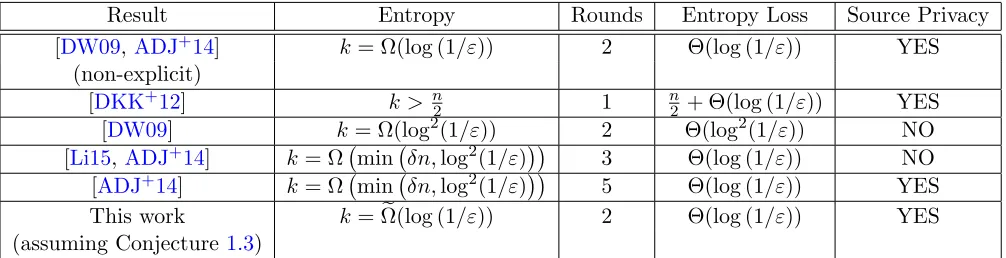
Result Entropy Rounds Entropy Loss Source Privacy [DW09,ADJ+14] k= Ω(log (1/ε)) 2 Θ(log (1/ε)) YES
(non-explicit)
[DKK+12] k > n2 1 n2 + Θ(log (1/ε)) YES [DW09] k= Ω(log2(1/ε)) 2 Θ(log2(1/ε)) NO [Li15,ADJ+14] k= Ω min δn,log2(1/ε)
3 Θ(log (1/ε)) NO [ADJ+14] k= Ω min δn,log2(1/ε)
5 Θ(log (1/ε)) YES This work k=Ω(log (1e /ε)) 2 Θ(log (1/ε)) YES
(assuming Conjecture 1.3)
Table 1: Comparison of our PA protocol with previous best-known protocols.
We note that in a typical PA application we would require the error to be significantly smaller than 2−O(
√
N (if say N is not too large), in which case all protocols that work for min-entropy
above log2(1/ε) will be useless.
Our Result. Our PA protocol using an affine-malleable extractor and an affine-evasive set can be described as follows. Like in the case of a passive Eve that we mentioned earlier, the aim of the protocol is to enable Bob to send an authenticated copy of a seed W for a strong extractor Ext. Bob chooses the seed W as a random element of an affine-evasive set S ⊂ F. In the first round
Alice sends a seed Y for the affine-malleable extractor amExt, which can possibly be changed by the adversary to A(Y) =Y0. Then in the second round, Bob sendsT =W +amExt(X, Y0). As we show in Section 4, by the definition of an affine-malleable extractor and an affine-evasive set, it is hard for the adversary to change T to some T0 =W0+amExt(X, Y), where W0 6= W and W0 is an element of S. Moreover, since both the messages sent in the first round and in the second are completely independent of X, we get source-privacy for free in this protocol.
We observe and give justification for the fact that the inner product function from Fn×Fn to F for a large prime p is likely to be a good affine-malleable extractor. In fact, under a plausible
conjecture that we call the spectrum doubling conjecture, our 2-round PA protocol using the inner product extractor as an affine-malleable extractor achieves near-optimal min-entropy and entropy loss requirements.
Theorem 1.4. Assuming conjecture1.3, there exists an explicit polynomial-time, two-round(k, ε) -private, (k, m, ε)-secure privacy amplification protocol, where k>O(log (1/ε) logN), andk−m6
(log (1/ε)).
A comparison of our result (under Conjecture 1.3) and the known results is summarized in Table1. All results achieve ε-secure post application robust PA protocols, where we assume that
ε= 2−nc wherec is any constant in (0,1). Also δ is assumed to be a constant.
1.3 Organization of this Paper
Section 5 we prove Theorem 1.2, and then conclude with the implication on the construction of affine-malleable extractors and our privacy amplification protocol.
1.4 Conclusions and Open Questions
In this work, we initiate the study of non-malleability properties of the inner-product function, which is one of the first family of simple mathematical constructions of a randomness extractor. We show, under a plausible conjecture, that even thoughh·,·i:Fn×Fn7→Fis not a non-malleable
extractor, it has strong non-malleability properties, i.e. that ifXhas sufficient min-entropy and Y
is uniform in Fn, then for any functionf :Fn 7→ Fn, hX, f(Y)i has distribution close to an affine
function of hX, Yi.
Even though we do not achieve a non-malleable extractor, we manage to construct a PA protocol (which is the main and most direct application of a non-malleable extractor) using this weaker notion of a non-malleable extractor that we call an malleable extractor along with an affine-evasive set [Agg15]. We show that under Conjecture 1.3, our PA protocol achieves near optimal parameters. In addition, in our protocol, we get the source privacy property for free unlike the recent results of [BF11, ADJ+14] where the previous protocols had to be modified significantly
(thereby making them more complicated) in order to achieve source privacy.
We note that our protocol is the first protocol that under a reasonable conjecture achieves privacy amplification with near optimal min-entropy. To the best of our knowledge, none of the previous constructions could even be conjectured to achieve similar parameters.
This work leaves open several questions but the most interesting question motivated by this work is to prove Conjecture 1.3. Even proving a weaker version of the conjecture like Theorem1.2
without assuming the PFR conjecture will be very interesting. We would like to mention that we have stated Conjecture 1.3 the way it is since this is the best bound for which we do not have a counter-example. We encourage the reader to suggest a counter-example which would imply that we will need to relax the lower bound on A.
2
Preliminaries
For a set S, we let US denote the uniform distribution over S. For an integer m ∈N, we let Um
denote the uniform distribution over {0,1}m, the bit-strings of length m. For a distribution or
random variable X we writex←X to denote the operation of sampling a random x according to
X. For a setS, we writes←S as shorthand fors←US.
Entropy and Statistical Distance. The min-entropy of a random variable X is defined
as H∞(X) def
= −log(maxxPr[X = x]). We say that X is an (n, k)-source if X ∈ {0,1}n and H∞(X) >k. For X ∈ {0,1}n, we define the entropy rate of X to be H∞(X)/n. We also define average (aka conditional) min-entropy of a random variable X conditioned on another random variableZ as
H∞(X|Z) def
= −log
Ez←Z
h
max
x Pr[X=x|Z=z] i
=−log
Ez←Z
h
2−H∞(X|Z=z)i
whereEz←Z denotes the expected value over z←Z. We have the following lemma.
Lemma 2.1 ([DORS08]). Let (X, W) be some joint distribution. Then, • For any s >0, Prw←W[H∞(X|W =w)≥H∞(X|W)−s]≥1−2−s.
The statistical distance between two random variablesW and Z distributed over some set S is
∆(W, Z)def= max
T⊆S|W(T)−Z(T)|=
1 2
X
s∈S
|W(s)−Z(s)|.
Note that ∆(W, Z) = maxD(Pr[D(W) = 1]−Pr[D(Z) = 1]), where D is a probabilistic function.
We sayW isε-close toZ, denotedW ≈εZ, if ∆(W, Z)≤ε. We write ∆(W, Z|Y) as shorthand for
∆((W, Y),(Z, Y)), and note that ∆(W, Z|Y) =Ey←Y∆(W|Y =y, Z|Y =y).
Lemma 2.2. LetF=Fpbe a finite field, and letA, B ∈Fbe random variables. If∆(A+α·B, UF)6 εfor all α∈F, then ∆((A, B); (UF, B))6ε·√p.
The proof uses the following inequality.
∀x1, . . . , xk >0, k X
i=1
x2i 6 k X
i=1
xi !2
6k
k X
i=1
x2i (2.1)
Proof of Lemma 2.2. We first show the following claim.
Claim 2.3. LetC, D∈ X be a pair random variables for some setX. Then ifC0, D0 are identically distributed as C, D and independent from them, then
4∆((C, D) ; (UX, D)))2
|X | 6Pr[C=C
0, D=D0]−Pr[D=D0]
|X | 64∆((C, D) ; (UX, D)) 2 .
Proof. We have
X
x,y∈X
Pr[C=x, D=y]−Pr[D=y] |X |
2
= X
x,y∈X
Pr[C=x, D=y]2−X
y∈X
Pr[D=y]2 |X | ,
and hence the result follows by Equation2.1.
Now, let (A0, B0) be independent and identically distributed as (A, B). By Claim 2.3, we have that for allα∈F,
Pr[A+α·B=A0+α·B0]6 1
p + 4ε
2 .
Summing over allα ∈F, we have that
1 + 4pε2 > X α∈F
Pr[A+α·B =A0+α·B0]
= X
α∈F
Pr[A+α·B =A0+α·B0|B =B0]·Pr[B =B0]
+X
α∈F
Pr[A+α·B =A0+α·B0|B 6=B0]·Pr[B 6=B0]
= |F| ·Pr[A=A0|B =B0]·Pr[B=B0] + Pr[B 6=B0] = pPr[A=A0, B=B0] + Pr[B6=B0]
> 1 + 4∆((A, B); (UF, B))2,
2.1 Known Primitives
Extractors. An extractor [NZ96] can be used to extract uniform randomness out of a
weakly-random value which is only assumed to have sufficient min-entropy. Our definition follows that of [DORS08], which is defined in terms of conditional min-entropy.
Definition 2.4 (Extractors). An efficient functionExt:{0,1}n× {0,1}d→ {0,1}m is an
(average-case, strong) (k, ε)-extractor, if for allX, Z such thatXis distributed over{0,1}nandH
∞(X|Z)≥ k, we get
∆( (Z, Y,Ext(X;Y)), (Z, Y, Um) )6ε
whereY ≡Uddenotes the coins ofExt (called theseed). The valueL=k−mis called theentropy
lossof Ext, and the value dis called theseed lengthof Ext.
It is well known [RTS00] that the optimal entropy loss of an extractor is 2 log (1/ε)−O(1), which is achieved by the famous Leftover Hash Lemma [HILL99] with seed lengthd=n. To reduce the seed length to d = O((log (1/ε) + logk) logn), we can also use more sophisticated extractor constructions, such as those in [GUV09, DKSS09]. Altentatively, we can extract m = (1−δ)k
bits using asymptotically optimal seed length d= O(log (1/ε) + logn) [GUV09]. We will use the following.
Theorem 2.5 ([HILL99]). There exists an efficient (k, ε)-extractor Ext : {0,1}n × {0,1}n →
{0,1}k−2 log(1/ε)−O(1).
Affine-evasive Sets. LetFbe a finite field. An affine-evasive set S⊆Fis a large set which has
small intersection with affine shifts of itself. For a, b∈F2 define aS+b={as+b|s∈S}.
Definition 2.6. A non-empty setS⊆Fis said to bea(γ, ν)-affine-evasive subset ofFif|S|=γ|F|,
and for any (a, b)∈F2\ {(1,0)}, we have
|S∩(aS+b)| ≤ν|S|.
The notion of affine evasive sets in this context initiated in [ADL13], where a somewhat lossy construction was given. This was improved in a recent work of one of the authors of this pa-per [Agg15].
Theorem 2.7([Agg15]). LetFp be a prime field. There exists an efficiently samplable(γ, ν)
-affine-evasive subset S⊂Fp with γ =p−3/4+o(1) and ν =p−1/4+o(1).
3
Inner product is a candidate affine-malleable extractor
Affine-malleable Extractors. We first define the family of desired distributions.
Definition 3.1 (Affine distribution). Let F be a finite field. A distribution D taking values in F×F is said to be anaffine distribution if it is a convex combination of distributions of the form
(U, aU +b) where a, b∈F and U is the uniform distribution overF.
Definition 3.2(Affine-Malleable Extractors). LetFbe a finite field. An efficient functionAmExt: {0,1}n× {0,1}d →
F is an (average-case) (k, ε)-affine-malleable extractor, if the following holds.
Let X ∈ {0,1}n, Z ∈ Z be jointly distributed random variables such that H
∞(X|Z) ≥ k. Let Y ∈ {0,1}d be uniform and independent. Let F : {0,1}d× Z 7→ {0,1}d be any adversarial
function. Then, there exist a random variable D=D(Y, Z) taking values inF×F, such that the
distributionD|Y =y, Z=z is affine for ally ∈ {0,1}d, z∈ Z, such that we have
∆ ((AmExt(X;Y),AmExt(X;F(Y, Z))) ; D|Z, Y)6ε.
Let F =Fp for the remainder of this section. We show that if for any large enough A ⊆ Fn,
there exists A0 ⊆ A such that Spec
ε(A0) has small doubling, then the inner product over F is a
good affine-malleable extractor. In this section, fixω=e2πip .
Let φf(X, Y) be the joint distribution hX, Yi,hX, f(Y)i, and let D be the set of affine
distri-butions over F×F. We will use the following result from [ADL14]. This was shown in [ADL14] for
a different definition of φf, but the proof is the same.
Lemma 3.3. Let P ⊆Fn×Fn. LetP1, . . . ,Pk be a partition of P. Assume that for all16i6k,
∆ φf(X, Y)|(X,Y)∈Pi ; D |Z, Y
6εi.
Then
∆ φ(X, Y)|(X,Y)∈P ; D |Z, Y
6Xεi
|Pi|
|P|.
We will need the following result that shows a connection between the statistical distance of the inner product from uniform, and the spectrum of a setA.
Lemma 3.4. Let A ⊆Fn, and let X be uniform over A. For all y∈
Fn, if for somea∈F\ {0},
a·y ∈ Specε(A) then ∆(hy, Xi, UF) > 2√ε
p. Also if ∆(hy, Xi, UF) >
ε√p
2 , then there exists an
a∈F\ {0} such thata·y∈Specε(A).
Proof. We have by the Parseval identity that
X
c∈F
Pr[hy, Xi=c]−1 p
2
= 1
p
X
a∈F\{0}
|E(ωa·hy,Xi)|2.
Using Equation 2.1, we get that
1
p ·∆(hy, Xi, UF) 2 6 1
4 ·
X
c∈F
Pr[hy, Xi=c]−1 p
2
6∆(hy, Xi, UF)2 .
Also,
1
pa∈maxF\{0} E[ω
a·hy,Xi] 2
6 1
p
X
a∈F\{0} E[ω
a·hy,Xi] 2
6 max
a∈F\{0} E[ω
a·hy,Xi] 2
.
Combining we get that
r
1
4p·a∈maxF\{0} E[ω
a·hy,Xi]
6∆(hy, Xi, UF)6 r
p
4 ·a∈maxF\{0} E[ω
For A ⊆Fn,X uniform in A, define Bad
ε(A)⊂Fn to be the set of “bad” choices for the seed
as follows:
Badε(A) ={y ∈Fn:∃w∈Fn such that (hX, yi,hX, wi) is notε-close to an affine distribution}
We will show that if Ahas controlled spectrum, then Badε(A) is small. Recall that for S⊂Fnwe
definedS+S ={s1+s2:s1, s2 ∈S} and F·S={c·s:c∈F, s∈S}. Lemma 3.5. Let A ⊆Fn. We have
Badε(A)⊆F·Specε0(A) +F·Specε0(A)
where ε0 = 2ε/p.
Proof. Let X be uniform in A. Let y, w ∈ Fn be such that (hX, yi,hX, wi) is not ε-close to any
affine distribution. In particular this implies that for anyc∈F, (hX, yi,hX, w+cyi) is notε-close to the convex hull of distributions {(U, b) :b∈F}. By Lemma2.2, this implies that for anyc∈F,
there existαc∈Fsuch thathX, y+αc(w+cy)iis not (ε/
√
p)-close to uniform. Thus by Lemma3.4, there exist β,∈F\ {0} such thaty+αw =βγ1 for some γ1 ∈Specε0(A). Ifα = 0, theny =βγ1,
and the claim is satisfied. So, we assumeα6= 0. Then, again by Lemma3.4,y+α0(w+α1y) =β0γ2,
for someγ2∈Specε0(A). Solving fory gives thaty =β0γ2− β·α 0
α ·γ1.
Now, we proceed to the main result of this section.
Theorem 3.6. Fix ε, η >0 and 16k6nlogp. Assume that for any A ⊆Fn of size |A|>2k we
have that there exists B ⊆ A such that
|F·Specε(B) +F·Specε(B)|6η|F|n.
Then for any δ >0, h·,·i:Fn×Fn is a (k+ 2 log1δ, ε+η+ 2δ)-affine-malleable extractor. Proof. Let X ∈ Fn, Z ∈ Z be jointly distributed random variables such that H
∞(X|Z) ≥ k+
2 log 1/δ. LetY ∈Fn be uniform and independent. First, by lemma 2.1we have that
Pr
z←Z[H∞(X|Z=z)>k+ log 1/δ]>1−δ.
Fix z so that H∞(X|Z = z) > k+ log 1/δ. It suffices to consider the case where the random
variable Xz = (X|Z =z) is distributed uniformly over a set A0 ⊆Fn of size |A0|> 2k/δ. Define B0,A1,B1,A2, . . . ,Bt−1,At iteratively as follows. For alli, let Bi be a subset of Ai such that
|F·Specε(Bi) +F·Specε(Bi)|6η|F|n.
and let Ai+1 = Ai\ Bi. We terminate for a t such that no such Bt exists. By the assumption,
|At|<2k 6δ|A0|. Thus,
A0 =B0∪ · · · ∪ Bt−1∪ At.
LetCj0 = Badε(Bj) and Cj =Fn\ Cj0. By Lemma3.5,|Cj0|6η|F|n. Consider the following partition
of A0×Fn:
A0×Fn= t−1 [
j=0
(Bj× Cj)∪ t−1 [
j=0
(Bj× Cj0)∪ At×Fn.
Let Xz,j = Xz|Xz∈Bj, and note that Xz,j is uniform in Bj. For any y ∈ Cj we know that
hXz,j, yi,hXz,j, wi is ε-close to affine for any w ∈ Fn, and in particular for w = F(y, z). Hence,
for any y ∈ Cj we have that φf(Xz,j, y) is ε-close to D. To conclude, note that Pr[(Xz, Y) ∈
∪(Bj× C0
j)]6η and Pr[(Xz, Y)∈ At×Fn]6δ. By Lemma3.3, we have that Ey∈Fn∆((hXz, yi,hXz,F(y, z)i)| D)6ε+η+δ.
4
Privacy amplification protocol
We define a privacy amplification protocol (PA, PB), executed by two parties Alice and Bob sharing
a secretX∈ {0,1}N, in the presence of an active, computationally unbounded adversary Eve, who
might have some partial informationE about X satisfying H∞(X|E)>k. Informally, this means
that whenever a party (Alice or Bob) does not reject, the keyRoutput by this party is random and statistically independent of Eve’s view. Moreover, if both parties do not reject, they must output the same keysRA=RB with overwhelming probability.
More formally, we assume that Eve is in full control of the communication channel between Alice and Bob, and can arbitrarily insert, delete, reorder or modify messages sent by Alice and Bob to each other. In particular, Eve’s strategy PE actually defines two correlated executions
(PA, PE) and (PE, PB) between Alice and Eve, and Eve and Bob, called “left execution” and “right
execution”, respectively. We stress that the message scheduling for both of these executions is completely under Eve’s control, and Eve might attempt to execute a run with one party for several rounds before resuming the execution with another party. However, Alice and Bob are assumed to have fresh, private and independent random tapesY andW, respectively, which are not known to Eve (who, by virtue of being unbounded, can be assumed to be deterministic). At the end of the left execution (PA(X, Y), PE(E)), Alice outputs a key RA ∈ {0,1}m ∪ {⊥}, where ⊥ is a special
symbol indicating rejection. Similarly, Bob outputs a key RB ∈ {0,1}m∪ {⊥} at the end of the
right execution (PE(E), PB(X, W)). We letE0 denote the final view of Eve, which includesE and
the communication transcripts of both executions (PA(X, Y), PE(E)) and (PE(E), PB(X, W). We
can now define the security of (PA, PB). Our definition is based on [DLWZ14,ADJ+14].
Definition 4.1. An interactive protocol (PA, PB), executed by Alice and Bob on a communication
channel fully controlled by an active adversary Eve, is a (k, ε)-private, (k, m, )-privacy amplification protocol if it satisfies the following properties whenever H∞(X|E)≥k:
1. Correctness. If Eve is passive, then Pr[RA=RB∧ RA6=⊥ ∧RB6=⊥] = 1.
2. Robustness. We start by defining the notion ofpre-application robustness, which states that even if Eve is active, Pr[RA6=RB∧ RA=6 ⊥ ∧ RB 6=⊥]6.
The stronger notion ofpost-applicationrobustness is defined similarly, except Eve is addition-ally given the key RA the moment she completed the left execution (PA, PE), and the key
RB the moment she completed the right execution (PE, PB). For example, if Eve completed
the left execution before the right execution, she may try to use RA to force Bob to output
a different key RB 6∈ {RA,⊥}, and vice versa.
3. Extraction. Given a stringr∈ {0,1}m∪ {⊥}, letpurify(r) be⊥ifr =⊥, and otherwise replace
r 6=⊥by a fresh m-bit random stringUm: purify(r) ←Um. Letting E0 denote Eve’s view of
the protocol, we require that
∆((RA, E0),(purify(RA), E0))≤ and ∆((RB, E0),(purify(RB), E0))≤
Namely, whenever a party does not reject, its key looks like a fresh random string to Eve.
4. Source Privacy. To define this property, we letFullOutput(X, E) denote the tuple (E0, RA, RB),
where Alice and Bob share a secret X and output keys RA and RB, respectively, and Eve
starts with initial side informationE and ends with final viewE0 at the end of the protocol. We require that for any two distributions (X0, E) and (X1, E), where H∞(X0|E) ≥ k and H∞(X1|E)>k, we have
The quantity k−m is called the entropy loss and the quantity log(1/) is called the security parameter of the protocol.
Our Protocol. We obtain the following result.
Theorem 4.2. Let F be a finite field. Assume that there exists
1. An efficiently samplable (γ, ν)-affine-evasive subset M of F.
2. An efficient (k1, ε0)-extractor Ext:{0,1}N × M → {0,1}m.
3. An efficient (k2, ε0)-affine-malleable extractorAmExt:{0,1}N × {0,1}d7→F.
Then there exists an explicit polynomial-time, two-round(k, ε)-private,(k, m, ε)-secure privacy am-plification protocol, where
k>max(k1+ 2 log|F|, k2),
ε= 3ε0+ max(γ, ν).
Proof. Using the given building blocks, the protocol is depicted as Protocol 1.
Alice: X Eve: E Bob: X
Sample uniformly randomY ∈ {0,1}d
Y −−−−−−−−→Y0
Sample uniformly randomW0∈ M K0=AmExt(X;Y0)
T0=W0+K0
Set finalRB =Ext(X;W0) T ←−−−−−−−−T0
K=AmExt(X;Y)
W =T−K
IfW /∈ M, setRA=⊥ Elseset finalRA=Ext(X;W)
Protocol 1: Our 2-round Privacy Amplification Protocol
Post-application Robustness. To have any chance of breaking robustness, Eve must chooseT
such thatW 6=W0because ifW =W0then eitherRA=RBorRA=⊥. Thus, we assumeW 6=W0.
We have that K = AmExt(X, Y) and K0 = AmExt(X, Y0) where Y0 = Y0(Y, Z). By the definition AmExt,
(K, K0), Y, Z ≈ε0 D, Y, Z
where D = D(Y, Z) has the property that D|Y = y, Z = z is an affine distribution for all y, z. Next, W0 is independent of D, Y, Z and H∞(X|D, Y, Z) >k−2 log|F|>k1 since H∞(X|Z)>k, Y is independent ofX, Z and D is supported onF×F. Hence
(K, K0), Y, Z, W0, RB ≈2ε0 D, Y, Z, W0, Um
whereUm is the uniform distribution over{0,1}m.
From now on, fix Y = y, Z = z. We have that D|Y = y, Z = z is a convex combination of (U, aU +b) fora, b∈F, andU =UF. Furthermore, we have T =f(T
0) wheref :
function (which may depend on y, z). Thus, it is sufficient to show that for all a, b ∈ F, and all functions f :Fp →Fp,
Pr f(W0+aU+b)−U ∈ M ∧ f(W0+aU+b)−U 6=W0
6max(γ, ν), (4.1)
whereU is uniform in F. This is because Equation 4.1implies that
Pr(RA6=⊥ ∧ W0 =6 W)6max(γ, ν) + 2ε0 ,
which implies post-application robustness. To prove Equation4.1, we consider two cases.
CASE 1: a= 0. In this case, f(W0+aU+b)−U is uniform inF. From Definition 2.6
Pr f(W0+aU+b)−U ∈ M
=γ .
CASE 2: a6= 0. LetC=W0+aU+b. Note thatC is independent ofW0 and uniform inF. Then
f(W0+aU+b)−U =f(C)− C−W 0−b
a .
FixC =c, and leta0 = 1a,b0 =f(c)−c−b
a . Thus it is sufficient to show the following:
Pr a0W0+b0∈ M ∧ a0W0+b0 6=W06ν .
Note that if (a0, b0) = (1,0), then a0W0 +b0 =W0. So, without loss of generality we assume that (a0, b0)6= (1,0). Then, Definition 2.6implies the result.
Extraction. Note thatY is independent of X. Thus, using Lemma2.1,
H∞(X|Z, Y, K0)>k−log|F|.
Thus, using the definition of Ext, we have that RB is ε0-close to uniform given the transcript of
Eve, E0 =Z, Y, W0+K0. Also, with probability 1−2ε0−max(γ, ν),RA=RB orRA=⊥. Thus,
conditioned on the event that RA=RB orRA=⊥,RAis ε0 close topurify(RA) givenE0. Thus,
∆((RA, E0),(purify(RA), E0))≤3ε0+ max(γ, ν).
Source Privacy. The source privacy follows easily from the following observations: RB isε0-close
to uniform given the final transcript of EveE0 =Z, Y, T0. Also,Y, T0 are uniform and independent of X, Z. Finally note that by the robustness property,RB=RA ifT0 =T andRA=⊥, otherwise
except with probability at most 2ε0 + max(γ, ν). Thus, the knowledge of RB doesn’t provide
any additional information than what can be concluded from (RA, E0), except with probability
2ε0+ max(γ, ν). Thus
5
Spectrum doubling
5.1 Weak Spectrum Doubling from PFR Conjecture
In this section, we prove Theorem 1.2. We will need the following approximate duality conjecture that was proved in [BDL14] assuming the polynomial Freiman-Ruzsa conjecture.
Theorem 5.1. [BDL14, Theorem 6.3] Let V be a subspace ofFn of dimension r. LetA⊆V, and letε>p−
√
r. Then, assuming the polynomial Freiman Ruzsa conjecture, there exist a universal
con-stant c, and A0 ⊆A and B0 ⊆V such that |A0|>p−crlogp/logr|A|, |B0|>p−crlogp/logr|Specε(A)∩ V|, andha, bi= 0 for alla∈A0, andb∈B0.
Note that in Theorem 6.3 from [BDL14], the authors only considered the case whenp is small, and hence did not explicitly state the dependence of|A0|and |B0|on p.
Proof of Theorem 1.2. Let δ = √ε/p, α = pclogp/logn, where c is the constant from Theo-rem 5.1. We can assume that α < 1/100, since otherwise, the result holds trivially by choosing
C sufficiently larger than c. We will now show the result for C = c. If |Specε(A)| 6 δ ·pn/2, then clearly Equation 1.1 holds for B = A. So, without loss of generality, we assume that
|Specε(A)|> δ·pn/2. By Theorem5.1, there exist A1 ⊆A,B1 ⊆Fnsuch that |A1|> 1ε·p(α−α 2)n
, and |B1|>δ·pn(1/2−α
2)
>δ·pn/3, and every element ofA
1 is orthogonal to every element ofB1.
Thus, A1 ⊂ V1 for a subspace V1 of size at most 1δ ·p2n/3 < δ12 ·p2n/3. Now, repeating the
argument, we have that if |Specε(A1)∩V1|6δ· p
|V1|, then Equation 1.1 holds for B =A1. So,
without loss of generality, we assume that|Specε(A1)∩V1|> δ· p
|V1|. By Theorem5.1, there exist
A2 ⊆A1,B2 ⊆V1 such that |A2|> 1ε·p(α−2α 2)n
, and |B2|>δ· p
|V1| ·p−α 2n
, and every element of A1 is orthogonal to every element of B1.
Thus,A2⊂V2 for a subspaceV2 of size at most
1
δ ·
p
|V1| ·pα 2n
6 1
δ2 ·p 4n/9,
as long as 23 ·1 2 +α
2 <(2 3)
2.
Continuing in this manner, we get A2 ⊇. . .⊇Ai such that either one of them already satisfies
Equation 1.1, or|Ai|> 1ε·pn(α−iα
2)
, and it is contained in a subspace Vi ofFn of size at most
1
δ2 ·p (2/3)in
,
as long as (23)i−1·1 2 +α
2 <(2 3)
i. This condition holds as long asi < i
max=b3/2 log2/3αc.
Now, we show that the above process terminates before i < imax, i.e., we find some j ∈[imax]
such that B = Aj satisfies Equation 1.1. Note that the above algorithm for generating Ai, Vi
terminates before the smallestj such that
1
ε ·p
n(α−jα2) > 1
δ2 ·p (2/3)jn
,
which clearly holds for j=imax since forj=imax, the right hand side is less than p 2
ε ·pn
·α3/2, and
5.2 Applications
Affine-malleable Extractors. We first mention the results of applying spectrum doubling to obtain affine-malleable extractors. By combining Theorem3.6and Theorem1.1, we get the follow-ing.
Theorem 5.2. For any ε > 0, and k > nlog2 p +O(logp+ log(1/ε)), h·,·i : Fn×Fn is a (k, ε) -affine-malleable extractor.
Also, for going below entropy rate 1/2, by combining Theorem 3.6 with Theorem 1.2, we get the following under the PFR conjecture.
Theorem 5.3. Assuming the PFR conjecture, we have that for any ε >0, and
k>O(nlogpplogp/logn+ log(1/ε)),
h·,·i:Fn×Fn is a (k, ε)-affine-malleable extractor.
We can get the following further strengthening to obtain near optimal parameters under Con-jecture1.3.
Theorem 5.4. Assuming Conjecture 1.3, we have that for any ε > 0, and k > O(log(nlogp)·
log(1/ε)), h·,·i:Fn×Fn is a(k, ε)-affine-malleable extractor.
Privacy Amplification. By instantiating Theorem 4.2 (where N = nlogp) with the seeded extractor from Theorem 2.5, the affine evasive sets from Theorem 2.7 and the affine-malleable extractor from Theorem5.2 withε= 1/p, we obtain the following.
Theorem 5.5. For any N ∈ N, ε > 0, and for k > N/2 +O(log (1/ε)) there exists an explicit polynomial-time, two-round (k, ε)-private, (k, k−O(log (1/ε)), ε)-secure privacy amplification pro-tocol.
If instead, we instantiate with the affine-malleable extractor from Theorem 5.4, then we get Theorem1.4.
References
[ADJ+14] Divesh Aggarwal, Yevgeniy Dodis, Zahra Jafargholi, Eric Miles, and Leonid Reyzin. Amplifying privacy in privacy amplification. In Advances in Cryptology - CRYPTO 2014 - 34th Annual Cryptology Conference, Santa Barbara, CA, USA, August 17-21, 2014, Proceedings, Part II, pages 183–198, 2014.
[ADL13] Divesh Aggarwal, Yevgeniy Dodis, and Shachar Lovett. Non-malleable codes from ad-ditive combinatorics. InElectronic Colloquium on Computational Complexity (ECCC), volume 20, page 81, 2013.
[ADL14] Divesh Aggarwal, Yevgeniy Dodis, and Shachar Lovett. Non-malleable codes from additive combinatorics. In STOC. ACM, 2014.
[BBCM95] Charles H. Bennett, Gilles Brassard, Claude Cr´epeau, and Ueli M. Maurer. Generalized privacy amplification. IEEE Transactions on Information Theory, 41(6):1915–1923, 1995.
[BBR88] Charles H. Bennett, Gilles Brassard, and Jean-Marc Robert. Privacy amplification by public discussion. SIAM Journal on Computing, 17(2):210–229, 1988.
[BDL14] Abhishek Bhowmick, Zeev Dvir, and Shachar Lovett. New bounds for matching vector families. SIAM J. Comput., 43(5):1654–1683, 2014.
[BF11] Niek J. Bouman and Serge Fehr. Secure authentication from a weak key, without leaking information. In Advances in Cryptology - EUROCRYPT 2011 - 30th Annual International Conference on the Theory and Applications of Cryptographic Techniques, Tallinn, Estonia, May 15-19, 2011. Proceedings, pages 246–265, 2011.
[Bou05] Jean Bourgain. More on the sum-product phenomenon in prime fields and its applica-tions. International Journal of Number Theory, 1(01):1–32, 2005.
[CG88] Benny Chor and Oded Goldreich. Unbiased bits from sources of weak randomness and probabilistic communication complexity. SIAM Journal on Computing, 17(2):230–261, 1988.
[CGL15] Eshan Chattopadhyay, Vipul Goyal, and Xin Li. Non-malleable extractors and codes, with their many tampered extensions. arXiv preprint arXiv:1505.00107, 2015.
[Cha02] Mei-Chu Chang. A polynomial bound in freiman’s theorem. Duke Mathematical Jour-nal, 113(3):399–420, 2002.
[CKOR10] Nishanth Chandran, Bhavana Kanukurthi, Rafail Ostrovsky, and Leonid Reyzin. Pri-vacy amplification with asymptotically optimal entropy loss. InProceedings of the 42nd ACM Symposium on Theory of Computing, STOC 2010, Cambridge, Massachusetts, USA, 5-8 June 2010, pages 785–794, 2010.
[CRS12] Gil Cohen, Ran Raz, and Gil Segev. Non-malleable extractors with short seeds and applications to privacy amplification. InComputational Complexity (CCC), 2012 IEEE 27th Annual Conference on, pages 298–308. IEEE, 2012.
[CZ15] Eshan Chattopadhyay and David Zuckerman. Explicit two-source extractors and re-silient functions. Electronic Colloquium on Computational Complexity (ECCC), TR15-119, 2015.
[DKK+12] Yevgeniy Dodis, Bhavana Kanukurthi, Jonathan Katz, Leonid Reyzin, and Adam Smith. Robust fuzzy extractors and authenticated key agreement from close secrets.
IEEE Transactions on Information Theory, 58(9):6207–6222, 2012.
[DKSS09] Zeev Dvir, Swastik Kopparty, Shubhangi Saraf, and Madhu Sudan. Extensions to the method of multiplicities, with applications to kakeya sets and mergers. InFoundations of Computer Science, 2009. FOCS’09. 50th Annual IEEE Symposium on, pages 181–190. IEEE, 2009.
[DORS08] Yevgeniy Dodis, Rafail Ostrovsky, Leonid Reyzin, and Adam Smith. Fuzzy extractors: How to generate strong keys from biometrics and other noisy data. SIAM Journal on Computing, 38(1):97–139, 2008.
[DP07] Yevgeniy Dodis and Prashant Puniya. Feistel networks made public, and applications. In Moni Naor, editor, Advances in Cryptology - EUROCRYPT 2007, volume 4515 of
Lecture Notes in Computer Science, pages 534–554. Springer-Verlag, 2007.
[DS02] Yevgeniy Dodis and Joel Spencer. On the (non-)universality of the one-time pad. In
43rd Annual Symposium on Foundations of Computer Science, pages 376–385. IEEE, 2002.
[DS05] Yevgeniy Dodis and Adam Smith. Entropic security and the encryption of high entropy messages. InTheory of Cryptography, Second Theory of Cryptography Conference, TCC 2005, Cambridge, MA, USA, February 10-12, 2005, Proceedings, pages 556–577, 2005.
[DW09] Yevgeniy Dodis and Daniel Wichs. Non-malleable extractors and symmetric key cryp-tography from weak secrets. In Michael Mitzenmacher, editor, Proceedings of the 41st Annual ACM Symposium on Theory of Computing, pages 601–610, Bethesda, MD, USA, 2009. ACM.
[DY13] Yevgeniy Dodis and Yu Yu. Overcoming weak expectations. InTCC, pages 1–22, 2013.
[GUV09] Venkatesan Guruswami, Christopher Umans, and Salil P. Vadhan. Unbalanced ex-panders and randomness extractors from parvaresh–vardy codes. J. ACM, 56(4), 2009.
[HILL99] J. H˚astad, R. Impagliazzo, L.A. Levin, and M. Luby. Construction of pseudorandom generator from any one-way function. SIAM Journal on Computing, 28(4):1364–1396, 1999.
[HL15] Kaave Hosseini and Shachar Lovett. On the structure of spectrum of small sets. arXiv, math/1504.01059, 2015. http://arxiv.org/abs/1504.01059.
[Li12a] Xin Li. Design extractors, non-malleable condensers and privacy amplification. In
Proceedings of the 44th Symposium on Theory of Computing Conference, STOC 2012, New York, NY, USA, May 19 - 22, 2012, pages 837–854, 2012.
[Li12b] Xin Li. Non-malleable condensers for arbitrary min-entropy, and almost optimal pro-tocols for privacy amplification. CoRR, abs/1211.0651, 2012.
[Li12c] Xin Li. Non-malleable extractors, two-source extractors and privacy amplification. In
FOCS, pages 688–697, 2012.
[Li15] Xin Li. Non-malleable condensers for arbitrary min-entropy, and almost optimal proto-cols for privacy amplification. InTheory of Cryptography - 12th Theory of Cryptography Conference, TCC 2015, Warsaw, Poland, March 23-25, 2015, Proceedings, Part I, pages 502–531, 2015.
[Mau92] Ueli Maurer. Conditionally-perfect secrecy and a provably-secure randomized cipher.
Journal of Cryptology, 5(1):53–66, 1992.
[NZ96] Noam Nisan and David Zuckerman. Randomness is linear in space.Journal of Computer and System Sciences, 52(1):43–53, 1996.
[RTS00] Jaikumar Radhakrishnan and Amnon Ta-Shma. Bounds for dispersers, extractors, and depth-two superconcentrators. SIAM Journal on Computing, 13(1):2–24, 2000.
[RW03] Renato Renner and Stefan Wolf. Unconditional authenticity and privacy from an ar-bitrarily weak secret. In Dan Boneh, editor, Advances in Cryptology—CRYPTO 2003, volume 2729 ofLNCS, pages 78–95. Springer-Verlag, 2003.
[Sha02] Ronen Shaltiel. Recent developments in explicit constructions of extractors. Bulletin of the EATCS, 77:67–95, 2002.