Round-Efficient Concurrently Composable Secure Computation
via a Robust Extraction Lemma
Vipul Goyal MSR India [email protected]
Huijia Lin MIT
Omkant Pandey UT Austin
[email protected] Rafael Pass
Cornell
Amit Sahai UCLA
Abstract
We consider the problem of constructing protocols for secure computation that achieve strong concurrent and composable notions of security in the plain model. Unfortunately UC-secure secure computation protocols are impossible in this setting, but the Angel-Based Composable Security notion offers a promising alternative. Until now, however, under standard (polynomial-time) assumptions, only protocols with polynomially many rounds were known to exist.
In this work, we give the first ˜O(logn)-round secure computation protocol in the plain model that achieves angel-based composable security in the concurrent setting, under standard as-sumptions. We do so by constructing the first ˜O(logn)-round CCA-secure commitment protocol. Our CCA-secure commitment protocol is secure based on the minimal assumption that one-way functions exist.
A central tool in obtaining our result is a new robust concurrent extraction lemma that we introduce and prove, based on the minimal assumptions that one-way functions exist. This robust concurrent extraction lemma shows how to build concurrent extraction procedures that work even in the context of an “external” protocol that cannot be rewound by the extractor. We believe this lemma can be used to simplify many existing works on concurrent security, and is of independent interest. In fact, our lemma when used in conjunction with the concurrent-simulation schedule of Pass and Venkitasubramaniam (TCC’08), also yields a constant round construction based additionally on the existence of quasi-polynomial time (PQT) secure one-way functions.
1
Introduction
The notion of secure multi-party computation protocols is central to cryptography. Introduced in the seminal works of [Yao86, GMW87], secure multi-party computation allows a group of (mutually) distrustful parties P1, . . . , Pn, with private inputs x1, . . . , xn, to jointly compute any functionality
f in such a manner that the honest parties obtain correct outputs yet no group of malicious par-ties learn anything beyond their inputs and the prescribed outputs. These early results on secure computation [Yao86, GMW87], along with a rich body of followup works that further refined and developed the concept [GL90, GMW91, Bea91, MR91, Can00, PW01, Can01, Gol04], demonstrated that the delicate task of designing secure protocols can be captured by general secure computation. Much of the early literature on secure computation only considered the stand-alone setting where security holds only if a single execution of the protocol takes place, in isolation with no other cryptographic activity in the system. We call this security stand-alone security. While stand-alone
security may be sufficient for basic purposes, it does not suffice in today’s more complex networked environments where other cryptographic protocols might be running in the system simultaneously.
Concurrent Security. To deal with more complex systems, the last decade has seen a push towards obtaining protocols that have strong concurrent composability properties. For example, we could require concurrent self-composability: the protocol should remain secure even when there are multiple copies executing concurrently. The framework of universal composability (UC) was introduced by Canetti [Can01] to capture a more general security requirement for a protocol that may be executed concurrently with not only several copies of itself but also with other protocols in an arbitrary manner.
Unfortunately, strong impossibility results have been shown ruling out the existence of secure protocols in the concurrent setting. UC secure protocols for most functionalities of interest have been ruled out in [CF01, CKL03]. Protocols in even less demanding settings of concurrent security were ruled on in [Lin04, BPS06, AGJ+12, Goy12]. We stress that, in fact, the latest sequence of these impossibility results provide an explicit attack in the concurrent setting using which the adversary may even fully recover the input of an honest party (see, e.g., the chosen protocol attack in [BPS06]). Hence, designing secure protocols in the concurrent setting is a question of great theoretical interest as well as practical motivation.
To overcome these impossibility results, UC secure protocols were proposed based on various “trusted setup assumptions” such as a common random string that is published by a trusted party[CF01, CLOS02, BCNP04, CPS07, Kat07, CGS08]. Nevertheless, a driving goal in crypto-graphic research is to eliminate the need to trust other parties. The main focus of this paper is to obtain concurrently-secure protocols in the plain model.
Relaxing the Security Notion. To address the problem of concurrent security for secure com-putation in the plain model, a few candidate definitions have been proposed, the most well studied one being that of super-polynomial simulation [Pas03, PS04, BS05]. The notion of security with
super-polynomial simulators (SPS) [Pas03, PS04, BS05] is one where the adversary in the ideal world is allowed to run in (fixed) super-polynomial time. Very informally, SPS security guarantees that any polynomial-time attack in the real execution can also be mounted in the ideal world execu-tion, albeit in super-polynomial time. This is directly applicable and meaningful in settings where ideal world security is guaranteed statistically or information-theoretically (which would be the case in most “end-user” functionalities that have been considered, from privacy-preserving data mining to electronic voting).
Angel-based UC security. To formalize the notion of SPS security in a way that allows modular analysis and provides composability, Prabhakaran and Sahai [PS04] put forward the notion of angel-based composable security. Very roughly, in the angel based security notion, the parties (including the simulator and the adversary) are all polynomial time but have access to an angel which will perform certain specific super-polynomial time computations. This angel-based definition is in contrast to the case where the simulator is given direct access to super-polynomial computation power: in this case, the resulting security notion isnot closed under composition and thus does not permit a modular protocol design in the concurrent setting1. A construction for concurrently secure computation in the angel based composable security model were given in [PS04, BS05], but only based on non-standard super-polynomial hardness assumptions.
Very recently, Canetti, Lin, and Pass [CLP10] obtained the first secure computation proto-col that achieves angel-based composable security based onstandard polynomial-time assumptions. Unfortunately, however, the improvement in terms of assumptions comes at the cost of the round complexity of the protocol. Specifically, the protocol of [CLP10] incurspolynomial-round complexity. A follow up work of Lin and Pass [LP12] considers the problem of designingblack-box constructions for secure computation in the concurrent setting. They propose a protocol making only a black-box use of oblivious transfer satisfying the angel-based composable security notion. However the round complexity of their protocol continues to remain polynomial.
We note that the latency of sending messages back and forth has been shown to often be the dominating factor in the running time of cryptographic protocols [MNPS04, BNP08]. Indeed, round complexity has been the subject of a good deal of research in cryptography. For example, in the context of concurrent zero knowledge (ZK) proofs, round complexity was improved in a se-quence of works [RK99, KP01, PRS02] from polynomial to slightly super-logarithmic (that nearly matches the lower bound w.r.t. black-box simulation [CKPR01]). The round complexity of non-malleable commitments in the stand-alone and concurrent settings has also been studied in several works[DDN91, Bar02, PR05b, PR05a, LP09, Wee10, Goy11, LP11], improving the round complex-ity from logarithmic rounds to constant rounds under minimal assumptions. We observe that for the setting of concurrently secure computation protocols with angel-based composable security, the situation is worse since the only known protocols that achieves angel-based composable security based on standard assumptions incurs polynomial-round complexity [CLP10, LP12]. This raises the following natural question:
“Do there exists round-efficient protocols in the concurrent setting satisfying the angel-based composable notion of security based on standard assumptions?”
Our Results. We answer the above question in the affirmative and provide a O(loge n) round
construction of concurrently secure computation in the plain model. Our construction satisfies the angel-based composable notion of security [PS04, CLP10]. To obtain our result, we construct a “CCA-secure commitment” protocol in O(loge n) rounds, based only the assumption that
one-way functions exist. CCA secure commitments were introduced in [CLP10]; roughly speaking, a commitment protocol is CCA-secure if it remains hiding even when the adversary is given an oracle that can open all commitment values (except the commitment given as a challenge to the adversary). In [CLP10], Canetti et al. show how to construct a protocol that securely realizes any functionality—under the angel-based composable notion of security—given an (appropriate) protocol for CCA secure commitments (see full version of [CLP10]). Prior to our work, the best known construction for CCA secure commitments based on standard (polynomial time) assumptions, requiredn rounds [CLP10, LP12]. In contrast, the round complexity of our protocol matches that of the best known constructions for concurrent extractable commitment schemes [PRS02, MOSV06].
A robust concurrent extraction lemma. A key technical tool that we introduce is a lemma that allows robust extraction of secrets from an adversarial committer A∗ in the concurrent setting. We call this lemma, the robust concurrent extraction lemma, which is of independent interest. Roughly speaking, the lemma is a strengthening of the concurrent extraction mechanism for thePRSpreamble [PRS02] (we shall call this the PRS commitment), and states that concurrent extraction can be performed even in the presence of an external protocol which cannot be rewound by the “simulator.” More precisely, consider an adversarial committer A∗ who commits to multiple values in con-current sessions of thePRScommitment to honest receivers; let us label these sessions as theright
sessions. Simultaneously, A∗ participates in a left execution of an arbitrary k-round protocol, de-noted Π := hB, Ai. Then, the robust concurrent-extraction lemma states that for every A∗ there exists a simulator S which, without rewinding the external party B in its execution of Π, extracts the values committed to by A∗ in every session of the PRS commitment. Furthermore, if ` is the round complexity of the PRS preamble, and T is the running time of A∗, then S only fails with probability that is exponentially small in`−O(k·logT).
In order to capture correctness of extraction, we formulate our lemma by considering a “real-world” experiment in which A∗ receives the values committed to in every valid PRS commitment from an exponentially powerful partyE, called the “online extractor.” The extraction of values are provided by E as soon as a PRS session ends. Our lemma states, intuitively speaking, that both the adversary A∗ and the exponentially powerful party E can be replaced with a polynomial-time simulator, that still interacts with the external party B in the external protocol Π. We remark that formulating the lemma in a generic way, so that it can handle as general usage of the PRS
commitment as we have seen in the literature, is a delicate task. Nevertheless, we show that it is possible to precisely capture the concurrent-extraction property of thePRScommitment in a generic way without referring to any specific protocol that uses it.
An immediate benefit of our formulation is that when the PRS commitment is used inside a larger protocol, the task of “concurrent extraction” can be formally isolated from other parts of the protocol. This allows one to design hybrid experiments without having to worry about the extraction. We provide two procedures for this purpose—a simulator S and an online extraction
E—and demonstrate their use in the security proof of our protocol.
We also wish to remark that the ability to extract without rewinding B turns out to be a very useful tool during concurrent security proofs, and we expect this will have significant applications elsewhere. This flexibility simplifies security proofs (of even previous works) to a great extent. For example, a situation similar to our lemma arises in previous works on concurrent non-malleable zero-knowledge [BPS06, LPTV10], In these works, the problem is solved in an arguably ad-hoc fashion, which stops rewindings after a certain point in the simulation during certain hybrids. This, overall, leads to a rather delicate analysis, and the order of hybrid experiments becomes important. By using our robust-extraction lemma, this problem can be avoided almost directly. We note however, that in our case, it is crucial that the rewindings not be stopped. This is because, in our situation, one needs to implement the super-polynomial angel from the beginning in each hybrid experiment. Hence, every session in every hybrid requires online extraction—which is possible either by using (all) rewindings or by using super-polynomial simulation.
Technical Overview. As mentioned before, the starting point of our construction is the robust extraction lemma. The basic problem encountered in proving the lemma is that given the entire transcript of interaction between A∗ and the honest right parties, there are various “breakpoints” in the transcript (representing messages of the left protocol) which cannot be rewound. In addition, during rewindings (or look-ahead threads), the breakpoints can change their location and can even come earlier than expected (at which point the current thread must be discontinued and another one started). At a high level, we start by considering the necessary modification of the KP/PRS simulator so that when a breakpoint is encountered during the execution of a look-ahead thread, the look-ahead thread is stopped and abandoned.
informa-tion learned during a “look-ahead block” in certain special sibling blocks. This new feature of our analysis must be done carefully to maintain the correctness of our swapping argument.
We note that we strive to obtain the best possible bounds for the round complexity ` of PRS
that is necessary to extract for a given value of k (rounds of the left protocol). For this reason, we choose to re-analyze the proof presented in [PRS02] (see also [PTV08])2.
For the goal of constructing CCA secure commitments, a direct application of the robust ex-traction lemma will not be sufficient. This is because the number of rounds in the left and the right interaction will be the same, and the robust extraction lemma cannot work with respect to protocols with the same round complexity as the PRScommitment! To construct CCA secure commitments (which is our main technical goal), we instead build upon techniques from prior work on concurrent non-malleable zero-knowledge (CNMZK) [BPS06, GJO10, LPTV10]. At a high level, our protocol is simple: commit to the value using a regular commitment scheme, and then, prove the validity of the commitment using a concurrent zero-knowledge protocol that is alsosimulation sound [Sah99]. We note that we design our own protocol for this task since we strive to achieve a construction based on
one-way functions only (for CCA secure commitments). Using techniques from [BPS06, LPTV10] is either not possible or results in stronger assumptions such as the existence of collision-resistant hash functions. Our protocol is presented in section 3.
A Constant Round Protocol from PQT One-way Functions. Our techniques can be seen as a general method which reduce the task of concurrent-extraction to that of concurrent-simulation. The method requires only a constant-factor blow up in the round-complexity (of a given concurrent-simulation method) and a polynomial-factor blow up in the running time of the (given) simulator. By applying our method to the concurrent-simulator of [PV08], we obtain a constant round proto-col for CCA-secure commitments based only on the existence of one-way functions secure against adversaries running in time super quasi-polynomial time (PQT) (see [PV08]).
Assuming more complex, and somewhat non-standard assumptions—namely the existence of adaptive one-way functions [PPV08]—a constant round protocol for CCA secure commitments is already known [PPV08]. In addition, our techniques can also be combined with the recent constant round concurrent zero-knowledge protocols of [CLP12, GS12]3, to obtain constant round CCA secure commitments from similar (non-standard) assumptions.
Related Works. The work of Garg, Goyal, Jain, and Sahai [GGJS12] is closely related to our work, who provide a constant round protocol under the non-composable SPS notion (instead of angel-based composable security). Their work requires the existence of statistically hiding commitment. Independently of [GGJS12], a recent work of Lin, Pass, and Venkitasubramaniam [LPV11] also provides a constant round protocol achieving non-composable SPS security, using very different techniques.
Other security notions that deal with concurrent security were presented in [MPR06, GGJS12] who propose the notion of input indistinguishable computation, and in [GS09, GJO10] who
consid-2
For example, one can consider the approach of applying a pigeonhole principle argument to argue thatω(logn) slots must occur between some two breakpoints, and then trying to apply the PRS analysis simply to these slots. However, note that even if no breakpoints occur during these slots,look-ahead threads that are started during these slots can still encounter breakpoints, since the adversary can choose the scheduling adaptively. Dealing with this analytically would require further loss, and result in a worse asymptotic bound than ours for super-constant values ofk. Our more direct approach shows how to amortize the gains made over all slots, even if only a few slots occur between some breakpoints.
3
Chung, Lin, and Pass [CLP12] construct a constant-round concurrent zero-knowledge protocol under a new (falsi-fiable) assumption, namely theexistence of strongP-certificate system. Gupta and Sahai [GS12] also obtain the same result, albeit under a (new) knowledge-type assumption.
ered a modified ideal world that allows the adversary to make more output queries to the ideal functionality (than just one) per session.
2
Robust Concurrent Extraction
In this section, we will prove the robust extraction lemma. We use standard notation. In particular, A(x;r) denotes the process of evaluating (randomized) algorithmAon inputxwith random coinsr, andA(x) the process of sampling a uniformr and then evaluating A(x;r). We defineA(x, y;r) and A(x, y) analogously. The set of natural numbers is represented by N. Unless specified otherwise, n∈Nrepresents the security parameter available as an implicit input. when necessary. All inputs are assumed to be of length at most polynomial in n.
For two probability distributionsD1 and D2, we write D1 c
≡ D2 to mean that D1 and D2 are
computationally indistinguishable. For two interactive Turing machines (itm) A and B, we write
OUTB[A(1n, x)↔B(1n, y)], the output of B after an interaction with A where their inputs in the
interaction are y andx respectively, and their random tapes are independent and uniform.
We assume familiarity with commitment schemes. Without loss of generality, we will be using commitment schemes with non-interactive reveal phase—i.e., the committer sends a single message (v, d) to decommit. For a commitment scheme hC, Ri, we denote by openhC,Ri(c, v, d) the decom-mitment function. That is, the receiver accepts v as the value committed to in the commitment-transcript c ifopenhC,Ri(c, v, d) outputs 1, and rejects otherwise. For statistically binding
commit-ments,v is uniquely determined givenc with high probability.
2.1 The PRS Preamble
The robust extraction lemma deals with the commitment preamble of Prabhakaran, Rosen, and Sahai [PRS02]. This preamble has been used in many prior works, and is often referred to as the
PRSpreamble. The preamble uses an underlying commitment scheme Com. Roughly speaking, the committer first commits to many shares of the valuev to be committed usingCom. This is followed by a several rounds where in each round, the receiver sends a random challenge, and the committer responds with appropriate decommitments. Each round is called aslot.
Essentially, thePRSpreamble is an interactive commitment scheme, which is statistically binding (resp. hiding) if the underlying scheme Com is statistically binding (resp., hiding). The formal description of the PRS preamble is given in figure 1. As before, we write openPRS(c, v, ρ) = 1, to formally mean that there exists randomness ρ such that c is the transcript of the PRS preamble, executed between the honest committer with input v and randomness ρ and the honest receiver with randomness (equal to its challenges) appearing inc.
2.2 The Extraction Lemma
In this section, we present the robust extraction lemma. We will consider an adversary A∗ who interacts in many sessions of thePRSpreamble; simultaneously, A∗ also participates in a single exe-cution of a two party computation protocol Π. The running time ofA∗ is not necessarily polynomial inn. However, the lemma becomes trivial if the hiding/binding of the underlying commitmentCom
can be broken in poly(n)·T2 time, whereT =T(n) is the maximum number of PRS preambles A∗ initiates.
Simplifying Assumption. We assume, for the clarity of presentation, that the commitment scheme
The security parameter is n, the value to be committed is v ∈ {0,1}n, and the round-parameter is`:=`(n).
Commitment. The committer and the receiver execute the following steps. 1. The committer chooses n` pairs ofn-bit random strings (v0
i,j, v1i,j) fori ∈[n], j ∈[`]
such that (for every i, j): vi,j0 ⊕v1i,j = v. It commits to strings v, vbi,j using the commitment schemeCom, for everyb∈ {0,1}, i∈[n], j∈[`].
2. Forj= 1 to`:
(a) the receiver sends an-bit challenge stringrj=r1,j, . . . , rn,j
(b) the committer responds by sending a decommitment to stringsvr1,j 1,j , . . . , v
rn,j n,j
Decommitment. The committer decommits to all remaining strings which were not opened in the commit phase.
Figure 1: ThePRSPreamble based onCom.
which deals with both kinds of Com, as well as varying round complexity of the preamble.
ProtocolΠ. Let Π :=hB, Aibe an arbitrary two-party computation protocol. We assume w.l.o.g. that both B and A receive a parameter n∈N as their first input. In addition, for a fixed n∈ N, let domB(n) denote the domain of valid (second) input for algorithm B, and k:=k(n) denote the
round complexity of Π.
The robust-concurrent attack. LetA∗ be an interactive Turing machine, called the adversary, n ∈ N the security parameter, and x ∈ domB(n) an input. In the robust-concurrent attack, A∗
interacts with a special, not necessarily polynomial time, party E called the “online extractor.” Party E simultaneously participates in one execution of the protocol Π, and several executions of the PRS preamble withA∗. Party E follows the (honest) algorithm B(1n, x) in the execution of Π withA∗. Further, it follows the (honest) receiver algorithm in each execution of the PRSpreamble. If A∗ successfully completes a PRS preamble s, E sends a string αs to A∗, together with a special
message ends, to mark the completion of the preamble.
The scheduling of all messages in all sessions—Π as well as PRSpreambles—is controlled by A∗ including starting new sessions and finishing or aborting existing sessions. We adopt the following conventions [Ros04, PRS02]:
1. WhenA∗ sends a roundimessage of sessions, it immediately receives the next—i.e., (i+ 1)-st message ofs; this is without loss of generality,4 and holds for messages of Π as well.
2. If a session shas been aborted, A∗ does not schedule any further messages ofs.
3. If A∗ starts a PRSpreamble s, it also sends a special message, denoted starts, immediately after the last message of step 1 of this preamble is completed (see figure 1). Message starts
indicates that the challenge-response phase is about to start.
At some point, A∗ halts. We say thatA∗ launches the robust-concurrent attack. For n ∈ N, x ∈ domB(n), z ∈ {0,1}∗, let REALA
∗
E,Π(n, x, z) denote the output of the following
probabilistic experiment: on input 1n and auxiliary input z, the experiment starts an execution of
4
This is because the next message can be stored and delivered whenever needed during the attack.
A∗. Adversary A∗ launches the robust-concurrent attack by interacting with the special party E
throughout the experiment, as described above. When A∗ halts, the experiment outputs the view of A∗ which includes: all messages sent/received by A∗ to/from E, the auxiliary input z, and the randomness of A∗.
We are now ready to present the robust extraction lemma. Informally speaking, the lemma states that there exists an interactive Turing machine—a.k.a the robust simulator—whose output is statistically close toREALAE,∗Π(n, x, z)even if the final response ofE at the end of a successfulPRS
session is actually the value A∗ commits to in that session. Further, the robust simulator does not “rewind”B, and runs in time polynomial in total sessions opened by A∗.
Lemma 1 (Robust Concurrent Extraction). There exists an interactive Turing machine S (“ro-bust simulator”), such that for every A∗, for every Π := hB, Ai, there exists a party E (“online extractor”), such that for every n∈N, for every x∈domB(n), and every z∈ {0,1}∗, the following conditions hold:
1. Validity constraint. For every output ν of REALAE,∗Π(n, x, z), for every PRS preamble s (ap-pearing in ν) with transcript τs, if there exists a unique value v∈ {0,1}n and randomness ρ such that openPRS(τs, v, ρ) = 1, then:
αs=v,
where αs is the value E sends at the completion of preamble s.
2. Statistical simulation. If k=k(n) and ` =`(n) denote the round complexities of Π and the PRS preamble respectively, then the statistical distance between distributions REALAE,∗Π(n, x, z)
and OUTs
B(1n, x)↔SA∗(1n, z)
is given by:
∆(n)≤2−Ω(`−k·logT(n)),
where T(n) is the maximum number of totalPRS preambles between A∗ and E.5 Further, the running time of S ispoly(n)·T(n)2.
We prove this lemma by presenting an explicit simulator S and a corresponding party E. The explicit constructions appear in subsection 2.3, and the full proof of the lemma appears towards the end of the paper, in section 5. We now make some important remarks about the lemma.
Remarks.
1. The special party E is not completely defined by the lemma. In particular, when a PRS
preamble s does not commit to a unique and valid value v, the value αs sent by E to A∗
is not defined. This can happen, e.g., when not all shares committed to in step 1 xor to v. In such situations, E can choose whatever value αs it wants. The only requirements on
E are that it uses honest algorithms during the robust-concurrent attack and that for each successfully completed PRS preamble it satisfies the validity constraint. Every E satisfying these requirements is called a valid E.
5
2. ThePRS preamble is used in a variety of complex ways. For example, some protocols require opening the committed PRS-value (e.g., [PRS02, BPS06, OPV10], whereas some others may never open this value (e.g., [LPTV10, GJO10]). To be able to capture such uses generically, we do not enforce any consistency requirements on the PRS preambles. The choice of not fully definingE when PRS preamble is not valid provides sufficient flexibility to capture such generic uses of the preamble.
3. When the preamble is used in a larger protocol, a “main” simulator is used to prove the security of the larger protocol. Typically, the main simulator employs the rewinding strategy of [KP01, PRS02] to extract the PRS-values and simultaneously deals with other details of the protocol. Our lemma separates the task of extracting PRS-values from other necessary actions of the main simulator. This makes the overall proofs simpler. Party E then only acts as mechanism to transfer the extracted PRS-values back to the main simulator. The main simulator takes upon the role ofA∗ to receive extracted values fromE, while only dealing with other details of the larger protocol.
4. A consequence of the above two remarks is that when aPRSpreamble is not consistent, we do not know what valueαs actually gets extracted. Our choice of the order of quantifiers allows
E to depend onA∗ as well asS. This essentially allowsE to extract and supply the same value αs (by running S internally) that a typical “main” simulator would extract for inconsistent PRSpreambles.
5. Requirements 1 and 2 of the lemma imply that if we sample an output of the simulator and consider aPRS preamble swith transcriptτs which contains a unique and valid valuev, and
receivesαsasE’s response in the end, then except with probability ∆(n), it holds thatαs=v.
2.3 A Robust Simulator and an Online Extractor
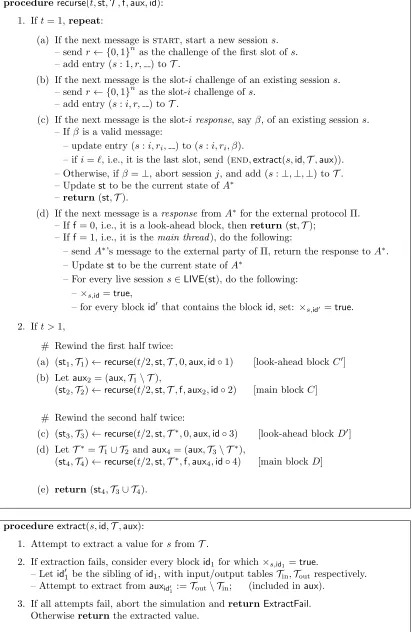
In this section, we present an explicit construction of a robust simulatorS, and the (online extractor) party E for which (the robust extraction) lemma 1 holds. The simulator is a slight modification of [KP01, PRS02], to also deal with messages of Π, without rewinding them. We start by defining a few terms first.
The states of A∗. Recall that the scheduling of messages in the robust-concurrent attack is controlled byA∗, and whenA∗sends thei-th message of a sessions(eitherPRSor Π), it immediately receives the next message of s, namely the (i+ 1)-st message. Thestate of A∗ at any given point during the attack consists of its view up to that point: it includes all messages sent/received byA∗, its auxiliary inputzand its randomness. Thestarting(ororiginal) state ofA∗—denoted throughout by st0—is its state before it receives the first message. If st denotes the state of A∗ at some point
during the robust-concurrent attack, the set of all PRS preambles which have not completed yet is denote byLIVE(st).
The robust simulator S. The simulator receives as input an auxiliary stringz∈ {0,1}∗, and the security parametern. The simulator participates with an external partyB of Π. Letx∈domB(n)
and γ denote the input and uniformly chosen randomness of B. The simulator incorporates the adversaryA∗ as a black-box; let T =T(n) define the maximum number ofPRS preambles that A∗ can open during the robust-concurrent attack.
Simulator S starts by setting (1n, z) on A∗’s input tape, and a sufficiently long uniform string on its random tape. The simulator then initiates a helper procedurerecurseas follows:
(st,T)←recurse(T,st0,∅,1,∅,0).
Throughout its execution, messages of recurse are forwarded back and forth to B(1n, x;γ) and (the black-box)A∗ as appropriate. Finally, the output of S is the first output ofrecurse, namelyst; the outputstis also known as themain thread. Procedurerecurseis given in figure 2, each execution of recurseis called a block, and has a unique name denoted byid.
The online extractor E. Formally, an execution of E begins during a robust-concurrent attack. Let (γ, ρ) denote the random tape ofE, and (n, x, z) denote its inputs. E incorporates the program of A∗, and performs the following internal steps before it sends out its first message in the robust-concurrent attack,
1. E proceeds identically to the robust simulator algorithm S, using ρ as its random tape and (1n, z) as its inputs. To successfully proceed in this step, E uses (x, γ) to simulate the honest
algorithm B(1n, x;γ), as well as black-box access to A∗.6 However, E differs from S in its actions only when a PRSpreamble scompletes, in the manner described below.
2. Let s be a successfully completed PRS preamble; at this point S either extracts a value µs
or reaches an ExtractFail. When this happens, E neither sends µs nor aborts the simulation;
instead it proceeds as follows. First,Eattempts to extract theactual valuecommitted to in the preamble by inverting all instances of the underlying commitment Com. Then, it decides the valueαs, to be sent, as follows. If a valid and unique valuevs exists, set αs=vs. Otherwise,
it has following cases:
(a) If there are more than one validvs, proceed as follows: if µs equals to any of them, set
αs =µs, otherwise, setαs to be one of them chosen at random.
(b) If no valid vs exists, then proceed as follows: if µs =ExtractFail, setαs to be a random
value; otherwise, set αs=µs.
3. After reaching the end of the simulation,E internally stores the randomnessρs and the values
αs for every PRSpreamble sappearing on the main thread.
Having completed the steps above,7 E is now ready to interact with the (outside) A∗ launching the robust-concurrent attack, and proceeds as follows.
• If A∗ sends a message intended for the (only) session of Π, E interacts with A∗ by following actions of B(1n, x;γ). Likewise, if A∗ sends a messages for a PRS preambles,A∗ follows the honest receiver algorithm ofPRS preamble withrandomness ρs already computed internally.
• IfA∗ successfully completes a PRSpreamble s,E sends the already stored valueαs toA∗.
3
CCA Secure Commitments in
O
e
(log
n
)
Rounds
In this section we apply our robust extraction lemma to construct a O(loge n)-round protocol for
CCA secure commitments. We will need the generalized version of the lemma which allows for
statistically hiding PRS preamble as well; the general version appears in A. We will also use a
6
Observe that althoughE depends onA∗here, it still usesA∗only as a black-box, as remarked earlier.
procedurerecurse(t,st,T,f,aux,id): 1. Ift= 1, repeat:
(a) If the next message isstart, start a new session s. – sendr← {0,1}n as the challenge of the first slot ofs. – add entry (s: 1, r, ) toT.
(b) If the next message is the slot-ichallenge of an existing sessions. – sendr← {0,1}n as the slot-ichallenge ofs.
– add entry (s:i, r, ) toT.
(c) If the next message is the slot-iresponse, sayβ, of an existing sessions. – Ifβ is a valid message:
– update entry (s:i, ri, ) to (s:i, ri, β).
– ifi=`, i.e., it is the last slot, send (end,extract(s,id,T,aux)). – Otherwise, ifβ=⊥, abort sessionj, and add (s:⊥,⊥,⊥) toT. – Updatestto be the current state ofA∗
–return(st,T).
(d) If the next message is aresponse fromA∗ for the external protocol Π. – Iff= 0, i.e., it is a look-ahead block, thenreturn(st,T);
– Iff= 1, i.e., it is themain thread), do the following:
– sendA∗’s message to the external party of Π, return the response toA∗. – Updatestto be the current state ofA∗
– For every live sessions∈LIVE(st), do the following: – ×s,id=true,
– for every block id0 that contains the blockid, set: ×s,id0 =true.
2. Ift >1,
# Rewind the first half twice:
(a) (st1,T1)←recurse(t/2,st,T,0,aux,id◦1) [look-ahead blockC0]
(b) Letaux2= (aux,T1\ T),
(st2,T2)←recurse(t/2,st,T,f,aux2,id◦2) [main blockC]
# Rewind the second half twice:
(c) (st3,T3)←recurse(t/2,st,T∗,0,aux,id◦3) [look-ahead blockD0]
(d) LetT∗=T
1∪ T2 andaux4= (aux,T3\ T∗),
(st4,T4)←recurse(t/2,st,T∗,f,aux4,id◦4) [main blockD]
(e) return(st4,T3∪ T4).
procedureextract(s,id,T,aux):
1. Attempt to extract a value forsfromT.
2. If extraction fails, consider every blockid1for which×s,id1 =true.
– Letid01be the sibling ofid1, with input/output tablesTin,Tout respectively.
– Attempt to extract fromauxid0
1 :=Tout\ Tin; (included inaux).
3. If all attempts fail, abort the simulation andreturnExtractFail. Otherwisereturnthe extracted value.
Figure 2: Procedures recurseandextractused by the robust simulator S.
non-malleable commitment scheme, denotedNMCom, that isrobust w.r.t. constant round protocols [LP09]. Constant round constructions for such protocols are now known, see section C for details and definitions.
The protocol has a very intuitive “commit-and-prove” structure where the committer commits to the valuevusing aPRSpreamble, and then proves its consistency using what resembles a “concurrent simulation-sound” protocol. We start by recalling the notion of CCA secure commitments from [CLP10].
3.1 CCA Secure Commitments
Let hC, Ri denote a statistically binding and computationally hiding commitment scheme. We assume w.l.o.g. that hC, Ri has a non-interactive reveal phase—i.e., the committer simply sends (v, d). The decommitment is verified using a functionopen(c, v, d); that is, the receiver accepts vas the value committed in the commitment-transcriptcifopen(c, v, d) outputs 1, and rejects otherwise. A tag-based commitment scheme withl(n)-bit identities [PR05b, DDN91] is a commitment-scheme where in addition to 1n,C andR also receive a “tag” (or identity) of length l(n) as common input. We will consider schemes which areefficiently checkable: meaning that ifRaccepts in the interaction (with transcriptc) then there exists a decommitment pair (v, d) such thatopen(c, v, d) = 1.
In CCA-secure commitments, we consider an adversarial receiverA, who has access to an oracle
O, called the “decommitment oracle.” The oracle participates with A in many concurrent sessions of (the commit phase of) hC, Ri, using tags of length l(n), chosen adaptively by A. At the end of each session, if the session is accepting, the oracle returns the (unique) value committed by A in that session; otherwise it returns ⊥. (In case there is more than one possible decommitment, O
returns any one of them.)8
Roughly speaking, we say that a tag-based schemehC, Riis CCA-secure if there exists a decomit-ment oracle OforhC, Ri, such that the hiding property of the scheme holds even for adversaries A with access to O. Formally, let INDb(hC, Ri,O, A, n, z) denote the output of the following
proba-bilistic experiment: on common input 1n and auxiliary inputz, theppt adversaryAO (adaptively) chooses a pair of challenge values (v0, v1)∈ {0,1}nand a tagid∈ {0,1}l(n), and receives a
commit-ment to vb using the tag id (note that A interacts with O throughout the experiment as described
before); finally, when AO halts, the experiment returns the output y of AO; y is replaced by ⊥ if during the experiment, Asends O any commitment using the tagid.
Definition 1 (CCA-secure Commitments, [CLP10]). LethC, Ribe a tag-based commitment scheme with tag-length l(n), and O be a decommitment oracle for it. We say that hC, Ri is CCA-secure w.r.t. O, if for every ppt itmA, every z∈ {0,1}∗, and every sufficiently large n, it holds that:
IND0(hC, Ri,O, A, n, z) c
≡ IND1(hC, Ri,O, A, n, z).
We say that hC, Ri is CCA-secure if there exists a decommitment oracle O0 such that hC, Ri is CCA-secure w.r.t. O0.
An analogous version of the definition which considers many concurrent executions on left (in-stead of just one), is known to be equivalent to the current definition (via a simple hybrid argument). Also note that, for this reason, this definition implies concurrent non-malleable security for commit-ments [PR05a].
8
3.2 Our Protocol for CCA Secure Commitments
We are now ready to present our CCA secure commitment protocol, denotedCCA-Com. The protocol employes thePRSpreamble inbothdirections (similar to [GJO10, LPTV10]). However, our protocol is much simpler, and admits an easier security proof.
We now provide a quick overview of our protocol. Our protocol will also use a constant-round non-malleable commitment scheme—NMCom—that is robust w.r.t. 4 rounds. The formal descrip-tion of our protocol appears in figure 3.
Let v ∈ {0,1}n be the value to be committed. Our commitment protocol, CCA-Com, consists of five phases. In the first phase, the committer C commits tov using a statistically-binding PRS
preamble. We denote this instance of the preamble by PRS1. In phase 2, the receiver R uses a
statistically-hiding PRSpreamble to commit to a random valueσ∈ {0,1}n; we denote this instance of the PRSpreamble by PRS2.
In phase 3,C commits to 0n using therobust NMComscheme. In phase 4,R decommits to the valueσ (of phase PRS2). Finally, in phase 5, C uses a witness-indistinguishable (WI)proof system
to prove that: “either there exists a valid valuevin phase 1 or the value committed inNMComisσ.” It can use, for example, Blum’s 3-round protocol repeated in parallel ntimes [Blu87]. We remark that it is necessary to use a proof system which ensures soundness against unbounded provers.
To decommit, C sends decommitments corresponding to the first phase, namely PRS1. The
round-complexity of both PRS preambles is ` ∈ ω(logn). We have the following theorem, whose proof appears in section 4.
Theorem 1. Assuming the existence of collision-resistant hash functions, protocol CCA-Com pre-sented in figure 3 is a O(loge n)-round CCA secure commitment scheme for identities of length n.
3.3 Construction based on One-way Functions
Protocol CCA-Com of the previous section requires the use of a statistically-hiding phase PRS2.
If we change the protocol so that PRS2 is statistically-binding, we will not be able to prove that
the right sessions of CCA-Com remain statistically binding. This is because of the presence of the super-polynomial time oracleO. Indeed, without the oracle we can makePRS2 statistically-binding
and have a protocol based on one-way functions; but in the presence of oracle, it may happen that A∗ is able to ensure that for some right sessions,eus=σes.
To avoid this problem, we must somehow remove PRS2 yet still be able to later modify the
left PRS slot-by-slot. The key observation is that in case of commitments, there is only one left session. Therefore, we can use a different simulation strategy which guarantees “soundness” w.r.t. unbounded committers as well.
Based on this observation, our one-way functions based protocol does not use PRS2. Instead it
uses a CoinFlipprotocol in which no unbounded prover can succeed in “setting up a trapdoor” but a rewinding party can. Our new protocol, denotedCCA-Com∗, appears in figure 4.
Theorem 2. Assuming the existence of one way functions, protocol CCA-Com∗ presented in figure 4 is a O(loge n)-round CCA secure commitment scheme for identities of length n.
For the proof of this theorem see appendix B. Although the proof is very similar to that of theorem 1, one crucial point is that we need to re-use the idea of robust-simulation, and be careful about how we apply it.
Protocol CCA-Com. The committing algorithm is denoted by C. The receiver algorithm is denoted by R. The common input is the security parameter n and an identity id of length n. The private input of C is the value v ∈ {0,1}n to be committed. The protocol proceeds in following five phases:
• Phase 1: C commits to v using a statistically-binding PRS preamble. This instance of the preamble is denoted by PRS1, and let τ1 be the
commitment-transcript.
• Phase 2: R commits to random σ ← {0,1}n using a statistically-hiding PRS
preamble. This instance of the preamble is denoted byPRS2.
• Phase 3: C commits to the all-zero string 0n using NMCom, with common identityid. Letτ3 be the commitment-transcript.
• Phase 4: Rdecommits toσ, by sending the appropriate decommitment strings.
• Phase 5: C proves to R, using a public coin, constant round WI proof system (e.g., nparallel repetitions of Blum’s protocol), that either:
(a)∃ v∈ {0,1}n s.t. τ1 is a valid PRS-commitment tov; OR
(b)τ3 is a valid commitment to σ as per NMCom.
Decommitment oracle O. The oracle extracts the value committed to in tran-script τ1 of the first phase, and returns it.
Figure 3: ProtocolCCA-Com.
4
Proof of Security for
CCA
-
Com
We start by noting that the scheme is statistically-binding even against an unbounded cheating committer algorithm C∗. This is because of the following. PRS2 is statistically-hiding for σ, and
therefore except with negligible probability, the value committed to inNMCom(which is statistically-binding) does not equalσ. Then, from the soundness of the WIproof, it follows thatC∗ can succeed only when thePRS1 is consistent. It will be important to have statistical-binding w.r.t. unbounded
C∗since we will be dealing with the super-polynomial time oracleOin various hybrid experiments. We now proceed to demonstrate the CCA security of our scheme. To do so, we will directly construct a pptsimulatorSIM, which simulates the view of any CCA adversary A∗O. SIMwill not have access to the decommitment oracleO, and usesA∗ only as a black-box. Recall thatOextracts the value from the transcript ofPRS1. SIMonly receives 1n and auxiliary-inputz forA∗, as its own
inputs.
Lemma 2. There exists a strict polynomial time machineSIMsuch that for every ppt itmmachine A∗, every z∈ {0,1}∗, every sufficiently large n, and every b∈ {0,1}, it holds that:
SIMA(1n, z) ≡c INDb(hC, Ri,O, A, n, z).
Protocol CCA-Com∗. The committing algorithm is denoted by C. The receiver algorithm is denoted by R. The common input is the security parameter n and an identity id of length n. The private input of C is the value v ∈ {0,1}n to be committed. Comis a statistically-binding scheme.
Round parameters. Letq:=q(n) be a fixed function inω(1), and let`:=`(n) = q(n)·logn·ω(1). Letk∈O(1) be the round complexity of NMCom.
• Phase 1: C commits to v using the PRS preamble with parameter ` ∈
ω(logn). This instance of the preamble is denoted by PRS1, and let τ1 be
the commitment-transcript.
• Phase 2: C and R execute the following CoinFlipprotocol. In roundi∈[q]: (a)C commits a “short” stringui ∈ {0,1}logn usingCom,
Letci be the commitment-transcript, anddi a decommitment-string.
(b)R sends a “short” random string σi ∈ {0,1}logn
Define u= (u1, . . . , uq),σ= (σ1, . . . , σq), andd= (d1, . . . , dq).
• Phase 3: C commits to string (u, d) using NMCom andidentity id. Letτ3 be
the commitment-transcript.
• Phase 4: C proves toR, using a public coin, constant round WIproof—e.g.,n parallel repetitions of Blum’s protocol—that either:
(a)∃ v∈ {0,1}n s.t. τ1 is a valid PRS-commitment tov; OR
(b)τ3 is a valid commitment to (u, d) as per NMCom, such that ∀i∈[q]:
– (i) openCom(ci, ui, di) = 1,and
– (ii) ui =σi.
Decommitment oracle O. The oracle extracts the value committed to in tran-script τ1 of the first phase, and returns it.
Figure 4: Protocol CCA-Com∗based on one-way functions.
Recall that during its execution A∗ opens one session of CCA-Com := hC, Ri on left, while simultaneously interacting in multiple concurrent sessions of CCA-Com with O, called the right sessions. LetT =T(n) be a polynomial upper-bounding the number of right sessions ofA∗.
AlgorithmSIMwill use the robust simulatorSguaranteed by the (general version of) the robust-extraction lemma (see sections 2 and A), allowing it to extract the values committed to by A∗ in all PRS preambles. It then uses these values to simulate the answers ofO, as well as to succeed in WI proof (by committing the extracted value inNMComof the left session).
SIM uses two helper procedures: the robust simulator S and an “interface” algorithm I to be described shortly. Procedure I essentially “decouples” the PRS preambles from the rest of the
CCA-Com protocol. It incorporates A∗ as a black-box, and handles all messages of all sessions of CCA-Com internally and honestly, except for all the PRS preambles in which A∗ acts as the
committer. All these preambles are forwarded to outsidePRS-receivers. That is,I participates in a robust-concurrent attack, interacting with the party E. It executes PRS preambles with E, and at the end of each PRS preamble s, I expects to receive a value αs from E. This value will be used
internally.
SIMis a polynomial time machine without access to any super-polynomial time helper. Therefore, to run I, it runs the robust-simulator S providing it black-box access to the “adversary” procedure I. SIM outputs whateverS outputs. Formal descriptions follow.
Algorithm SIM(1n, z). Return the output ofSI(1n, z), where procedureI—which has black-box access to adversary A∗—is described below.
ProcedureI(1n, z). ProcedureI launches the robust-concurrent attack, by committing in several
PRS sessions to external receivers denoted R1, . . . , RT. At the end of each preamble, it expects to
receive a stringαs. I incorporates the CCA adversary A∗ internally, as a black-box. I initiates an
execution of A∗, simulating various sessions of CCA-Comthat A∗ opens as follows.
1. If A∗ starts a new session s of CCA-Com on right, I starts by initiating a new session of the statistically-binding PRS1 with an external receiver Rs. Then, messages of phase-1 of s are
relayed betweenA∗ andRs. I simulates all other phases ofsinternally by following the honest
algorithm for each phase.
2. If A∗ starts a new session sof CCA-Com on left,I initiates a new session of the
statistically-hiding preamble to be used as PRS2 of s with an external receiver R0s. I completes various
phases of sas enumerated below.
(a) Phase 1: I commits to an all zero string toA∗.
(b) Phase 2: I simply relays messages between A∗ andR0s.
(c) Phase 3: I commits to value αs using NMCom (instead of 0n). Value αs was received
from outside at the end of PRS2 of sessionss.
(d) Phase 4: If A∗ correctly opens the value in PRS2 of session s,I checks that the opened
value is equal to the “fake witness” αs. If not, it outputs a special symbol ExtractFail,
and halts. Otherwise it continues the execution.
(e) Phase 5: I uses αs and the randomness used in phase 3 (NMCom) to complete the WI
proof in phase 5.9
9
Note that, technically,Ican use the valid witness corresponding to thePRS1 phases. This is since it committed to a valid value, namely 0n. However, we choose to useα
s so thatSIMwill in fact be a valid simulator even for our
3. Oracle answers: If A∗ successfully finishes a session s of CCA-Com on right, I sends the (already extracted) valueαs toA∗.
When A∗ halts,I outputs the view of A∗, and halts.
Proving Indistinguishability. We are now ready to prove our lemma. We will prove this by using a series of hybrid experiments. Our hybrid experiments will be designed my making step-by-step changes to how I communicates with A∗ internally in various phases of the protocol. For i∈[7], we denote byνi the output of hybridHi.
Hybrid H0: This hybrid is identical the experiment INDb(hC, Ri,O, A, n, z). Recall that in this
experiment, A∗O receives a commitment to valuevb ∈ {0,1}n from the honest committerC, while
interacting with the oracle O. The output of the experiment consists of the view of A∗, which is also the output ofH0.
Hybrid H1: This hybrid is identical to H0, except for the following differences:
(a) H1 does not forward the right sessions toO. Instead, it executes all right sessions on its own,
by playing the honest receiver strategyR. Denote byRsthe instance ofR executed in session
s.
(b) When A∗ successfully completes the session Rs, H1 queries a different oracle O0, which acts
as follows. The query to O0 consists of only part of the commitment-transcript PRS
1 that
belongs for the value to be committed. All other messages (e.g., commitments of shares and slot-messages) are not part of the query. In particular, if Com is non-interactive, the query will be commitment of the valueves. If there is a unique value defined by the query,O0 extracts
that value, and returns it as the answer. In all other cases, it behaves exactly asO.
HybridH2: This hybrid is identical toH1; we use it to set up some notation. Define a procedure
I2, which is identical to procedure I (defined above), except that it it executes (all internal phases
of) the left session honestly and that it uses the oracleO0as inH
1. That is, it only forwards thePRS
preambles received fromA∗ outside, but executes all other phases internally and honestly. Formally, I2 is identical is identical toI except:
(a) I2receives the valuevbto be committed in left sessions ofCCA-Com, as an input. Furthermore,
I2 commits to valuevb inPRS1 of the left session (instead of 0n, step 2(a)).
(b) When a session s of PRS1 ends, I2 expects to receive a value αs from outside. If s is a
statistically-binding sessions, thenI2 givesαs toA∗. Ifsis statistically-hiding, itignores the
values—there is only one such session corresponding to the left session.
(c) I2 uses the valid witness,vb and the randomness of PRS1 to complete its WI proof in the left
session (step 2(e)). I2 does not check the validity of the “fake witness” (step 2(d)).
Observe thatI2is essentially launching a robust-concurrent attack. It does not perform any
rewind-ings. Hybrid H2 simply runs the procedure IA ∗
2 , and simulates PRS-receivers for it exactly as H1
does; furthermore, when a statistically-binding session s finishes, H2 forwards its commitment to
O0 and returns the oracles answer, denoted αs, to I. On the other hand, if the statistically-hiding
session of PRS ends, H2 sends a random string αs (which, by construction, is ignored by I2, see
point (b)). The output of H2 is the view ofI2 (which in turn is the view ofA∗).
HybridH3: For procedureI2, letE be our online extractor as defined in section 2.3 (with
adden-dum from section A to deal with statistically-hidingPRSas well). Recall thatEis a super-polynomial time machine, which facilitates the robust-concurrent attack. In particular, it acts honest receivers in all PRSpreambles, as well as provides extractions for each one of them when they finish.
On input (1n, vb, z), hybridH3 starts an execution of I2(1n, vb, z), making it interact with party
E. The output of H3 is the output of the robust-concurrent attack, which in turn consists of the
view ofI2(and henceA∗). Therefore,H3 differs significantly fromH2: it does not runPRSreceivers
and does not have access to O0, since these are automatically done byE forH
3.
From hereon, we will only be making changes to the interface procedure I2. All future hybrids,
except for the last one, differ fromH2 in only that they use a modified version of I2. Furthermore,
changes are made to the phases of theleft session only, of which there is only one.
Hybrid H4: This hybrid is identical to H3 except that instead of using I2, it uses procedure
I4. Let αs be the value that I2 receives from E at the end of statistically-hiding PRS2 of the left
session. Furthermore, let σs be the value opened byA∗ which appears internally, in the left session
of CCA-Com(simulated for A∗ by I2).
ProcedureI4 is identical toI2 except that when A∗ sends σs along with valid openings, I4 tests
that αs =σs; it aborts the entire simulation if this test fails, and outputs BindingFail. Recall that
I2 simply ignores αs.
Hybrid H5: This hybrid is identical to H4 except that instead of using I4, it uses a modified
procedureI5. ProcedureI5 is identical toI4 except that instead of committing to 0n, it commits to
αs in protocolNMComof the left session s.
Hybrid H6: Identical to H5 except that instead of using I5, it uses a modified procedure I6.
Procedure I6 is identical to I5 except that it uses the“fake witness” in the WI proof of the left
session s. Recall that the “fake witness” consists of the value αs and the randomness used in NMCom.
Hybrid H7: Identical to H6 except that instead of using I6, it uses a modified procedure I7.
ProcedureI7 is identical toI6 except it does not receive the inputvb, and commits to 0nin the first
phase PRS1 of the left session. Observe thatI7 is in fact identical to I.
HybridH8: This hybrid differs fromH7 in two crucial places. First, it does not receive the value
vb as input. Therefore, its only inputs are (1n, z). In addition, it does not use the partyE. Instead,
H8 simply runs the robust simulatorS with inputs (1n, z) and black-boxI7. It outputs whateverS
outputs. Observe that H8 is in fact our original simulatorSIM, presented earlier.
Notation. Letν0 denote the output ofH0. Letu0 be the variable denoting the value committed
by C in NMCom in the left session, and let σ0 be the variable denoting PRS-value opened by A∗
in (phase-4 of) the left session. Since there is only one left session, we will not use any subscripts. Analogously, define variables ue0s and eσs0 for the s-th right session in hybrid H0. Finally, we denote
byve0
s the valueA∗ commits inPRS1 of the s-th right session inH0. Fori∈ {0, . . . ,8} define values
νi,ue
i s,eσ
i s and ev
i
s w.r.t. the hybrid Hi analogously. Identity of the left session is referred to by id,
otherwise, indexsis in [T], andides is not equal toid, and the probability is taken over the
random-ness of the hybrid in consideration.
We start by noting thatν0 is identical to INDb(hC, Ri,O, A, n, z). Next, we claim the following.
Claim 1. For every hybrid i∈ {0, . . . ,4} and for every right session s∈[T],
ν0 s≡ ν1≡ν2 s≡ν3 s≡ ν4 (1)
Prue
i s =eσ
i s
≤negl(n) (2)
Proof. It is seen by way of construction of hybrids H1 and H2, that ν0 s
≡ ν1 ≡ ν2.10 In case of hybrid H3 party E, which also simulates PRS sessions exactly as H2 does (since E is valid).
Furthermore,E extracts the valuesαs in the (first message) of thePRSpreamble exactly asO0 does
in H2. If a unique and valid αs exists, the value αs returned to I2 is the same in both hybrids.
However, when the value is not unique,Euses a different decision procedure to decide the value ofαs.
Nevertheless, statistical-binding of PRS ensures that this happens with only negligible probability. It follows that the distribution of answersαsin both hybrids is statistically close, and henceν2 s≡ν3.
Finally, inH4 the only difference is thatI4 verifies thatαs=σs (i.e., the fake witness is correct).
From the validity constraint 1(b) on E (see lemma 6, section A) this condition fails with only negligible probability. Therefore,ν3 s≡ν4.
We first prove the second equation for hybrid H0. Fix any right-session s of H0. Observe that
PRS2 of s is statistically-hiding. Therefore, except with negligible probability, we have that value
e
σs0 is not defined until after the completion of NMComof session s. SinceNMCom is statistically-binding, and there are exponentially many possible values forσe0s, the claim follows (for hybridH0).
Now, observe that the same argument applies for hybrids H1 and H2 as well. In case of H3 and
H4, sinceEsimulatesPRSreceivers honestly, the same argument applies to these hybrids as well.
A corollary of the second equation is that in each of these hybrids, for every right session s that is accepting, there exists a unique and valid11 value ev
i
s to which A∗ is committed to (except with
negligible probability). This is because if the second equation holds, from the soundness of WI proof against unbounded adversaries,12 phasePRS1 must be consistent defining a unique and valid value.
Therefore, in all future hybrids, we will continue to maintain the second equation as an invariant.
Claim 2. We have that, ν4 c≡ ν5; and ∀s: Pr e
u5s =eσs5
≤negl(n).
Proof. Both hybridsH4 and H5 use partyE which is super-polynomial time. Therefore, to prove
the claim, we need to first need to eliminate the use ofE. Observe that this can be done by employing the robust simulatorS. However, since we aim to reduce the claim to the non-malleability ofNMCom, we would like one left execution and one right execution of NMCom that the robust-simulator S does not rewind.
Recall that the only difference between H4 and H5 is that they use different procedures: I4
and I5 respectively. The only difference between I4 and I5 is that the first one commits to x = 0n
10
First two hybrids are not identical since the oracle changes: Oextracts from the fullPRStranscript (and therefore always checks for consistency), whereasO0 simply extracts from the (first) committing message ofPRS. Statistical-binding ensures that this difference happens only in negligible cases.
11Recall that vis valid if all shares
xor tov; formally, there exists randomnessρ such thatopenPRS(τ1, vs, ρ)=1
whereτ1 is the commitment-transcript ofPRS1 ofs. 12We need this sinceA∗
does have access to super-polynomial computations via O, and we do not know what he might be learning.
whereas the second one commits to x = αs in phase NMComof the left session. Recall that αs is
the value sent byE at the conclusion ofPRS2 of the left session.
We design an intermediate procedure I∗, which is identical to I4 except for the following
differ-ences:
1. When the NMComphase of the left session is about to begin, I∗ sends (0n, αs) to an external
committer.
2. I∗ does not execute theNMComof the left session internally. Instead, it expects to receive it
from an external honest committer, denotedCnm, who either commits to 0n orαs.
3. For a randomly chosen right session j, I∗ does not execute the the NMCom of session s
internally. Instead, it forwards the messages of this NMCom to an external honest receiver, denoted Rjnm.
Therefore,I∗is executed severalPRSpreambles, and at the same time acting as a man-in-the-middle
for protocolNMComby receiving a commitment and making a commitment at the same time. Let B denote the party who runs algorithm Cnm as well as Rjnm for I∗, both honestly. Observe that
the number of rounds of interaction between B and I∗ are 2k where k is the round-complexity of NMCom. The inputxtoB consists of the value to be committed byCnm.
Viewed this way, I∗ is an adversary who launches the robust-concurrent attack with respect to
party B, and the party E. Furthermore, if B commits to x = 0n then the execution is identical
to that of H4 with I4; on the other hand, if x =αs, the execution is identical to that of H5 with
procedureI5. That is,
ν4 ≡ REALI∗
E,Π(n,0
n, z),
ν5 ≡ REALI∗
E,Π(n, αs, z).
where protocol Π = (B, P2), andP2 is “converse ofB—that isP2 acts as a receiver in oneNMCom
in which B is acting as a committer and vice-versa in the other.
Now, we can removeEand instead use the robust-simulatorS to sample statistically close views. That is, suppose that we runSwithI∗and consider the outputOUTs(x) :=OUTs
B(1n,0n)↔SI∗(1n, z).
By applying the robust concurrent extraction lemma, we have that statistical distance between
OUTs(x) and REALI∗
E,Π(n, x, z) is at most:
∆(n)≤2−Ω(`−2k·logT)≤negl(n),
for everyx∈ {0n, αs} since`∈ω(logn),kis a constant, and T is at most a polynomial. Using this
with the equations above, we get:
ν4 ≡s OUTs(0n) (3)
ν5 ≡s OUTs(αs) (4)
By construction, OUTs(x) is the output of SI∗ in an interaction withB on input x. Algorithm
SI∗ is a
ppt man-in-the-middle adversary for NMComwho receives a commitment to x from Cnm, and commits a value, sayuej(x), toRjnm. From non-malleability of NMComw.r.t. to itself, we have that:
(uej(0
n),OUT
s(0n))
c
It immediately follows from (3), (4), and (5), thatν4 c≡ν5. Furthermore, suppose that the other part of the claim is false, so that for some session s∈[T] valueeu
5
s =eσ
5
s with noticeable probability
p. Define this to be event bad5 for hybrid H5, and analogously define bad4 forH4.
Now observe that since j was chosen uniformly from T sessions, j = s with probability 1/T. Therefore, valueeu
5
s appears as the variableeuj(αs) with probability 1/T. In addition, valueeσj(αs) is
a part ofOUTs(αs), and therefore, eventbad5is efficiently observable given both (uej(αs),OUTs(αs));
and it occurs with probability p/T which is noticeable. By an analogous argument, event bad4 is
also efficiently observable; furthermore bad4 must occur with noticeable probability as well due to
equation (5). This contradicts equation (2). Hence the claim.
Claim 3. We have that, ν5 c≡ ν6; and ∀s: Preu
6
s =eσ
6
s
≤negl(n).
Proof. The proof of this claim is almost identical to the proof of claim 2. The only difference is that instead of using non-malleability w.r.t. itself property ofNMCom, we use the fact thatNMCom
is robust w.r.t. every interesting 3-round protocol (i.e., one that “hides” its input, see section C). Since the only difference betweenH5andH6 is in the WI part, the proof follows; we omit the details.
Claim 4. We have that, ν6 c≡ ν7; and ∀s: Pr e
u7
s =eσ
7
s
≤negl(n).
Proof. Observe that inH6, since the “fake witness” is being used in the WI part, the PRS1 phase
of the left session (which commits to input valuevb) does not have to be consistent. Therefore, we
proceed as follows:
1. Design`+ 1 intermediate hybridsH6:i fori={0, . . . , `−1} whereH6:0 =H6,H6:`=H7.
2. HybridH6:i is the same asH6:i+1 except that in slot-iofPRS1 phase of the left session,H6:i+1
commits to shares of an all-zero string.
3. Now, following the proof of claim 4 and by using the robustness ofNMComw.r.t. the 3-round protocols, we conclude that ν6:i ≡c ν6:i+1 and that ∀s : Preu
6:i s =eσ
6:i+1
s
≤ negl(n), where variables are analogously defined. The details of this part are repetitive, and omitted.
The claim now follows.
Completing the proof. Note that the output ofH8, is statistically-close toν7due to the
robust-concurrent-extraction lemma. Therefore, combining all the equations we have that ν0 c≡ ν8. Since
H8 is identical tot he simulator, the lemma follows.
5
Proof of the Robust Extraction Lemma
We organize this section in two parts. The first part introduces important terminology used through-out the proof. The terminology is mostly consistent with previous literature [KP01, PRS02, Ros04, PTV08], and can be skipped by experts at first reading—except, for the notion ofbreakpoints (para-graph 2) and unmarked view of a block. In the second part, we present the actual proof of the lemma.
5.1 Terminology
We now introduce some terminology about the recursive structure ofrecurse. An execution ofrecurse
is called a block. The six inputs of a blockB, namely (t,st,T,f,aux,id) are referred to as follows. Inputtis called the length,stthestarting state, and T thestarting solutions. Input f is used as an identifier whose only purpose is to formally identify if B “lies on the main thread” (defined later); it does if f = 1. Inputaux is called theauxiliary table (or auxiliary solutions), used only in special cases. Finally, id is the identity of the block B, used to uniquely specify B in the full recursive structure of recurse.
Blocks of length t = 1 are called the atomic blocks. The output (st0,T0) of a block consists
of the final (or output) state and the final (or output) solutions. Each message of protocol Π is called a breakpoint, often dented by a cross mark ×. IfB is an atomic block, and a message of Π is scheduled during its execution, we say thatB contains a breakpoint; B may contain one or several breakpoints.
Let B be a block that is not atomic. B executes four blocks during its own execution, in the following order: C0,C,D0 andD. BlocksC0, D0 are called thelook-ahead blocks; andC, Dthemain blocks (see steps 2(a) to 2(d) of procedure recurse). Furthermore, blocks C and C0 (resp., D and D0) are called siblings; they are the children of the same parent blockB. We say that B contains
its children blocks.
We say that blocks B1 and B2 are consecutive, denoted B1 → B2, if the final state of B1 is
the starting state of B2. We say that B1 and B2 are connected if B1 → B2 or B2 → B1. A
thread h is represented by a sequence of consecutive blocks (B1, . . . , Bm), i.e.,Bi →Bi+1 for every
i∈ {1, . . . , m−1}. Further, if it holds that for everyi∈[m], blockBi in the sequence is an atomic
block, then we say that the sequence is theprimitive sequence of h. Note that a primitive sequence
uniquely identifies a thread. That is, a thread h can be uniquely referred to by specifying the
identity of each atomic block Bi in the sequence. Note that identities, by construction, are indeed
unique for every block, including blocks that are not atomic. We say that threads h1 and h2 are
the same if their primitive sequences are equal. We say that a thread h is an internal thread of a block B if every block Bi in the primitive sequence of h is contained in B. If B is not an atomic
block, it contains many internal threads. Thebase thread h of a blockB is an internal thread of B whose primitive sequence consists of onlymain blocks. That is every atomic block appearing in the primitive sequence of the base-thread is actually amain block of its parent block. By construction, the base thread of a block B is unique. Finally, we say that a blockB lies on a thread h if there exists a sequence h0 of blocks containing B such that the primitive sequence of both h and h is identical.
We note that the terminology so far is exclusively about the recursive structure of recurse. In particular, it allows us to refer to various blocks and threads without considering any specific execution with any given random tape or inputs. Fixing the length t of a block, completely fixes the flow chart of all recursive calls inside that block and hence its internal structure.
Main Thread: A threadh is called the main thread, if every sequence of blocks{Bi}i specifying
h, is amain block. Equivalently,his a main thread if every (atomic) block in the primitive sequence of h has receives the flag f = 1. Observe that, by construction, there exists a unique main thread. All other threads are called look-ahead threads.
Recall that the original state of A∗ is denoted by st0, and consists of its auxiliary inputz and