A Study on Microstructures of
Homogenization for Topology
Optimization
By
Yulu Wang, BEngSc, MEngSc
A thesis submitted in fulfillment of the requirement of
the degree of Doctor of Philosophy
to Victoria University of Technology
School of Architectural, Civil and Mechanical Engineering
Victoria University of Technology
DECLARATION
This thesis does not contain any material, which has been previously submitted for a degree or diploma at any university. Except where due reference is made in the text, the work described in this thesis is the result of candidate’s own investigations.
_________________ Candidate
__________________ Supervisor
I wish to express my sincere gratitude to my supervisor, Dr. Danh Tran and co-supervisor, Prof. Mike Xie. They have been offering unfailing support in my PhD study. Their advice on technical matters, constant encouragement and motivation, ready accessibility and constructive criticism are greatly acknowledged. They made every effort to ensure that I was provided with excellent equipment and a comfortable working environment.
I would like to take this opportunity to express my appreciation to the School of Architectural, Civil and Mechanical Engineering, Victoria University of Technology which has provided research resources and facilities and a stimulating and positive study environment.
I am also grateful to the Victoria University of Technology in providing financial support through the Victoria University Postgraduate Research Scholarship, throughout my PhD study.
I wish to thank the academic and administrative staff of the School of Architectural, Civil and Mechanical Engineering for their encouragement, support and friendship throughout my study. I would also like to express my appreciation to the technical staff of the School in particular to Mr. Tien Do for their help.
This thesis studies topology optimization method employing the homogenization method, with a focus on different microstructures and their effects on the topology optimization solutions. The method is based on considering the design domain as a composite having an infinite number of infinitely small holes which are periodically distributed. As a result of introducing a material density function to represent the microstructure, the complex nature of the topology optimization problem can be converted to a problem of sizing optimization of determining the values of the parameters describing the microstructures. The main task for the homogenization method is to model and formulate these microstructures.
In the thesis, different microstructure models were investigated. The strengths and weaknesses of each type of microstructures were discussed. Homogenization method was employed to formulate the homogenized properties of the material. The optimality criteria and schemes of updating the design variables in the topology optimization process were derived for the newly developed microstructures and existing microstructures for which the information is not available in the literature. New microstructure models of one-material and bi-material were established. Based on these studies, a computer software package called Homogenization with Different
Microstructures (HDM) incorporating fifteen existing and the new
Firstly, the effects of the various one-material microstructure models were investigated. A number of examples of topological optimization problems with different loading cases were solved. The loading cases considered were single loading, surface loading, multiple loading and gravity loading.
For bi-material microstructure models, both cases of material without void and materials with void under different loading cases were studied. Benchmark topological optimization problems were investigated by using six different bi-material microstructure models that have been developed and programmed in the Chapter 4 and Chapter 5.
In the thesis, we proposed a new method to define microstructures to permit using shape optimization method to find optimal microstructures or using simple boundary shapes to describe a microstructure, hence to avoid the use of the complicated topology optimization method. Two types of microstructures, circular and cross shape were developed under this definition. Three multi-void microstructures and four new bi-material models are developed.
developed by Hassani and Hinton (1998).
____________________________________________________________ DECLARATION ii ACKNOWLEDGEMENTS iii
SUMMARY iv
TABLE OF CONTENTS vii
LIST OF FIGURES xii
LIST OF TABLES xix
NOTATIONS xx
CHAPTER 1 INTRODUCTION
1.1 General 1-1
1.2 Aims of the Research 1-4
1.3 Contribution of the Research 1-4
1.4 Significance of the Research 1-5
1.5 Layout of the Thesis 1-5
CHAPTER 2 OVERVIEW OF STRUCTURAL OPTIMIZATION
2.1 Structural Optimization Method 2-1
2.5.2 Topology optimization for continuous structures 2-16 2.6 Summary 2-18
CHAPTER 3 HOMOGENIZATION AND MICROSTRUCTURES REVIEW
3.1 Homogenization Method 3-2 3.1.1 Introduction 3-2 3.1.2 A brief review of periodic structure 3-4 3.1.3 The homogenization formulas in elastic composite materials with a
periodic structure 3-7 3.1.4 Application of homogenization for topology optimization in minimum
compliance problems 3-11
3.2 Microstructures Review 3-14
3.2.1 One-material microstructure 3-15 3.2.2 Bi-material microstructure 3-29 3.3 Summary 3-32
CHAPTER 4 MICROSTRUCTURES STUDY
4.1 Development of New Microstructures 4-1
4.1.1 Simple internal boundary (SIB) microstructures 4-2 4.1.2 Multi-void microstructures 4-8
4.1.3 Bi-material microstructures 4-9
4.2.2 Boundary condition 4-19 4.2.3 Computer Program Implementation 4-21
4.3 Summary 4-23
CHAPTER 5 OPTIMIZATION APPROACH
5.1 Optimality Conditions for Different Microstructure Models 5-2
5.1.1 Kuhn-Tucker conditions 5-4
5.1.2 Updating design variables 5-7 5.1.3 Optimality conditions for new microstructure models 5-9 5.1.4 Optimality conditions for existing microstructure models 5-21 5.2 Principal Stress Based Optimal Orientation 5-30 5.3 Convergence Criterion 5-31 5.4 Measures to Control Checkerboard Pattern 5-32
5.5 Computer Program Implementation 5-34
5.6 Summary 5-38
CHAPTER 6 COMPARISONS BETWEEN ALGORITHMS USING BENCHMARK TOPOLOGY OPTIMIZATION PROBLEMS 6.1 Algorithm Test by Deep Cantilever Beam Optimization 6-1 6.2 Comparing Algorithms for One-material Microstructure Models with
model 6-21 6.2.4 Iteration history for different material models 6-23
6.3 Comparisons Between Algorithms for Bi-material Microstructure
Models 6-26
6.4 Effect of finite element discretization 6-34
6.5 Conclusions 6-36
CHAPTER 7 STUDY ON THE EFFECT OF VARIOUS ONE-MATERIAL MICROSTRUCTURES ON TOPOLOGY OPTIMIZATION RESULTS
7.1 Topology Optimizations with Single Load 7-2 7.2 Topology Optimizations with Surface Load 7-32 7.3 Topology Optimizations with Multiple Loads 7-53 7.4 Topology Optimizations with Gravity Load 7-57 7.5 Effect of Microstructures on Topology Optimization 7-60
7.6 Conclusions 7-62
CHAPTER 8 STUDY ON THE EFFECT OF BI-MATERIAL MICROSTRUCTURES ON TOPOLOGY OPTIMIZATION
8.1 Topology Optimization Using Bi-material Models with Void 8-2 8.2 Topology Optimization Using Bi-material Models without Void 8-14
8.3 Effects of Different Models on Topology Optimization 8-27
9.1 Conclusions 9-2 9.1.1 Comparison of microstructure models 9-2
9.1.2 Optimization results given by HDM 9-5
9.1.3 Optimal layout criteria 9-6
9.1.4 Checkerboard control 9-7
9.2 Recommendations for further investigations 9-7
Appendix A Appendix B Appendix C
Figure 2.1 Three categories of structural optimization 2-5
Figure 3.1 Homogenization limit 3-3
Figure 3.2 (a) A oscillating function 3-5
Figure 3.2 (b) One of oscillations in the expended scale 3-6 Figure 3.5 A periodic structure of composites and an enlargement of a
basic cell 3-6
Figure 3.4 A structure with cellar microstructures 3-8
Figure 3.5 A base cell 3-9
Figure 3.6 Ranked layered microstructure 3-16
Figure 3.7 Rectangular microstructure 3-20
Figure 3.8 Triangular microstructure 3-22
Figure 3.9 Hexagon microstructure 3-23
Figure 3.10 Minimum weight microstructure 3-26
Figure 3.11 Four microstructures with extremal bulk modules 3-27 Figure 3.12 Topology optimized microstructures 3-28
Figure 3.13 Parameterized microstructures 3-29
Figure 3.14 Ranked layered bi-material cells 3-30
Figure 4.1 Definition of base cell 4-3
Figure 4.2 New coordinate system 4-3
Figure 4.3 A quarter of unit cell 4-3
model in 1 1
2 < ≤r 4-5
Figure 4.6 The area occupied by hard and soft materials of circular model for 1
2 r
0≤ ≤ −δ 4-6
Figure 4.7 The area occupied by hard and soft materials of circular
model for 1 1
2 r
δ δ
−
< ≤ − 4-6
Figure 4.8 The area occupied by hard and soft materials of circular
model for 1− < ≤δ r 1 4-7
Figure 4.9 Cross shape boundary 4-8
Figure 4.10 Multi-void microstructures 4-9
Figure 4.11 Bi-material microstructures 4-10
Figure 4.12 Boundary conditions for case a, b and c 4-20
Figure 4.13 Boundary conditions for case d 4-21
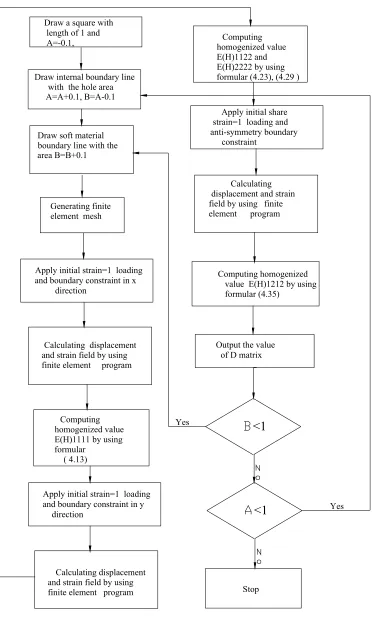
Figure 4.14 Algorithm for one-material model 4-23 Figure 4.15 Algorithm for bi-material model 4-24 Figure 4.16 Polynomials for cross shape model 4-25 Figure 5.1 Geometrical interpretation of Kuhn-Tucker condition 5-5
Figure 5.2 Checkerboard problem 5-32
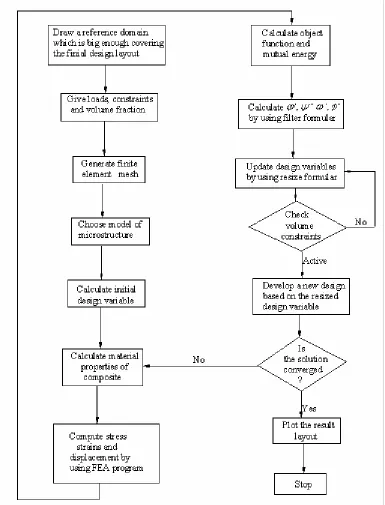
Figure 5.3 Topology optimization procedure using homogenization
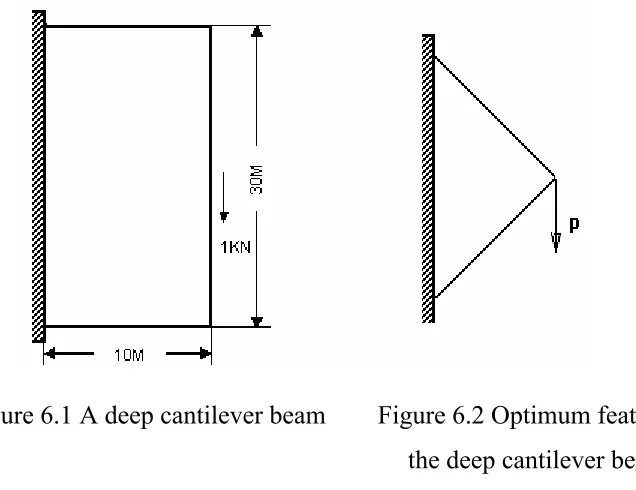
method 5-40 Figure 6.1 A deep cantilever beam 6-2
Figure 6.4 Optimum layout of deep cantilever beam for ranked
layered material model 6-3
Figure 6.5 Optimum layout of deep cantilever beam for triangular
material model 6-4
Figure 6.6 Optimum layout of deep cantilever beam for hexagon
material model 6-4
Figure 6.7 Optimum layout of deep cantilever beam for cross shape
material model 6-4
Figure 6.8 Optimum layout of deep cantilever beam for circular
material model 6-5
Figure 6.9 Optimum layout of deep cantilever beam for triangular
multi-void material model 6-5
Figure 6.10 Optimum layout of deep cantilever beam for rectangular
multi-void material model 6-5
Figure 6.11 Optimum layout of deep cantilever beam for square
multi-void material model 6-6
Figure 6.12 Optimization layouts of case a 6-8~10
Figure 6.13 Optimization layouts of case b 6-11~13
Figure 6.14 A short cantilever beam 6-15
Figure 6.15 Discretized design domain from Min etc. 6-15 Figure 6.16 Optimal structure layouts from Min etc. 6-16 Figure 6.17 Convergence histories in the case of volume constraint
Hinton 6-17 Figure 6.19 Optimal layouts of using artificial model with different
penalty from Hassani and Hinton 6-18
Figure 6.20 The iteration history of using artificial model with
different penalty from Hassani and Hinton 6-18 Figure 6.21 The optimization results of using ranked layered material
model from Hassani and Hinton 6-18
Figure 6.22 The iteration history of using ranked layered model from
Hassani and Hinton 6-19
Figure 6.23 Optimization result with different microstructures 6-20~21 Figure 6.24 Optimization results for different power values 6-22~23 Figure 6.25 Iteration histories for different material models 6-24~25 Figure 6.26 Iteration histories for different power values 6-27~28
Figure 6.27 A cantilever beam problem 6-29
Figure 6.28 Optimal layout from Thomsen 6-30
Figure 6.29 Optimization layouts of using HDM 6-31~33 Figure 6.30 The optimum layouts for different finite element
discretizations. 6-34 Figure 6.31 Iteration histories for different finite element
discretizations. 6-35
Figure 7.1 A simply supported beam 7-3
HDM for the simply supported beam problem 7-3~5 Figure 7.4 Iteration histories with different models for the simply
supported beam problem 7-7~8
Figure 7.5 Comparison iteration histories 7-9 Figure 7.6 Optimization results with different power values for the
simply supported beam optimization 7-10~12 Figure 7.7 Iteration histories with different power values for the
simply supported beam problem 7-13~14
Figure 7.8 A square domain with a point load 7-16 Figure 7.9 Optimum layouts of using the PLATO software for the
square domain with a point load problem 7-17 Figure 7.10 Optimization result for different microstructures for
case a 7-17~19
Figure 7.11 Optimum layout of using PLATO with rectangular
model 7-20 Figure 7.12 Optimization layouts for different models for case b 7-20~21
Figure 7.13 Optimization results with different power values for the
volume fraction Vs / V = 40%. 7-22~23
Figure 7.14 A domain with two sides’ boundary constraints 7-24 Figure 7.15 Optimum layout of using PLATO software for the domain
with two sides’ boundary constraints problem 7-25 Figure 7.16 Optimization layouts of different microstructures for the
the two sides’ boundary constraints problem 7-29~32 Figure 7.18 Design domain of a bridge model 7-33 Figure 7.19 Result of using PLATO software for the bridge model 7-33 Figure 7.20 Optimization layouts of different microstructures for the
bridge model 7-34~36
Figure 7.21 Sydney Harbor Bridge 7-36
Figure 7.22 Iteration histories of different material models for the
bridge model problem 7-37~38
Figure 7.23 Optimization layouts of different power values for the
bridge model problem 7-39~42
Figure 7.24 Iteration histories of different power values for the
bridge model problem 7-42~44
Figure 7.25 A square domain with pressure load 7-46 Figure 7.26 Result of using PLATO software for the square domain
with pressure load problem 7-46
Figure 7.27 Optimization layouts of different microstructures for the
square domain with pressure load problem 7-47~48 Figure 7.28 Optimization results with different power values for the
square domain with pressure load problem 7-49~50 Figure 7.29 Optimization layouts of different microstructures for the square
simply supported beam with multiple load 7-54~56 Figure 7.32 Design domain under gravity loads 7-57 Figure 7.33 Optimization layouts for different microstructures
models with gravity load 7-58~59
Figure 8.1 Optimization layouts of bi-material models 8-3~4 Figure 8.2 Iteration history for ranked layered bi-material model 8-4 Figure 8.3 Iteration histories for the rest of bi-material models 8-5 Figure 8.4 Optimization layouts for different power values 8-6~7 Figure 8.5 Layouts of six bi-material models 8-7~8 Figure 8.6 Result layouts of six bi-material models 8-10~11 Figure 8.7 Design domain of a bridge model 8-12 Figure 8.8 Optimization layouts of six bi-material models 8-12~13
Figure 8.9 A short cantilever beam 8-15
Figure 8.10 Result layouts of six bi-material models 8-15~17
Figure 8.11 A supported beam 8-18
Figure 8.12 Optimization layouts of six bi-material models 8-18~19
Figure 8.13 A two side’s supported beam 8-20
Figure 8.14 Optimization layouts of six bi-material models 8-20~22
Figure 8.15 Press machine frame model 8-23
Table 4.1 Parameters of the bi-material models 4-10 Table 6.1 Iteration numbers for different convergence tolerance 6-6
Table 6.2 The initial and final strain energy for different power values
for short cantilever beam problem 6-28
Table 6.3 Strain energies for the different finite element discretizations 6-35 Table 7.1 Iteration numbers and final strain energies at convergence
tolerance for the microstructures using HDM 7-9 Table 7.2 The initial and final strain energy with different power values for
single supported beam optimization 7-15 Table 7.3 Iteration numbers and final strain energies at convergence
tolerance for the microstructures using HDM 7-39 Table 7.4 The initial and final strain energy for different power values for the
bridge model problem 7-44
Table 8.1 Iteration numbers and final strain energies at convergence tolerance
for the microstructures using HDM 8-5
Table 8.2 Iteration numbers and final strain energies at convergence tolerance
NOTATIONS
________________________________________________________________
Acronyms:
CATO Constrained adaptive topology optimization software developed by Bulman, Sienz and Hinton.
ESO Evolutionary structural optimization
HDM Homogenization with different microstructures program
PLATO Topology optimization software developed by Hassani and Hinton SIB Simple internal boundary
SIMP Solid Isotropic Microstructures with Penalization
Strand7 Finite element software developed by G+D Computing Limlted
Tensors, Scalars and Functions
( , )
a u v Energy bilinear form for internal work a Design variables
b Design variables
e as a superscript indicates dependency to the cell of periodicity f(x) Objective function
f Average body forces within the cell
k
p Function of the position vector x q Function of the position vector x r Design variable
s Boundary of the hole in base cell t Slack variables
1 i
u% Arbitrary constants of integration in y
i
u Displacement associate with i
l m
x Lower bounds of design variable
u m
x Upper bounds of design variable ,
x y Global Cartesian coordinates
i
x , yi Cartesian coordinate of node i E Young’s modulus of solid material
ad
E Admissible elasticity tensors
ijkl
E Elasticity tensor
G ijkl
E General elasticity tensor
H ijkl
E Homogenized elasticity tensor
e ijkl
E Coefficients of elasticity of an inhomogeneous body F Objective function
G Base cell body H Hole of the base cell
2
L Hilbert space
L Lagrangian function
g
N Global shape function.
i
Y Dimension of periodic base cell
Greek symbols
α Solid part shape function β Y- periodic function ζ Lagrangian multiplier
ij
δ Kronecker delta symbol
λ Lagrangian multiplier
ij
ε Second order strain
0
ε Initial strain loading
δ A small value to define solid size
ς Small parameter indicating the characteristic of non-homogeneity dimension
ij
σ Second order stress
ij
σ Average residual stress within the cell
θ Orientation angle
µ Intermediate values as a penalization
η Moving limit
ρ Density
)
χ Discrete function ( )χ kl Y- Periodic function ∆ Convergence tolerance
( )x
ξ Continuous approximation function Ψ Solid part of cell
Π Total potential energy Ω Design domain
s
Ω Solid part of design domain
t
Γ Boundary on which the surface force applied
d
Γ Boundary on which displacements are prescribed
Special Symbols
g Norm
∈ Belongs to
∑
Summation∩ Intersection of sets
∀ For all
f Vector of structure load
p Vector of surface force in the hole
t Vector of traction force u Displacement vector
v Vector of virtual displacement x Vector of design variables
y Position vector in microscopic coordinate
p
Y Vector of periodicity, Yp = Y Y Y1, 2, 3T
e i
f Force vector for element e associated with node i
n
R n dimensional space
V Space of admissible displacement
Ω×Ψ
V Space of admissible displacements defined in Ω× Ψ ( )Y
W Space of periodic function B Strain-displacement matrix D Element of constitutive matrix
G
D Element of general constitutive matrix of
H
D Element of homogenized constitutive matrix K Symmetric, banded stiffness matrix
N Matrix of arbitrary integers
1 2
3
0 0
0 0
0 0
n n
n
=
N
Chapter 1
INTRODUCTION
1.1 General
The natural resources available to human beings are very limited, which means
we should use these resources as efficiently as possible. Optimization is a tool
for finding the best possible solution to an engineering problem. In this
respect, optimization plays a very important role in the engineering field.
The concept of an optimum in an engineering problem is intriguing and has
been under intensive investigation for decades. Earlier, engineering design was
conceived as a kind of art that demanded great ingenuity and experience of the
designer, and the development of the field was characterised by gradual
improvement of existing types of engineering design. The design process was a
sequential trial and error. It started from an initial design based on the
knowledge and experience of the designer, then followed by an analysis to the
performance of the design. Based on the information obtained, a new design
was developed. Nowadays, intense technological competition requires
and functionality. The current concept of design places greater emphasis on
efficient use of energy, environmental problems, saving as much natural
resources as possible, Therefore it often involves creative activity for which
prior engineering experience is totally lacking. Such creativity must naturally
resorts to application of scientific methods. In recent decades, the development
of computer technology has provided the opportunity to revolutionize the
traditional design process. The engineering design has been changing from trial
and error to scientifically based methods of rational design and optimization.
This has already occurred with structural optimization.
Structural optimization is a part of an optimal design field dealing with
structural elements or structural systems and is employed in several
engineering fields. The main task of structural optimization is to find the ‘best
possible solution’ to a structure that meets all the multidisciplinary
requirements imposed by functionality and manufacturing conditions. A
structural optimization design is a rational establishment of a structure which is
the best of all possible solutions within a prescribed objective and a set of
constraints. Structural optimization has become a multidisciplinary subject with
applications in many fields, such as automotive, aeronautical, mechanical, civil,
nuclear, naval and off-shore engineering. As a result of rapidly growing
applications of structural optimization, the importance of the research in
structural optimization methods is realized by more and more scientists and
Topological structural optimization is regarded as one of the most challenging
topics in structural mechanics, in which one needs to change the topology as
well as the shape during the process of optimization. This significantly
increases the complexity of the optimization problem.
In order to overcome the difficulty of topology optimization problems, various
optimization design techniques have been developed in recent decades. Among
these, the homogenization method proves to be one of the general approaches
to shape and topology optimization. This method is based on the theory of
homogenization. The main idea of the homogenization method is to consider
the design domain as a composite material consisting of an infinite number of
periodically distributed small holes. By introducing a material density function,
the complex nature of the topological optimization problem can be converted to
a sizing optimization problem by treating the sizes of the small holes as the
design variables. The very important task of homogenization method for
topology optimization is to create and formulate a microstructure model for the
design domain.
Although there has been considerable work done in the field of the
homogenization method for structural topology optimization, the studies and
comparisons of the existing microstructures and exploration for new
microstructures are comparatively modest and limited. More studies on
1.2 Aim of the Research
The general aim of the research is to develop simple, general, and more
computationally efficient microstructures to improve the homogenization
method so that it can be put for practical use and to examine the effect of these
different microstructures on different kinds of topology optimization problems.
The specific aims of the proposed project are:
a. Investigating the properties of existing microstructures.
b. Identifying the strengths and weaknesses of each type of microstructures.
c. Establishing new microstructures for shape and topology optimization.
d. Deriving an efficient algorithm of optimization procedure for different
microstructure models.
e. Developing a general computer software package incorporating all the
existing and new microstructures.
f. Solving different types of optimization problems by using different
microstructures and comparing the optimization results.
1.3 Contribution of the Research
In this thesis, a study on the microstructures has been carried out and new
microstructures including one-material and bi-material microstructures have
been proposed. These microstructures help to overcome the inherent difficulties
design more accurate. A computer software package for topology optimization
catering for all microstructures, existing and newly studied here, was developed.
All these will reduce the gap between the mathematical complexity of
topological optimization and its practical application in engineering design.
1.4 Significance of the Research
In the topology optimization field, the homogenization method can be used to
solve a wide range of practical problems. In this respect, this study is
significant in that it contributes to the development of homogenization to a
comprehensive and practical tool in engineering. The finding from this research
will provide useful information for researchers and design engineers in
choosing microstructures suitable for their tasks. The computer software
package can be used for practical applications as well as for future research and
development. Consequently, more efficient designs using less material and
energy can be obtained for engineering structures.
1.5 Layout of the Thesis
The thesis consists of nine chapters. An outline is given as follows:
Chapter 1 outlines the general background and basic concept of structural
optimization and the homogenization method as well as the aims, contribution
Chapter 2 presents a comprehensive review of the development history and
status of structural optimization. Different optimization methods are described
and their advantages and limitations are discussed, topological optimization
methods are emphasized.
Chapter 3 describes the theoretical basis of the homogenization method and its
application in topological optimization. In this chapter, the concept of periodic
structure is first described. It is followed by the homogenization formulas in
elastic composite materials with a periodic structure and the application of
homogenization method in topology optimization. Next is a review on
microstructures. In this section, different models of microstructures are studied.
The advantages and disadvantages of current microstructures model are
described. Finally, a brief summary is presented.
Chapter 4 In this chapter, a new definition for developing microstructures is
given. Nine new microstructure models are developed. The method for
deriving material properties of the new microstructures is studied.
Chapter 5 mainly deals with computer program implementation for different
microstructure models, followed by the treatment of the technique of
principal-stress based optimal orientation and checkerboard control technique.
Chapter 6 In this chapter, structural topology optimization of a number of
are tested and compared with other methods.
Chapter 7 deals with different loading cases (single load, surface load,
multiple load, and gravity load cases). A series of structural topological
optimization problems are carried out. The results and their accuracy for
different microstructures are compared. Advantages and disadvantages of
different microstructures are summarized.
Chapter 8 conducts numerical tests on bi-material models. The two types
investigated are: one is a model of bi-material without void and the other is
bi-material with void. Examples of structural topological optimization under
different loading cases are presented. Their solutions are compared. Advantages
and disadvantages of different bi-material microstructures are summarized.
Chapter 9 presents general conclusions regarding the effectiveness and
efficiency of microstructures studied. Suggestions for further investigations
were given.
Appendix A presents the homogenization formulas in elastic composite
materials with a periodic structure.
Appendix B presents a typical run of the HDM software.
Appendix C presents Optimality criteria for deep cantilever beam with a single
load
Chapter 2
_________________________________________________________OVERVIEW OF STRUCTURAL OPTIMIZATION
This chapter reviews the development of the theory of structural optimization
and its applications. The background of structural optimization method is first
described, followed by mathematical description for general optimization
problems. Approaches for structural optimization including classical calculus
methods and numerical methods are reviewed and their algorithms are
presented. Topology optimization is introduced in more details. The current
situation and future directions of structural optimization are summarized.
2.1 Structural Optimization Method
A structural optimization design problem is described by the objectives of the
problem, the constraints involved and the design variables. A general structural
optimization problem is formulated as: “Minimise (or maximise) an objective
function subject to behavioural and geometrical constraints.”
The objective function or behavioral constraints are usually described as
• structural volume or weight, storage capacity.
• cost of material or manufacturing.
• global measure of the structural performance such as stiffness, buckling
load, plastic collapse load, natural vibration frequency, dynamic
response, etc.
• local structural responses such as stress, strain or displacement at
prescribed points; maximum stress, strain or displacement in the whole
structure, stress intensity factor, etc.
Geometrical constraints are usually described as follows:
• manufacturing limitations.
• availability of member sizes.
• fabrication.
• physical limitations.
The design variables are to be determined during the optimization process.
Design variables can be continuous or discrete.
2.2 Mathematical Description of an Optimization Problem
An optimization problem can be mathematically stated as searching for the
minimum (or maximum) value of a function f( )x and the related variable vector ( , ... )1 2 n, is n dimensional space, which yields the optimal
n x x x =
solution subject to some constraints. The optimization problem in its most
general form may be expressed as follows (Haftka and Gurdal, 1992):
( )
( ) 0 1, 2, , ( ) 0 k 1, 2, ,
j
k k
Minimize f
Such that h j n
g n
= =
≤ =
x x
x
ggg ggg
h (2.1)
where and are constraints, j and k are the number of equality of
constraints and inequality constraints, respectively. j
h gk
The sets of design variables which satisfy all the constraints constitute the
feasible domain. The infeasible domain is the collection of all design points
that violate at least one of the constraints. If the objective function and both
equality and inequality constraints are linear functions of the design variables,
then the problem is a linear optimization problem. In a non-linear optimization
problem, either the objective function or at least one of the constraints is a
non-linear function of the design variables. From the engineering point of view, the
objective function f(x) is usually chosen as the structural volume, weight, cost, performance, serviceability or their combination. Structural optimization
problems are usually non-linear optimization problems (Chu, 1997).
2.3 Classifications of Structural Optimization
According to the design variables to be optimised, the structural optimization in
Sizing optimization: In this type of optimization problems, the domain of the structure is fixed during the optimization process. Design variables for sizing
can be discrete or continuous. Sizing optimization can usually be considered as
the implementation of optimization at details design stage.
Shape optimization: In shape optimization problems, the domain is not fixed but the topology is. Shape optimization is always used in the selection of the
optimum shape of external boundary surfaces or curve. Examples of this type
of problem include finding the boundaries of a structure, finding the location of
joints of a skeletal structure, finding the optimal values for parameters, which
define the middle surface of a shell structure. This may be seen as the
implementation of the optimization techniques at the preliminary design stage.
Topology optimization: In some cases, sizing and shape optimization methods may lead to sub-optimal results. To overcome this deficiency topology
optimization must be considered. Topology optimization is to find the optimal
layout of a structure within a defined design domain. Different from shape or
sizing optimization method, the initial design domain in topology optimization
is a grand or universal structural, for example, a rectangular plate, in some two
dimensional design problems. The only known quantities in the problem are the
applied loads, the possible support conditions, the volume of the structure to be
constructed and maybe some additional design restrictions defined by the
designer. The physical size, shape, and connectivity of the structure are not
standard parametric functions but by a set of distributed functions defined over
the fixed design domain. These functions in turn represent a parameterization
of the stiffness tensor of the continuum and a suitable choice of this
parameterization, which would lead to the proper design formulation for
topology optimization (Bendsøe and Sigmund, 2002). Topology optimization
is the most difficult and challenging task among the three types of structural
optimization problems.
Figure 2.1, which is extracted from Bendsøe and Sigmund (2002) shows the
three categories of structural optimization, a) sizing optimization problem of a
truss structure, b) shape optimization and c) topology structural optimization.
Figure 2.1 Three categories of structural optimization.
(From Bendsøe and Sigmund, 2002, page 2)
2.4 Solution Methods for Structural Optimization
Different approaches to solve the structural optimization problems can be
2.4.1 Calculus methods
The differential calculus was introduced into optimization problem in the 17th
century. The first use of the calculus methods to structural design can be
attributed to Maxwell (1895) in designing the least weight layout of
frameworks. The later research on the optimal topology of trusses by Michell
(1904) resulted in the well known Michell type structures. The typical calculus
methods are differential calculus and calculus of variations
Differential Calculus
The method of differential calculus stated that the conditions for existence of
extreme values are the first order partial derivatives of the objective function
with respect to the design variable to be zero.
The formula of differential calculus is as follows:
( ) 0,i 1, 2,...., .
F x i n
∇ = = (2.2)
Where the vectorx= {xl, x2,..., xn} is the extreme points.
The differential calculus usually can only be applied to very simple cases such
as unconstrained optimization problems.
Calculus of Variations
Calculus of variations is a generalization of the differentiation theory. It deals
definite integral of a functional Q, Q is defined by an unknown function y and
some of its derivatives (Haftka and Gurdal 1992):
( , ,..., )
b n
n a
d d
F Q d
d d
=
∫
x, y y y xx x (2.3)
Where y y(x)= is directly related to the design variable x. Optimization is to find the form of function y y(x)=
instead of individual extreme values of
design variables.The necessary condition for an extremum is the first order of variation equal to
zero.
( ' ...) 0
' b
a
Q Q
F
δ = ∂ δ +∂ δ + d
∂ ∂
∫
y y xy y = (2.4) Where y'=dy/dx
Taking into account of boundary conditions at fixed y(a) and y(b) (Haftka and Gurdal 1992), Equation (2.4) can be expressed as
0 '
Q d Q
d
∂ ∂
−
∂y x∂y = (2.5) This is the well known Euler-Lagrange equation.
Although the application of calculus method is very limited, it is a very
important stage in the development of optimization methods. Calculus methods
have the fundamental importance in exploring mathematical nature of
optimization and in providing the lower bound optimum against which the
2.4.2 Numerical methods
In general structural optimization problems are highly non-linear. In the design
of real structural systems, the use of numerical methods is unavoidable.
Nowadays the numerical methods of structural optimization generally fall into
the following categories:
• Direct minimization techniques (e.g. mathematical programming, MP)
• Indirect methods (e.g. optimality criteria, OC)
• Genetic Algorithms method
Mathematical Programming
Mathematical programming (MP) was one of the most popular optimum search
techniques formulated in 1950s (Heyman 1951). It is a step-by-step search
approach involving iterative processes. Each iteration consists of two basic
steps:
a) differentiating the value of the objective function and its gradients with
respect to all design variables,
b) calculation of a change of the design variable that would result in a
reduction of the objective function.
Steps a) and b) are repeated until a local minimum of the objective function is
In the early stages, the mathematical programming method was only limited to
linear problems where the objective functions and constraints are linear
functions of design variables. Since 1960, numerous algorithms of nonlinear
programming techniques have been developed such as: nonlinear programming
(NLP) (Schmit, 1960), feasible direction (Zoutendijk 1960), gradient projection
(Rosen 1961) and penalty function method (Fiacco and McCormick 1968). At
the same time, approximation techniques using the standard linear
programming to address nonlinear problems, such as sequential linear
programming (Arora 1993) have been studied.
The main advantage of MP methods is that they can be applied to most
problems within and outside the field of structural optimization. The main
disadvantage of MP methods is that as the number of design variables and
constraints increases, the cost of computing derivatives becomes expensive.
Optimality Criteria
Optimality criteria are necessary conditions for minimality of the objective
function and these can be derived by using either variational methods or
extremum principles of mechanics. Optimality criteria (OC) method was
analytically formulated by Prager and co-workers in 1960s (Prager and Shield
1968; Prager and Taylor 1968). It was later developed numerically and become
OC methods can be divided into two types. One type is rigorous mathematical
statements such as the Kuhn-Tucker conditions. The other is algorithms used to
resize the structure for satisfying the optimality criterion. Different
optimization problems require different forms of the optimality criterion.
In Kuhn-Tucker conditions (Haftka and Gurdal 1992), the inequality
constraints can be transformed into equality constraints by adding slack
variables. In this case, the inequality constraints in Equation (2.1) can be
written as
2 k
t is slack variables
2
( ) 0, 1, 2,3, ,
k k
g x + =t k= ⋅⋅⋅ ng (2.6)
The Lagrangian function of the optimization can be defined as
2 (2.7)
1 1
( , , , ) ( ) ( ) ( ( ) )
g
h n
n
j j k k k
j k
L t λ ζ f ζ h λ g t
= =
= +
∑
+∑
+x x x x
where ζj and λk are Lagrangian multipliers.
Differentiating the Lagrangian function (2.7) with respect to x, t, λ, and ζj we obtain
1 1
( ) ( )
0, 1, 2, , g h n n j k j k j k
i i i i
h x g x
L f
i
x x = ζ x = λ x
∂ = ∂ + + = = ⋅⋅⋅
∂ ∂
∑
∂∑
∂ n (2.8)0 1, 2, ,
j h j L h j ζ ∂ = = = ⋅⋅⋅
∂ n (2.9)
2 0 1, 2, , k k
k L
g t k n
λ
∂ = + = = ⋅⋅⋅
2 k k 0 1, 2, , g k L t k t λ ∂ = = = ⋅⋅⋅ ∂ n n (2.11)
From (2.10) and (2.11) we can get
( ) 0, 1, 2, , 0, 1, 2, ,
k g
k k g
g x k n
g k
λ
≤ = ⋅⋅⋅
= = ⋅⋅⋅ (2.12)
This implies that when an inequality constraint is not active, the Lagrangian
multiplier associated with the constraint is zero.
By using Kuhn-Tucker conditions, the optimality conditions for the
optimization problem can be stated as
1 1
( ) ( )
0, 1, 2, , 0 1, 2, , ( ) 0,
g h n n j k j k j k
i i i i
j h
j k
h x g x L f
i n
x x x x
L h j g x ζ λ ζ = = ∂ ∂ n = + + = = ∂ ∂ ∂ ∂ ∂ ⋅⋅⋅ = = = ⋅⋅⋅ ∂ ≤
∑
∑
1, 2, , 0, 1, 2, , 0, 1, 2, ,
g
k k g
k g k g k k n λ λ n n = ⋅⋅⋅ = = ⋅⋅⋅ ≥ = ⋅⋅⋅ (2.13)
The optimal criteria method is one of the best-established and widely accepted
optimization techniques.
It should be mentioned here the attempt to combine both the mathematical
dual methods search the optimum direction in the space of Lagrangian
multipliers instead of that of the initial design variables, it can save
considerable computing efforts when the number of constraints is smaller than
that of design variables (Fleury, 1979).
Genetic Algorithms
Genetic Algorithms (GA) were first developed in 1970s (Holland, 1975). The
GA method uses genetic processes of reproduction, crossover and mutation.
The procedures are summarized as follows:
a) An initial population of designs is randomly created.
b) The fitness of each individual is evaluated according to a fitness
function.
c) The fittest members are reproduced and allowed to cross among
themselves.
d) A new generation is developed with member having higher degree of
desirable characteristics than the parent generation.
e) This procedure is repeated until a near optimum solution has been
reached.
Although the GA method may not yet be as popular as MP or OC method, this
method has merits of being reliable and robust (Nagendra, Haftka and Gurdal,
2.5 Structural Topological Optimization
With the exception of a few early landmark results (Maxwell 1895; Michell
1904), the historical development of the field of structural optimization seems
to have followed an opposite route to the actual structural design process
(Haftka and Gurdal 1992; Kirsch 1993). Since its inception, research in
numerical optimal structural design went from element stiffness design,
through geometric and shape optimization to topology optimization design. It is
also clear that the major impact on the structural efficiency, in the sense of
stiffness/volume or stress/volume ratio, is determined at the conceptual stage
by the topology and shape of the structure. No amount of fine-tuning of the
cross-sections and thicknesses of the elements will compensate for a conceptual
error in the topology or the structural shape (Olhoff et al. 1991).
With the development of high-speed computer, the topology optimization
method using numerical approach has been growing quickly (Haftka and
Grandhi (1986), Kirsch (1989) and Rozvany et al. (1995)). A numerical
approach to topological design starts with a domain of material to which the
external loads and boundary conditions apply. The optimization algorithm then
proceeds with removing out ineffectual material to generate best structural
solutions. In most cases, the objective function for topology optimization
Generally speaking, structural topology optimization can be considered as a
material distribution problem. Two classes of structural domains have been
used in topology optimization problems. One is called the ‘Discrete’ structure.
Early solutions can be seen in the papers of Don et al. (1964); Dobbs and
Felton (1969), examples of applying the concept to large-scale structures have
been given by Zhou and Rozvany (1991). The other domain is continuous
structures. The continuum is typically divided into appropriate finite elements
where every element has intrinsic structural properties. They are reviewed in
the following sections.
2.5.1 Topology optimization for discrete structures
According to the survey by Topping (Topping, 1993), topology optimization
method for discrete structures can be classified into three categories:
Geometric Approach
In the geometric approach, the properties of cross-section and the coordinates
of joints are design variables. During the optimization process, the number of
joints and connecting members are fixed while some joints are permitted to
coalesce.
Hybrid Approach
In the hybrid approach, the design variables are divided into size design
space. During the optimization process, the element size is firstly changed
while keeping the topology unchanged; next, optimum position of the element
nodes is searched.
Ground Structure Approach Method
Combined with the MP and OC method, the ground approach method is now
widely used in topology optimization problems. In the ground structure
approach, a ground structure is considered as a dense set of nodes and a
number of potential connections between the nodes. During the optimization
process, the number and size of connecting elements are changed, but the nodes
numbers and position are fixed. If the section area of elements are reduced to
zero during the optimization process, the elements are considered as
non-existent and the topology is changed accordingly.
A remarkable advantage of the ground structure approach method is that the
design domain is fixed thus the problem of mesh regeneration can be avoided.
2.5.2 Topology optimization for continuous structures
Heuristic Methods
Heuristic methods are those addressing structural optimization problems in a
formulation, the heuristic methods are based on simple concepts or natural
laws. These methods fall into two categories.
Evolutionary structural method (ESO)
The evolutionary structural method was first proposed by Xie and Steven
(1993, 1994a). This method is based on the concept of slowly removing the
inefficient material from the structure and/or gradually shifting the material
from the strongest part of the structure to the weakest part until the structure
evolves to the desired optimum. The ESO method offers a simple way to obtain
optimum designs using standard finite element analysis codes. Compared to
other structural optimisation methods, the ESO method is overwhelmingly
attractive due to its simplicity and effectiveness. During the last ten years, ESO
has been demonstrated to be capable of solving many problems of size, shape
and topology optimum designs for static and dynamic problems (Rong et al,
2001).
Homogenisation Method
Compared to the methods discussed above, the homogenization method is more
complex. This method is based on the mathematical theory of homogenization,
which has been developed since 1970’s (Babuska, 1976, Cioranescu and Paulin
1979). The homogenization method can be used to find the effective properties
of the equivalent homogenized material and can be applied to many areas of
in 1988 by Bendsøe and Kikuchi (1988), homogenization method has attracted the attention of many researchers and design engineers and has been used by
industrial companies around the world for product development, particularly in
the automobile industry.
The homogenisation method has been successfully applied to both static and
dynamic problems with weight constraint (Tenek and Hagiwara 1993, Ma et al.
1995). With regard to the algorithm aspect, the homogenisation method uses
traditional mathematical programming or optimality criteria as search
techniques. The advantages of homogenization method are rigorous theoretical
basis and good convergence behaviour. The disadvantage of homogenization
method is that difficulties associated with those traditional methods are
magnified in the homogenisation method.
H/e-method
The h/e-method is a hybrid method. It is an abbreviation of the combination of
homogenization and evolutionary methods in various degrees. Bulman, Sienz
and Hinton (2001) developed the CATO (constrained adaptive topology
optimization) algorithm combines idea from the two procedures: the more
mathematically rigorous homogenization method and more intuitive
evolutionary methods. They systematically investigated the performance of the
algorithm for topology optimization using a series of benchmark problems and
their study results show that in general cases, the h/e CATO algorithms
2.6 Summary
With the development of computer technology, structural optimization has
become a very important design tool in engineering. The applications of
structural optimization designs have been widely extended to various fields
such as aerospace, transportation, mechanical and civil engineering.
Numerical methods have been developed very rapidly and have been widely
used in the structural optimization problems. With the advance of high-speed
computers and the relatively inexpensive computational power, numerical
methods play more and more important role in structural optimization.
In structural optimization problems, topological structural optimization has the
complex features of both sizing, and shape optimization problems. In the
optimization process, trying to change the topology as well as the shape during
the optimization processes makes the problem more complex. This class of
problems is still regarded as one of the most challenging in structural
mechanics.
Homogenization method is very useful tool in solving topology structural
optimization problems. It is regarded as the one of the most general approach to
finding optimum shapes and topology of structures. Details of this method will
Chapter 3
_________________________________________________________HOMOGENIZATION AND MICROSTRUCTURES
REVIEW
By using the concept of the composite microstructures distribution, the
homogenization method can be used to solve structural topology optimization
problems. The results obtained have good agreements with the experimental
data available in literature.
In general, the mathematical theory of homogenization does not provide
analytical formulas or numerical algorithms directly suited to obtaining
answers to engineering problems. Thus, a 'gap' exists between the mathematical
theory of homogenization and the mechanics of composites. This gap acts as
the principal obstacle to a wide application of the methods of the mathematical
theory of homogenization in practical work. To solve this problem,
microstructure model of homogenization and its formulation must be well
established.
In the last ten years, researchers and engineers have done a lot of work on
been proposed and used for shape and topology optimization. In this chapter,
the detailed homogenization formulas and different microstructures are
reviewed.
3.1 Homogenization Method
3.1.1 Introduction
Homogenization is a mathematical method. It considers problems which are
parameterized by a scale parameter ς and represented by a family of functions
w(ς ). It allows us to "upscale" the governing differential equations and
transforms the initial problem to a problem for a homogeneous body, where ς >
0 is a spatial (length) scale parameter, the typical size of a pore in a basic cell.
The essential step for homogenization is to determine the limit
0 lim ( ) ς→ ς =
w w (3.1)
This limit can be considered as the result of the "up scaling" procedure (Figure
3.1), followed by finding differential equations that the limit w satisfies and
proving that formula (3.1) holds (Hornung, 1997).
This method not only offers formulas for upscaling but also provides tools for
Figure 3.1 Homogenization limit (Hornung, 1997)
From a mathematical point of view, the theory of homogenization uses the
asymptotic expansion and the assumption of periodicity to substitute the
differential equations with rapidly oscillating coefficients with differential
equations whose coefficients are constant or slowly varying in such a way that
the solutions are close to the initial equations (Oleinik, 1984).
Homogenization theory, a rigorous mathematical theory, can be used as an
alternative approach to find the properties of composites and advanced
materials with microstructures. This theory can be applied in many areas of
physics and engineering having finely heterogeneous continuous media such as
heat transfer or fluid flow in porous media or, for example, electromagnetism
in composites. In fact the basic assumption of continuous media in mechanics
and physics can be thought of as sort of homogenization, as the materials are
composed of atoms or molecules.
The essential steps to solve problems by the homogenization method are
assuming a periodic structure for a design domain, defining shapes of
microstructure for the small-scale ς and finding homogenized material
3.1.2 A brief review of periodic structure
In the homogenization theory, the composite structure is supposed to be made
of sets of basic cells that have a regular periodicity. For general boundary
condition Γ ∩ Γ = ∅d t , they have the following properties.
( p)
q x NY+ =q( )x (3.2) Where: x=
[
x x x1, ,2 3]
Tis a position vector of a point.q is a function of the position vector x.
Yp = Y Y Y1, 2, 3Tis a constant vector N is a 3x3 diagonal matrix
1
2
3
0 0
0 0
0 0
n n
n
=
N ,
Where n n n1, ,2 3 are arbitrary integer numbers.
Most of the natural and artificial materials are heterogeneous at a micro-scale
level. Periodic materials and structures are widely found in engineering
practice. They are also found in nature, with various small deviations from
periodicity.
The dimension of cell or microstructure is very small compared to that of the
structural body, the scale, of order ς (0< ς << 1). Due to high level of
rapidly within a very small neighborhood ς of a given point x. Thus, all
quantities have two explicit dependences. One is on the macroscopic level x,
which indicates slow variations. The other is on the microscopic level y = x/ς,
which describes rapid oscillations. We also assume that the form and
composition of the base cell varies in a smooth way with the macroscopic
variable x. For example, let a property be represented by a general function,
( )
φ φ= x, y , where the dependence of the function on the microscopic variable
y=x/ς is periodic, φ φ= (x, y+Y). The functions having this nature are called Y-periodic functions. If we assume that φ( )x is a physical quantity of a
heterogeneous medium. Then φ( )x will have the oscillation as shown in Figure
3.2 (a). An enlargement of one of the oscillations in the expanded scale is
shown in Figure 3.2(b). The characteristic dimension of in-homogeneity and
scale enlargement is shown in Figure 3.3.
Figure 3.2 (b) One of the oscillations in the expended scale, magnifying the
section in (a) (Hassani and Hinton, 1998)
(a) (b)
Figure 3.3 (a) The periodic structure of composites and (b) an enlargement
of a base cell
If we assign a coordinate system x=( , , )x x x1 2 3 in R (where is a three dimensional space) to define
3 R3
Ω, a periodic domain of the composite material
problem. The domain can be regarded as a collection of parallelepiped cells of
identical dimensions ςY1, ς Y2, ς Y3, which Y Y and are the sides of the base cell Y in a local microscopic coordinate system.
3 1 2
/ ( , ,
1 2 )
x x x y , y , y ς
ς ς ς
=
3
y = ( ) = x .
Therefore for a fixed x on the macroscopic level, any dependency on y is considered Y-periodic. For different points, the structure of the composite may
vary, but if we look through a microscope at a point at x, the pattern is periodic. The behavior of the composite can be expressed by a function of scale ς
0 1 2 2
1
( ) ( ) ( ) ( ) i i(
i
ς
φ φ ςφ ς φ ∞ ς φ
=
= + + + ⋅⋅⋅ =
∑
x x,y x, y x, y x, y) (3.3)
To illustrate the application of the asymptotic expansion method, a problem of the
linear elasticity for a non-homogeneous solid with a periodic structure is given by
homogenization method in the following section.
3.1.3 The homogenization formulas in elastic composite materials with a
periodic structure
The homogenization formulas in elastic composite materials with a periodic
structure can be found in Hassani and Hinton (1998). Following is a brief
review.
Let us consider a non-homogeneous, elastic solid, which occupies a domain Ω
in the space with a smooth boundary R3 Γ comprising d
Γ (where displacements
are prescribed) and Γ (the traction boundary, where body force f and traction t
Let f be the body force, u the displacement field that defines equilibrium of elastic structure and v the kinematically admissible virtual displacement field.
Figure 3.4 A structure with cellular microstructures
Let a(u, v) be the energy bilinear form
( ) ijkl( ) ( ) ( )ij kl
a E ε ε
Ω
d
=
∫
Ωu, v x u v (3.4)
with strain-displacement relations
1 ( )
2
j i ij
j i
u u x x ε = ∂∂ +∂
∂
u
ds
(3.5)
and the load bilinear form for external work
( )
T
L d
Ω Γ
=
∫
⋅ Ω +∫
⋅v f v t v (3.6)
The linear problem of elasticity for such a body can be formulated in the
following way:
• equilibrium equations ij 0 in
i j
f x σ
∂
+ =
∂ Ω
d
(3.7)
• loading conditions σijnj = pi on , Γt ui =0 on Γ (3.8)
The coefficients of elasticity {Eijkl } of a non-homogeneous body are functions
of the spatial coordinates x=( , , )x x x1 2 3 , and are assumed to satisfy the
following conditions (Kalamkarov and Kolpakov 1997, Bendsøe 1995):
C1. Eijkl =Ejikl =Eijlk =Eklij, (3.10) C2
( )
( ) ( ) and ,
ad
ijkl ad ijkl E
E x ∈E Ω E Ω ≤M
m
(3.11)
C3. Eijkl( )x ε εij kl ≥ εij klε (3.12)
where the constants 0 < m and M < ∞ do not depend on x, is
admissible elasticity tensors which are allowed to vary over the domain of the
body.
( )
ad
E Ω
Let us consider the case when a non-homogeneous elastic material has a
periodic structure in the coordinatesx x x1, , ,2 3 . The rectangular base cell of the cellular body Y is illustrated in Figure 3.5. The boundary of the hole H is
defined by S ( ) and is assumed to be smooth and the tractions p may exist inside the holes.
H S
∂ =
Figure 3.5 A base cell