IJEDR1402120
International Journal of Engineering Development and Research (www.ijedr.org)2042
Energy Efficient EE-DSR Protocol for MANET
1
Mr. Prakash Patel,
2Ms. Tarulata Chauhan
1Department of Computer engineering, 1 LJ Institute of Technology, Ahmedabad, India
1[email protected],2[email protected]
________________________________________________________________________________________________________
Abstract—Dynamic Source Routing protocol (DSR) has been accepted itself as one of the distinguished and dominant routing protocols for MANETs. From various performance analysis and results, it is shown that DSR has been an outstanding routing protocol that outperforms consistently than any other routing protocols. But it could not pervade the same place when the performance was considered in term of energy consumption at each node, energy consumption of the networks, energy consumption per successful packet transmission, and energy consumption of node due to different overhead. Because, DSR protocol does not take energy as a parameter into account at all and as MANET is highly sensible towards the power related issues and energy consumption as it is operated by the battery with the limited sources, needed to be used efficiently, so that the life time of the network can be prolonged and performance can be enhanced. I have proposed a novel energy efficient DSR routing protocol which will be modified to improve the networks lifetime in MANET in terms of energy.
Index Terms— Dynamic Source Routing (DSR), Energy Efficient Dynamic Source Routing (EE-DSR), Mobile Ad-hoc Network (MANET), Energy Efficiency, Energy Efficient Protocol
________________________________________________________________________________________________________
I.INTRODUCTION
Networks are classified into two main types based on connectivity, wired and wireless networks. A wireless network provides flexibility over standard wired networks. Only with the help of wireless networks, the users can retrieve information and get services even when they travel from place to place. [1] Ad Hoc Network is a multi-hop wireless networks which is consist of autonomous mobile nodes interconnected by means of wireless medium without having any fixed infrastructure. It’s quick and easy deployment in a situation where its highly impossible to set up any fixed infrastructure networks, has increased the potential used in different applications in different critical scenarios. Such as battle fields, emergency disaster relief, conference and etc.[2].The single-hop and multi-hop Mobile Ad-hoc Networks (MANET) are the two major classifications of wireless networks. Base stations are used in single-hop networks to accomplish communication between nodes. MANETs are infra structure-less, self organizing networks of mobile nodes without any centralized administration like base stations. The communication between nodes is accomplished via other nodes which are called intermediate or forwarding nodes. So there is a need of a routing procedure between nodes. And hence the routing protocol plays a major role in MANET.
The routing protocols in MANET are mainly classified using their routing strategy and network structure. Flat routing, hierarchical routing and geographic position assisted routing are the three major classification of routing protocols based on the network structure. Based on routing strategy, the routing protocols are grouped as Table-driven and source initiated on-demand driven. Table-driven protocols usually find routes constantly and maintain in routing table for all source-destination pairs at the expense of high routing overhead. On-demand protocols such as AODV and DSR[1].
Fig 1 Routing Protocols[5]
IJEDR1402120
International Journal of Engineering Development and Research (www.ijedr.org)2043
packet loss due to transmission error, mobility, stimulated change of route, security problem and battery constraint.One of the important challenges of MANET is power constraint. The mobile ad hoc networks are operated on battery power. And the power usually gets consumed in mainly two ways. First one is due to transmitting of data to a desired recipient. Secondly, mobile node might offer itself as an intermediate forwarding node in the networks. The power level of the node is also getting affected while any route is established between two end points. The tradeoff between frequency of route update dissemination and battery power utilization is one of the major design issues of ad hoc network protocols. Because high power consumption will increase the battery depletion rate which in turn reduces the node’s lie time, network lie time and causes network partition. Due to high network partition performance et a affected due to increase in number of retransmission, packet loss, higher end to end delay and many more problems.
Therefore, various energy efficient routing protocols have been proposed to increase the lifetime of the nodes as well as lifetime of the networks, so that communication can be carried out without any interruption. This article provides as well as analyzes different energy efficient routing protocols designed for ad hoc wireless networks which are only based on the mechanism of traditional DSR routing protocol[2].
II.RELATED WORK
A number of routing protocols have been projected and implemented for wireless ad hoc network in order to enhance the bandwidth utilization, higher throughputs, lesser overheads per packet, minimum consumption of energy and others. All these protocols have their own advantages and disadvantages under certain situations[3].
DSR Protocol Overview
The Dynamic Source Routing is an on-demand protocol based on source routing. It consists of two main mechanisms that allow the discovery and maintenance of routes in the MANET. The DSR protocol is composed of two mechanisms that work together to allow the discovery and maintenance of source routes in the ad hoc network:
Route Discovery is the mechanism by which a node S wishing to send a packet to a destination node D obtains a source route to D. Route Discovery is used only when S attempts to send a packet to D and does not already know a route to D.
Route Maintenance is the mechanism by which node S is able to detect, while using a source route to D, if the network topology has changed such that it can no longer use its route to D because a link along the route no longer works. When Route Maintenance indicates a source route is broken, S can attempt to use any other route it happens to know to D, or can invoke Route Discovery again to find a new route. Route Maintenance is used only when S is actually sending packets to D.
Route Discovery and Route Maintenance each operate entirely on demand. In particular, unlike other protocols, DSR requires no periodic packets of any kind at any level within the network. For example, DSR does not use any periodic routing advertisement, link status sensing, or neighbor detection packets, and does not rely on these functions from any underlying protocols in the network. This entirely on-demand behavior and lack of periodic activity allows the number of overhead packets caused by DSR to scale all the way down to zero, when all nodes are approximately stationary with respect to each other and all routes needed for current communication have already been discovered. As nodes begin to move more or as communication patterns change, the routing packet overhead of DSR automatically scales to only that needed to track the routes currently in use.
In response to a single Route Discovery (as well as through routing information from other packets overheard), a node may learn and cache multiple routes to any destination. This allows the reaction to routing changes to be much more rapid, since a node with multiple routes to a destination can try another cached route if the one it has been using should fail. This caching of multiple routes also avoids the overhead of needing to perform a new Route Discovery each time a route in use breaks.
The operation of Route Discovery and Route Maintenance in DSR are designed to allow uni-directional links and asymmetric routes to be easily supported. In particular, in wireless networks, it is possible that a link between two nodes may not work equally well in both directions, due to differing antenna or propagation patterns or sources of interference. DSR allows such uni-directional links to be used when necessary, improving overall performance and network connectivity in the system.
DSR also supports internetworking between different types of wireless networks, allowing a source route to be composed of hops over a combination of any types of networks available For example, some nodes in the ad hoc network may have only short-range radios, while other nodes have both short-short-range and long-short-range radios; the combination of these nodes together can be considered by DSR as a single ad hoc network. In addition, the routing of DSR has been integrated into standard Internet routing, where a “gateway” node connected to the Internet also participates in the ad hoc network routing protocols; and has been integrated into Mobile IP routing, where such a gateway node also serves the role of a Mobile IP foreign agent.[10]
III.PROPOSED ALGORITHM
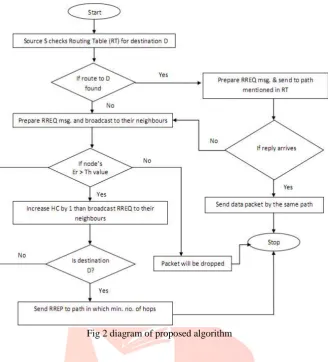
There two main components of the algorithm. 1. Route discovery
IJEDR1402120
International Journal of Engineering Development and Research (www.ijedr.org)2044
Fig 2 diagram of proposed algorithm1. Route discovery
Here the different paths between the given pair of source and destination are first identified and then RREQ packets are flooded throughout the network. When these packets are reaches the required destination, then they store the path present in the packet along with the source and the destination id also. Then a RREP packets are sent from the destination to the source back in order to acknowledge the transmission. These messages can also be piggybacked with not only the path but also some data needed to be sent from the destination to the source. Route discovery is the major and most time taking part of the DSR algorithm as it explores the paths between two nodes. But is doesn’t guarantee reliability as once the discovery is done then in order to keep up the connection maintenance of the network is very important.
2. Route Maintenance
Here the discovered paths are maintained in the sense they are checked on demand to look out for failures or defects or losses. Whenever a connection is loosed then the node just before the failure sends back the negative acknowledgement informing the sender that from that point there has been failure. Then again after getting this message the sender urges for route discovery to find out another path from the source to destination and hence the routing cache is updated properly with the new entry.
IJEDR1402120
International Journal of Engineering Development and Research (www.ijedr.org)2045
Energy loss is directly proportional to:(1) Number of hops (2) Delay
(3) Packet size
IV.SIMULATION RESULT
As there are several different simulation packages that can be used for MANET simulation, a survey of the commonly used simulators: OPNET, NS2, QualNet and Glomosim is performed in order to determine the most suitable simulator to use. NS2’s documentation is very good and it is easy to get support from the many researchers using it. In addition, many papers related to my field of research have used and recommended using NS2 to simulate MANET protocols.
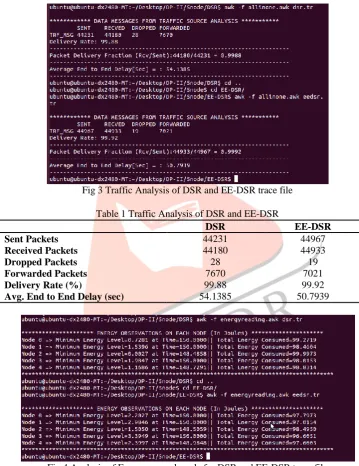
Fig 3 Traffic Analysis of DSR and EE-DSR trace file
Table 1 Traffic Analysis of DSR and EE-DSR
DSR EE-DSR
Sent Packets 44231 44967
Received Packets 44180 44933
Dropped Packets 28 19
Forwarded Packets 7670 7021
Delivery Rate (%) 99.88 99.92
Avg. End to End Delay (sec) 54.1385 50.7939
Fig 4 Analysis of Energy on each node for DSR and EE-DSR trace file
Table 2 Comparison Table of Energy Consumed for DSR & EE-DSR (in Joules)
DSR EE-DSR
IJEDR1402120
International Journal of Engineering Development and Research (www.ijedr.org)2046
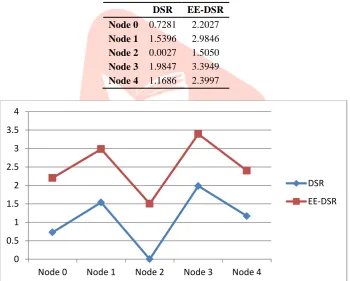
Fig 5 Graph of Energy Consumed for DSR & EE-DSR (in Joules)Table 3 Comparison Table of Energy Remain for DSR & EE-DSR (in Joules)
DSR EE-DSR
Node 0 0.7281 2.2027 Node 1 1.5396 2.9846 Node 2 0.0027 1.5050 Node 3 1.9847 3.3949 Node 4 1.1686 2.3997
Fig 6 Graph of Energy Remain for DSR & EE-DSR (in Joules)
It is clear that the proposed DSR algorithm is better as compared to the performance of DSR. This improvised algorithm based on energy-based routing is an advanced form of DSR is Energy Efficient Dynamic Source Routing(EE-DSR).
II.CONCLUSION
Thus from the graph its clear that the proposed DSR algorithm is better as compared to the performance of DSR. This improvised algorithm based on energy-based routing is an advanced form of DSR where the performance parameters are taken into account to choose the best path among the different paths. As the DSR algorithm says that the route discovery part is the most exhaustive part, therefore it takes the major attention while setting up of manet. This process also includes the route cache updating. Hence a better algorithm solves the purpose better. There is no doubt that the improvised algorithm so proposed is even lengthier but it helps a lot during route maintenance phase as the best path is always stored in the cache reducing its size and thus increasing its speed and reliability.
Another major advantage of this algorithm is that it prevents back flooding of the packets. If a node is already added to the packet path then no more flooding of packets occur to that particular node. This not only saves the network congestion but also
93 94 95 96 97 98 99 100 101
Node 0 Node 1 Node 2 Node 3 Node 4
DSR
EE-DSR
0 0.5 1 1.5 2 2.5 3 3.5 4
Node 0 Node 1 Node 2 Node 3 Node 4
DSR
IJEDR1402120
International Journal of Engineering Development and Research (www.ijedr.org)2047
increases the life span of the packets and the network. Hence this algorithm is no doubt a better approach for a mobile adhoc network route discovery rather than the DSR algorithm as it provides the best path between any two source and destination pair.REFERENCES
[1] Ajay Shah, Hitesh Gupta, Mukesh Baghel. “Energy-Efficient Routing Protocol For Mobile Ad Hoc Networks" International Journal of Engineering Researchand Applications(IJERA):2248-9622.Vol. 2 Issue-4(July-August 2012).
[2] Baisakh, Baisakh. "A Review of Energy Efficient Dynamic Source Routing Protocol for Mobile Ad Hoc Networks." International Journal of Computer Applications 68.20 (2013): 6-15.
[3] Akhter, Md Shahid, and Vijay Prakash Singh. "Power Aware Dynamic Source Routing Protocol To Increase Lifetime Of Mobile Ad Hoc Networks."International Journal of Innovative Research and Development 2.6 (2013).
[4] Johnson, David B., and David A. Maltz. "Dynamic source routing in ad hoc wireless networks." Mobile computing. Springer US, 1996. 153-181.
[5] Lakshmi, P. S., Pasha Sajid, and M. V. Ramana. "Security and Energy Efficiency in Ad hoc Networks." Res. J. Computer and IT Sci 1.1 (2013): 14-17.
[6] Kadiveti. Koteswar Rao, Rao, Ragendra. C, Ramesh.Ragela. "An Enhanced Energy Efficient Routing Protocol for MANETs" International Journal of Computational Engineering Research (IJCER) ISSN : 2250-3005.
[7] Krevat, Elie, and Arian Shahdadi. "Energy-Efficient Dynamic Source Routing in Ad-Hoc Wireless Networks."
[8] Senouci, S-M., and Guy Pujolle. "Energy efficient routing in wireless ad hoc networks." Communications, 2004 IEEE International Conference on. Vol. 7. IEEE, 2004.
[9] Sharma, Divya, and Ashwani Kush. "Performance comparison of energy efficient AODV protocols." International Journal of Computing and Business Research (IJCBR) 2.1 (2011).
![Fig 1 Routing Protocols[5] With the rapid demands of MANET in the recent years, certainly have challenged the researchers to take up some of the](https://thumb-us.123doks.com/thumbv2/123dok_us/8511074.1393148/1.595.183.416.557.752/routing-protocols-demands-manet-recent-certainly-challenged-researchers.webp)