Implementation of Mathematics Learning Model
Based on Theory: Action, Process, Object,
Scheme (APOS Model) On Improper Integral
Subject
Hanifah, Nur Aliyyah Irsal
Abstract—The APOS model is a Mathematics Learning Model Based on Theory: Action, Process, Objects, Schemes with syntax consisting of phases: Orientation, Practicum, Small Group Discussion, Class Discussion, Exercise and Evaluation. The APOS model has been implemented in the Integral Calculus course by Class A 3rd Semester Students in the Mathematics Education Study Program FKIP UNIB 2018/2019 in the amount of 38 student. The APOS model is equipped with Integral Worksheet based on the APOS model consisting of 14 worksheets. Concept about improper integral was in 14th worksheet. Based on the poll results, the 14th worksheet was the most difficult worksheet so they are not tested on the Examination. Examination was held on December 6, 2018. After the final assessment is carried out, information was obtained that those who get the A- or A score were 15 people (39.47%). The purpose of this research was to find out whether students who get A- or A scores in the Integral Calculus course were able to solve the improperl integral test questions. The test was held on February 2, 2019, and was attended by 12 students. Previously students were not notified of a test. The instruments of this research was test sheets, Likert scale questionnaires, and open questionnaires. After the data was processed, information was obtained as follows: there were 41.67% of students who still remember very well and got score ≥ 80, and there were 16.67% of students who could remember well and got score >70. Based on the result, it concluded that students who study the lesson before going to college from various sources, then active in small group discussions and presentation in front of the class would took longer to remember the lesson than students who were waiting for a friend's explanation in front of the class. These results prove the truth of Edgar Dale's Cone of Experience. The establishment of mutual assistance between students proved the truth about Vygotsky's social constructivism.
Index Terms—Improperl Integral, APOS Model, APOS Models’ Syntax, Integral Calculus Worksheet.
————————————————————
1
BACKGROUNDIntegral calculus was a compulsory subject in Mathematics Education Study Program Faculty of Teacher Training and Education of University of Bengkulu with 4 (3-1) credit semester. The goal to be achieved after a student learns Calculus well is to acquire basic knowledge and mathematical mindset, in the form of: (1) the critical, logical, and systematic thinking of scientific thinking; (2) the trained of reason and creativity after studying the various strategies and tactics in solving the calculus problem; (3) trained in designing simple mathematical models; (4) skilled in standard technical math supported by correct concepts, reasoning, formulas, and methods. [8] The test result shows that there are 3 students who well-master about the improper integrals. Although after 2 months of semester off, and they do the test without learning first, AB, ET and RD still remember the improper integrals matter. So the goal of learning calculus well has been achieved. Nevertheless, two other students still lack the mastery of theselessons.[1] (Martono, 1999).
In the 2017/2018 Academic Year calculus integral learning was carried out by applying the Mathematical Learning Model
Based on Theories of Action, Processes, Objects and Schemes (APOS Model). The APOS model was a refinement of the Calculus Learning Model Based on APOS Theory (MPK-APOS) [2] (Hanifah, 2016). MPK-APOS was equipped with Worksheet Based on APOS MODEL with Maple 11 Assisted which consists of 14 Worksheets that were valid, practical, and effective [3] (Hanifah 2015). The title of each worksheets were as follows: 1st worksheet was indefinite integral as anti-derivate ; 2nd worksheet was Extensive Introduction; 3rd worksheet was definite integral; 4th worksheet was Basic Calculus Theorem; 5th worksheet was Area-wide; 6th worksheet was Swivel Volume (1); 7th worksheet was Swivel Volume 2; 8th worksheet was Transcendent Function; 9th worksheet was Substitution Integration; 10th worksheet was Some Integral Trigonometry; 11th worksheet was Substitution Rationalizes; 12th worksheet was Partial Integral; 13th worksheet was Integral Rational Function;14th worksheet was Improper Integral. Each worksheet was distributed to each group after students were in class and calculus integral learning was ready to learn.
Especially for 14th worksheet about improper integral, because on the Integral Calculus syllabus in the S1 Mathematics Education Study Program Faculty of Teacher Training and Education University of Bengkulu did not contain improper integral lesson, so 14th worksheet has not been implemented in the classroom. In order for 14th worksheet to be utilized, the authors asked the 5 best students during the class to do homework in groups about 14th ————————————————
Hanifah, Mathematics Education Study Program, Faculty of Teacher Training and Education, University of Bengkulu, Indonesia. Email: [email protected]
2167 worksheet. Tasks were given in the last week of the class. The
4th worksheet that has been answered was collected before the examination. The other students made homework independently about rational function integration which was also gathered before the examination.
Two months later after the holiday was finished, the five students that discussing the 14th worksheet about Improper Integral Unqualified were recalled, and they were given a test question about Improper Integral. The questions were taken as many as 3 questions in the 14th worksheet exercise phase. After the 5 answer sheets of the students was examined, the following results were obtained: 40% answered correctly all three questions, 20% answered correctly for 2 questions, and answered incorrectly for the other questions because they were not careful in answering, and there were 40% did not remember the Improper Integral but remember the integration technique [4] (Hanifah, 2018). These results were very astonishing and it could be concluded that improper integral lesson which was difficult, could be understood by several students well, even without the assistance of lecturers. Some even remember it well how to solve an improper integral problem after almost two months time has passed. Though the implementation of the test was held without informing the student first. At the time of the test, students did not carry books or notes about improper integral. Students were also not allowed to open cellphones. Based on this result, finally in 2018/2019 the improper integral becomes part of the integral calculus‘s class.
In 2018, improvements were made to all the Integral Calculus Worksheets. Worksheet simprovement was carried out mainly in terms of the content. Previously, worksheets consisted of Practicum Worksheet, Manual Worksheets, Class Discussion Sheet, and Exercise Sheet. Renewal was done by removing Practicum Worksheet and Manual Worksheets and replacing them with the syntax of the APOS Model which consists of: Orientation Phase, Practical Phase, Small Group Discussion Phase, Class Discussion Phase, and Exercise / Evaluation Phase. All Worksheets combined with Introduction to Maple are used as Integral Calculus Textbooks Based on APOS Model assisted with Maple [5] (Hanifah, 2018).
In the 2018/2019 Academic Year, the Integral Calculus Teaching book based on the APOS Model was implemented by 38 students of 3rd semester in the class A of Mathematics Study Program Faculty of Teacher Training and Education University of Bengkulu. At the beginning of the class the Integral Calculus textbook was distributed to each heterogeneous group consisting of 3-4 students. Textbooks could be taken home. Besides bringing the Teachings of Integral Calculus books to each class, students were also asked to bring a compulsory source book, the Calculus Book by Purcell and friends. The hope was that students were better prepared to complete the Worksheet so that students could understand the lesson well.
The lesson of improper integrals includes difficult lesson and students must thoroughly master the lesson of Differential and integral calculus. Here's some explanations about Improper Integral [1][6][17][8].
For a function f the Riemann integral to the interval [a, b], the definite integral definitions ismeans only when a and b are finite. This concept will be expanded to the case of the origin
region of function f in the form:Finite interval (a, b], [a, b), and [a, c) ∪ (c, b], or a combination of cases;Infinite interval [a, ∞), (-∞, b], and (-∞, ∞) which can also load the hose case up.
Improper Integral in TheFinite Interval
For the improper integral in the finite interval, we have 3 definitions.
For every𝜀 > 0 𝑤𝑖𝑡 0 < 𝜀 < 𝑏 − 𝑎,the function f integrated in [𝑎 + 𝜀,b],
lim 𝑓(𝑥)= ± ∞, and provided lim ∫ 𝑓(𝑥) 𝑑𝑥=
lim ∫ 𝑓(𝑥) 𝑑𝑥= L
In this situation, the improper integrals in interval [ a, b] defined as ∫ 𝑓(𝑥) 𝑑𝑥= lim ∫ 𝑓(𝑥) 𝑑𝑥 =
lim ∫ 𝑓(𝑥) 𝑑𝑥= L
It says the improper integral ∫ 𝑓(𝑥) 𝑑𝑥 convergen to L. Then if ∫ 𝑓(𝑥) 𝑑𝑥= lim ∫ 𝑓(𝑥) 𝑑𝑥 = lim ∫ 𝑓(𝑥) 𝑑𝑥= ±∞
doesnt exis, the improper integral ∫ 𝑓(𝑥) 𝑑𝑥 𝑠𝑎𝑖𝑑 𝑑𝑖𝑣𝑒𝑟𝑔𝑒𝑛. For every𝜀 > 0 with 0 < 𝜀 < 𝑏 − 𝑎 the function f integrated in [𝑎, 𝑏 − 𝜀 ], lim 𝑓(𝑥) = ± ∞, and if
lim ∫ 𝑓(𝑥) 𝑑𝑥= lim ∫ 𝑓(𝑥) 𝑑𝑥= L exist
So the improper the improper integrals in interval [a,b] defined as ∫ 𝑓(𝑥) 𝑑𝑥=lim ∫ 𝑓(𝑥) 𝑑𝑥=
lim ∫ 𝑓(𝑥) 𝑑𝑥= L
It says the improper integral∫ 𝑓(𝑥) 𝑑𝑥 convergen to L. Then iflim ∫ 𝑓(𝑥) 𝑑𝑥
= lim ∫ 𝑓(𝑥) 𝑑𝑥= ±∞ doesnt exist,
the improper integral ∫ 𝑓(𝑥) 𝑑𝑥 𝑠𝑎𝑖𝑑 𝑑𝑖𝑣𝑒𝑟𝑔𝑒𝑛.
Improper Integral in TheInfinite Interval
For the improper integral in the infinite interval, we have 3 definitions
1) Let the function f integrated for every [a, b] and let lim ∫ f(x) dx= L. the improper the improper integrals
in interval [a, ∞) defined as ∫ f(x) dx = lim ∫ f(x) dx=
L
It says the improper integral ∫ f(x) dxconvergent to LThen iflim ∫ f(x) dx=±∞ or does not
exist, the improper integral ∫ f(x) dx said to be divergent. 2) Let the function f integrated for every [a, b] and let lim ∫ f(x) dx= L. the improper the improper integrals
in interval [ −∞, b) defined as ∫ f(x) dx = lim ∫ f(x) dx= L
It says the improper integral∫ f(x) dx convergence to L. Then if = lim ∫ f(x)dx = ±∞or doesnt exist,
improper integral∫ f(x) dx said to be divergen.
3) Let the function f integrated for every finite intervals, with the improper integral ∫ f(x) dx to be convergence to L and ∫ f(x) dx convergence to M. In this matter, the improper integral of function f in ( - ∞, ∞) defined as ∫ f(x) dx = ∫ f(x) dx + ∫ f(x) dx = L + M
It says the improper integral
divergence, so ∫ f(x) dx said to be divergence.
From the explanation above, it could be seen that the concept of improper integral was concept with a very high level of difficulty. Students must know where the function was defined, where the discontinuous function, how to calculate the limit, must be proficient using Integration Technique. For that we needed a learning model that could help students understand the concept properly.
In Indonesian Education system, teacher students surely need to practice learning that support the curriculum 2013 (K13) context in their lecture. In curriculum 2013, learning process must be focus on how students can develop their knowledge, skills, and good attitudes. In line with this orientation, learning in 2013 curriculum should be done through active and creative learning so that students can develop critical thinking skills and communication skills and develop creativity as well. There are at least five points that teachers must develop in teaching in order to get the realization of this learning. Those five points are: to observe with the approach of science, developing the ability to ask or intellectual curriousity, the ability to think, experiment, and communication [9].
Based on the explaining, Calculus Integral‘s class did in applying APOS Model. The syntax of APOS model consists of phases: Orientation, Practicum, Small Group Discussion, Classroom Discussion, Exercise and Evaluation. The time division for each phase depends on the weight of the course credits, for Integral Calculus with 4 (3-1) credits, the 15 'Orientation phase, Practicum 50', Small Group Discussion 50 ', Break 15', 50th Class Discussion ' Exercise / Evaluation 20 ‗.
APOS was a learning theory devoted to learning mathematics at the college level, which integrated the using of computers, learning in small groups, and paying attention to mental constructions carried out by students in understanding a mathematical concept. These mental constructions were: actions, processes (processes), objects (objects), and schemes (schema) which were abbreviated as APOS [10] [11] [12] (Dubinsky, 2001; Arnawa, 2006; Suryadi , 2010).
Broadly speaking the characteristics of the Mathematical Learning Model Based on APOS Theory (APOS Model) were: (1) knowledge constructed by students through the APOS mental construction; (2) using syntax with phases: Orinetation, Practicum, Small Group Discussion, Class Discussion, Exercise, and Evaluation; (3) use a computer; (4) students study in small groups. The following was an explanation of the APOS Model Syntax [2] [3] (Hanifah, 2015; Hanifah 2016). 1) Orientation Phase. Lecturer activities were to prepare
students to take part in learning by using the APOS Model Worksheet, as well as to explain the objectives of the study that week.
2) Practicum Phase. In this phase students carried out activities to work on the Maple command on the Worksheet in the Practicum phase. Maple's answer was copied back to the place provided by the worksheet. The purpose of the practicum phase was to introduce new concepts, information, or situations. Practical activities were carried out in groups, with the division of tasks typing orders or copying Maple / Geogebra answers to tables that have been provided. In addition to computer labs, practicum could took place in the classroom, with
students carrying laptops. During the practicum phase, the lecturer acts as a guide that ran from one group to another. 3) Small Group Discussion Phase. After the tables on the
worksheet for the practicum phase were filled, in the small group discussion phase, the worksheet contains questions related to the contents of Maple's execution table. Students were asked to discuss the answers to these questions in small groups. Discussions in small groups will help students found and constructed and understand the intent of the contents of the table. Through small group discussions, students were expected to be able to understand the concept of learning that was being discussed. To strengthen students' understanding of a subject, questions were provided that would be solved manually without the help of Maple. Students were asked to discuss answers to the questions provided. For a subject that was not able to be explained by using Maple, it was the duty of the lecturer to provide assistance (scaffolding) about the subject matter.
4) Class Discussion Phase. In this phase the lecturer choose a group of students to explain in front of the class the answers of questions that were in the class discussion phase, or explain the results of work in their small group about solving questions manually. . Another group of students listened and was given the opportunity to ask questions, or express opinions. Lecturers act as mentors who were ready to provide scaffolding if needed during class discussions.
5) Training Phase. The purpose of the Training phase was to strengthen students' understanding of a subject, which was discussed in the previous phase. In the Exercise phase, the lecturer gives questions taken from the practice questions. The limited time in class, the questions in the exercise could be used as homework. In completing homework, students were asked to study Calculus books, so that time and info limitations when in class could be completed by students from studying Calculus books at home.
2169 worksheet which began with practicum using a laptop, then
continued with a small group discussion phase, class discussion phase, and training / evaluation phase.
When it came to the class discussion phase, the selected group copied the results of their work on the board and explained them. Before they explained, the researcher first checked the results of their work, and straightens out if something got wrong. This was done in order to save time, and students explained the correct results. From the observation during the lecture, this class discussion phase was the phase awaited by students.
The density of integral calculus lesson, and the difficulty of integral lesson was not reasonable, making the writer took the decision that the improper integral lesson was not tested in the examination. Curiosity whether there were students who were able to solve improper integral problem, at the beginning of the class after the semester break, a test was held for students who get A or A- scores for integral calculus courses at 2018/2019. The number of participants should be 15 people, 3 people were absent, so 12 people participated in the test. Just like last year, the test was given after students returned to campus after the semester break. The test was also not informed beforehand so that no one brought the Calculus book. The aim of the research was to determine the implementation of the APOS Model assisted by the Integral Calculus Textbook on the subject of improper integral by 3rd semester students of class A Mathematics Study Program Faculty of Teacher Training and Education University of Bengkulu Academic Year 2018/2019.
2
M
HETODSThis research was an experimental research. Data collected in the form of quantitative and qualitative data. The instruments used to collect data were test sheets, Likert scale questionnaires, and open questionnaires.
2.1 Subject
The subject of this research was third semester students in class A Mathematics Education Study Program FKIP UNIB 2018/2019 who participated in the Integral Calculus class, and obtained an A or A-. The number should be 15 students, but 3 students were absent, so 12 students were carrying out an improper integral test.
2.2 Data Analysis Technique
The research data were analyzed in descriptively quantitatively. For data in the form of questionnaires using a Likert scale, data analysis techniques obtained were as follows [13] (Riduan, 2009).
a. Give a score for each item with an answer: strongly agree (5), agree (4), doubt (3), disagree (2), and strongly disagree (1).
b. Add the total score of each respondent to all indicators. c. Granting scoresby:
𝑆𝑐𝑜𝑟𝑒 = 𝐺𝑒𝑡𝑡𝑖𝑛𝑔 𝑆𝑐𝑜𝑟𝑒
𝑀𝑎𝑥𝑖𝑚𝑢𝑚 𝑆𝑐𝑜𝑟𝑒 × 100%
3 R
ESULT AND DISCUSSION3.1 Result
a) Activity in Small Groups
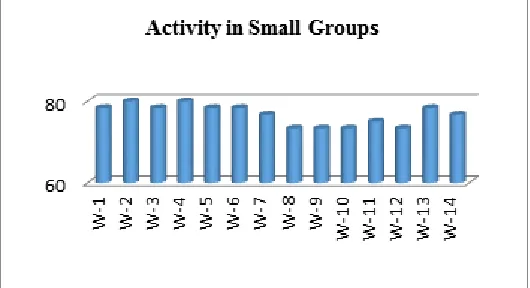
The active discussion in small groups influenced the mastery of the lesson. This figure 1 follows about the activeness of high group students during Integral calculus learning.
Figure 1 Activity of Students in Small Groups
w : worksheet
From Figure 1 it could be seen that from 1st worksheet to 7th worksheet students were actively involved in small group discussions. After mid examination, starting from 8th worksheet to 12th worksheet, students activity decreased. 8th worksheet about Transcendent function was a new lesson that has never been taught in high school. 9th worksheet – 13th worksheet contained lesson about Integration Technique. Lesson about Integration Technique was something that has never been taught in high school, and has a high level of difficulty. 14th worksheet concerning improper integral was also new and most complicated lesson. Scaffolding given in the Orientation phase could enable students to actively discuss in small groups. Some students had already learned it from various sources before the lecture takes place. Those who have learned this encourage a teammate to be active in small group discussions. They also explained in front of the class during the Class Discussion phase.
b) Phase of Students Began to Understand Improper Integral Lesson
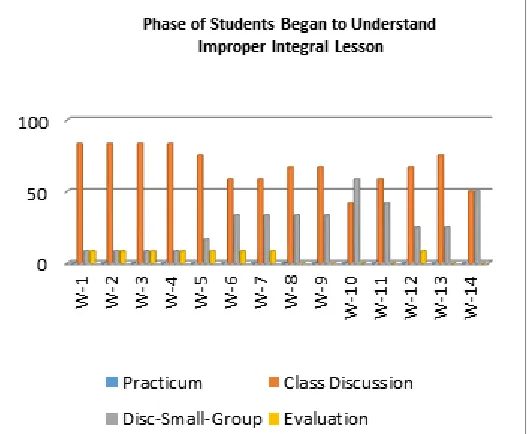
Figure 2Phase of Students Began to Understand Improper Integral Lesson
w : worksheet
Based on Figure 2, it could be seen that from 1st worksheet to 14th worksheet, majority of students began to understand the lesson in the Small Group Discussion phase. For 14th worksheet about Improper Integral the number of student who have understood in the small group discussion phase was as much as the number that understood in the class discussion phase. Figure 2 showed that some students have studied improper integral lesson at home. When the lecturer provided assistance in the Orientation phase, several students who have studied it, try to answer the lecturer's questions, and explained it in front of the class. Improper integral lesson with a high degree of difficulty is not easily understood by some students in small groups. They only understood when a selected group explained it in front of the class.
c) Test Results
To find out whether the students who work on the Improper Integral with APOS Worksheet based on the Model still remember the improper integral, then on February 6 a test of improper integral was carried out. This question was different from the questions on the 14th worksheet. Students were given 90 minutes. The test was carried out without prior notice.
The problem was as follows. Count: 𝟏. ∫ 𝒙 (𝒙 + 𝟏) 𝒅𝒙
. ∫ 𝟏
𝒙 − 𝒙 −
𝟏
𝒅𝒙
𝟑. ∫
𝒙 − 𝟑 𝒅𝒙
After students' answers were examined, the results obtained were shown in figure 3 below:
Figure 3 Improper Integral Test Result
Based on Figure 3 it could be seen that, there were three students who were able to answer correctly improper integral question even though the distance between completing the 14th worksheet in the class with the implementation of the test distance was almost 2 months. The following was a form of student answers.
Table 1. Improper Integral Test Result
Code Score
Answers
(question) Mistaken of Student’s
Answers
1 2 3
X5 80 T F T
True for integration technique but forgot improper integral and the final solution.
X8 30 F F F
forgot for integration
technique for 2nd
question, forgot
improper integral for three questions.
X9 73 F T T
false changing upper limit and lower limit integration in the first step
X15 30 F F F
Forgot for improper
integral for question 1,2,3 Unfinish for integration technique
X17 37 F F F
false for integral
operation and forgot for improper integral for three questions
X19 73 F F T
True for integration
technique but just
remember improper
integral for 3rd question
X20 100 T T T 0
X23 100 T T T 0
X26 30 F F F
Remember improper
integral for 1st and 3rd
question, but false in integral operation in 2nd
question
X27 50 F F T
Remember integration
technique for 2nd
question, unfinish, and
2171
Code Score
Answers
(question) Mistaken of Student’s
Answers
1 2 3
intergral.
X28 90 F T T
For the 2nd question, the
integration technique true, remember improper integral, but unfinish
X29 100 T T T 0
F : false T : true
X : student‘s code
From the table above, it could be seen that there were 5 students (41.67%) who still remember very well the improper integral lesson, and there were 2 students (16.67%) who could remember well. Even though the test was not informed beforehand and students also did not bring calculus books during the test. It was also seen that there were more students who remembered well than those who did not remember them anymore, which were 41.67%.
To find out more about what made them remember or forget, an open questionnaire was given. Questionnaire was analysist using persentage of the answer from the student who got score more than 70 and student who got score less than 70. The following explaining was the results of an open questionnaire.
Question number 1 was “Are you having trouble answering the question above? What is the reason?”. Students who got score ≥ 70 answered that 100% they felt the questions were difficult, but then they tried hard to remember it again. Students who got score < 70 answered that 100% they were in trouble, it happened because during the holidays they did not open the calculus book so they forgot the lesson.
Question number 2 was “When did you understand how to solve a similar problem above? (Choose one of the phases: Orientation, Practicum, Small Group Discussion, Class Discussion, Exercise / Evaluation).” Students who got score ≥ 70 85.71% said they began to understand in small group discussions, 14.29% had begun to understand in small group discussions, but really understood in class discussions. There was mutual assistance and sharing knowledge between teammates. In class discussion there was additional knowledge gained from the presentation group so that they knew more about the right way and results in solving the problem. Students who got score < 70100% just understood in the Class Discussion phase. Explanation of friends in front of the class made the obscure lesson clear.
Question number 3 was “Have you ever explained to a small group friend how to solve a similar problem above? What is the reason?”. Student who got score ≥ 70 answered 100% ever. When they understood and other friends did not understand, they helped friends by explaining it to other friends. Student who got score < 70 answered 100% ever for easy questions. Because sharing assignments to explain in small groups.
Question number 4 was “Is there any influence on your reasons for question 6 on ability to remember how to solve the above
questions?” 100% Student who got score ≥ 70 said that has an effect. 100% Student who got score < 70 anwered has no effect, because improperl integral was not easy.
―If you have explained to a friend, is there any influence on your activities in learning the integral calculus? Give reasons for your answer‖ was the question 5. 100% student who got score more that 70 said it has an effect. The more understanding the lesson would be able to solve other questions and be more confident. For student who got <70, 100% student said it has an effect. They just explained if they understand the lesson. When explaining they became more understanding and better understand what is learned, and want friends to answer other questions. It made their confidence increased.
The 6th question was “What preparation do you make so you
can explain in small groups or in front of the class?” For student who got score more than 70, they were learning through videos and discussions with friends and lecturers. They understood the lesson first and answer questions repeatedly. Student who got score less than 70 said that they studied at home and practice.
The last question was “Is there any influence explaining in small groups or in front of the class of your ability to solve problems?”. Student who got more than 70 said 100% has an effect. The other said 100% has no effect.
3.2 Discussion
Judging from the level of difficulty of the Worksheet, students used the 14th worksheet which was improper integral calculus as the most difficult worksheet. Although in reality the improper calculus was the most difficult lesson, it turns out that there were some students who were able to understand it and were able to explain it well in front of the class. Some of these students had prepared themselves to progress later in the presentation phase by learning the improper integrals from the source book, asking the senior students who have learned improper integrals, learning from videos on youtube. The independent attitude arised as a result of previous learning where students must be prepared to explain how to solve an improper integral in front of the class if the lecturer is appointed at the presentation phase. This reinforces the results of the study [14] Hanifah (2019) which concluded that the APOS Model has a syntax with phases: Orientation, Practicum, Small Group Discussion, Class Discussion, Exercise and Evaluation. The APOS model was supported by the APOS Model Based Worksheet. The impact of applying the APOS Model on Integral Calculus learning was the formation of critical, resilient, confident and independent characters. Independent was meant to be able to find information from source books or from lab results or from other sources to solve the problem of Integral Calculus being studied.
Figure 6. Edgar Dale’s Cone of Experience [18] [19] [20]
Students who tried to understand the lesson by learning it from various sources and explaining it in front of the class, it turns out that they remember the lesson longer. They could solve improperl integral questions correctly, even though it has been two months since they studied the lesson. The value they obtained from the results of tests on improper integrals was ≥70. There were even 40% who scored 100. The group with a score of ≥70 said that 85.71% had begun to understand since the small group discussion phase. They said that when they explained to other friends, they became more understanding and more confident. For groups that have a value of <70, they said they didn't remember the lesson because during the holidays they no longer open the Calculus book. When they were in the class, they could handle the lesson after listening to the explanations from their friends both in small groups and in class discussions. Only really understood in the class discussion phase. This meant that they did not try to find it by reading a book or watching a video, but waiting for an explanation from the presentation group. Based on the research did by [4] Hanifah (2018), we conclude that mastery of the lesson was in category ―very effective‖. The responses from the questionnaire, showed that the worksheet based on the APOS Model was effective to help the development of independent, diligent, thorough, resilient, responsible, jointly active, helpful, critical and creative characters of students. So, the APOS Based Worksheets was effective to use in calculus class on the Improper Integral lesson. The worksheet effectiveness also seen from the formation of independent , diligent, thorough, resilient, responsible, active cooperate, help each other, critical and creative characters of calculus students. Vygotsky in [15] Dagar and Yadav (2016) opinion that, Vygotsky views the origin of knowledge construction as being the social intersection of people, interactions that involve sharing, comparing and debating among learners and mentors. Нrougha highly interactive process, thesocial milieu of learning is accorded center stage and learners both refinetheir own meanings and help others findmeaning. In this way knowledge is mutually built. Нis view is a direct reflection of Vygotsky‘s sociocultural theory of learning, which accentuates the supportive guidance of mentors as they enable the apprentice learner to achieve successively more
complex skill, understanding, and ultimately independent competence (Dagar and Yadav, 2016),. Vygotsky asserted that knowledge can‘t be isolated from social and cultural context. He argues that all higher mental functions are social in origin and are embedded in the context of sociocultural setting. In social constructivist model, the knowledge is constructed through interaction between teacher and student. Нe role of teacher in social constructivist approach shiіs from the sole dispenser of knowledge to motivator, guide and resource person. Constructivism emphasizes on learner centered, learner directed and collaborative style of teaching learning process in which learning is supported by teacher scaٶoldingand authentic tasks [15] (Dagar and Yadav, 2016). Hanifah [16] concluded that the effect of learning This APOS model is also in line with Vigotsky‘s social constructivism. As Vygotsky famously stated, ―Every function in the child‘s cultural development appears twice: first, on the social level, and later, on the individual level; first between people …, then inside the child[17] [22] According to Vygotsky, students develop higher mental functions through mediated, social and collaborative activity. Thinking and reasoning emerge through practical activity in the social environment and in relation to the cultural, historical, and lesson reality of the activity.[18] [23]. Vygotsky defines ZPD (Zone of Proximal Development) as ―the distance between the actual developmental level as determined by independent problem solving and the level of potential development as determined through problem solving under adult guidance, or in collaboration with more capable peers‖. So we need learning lessons that allow learners and teachers to shift within the zone of proximal development gaining relational understanding of the content studied in that particular topic[19] [24] in this research, we had used a worksheet and computer application and its works in our students learning.
4 C
ONCLUSIONAPOS model with syntax which consists of: Orientation phase, Practicum phase, Small Group Discussion phase, Class Discussion phase, and Latiham / Evaluation phase, has been applied to third semester grade A students of Bachelor‘s Degree Mathematics Education Study Program Faculty of Teacher Training and Education University of Bengkulu 2018/2019.After the data was processed, the information as follows:there were 41.67% of students who still remember very well and got score ≥80, and there were 16.67% of students who could remember well and got score >70. Based on the result, it concluded that students who study the lesson before going to college from various sources, then active in small group discussions and presentation in front of the class would took longer to remember the lesson than students who were waiting for a friend's explanation in front of the class. These results prove the truth of Edgar Dale's Cone of Experience. The establishment of mutual assistance between students proved the truth about Vygotsky's social constructivism.
A
CKNOWLEDGMENT2173 Bengkulu University for their active participation in this
study.
R
EFERENCES[1] Martono 1999 Kalkulus. Bandung: Erlangga.
[2] Hanifah 2016 Model APOS Inovasi Pada Pembelajaran Matematika.FKIP UNIB.
[3] Hanifah2015Pengembangan Model Pembelajaran Kalkulus Berdasarkan Teori APOS Disertasi Pascasarjana Universitas Negeri Padang.
[4] Hanifah, Irsal. 2018. The Effectivity of APOS Model Based Worksheets on The Improper Integral. presented in The 3rd International Conference on Mathematics, Sciences, Education and Technology and Asosiasi MIPA LPTK Indonesia (ICOMSET & AMLI) at Universitas Negeri Padang, Padang City, Indonesia on October 4-5 th,2018. [5] Hanifah, 2018. Buku Ajar Kalkulus Integral Berbasis
Model APOS Berbantuan Maple. Bengkulu. FKIP Press. UNIB. ISBN 978-502-804382-9.
[6] Bohner M & Guseinov G S 2003 Improper Integrals on Time Scale. Dinamyc Systems and Aplications 12 2003: p45-46.
[7] Laval P B 2005 Improper Integral Lecturer Notes: Kennesaw State University Accessed on:
http://www.math.wisc.edu/~park/Fall2011/integration/Im proper%20Integral.pdf.
[8] Varberg, Purcell & Rigdon (2007) Calculus, 9th Edition Pearson.
[9] Abidin 2016 Desain Sistem Pembelajaran Dalam Konteks Kurikulum 2013 Refika Aditama Bandung.
[10] Dubinsky 2001 Using a Theory of Learning in College Mathematics Courses Coventry: University of Warwick http://mathstore.ac.uk/newsletter/may2001/pdf/learning.p df.
[11] Arnawa 2006 Meningkatkan Kemampuan Pembuktian Mahasiswa dalam Aljabar Abstrak Melalui Pembelajaran Berdasarkan Teori APOS. Disertasi pada Universitas Pendidikan Indonesia Tidak diterbitkan.
[12] Suryadi, Didi 2010 Menciptakan Proses Belajar Aktif: Kajian Dari Sudut Pandang Teori Belajar Dan Teori Didaktik1 Makalah disajikan pada Seminar Nasional Pendidikan Matematika di UNP, 9 Oktober 2010 access on
http://didi- suryadi.staf.upi.edu/files/2011/06/MENCIPTAKAN-PROSES-BELAJAR-AKTIF.pdf.
[13] Riduan. 2009. Belajar Mudah Penelitian. Bandung, Alpabeta
[14] Hanifah. 2018. Implementasi Model APOS Pada BAB Teknik Integrasi di Prodi Pendidikan Matematika FKIP UNIB TA 2017/2018. Makalah dipresentasikan di Seminar Nasional PGSD FKIP UNIB Bengkulu tanggal November 2018.
[15] Dagar and Yadav. 2016. Constructivism: A Paradigm for Teaching and Learning. Arts and Social Sciences Journal
ISSN: 2151-6200. an open access journal Volume 7 • Issue 4 • 1000200.
[16] Building Critical, Tenacious, And Confident Characters Through Application Of Apos Model (Case Study In Integral Calculus Learning). Proceedings of the International Conference on Educational Sciences and Teacher Profession (ICETEeP 2018). FKIP UNIB Bengkulu. www.atlantis-press.com.
[17] Tang G & Titus A 2002 Promoting Active Learning in Calculus and General Physics through Interactive and Media-Enhanced Lectures SYSTEMICS, CYBERNETICS AND INFORMATICS VOLUME 2 - NUMBER 1 Conf. Montreal Canada June 15-19, 2002.
[18] Thompson P W (2013) Constructivism in Mathematics Education. In Lerman, S. (Ed.) Encyclopedia of Mathematics Education SpringerReference (www.springerreference.com ) Springer-Verlag Berlin Heidelberg DOI: 10.1007/SpringerReference_313210 2013-05-10 00:00:07 UTC.
[19] Walshaw M (2017) Understanding mathematical development through Vygotsky, Research in Mathematics Education, DOI: 10.1080/14794802.2017.1379728.
[20] Dale, Edgar 1946 Audio-Visual Methods in Teaching. New York: Dryden Press.
[21] Anderson H M 2015 Dale’s Cone of Experience Summary. Teaching and Learning in Higher Education Online Module: collaboratively developed by Queen’s University Western University and University of Waterloo
http://www.queensu.ca/teachingandlearning/modules/acti ve/documents/Dales_Cone_of_Experience_ summary.pdf. [22]
https://cdn.elearningindustry.com/wp-content/uploads/2017/08/723a49c849d9f25a2a939fd0edd5b 4d1.png.
[23] Yu , Chii-Huei 2013 Solving Improper Integrals with Maple. International Journal of Computer Science and Mobile Computing Vol.2 Issue. 6, June- 2013, pg. 389-393. [24] Hanifah 2017 Computer Based Apos Model In
Mathematics Learning Proceeding of International Conference on Applied Sciences in Engineering, Business, Linguistik and Information TechnologyPoliteknik Negeri Padang and Politeknik Ibrahim Sultan, 13-15 October 2017 ISSN : 2598-2532.
[25] Harsono, dkk 2005Pembelajaran Berpusat MahasiswaYogyakarta Pusat Pengembangan Pendidikan Universitas Gajah Mada.
[26] Joseph M. & Thierry Dana-Picard (2004) Classroom note: Teaching Mathematical Integration: Human Computational Skills Versus Computer Algebra International Journal of Mathematical Education in Science and Technology, 35:2, 249-258, 2017.
[27] Suryadi Didi 2011 Membangun Budaya Baru dalam Berpikir Matematika Sekolah Pascasarjan Universitas Pendidikan Indonesia http://www.scribd.com/doc/93456342/Membangun-Budaya-Baru-Dalam-Berpikir.
[28] Borchelt N (2007) Cognitive Computer Tools in the Teaching and Learning of Undergraduate Calculus International Journal for the Scholarship of Teaching and Learning Vol. 1, No. 2 (July 2007)ISSN 1931-4744 : Georgia Southern University.
[29] King dkk 2010 Higher Order Thinking Skills www.cala.fsu.edu.
[30] Mustaji 2012 Pengembangan Kemampuan Kritis dan Kreatif Dalam Pembelajaran. http://pasca.tp.ac.id/site/pengembangan-kemampuan-berpikir-kritis-dan-kreatif-dalam-pembelajaran.
[31] Usman 2013 Model Pbi Untuk Mengembangkan Pemahaman Mahasiswa Dalam Memecahkan Masalah Tentang Integral Tentu. Jurnal Peluang, Volume 1, Nomor 2, April 2013, ISSN: 2302-5158.