Platinum and the Refractory
Oxides
II-INFLUENCE
OF
GEOMETRY
ON
THE
REACTING SYSTEMS
By
A.
S. Darling, G.
L.
Selman and
R.
Rushforth
Research Laboratories, Johnson Matthey & Co LimitedI
Severe reactions can occur between heated p l a t i n u m and the more refractory oxides when the oxidising potential of
the surrounding atmosphere i s reduced below a critical level. I n the second p a r t
of this paper i t i s shown that the severity
of these reactions i s largely controlled by the surface area of the refractory and by the ahility of oxygen to escape f r o m the reaction zone. Alloying occurs predomi- nantly by vapourphaseprocesses. Under vacuum conditions complicating effects are introduced by p l a t i n u m vapour particularly in the presence of steep temperature gradients.
I
Some of the more interesting effects ob- served when platinum, heated under ex- tremely inert atmospheric conditions, reacts with powdered refractory oxides have been described in the first part of this paper (I). When it is remembered that platinum can be safely melted in vacuum in contact with refractories such as alumina and zirconia, the severity of these reactions with solid platinum appears particularly noteworthy. Variations in the rate and extent of the alloying which occurred were obviously associated with the geometry of the reacting components, and it eventually became possible to distinguish a number of basic configurations which symbolised all the practical relationships which were likely to occur.
The simplest possible configuration occurs when a sphere of platinum contacts a sphere of refractory, as shown in Fig. I. In a practical
way this corresponds with a bed of loose
Fig. 2 Fused zone of pEatinum thermo- couple limb after failure i n contact withJine “Purox” alumina powder after 8+ hours at 1475°C under a gettered argon atmosphere.
x 150
surface areas of the two reactants and also the volume of the voids between them.
By increasing the diameter of the refractory particle we arrive eventually at the stage when a small particle of platinum contacts a re- fractory surface of such a large radius that it
can be considered a plate. A furthcr change in curvature of this refractory surface results in partial encapsulation of the platinum. One practical exemplification of this configuration is the containment of platinum in a crucible. A limiting stage in the changing curvature of the refractory is arrived at when the platinum is completely surrounded on all sides with oxide.
After the curvature of the platinum particle is changed through the same sequences we arrive eventually with a particle of refractory oxide completely surrounded with platinum. Platinum cermets form a good illustration of this important configuration,
Effect of Oxide Particle Size
The effect of varying the particle size of the refractory relative to that of platinum was studied in the test cell using “Purox” alumina. Tubular alumina insulators were crushed and sieved to provide “fine” (less than 200 mesh) and “coarse” (16 to 60 mesh) powders of identical composition, and the uncrushed “Purox” tubes provided a reason-
Fig. 3 Fused zone of pZatinum thermo- couple limb after failure in contact with coarse “Purox” alumina powder afer 65 hours at 1475°C under a gettered argon atmosphere. x 125
able approximation to the geometry where point contact exists between platinum and a relatively flat refractory surface.
The tests in the fine and coarse grades of crushed alumina powder under gettered argon were cut short by fusion of the platinum limbs after, respectively, S+ and 65 hours at
1475°C. The microstructures of the fused zones are illustrated in Figs z and 3. Reac- tions in the coarse oxide bed were confined to areas of direct physical contact betwcen the platinum and the oxide particles. This effect was particularly noticeable in the alloy limb where the rhodium addition appeared to restrict the solid state diffusion of aluminium into platinum. Generally speaking, inter- reactions between the thermocouple limbs and the coarse refractory oxide appeared to be most severe in regions close to the surface of the bed, although failure occurred close to the hot junction.
In the fine oxide powder bed, failure oc- curred immediately below the surface in the gettered argon atmosphere. Metallographic examination revealed extensive contamina- tion throughout the thermocouple limbs with the surprising exception of the rhodium platinum limb in those areas close to the oxide surface. Corresponding areas on the platinum limb had suffered severely.
Fig. 4 Local areas of reaction between pure platinum and the coarse alumina particles i n contact with it after 72 hours at
1475°C in vacuum. x 150
couple heated in the coarse grade of alumina powder survived for 72 hours at 1475‘C without failure. In this instance, reaction was not confined to those portions of the wire close to the surface of the refractory bed, substantial quantities of aluminium being detected throughout the immersed length
of the thermocouple. The reaction was limited, however, to those points along the wire surface which were in direct contact with alumina particles as illustrated in Fig. 4.
The thermocouple heated within a single alumina insulator under the gettered argon atmosphere maintained its thermoelectric output, within the limits of experimental error for the 180-hour test period. In contrast, the corresponding thermocouple heated in vacuum exhibited a large drop in output at the gold point after 140 hours at temperature. Microexamination and analysis of the wires indicated that in both instances the alumina had reacted with the thermocouple limbs at the ends of the tubing where extremely local contact had been made.
Under the argon atmosphere, visible evid- ence of reaction was detected in the form of a
second phase at the surface of the rhodium bearing leg as shown in Fig. 5. Aluminium had diffused away to broaden the affected area during the run, and was detected at distances up to 800 microns away from the main seat of the reaction, which coincided with the point of contact between the inner edge of the tube and the wire emerging from
it. The platinum leg had been similarly,
Fig. 5 Local reaction area i n 13% rhodium- platinum wire due to point contact with “Purox” alumina xhermocouple tube i n a gettered argon atmosphere for 180 huurs at 1475’C. x150
although a little more extensively, affected at
the point where it emerged from the opposite end of the insulator.
Traces of aluminium were also detected in the limbs close to the hot junction enclosed within the tube after heating in gettered argon, although this did not occur after vacuum testing, when the reaction zones were more limited in extent and confincd entirely to the points of contact at the extremeties of the insulator. Rhodium evaporated rapidly from the alloy limb in vacuum, and this probably accounted for the deterioration in thermal EMF.
Thermocouples in vacuum furnaces operate under conditions very similar to those arranged in this experiment. Their deteriora- tion in electrical performance can be directly attributed to rhodium evaporation, and the reactions with the alumina insulators are fairly local and not serious enough to cause premature mechanical failure unless the thermocouple is severely disturbed.
This series of tests showed that the rate and extent of contamination increases with the surface area of the refractory oxide. Extremely rapid failure occurred when the platinum wires were heated in fine alumina powders, whereas reaction with a rigid smooth alumina tube of low surface area was largely confined to points of local contact. The profound effect of surface area upon the rate of reaction implies the operation of vapour phase transfer processes which will be
Vacuum
Melting
Experiments
The containment of molten platinum within a refractory crucible exemplifies one of the more important configurations symbolised in Fig. I and it is of interest therefore to consider the extent of the contamination introduced into induction-melted platinum by metal/crucible reactions.The following results were obtained when a 200 ounce charge of platinum sponge was induction melted in a calcium-stabilised zirconia crucible, which was 2.75 inch bore and 5.5 inch high. The sponge was introduced into the crucible in the form of pressed bars and melted initially for 5 minutes in air to remove volatile salts and other non-metallic impurities. The furnace was then evacuated, over a further period of 5 minutes to a pressure of about Z X I O - ~ Torr and the molten charge held at this pressure, at about
1850"C, for a total period of 105 minutes. The following analytical information was obtained from dip samples taken from the melt at 15-minute intervals during this period:
D i p sample
I
2
3 4 5 6 7
Zirconium content ?&
0.056 0.065
0.092
0.104 0.116
0.129
0.021
The above results were obtained using a crucible in which several previous platinum melts had been made. The tendency for contamination to increase with the number of melts appeared to be associated with a leach- ing action which roughened the interior surface of the crucible during vacuum melting and increased the area of the re- fractory/molten platinum interface. In general, the zirconium reversion occurred less rapidly when new crucibles were used, and melts held for up to 15 minutes in these crucibles under vacuum conditions were rarely contaminated to an unacceptable degree.
Surface area appears again, therefore, to be an important factor in platinum/refractory reactions, although the extent of the con- tamination introduced into the molten plati- num was fairly minor compared to that which occurred in the earlier solid state experiments. During vacuum melting, reaction rates must obviously be controlled by conditions at the interface, where the development of small partial pressures of oxygen would hinder any rapid dissociation process. The area of the reaction interface, although increased by the leaching action, is relatively small in relation to the volume of platinum present, and the hydrostatic pressure of the melt would also tend to hinder any reactions which evolved a vapour phase.
Fig. 8 Zirconia particles i n platinum- Fig. 9 Zirconia particles in platinum- zirconia cermet after consolidation and hot zirconia cermet after heat treatment for 700 rolling. x 300 hours at 1400’C. x 300
Vacuum melting presents, therefore, an interesting intermediate stage of a configura- tion which inhibits but does not completely prevent the escape of volatile reaction products.
Reactions at
a Confined
Interface Extreme examples of the configurations symbolised in Fig. I occur when platinum becomes completely encapsulated in re- fractory, or the refractory oxide becomes completely encapsulated in platinum. In both instances the metal released by thecluded that the zirconia sheath, though imperfect, retards considerably the removal
of free oxygen from the reacting interface. Complete retardation occurs when the oxide particles are entirely surrounded with platinum. This condition prevails in a platinum-zirconia cermet as shown in Figs 8 and 9. The particles of oxide, after con- solidation and hot rolling are fine and well distributed. After heat treatment for nearly
700 hours at 1400OC no evidence of dissocia- tion can be detected. The oxide particles retain their identity although growth of the dissociation of the refractory can be removed large particles at the expense of the smaller by the platinum. The slightest dissociation has occurred in accordance with normal laws. will, however, evolve oxygen and the extent to
which the reaction can proceed depends upon
Temperamre
Gradients
the rate at which this gas is removed. Strong temperature gradients were an Platinum sheet and wire can be encap- essential feature of the experimental con- sulated in zirconia by flame and plasma
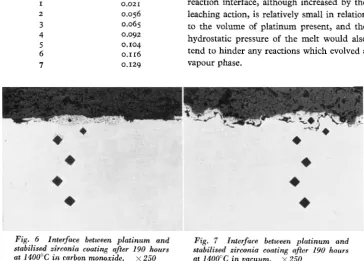
spraying. The resultant coatings, although strong mechanically and resistant to thermal cycling, are obviously not completely resistant to oxygen permeation. Figs 6 and 7 illustrate the rnetal/refractory interfaces of such en- capsulations after heat treatment for 190 hours at 14ooOC. Considerable surface alloying has occurred in the carbon monoxide atmosphere. In vacuum the reaction, although irregular, has penetrated locally well into the platinum rods. These reactions are less severe than those which occur when
ditions within the glass test cell, and to allow their influence on platinum/refractory re- actions to be evaluated, further compatibility trials were made in a resistance heated furnace which ensured that the thermocouple wire and its associated refractory bed was main- tained at temperatures uniform to about 10°C.
The thermocouples were immersed to a depth of about z inches in h e alumina powder having impurities as listed in the previous article (I). Approximately 50 gm of powder were contained in a “Purox” alumina crucible, and the initial tests at 1500°C were platinum wires are heated in contact with loose
beds of zirconia powder and it must be con-
tions both limbs of the thermocouple melted completely after only two hours. The fused areas were found to contain, in addition to the normal eutectiferous networks of aluminium- platinum phases, areas of the platinum- platinum silicide eutectic.
The silicon must have come from the alumina powder and from the “Purox” alumina crucible which were the only non- metallic components within the furnace. Although the alumina powder contained only about 5 p.p.m. of silicon, its total weight exceeded that of the thermocouple wire by many times, a situation which did not exist in experiments made in the normal test cell, where the weight of powder actually at the platinum wire temperature was very small. When further experiments were made in this resistance furnace, in argon at 125oOC no evidence of siliceous contamination was observed. The e.m.f. of the thermocouple changed little in spite of the considerable quantities of aluminium detected along its immersed length.
Vacuum experiments were made in the same resistance heated furnace. A molyb- denum heater tube was used so that excessive gettering action would be avoided, and the vacuum obtained would be comparable in quality to that used in the standard test cells. After 72 hours at 15oo~C in vacuum it was found that considerable amounts of alumin- ium had been uniformly alloyed along the whole length of both thermocouple limbs, which however had not melted. This tend- ency for the whole length of the thermocouple to react with the oxide in vacuum under the uniform temperature conditions prevailing in the resistance furnace was confirmed by fur- ther experiments made at I Z O O ” ~ .
The intense local attack, in vacuum, which occurred in the glass test cells at or near the surface of the refractory bed was therefore a consequence of the temperature gradient present in that region. The finding that the rate and severity of platinum/refractory reactions increased greatly with the weight of refractory powder actually maintained at the
reaction temperature helps to confirm the vapour phase concept of metal transport.
Effect
of
TemperatureAlthough the time taken for a thermocouple to fail mechanically does not always reflect the extent to which it has become contami- nated, the gradual accumulation of test results showed a surprisingly well-defined relationship between temperature and time to failure with the standard 13 per cent rhodium-platinum thermocouple. The data used to plot the graphs shown in Fig. 10 were
obtained in glass test cell experiments when standard thermocouples, 0.020 inch diameter, were immersed in beds of IOO mesh alumina powders.
Fig. 11
113 hours at 17OO"C in thoria in vacuum. Pt:13 per cent Rh-Pt thermocouple nfter
x 2.5
to absorb sufficient aluminium to cause it to melt at the test temperature. Couple lives, in alumina under a gettered atmosphere, are less than 2 or 3 hours at 1650°C. Under vacuum conditions at this temperature couples last for approximately 80 hours before failure and in argon of commercial purity tests of well over 1000 hours at
1600'C have shown only minor deterioration. No metallurgical failures in magnesia powders have been obtained even in gettered argon at 1700°C. T h e changes in thermo- electric output at this temperature are very small.
Discussion
It can be concluded from this work that reactions between platinum and the refractory oxides are controlled by the affinity of platinum for the metal released on decom- position, by the surface area of the reacting substances, and by the rate at which oxygen and metal vapours can be removed from the reaction zone. It is probably safe to suggest that vapour phase transfer accounts for most of the metal transfer observed, as the reactions proceed most rapidly in fine beds of powders where surface areas are high and also in large heated beds of refractory, where higher metal vapour concentrations might be expected to develop.
The main difficulty is to explain why the vacuum reactions are slower and different in character to those which occur in highly pure argon. The vapout phases so far discussed have been those released by the process of decomposition and it is important, therefore, to consider the complicating effects of platinum vapour, which at 16oo0C has a saturation pressure of the order of 10-' TOKK,
one order of magnitude higher than that of the aluminium or oxygen partial pressures. At 16oo3C, platinum evaporates in vacuo at
a rate of approximately I O - ~ gm/cm2 sec, while rhodium leaves the heated surface even faster. It seems not unreasonable to suggest, therefore, that thermocouples heated in vacuum are attacked less rapidly by alumina than they are in pure argon simply because the aluminium alloy which develops in inert atmospheres evaporates in vacuum as soon as, or even before, it is formed. Evidence in favour of this hypothesis is provided by the thermoelectric measurements made during the course of these experiments, In all the vacuum test runs, rhodium was lost at a high rate by evaporation, and since this reflected itself in reduced thermal e.m.f.s, a low thermal output generally coincided with the local aluminium attack just below the refractory surface which was a characteristic feature of these low pressure experiments.
How, therefore, do we account for this rapid attack in vacuum below the refractory surface ? It is obviously associated with the steep temperature gradient which exists in this region as it does not OCCUT when tempera- tures are uniform. Variation of temperature affects the rate, but not the position of this local attack which is well illustrated by Fig. 11. In this region, aluminium or any other contaminating metal must be absorbed by the wire faster than platinum can evaporate. This implies a temperature level for the wire in this region which is low relative to the ambient pressure of contaminating metal vapour within the bed of powder.
co-ordinates as the aluminium-alumina disso- ciation vapour pressure curve we obtain two curves of the form shown in Fig. 12. The horizontal temperature interval betwcen the two lines is the minimum which need exist between decomposing alumina and a platinum surface before aluminium will tend to deposit and be absorbed on the latter.
Optical pyrometer measurements indicated that under vacuum conditions the wires entering the refractory bed were approxi- mately 150°C cooler than the temperatures corresponding to the thermal e.m.f. generated by the immersed hot junction. Fairly strong temperature gradients thus existed in the emerging portions of the wires and it became possible to envisage a mechanism whereby attack from the heated alumina particles was confined to fairly small regions of the plati- num wire close to the surface of the re- fractory bed.
The curves shown in Fig. IZ suggest the interesting possibility that at test tempera-
tures below
XOOO’C
the reaction in vacuum atmospheres should proceed at all points along the wire, and further work at these lower temperatures would obviously con- tribute greatly towards our understanding ofthese reactions.
The extreme reluctance uf magnesia to
dissociate at high temperatures shows that the affinity of platinum for the metal released by the refractory is a dominant factor which obviously overrides most of the geometrical and environmental conditions so far con- sidered, since the magnesium-magnesia disso- ciation pressure is at all temperatures higher than the vapour pressure of platinum. Zirconia and thoria lie at the opposite ends of
the scale, the metallic vapour pressures of zirconium and thorium lying well below that of platinum. Whilst explaining the tendency for reactions between these oxides and plati- num to occur at positions fairly well removed from the wire surface, vapour pressure con- siderations do not easily lend themselves to an explanation for all the geometrical effects observed when these oxides were examined in the test cell arrangement.
Constitutional relationships in the alloys of platinum with aluminium, magnesium, zirconium and thorium will be reviewed in subsequent articles, which will also deal with the effects on the user of platinum of the processes leading to this type of reaction.
It is important that reactions of the type described should not be considered merely in their negative aspects as additional ob-
stacles in the already difficult field of high temperature research. The metallurgist might well exploit them for the production of inter- metallic compounds and dilute solid solutions.
Acknowledgements
Acknowledgements are due to the United Kingdom Atomic Energy Authority who sup- ported much of this work. We are particularly indebted to Mr J. P. Evans and Dr L. E. Russell, Process Technology Division at Harwell, for their
help and encouragement.
References