University of South Carolina
Scholar Commons
Theses and Dissertations
12-15-2014
How School Leadership Develops Parental
Involvement Strategies with Social Capital in Four
South Carolina Middle Schools
Anthony Neil Boatwright University of South Carolina - Columbia
Follow this and additional works at:https://scholarcommons.sc.edu/etd Part of theEducational Administration and Supervision Commons
This Open Access Dissertation is brought to you by Scholar Commons. It has been accepted for inclusion in Theses and Dissertations by an authorized administrator of Scholar Commons. For more information, please [email protected].
Recommended Citation
HOW SCHOOL LEADERSHIP DEVELOPS PARENTAL INVOLVEMENT
STRATEGIES WITH SOCIAL CAPITAL IN FOUR SOUTH CAROLINA MIDDLE
SCHOOLS
by
ANTHONY NEIL BOATWRIGHT
Bachelor of Science
University of South Carolina, 1998
Master of Education
University of South Carolina, 2005
Educational Specialist
University of South Carolina, 2009
______________________________________________
Submitted in Partial Fulfillment of the Requirements
For the Degree of Doctor of Philosophy in
Educational Administration
College of Education
University of South Carolina
2014
Accepted by:
Edward Cox, Major Professor
Zach Kelehear, Committee Member
Peter Moyi, Committee Member
Susan Schramm, Committee Member
DEDICATION
This dissertation is dedicated to my daughter Ayden and my mother Betty whose
love, support and encouragement means everything to me. I especially want to thank all
the colleagues and friends who have always believed in me and provided that little extra
push. Thank you, Dr. Roof, I simply cannot put into words how much I appreciate you!
My journey never would have amounted to this if you were not such a caring teacher. To
my mom, thank you for teaching me the importance of education and working hard. Your
sacrifices are countless to the betterment of my future. To my daughter, this passage was
possible because of your unbelievable heart! My success only comes because you were
able to remain focused through all the trials and tribulations that would make any
ACKNOWLEDGEMENTS
I would like to acknowledge the wonderful individuals who have guided me
through this journey. I offer Dr. Edward Cox, who is my advisor and chair of my
committee, the utmost respect. He has spent numerous hours reading and supporting me
through the dissertation process. His firm and direct approach really helped me get
through many frustrating moments.
I also want to thank the other members of my committee. Each challenged me by
reflecting on varying aspects in this research. Dr. Zach Kelehear, your leadership
methods as a professor and an individual cannot be duplicated. I have enjoyed every one
of our challenging debates only to be followed with wonderful laughter. Dr. Peter Moyi,
your humor provided such a unique medium for many difficult topics. I am also thankful
to Dr. Susan Schramm, who helped prepare my thought processes by bringing in a
perspective from outside the educational leadership department prior to conducting this
research.
Finally, I want to thank the principals, teachers, and parents who openly shared
ABSTRACT
Passed in 2001, the No Child Left Behind (NCLB) mandate requires schools to
have a comprehensive plan for addressing parental involvement. Identifying successful
practices to increase social capital and academic achievement in lower socio-economic
schools appears to be the area that is having the most impact. Principals can contribute to
higher success rates by generating productive partnerships between the school and
parents/guardians. The purpose of this study is to describe the parental involvement
strategies that four successful South Carolina (SC) middle school principals used and to
identify successful practices being implemented to increase social capital and academic
achievement. The researcher connected data to support how parental involvement
strategies are perceived to contribute to higher student achievement by principals,
teachers and parents/guardians.
Another area the researcher planned to examine is whether SC middle school
principalswere successful because they were utilizing Epstein’s model to improve social
capital of low socio-economic families. To determine how school leadership developed
parental involvement strategies with social capital in four SC middle schools, the
researcher investigated the strategies these schools’ principals utilized to increase
parental involvement among students of low socio-economic statuses, analyzed the
perceptions of their parental involvement strategies, and measured the consistency of
Epstein’s model of improving social capital of low socio-economic status families.To
principals, teachers and parents/guardians. Additionally, shadowing the principals and
teachers supported the data collected from the conducted interviews. This provided the
researcher with the opportunity to observe exactly how the principals interacted with
parents/guardians from varying socio-economic groups and how the teachers interacted
with the parents/guardians whether in person or through communication strategies. The
final part of the research came from collecting actual artifacts that provided strong,
fundamental support hoping other schools could replicate them in order to be successful
in increasing academic achievement through parental involvement practices. These
schools were successful partially because they adhered to the recommendations of
TABLE OF CONTENTS
DEDICATION ... iii
ACKNOWLEDGEMENTS ... iv
ABSTRACT ...v
CHAPTER I: INTRODUCTION ...………..………1
Goals and Principles of Parental Involvement ...6
Positionality ...6
Statement of Problem ...8
Research Purpose ...10
Research Questions ...10
Research Design...11
Interview Protocol ...11
Observation Protocol ...13
Document Protocol ...13
Data Analysis ...13
Theoretical Framework ...14
Significance of Study ...16
Limitations ...16
Definitions of Terms ...17
CHAPTER II: REVIEW OF THE LITERATURE ...18
Perceptions on Parental Involvement...24
Varying Types of Parental Involvement ...33
School Leadership’s View on Parental Involvement ...40
Environmental Influences on Parental Involvement ...52
Programs to Assist with Parental Involvement ...55
CHAPTER III: METHODOLOGY ...60
Introduction ...60
Study Design and Rationale ...60
Theoretical Framework ...61
Participant Selection ...62
Researcher Role ...63
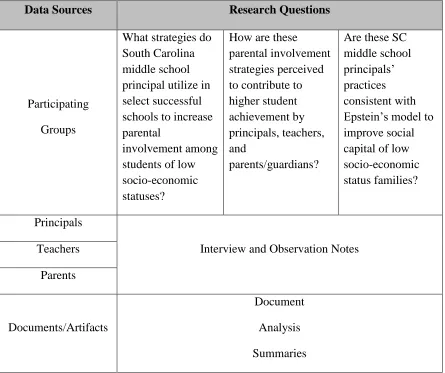
Data Collection Methods ...64
Data Collection Design Matrix ...65
Interview Protocol ...65
Observation Protocol ...66
Document Protocol ...67
Data Analysis ...67
CHAPTER IV: DATA COLLECTION AND ANALYSIS ...68
Introduction ...68
Data Analysis Findings ...68
Summary ...96
CHAPTER V: SUMMARY, DISCUSSION AND RECOMMENDATIONS ...98
Introduction ...98
Discussion of the Findings ...100
Recommendations for Future Research ...112
Conclusion ...114
REFERENCES ...116
APPENDIX A: Sample Superintendent Letter ...124
APPENDIX B: Sample Participant Letter ...126
APPENDIX C: Sample Informed Consent Form ...128
APPENDIX D: Interview Questions ...130
APPENDIX E: IRB Approval Letter ...131
CHAPTER I
INTRODUCTION
The No Child Left Behind (NCLB) Act (2002) requires schools in the United
States to have a comprehensive plan for addressing parental involvement. In 2004
Epstein conducted a national study of over 200 middle schools in the US, demonstrating
the need for parental involvement for all socio-economic classes. Her study utilized
schools associated with the National Network of Partnership Schools (NNPS) and used
an Action Team for Partnerships (ATP) to execute six types of involvement: 1) parenting,
2) communicating, 3) volunteering, 4) learning at home, 5) decision making, and 6)
collaborating.
In addition to Epstein’s six types of involvement, ATP recommends a number of
other plansthat focus on parental involvement in the publication, Promising Partnerships
Practices, produced by the National Network of Partnership Schools (NNPS) and
provides for participating schools in the NNPS. According to Thomas (2013),
From about 150 submissions, the editors of Promising Partnership Practices
2013 selected 94 activities from 76 schools, 15 districts, 2 organizations, and 1
state department of education. The contributors are economically, racially,
culturally, and linguistically diverse communities in 16 states in all parts of the
country. (Thomas et al, 2013, p. 1)
(The Pee Dee region of the state) and St. Andrews Middle School in Columbia (The
Midlands region of the state). The activity submitted by Lee Central Middle School is
Books and Basketball Family Literacy Night. The concept was to utilize basketball to
attract more family participants. According to the activity, the teachers reported over time
that students’ test scores did improve. The second middle school submitted an activity
titled Curriculum Nights. The school decided to have a series of four Curriculum Nights
for parents/guardians since the results from a parent survey indicated the desire to
understand what their children were learning. The school placed priority on convenience
for parents to attend by providing food so parents/guardians would not have to worry
about preparing dinner. Administration reported in the activity that parents/guardians
were extremely excited and gave rave reviews to this event.
These two SC schools are just a couple of examples of districts utilizing Epstein’s
(2004) six types of parental involvement strategies. Implementation of these strategies
and annually publishing them across all regions of the US offer potential evidence that
schools can possibly improve their relationship with parents/guardians across
socio-economic status lines.
Schools in the US are middle class places. That is to say, the value, work ethic,
beliefs, rituals, and cultural norms coincide with what sociologists referred to as
“middle-class.” In this sense, SES has less to do with monetary wealth and more to do with the
ways in which people believe that the institution of schooling can improve the lives of
US citizens by enabling them to compete economically in a capitalist free market system.
The American Dream holds that by working hard, completing school (i.e., 12th grade), an
with middle-class values and often the children of the working class poor are deemed
marginalized from this value system. In this dissertation, the term “social capital” is used
to describe SES and its connection to persons who value the institution of schooling for
their children. The researcher’s premise is that oftentimes the children of the working
class poor have parents/guardians who are disconnected from public schooling and
therefore work needs to be done in order to enable this population to be involved in the
education of their children.
“Social capital is the information, attitudinal and behavioral norms, and skills that
individuals can spend or invest to improve their chances for success in societal
institutions, such as schools. Individuals gain social capital through their social networks”
(Sanders & Epstein, 2000, p.342). Developing social capital in all socio-economic classes
will help to sustain strategies implemented by school principals to increase parental
involvement. Social capital refers to an established set of information, behaviors,
resources, or skills that are gained or developed through a person’s social network and
are used in various environments to improve the opportunity for social success (Sanders
& Epstein, 2000). School principals have a very valuable and untapped resource with the
development of social capital in parents/guardians of their students (Bourdieu, 1986;
Sanders & Epstein, 2000).
In 1986, Pierre Bourdieu, a French sociologist, studied how communities in
France reproduced and particularly focused on how classes remained either as a dominant
or recessive position. Cultural capital is the primary area in which Bourdieu is
recognized. He is also known for his 1979 book Distinction, which investigates the
individuals compared a variety of items they possessed to those higher on the social
ladder to see where they stood in society. Bourdieu learned that the quality of social
capital is dependent upon a variety of other variables. These collective variables are items
like having financial resources, the acquisition of knowledge, and knowing how certain
groups act and preferences. An example is how only a few will ever be able to cross class
lines and “fit-in” with certain groups. In order to obtain the level, one needs not only to
have the knowledge of which social circles to transition but must also have the financial
resources to be in those certain social circles. The few that are able to transition into those
different social circles would develop the quality of social capital as those in that
particular group.
School reformers could generalize Bourdieu’s thoughts of social class
transitioning to apply to the school environment as well:
Bourdieu’s definition works on the premise that those who are successful have the
resources to continue to be successful. He purported that social capital is
comprised of social obligations or connections that can be converted into
economic capital (Dika & Singh, 2002). Bourdieu viewed this as the reason for
inequality in academic achievement and the lack of development of human
capital. Because of the organizational structure of public schools, the social
capital of educated middle-class White families is more conducive to school
success than is the social capital of less-educated and/or families in poverty.
(Mickelson, 2003)
If one could blend the philosophy of a practitioner of sociology and those in the higher
particularly for low socio-economic status. As interest in the international community
grows, Bourdieu’s work could certainly become applicable to both American culture and
the American school system.
Auerbach’s study in 2007 examined how to include all families in the urban
school environment successfully. Many districts are successful at including
parents/guardians from middle to upper socio-economic classes but fail to include those
of lower socio-economic status. Minority parents/guardians and parents/guardians of
poverty support education in their homes but are often not as visible to educators as
parents/guardians from upper social levels. Auerbach indicates the need to perform
proactive strategies to gain trust with certain culturally challenged groups. Cultivating
relationships has proven to be successful in bridging the collaboration between families
and schools. Society benefits when educational leaders allow for full partnerships in
decision making from all families at all socio-economic statuses. Other studies have also
demonstrated that educational leaders struggle with fully involving all parents/guardians
in school decision making. This data collected from surveys of principals’ attitudes about
their roles in this area (Auerbach, 2007; 2009; 2010). Auerback (2007) observed that
although many studies have been conducted concerning administration in
school-community collaboration, few have examined parental leadership.
Auerbach’s (2007) study reflects upon theories of stewardship and shared
leadership, social capital, opportunities-to-lead frameworks, and psychosocial role theory
to encourage school leaders to share decision making with all social classes in their
the policies of shared leadership enrich the social capital of those families living in
economically-challenged communities (Auerbach, 2007).
Goals and Principles of Parental Involvement
Auerbach (2009) suggests administrators merely talk of having parents/guardians
share equally in making decisions involving their children’s education, but the reality of
parents/guardians actually having equal decision-making is far from that. The results of
such mutual involvement, however, are powerful: a cooperative partnership between
schools and parents/guardians improves social capital in low socio-economic
communities and increases significantly the opportunities for improvement for all
involved (Auerbach, 2009). Such partnerships, however, are recommended to begin
structurally within the schools from the top down, most effectively institutionalized by
the principal. Building the partnership with the families and communities requires a solid
commitment from the school leader. Auerbach is interested in expanding the literature of
social capital growth with families in the lower socio-economic communities so that a
better understanding of how escalating those resources will provide great gains
academically.
Positionality
The researcher of the present study recalls his parents always saying, “Education
is very important.” The researcher also remembers his parents never helping him with his
homework or even visiting his schools. The researcher’s father was never at home; he
was always traveling for work, and his mother worked two jobs. The researcher recalls
how persistent his mother was about asking if he had done all of his homework. The only
bad behavior. Outside these areas, the researcher’s parents did not pressure the
researcher’s brother nor him about school. From his perspective, the researcher’s parents’
idea of parental involvement with the school was making sure we had clean clothes, food,
shelter, and that we were disciplined and attended school. In the researcher’s adult years,
when he had asked his mother about her lack of help with homework, she admitted that
she was embarrassed because she did not understand the work the researcher was doing.
The researcher asked why she had never attended school functions, and she said, “I
worked two jobs and never had time, and if I did, I was intimidated by the folks at the
school.” She explained further, “I felt like all I needed to do was make sure your brother
and you stayed out of trouble and did your work like you are supposed to and that was
my responsibility. I did not feel like I had to be at your school to show my support. Just
making sure I provided for you was my way of being involved.” Had a middle school
administrator reached out to my mother and developed her social capital my future would
have been different. Evidence of this action was demonstrated at the middle schools
involved in this research. My mother admitted that she would not visit the school unless
she had to. Auerbach (2007) discusses how low socio-economic families do not feel
valued, but if they did and if they received specific information about how their input
would benefit their children, they would probably have been more involved.
Lopez (2001) describes cultural differences as reasons for a lack of parental
involvement in children’s education, and she paints a similar picture to the researcher’s
own. Parental involvement does not always mean visibility at school. The present study
provides data that supports how marginalized families are often viewed unfairly as
involvement studies serve to decide current practices and pave the way for policies.
Lopez’s qualitative research highlights cultural differences in parental involvement that
many middle-class teachers do not consider.
Statement of Problem
Middle schools’ personnel struggle with parental involvement, especially with
families of low socio-economic status (Auerbach, 2009; Brannon, 2007; Catsambis &
Gardland, 1997; Gould, 2011; Griffin & Galassi, 2010). There are a number of reasons
for this difficulty. Factors which can impact parental involvement stem from all involved
in the educational process: the principal, the teachers, and by the parents/guardians
themselves. School principals lack courses in college to prepare them for building
parental involvement strategies. Some teachers lack knowledge of parental involvement
beyond thinking parents/guardians are only involved when they are visibly present at the
school (Auerbach, 2007; Brayan & Holcomb-McCoy, 2004; Duchesne & Ratelle, 2010).
Many parents/guardians of low socio-economic status are not able to be more involved
due to work, lack of transportation or lack of knowledge about involvement. A number of
studies have demonstrated how Epstein’s six types of involvement (parenting,
communicating, volunteering, learning at home, decision making, and collaborating with
the community) contribute to higher success rates in producing productive partnerships
between the school and parents/guardians (Epstein, 2004; Epstein & Sanders, 2006;
Gould, 2011; Griffin & Galassi, 2010; McCollough, 2011; Patel & Stevens, 2010;
Wiseman, 2010). Epstein’s conceptual framework came from the theory of overlapping
spheres of influence, based on the concept that if the home and school are working as a
more managerial in schools and lack collegial training to build parental involvement
(Auerbach, 2010; Epstein, 2006; Sanders & Epstein 2000; Wiseman, 2010). Research has
demonstrated that principals lack the knowledge of how to improve social capital
(Boethel, 2003; Brannon, 2007; Epstein, 2004; Lew, 2007). Although the passage of the
NCLB Act requires schools to implement parental involvement, schools have struggled to
include parents/guardians of low socio-economic status as partners (Epstein, 2004).
Although Epstein’s model is more often used than others, she does have her
critics. Graue (1999) suggests that Epstein delegates power more toward administrators
and teachers than parents. The limited power directed to parents by teachers and
administrators makes the process less collaborative for parents. Consequently, the model
has more of a top down design than a democratic one. Martin (2009) disputes Graue’s
criticism; he states that Epstein favors the parents too much in her model, thus giving
them control of those involved. “Because schools are not designed for ‘parenting’ or
‘learning at home,’ the promotion of parental involvement by schools through this
typology, although seemingly plausible and very likely helpful, becomes quickly
convoluted” (Martin, 2009, p. 10). De Carvalho sides with Martin, agreeing that
educators have too much control, “Taking a decidedly opposite stance to educators
encouraging broad policies for engaging parents in their child’s education….” (Smith,
2001, p. 152). In spite of such criticism, the researcher still chose to use Epstein’s work
which continues to serve as the definitive instrument of its kind, both historically and
Research Purpose
The purpose of this study is to describe the parental involvement strategies that
four SC middle school principals used and to identify successful practices being
implemented to increase social capital and academic achievement in these four lower
socio-economic schools. The researcher connected data to support how parental
involvement strategies are perceived to contribute to higher student achievement by
principals, teachers and parents/guardians. Another area the researcher investigated was
whether or not these SC middle school principals are successful because they are utilizing
Epstein’s model to improve social capital of low socio-economic families. The researcher
concedes that it is often difficult to conclude that only the variables being investigated are
inclusively responsible for set outcomes.
Research Questions
To determine how school leadership developed parental involvement strategies
with social capital in four SC middle schools, the researcher asked the following three
questions to guide this research:
1. What strategies do South Carolina middle school principals utilize in
select successful schools to increase parental involvement among students of
low socio-economic status?
2. How are these parental involvement strategies perceived to contribute to
higher student achievement by principals, teachers and parents/guardians?
3. Are these South Carolina middle school principals’ practices consistent
with Epstein’s model to improve social capital of low socio-economic status
Research Design
This study was submitted to the University of SC Institutional Review Board
(IRB) for approval. The researcher visited each of the four schools three times. The first
visit was to interview the principal, teacher, and parent. This and the other interviews
provided descriptive data in the interviewees’ own words. The researcher’s questions
were structured from Patton’s (2002) six types of questions. The second visit consisted of
shadowing the principal and teacher for a day. The shadowing for each participant was in
a role as an Observer as participant (Patton, 2002). The third visit was for visiting the
school to obtain study-related documents. The researcher analyzed the documents for
contextual and analytical value. These documents included agendas, newsletters
informing parents/guardians of upcoming events.
Interview Protocol
Epstein identifies six types of involvement (parenting, communicating,
volunteering, learning at home, decision making, and collaborating with the community)
that she states can contribute to higher success rates in forming productive partnerships
between parents/guardians and schools. The six interview questions are posed to obtain
data in each of Epstein’s Framework of Six Types of Involvement for Comprehensive
Programs of Partnership. The researcher asked the principals about each of these types
of involvement at their schools and focused primarily on communicating, decision
making and collaborating with the community. Communicating consists of designing
effective ways of delivering information to parents/guardians and receiving
communications back from parents/guardians. The next type of involvement applicable to
committees to provide input on decisions being made for the school? The researcher
asked the principal about the final type of involvement, collaborating with the
community; the researcher also asked him or her to provide examples. Epstein (2009)
defines community collaboration as being able to prioritize the needs of the group to
assist in building stronger relationships that will serve in bridging the home to the school.
Teachers were the second group interviewed. The researcher asked the teachers
about each of the types of involvement at the school but focused primarily on
communicating and decision making. The researcher asked questions, such as (1) Tell me
about your communication methods with parents/guardians and strategies you use to
include parents/guardians in decision-making with instruction and curriculum at this
middle school; (2) What could this school do better to serve your students’ potential for
academic achievement?
The final interview group was the parents/guardians. The interviews focused on
types of involvement: parenting, volunteering and learning at home. The researcher asked
questions, such as (1) Tell me about your parenting strategies as they relate to support for
optimal learning, volunteering at the school and helping your child to learn at home; (2)
What could this school do better to serve your child’s potential for academic
achievement? The answers from the principals, teachers and parents/guardians provided a
first-hand experience to what efforts the school leader is executing at the school to build
partnerships. The answers were used in a second part of the triangulation of the study.
For example, the responses from the parents/guardians did match up with what the
Observation Protocol
The researcher shadowed the principals and teachers to collect data possibly
pertaining to Epstein’s six types of involvement (Type 1 Parenting: Understanding of
student diversity; Type 2 Communicating: Appreciation and use of parent network for
communications; Type 3 Volunteering: Readiness to involve families in new ways,
including those who do not volunteer at school; Type 4 Learning at Home: Respect of
family time; Type 5 Decision Making: Awareness of parent perspectives as a factor in
policy development and decisions; Type 6 Collaborating with the Community:
Awareness of community resources to enrich curriculum and instruction). Shadowing
provided an opportunity to observe things such as how the principal interacts with
parents/guardians from different socio-economic groups and how and/or if the principal
implements Epstein’s six types of involvement.
Document Protocol
Collecting documents like school newsletters, teacher/parent communication logs,
and guidance documents for parents/guardians/students provided evidence of
communication to parents/guardians. The researcher did see invitations for parent
education and other activities for all stake-holders. This served to see the degree of
communication to the varying groups of parents/guardians. The documents provided by
guidance counselors showed parent education opportunities for involvement.
Data Analysis
The researcher organized the data by Epstein’s six types of involvement -
parenting (e.g., Increase parents/guardians’ confidence about discussing school and
about their own work; Enable students to set goals, with school and family support, for
high achievement and positive attitudes and behavior), volunteering (e.g., Increase the
number of volunteers available to conduct activities that benefit students and welcome
parent volunteers who do not speak English), learning at home (e.g., Improve students’
reading skills and attitudes; improve parents/guardians’ abilities to support students’
independent reading, fluency, and comprehension), decision making (e.g., Increase the
number of parents/guardians who are comfortable with the Parent Teacher Association
(PTA), improve the dissemination of information in middle school programs and
curriculum, and strengthen parent networks), and collaborating with the community (e.g.,
Create productive connections with a key community partner). Organizing this data into
these categories helped to identify the areas in which a middle school principal performs
well.
Theoretical Framework
The goal of this study was to discover critical data by investigating well below the
surface of reported parental involvement methods in select middle schools by conducting
a qualitative research study. Glesne (2011) describes the study of the case by doing a
deep examination, collecting data while conducting the observation of the individual,
performing a thorough interview, and collecting artifacts to investigate.
Patton’s maximum variation (heterogeneity) sampling and confirming was the
strategy used in this study. Patton’s (2002) strategy for purposeful sampling is collecting
and reporting the main idea free of a variant. This study investigated the “stated” methods
of parental involvement by middle school principals in four school districts in SC. To
an eligibility of fifty percent or higher free and reduced school meals benefits from
different regions of SC: the Upstate, the Midlands, the Pee Dee, and the Low Country.
Patton notes how a study can be effective in selecting a few sites as long as the researcher
utilizes geographical variation. The site selection included public middle schools that
house grades six – eight. Private, charter, parochial, and virtual schools were not included
in this study. The 2012 SC Annual School Report Card was used to select one middle
school in each of the four areas of the state, all with an Absolute Rating of Good or
Above. The researcher requested participation from all school districts in each of the four
regions for the sake of getting at least one in each region to agree. It was stated that
whoever responded first would be the district selected for the research.
Confirming and disconfirming cases was the participant selection strategy used in
this study. Patton (2002) provides the purpose as expanding and strengthening the
investigation and examining the differences. Participants for this study began with a list
of qualified districts from the SC Department of Education website. A formal letter
requesting permission to have the qualified district and middle school principals selected
to participate in this study was mailed to all qualified SC school district superintendents.
For each of the districts that provided consent to participate, the researcher obtained and
emailed all the middle school principals in the respective district who have the Absolute
Rating of Good or Above on their School Report Card with the consent letter from their
superintendent, asking them to participate in the study. Those that did not reply by email
received a phone call verifying that they had received the study request information. The
Significance of the Study
This study provided significant data to SC middle school principals. Epstein
(2004) advocates that the six types of involvement provide a proven path in excellence
with student achievement and bridging parents/guardians with schools. There is a gap in
the literature regarding accountability and parental involvement, especially at the middle
school level. This study will contribute to that educational leadership’s body of literature
by researching what some successful middle schools report that they do and how they go
about it. The study is a snapshot of four middle schools in SC and will allow future
researchers to add to this research by examining other states which will identify whether
the problem is isolated only in SC or if it is a significant issue that might contribute to
school boards and lawmakers changing policies that ensure accountability.
Limitations
Cicciarella (1997) states that limitations in a study are possible shortcomings or
weaknesses of the study. The limitations of this study concern the transparency of sharing
the actual strategies being performed on a regular basis by the principals. Utilizing
strategies such as triangulation helped to eliminate some such concerns. Also,
understanding the intent of the study, the principals themselves, not the researcher, were
asked to select the parents/guardians to participate. The data (the interviews and data
transcription and analysis) was collected only by the researcher, his skills somewhat
limited in these areas. The research in this study is limited to the experiences of the
Definition of Terms
Academic Success: “School performance exceeds the standards for progress toward the
2020 SC Performance Vision” (SCDE, 2012).
Middle School: “designates a school in between elementary and high school, housed
separately and ideally, in a building designed for its purpose, and usually covering three
of the middle school years beginning with grades 5 or 6” (Wiles & Bondi, 1986).
Parental Involvement: “the participation of parents/guardians in regular, two-way, and
meaningful communication involving student academic learning and other school
activities” (NCLB, 2002).
Parents/guardians: “biological parents/guardians, adoptive and stepparents/guardians, and
primary caregivers.
NCLB: “No Child Left Behind –common name for the Elementary and Secondary
Education Act of 2001 – “An Act to close the achievement gap with accountability,
flexibility, and choice so that no child is left behind” Elementary and Secondary Act
(ESEA), 2001.
Social Capital: “Social capital is the information, attitudinal and behavioral norms, and
skills that individuals can spend or invest to improve their chances for success in societal
institutions, such as schools. Individuals gain social capital through their social networks”
CHAPTER II
REVIEW OF THE LITERATURE
Parental Involvement
Auerbach (2009) suggests that weaknesses of a study are called “limitations.” In
her study many administrators often talked of providing equal decision-making with
parents/guardians, but in actuality the administrators are selective to agenda items that are
open for parent input. The results of having family and community involvement with
schools can be powerful. She supports the types of involvement with low socio-economic
communities that are genuine and will increase the social capital which will open the
door for additional opportunities (Auerbach, 2009). The majority of schools begin with
the best intentions of implementing the practices mentioned above, but only a few
schools actually make it a priority and are successful. The most effective way to get
anything to become institutionalized at a school is to work through the building principal.
It is important to obtain the “buy-in” of the school leader. Building the partnership with
the families and communities requires a solid commitment from the school leader.
Research is needed regarding what school leaders are actually doing to increase
family involvement. The literature suggests that one of principals’ roles is to provide
specific invitations to families to become involved at school. The strongest predictor of
parent involvement is the way in which parents/guardians conceptualize and construct
education. Middle schools struggle to maintain the parental involvement level found in
elementary schools.
Parental involvement provides initiated benefits for everyone who is vested in the
achievements of students. The literature on parental involvement provides an
understanding that middle-class families typically are equipped with tools that have been
obtained from social capital that helps with activities to benefit their children with
school-related strategies (Williams, 1998; Wiseman, 2010). These strategies are learned
and passed down from generation to generation and are not present with all classes of
families. The schools that go beyond the call of duty to promote genuine bridges between
families and the schools reap the benefits through a number of positives that include
higher academic achievement and improved student behavior. The schools that are still
struggling have not realized the significance of genuine partnerships between families
and schools.
Parental involvement takes many different focuses. The school leader may
provide his or her definition which will be different from the teacher’s perspective.
Parental involvement from families is also different, depending on who the family is and
where they are from. The literature states that a middle-class white family may see
parental involvement as serving on PTA/PTOs, helping with field trips, and being visible
at the school site (Overstreet, Devine, Bevans, & Efreom, 2005; Patel & Stevens, 2010;
RMC Research Corp., 1993). A Hispanic family may see parental involvement as
assuring their children understand the importance of working hard at school instead of
having to work with their hands. Parents/guardians come from all socio-economic
Joyce Epstein is a noted expert on the subject of parental involvement. She is the director
of the Schools, Family and Community Partnerships Program and the National Network
of Partnership Schools at Johns Hopkins University. Epstein’s six types of parental
involvement are described as follows:
Type 1: Parenting. This type of involvement consists of helping families to establish a
home environment that will support children as students by assisting families with
parenting skills, family support, understanding child and adolescent development, and
setting home conditions to support learning at each age and grade level. In addition, it
involves assisting schools in understanding families’ backgrounds, cultures, and goals for
children (Epstein, 1995; Epstein & Jansorn, 2004; Epstein & Salinas, 2004).
Type 2: Communicating. This type of involvement enforces school-to-home and
home-to-school communication by creating two-way communication channels between school
and home and communicating with families about school programs and student progress.
This allows families the ability to stay in touch with teachers, administrators, and
counselors as well as other staff members and families (Epstein, 1995; Epstein &
Jansorn, 2004; Epstein & Salinas, 2004).
Type 3: Volunteering. This type of involvement focuses on recruiting and organizing
parent help and support. Components of this type include recruitment, training, activities,
and schedules in order to involve families as volunteers and as audiences at the school or
in other locations. It enables educators to work with regular and occasional volunteers
who assist and support students and the school families (Epstein, 1995; Epstein &
Type 4: Learning at Home. In this type of involvement, parents/guardians and families
learn how to become involved with their children’s academic learning at home.
Parents/guardians and families are provided with information and ideas about how to help
students with homework and other curriculum-related activities, decisions, and planning.
It encourages teachers to design homework that enables students to share and discuss
interesting work and ideas with their parents/guardians and other family members
(Epstein, 1995; Epstein & Jansorn, 2004; Epstein & Salinas, 2004).
Type 5: Decision Making. This type of involvement includes families as participants in
school decisions, governance, and advocacy activities through school councils or
improvement teams, committees, and various parent organizations, such as Parent
Association (PA) and Parent Teacher Association (PTA)/Parent Teacher Organization
(PTO). In addition, it provides assistance for family and teacher representatives in
retrieving and disseminating information for those who represent families (Epstein, 1995;
Epstein & Jansorn, 2004; Epstein & Salinas, 2004).
Type 6: Collaborating with the Community. This last type of involvement focuses upon
coordinating resources and services for families, students, and the school with
community groups, including businesses, agencies, cultural and civic organizations, and
colleges or universities. It enables all stakeholders to contribute their services to the
community (Epstein, 1995; Epstein & Jansorn, 2004; Epstein & Salinas, 2004).
The benefits of parental involvement impact the student, the family, the school,
and the community. Students generally do better both academically and socially when
parents/guardians are involved. The benefits of quality parental involvement apply to all
parental involvement occurs when students transition from elementary school level to
middle school level. The research does provide evidence regarding the power of parental
involvement at all levels of education (Harwell, Brown, Caldwell, Frazier, & McGee,
2009; Lopez, 2001; Marchant, Paulson, & Rothlisbert, 2001).
Parental involvement is different at the secondary level than at the elementary
level. Parents/guardians may not be as visual at the secondary level by helping in the
school and the classroom as in the elementary level, but parents/guardians are motivating
their children and talking with them about school and their future. The literature
demonstrates higher rates of success with students in home with authoritative parenting
style over authoritarian parenting style (Desimone, 1999; Marchant, Paulson, &
Rothlisbert, 2001; Regner, Loose, & Dumas, 2009). Parents/guardians and teachers often
have broken communication which hinders their relationships. Research provides solid
evidence of the benefits of building a successful relationship between parent and teacher
for the sake of the parents/guardians. Parents/guardians and teachers are able to discover
the skills and talents each possesses, which directly and indirectly contributes to the
academic success of the student. There is a wonderful performance happening when both
parties interact with one another like a perfectly choreographed play. Another
contribution to strengthening students’ success is when the parents/guardians are actively
engaged with the school. When this interaction is witnessed by the child, research shows
how learning and behavioral problems tend to vanish. Many positive outcomes develop
from genuine relationships between the parents/guardians and teachers. Educating both
the educator and parent about such a partnership will benefit the student through
That partnership between families and the school is described or defined in many
and various ways. A clear definition needs to be established since there are many
different perceptions of what parental involvement is or looks like. The following list
gives key words and their definitions used in this research.
Middle school. In this research, middle school is a public school facility with
students attending sixth through eighth grades for educational instruction.
Parent. In this research, “The term ‘parent’ includes a legal guardian or other
person standing in loco parentis (such as a grandparent or stepparent with whom the child
lives, or a person who is legally responsible for the child’s welfare)” [Section 9101(31),
ESEA.](p. 31).
Parental involvement. In this research, “The term ‘parental involvement’ means
the participation of parents/guardians in regular, two-way, meaningful communication
involving student academic learning and other school activities, including ensuring: That
parents/guardians play an integral role in assisting their child’s learning; That
parents/guardians are encouraged to be actively involved in their child’s education at
school and That parents/guardians are full partners in their child’s education and are
included, as appropriate, in decision-making and on advisory committees to assist in the
education of their child” (p. 31).
The literature search strategies consisted of a search for materials on parental
involvement and academic achievement at the middle school level in academic journals,
books, periodicals, reviews, and trade publications through the University of South
was an additional method of accomplishment. References from articles read provided a
wealth of leads for related works on this topic.
The literature surrounding parental involvement and academic achievement at the
middle school levels is limited. Initial searches produced a number of articles discussing
areas surrounding this topic, but few studies have actually been performed in detail. The
experts in this field, like Joyce L. Epstein, continue to conduct research in this area. The
gap appears to be around what school leaders are actually doing in the schools with an
emphasis on minority and low socio-economic groups. The literature demonstrates how
school leaders are satisfying the federal mandates on paper, but only minimal numbers of
studies provide actual programs principals are implementing.
The organization of the balance of this literature review provides a
well-documented list of the articles surrounding perceptions on parental involvement, varying
types of parental involvement, school leadership’s view on parental involvement,
environmental impacts on parental involvement, and programs to assist with parental
involvement. Theories regarding parental involvement regularly led to Joyce L. Epstein
and her Six Types of Parental Involvement. They are classified as (a) parenting, (b)
communicating, (c) volunteering, (d) learning at home, (e) decision making, and (f)
collaborating. A number of theories are provided in the following review of articles in the
field of parental involvement.
Perceptions on Parental Involvement
Kusum et al (1995) analyzed four components of parental involvement: parental
aspirations for children’s education, parent-child communication about school, home
aspirations for their children’s education have the strongest influence on academic
achievement; thus the study suggests that educators and practitioners should work to
nurture parents/guardians’ educational goals for their children. The researchers state that
a need exists for discovering parental involvement strategies for middle school students
and more specifically for identifying which aspects of parental involvement would
produce the best academic achievement for students during the middle school years
(Kusum et al., 1995). Interestingly, the researchers imply that having parents/guardians
active in the activities at school provided no evidence for increased academic
achievement, which contradicts researcher findings. Many of the activities performed by
parents/guardians with their children’s education in elementary schools did not produce
the same results in middle school. The research suggests that the students in middle
school are dealing with other factors like socializing and seeking independence. Kusum
et al state that a high number of elementary school children enjoy parents/guardians being
at the school and volunteering in the classroom. Middle school students, however, do not
appreciate their parents/guardians visiting the school or the classroom. The young
adolescents reflect more embarrassment than enjoyment of their parents/guardians’
presence. This study suggests that there are different types of parental involvement
needed at different ages.
Desimone’s 1999 study examined parental involvement through actions, beliefs
and attitudes.He supports data provided on parenting studies and the diverse educational
outcomes, suggesting that variables like race and income have an impact on parenting
practices (Desimone, 1999). Parental involvement is one of the items described by
stress the importance of parent involvement policies, suggesting that they are critical to
gaining grounds with parental involvement. It is also acknowledged that even though
parental involvement is in major parts of federal legislation, the key components are still
missing. Attempting to focus on poor families and diverse families seems to be the
challenge and is the key component missing in the mandates. Parenting style, like
authoritative parenting style, and many other variables produce the best effects for
student achievement. Social capital is an area noted by the researcher. If educators are
able to teach parents/guardians the complexities of the middle school system, how best to
help the children with school work, best parenting practices, and simply how to be more
effective in the role of policy modification, the social capital and student achievement
will grow simultaneously. Desimone (1999) advocates for improved school – to - home
practices for low-income parents/guardians so they will have equal opportunities to those
who have middle to high incomes.
Lopez (2001) examines cultural differences involving parental involvement.
Parental involvement does not always mean parent active participation and visibility at a
school. Lopez’s study provides data that supports how marginalized families are often
viewed unfairly as uninvolved families for these reasons. Such knowledge is critical for
schools because federal funding is connected to those programs oriented toward
increased parental involvement. He endorses the majority of research that demonstrates
global acceptance of parental involvement practices that improve student academic
achievement (Lopez, 2001). This qualitative research was interesting and highlighted
some cultural pieces to parental involvement that many middle-class teachers do not
study. Observations and interviews were performed over a six-month period. One family
shared how the children experienced hard manual labor working in the fields early in life.
The father explained how it was important for him to provide that experience for his
children because he wanted them to understand they would either work hard in the fields
or in the classroom. Secondly, he wanted them to possess a skill to resort to if things did
not work out with a position obtained by a formal education. This father feels completely
involved in his children’s education by making sure they understand their options;
essentially, he is trying to teach them to work hard to obtain a good education so that they
do not have to perform straining manual labor in the future.
The work by Marchant et al (2001) shows the influences on student achievement
through a review of pertinent literature focusing on the more promising parenting styles
for achievement. Marchant et als’ (2001) study demonstrated the connection the
parents/guardians have on student success, and a number of studies show authoritative
parenting styles and active parental involvement prove to have higher levels of academic
achievement across variables like race and income. High parental expectations and
parental values about achievement are important reasons for success. Such realization is
providing concrete justification to providing academic achievement for all students
regardless of gender, race, or ethnic groups. The researchers preach that if the
authoritative parenting style is shared by both the teacher and parent, students
demonstrate more motivation (Marchant et al, 2001). Although a number of variables
were studied, a student’s perception was noted as the most powerful variable for
comes from an environment where both home and school blend well, collaborating
seamlessly.
Bryan et al (2004) conducted a study involving 72 SC school counselors,
randomly selected. This study examined the perception of their involvement with
school-family-community (SFC) partnerships and what barriers they faced at their schools in
these areas. The literature mentions the National Education Goals (Goals 2000) as federal
legislation which suggests schools find creative ways to build partnerships to generate
more parental involvement. The researchers developed a survey which was validated by
using a focus group consisting of three school counselors and two counselor educators to
pilot and provide feedback on the survey.
Tonn (2005) provides an examination of motivations for parents/guardians.
According to Kathleen V. Hoover-Dempsey, an associate professor and the Chairperson
of the Department of Psychology and Human Development at Vanderbilt University’s
Peabody College, parents/guardians’ motivations for involvement are influenced by three
variables: their sense of invitation from the school, teachers, and their own children; their
perceptions of how effective their involvement will be; and their personal beliefs about
how they should be involved. This study looks at the partnership between family and
school. Technology has helped provide instant information, often utilized for bridging the
two. Tonn urges school leaders to implement practices that will keep parents/guardians
involved prior to their children being in middle school. In order to have an effective
program, parents/guardians need specific invitations to be involved and to feel as if their
time is important. Because many families attend meetings at schools only to feel
and gives opportunities for them to be contributing stakeholders. The researcher
demonstrates the need to execute the basics like posting directions to key offices in the
school to help the parents navigate to selected areas of the school and also to alleviate
some aspects of their worries.
Green et al (2007) focuses on areas that helped support student learning through
attributes like self-efficacy for learning, perceptions of personal control over school
outcomes, and self-regulatory skills and knowledge. This study examines what motivates
parents/guardians to be involved with their children’s education, such as what practices
certain parents/guardians utilized and why the parents/guardians selected certain practices
for being involved.
Grounded primarily in psychological literature, the Hoover-Dempsey and Sandler
model of the parent involvement process proposes three major sources of
motivation for involvement. The first is parents/guardians’ motivational beliefs
relevant to involvement, including parental role construction and parental
self-efficacy for helping the child succeed in school. The second is parents/guardians’
perceptions of invitations to involvement, including general invitations from the
school. The third source is personal life context variables that influence
parents/guardians’ perceptions of the forms and timing of involvement that seem
feasible, including parents/guardians’ skills and knowledge for involvement, and
time and energy for involvement. (Green et al., 2007, p. 532)
Self-efficacy theory provides parents/guardians with a simple conclusion in the form of a
question: What will the outcome be of the researcher’s involvement? Another area
is specific invitations. Parents/guardians would like to be invited to schools for specific
reasons. They want to know they are valued by the school and that they will be
contributing something specific simply by being involved.
Harwell et al (2009) examines three rural southern middle schools, primarily
focusing on homework and how homework impacts students’ attitudes. It concentrated
primarily on parental involvement and gender differences, authenticating the fact that
parents/guardians spend more time at school events with their daughters and are stricter
on their daughters’ socializing time (Harwell et al, 2009). It was noted that homework
seems to be the major vein between the home and school. Parents/guardians often see this
as a time for them to be involved with their children’s education, but for a number of
parents/guardians it is an area for issues. The researchers provide evidence that many
parents/guardians had low efficacy in helping their children with homework at the middle
school level. They were not confident with their ability to understand much less help with
the middle school curriculum. Additional research suggested that whether children
received help at home with their homework or not contributed little toward student
achievement. A growing number of studies suggest that a different type of parental
involvement is needed at the middle school level than the elementary level. Providing
more space for the middle school student is just one suggestion. Maintaining structure
and providing a schedule for the student, however, are mandatory requirements.
Parents/guardians who play a supervisory role produce the students’ highest academic
gains.
Regner et al (2009) conducted a study in France. The students’ perceptions were
wanting to adopt goals of academic achievement. Achievement goal theory was the
framework for this research. Previous research on achievement goals provided
information like cognitive processing strategies and performance outcomes. The
researchers corroborate the importance of variables like perceived competence and fear
of failure as major indicators of achieving academic goals (Regner et al, 2009).
Encouraging and supporting the decisions made by the students are described as items
that help with academic support by parents/guardians and teachers. Authoritative
parenting style might be used to describe this type of support. Students want to know that
they are cared about. Regardless of how it is done, students simply want to know their
parents/guardians and teachers care about their interests, and they need to see it
demonstrated. Regner et al (2009) support school practices that involve teachers talking
to students about being successful, and protocols should be in place to encourage
parents/guardians to communicate to their children about being successful to develop
higher success with academic tasks. This study provides some insight to the need of
students to have both parents/guardians and teachers involved and to demonstrate the
importance of education in order for them also to value the work they must contribute to
achieve what is necessary.
Duchesne et al (2010) examined academic motivation through parenting and
emotions. The researchers advocate that achievement goal theory is the most significant
of socio-cognitive approaches explaining why some students do better in schools and
why others do not (Duchesne et al, 2010). Involvement and control are two parenting
We believe that our study fits into this recent body of work and propose a
mediation model to examine the predictive relationship between perceived
parental behaviors (involvement and control) before the transition and
achievement goals (mastery, performance-approach, and performance-avoidance
goals) after the transition during which pretransition negative emotions such as
anxiety and depression act as mediators. (Duchesne et al, 2010, p.497)
The first area studied is parental involvement with a focus on the behaviors and attitudes
of parents/guardians toward their children. The second area is parental control, the
influence to motivate the child to adopt the parents/guardians’ beliefs. This research
demonstrates a history of positive academic accomplishments connected to children’s
feelings about success and motivation. An extreme opposite view is when
parents/guardians have too much control; abuse of such control can cause children to be
less motivated and have low achievement.
Gould (2011) examined parental participation in a child’s education during the
middle school years. Gould uses the Ecological Systems Theory, which served as his
theoretical framework. The students’ satisfaction with school and parental involvement
were the dependent and independent variables used in this research. This study uses the
following research hypothesis: there is a difference in student satisfaction with schools
where students reside with only biological parents/guardians and those who do not. The
null hypothesis claimed there is no difference in student satisfaction in relation to these
residences. The Student Satisfaction Survey (SSS) was used to measure how satisfied the
students were with school in a Midwest public middle school. Gould (2011) validates