
On Security Models and Compilers for Group Key Exchange Protocols
(Full version)
Emmanuel Bresson1, Mark Manulis2, and Jörg Schwenk2? 1 DCSSI Crypto Lab, France
2 Horst Görtz Institute, Ruhr University Bochum, Germany
{mark.manulis, joerg.schwenk}@nds.rub.de
Abstract. Group key exchange (GKE) protocols can be used to guarantee confidentiality and group authenti-cation in a variety of group appliauthenti-cations. The notion of provable security subsumes the existence of an abstract formalization (security model) that considers the environment of the protocol and identifies its security goals. The first security model for GKE protocols was proposed by Bresson, Chevassut, Pointcheval, and Quisquater in 2001, and has been subsequently applied in many security proofs. Their definitions of AKE- and MA-security became meanwhile standard.
In this paper we analyze the BCPQ model and some of its later appeared modifications and identify several security risks resulting from the technical construction of this model – the notion ofpartnering. Consequently, we propose a revised model with extended definitions for AKE- and MA-security capturing, in addition, attacks of malicious protocol participants.
Further, we analyze some well-known generic solutions (compilers) for AKE- and MA-security of GKE pro-tocols proposed based on the definitions of the BCPQ model and its variants and identify several limitations resulting from the underlying assumptions.
In order to remove these limitations and at the same time to show that our revised security model is in fact practical enough for the construction of reductionist security proofs we describe a modified compiler which provides AKE- and MA-security for any GKE protocol, under standard cryptographic assumptions.
Key words:Group key exchange, extended security model, malicious participants, compiler for AKE- and MA-security
1
Introduction
MOTIVATION. Security of many privacy-preserving multi-party applications like encrypted group communication for audio/video conferences, chat systems, computer-supported collaborative workflow systems, or secure server replication systems depends on group key exchange (GKE) protocols. Security of those latter is therefore critical. The paradigm ofprovable securityis used across the modern literature to prove in a mathematical way, and under reasonable assumptions, that a cryptographic scheme achieves the required security goals. Such proofs are usu-ally constructed using a formal setting that specifies: (1) the computing environment (involved users, their trust relationship, cryptographic parameters, communication. . . ), (2) the adversarial environment and (3) the definitions of some concrete security goals. Security of earlier GKE protocols [3, 5, 18, 31, 35, 36, 42, 45–47] has been ana-lyzed heuristically based on informal definitions so that some of them have been broken later, e.g., [40, 41]. In particular some fundamental notions, like key secrecy [24], resistance against known-key attacks [17, 48], implicit and explicit key authentication [18, 39], and forward secrecy [30, 39] were not formally defined at that time. In 2001 Bresson, Chevassut, Pointcheval, and Quisquater [15] introduced the first computational (game-based) se-curity model (referred to as the BCPQ model) designed for GKE protocols. They adopted some ideas previously proposed by Bellare and Rogaway [7, 9] in the context of two- and three-party key establishment protocols. The BCPQ model, as well as its refinements [12, 13] and variants [14, 27, 32, 33], have been meanwhile used in many GKE security proofs including [1, 11–15, 26, 27, 32–34] and becamede factostandard. Therefore, it is immense important that the definitions provided by these models are correct and general enough to be applicable forany
GKE protocol, regardless of its concrete specification.
?
Last two authors were supported by the European Commission (IST-2002-507932 ECRYPT).
MODULARITY OFPROTOCOLDESIGN. Since GKE protocols are used as building blocks for high-level applica-tions, it is interesting to design them in a modular way: applications that make use of these protocols may have specific security goals, and thus it is desirable that a specific GKE protocol can provide the corresponding proper-ties. Modular design allows to build such “à la carte” protocols. In order to provide these modular constructions in a generic way, so-called “compilers” have been developed, e.g., [32, 33]. They allow designers to enhance security of a protocol in ablack-boxmanner, that is, independently of the implementation of the protocol being enhanced. In general, security enhancement means enlarging the class of adversaries the protocol can deal with, or adding new security properties.
CONTRIBUTIONS AND ORGANIZATION. We start with the brief overview of the BCPQ model and its security definitions. In Section 3 we point out a problem in the BCPQ model between its technical core – the notion of
partnering– and its definition of MA-security. In Section 4 we analyze some well-known variants of the BCPQ model, i.e., [27, 32, 33], from the perspective of general applicability (independence of protocol design), techni-cal construction of partnering, and MA-security whereby focusing on possible attacks carried out bymalicious participants. By malicious participants we mean legitimate protocol participants who are fully controlled by the adversary. We emphasize that consideration of malicious participants makes sense in the scope of MA-security but not of AKE-security that deals with the secrecy of the group key since malicious participants learn the established group key anyway.
After identifying some drawbacks in the mentioned variants we describe in Section 5 an extended “game-based” security model with revised definitions of AKE- and MA-security under consideration of malicious participants. Our model is based on the more powerful BCPQ refinement from [13] that considers AKE-security in the presence of (partial) internal state corruptions (strong corruptions). We also introduce an additional notion ofbackward secrecywhich leads to new corruption models in case of AKE-security.
In Section 7.2 we provide a brief analysis of some known security-enhancing compilers for GKE protocols. In particular, we show that the compiler proposed by Katz and Yung in [33] needs some additional assumptions in order to be considered as a really generic solution. On the other hand, in order to show that our extended security definitions are feasible enough for the construction of practical reductionist security proofs, in Section 7.3 we describe a compilerC-AMA(as a slightly modified combination of the compilers from [33] and [32]) that satisfies ourstrongerdefinitions of AKE- and MA-security for any GKE protocol and prove its security under standard cryptographic assumptions.
2
Overview of the BCPQ Model
The BCPQ model extends the methodology introduced by Bellare and Rogaway [8, 9] to a group setting. Each protocol participantUi ∈ID3,i= 1, . . . , nis modeled by an unlimited number of instances calledoraclesand denotedΠsi
i (si-th instance ofUi) that can be involved in different concurrent executions ofP. Each userUi is assumed to have a long-lived keyLLi (either symmetric or asymmetric). The BCPQ model uses session ids to define the notion of partnering which is the technical construction used in the definition of all security goals. A session id of an oracleΠsi
i is defined asSID(Π si
i ) := {SIDij |Uj ∈ ID} whereSIDij is the concatenation of all flows thatΠsi
i exchanges with another oracleΠ sj
j . According to the BCPQ model two oraclesΠ si
i and Πsj
j are calleddirectly partnered, denotedΠ si
i ↔ Π sj
j , if both oraclesaccept(compute the session key) and if
SID(Πsi
i )∩SID(Π sj
j )6= ∅. Further, oraclesΠ si
i andΠ sj
j arepartneredif, in the graphGSIDS:= (V, E)with V :={Πsl
l |Ul ∈ ID, l= 1, . . . , n}andE :={(Π sl
l , Π sl0 l0 )|Π
sl
l ↔Π sl0
l0 }, there exists a sequence of oracles
(Πsl1
l1 , Π
sl2
l2 , . . . , Π
slk
lk )withlk >1,Π
si
i = Π sl1
l1 ,Π
sj
j = Π slk lk , andΠ
sl−1
l−1 ↔ Π sl
l for alll = l2, . . . , lk. This kind of partnering is denotedΠsi
i !Π sj
j . The BCPQ model uses graphGSIDSto construct (in polynomial time
|V|) the graph of partneringGPIDS:= (V0, E0)withV0=V andE0={(Πlsl, Π sl0
l0 )|Πlsl !Π sl0
l0 }, and defines thepartner idfor an oracleΠsi
i asPIDS(Π si
i ) ={Π sl
l |Π si
i !Π sl
l ∀l∈ {1, n} \ {i}}.
3IDis a set ofnparticipants involved in the
The BCPQ model considers a Probabilistic Polynomial-Time (PPT) adversaryAwhich while executed is al-lowed to send messages to the oracles (and invoke the protocol execution) via aSendquery, reveal the session key computed by an oracle via aRevealquery, obtain a long-lived key of a user via aCorruptquery (note that the oracle’s internal state information is not revealed), and ask aTestquery to obtain either a session key or a random number. Using this adversarial setting the BCPQ model specifies two security goals for a GKE protocol: AKE-security and MA-security, both based on the notion of partnering. We emphasize that the above definition of partnering has been further used in the BCPQ variants proposed in [12–14] and these models in turn have been used in security proofs of GKE protocols in [12–15].
For the AKE-security the model requires that, during its execution, adversaryAasks a singleTestquery to a fresh oracle. An oracleΠsi
i isfreshif (1) it has accepted, (2) no oracle has been asked for aCorruptquery before Πsi
i accepts, and (3) neitherΠ si
i nor any of its partners have been asked for aRevealquery. A GKE protocol is said to be AKE-secure ifAcannot guess which value it has received in response to itsTestquery, i.e., the session key or a random number, significantly better than at random. This definition of AKE-security, applied with an appropriate definition of freshness, subsumes the following earlier informal definitions:
– key secrecy[24] (a.k.aimplicit key authentication[39]) which requires that each legitimate protocol participant is assured that no other party except for other legitimate participants learns the established group key; – resistance against known-key attacks[17, 48] meaning that an adversary who knows group keys of previous
sessions must not be able to compute subsequent session keys,key independence[35] meaning that an adver-sary who knows a proper subset of group keys must not be able to discover any other group keys;
– perfect forward secrecy[24, 30, 39] requiring that the disclosure of long-term keying material must not com-promise the secrecy of the established keys from earlier protocol runs.
The definition of MA-security in the BCPQ model captures the fact that it is hard for a computationally bounded adversaryAto impersonate any participantUithrough its oracleΠisi. For a GKE protocol amongnusers to be MA-secure, the probability that there exists at least one oracleΠsi
i which accepts with|PIDS(Π si
i )| 6=n−1is required to be negligible. In other words, for such protocols, the authors claim that if each participating oracleΠsi
i accepts with|PIDS(Πsi
i )|=n−1then no impersonation attacks could have occurred — thus the informal notion ofmutual authentication[8]4meaning that each participating oracle is assured of every other oracle’s participation in the protocol is satisfied.
Further, we point the reader’s attention to the following claims given by the authors of [15]:
In the definition of partnering, we do not require that the session key computed by partnered oracles be the same since it can easily be proven that the probability thatpartneredoracles come up with different session keys is negligible. [15, Footnote 3]
We are not concerned with partnered oracles coming up with different session keys, since our definition of partnering implies the oracles have exchangedexactlythe same flows. [15, Section 7.4]
If these claims hold then the above definition of MA-security additionally captures the following informal security goals earlier specified in the literature:
– key confirmationmeaning that each protocol participant must be assured that all other protocol participant that have accepted hold identical group keys5,
– explicit key authentication[39], i.e., key confirmation and mutual authentication at the same time.
In Section 3 we explain why the definition of MA-security might not be general enough for GKE protocols. We do not pretend having broken some provably MA-secure scheme. In contrast, we explain why, if every participating oracleΠsi
i accepts with|PIDS(Π si
i )|=n−1, it does not necessarily mean that the considered protocol provides mutual authentication and key confirmation. To do so, we exhibit cases where an impersonation attack may likely result in different group keys accepted by different partnered oracles.
4
introduced originally for two-party protocols
5This is a slightly modified definition from [39] wrt. to the arguments from [43] on impossibility of the assurance of some
3
Problems with the Definition of MA-Security in the BCPQ Model
PROBLEMS. We provide examples for the following two scenarios:
1. there exists GKE protocols where an active adversaryAcan impersonate one of the participants through its oracle but nevertheless every participating oracleΠsi
i accepts with|PIDS(Π si
i )|=n−1 2. there exists GKE protocols where each participating oracleΠsi
i accepts with|PIDS(Π si
i )|=n−1but there are at least two partnered oracles that have computed different keys.
Note that these problems become visible only in the group setting with at least three protocol participants: therefore, it does not concern the original notion of mutual authentication by Bellare and Rogaway [7] defined via matching conversations. Before we give examples using a concrete GKE protocol we provide an abstract description of our idea. Figure 1 shows the abstract messages denotedmi(indexispecifies the order in which messages have been sent) that have been exchanged between the oracles (at least three participants are required) during the honest execution of any GKE protocol from [12–15]. A concrete equivalent message of each abstract messagemican be found in the correspondingup-ordownflowstage of any of these GKE protocols.
Πs1
1 Π
s2
2 Π
s3
3
m1 m1 m2 m2
m3
m3
m3
Fig. 1. Honest execution of protocols in [12–15]. By miat the beginning of the arrow we mean the original message sent by the oracle, and bymiat the end of the arrow we mean the corresponding message received by another oracle.
Πs1
1 Π
s2
2 Π
s3
3
m1 m˜1 m2 m2
m3
m3
m3
Fig. 2.Protocol execution whereAimpersonatesU1
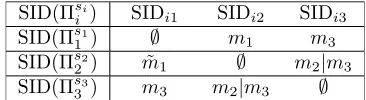
Obviously, Figure 1 shows a correct execution of the protocol since no message is modified. Figure 3 specifies the session ids of the oraclesΠs1
1 , . . . , Π s3
3 during this honest protocol execution using the construction from the BCPQ model.
SID(Πsi
i ) SIDi1 SIDi2 SIDi3
SID(Πs1
1 ) ∅ m1 m3
SID(Πs2
2 ) m1 ∅ m2|m3
SID(Πs3
3 ) m3 m2|m3 ∅
Fig. 3.SID(Πsi
i )in the honest protocol execution
SID(Πsi
i ) SIDi1 SIDi2 SIDi3
SID(Πs1
1 ) ∅ m1 m3
SID(Πs2
2 ) m˜1 ∅ m2|m3
SID(Πs3
3 ) m3 m2|m3 ∅
Fig. 4.SID(Πsi
i )in the protocol execution with imper-sonation ofU1
To show the first problem we consider the case whereAimpersonatesU1 and modifies messagem1 tom˜1 (Figure 2) such thatSID21 = ˜m1(Figure 4). Wecannotgenerally assume that all oracles accept after this mod-ification but we may assume that there exists protocols for which this is the case (our example later is such a protocol where the oracles nevertheless accept). If so, we show that every participating oracleΠsi
i accepts with
|PIDS(Πsi
i )| = 2. To that goal, we need to show thatΠ si
i ! Π sj
j (orΠ si
i ↔ Π sj
j ) still holds for any two participating Πsi
i andΠ sj
j . Thus we need to look more precisely on the session ids of the oracles. First note that SID12 = m1. Though SID(Π1s1)∩SID(Π
s2
2 ) = {m1, m3} ∩ {m˜1, m2|m3} = ∅and thusΠ1s1 6↔ Π s2
2 , we still have SID(Πs1
1 )∩ SID(Π s3
3 ) = {m1, m3} ∩ {m3, m2|m3} = m3 and SID(Π3s3)∩SID(Π s2
2 ) =
{m3, m2|m3} ∩ {m˜1, m2|m3} = m2|m3so thatΠ1s1 ! Π s2
2 (andΠ s1
1 ↔ Π
s3
3 andΠ s2
2 ↔ Π
s3
3 as well). Hence,|PIDS(Πsi
i )| = 2for everyΠ si
Πs2
2 having received a different message than the one originally sent byΠ s1
1 , this may result in different group keys computed byΠs1
1 andΠ s2
2 .
CONCRETE EXAMPLE. Consider the GKE protocol described in the same paper as the BCPQ model [15] but without the additional confirmation round; this additional round belongs to a concrete protocol design but not to a general security model; it is not required that a protocol uses this additional round to achieves MA-security.
Recall, our goal is to show that despite of the acceptance of each oracleΠsi
i with|PIDS(Π si
i )| = 2mutual authentication and key confirmation are not necessarily provided.
The protocol proceeds as described in Figure 5;[m]Ui denotes a messagemsigned byΠ
si
i , andV(m) ?
= 1
its verification;g is a generator of a cyclic group of prime orderp. Upon computingK = gx1x2x3 each oracle
derives the resulting group key k := H(ID, F L3, K)with a random oracle H : {0,1}∗ → {0,1}lwherel is the security parameter. Now we consider thatΠs1
1 choosesx1 ∈ Z?p butAdrops the original message[F l1]U1
Πs1
1 Π
s2
2 Π
s3
3
X3:={gx1x2, gx1x3, gx2x3}
x1∈RZ∗p;X1:={g, gx1}
F l1:={ID, X1} [F l 1]U1
x2∈RZ∗p;X2:={gx1, gx2, gx1x2}
V(F l1) ?
= 1
F l2:={ID, X2}
[F l2]U2
x3∈RZ∗p; V(F l2)
?
= 1
F l3:={ID, X3}
K:= (gx1x2)x3 [F l3]U3
V(F l3) ?
= 1 V(F l3)
?
= 1 K:= (gx2x3)x1 K:= (gx1x3)x2
Fig. 5.Execution of the protocol in [15] with three participants
and replays a corresponding message from some previous protocol execution. The replayed message is likely to be
[F lg1]U1withF lg1:= (ID,Xf1)andXf1:={g, gf
x1}for some
f
x16=x1. Obviously,Π2s2can still verify the replayed message, i.e.,V(F lg1) = 1holds. It is easy to see thatX2 ={gfx1, gx2, gxf1x2}andX3 :={gfx1x2, gfx1x3, gx2x3}
so thatΠs1
1 computesK =g
x1x2x3 whereasΠs2
2 andΠ s3
3 compute another value, i.e.,K =gf
x1x2x3. Thus the
derived group keys are different. Though (without the confirmation round) all oracles accept since all signature verifications remain correct. Moreover, and similarly to the abstract problem description above, it is easy to check that|PIDS(Πsi
i )|= 2for everyΠ si
i ,i∈ {1,2,3}. This illustrates the case where|PIDS(Πsi
i )|= 2and yet the protocol does not provide mutual authentication and key confirmation. We stress, again, that this does not contradict the MA-security of the proposed protocol when the additional round is executed. However, there may exist other protocols (including our example) for which this statement is not true (if the MA-security is tentatively achieved with other techniques), and thus it is worth studying the generality/applicability of MA-security definition in the BCPQ model.
4
Discussion on Technical Constructions of some BCPQ-Variants and their Definitions
of MA-Security
A VARIANT BYKATZ ANDYUNG. The modification by Katz and Yung [33] (denoted as the KY model) suggests a different construction of partner ids and session ids. Thepartner idof an oracleΠsi
i consists of the identities of all group members who intend to participate in the protocol and is defined straight after the invocation of the protocol execution. Hence, opposite to the BCPQ model, this set is known before the protocol completes. Further, thesession idofΠsi
i is simply the concatenation of all messages thatΠ si
i has sent or received during the protocol execution. Note that the KY model was proposed in the context of a GKE protocol over an unreliable asynchronous broadcast channel. Obviously, in this case every oracle computes the same session id. However, the KY model fails in protocols where some messages are sent over unicast, e.g., in protocols from [12–15]. Note, however, that any construction of session ids based on the concatenation of exchanged message flows has one significant drawback — it becomes available after the protocol termination only. Since some protocols use uniqueness of session ids as protection against replay and protocol interference attacks it is desirable to have a unique session id prior to the protocol termination. Thepartneringbetween two oracles holds if they have equal partner ids and equal session ids. Note that the KY model does not provide own definition of MA-security but refers to the one in the BCPQ model. Due to the different construction of partnering the identified problems in the BCPQ model have no consequences here.
Finally, another limitation of the KY model is that it is not intended for considering malicious participants.
A VARIANT BY DUTTAet al. The modification by Duttaet al. [27] is similar to the KY model regarding the construction ofpartner ids. However, they define asession idof an oracleΠsi
i as{(U1, s1), . . . ,(Un, sn)}where each pair(Uj, sj),j ∈ {1, . . . , n}corresponds to the oracleΠsj
j of the protocol participantUj, and say that two oracles arepartneredif they have equal partner ids and equal session ids. In order to keep session ids unique the authors require the uniqueness of oracles for each new session. To have this notion made sense, [25] suggests to use a counter value as an additional parameter which should be increased for every new oracle of the user. Though this makes unique session ids available prior to the protocol termination, it forces the counter to be saved after each execution and protected against modifications. A more practical approach seems to be using nonces in each new protocol execution (excluding the highly improbable case of collisions). Note also that [27] and [25] had no intentions to consider mutual authentication and key confirmation.
A VARIANT BY KATZ ANDSHIN. Katz and Shin [32] proposed a different security model (referred to as the KS model) for GKE protocols, and provide a security analysis in the framework of Universal Composability (UC) [20]. The KS model provides the first formal treatment of GKE protocols security in the presence of malicious participants. The KS model is an extension of the BCPQ and KY models. The partner ids and the partnering relationship between the oracles is similar to the KY model but unique session ids are assumed to be provided by some high-level application mechanism.
Among other things, the KS model definessecurity against insider attacksas a combination of two require-ments:agreementandsecurity against insider impersonation attacks:
– the adversaryAis said toviolate agreementif there exist two partnered oraclesΠs
i andΠjtsuch that neither UinorUjis corrupted butΠisandΠjthave accepted with different session keys. Intuitively, this considers key confirmation in case that all other participants are malicious (corrupted);
– the adversaryAis said toimpersonateUjto (accepting)ΠisifUjis uncorrupted and belongs to the (expected) partner id ofΠisbut in fact no oracleΠjtis partnered withΠis. In other words, the instanceΠiscomputes the session key andUibelieves thatUjdoes so, but in fact an adversary has participated in the protocol on behalf ofUj; a protocol is said to besecure against insider impersonation attacksif for any partyUjand any instance Πs
i,Acannot impersonateUj toΠisunder the (stronger) condition that neitherUjnorUiis corrupted at the timeΠs
i accepts.
participants. Intuitively, security against insider impersonation attacks considers mutual authentication and un-known key-share resilience in the presence of malicious participants. Note that the KS model does not describe what relationship do their formal definitions have with the well-known informal definitions. Their security analysis holds in the framework of UC-security, based on the simulatability approach [19] rather than on a reductionist approach [6, 37].
Further, in addition to their model, Katz and Shin proposed a compiler to turn any GKE protocol which is secure in the BCPQ model into a protocol which is secure in their UC-based model, and provided simulatability-based security proofs for this case. However, they left open the question whether their definitions of agreement and security against insider impersonation attacks are practical enough for the construction of reductionist security proofs (even though UC-security is considered to be stronger).
5
The Revised “Game-based” Security Model
In the following we propose a new variant of the BCPQ model while considering malicious participants. We provide an alternative definition (which we call MA-security to keep consistency with all previous models) that can be used to replace definitions of agreement and security against insider impersonation attacks of the KS model. One advantage is that, for the same requirements, our model needs only one definition (and consequently one reductionist proof) whereas in the KS model two definitions are needed. Furthermore, we prove that our definition really unifies the informal notions of key confirmation, mutual authentication and unknown key-share resilience in the presence of malicious participants while the KS model does not explicitly prove this.
Our variant is based on the refined BCPQ model as presented in [13], a refinement that considersstrong cor-ruptions, i.e., attacks against internal states. We also extend the original definition of AKE-security (in a modular way) considering a new requirement which we callbackward secrecy.
5.1 Protocol Participants, Variables
USERS, INSTANCE ORACLES. We considerU as a set ofN users in the universe. Each userUi ∈ U holds a long-lived keyLLi. In order to handle participation ofUiin distinct concurrent protocol executions we consider thatUi has an unlimited number of instances calledoracles;Πis, withs∈ N, denotes thes-th instance oracle of
Ui.
INTERNALSTATES. EveryΠs
Umaintains aninternal state informationstatesUwhich is composed of all private, ephemeral information used during the protocol execution. The long-lived keyLLUis, in nature, excluded from it (moreover the long-lived key is specific to the user, not to the oracle).
SESSIONGROUPKEY, SESSIONID, PARTNERID. In each session we consider a new groupG ofn ∈ [1, N]
participating oracles. Each oracle inGis called agroup member. ByGifori∈ [1, n]we denote the index of the user related to thei-th oracle involved inG(thisi-th oracle is denotedΠ(G, i)). Thus, for everyi ∈ [1, n]there existsΠ(G, i) = Πs
Gi ∈ G for some s ∈ N. Every participating oracleΠ
s
U ∈ G computes thesession group
key ksU ∈ {0,1}κ. Every session is identified by a uniquesession id
sidsU. This value is known to all oracles participating in the same session. Similarly, each oracleΠUs ∈ G gets a valuepidsU that contains the identities of participating users (includingU), or formally
pidsU :={UGj |Π(G, j)∈ G, ∀j = 1, . . . , n}.
We say that two oracles,Πsi
i andΠ sj
j , arepartneredifUi∈pid sj
j ,Uj∈pid si
i , andsid si
i =sid sj
j . INSTANCE ORACLESTATES: STAND-BY, PROCESSING, ACCEPTED, TERMINATED. An oracleΠs
U may be ei-therusedorunused. The oracle is considered as unused if it has never been initialized. Each unused oracleΠs
possiblysidsU) and turns into aprocessingstate where it sends, receives and processes messages according to the description of the protocol. During the whole processing state the internal state informationstatesUis maintained by the oracle. The oracleΠUs remains in the processing state until it collects enough information to compute the session group keyks
U. AfterΠ s
U computesk s
U itacceptsandterminatesthe execution of the protocol operation (possibly after some additional auxiliary steps), meaning that it would not send or receive further messages. If the protocol execution fails (due to any adversarial actions) thenΠs
U terminates without having accepted, i.e., the session group keyks
Uis set to some undefined value.
5.2 Definition of a Group Key Exchange Protocol
Definition 1 (GKE Protocol).A group key exchange protocolPconsists of a key generation algorithmKeyGen, and a protocolSetupdefined as follows:
P.KeyGen(1κ): On input a security parameter1κeach user inU is provided with a long-lived keyLLU.
P.Setup(S): On input a setSofnunused oracles a new groupGis created and set to beS, then a probabilistic interactive protocol is executed between oracles inG.
We callP.Setupanoperation. We say that a protocol iscorrectif all oracles inGaccept with the same session group keyk. We assume it is the case for all protocols in this paper.
5.3 Adversarial Model
QUERIES TO THEINSTANCE ORACLES. The adversaryAis represented by a PPT machine and is assumed to have complete control over all communication in the network. It may interact with group members by making the following oracle queries:
– Setup(S): This query modelsAeavesdropping the honest operation execution ofP.Setup.P.Setup(S)is executed andAis given the transcript of the execution.
– Send(ΠUs, m): This query modelsAsending messages to the oracles. Areceives the response whichΠUs would have generated after having processed the messagemaccording to the description ofP. The adversary can ask an oracleΠUs to invokeP.Setupwith the oracles inSvia the query of the formSend(ΠUs,S)which givesAthe first message thatΠUs would generate in this case. Thus, usingSendqueries the adversary can actively participate inP.Setup.
– RevealKey(Πs
U):Ais given the session group keyk s
U. This query is answered only ifΠ s
U has accepted. – RevealState(Πs
U):Ais given the internal state informationstatesU.6 – Corrupt(U):Ais given the long-lived keyLLU.
– Test(ΠUs): This query will be used to model the AKE-security of a GKE protocol. It can be asked byAat any time, to any oracle having accepted, but only once during the entire attack. The query is answered as follows: the oracle generates a random bitb. Ifb= 1thenAis givenks
U, and ifb= 0thenAis given a random string. Apassiveadversary can eavesdrop the execution of the protocol operations viaSetupqueries, reveal session group keys, internal states and corrupt participants viaRevealKey,RevealState, andCorruptqueries, respectively, and is also allowed to askTestqueries. Additionally, it is given access to theSendqueries, however, with the restriction that it is not allowed to inject, replay, or modify messages. Thus, a passive adversary can truly forward, drop, and delay messages, or deliver them out of order. Although Setup queries can be simulated using Sendwith the appropriate invocation messages, the presence of these queries still allows a separate treatment of the (weaker) passive adversaries who are restricted to the eavesdropping of the protocol execution in the sense of [33]. Note that in our model the passive adversary is stronger than in [33] and is comparable to the one from [21].
6This kind of the adversarial query has previously been mentioned by Canetti and Krawczyk in their model for two-party
FORWARDSECRECY. The notion of forward secrecy allows to distinguish between damages (in previously com-pleted sessions) that result from actions of the adversary in the current session. Similar to [13] we distinguish between weak-forward secrecy (wfs) where the adversary is additionally allowed to ask Corruptqueries, and
strong-forward secrecy(sfs) where it is additionally allowed to askCorruptandRevealStatequeries.
BACKWARDSECRECY. The notion of backward secrecy is symmetric to that of forward secrecy in the sense that it considers damages to the AKE-security of future sessions after actions of the adversary in past/current sessions. The notion might seem useless at first glance (such actions can make secrecy just impossible), however, there might exist intermediate actions, such as corruptions of internal states, that do not compromise future session keys (or at least not all of them). We distinguish betweenweak-backward secrecy(wbs) where the adversary is allowed to askRevealStatequeries, andstrong-backward secrecy(sbs) where the adversary is additionally allowed to ask
Corruptqueries7.
Note that in our definition of AKE-security that models key secrecy, the adversary is a non-participating party and not a malicious participant, even in case that it reveals long-lived keys prior to the protocol execution. In order to consider only non-participating adversaries we introduce the following notion ofα-fresh sessions.
ORACLEFRESHNESS, CORRUPTIONMODELS, ADVERSARIALSETTINGS. The notion of freshness for an oracle Πs
Uis needed to distinguish between various definitions of security with respect to different flavors of backward or forward secrecy. Each flavorα∈ {∅,wbs,wfs,sbs,sfs}leads to a different definition of freshness.
Definition 2 (α-Freshness).Letα∈ {∅,wfs,wbs,sfs,sbs}. The oracleΠs U ∈ Gis
∅-fresh if: neitherΠs
U nor any of its partners is asked for aRevealKeyquery after having accepted; wbs-fresh if: (1) neitherΠs
U nor any of its partners is asked for aRevealStatequery afterGis created, and (2)
neitherΠs
U nor any of its partners is asked for aRevealKeyquery after having accepted; wfs-fresh if: (1) noUi ∈ pidsU is asked for aCorruptquery prior to a query of the formSend(Π
sj
j , m)such
thatUj∈pidsU beforeΠUs and all its partners accept, and (2) neitherΠUs nor any of its partners is asked for
aRevealKeyquery after having accepted;
sbs-fresh if: (1) noUi ∈ pidsU is asked for aCorruptquery prior to a query of the formSend(Π sj
j , m)such
thatUj ∈pidsU afterGis created, (2) neitherΠUs nor any of its partners is asked for aRevealStatequery
afterGis created, and (3) neitherΠs
U nor any of its partners is asked for aRevealKeyquery after having
accepted;
sfs-fresh if: (1) noUi ∈ pidsU is asked for aCorruptquery prior to a query of the formSend(Π sj
j , m)such
thatUj ∈pidsU beforeΠUs and all its partners accept, (2) neitherΠUs nor any of its partners is asked for a RevealStatequery before they accept, and (3) neitherΠs
U nor any of its partners is asked for aRevealKey
query after having accepted.
We say that asession isα-freshif all participating oracles areα-fresh.
The above definition is given from the perspective of an oracle which participates in a concrete operation execution ofP. Note that in our model a new groupGis created for every invoked operation, i.e., new session. In the following we provide some additional explanations concerning our definition ofα-freshness.
Obviously, thewfs-freshness allowsCorruptqueries to any user inU after the oracles in G have accepted whereas thesfs-freshness allows, additionally,RevealStatequeries to any oracle of any user inUafter the oracles inGhave accepted. Beside this, thewfs-freshness allowsCorruptqueries in previous and concurrent operations to any user inU who does not have an oracle inG whereas thesfs-freshness allows, additionally,RevealState
queries in previous and concurrent operations to all oracles that do not belong toG.
The notion ofα-fresh sessions becomes important in security proofs in order to distinguish between “honest” and “corrupted” sessions. Intuitively, the above definitions are to be used as follows. In each of the secrecy cases
7
considered, either the adversary is not allowed to ask some “bad” queries, more precisely such queries are allowed but immediately make the oracle unfresh. The scenario aims to delimit the “bad” queries. To properly manage the adversarial capabilities for each scenario of freshness, we distinguish between the following corruption models. Definition 3 (Corruption Modelβ).A PPT adversaryAis an adversary that acts with respect to the corruption modelβaccording to the following definition:
weak corruption modelwcm : An adversaryAcan ask the queriesSetup,Send,TestandRevealKey.
weak corruption model for forward secrecywcm-fs : An adversary A is given access to the queries Setup,
Send,Test,RevealKey, andCorrupt.
weak corruption model for backward secrecywcm-bs : An adversaryAis given access to the queriesSetup,
Send,Test,RevealKeyandRevealState.
strong corruption modelscm : An adversaryAis given access to the queriesSetup,Send,Test,RevealKey,
RevealStateandCorrupt.
A concrete proof of AKE-security needs to specify capabilities of the adversary depending on the intended freshness type. Combining definitions for freshness and corruption we obtain a set of reasonableadversarial set-tings(α, β)∈ {(∅,wcm),(wfs,wcm-fs),(wbs,wcm-bs),(sbs,scm),(sfs,scm)}. Note that other imaginable set-tings are not reasonable from the perspective of the attacks. Nevetheless, separation in five types of freshness and four types of corruption models allows to talk about the corruption model in a general way, that is not necessarily in the context of AKE-security (but also wrt. other security requirements).
Remark 1. In practice long-lived keys are mostly used to achieve authentication rather than for the actual group key computation. It is thus intuitively clear that if an adversary is able to corrupt a group member (obtaining its long-lived key) then it can impersonate that member in subsequent sessions. Therefore, achieving AKE-security in the(sbs,scm)sense would require the long-lived keys to be fresh for each new execution, a contradiction with the long-lived key terminology. To the contrary, the adversarial setting(wbs,wcm-bs)appears of great interest since it concerns only oracle internal state information and is independent of any long-term secrets. Moreover we argue that(wbs,wcm-bs)is important since in previous models [13, 32] a persistent internal state is used in both past and future sessions, and thus, while forward secrecy looks at (state) corruptions in later sessions, backward secrecy must legitimately look at state corruptions in previous sessions.
5.4 Security Goals
In this section we describe security goals for a GKE protocol. We give a formal definition of (Authenticated)KeyExchange-security (indistinguishability of session group keys), and a new definition of MA-(Authenticated)KeyExchange-security that considers malicious participants and internal state corruptions of honest participants.
Definition 4 ((A)KE-Security).LetPbe a correct GKE protocol andba uniformly chosen bit. Consider a rea-sonable adversarial setting(α, β)and an (active) adversaryA. We define gameGame(a)keα,β,P−b(A, κ)as follows:
– after initializationAinteracts with instance oracles using queries;
– ifAasks aTestquery to anα-fresh oracleΠUs which has accepted, it receives eitherkey1:=kUs (ifb= 1)
orkey0∈R{0,1}κ(ifb= 0);
– Acontinues interacting with instance oracles;
– whenAterminates, it outputs a bit trying to guess which case it was dealing with.
The output ofAis the output of the game. The advantage function (over all adversaries running within timeκ) in winning the game is defined as
Adv(a)keα,β,P(κ) := max
A 2 Pr
h
Game(a)keα,β,P−b(A, κ) =bi−1
We emphasize that at this step we do not consider malicious participants (users), but only (partially) corrupted oracles for dealing with forward- and backward-secrecy.
The following definition of MA-security considers an adversary who is allowed to corrupt and act on behalf of participants during the protocol execution.
Definition 5 (MA-Security).LetPbe a correct GKE protocol andGamemaP (A, κ)the interaction between the in-stance oracles and an active adversaryAwhich can querySend,Setup,RevealKey,RevealState, andCorrupt. We say thatAwinsif at some point during the interaction there exist an uncorrupted userUiwhose instance oracle
Πsi
i has accepted withk si
i and another userUjwithUj ∈pid si
i that is uncorrupted at the timeΠ si
i accepts, such
that
1. there existsnoinstance oracleΠsj
j with(pid sj
j ,sid sj
j ) = (pid si
i ,sid si
i ),or
2. there existsaninstance oracleΠsj
j with(pid sj
j ,sid sj
j ) = (pid si
i ,sid si
i )that accepted withk sj
j 6=k si
i .
The maximum probability of this event (over all adversaries running within timeκ) is denotedSuccmaP (κ). We say
that a GKE protocolPisMA-secure(MAGKE) if this probability is a negligible function ofκ.
Note thatUiandUjmust be uncorrupted, however,Ais allowed to reveal internal states of their oracles. Hence, our MA-security definition seems to be stronger than definitions of security against insider attacks in the KS model. Note also that we do not deal withα-fresh sessions since malicious participants learn established keys implic-itly. Also inGamemaP (A, κ)the adversarialTestquery is useless. In the next section we show how this definition subsumes informal requirements of unknown key-share resilience, key confirmation, and mutual authentication (note that this is missing for the definitions in [32]).
6
Claims Concerning MA-Security
In the following we present some claims to illustrate the relationship between our definitions of MA-security and the related mostly important informal notions concerning key confirmation, mutual authentication and unknown key-share resilience, since this relationship may be difficult to see at first sight. The informal definition ofkey confirmation[39] refined wrt. to the arguments in [43] means that each protocol participant must be assured that all other protocol participant that have accepted hold identical group keys. The notion ofmutual authentication
introduced in [8] for two-party protocols when considered for group key exchange protocols means that each identified protocol participant is known to actually possess the established group key. Note that this requirement is similar toexplicit key authentication[39]. The related requirement calledunknown key-share resiliencesurfaced in [24] means that an active adversary must not be able to make one protocol participant believe that the key is shared with one party when it is in fact shared with another party. Note that the adversary may be a malicious participant and does not need necessarily to learn the established key [10].
The missing formalism of the original informal definitions allows only argumentative proofs for our claims. We also stress that none of the previously proposed models provides such claims for their definitions.
Claim. IfPis aMAGKEprotocol then it provides key confirmation and mutual authentication (explicit key authen-tication), i.e., every legitimate protocol participant is assured of the participation of every other participant, and all participants that have accepted hold identical session group keys.
Proof. IfP does not provide key confirmation and mutual authentication then there exists at least one honest participantUi∈ Gwhose oracleΠsi
i has accepted with a session group keyk si
i and there exists at least one another honest participant Uj ∈ pidsi
i whose oracleΠ sj
j has accepted with a different session group keyk sj
j 6= k si
i . According to Definition 5 this is a successful attack against the MA-security ofP. This, however, contradicts to the
assumption thatPis aMAGKEprotocol. ut
Proof. With respect to our model we assume that oraclesΠsj
j andΠ si
i participate in the protocol on behalf ofUj andUi, respectively. If an unknown key-share attack occurs thenΠsj
j andΠ si
i accepted with the identical session groupk, but since Πsj
j believes that the key is shared withAwe conclude thatUi 6∈ pid sj
j must hold (other-wise after having acceptedUj would believe that the key is shared withUi) whereasUj ∈ pidsii. This implies
(pidsj
j ,sid sj
j )6= (pid si
i ,sid si
i ). On the other hand,Pis by assumptionMAGKE. Thus, for anyUj∈pid si
i there must exist a corresponding oracleΠsj
j such that(pid sj
j ,sid sj
j ) = (pid si
i ,sid si
i ). This is a contradiction. ut
7
Compiler for AKE-Security and MA-Security under Standard Assumptions
7.1 Security-Enhancing Compilers and their Goals
Imagine, there exists ablack-boximplementation of a GKE protocol which should be used by some group appli-cation. Assume this GKE implementation provides strong security properties but not all of them are in fact needed for the application. This means that some communication or computation resources are uselessly spent, resulting in a less efficient high-level application.
Assume, on the other hand, that the given GKE implementation does not satisfy all security requirements desired for the particular group application. Instead of designing and implementing a new GKE protocol in an ad-hocfashion, it is desirable to have a generic technique which can be applied to the givenblack-boximplementation in order to enhance its security.
We are thus concerned with the following question. What is a good strategy for the implementation of GKE protocols? Of course this depends on the relationship between the protocol and the application using it. Should the protocol be designed for a very specific application (and not likely to be re-used), it might be better to con-sider all stated requirements in the implementation and optimize the protocol accordingly. However, what to do if the GKE implementation should be flexible and easily modifiable, in order to be reused by various applications without any significant additional effort? Obviously, a good strategy (though not always optimal) is to implement a GKE protocol in a modular way: one starts with the basic implementation that satisfies the most common set of security requirements, then continues with the implementation of optional modules that can be added to provide extended security requirements. The main goal of security-enhancing GKE protocol compilers is to enable secure construction of GKE protocols in such a modular way.
Definition 6 (Security-Enhancing GKE Protocol CompilerC).Asecurity-enhancing GKE compilerCis a pro-cedure which takes as input a GKE protocolPand outputs a compiled GKE protocolCP with additional security
properties possibly missing inP.
7.2 Discussion on Existing Compilers for GKE Protocols
In the following we provide some analysis on currently known security-enhancing compilers for GKE protocols. Each compiler description holds in the perspective of one particular operation execution (session). Therefore, byΠis ∈ G we consider thei-th oracle inG assuming that there exists an indexj ∈ [1, N]such thatUj owns Πis. Similar, bysk0iandpki0(resp.,skiandpki) we denote the private and public keys ofUjused in the compiled protocol (resp., in the underlying protocol).
Definition 7 (Compiler for AKE-Security by Katz and Yung [33])).LetPbe a GKE protocol andΣ:= (Gen,
Sign,Verify)a digital signature scheme. Acompiler for AKE-securityconsists of an initialization algorithm and a modified protocol execution defined as follows:
Initialization: In the initialization phase eachUi ∈ U generates own private/public key pair(sk0i, pk0i)
usingΣ.Gen(1κ0). This is in addition to any key pair(sk
i, pki)used inP.
The protocol: This is an interactive protocol between the partnered oracles Πs
1,. . .,Πns invoked prior to
any operation execution ofP. EachΠischooses a random nonceri ∈R {0,1}κ and sendsUi|0|ri to every
partnered oracleΠjs. AfterΠisreceivesUj|0|rj from all partnered oracles it computessidsi := U1|r1|. . .
|Un|rn. Then, members ofGexecutePwith the following changes:
– IfΠisis supposed to send a messageUi|t|mthen it computes additionallyσi:=Σ.Sign(ski0,t|m|sidsi)
and outputs a modified messageUi|t|m|σi.
– IfΠs
i receivesUj|t|m|σj it checks whether (1)Uj ∈pid s
i, (2)tis the next expected sequence number,
and (3)Σ.Verify(pkj0,t|m|sidsi,σj)= 1? . If any of these verifications fail thenΠs
i terminates without
accepting; otherwise it proceeds according to the specification ofPupon receivingUj|t|m.
– AfterΠs
i computes the session group keykisin the execution ofPit accepts with this key.
Missing Generality of Katz-Yung Compiler Katz and Yung proved security of this compiler assuming an unreliable asynchronous broadcast channel and a passive adversary, which is only aneavesdropper. We show that in this case their compiler is not really generic: there exist GKE protocols that are secure against eavesdroppers but become insecure against active adversaries (even after the execution of the above compiler).
We consider the following (pathologic, but illustrative) protocol betweenΠs
1 andΠ1s. First Π1s chooses his exponentx1 ∈R Z?q and sendsX1 := gx1 toΠ2s. IfΠ2s receivesX1 within some specified time periodδthen Πs
2 replies with X2 := gx2 for some randomly chosenx2 ∈R Z?q and accepts with the Diffie-Hellman session keygx1x2. Similar ifΠs
1receivesX2within timeδthen it accepts withgx1x2 too. However, if an oracle does not receive data in time, it accepts withg. If the passive adversary is just an eavesdropper, messages are delivered on time, and the protocol is “passively” secure. But an active adversary can drop messages so that both participants accept withg. Obviously, it is insufficient to restrict passive adversaries to be just eavesdroppers. Passive attacks should also model the unreliability of the communication, like we do.
Further, the compiler in [33] assumes that each sent message is of the formUi|t|mwheretis a sequence number which starts with 0 and is incremented each time an oracleΠs
i sends a new message. Before any received message is processed by the original protocolPthe compiler checks whether this message is expected or not with respect to the next expected sequence number. Note that Katz and Yung introduced sequence numbers in order to simplify the description of their proofs. In our setting we can easily omit sequence numbers since any protocol which is KE-secure in our setting resists attacks based on modification of the delivery order of the protocol messages. Note also that sequence numbers do not provide any additional security advantages for the protocol (e.g., they do not protect against replay attacks). Another reason is that in order to check whether a message is expected or not the compiler must explicitly know the total number of messages required in the protocol execution. Thus, these numbers should be additionally given as input to the compiler. This additional effort must be applied for each GKE protocol to be used with the compiler. This can be considered as an additional inconvenience, especially if the protocol’s implementation is available as a “black-box” that allows access only to the established group key.
Compilers for MA-Security The first compiler for key confirmation and mutual authentication was proposed by Bressonet al.[15]. However, their definition of MA is (de facto) the old one, and the proof is conducted in the Random Oracle Model [8].
Katz and Shin [32] showed how to turn an AKE-secure GKE protocol into a UC-secure GKE protocol that provides security against insider attacks (see Section 4).
It requires a EUF-CMA digital signature schemeΣ, and a collision-resistant pseudo-random functionf (see Appendix A for details).
{0,1}λ,λ∈
Nand domain{0,1}κ, andsidsiis a unique session id. Acompiler for security against insider attacks
consists of an initialization algorithm and a protocol defined as follows:
Initialization: eachUi∈ Ugenerates his own additional private/public key pair(ski0, pki0)usingΣ.Gen(1κ0).
The protocol: After an oracleΠs
i accepts with(ksi,pid s i,sid
s i)inP: – it computesµi:=fks
i(v0)wherev0is a constant public value;
– it computesKs i :=fks
i(v1)wherev16=v0is another constant public value;
– it erases its local state information except forµi,Kis,pidsi, andsidsi;
– it computes a signatureσi:=Σ.Sign(ski0,µi|sidis|pidsi)and sendsUi|σito its partnered oracleΠjs. AfterΠsi
i receivesUj|σjfrom all its partnered oracleΠ s j: – it checks whetherΣ.Verify(pk0j, µi|sidsi|pidsi, σj)
?
= 1;
– if all checks pass, it accepts with the session keyKis.
Working in the UC framework, Katz and Shin assume that session ids are unique and specified by some high-level application (see [4] for setting up session ids in the UC framework). In this case the above compiler can be proven to satisfy our MA-security requirement. On the other hand, if such unique session ids are not available then it is obvious that some additional communication rounds are needed to set up such session ids. Intuitively, leaving out session ids would allows replay attacks against the compiled protocol as illustrated in the following.
Imagine, the adversaryAcorrupts n−2 participants (except for Ui andUj) in some previous session and behaves honestly in another session. Thus, he learns the keyk¯itcomputed in that session and the messageUi|¯σi sent byΠitduring the compiler round of that session. Remind,σi¯ is computed onpidti andµi¯ =f¯kt
i(v0). After
the compiled protocol is executedAinvokes a new session with the same protocol participants. Thus, usersUiand Ujparticipate via fresh oraclesΠisandΠjs, respectively. Note also that we havepidsi =pidti. Let us assume that
Acan influenceΠs
j in some way such that it computeskjs= ¯ktiandΠiscomputes a different keyksi 6= ¯kit. ThenA intercepts (and drops) the original messageUi|σiand replaysUi|¯σitoΠjs. Becauseµj=fks
j(v0) =f¯kit(v0) = ¯µi,
oracleΠs
j verifiesσ¯isuccessfully butksj 6=kis(which results inKjs6=Kis). Thus, uncorrupted oraclesΠisandΠjs accept with different session keys.
7.3 CompilerC-AMA
In the following we describe a compiler (denotedC-AMA) which provides both AKE- and MA-security for any GKE protocolPwhich satisfies the basic requirement of (unauthenticated) KE-security wrt. to our security model, i.e., where the passive adversary is given access to the querySendbut is restricted not to modify, replay, or introduce protocol messages.C-AMAcombines KY and KS compilers whereby slight modifications are applied (as mentioned in the previous chapter).
C-AMAuses digital signatures and collision-resistant pseudo-random functions (see Appendix A for details) and can be proven secure in the standard model.C-AMAuses nonces to achieve uniqueness of protocol sessions and security of concurrent executions without relying on session ids given by high-level applications.
Definition 9 (Compiler for AKE- and MA-Security C-AMA). Let P be a GKE protocol, Σ := (Gen,Sign, Verify)a digital signature scheme,F :=
fk
k∈{0,1}κ a function ensemble with range {0,1}
λ,λ ∈
Nand
domain{0,1}κ. Acompiler for AKE-security and MA-security, denoted
C-AMA, consists of an algorithmINITand a protocolAMAdefined as follows:
INIT: eachUi∈ U generates own private/public key pair(ski0, pk0i)usingΣ.Gen(1κ 0
).
AMA: prior to the execution ofP:
– EachΠischooses aAMA nonceri∈R{0,1}κand sendsUi|rito its partners. – AfterΠs
i receives allUj|rj, it computessid s
i :=r1|. . .|rn.
Then it invokes the execution ofPand proceeds as follows:
– IfΠisinPoutputs a messageUi|mthen inC-AMAPit computes additionallyσi:=Σ.Sign(sk0i,m|sid s i|pid
s i)
– On receivingUj|m|σj from a partnerΠs
j it checks whetherΣ.Verify(pk0j,m|sid s i|pid
s i,σj)
?
= 1. If this fails thenΠs
i terminates; otherwise it proceeds as inPupon receivingUj|m. – After an oracleΠs
i computeskisinPit computes anAMA tokenµi := fksi(v0)wherev0is a constant
public value, a signature σi := Σ.Sign(ski0,µi|sidsi|pidsi)and sendsUi|σi to everyΠs
j withUj ∈ pidsi.
– On receivingUj|σjfrom its partner,Πischecks ifΣ.Verify(pk0j, µi|sidsi|pidsi, σj) ?
= 1.
– If all checks pass,Πs
i computesKis :=fks
i(v1)wherev1 6=v0is another constant public value, erases
all private state information fromstatesi (includingks
i) and accepts withKis.
PERFORMANCEANALYSIS. C-AMArequires two further rounds: one to exchange random nonces and another one to exchange signatures on AMA tokens. As for the computation costs, every participant generates one signature for every message sent duringPand one additional signature on the computed AMA token. Furthermore, every participant must verify one signature for every incoming message inPandn−1signatures during the additional confirmation round. The computation of the AMA tokenµand of the session keyKcan be seen as negligible.
SECURITYANALYSIS. Our first theorem shows thatC-AMAadds AKE-security to any KE-secure GKE protocol. Following Remark 1, we do not consider the adversarial setting(sbs,scm). Well-known definitions of EUF-CMA-security forΣas well as pseudo-randomness and collision-resistance forFcan be found in Appendix A.
Theorem 1 (AKE-Security ofC-AMAP).Let(α, β)∈ {(∅,wcm),(wbs,wcm-bs),(wfs,wcm-fs),(sfs,scm)}be an
adversarial setting, letPbe aGKE-αprotocol, andAan active adversary in the corruption modelβlaunching at mostqssessions ofC-AMAP. IfΣis EUF-CMA andFis pseudo-random thenC-AMAPisAGKE-α, and
Advakeα,β,C-AMAP(κ)≤2NSucc
euf−cma Σ (κ) +
N q2s
2κ−1 + 2qsAdv
ke
α,β,P(κ) + 4qsAdvprfF (κ).
Proof. In our proofs we use a well-known proving technique calledsequence of games[44] which allows to reduce complexity of “reductionist” security proofs for complex cryptographic protocols, and became meanwhile standard for security proofs of group key exchange protocols, e.g., [1, 13, 14, 26, 27, 34].
We define a sequence of gamesGi,i= 0, . . . ,6and corresponding eventsWinakei as the events that the output bitb0ofGiis identical to the randomly chosen bitbinGameakeα,β,C-AMA−b P(A, κ).
GameG0:This game is the real gameGameakeα,β,C-AMA−b
P(A, κ)played between a simulatorSand an active adversary
A. Assume that theTestquery is asked to anα-fresh oracleΠis. Keep in mind that on the test query the adversary receives either a random string or a session group keyKs
i.
GameG1:This game is identical toG0with the only exception that the simulation fails and bitb0is set at random ifAasks aSendquery on someUi|m|σ(orUi|σ) such thatσis a valid signature that has not been previously output by an oracleΠs
i before queryingCorrupt(Ui). In other words the simulation fails ifAoutputs a successful forgery. In order to estimatePr[Forge]we show that usingAwe can construct a EUF-CMA forgerFagainst the signature scheme Σas follows.F is given a public keypk and has access to the corresponding signing oracle. During the initialization ofC-AP,F chooses uniformly at random a userUi∗ ∈ U and definespki0∗ :=pk. All other key pairs, i.e.,(sk0i, pki0)for everyUi6=i∗ ∈ Uare generated honestly usingΣ.Gen(1κ).Fgenerates also all key pairs(ski, pki)withUi∈ Uif any are needed for the original execution ofP. The forger simulates all queries of Ain a natural way by executingC-AP, and by obtaining the necessary signatures with respect topki0∗ from its signing oracle. This is a perfect simulation forAsince by assumption noCorrupt(Ui∗)may occur (otherwise
F would not be able to answer it). AssumingForgeoccurs,Aoutputs a new valid message/signature pair with respect to somepk0i; sincei∗was randomly chosen and the simulation is perfect,Pr[i=i∗] = 1/N. In that case
Foutputs this pair as its forgery. Its success probability is given byPr[Forge]/N. This implies
|Pr[Winake1 ]−Pr[Win
ake
0 ]| ≤NSucc euf−cma
Σ (κ). (1)
sessions, the probability that a randomly chosen A nonceri appears twice isqs2/2κfor one particular user. Since there are at mostN users we obtain
|Pr[Winake2 ]−Pr[Win
ake
1 ]| ≤ N q2
s
2κ . (2)
This game implies thatsidsicomputed by any uncorrupted user’s oracleΠs
i remains unique for each new session. Note thatsidsi is used to generate signatures in theAMAprotocol of the compiler. This prevents any replay attacks ofA.
GameG3:This game is identical toG2except that the following rule is added:Schoosesqs∗∈[1, qs]as a guess
for the number of sessions invoked beforeAasks the queryTest. If this query does not occur in theqs∗-th session then the simulation fails and bit b0 is set at random. Let Qbe the event that this guess is correct. Obviously,
Pr[Q] = 1/qs. Thus, we get
Pr[Winake3 ] = Pr[Win
ake
3 ∧Q] + Pr[Win
ake
3 ∧ ¬Q]
= Pr[Winake3 |Q] Pr[Q] + Pr[Win
ake
3 |¬Q] Pr[¬Q]
= Pr[Winake2 ]
1
qs +1
2
1− 1
qs
.
This implies
Pr[Winake2 ] =qs
Pr[Winake3 ]−
1 2
+1
2. (3)
Game G4:In this game we consider the simulator S as a passive adversary against the KE-security of Pthat participates inGamekeα,β,P−1(S, κ), i.e., theTestquery ofS to an acceptedα-fresh oracleΠs
i inPis answered with the real session group keyks
i. In the following we show howSanswers the queries ofA.
We focus on the construction w.r.t. the adversarial settings(wfs,wcm-fs)and(sfs,scm)and describe a simpler construction for the settings(∅,wcm)and(wbs,wcm-bs)at the end of the proof. Note that in case of(wfs,wcm-fs)
and(sfs,scm)the active adversaryAis given access to theCorruptquery and can actively participate in the protocol execution viaSendqueries in any session which is notα-fresh. Thus, if the guess ofS is correct then no active participation ofAin theqs∗-th session is possible. Also none of the oracles participating in the q∗s-th session can be asked for aRevealStatequery, and after these oracles have accepted none of them can be asked for aRevealKeyquery either. With these observations in mind we constructSas follows.
S corrupts every userUi ∈ U to obtain the long-lived key pair(ski, pki)used in the original protocolP(if any such keys are defined). Then, S generates all key pairs (ski0, pki0)honestly using Σ.Gen(1κ), and provides the active adversaryAwith the set of the public keys{pk0i, pki}Ui∈U.S initializes the listTListand runsAas a
subroutine.
The idea of the reduction is that in all sessions except for theqs∗-th sessionSexecutes the operation ofC-AMAP itself, whereas in theq∗s-th sessionSasks ownSetupquery to obtain a transcriptTfor the operation execution of Pwhich it extends to a transcriptT0for the simulated operation execution ofC-AP. An entry(sid,⊥)is saved in
TListfor every session processed directly bySwhereas(sid,T0)is saved for theq∗
s-th session. In both casessid
specifies the unique session id used in that session. We need also to consider thatAcan invoke theqs∗-th session either via aSetupor an appropriateSendquery. The queries ofAare answered bySas follows.
Setup queries: IfA invokes a protocol session via a Setup(S) query and the invoked session is not the qs∗-th session then S executes C-AMAP itself and saves (sid,⊥)in TList wheresid is the unique session id built byA for that session.S can simulate the operation execution efficiently because it knows the long-lived keys of all users. If the invoked session is the qs∗-th session then S forwards the receivedSetup(S)query as its own query and obtains a transcript T for the execution ofP.Setup between the oracles Πs
i inG which is composed of the ordered oracles inS. Then S extends Tto a transcript T0 for the corresponding execution of C-AMAP.Setupby adding the initial messages of the form {Ui|ri}1≤i≤n.S also builds the correspondingq∗s-th
Testquery to any oracle activated via theSetupquery in theq∗s-th session and obtains (real)kwhich it then uses to compute the AMA tokenµ:=fk(v0). Then,Scomputesσi:=Σ.Sign(sk0i,µ|sid|pid)and appends messages of the form{Ui|σi}1≤i≤ntoT0.Ssaves(sid,T0)inTListand givesT0toA.
Sendqueries:BySend0we define the query of the formSend(Πis,S)which invokes a new operation exe-cution forΠis. Consequently the secondSendquery to the same oracleΠisshould include messages of the form Uj|rjfor eachUj6=iwho holds an oracle inS. We denote such second query asSend1(Πis,(U1|r1)|. . .|(Un|rn)) whereby eachUj that is part of(Uj|rj)is different from Ui. Note thatΠis must have received aSend0 query before in order to be able to answer theSend1query.
On anySend0query asked to an oracleΠisthe simulator chooses a random nonceri ∈ {0,1}
κand answers withUi|ri.
If aSend1query is asked to an oracleΠisin a session which is different fromq∗s thenScomputes the session
idsidsi using nonces from the received query while the nonceriis already known after the previousSend0query, saves(sidsi,⊥)inTList, and replies by executing the next step of the compiled protocolC-AMAP.Setupitself. Note that if noSend0 query was previously asked toΠisthenS replies with an empty string since theSend1 query is unexpected.
IfΠs
i receives aSend1query in theqs∗-th session thenScomputes the session idsidsi using nonces from the received query while the nonceriis already known after the previousSend0query and looks inTListfor the entry of the form(sidsi,T0). If such an entry exists thenStakes the appropriate response message fromT0and gives it to
A. This means thatShas already asked ownSetupquery in theqs∗-th session and saved the obtained transcript in the “patched” form inTList. Note that in theqs∗-th sessionAis restricted to the actions of a passive adversary. If no entry of the form(sidsi,T0)exists thenA0asks ownSetup(S)query whereSis composed of the unused oracles of the users whose identities are part of theSend1query, and obtains the transcriptTof the operation execution ofP.Setup. Similar to the description of theSetupquery for theq∗
s-th session aboveS“patches” the transcriptT
with digital signatures to obtain the transcriptT0for the corresponding operation execution ofC-AP.Setup, saves
(sidsi,T0)inTList, and replies toAwith the appropriate message taken fromT0.
On any other validSendquery to an oracleΠistheSlooks inTListfor the entry of the form(sidsi,T∗). Such an entry must exist sinceTListcontains such pairs for all session ids of the previously invoked sessions; otherwise the query cannot be valid due to the uniqueness of the session ids. IfS executes the operation forΠs
i itself then
T∗ =⊥must hold. In this caseS executes the next step ofC-AMAP.Setupand replies accordingly. Otherwise,S
finds the appropriate messageUi|m|σiinT∗=T0and gives it toA. Note that ifT∗ 6=⊥thenT∗ =T0must hold wherebyT0corresponds to the “patched” transcript saved during the processing of theSend1query for theq∗s-th
session.
Corruptqueries:IfAasks a query of the formCorrupt(Ui)thenSreplies with(ski, sk0i).
RevealStatequeries:IfAasks a query of the formRevealState(Πis)thenS finds an entry(sidsi,T∗)in
TList. IfT∗=⊥it means thatSexecutes the protocol itself and is, therefore, able to answer this query directly. If
T∗=T0thenSchecks whetherΠishas already accepted. In this caseSasks its ownRevealStatequery to obtain statesi and replies accordingly. Note that ifΠishas not yet accepted inC-AMAP.Setupthen an empty string is returned.
RevealKeyqueries:If Aasks a query of the formRevealKey(Πis)thenS checks thatΠis has accepted; otherwise an empty string is returned. Next,S finds an entry(sidsi,T∗)inTList. IfT∗ = ⊥thenS is able to answer withKisdirectly since the protocol execution withΠishas been done byS. IfT∗ =T0then the query is invalid since noRevealKeyqueries are allowed to the oracles that have accepted in theq∗s-th session.
Testquery:Note that in this game we are dealing with theTestquery asked to an oracleΠisthat has participated in theqs∗-th session. The simulatorS already knowskissince it has already asked ownTest query to build the transcriptT0straight after the invocation of theq∗s-th session. Thus,S computes the resulting session group key Kis := fks
i(v1)as specified inC-AMAP, chooses a random bitb ∈R {0,1}and returnsK
s
i ifb = 1or a random string sampled from{0,1}κifb= 0.
This provides a perfect simulation forA. SinceSuses the realkisto deriveKiswe can consider this game as a “bridging step” so that
![Fig. 5. Execution of the protocol in [15] with three participants](https://thumb-us.123doks.com/thumbv2/123dok_us/1849875.1240064/5.596.114.483.284.431/fig-execution-protocol-participants.webp)
