MUTATIONS AFFECTING
SYNTHESIS OF
,&GALACTOSIDASE ACTIVITYIN
THE YEAST KLUYVEROMYCES LACTZSlR. MICHAEL SHEETZ AND ROBERT C. DICKSON Department of Biochemistry, College of Medicine, University of Kentucky,
Lexington, Kentucky 40536 Manuscript received November 13,1979
Revised copy received April 22,1980
ABSTRACT
Fifty-one mutants of Kluyveromyces lactis that cannot grow on lactose (Lac-) were isolated and characterized. All of the mutations are in nuclear genes, are recessive in their wild-type allele and define seven complementation groups, which we designate lac3 through lac9. Strains bearing mutations in lac3,lac5, h 7 , kc8 and lac9 are also unable to grow on galactose (Gal-). Since the Gal- and Lac- phenotype co-segregate, they are probably due to a single mutation. Strains bearing mutations in any of the seven complementation groups grow normally on glucose. However, strains bearing mutations in l a d , lac5 and lac6 do not grow on glucose if lactose is also present in the medium. Likewise, strains bearing mutations in lac3 and lac5 do not grow on glucose in the presence of galactose. Complementation groups lac4 and lac5 are loosely linked and map within a cluster of auxotrophic mutations on a chromosome that we designate Chromosome 2. The remaining five groups are unlinked. Thus, there is no evidence for clustering of Lac genes into an operon-like regu- latory unit.-To further characterize the nature of the Lac- phenotype, the basal and inducible level of 8-galactosidase activity were measured. All mutants had nearly normal basal enzyme levels, except those in hc4, which had barely detectable levels. Inducible enzyme levels varied from barely detectable levels in mutants bearing lac4 mutations up to four-fold inducible levels in strains bearing mutations in other complementation groups. In all cases, how- ever, induction levels were below the 30-fold level obtained in wild-type cells. Three strains bearing lac5 mutations contain increased enzyme activity in the absence of inducer, indicating constitutive synthesis of p-galactosidase. I n summary, these data indicate that several genes are necessary for synthesis of 8-galactosidase activity.
HE
yeast Kluyveromyces l a d s (Saccharomyces; VAN DERWALT
1970) canTutilize lactose by virtue of an intracellar /?-galactosidase (EC 3.2.1.32), which is inducible by lactose and galactose
(TINGLE
and HALVERSON 1972). Cells grown in the absence of lactose contain low enzyme levels. Upon addition of lactose to the medium there, is about a IO-fold increase in /?-galactosidase activity during the first cell generation. Enzyme levels continue to rise during subsequent genera- tions until a plateau value, 100- to 150-fold greater than the uninduced level, is reached (DICKSON and MARKIN 1980). This phenomenon is interesting because1 This investigation was supported by Public Health Service research pants GM22744 and RRO5374-15, and by a Faculty Research Award, #FRA-183, from the American Cancer Society t o R. C. DICKSON.
8 78 R. 111. SHEETZ A N D R. C. DICKSON
it offers a n opportunity to examine a eukaryotic regulatory system using genetic and biochemical techniques.
Insight into the molecular mechanism of &galactosidase induction is beginning to emerge from recent studies using cloned 8-galactosidase structural gene (DICK-
SON and MARKIN 1978) as a hybridization probe to measure levels of P-galacto-
sidase mRNA before and after enzyme induction. These experiments demonstrate a corresponding increase in both mRNA and enzyme levels following induction. Moreover, the half-life of @-galactosidase mRNA before and after induction is the same, indicating that the increased
mRNA
level is due to increased initiation of transcription rather than to decreased turnover (LACY andDICKSON,
unpub- lished). Thus, induction of p-galactosidase is governed at the level of transcription. In another aspect of our work, we have isolated and characterized genetic mu- tants ofK .
lactis that cannot grow on lactose (Lac-). The results of these experi- ments are presented here. Our data show that utilization of lactose can be blocked by mutations in any one of seven genes. One gene codes for p-galactosidase; the function of the other six is not known, but several seem to regulate induction of p-galactosidase. Mutants in five of the seven genes also block galactose utilization(Gal-).
HERMAN
and HALVORSON (1963) first examined the genetic basis of lactose utilization by crossing two wild-type strains of K . Zactis, Y11M and Y1118, and examining progeny spores for the Lac+ phenotype. They found that 25% of the progeny from four-spored tetrads were Lac-, When Lac- progeny were back- crossed to each Lac+ parent there was always a 2 + : 2- segregation pattern for lac- tose utilization. They concluded that there are two unlinked, polymeric genes for &galactosidase in K . hetis, with one strain having a genotype LAC-I lac-2(Y1
118) and the other lac-I LAC-2 (Y1140). The physical basis for these results is unknown. Initially, we verified their results and concluded that the polymeric gene phenomenon would hamper a genetic analysis of lactose utilization using Lac- mutants. To avoid this problem, we constructed a Lac+ strain that, when crossed to wild-type strain Y1140, gives all Lac+ progeny.MATERIALS A N D METHODS
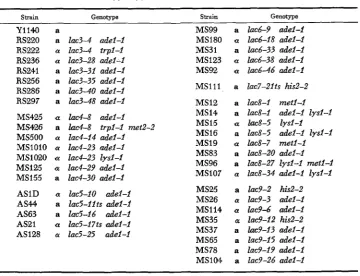
Strains: The wild-type strains Y1140 (a lac1 LAC2) and Y1118 (a LAC1 l a d ) were kindly supplied by ALBERTA HERMAN, U.S. Department of Agriculture, Northern Regional Research Laboratory, Peoria, Illinois. A strain isogenic to Y1140 for the Lac+ phenotype, 2A610, was constructed in our laboratory as described below. All Lac- and auxotrophic mutants (except ade2 and ade3) were derived from strain Y1140. The other mutant strains used in this study are listed in Table 1.
Media and growth conditions: Complete mednum (YMPD) contained: 0.3% yeast extract, 0.3% malt extract, 0.5% peptone and 1.0% glucose (WICKERHAM 1951). Minimal medium was either Difco Yeast Base without amino acids (MM) or defined sulfate medium without amino acids and without adenine (MDS). MDS medium contained per 100 ml: 2 g NH,H,PO,, 0.167 g KH,PO,, 0.167 g NaH,PO,, 10 m g CaCl,, 60 m g MgSO,, 2 pg biotin, 400 gg calcium pantothenate, 2 ,pg folic acid, 2 fig inositol, 440 g g niacin, 200 pg p-aminobenzoic acid, MO gg pyridoxal-HCl,
,&GALACTOSIDASE IN
K .
lactis 879TABLE 1
Genotypes of yeast strains used in these studies
~~ Strain Y114.0 RS220 RS222 RS236 RS241 RS256 RS286 RS297 MS425 MS426 MS500 MSIOIO MSlOU) MS125 MS155
-
a a a Q a a a a ff a a a ff ff a Genotypelac3-4 adel-I lac3-4 trpl-I lac3-28 adel-I lac3-31 adel-I lac3-35 adel-I l a c 3 4 0 adel-l lad-48 adel-I
lac4-8 adel-I lnc4-8 trpl-I met2-2 lac4-14 adel-I lac4-23 ndel-I lac4-23 lysl-I lac4-29 adel-I lac4-30 adel-I
ASID a lac510 adel-I
AS44 a lac5-llts adel-l
AS63 a lac5-I6 adel-I
AS21 Q lac5-17ts d e l l
AS128 a lac5-25 adel-I
Strain MS99 MS180 MS31 MS123 MS92 MS111 MS12 MS14 MS15 MS16 MS19 MS83 MS96 MS107 MS25 MS26 MS114 MS35 MS37 MS65 MS78 MS104
-
a a ff a Q a Genomelad-9 adel-2 lac6-IS adel-I lad-33 adel-I lac6-38 adel-I lac6-46 adel-2
lac7-21ts his2-2
lacs-I metl-I lacs-I adel-I lysl-l
lad-5 adel-I lysl-I lacs-7 metl-I lac8-20 adel-I
lacs-27 lysl-I m e t 1 1 lad-34 adel-I lysl-I h 8 - 5 1 ~ ~ 1 - I
a lac9-2 his2-2
a lac9-3 adel-I a l a c 9 4 adel-I
CY lac9-12 his2-2
a lac9-13 adel-I a lac9-15 adel-I a lac9-I9 adel-I a lac9-26 adel-l
-
1951). Carbon sources were added to a final concentration of 0.5%, unless otherwise indicated. L-amino acids and adenine were supplemented as needed according to SHERMAN, FINK and LAWRENCE (1974). Solid minimal and YMPD media contained 1.5% agar; solid ME medium contained 3.0% agar.
Liquid cultures were incubated with shaking in a New Brunswick Gyratory water-bath shaker at 30°, except for temperature sensitive ( t s ) mutants, which were incubated at 23" and
36" for permissive and nonpermissive growth, respectively.
Isolation of strain 2A610: Because o f the polygenic nature of the Lac system in K. lactis
(HERMAN and HALVORSON 1963), 25% of the progeny spores from a Y1140 (lac+) X Y1118
(lac+) cross will be Lac-. The identification of single chromosomal lac mutations, therefore, required the construction of a strain isogenic to Y1140 for the Lac genes, but of opposite mating type.
To construct such an isogenic strain, the parental strain Y1118 was mutagenized by treat- ment with ethyl methanesulfonate (EMS) as described below (FINK 1970), and an a h - canR
mutant, designated A41005-2, was isolated. This mutant was mated to wild-type strain Y1140,
and asci were dissected by micromanipulation. Several progeny from parental ditype (PD)
tetrads that were a LAC+ and showed 2+:2- segregation of the ade and can markers were back- crossed to Y1140. Our rationale was to select LAC+ progeny that, when crossed to YIIM, would always give 4+:0- segregation of the Lac+ phenotype. One spore, designated 2A610 (a a&-I lac1 L A C 2 ) , exhibited this segregation pattern in over WO tetrads and was chosen as our strain isogenic to Y1140 for the Lac system.
Isolation of L a c mutants: This procedure is based upon one described by FINK (1970).
880 R. M. SHEETZ A N D R. C. DICKSON
and resuspended at 108 cells/ml in buffer (26 mM Na,NPO,, 22 miu KH,PO,, 68 mM NaC1). EMS was added (30 jd/ml), dispersed by vortexing, and the cells were incubated at 30" with gentle agitation for 100 min. EMS was removed by washing the cells and each mutagenized culture was split into several aliquots. This treatment: gave approximately 10% survival of strain Y1140. Cells were grown in YMPD at 30" for 24 hr and then plated on complete medium at approximately 250 viable cells/plate. Plates were incubated at 30" for 48 hr and then replica- plated to minimal medium f lactose (MML), to MM
+
galactose (MMG) and to MM+
glucose (MMD). Lac- and Gal- mutants were identified by their ability to grow on MMD, but not on MML or MMG, respectively.To insure that the majority of the Lac- isolates were nonidentical mutants, we retained only 1 mutant from each of the first 35 outgrown cultures and 2 mutants from each of 8 other CUI-
tures. Only 1 pair of isolates from the latter group contained mutants belonging to the same complementation group. Therefore, each of the L a c mutants, with the possible exception of
lac3-36 and lac3-37, represent independent mutational events.
In addition to Lac- mutations, EMS may have produced secondary mutations that could affect the phenotype of our strains. To restore a wild-type genetic background in Lac- strains, each mutant was backcrossed twice to strain 2A610 and mutants only from the second backcross were used for further genetic and biochemical analyses.
Colonies that were unable to grow on all 3 carbon sources were tested for auxotrophic require- ments as described by SHERMAN, FINK and LAWRENCE (1 974).
Genetic analysis: Haploid strains were mated by mixing equal amounts of cells from a 24- hr-old YMPD plate on an ME plate (WICKERHAM 1951). After incubation at room temperature for 2 to 5 days to allow mating and sporulation, the culture was resuspended in sterile distilled water and treated with 3% glusulase (v/v, Endo Laboratories, Garden City, NY) for 1 hr at 36". Tetrads were dissected onto YMPD plates, using a mechanical micromanipulator (Lawrence Precision Machine, Hayward, CA), grown 2 to 3 days and then replica-plated to appropriate media for phenotype determination. Mating type was determined by crossing with the tester strains,Y1140 (a) and2A610 (a).
Auxotrophic strains were mated with 2A610 and replica-plated to unsupplemented minimal medium to test for recessiveness. The diploid state of presumed prototrophic diploids was veri- fied by testing their ability to sporulate after 5 to 7 days on MM. Lac- mutants carrying auxo- trophic markers (Table 5) were constructed by crossing the appropriate haploid strains.
Unlike S. cereuisiae, which has a stable diploid phase, K . Zactis has only a transitory diploid phase (HERMAN and HALVORSON 1963). In order t o perform complementation tests, it was neces- sary to extend the length of this transitory phase. The diploid phase can be stabilized for from
5 to 10 days by mating haploid strains that carry different recessive auxotrophic markers and requiring the resulting diploids to grow on unsupplemented MM. To test for complementation of the Lac- mutations, auxotrophic Lac- haploid strains were mated on ME plates. Following zygote formation, cells were replica-plated onto MMD to select prototrophic diploids. After 2
to 3 days of growth at 36", diploid colonies were replica-plated to 2 plates each of MML, MMG and MMD and incubated for 2 to 3 days at both 23" and 36". If the diploid grew on MMD, but
not on MML, the 2 Lac- mutations were placed in the same complementation group. If growth occurred on both media, the mutants were placed in separate complementation groups. MMG was used to test for complementation of the Gal- mutations in the same manner,
Genetic mapping was done by tetrad analysis (MORTIMER and HAWTHORNE 1969), using asci obtained by allowing isolated colonies of diploids t o sporulate on unsupplemented MM. Only asci with 4 viable spores were included in the analysis. Map distance was calculated using the Poisson distribution function (I-@)
4-
(2NPD+T)/2(PD+NPD+T) (SUZURI and GRIFFITHS 1976) and expressed as centimorgans (cM).
Preparation of permeable yeast cells: Log-phase cells, growing in liquid medium, were cen- trifuged at 1000
x
g for 5 min and resuspended in distilled water. Cells were diluted into Z-buffer (60 mix Na,HPO,, 4 4 miw NaH,PO,, 10 mM KC1, 1 mM MgSO,, 50 mM 2-mercapto- ethanol, pH 7.0; MILLER 1972) to a cell density corresponding to an absorbance at 600 nmP-GALACTOSIDASE
INK .
lactis 88 1 vortexing for U) sec. Cells were then incubated with vigorous shaking at 30" for 60 to 90 min and immediately assayed for P-galactosidase activity.p-ga'alactoesidase assay: P-galactosidase activity was assayed using the chromogenic substrate
o-nitrophenyl-P-D-galactoside (ONPG) according to the procedure described by MILLER (1972). One ml of a suspension of toluene-treated cells was equilibrated at 30" for 5 min. The reaction was initiated by adding 0.2 ml of ONPG (4 mg/ml) and stopped by adding 0.5 ml of I N Na,CO,. Liberated o-nitrophenol (ONP) was measured spectrophotometrically at 420 nm. ONP concen- tration was calculated using an extension coefficient (pH 11) of 4.5
x
lO3wkm-l (MILLER1972). Unit p-galactosidase activity is defined as the hydrolysis of 1 nmole of ONPG per min at 30°, pH 7. Specific enzymatic activity is expressed as units of enzyme/mg protein.
Protein assay: Protein was extracted from whole cells by treatment with 0.5 N NaOH at 100" for 20 to 30 min (STEWAF~T 1975). Protein concentration was determined using the procedure
of LOWRY et al. (1951), with bovine gamma globulin (Bio-Rad) as a standard.
RESULTS
ZsoZation of
Lac-
mutants: Following mutagenesis of strain Y1140 withEMS,
approximately 150,000 colonies were screened for loss of the ability to grow on lactose (Lac-) and 51 colonies with this phenotype were obtained. All of these mutants were derived independently, except 2ac3-36 and lac3-37. We initially tried to enrich for Lac-mutants, using three enrichment procedures: (1) Nystatin selection (SNOW 1966), ( 2 ) rescue from inositolless death(HENRY,
DONAHUE and CULBERTSON 1975), and ( 3 ) resistance to spheroplast formation(DEUTCH
andPARRY
1974). For unknown reasons, all three procedures failed to enrich for Lac- mutants. However, sinceEMS
induced Lac- mutations at a frequency greater than one in IO4, we found it unnecessary to use an enrichment procedure. As described in MATERIALS AND METHODS, all mutants were backcrossed at leasttwice to wild type to try to segregate out hidden secondrsite mutations that might complicate genetic analyses.
Growth properties of Lac- mutants: The phenotype of Lac- mutants was exam- ined more thoroughly by measuring growth on several carbon sources. Galactose was of particular interest, since it is a n excellent inducer of P-galactosidase
(DICKSON
andWRKIN
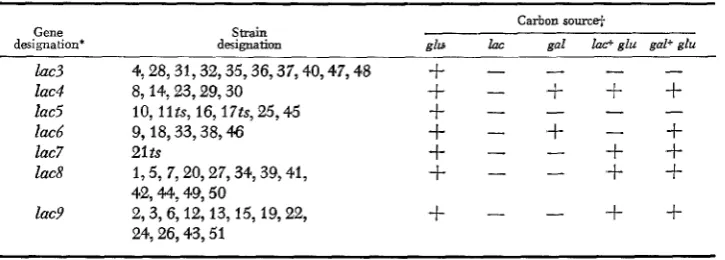
1980), is a product of lactose hydrolysis and is toxic to strains of S. cerevisiae defective in galactose epimerase and transferase; conceiva- bly, some of our Lac- mutants are defective in these enzymes and not in lactose utilization per se. As shown in Table 2, all mutants grow on glucose, but not on lactose. Surprisingly, Zac3,5,7,8 and9
fail to grow on galactose as the sole carbon source. This result was further examined by measuring growth on glucose in the presence of either lactose or galactose. If lactose or galactose is toxic to cells, they should fail to grow even though glucose is available. The results in Table 2demonstrate that strains bearing Zac3,
5
or 6 mutations are inhibited for growth by lactose, while strains bearing lac3 or 5 mutations are inhibited by galactose. Lac- mutants were also tested for temperature-sensitive ( t s ) growth. Three tsmutants were isolated that could utilize glucose at 23" and 36", but could utilize lactose and galactose only at the permissive temperature, 23" (Table 2 ) .
882 R. M. SHEETZ A N D R. C . DICKSON
TABLE 2
Summary of the complementation analysis and growth properties of Lac- mutants
Gene
designation' designat" Stra+
Carbon sour&
- -
-
lac3 4,28,31,32,35,36,37,40,47,48
+ -
lac4 8,14,23,29,30
+
-
+
+
+
lac5 I O , l l t s , 16,17ts,25,45
+ -
lac6 9,18,33,38,46 f -
+ -
+
lac7 21 ts
+ -
-
+
+
lac8 1,5, 7,20,27,34,39,41,
+ -
-
+
+
lac9 2 , 3 , 6,12, 13, 15, 19,22,
+ -
-
+
+
-
-
-
42,44,49,50
24,26,43,51
* HERMAN and HALVORSON (1963) used the designations lac1 and Zac2; therefore, our designa- tions start with lac3.
-t Cells were grown overnight a t 36" in MMG. Fifty pl of the overnight culture were diluted into 2 m l of minimal medium plus the indicated carbon source (s), and the culture was incu- bated overnight a t 36". Cell density was measured a t 600 nm and cultures with an absorbance of less than one were considered nongrowers. Identical results were obtained for cultures grown at 23", except for the three ts mutants that grew on all carbon sources at 23" but did not grow at 36" on galactose or lactose. Carbon sources were each added to a final concentration of 0.5%.
mated
with
strain 2A610 (a&) and 25 to 30 four-spored asci were dissected by micromanipulation. For all mutants, asci displaying 2+:2- segregation of the a&marker also segregated 2+:2- for lactose ustilization, except for an occasional 1 +: 3- segregant. The 1 + : 3- segregation of lactose negativity is probably the result of gene conversion a t the LAC locus since occasional 1 + : 3- segregation was also observed for the ade marker. These results indicate that all 51 Lac- mutants are in nuclear genes.
The genetic nature of the Gal- phenotype was also examined by tetrad analy- sis. We were particularly interested in knowing if the Gal- and Lac- phenotypes co-segregated, since such behavior would indicate that the two phenotypes were due to a single nuclear mutation. lad-2, lac9-2,1m3-4, lac5-2Zts and lac7-22ts
were crossed to wild type, and approximately 300 asci from each were dissected. I n all crosses, galactose negativity not only segregated 2+:2-, but co-segregated with lactose negativity. Therefore, the double sugar-negative phenotype in these strains is most likely due to a single nuclear mutation, although the possibility of two tightly linked loci cannot be excluded.
Genetic complementation: Complementation tests were used to determine whether Lac- alleles were dominant or recessive to Lac+ alleles and to determine how many complementation groups were represented by the 51 Lac- mutants. The number of complementation groups was determined by crossing the mutants in all pairwise combinations and testing the resulting diploids for growth on lac- tose and galactose. As shown in Table 2, the mutants define seven complementa- tion groups. Mutations in all seven complementation groups are recessive.
Genetic mapping: Mapping studies were conducted to determine whether any
p-GALACTOSIDASE
INK .
Zactis 883distance between them. The distribution of parental ditype
(PD)
,
nonparental ditype(NPD)
and tetratype (T) configurations in tetrads were used to test for linkage and to calculate genetic map distance, as described in MATERIALS AND METHODS. Genetic linkage was indicated when thePD
tetrads outnumbered theNPD's
(MORTIMER
andHAWTHORNE
1969).The number of
PD, NPD
andT
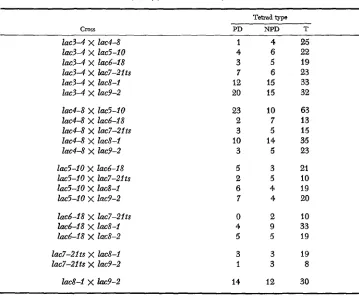
tetrads for the pairwise combinations of Lac- strains are given in Table 3. The results show linkage only between lac4 and lac5( P
<
0.005). In three of the crosses in Table 3 (Zac8 X Zac9, lac8 X lac3 andlac9 X Zac3), the ratio of
(PD
+
NPD)
tetrads to T tetrads was greater than 0.5(P
<
O.OoS), indicating that the k 3 , l a c 8 and Zac9 loci are linked to centromeres. The three loci are 16.6, 21.7 and 14.7CM
from their centromeres, respectively(FINCHAM
andDAY
1971). The low frequency of tetratypes in all three cases confirms that the three loci are on different chromoosmes (FINCHAM andDAY
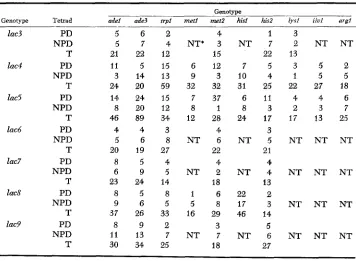
1971).We also examined the meiotic segregation patterns of at least one Lac- mutant in each of the seven LAC genes and a series of auxotrophic markers These results (Table 4) demonstrate linkage between lac 4 and the auxotrophic markers adel
and met2, and between Zac5 and met2 and his2. We designate this linkage group
TABLE 3
Tetrad analysis of pairwise crosses of lac mutants
Tetrad type
Cross PD NPD T
lac3-4
x
lac4-8 l a d 4x
lac5-I0 lac9-4x
lac6-18lac3-4
x
lad-1 lac3-4x
lacy-2lac4-8 X lac5-IO lac4-8 X lacb-I8 lac4-8
x
lac7-21ts Eac4-8x
lad-I lac4-8x
lacy-2lac5-IO
x
lacb-18 lac5-IOx
lac7-2Its lad-IO X lad-I lac5-IOx
lac9-2lacb-18
x
lac7-2lts lad-18x
l a d - I lacb-f 8x
l a d - 2lac7-2Its x lac8-I lac7-21ts
x
lacy-2lac8-1
x
h 9 - 2 l a ~ 3 - 4 X lac7-2i't~1 4 25
4 6 22 3 5 19 7 6 23 12 15 33
20 15 32 23 10 63 2 7 13 3 5 15
10 14 35 3 5 23 5 3 21 2 5 10 6 4 I 9 7 4 20
0 2 10 4 9 33
884 R. M. SHEETZ A N D R. C. DICKSON
as chromosome 2. Linkage between other lac genes and auxotrophic markers was not detected.
The relative order and distance between markers on chromosome 2 was deter- mined by tetrad analysis of the multiple-factor crosses shown in Table 5 . These data were used to deduce the genetic map shown i n Figure
1.
For example, the first cross in Table 5 shows that, while lac4 and t r p l are unlinked, they are both linked to adel. Thus, the order for these markers is trpl-adel-lac$. The second cross verifies this arrangement and establishes the position of ade3 relative totrpl and adel. The order of met2 and lac5 with respect to lac4 was established from the first and third crosses as follows: The linkage distance between lac4 and
lac5 (100 cM) is approximately the sum of the lac4-met2 interval (87 cM) plus the met2-lac5 interval (18 cM)
.
Furthermore, while lac4 is linked to adel, neitherlac5 nor met2 are, implying that they are further from adel than 2ac4. Thus, the map order is adel-lac4-met2-lac5. Finally, the position of his2 was established in the third cross. This cross also verifies the map order lac4-met2-1ac5-his2, since the linkage distance between met2 and his2 (93 cM) is approximately equal to the sum of the lac5-his2 interval (72 cM) plus the met2-lac5 interval (18 cM)
.
The orientation of these genes with respect to the centromere has not been determined, since none of the genes show centromere linkage.TABLE 4
Meiotic linkage of LAC gems to auxotrophic markers
Genotype
Genotype Tetrad adef ade3 trpf metf met2 his1 his2 lysf ilvl argl
lac3 PD
NPD T
lac4 PD
NPD T
lac5 PD
NPD T
lac6 PD
NPD T
lac7 PD
NPD T
lac8 PD
NPD T
lac9 PD
NPD T 5 5 21 11 3 24 141 8 46 4 5 20 8 6 23 8 9 37 8 11 30 6 7 22 5 14 20 24 20 89 4 6 19 5 9 24 5 6 26 9 13 34 2 4 12 15 13 59 15 12 34 3 8 27 4 5 14 8 5 33 2 7 25 4
NT* 3 15
6 12
9 3
32 32
7 37
8 1
12 28
4
NT 6
22 4
NT 2
18
1 6
5 8
16 29
3
NT 7
18
1
NT 7
22
7 5
10 4 31 25
6 11
8 3
24 17
3
NT 5
21
4
NT 4
13
22 2
17 3
46 14
5
N T 6 27
3
2 NT NT
13
3 5 2
1 5 5
22 27 18
4 4 6
2 3 7
17 13 25
NT NT NT
NT NT NT
NT NT NT
NT NT NT
/%GALACTOSIDASE IN
K .
lactis 885TABLE 5
Meiotic linkage of auxotrophic markers to lac4 and lac5 on chromosome 2
Multiple-factor
cross Gene pair
met2 t r p l lac4 met2-trpl
X met2-lac4
adel lac5 met2-adel met2-lac5 trpl-lac4 trpl-adel trpl-lac5 lac4-adel lac4-lac5 adel-lac5
a d d ade3 a d d - a d e l
X ade3-trpl
trpi lac4 lade3-lac4 adel -lac4 adel-trpl trpl-lac4
met2 lac4 met2-his2
X lac4-his2
his2 lnc5 lac5-his2 met2-lac5 lac4-lac5
Tetrad type
PD 33 48 29 I 42 34 74 35 57 46 41 39 49 30 60 68 32 59 29 58 139 52
NPD T
39 117 14 134 19 142 4 49 29 130 16 110 33 126 13 123 20 126 29 129
23 135 11 135 45 120 19 119 10 120 35 126
29 108 23 144 11 130
a
4424 121
Linkage distance (cM) NL* 87 NL 17 NL 62 NL 74 100 NL NL 82 NL 79 61 NL 93 NL 72 19 98
* NL = markers not linked ( x 2 tests indicate m significant difference between the number
A second line of evidence also supports the order of genes shown in Figure
1.
Three markers at a time, a, b and c, were chosen from any of the crosses in Table
5.
We then examined the meiotic exchange patterns required to produce the ob- served genotypes of the spores in each tetrad for the three possible map orders, a-b-c, a-c-b and b-a-c. In each case, the gene order requiring the minimum number of exchanges between markers agreed with that in Figure 1.The segregation pattern of markers in the cross between hid and the centro- mere-linked lac8 locus indicates that his? is also located near a centromere (Table
4).
We have not determined if hisl maps near either of the other two centromere- linked genes, 2ac3 and lac9, or whether it defines a fourth linkage group.We
did of PD and NPD tetrads a t the 95% coincidence level).&
XRel
A Q d
LA&
MEl2LBd
I I I I I I
82
62
76
87
18
72
886 R. M. SHEETZ A N D R. C. DICKSON
find that his1 is linked to the mating-type locus (tetrads segregation in the cross (Y
his1 X a HZS1 was 6
PD;
0NPD;
l T ) , indicating that his1 is probably allelic to the centromere linked his4 (defective in L-histidinol dehydrogenase) isolated byTINGLE,
HERMAN
andHALVORSON
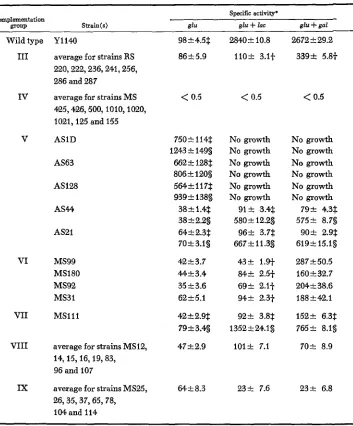
(1968). W e will refer to the his1 linkage group as chromosome 1.Enzyme Qlctivities in Lac- mutants: The isolation of all 51 Lac- mutants was based upon their inability to grow on lactose. However, we did not know what effect these mutations had on /3-galactosidase activity. We expected that mutations i n the /?-galactosidase structural gene or in certain regulatory genes would result in low levels of enzyme activity. Since one of our goals was to identify these genes, we were particularly interested in knowing which of the Lac- mutants were de- fective in P-galactosidase activity. The specific activity of @-galactosidase in wild- type and mutant strains is presented in Table 6. Enzyme activity was induced approximately 30-fold in the parental wild-type strain under the conditions used here.
Beta-galactosidase activity was not induced by lactose in lac3-bearing mutants; in contrast, galactose induced enzyme activity approximately four-fold. Higher induction values might be obtained if growth were not so severely retarded by the inducer (see Table 2 and footnote in Table 6).
Strains bearing mutations i n lac4 contained very low levels of @-galactosidase activity on all three media. Enzyme activity in these mutznts was detectable only after assaying toluenized cells overnight. Mutations only in this complementation group caused such low enzyme levels.
Three of the strains bearing mutations in lac5 synthesized /?-galactosidase con- stitutively (in the absence of inducer) ; enzyme levels were slightly higher at 23"
than at 36". The strains may be t s mutants, but this could not be measured because they fail to grow on glucose in the presence of inducer (Table 6). Unlike other Lac- mutants, these three displayed considerable variation in enzyme activity as evidence by the large standard deviation. The reason for this variation is un- known. The two other mutants bearing mutations in lac5 are ts for growth and can be induced only at 23". Levels of induction are about one-fourth that of the wild-type.
Beta-galactosidase activity was induced three- to seven-fold by galactose in strains bearing mutations in lac4 but less than a two-fold induction was obtained with lactose. The low induction value may be due to growth inhibition by lactose
(Table 2 and footnote in Table 6).
The one mutant bearing a mutation in lac7 is a t s mutant and is induced 17- fold by lactose and 10-fold by galactose to 23" (Table 6). The mutant may be leaky since some induction occurs at 36".
@-GALACTOSIDASE IN
K .
lactis
887TABLE 6
Specific p-galactosidase activity in Lac- strains ~~ ~
Specific activity* Complementation
P U P Strain(s) d u glu -I- lac glu -I- gal Wild type Y1140
I11 average for strains RS 220,222,236,241,256, 286 and 287
IV
average for strains MS 425,426,500,1010,1020, 1021,125 and 155V
ASIDAS63
AS128
AS44
AS21
V I MS99
MS180 MS92 MS31
VI1 MS11 I
VI11 average for strains MS12, 14,15,16,19,83, 96 and 107
IX average for strains MS25, 26,35,37,65,78,
104 and 114
98+4.5$
86 & 5.9
<
0.5750 C 114% 1243 f 149s
662-C l28$ 806f 120s 56.F-C I 17$ 939-C 138s 38&1.4$ 3822.2s 64&2.3$ 70+-3.1§ 42k3.7 44c3.4 3523.6 62k5.1 42+2.9$
79 -c 3.4s 47 f 2.9
6428.3
2840+ 10.8
liOC 3.1f
<
0.5No growth No growth No growth No growth No growth No growth
91+ 3.4$ 5802 12.2,s
9 6 2 3.72 667&11.3,$
43+ 1.9+
84f 2.5f 6 9 f 2.1$ 9 4 2 2.31. 9 2 2 3.8% 1352 t- 24.1s
I O l f 7.1
2 3 2 7.6
2672 t-29.2 339k 5.81-
<
0.5No growth No growth No growth No growth No growth No growth 79-c 4.3$
575C 8.7s 9 0 2 2.92 619k 15.1s 287k50.5 160 c32.7 204k 38.6 1883~42.1 1522 6.3% 7652 8.1s
7 o t 8.9
23+- 6.8
* The specific activity of P-galactosidase (units of enzyme/mg protein was determined on night in supplemented glucose minimal medium at 30", unless indicated otherwise. Carbon source(s) was added to a Gnal concentration of 0.5%.
)These mutants do not form visible colonies on this medium when assayed on agar plates. However, in liquid medium they divide two to four times before growth stops. Thus, it is possible
to assay for enzyme induction. In contrast, strains ASID, AS63 and AS128 do not grow in liquid culture and were therefore not assayed.
toluene-treated whole cells as described in MATERIALS AND METHODS. Ce
?
Is were grown over-$ Cells were grown overnight at 36".
888 R. M. SHEETZ A N D R. C. DICKSON
DISCUSSION
The work presented in t h i s paper demonstrates that a defect in any one of seven genes, termed LAC, prevents K . lactis from utilizing lactose as a carbon and energy source. These seven genes were detected in a sample of 51 Lac- mutants; new LAC genes will probably be uncovered when a larger sample of Lac- mutants or when other mutant phenotypes, such as constitutive p-galactosidase synthesis, are examined. I n fact, we have recently discovered an eighth gene by analyzing constitutive mutants ( SHEETZ and DICKSON, unpublished).
The large number of genes governing lactose utilization is somewhat surprising since lactose need only be transported into the cell by a n energy-dependent process (DICKSON, unpublished) and hydrolyzed by &galactosidase to yield glucose and galactose. However, there are several tenable explanations for so many genes. First, any one or all of the proteins, including P-galactosidase, regula- tory proteins and the lactose transport system, could be constituted from more than one gene product. At the moment, only one of these proteins, /I-glactosidase, has been purified and characterized. It is a dimeric protein composed of identical, 135,000
MW
subunits (DICKSON, DICKSON and MARKIN 1979).Second, the induction mechanism could be complex involving many regulatory genes. Third, some of our mutants may affect lactose utilization indirecily by blocking galactose catabolism. For example, mutants exhibiting both the Lac- and Gal- phenotype may be defective in galactose tansferase o r epimerase, i n which case galactose-1 -phosphate and UDP-galactose would accumulate, respec- tively. Accumulation of these compounds could be toxic and inhibit growth of K .
@-GALACTOSIDASE IN
K .
lactis 889An examination of the uninduced and induced P-galactosidase levels in our Lac- mutants allows speculation concerning the nature of their genetic defects. Mutants containing a lesion in the &galactosidase structural gene should be unin- ducible and have a Lac- Gal+ phenotype. In addition? the P-galactosidase activity in these mutants should be very low or undetectable. Mutants bearing mutations in lac4 behave in this manner. These data, along with our unpublished data, strongly suggest that LAC4 codes for p-galactosidase. K . Zactis probably contains a single structural gene for this enzyme since it is composed of two identical subunits
(DICKSON,
DICKSON
andMARKIN
1979).The several phenotypes displayed by lac5 mutants, including temperature sen- sitivity? growth inhibition by lactose and galactose and constitutive synthesis, could be explained by several models. Further data are needed to determine the function of this gene product.
The phenotype of the other mutants representing the Zacb, 7,8 and 9 loci could be explained by any one of a variety of nonexclusive models. Mutants defective in lac6 are unique since their growth is inhibited by lactose, but not galactose, suggesting that their defects are specific to lactose utilization. Mutants in lac9 are unusual because the basal level of P-glactosidase decreases in the presence of inducer.
The results presented here indicate that the mechanisms of p-galactosidase in- duction in
K .
Zactis may be quite complex. Further investigation of Lac- mutants should help to resolve this complexity. The isolation and characterization of Lac+ strains that synthesize /%galactosidase constitutively should also be valuable, not only in studying the regulation of enzyme induction, but in determining if there is co-regulation of the Lac and Gal systems.LITERATURE CITED
DEUTCH, C. E. and J. M. PARRY, 1974
DICKSON, R. C., L. R. DICKSON and J. S. MARKIN, 1979
DICKSON, R. C. and J. S. MARKIN, 1978
Spheroplast formation in yeast during the transition from exponential phase to stationary phase. J. Gen. Microbiol. 80: 259-265.
Purification and properties of a n induci- ble p-Galactosidase isolated from the yeast Kluyveromyces lactis. J. Bacteriol. 137 : 51-61.
Molecular cloning and expression i n Escherichia coli
of a yeast gene coding for @-galactosidase. Cell 15: 123-130.
-
,
1980. Physiological studies of fi-galactosidase induction in Kluyveromyces lmtis. J. Bact. 142 : 777-785.FINCHAM, J. R. S. and P. R. DAY, 1971 FINK, G. R., 1970
HENRY, S. A., T. F. DONAHUE and M. R. CULBERTSON, 1975
HERMAN, A. and H. 0. HALVORSON, 1963
LOWRY, 0. H., N. J. ROSEBROUGH, A. L. FARR and R. J. RANDALL, 1951
MILLER, J. H., 1972
Fungd Genetics 3rd edition. Blackwell, Oxford. The biochemical genetics of yeast. pp. 59-78. In: Methods in Enzymology,
Selection of spontaneous mutants
Identification of the structural gene for p-glucosidase
Protein measurement Vol. XVIIA. Edited by H. TABOR and C. W. TABOR. Academic Press, New York.
by isositol starvation in yeast. Mol. Gen. Genet. 143 : 5-1 1.
i n Saccharomyces lactis. J. Bacteriol. 85 : 895-900.
with*the folin phenol reagent. J. Biol. Chem. 193 : 265-275.
Cold Spring Harbor, New York.
890
MORTIMER, R. K. and D. C. HAWTHORNE, 1969 Yeast genetics. pp. 386-440. In: The Yeasts, Vol.
SHERMAN, F., G. R. FINK and C. W. LAWRENCE, 1974 In: Methods in Yeast Genetics. Cold
SNOW, R., 1966 An enrichment method for auxotrophic yeast mutants using the antibiotic
STEWART, P. R., 1975 Analytical methods for yeasts. pp. 111-147. In: Methods in Cell Biology,
SUZUKI, D. T. and A. J. F. GRIFFITHS, 1976 pp. 101-130. In: A n Introduction to Genetic Analy-
TINGLE, M. and H. 0. HALVORSON, 1972 Mutants in Saccharomyces lactis controlling both
TINGLE, M., A. HERMAN and H. 0. HALVORSON, 1968 Characterization and mapping of histidine
WICKERHAM, L. J., 1951 VAN DER WALT, J. P., 1970
R. M. SHEET2 AND R. C. DICKSON
1. Edited by A. ROSE and J. S. HARRISON. Academic Press, Inc., London.
Spring Harbor Laboratory, Cold Spring Harbor, New York.
“nystatin.” Nature 211: 906-207.
Vol. XII. Edited by D. M. PRESCOIT. Academic Press, New York.
sis. W. H. Freeman and Company, San Francisco.
p-glucosidase and ,(?-galactosidase activities. Genetics Res. 19 : 27-32.
genes in Saccharomyces lactis. Genetics 58: 361-371.
Taxonomy of Yeasts. U.S. Dept. Agr. Tech Bulletin, No. 1029. Genus 8. Khyueromyces. pp. 316-352. In: The Yeast. Edited by