Image Processing For Vector- Valued Using Gradient Descent
Scheme
RavillaSravanthi
1&
K.V. Rathnam
21
PG Scholar,Dept of CSE,Rao& Naidu Engineering College, Ongole,PrakasamDist,Andhra Pradesh
2
AssociateProfessor,Dept of CSE,Rao& Naidu Engineering College, Ongole,PrakasamDist,Andhra Pradesh
Abstract-
In an image processing tools we can reserve rooms or pixels for the image this pixels have a angles that are connected with the neighbor pixels that will be spatial gradients of their channels this will have strong inter channel correlated which can be penalize large angles image with parallel level sets can be obtained.
In this paper we discuss gateaux derivatives that lead to a diffusion like gradient descent schema. This will explain about RGB colors that are allocated for the pixels. The pixels will consider the parallel cells and will fill all the gradients colors to give visuvally perfect results for low noise level. So this concept will gives the perfect sharper image and reducing noise of the image.
Keywords- Demosaicking; Denoising; Gray images; Parallel levelsets; Vector processing
I. INTRODUCTION
The principal objective of image enhancement is to process a given image so that the result is more suitable than the original image for a specific application. It accentuates or sharpens image features such as Edges, Boundaries, or Contrast to make a graphic display more helpful for display and analysis. The enhancement doesn't increase the inherent information content of the data, but it increases the dynamic range of the chosen features so that they can be detected easily. Image enhancement is analyzed by following authors as
follows: L. I. Rudin, et al., 1992 [1] proposes the
mathematical algorithm is undemanding and pretty fast. The outcome show to be modern for extremely strident images. The technique is
Noninvasive, squashy jagged boundaries in an image. The method might be construe as an initial rung of stirring all stage position of the image usual to itself with rapidity identical to the warp of the stage position separated by the substance of the rise of the image. S. R. Arridge et al., 1997
[2] analyze a circulation method used for
multi-spectral images which fit in together spatial
plagiaristic and feature-space sorting. A Ayache
et al.,2005 [8] introduce a fresh scheme for anisotropic circulation of ultrasound images was established.
It applies the restricted coefficient of
deviationanda forceful circulation tensor to strain reverberate realistic images. The LCV is calculating in the vicinity and evaluated to the universal coefficient of deviation. In standardized areas pretentious by spoil is lock to GCV.
The residue of this paper is planned as follows:
Sec. 2 introduces color image enhancement. Sec.3 presents gray scale image enhancement. Sec. 4 describes performance of the system.
II.COLOR BASED IMAGE PROCESSING
Like in the container of scalar-valued metaphors,
trouble because demising, in painting,
Where g is the experimental data,
the vector-valued image, ℛ is blame competent
and ∝ the operation restriction among devotion of
the data fit and a-priori in order of the clarification.
For some preferences of R, an explanation of equation (1) is the stationary point (in time) of the partial differential equation (PDE)
Wherever the diffusivity K is in common a
spatially changeable N.K× N.K template
depending on the image z, i.e.
And the disagreement and slope are definite component-wise. Furthermore, use the NΧN
sub-matrices kiis called within-channel diffusivities
and Tijare known as cross-diffusivities.
If any of the sub-matrices is of the form c .I where cis a scalar and I the uniqueness medium to facilitate indicate the entire template c as well.
The extraordinary holder while all sub-matrices are multiples of the uniqueness matrixes is called
isotropic, or else anisotropic. In this paper all
circulation equations will be isotropic.
Lastly, if any cross-diffusivity Ti,jis non-zero it iscall as cross guide circulation, or else channel-wisecirculation. This’ll be a key point later on.
Significant to note is, to flush after the exchange is presently channel-wise, the structure of PDEs
can be coupled if the diffusivities kidepend on
other channels j ≠i.
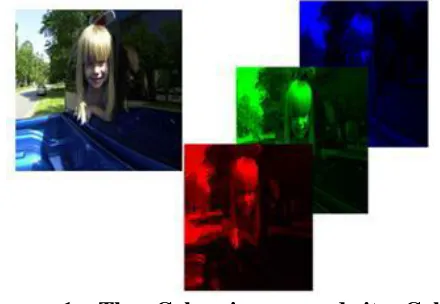
Here, figure 1 below shows the Color image and itsthree Color channels (Red, Blue and Green).
Figure 1: The Color image and its Color (R,G,B) channels
Aiming at existing medical image enhancement method is unable to prominent part and detailed information and will be interfered by noise easily when medical image contrast is increased; this
work proposed enhancement algorithms
combining the histogram equalization with image details preservation and bi-dimensional empirical mode decomposition.
First, through the GVF with image details preservation to increase the overall image contrast; and then based on bi-dimensional empirical mode decomposition, the medical image has been decomposed into the image information with different frequency, with various levels improvement of the information, to perform image enhancement.
Figure 2: The Gray image and its Color (R, G, B) channels
In this analyze it is possible to import retinal gray images to identify the diseases with improved accurate rate. It can be measured using PSNR and SSIM values. The PSNR (in dB) and SSIM are defined as follows
The measure between two windows x and y of common size NxN is:
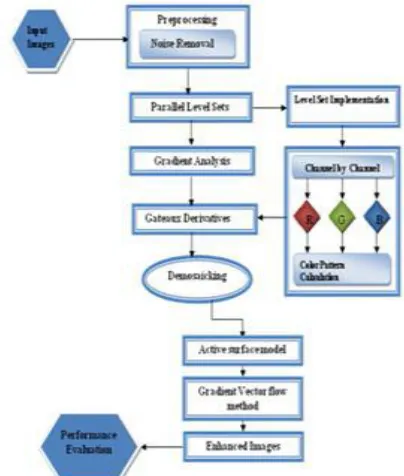
Figure 3 below illustrates the process of gray scale image enhancement.
Figure 3: Gray based image enhancement
IV. EXPERIMENTAL RESULTS
In this experimental results show the rate for PSNR and SSIM results. PSNR is commercial word designed for the relation amid the most possible power of a signal and the power of corrupting noise that affects the fidelity of its representation.
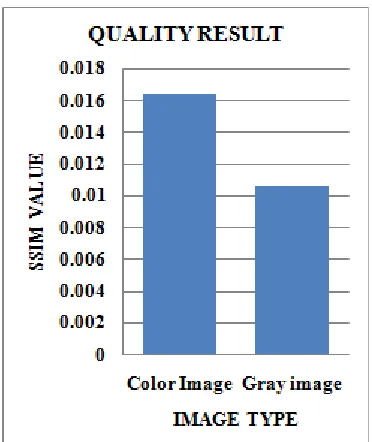
SSIM index is a method for measuring the similarity between two images. The SSIM index is a full reference metric; in other words, the measuring of image quality based on an initial
uncompressed or distortion-free image as
reference.
Table 1: Comparison of PSNR rate & SSIM in both color and gray scale images
The below graph shows the PSNR rate betweenColor and Gray images.
Figure 4: Graph – PSNR Rate between Color andGray Scale images
Figure 5: Graph – SSIM Rate between Color andGray Scale images
STRUCTURAL THINGS:
Structural things are the nouns of the UML models. These are mostly static parts of the model, representing elements that are either conceptual or physical. In all, there are seven kinds of Structural things.
Usecase diagram
V. CONCLUSION
In this paper, gray scale image enhancement
iscarried out. Existing gray scale image
enhancement technique is not efficient because of noise occurrence. In the proposed work GVF technique is applied, so that particular part of an image can be enhance according to the user choice. Parallel level sets technique is applied to the entire image to separate each color space (Red, Blue and Green). Color pattern is applied to the predicted color variance of the image by the parallel level sets. After these operations improved enhanced image with the reduced level noise and efficient image structure is obtained. These results are proved using PSNR and SSIM measurements.
REFERENCES
[1] D. L. Bailey, D. W. Townsend, P. E. Valk, and M. N. Maisey, Positron Emission Tomography - Basic Sciences. London: Springer, 2005.
[2] D. W. Townsend, “Multimodality Imaging of Structure and Function,” Physics in Medicine and Biology, vol. 53, no. 4, pp. R1–R39, 2008.
[3] B. K. Gunturk, Y. Altunbasak, and R. M. Mersereau, “Color Plane Interpolation using Alternating Projections.” IEEE Transactions on Image Processing, vol. 11, no. 9, pp. 997–1013, Jan. 2002.
[4] P. Blomgren and T. F. Chan, “Color TV: Total Variation Methods for Restoration of Vector-Valued Images,” IEEE Transactions on Image Processing, vol. 7, no. 3, pp. 304–309, 1998.
[5] L. I. Rudin, S. Osher, and E. Fatemi, “Nonlinear Total Variation Based Noise Removal Algorithms,” Physica D: Nonlinear Phenomena, vol. 60, no. 14, pp. 259–268, 1992.
[6] N. Sochen, R. Kimmel, and R. Malladi, “A General Framework for Low Level Vision,” IEEE Transactions on Image Processing, vol. 7, no. 3, pp. 310–318, 1998.
[7] S. R. Arridge and A. Simmons, “Multi-Spectral Probabilistic Diffusion Using Bayesian Classification,” in Scale-Space Theory in Computer Vision : Proc. First Intl. conf., Scale-Space, Utrecht, The Netherlands, B. terHaarRomeny, L. Florak, J. Koenderink, and M. Viergever, Eds. Berlin: Springer, 1997, pp. 224–235.
[8] B. K. Gunturk, J. Glotzbach, Y. Altunbasak, R. W. Schafer, and R. M. Mersereau, “Demosaicking: Color Filter Array Interpolation,” IEEE Signal Processing Magazine, pp. 44–54, 2005.
[9] K. Deckelnick, G. Dziuk, and C. M. Elliott, “Computation of Geometric Partial Differential Equations and Mean Curvature Flow,” ActaNumerica, vol. 14, pp. 139–232, May 2005.
[10] D. Cremers, M. Rousson, and R. Deriche, “A Review of Statistical Approaches to Level Set Segmentation: Integrating Color, Texture, Motion and Shape,” International Journal of Computer Vision, vol. 72, no. 2, pp. 195–215, Aug. 2006.
[11] S. Di Zenzo, “A Note on the Gradient of a Multi-Image,” Computer Vision, Graphics and Image Processing, vol. 33, pp. 116–125, 1986.
[12] L. A. Gallardo, “Characterization of Heterogeneous Near-Surface Materials