Implementation of Wireless Communication to
Enhance the Working of Emergency Vehicles
Hitesh Gaba & Himanshu Mehndiratta
Electronics & Communication Department, Dronacharya College of Engineering, Gurgaon, India Email: [email protected]
Abstract –
Recent studies conclude that early and specialized prehospital management contributes to emergency case survival. We have developed a portable medical device that allows telediagnosis, long distance support and teleconsultation of mobile health care providers by expert physicians. The device allows the transmission of vital biosignals and still images of the patient from the emergency site to the consultation site using the GSM mobile telephony network. The device can telematically “bring” an expert specialist doctor at the site of the medical emergency, allow him to evaluate patient data and issue directions to the emergency personnel on treatment procedures until the patient is brought to hospital. Legal reasons mandated the inclusion at the consultation site of a multimedia database able to store and manage the data collected by the system. The performance of the system has been validated in four different countries using a controlled medical protocol and a set of 100 patients per country treated has been collected and analyzed.
Keywords: Emergency Telemedicine, Ambulance,
Emergency health care, wireless communication, GSM
I. INTRODUCTION
Recent studies conclude that early and specialized prehospital patient management contributes to emergency case survival [1]. Especially in cases of serious injuries of the head,
the spinal cord and internal organs the way of transporting and generally the way of providing care are crucial for the future of the patient. Previous statistics are grim: in 1994, there were 2,070 persons deaths and 33,698 injured in car accidents in Greece. The number of deaths is substantially higher since it does not include the 15% of injured dying during hospitalization. Furthermore, in the London area, 49% of casualties require at least 2 hours to reach adequate hospital care, 79% of victims of accidents in rural roads die on the scene, another 11% during transportation [2]. At least 8% of these cases had a 50% chance of survival, if adequate pre -hospital care existed. The reduction of this death toll is definitely achievable through measures and strategies, which improve access to care, and administration of pre-hospital care.
Cardiac disease is another common killer. Much can be done today to stop a heart attack or resuscitate a victim of sudden cardiac death (SCD). Time is the enemy in the acute treatment of a heart attack or SCD. Many studies worldwide have shown a rapid response time in the pre-hospital setting resulting in treatment of acute cardiac events increases mortality and improves patient outcomes dramatically [3-8]. Studies have also shown that 12-lead ECG performed within an ambulance increase available time to perform thrombolytic therapy effectively stopping a heart attack in progress and preserving heart muscle function [9]. This means the patient is more likely to return to a normal lifestyle after a cardiac event.
IMPLEMENTATION OF WIRELESS COMMUNICATION TO ENHANCE THE WORKING OF EMERGENCY VEHICLESHitesh Gaba & Harsh Yadav P a g e | 760
Technicians - EMTs, Emergency Medical Paramedics-EMPs or General Practitioners - GPs), who usually are the first to handle such emergency situations, do not have the required advanced theoretical knowledge and experience. Furthermore, practical and financial reasons do not allow the participation, routinely on ambulance vehicles, of specialized physicians such as neurosurgeons, cardiologists, orthopedics etc. Ambulance personnel however, can rely on the directions provided to them by experts, with the assumption that information concerning the clinical status such as vital biosignals and a picture of the patient can be available to the experts. Emergency Telemedicine has been evolving in the past years. According to the most recent Telemedicine Today/ATSP Annual Program Survey [10], emergency room teleconsultations are the second most common interactive video applications (14.6% of the total) after mental health (19.7%). Furthermore, recent developments in mobile telecommunications and information technology enabled the development of emergency telemedicine systems for ambulances using existing communication infrastructure. In 1996, researchers at the National Technical University of Athens have successfully demonstrated [11] real-time transmission of ECG data from a moving ambulance vehicle using GSM data links. In 1997, researchers at the University of Maryland Hospital have developed a wireless ambulance telemedicine system for stroke victims [12]. The system would use 4 digital wireless telephone lines to transmit images and biosignals captured from within an Ambulance to a consultation center. Also, researchers at the Athens University School of Medicine have used an experimental set-up to transmit 12-lead ECGs from an ambulance using wireless links [13]. In most cases however, applications were limited to store -and-forward biosignals although, in many emergency applications, real-time biosignal monitoring is needed, especially in cases were transportation time is long. Along this direction, we have developed a portable emergency telemedicine device that
supports real -time transmission of critical biosignals as well as still images of the patients. Thus, the device can telematically “bring” the expert at the emergency site, allow him to review critical biosignals and images of the patient and thus perform remote diagnosis and provide specialized prehospital care. The system makes use of the GSM mobile communication network, an infrastructure with over 95% coverage of the population of the European Community countries.
The AMBULANCE project, the results of which are presented in this paper, was a cost-shared R&D project partially funded by the European Commission within the framework of the Health Telematics Programme.
II. METHODS
We have developed a portable medical device, that allows telediagnosis, long distance support, and teleconsultation of mobile health care providers by experts located at an emergency coordination center or a specialized hospital. As with all typical telemedicine applications, the system is comprises of two separate modules: (a) the mobile unit (ambulance site), where expert assistance is needed, and (b) the consultation unit (hospital site) where experts are located and telemedicine directions are given. Figure 1 depicts the AMBULANCE system architecture as formed by the two separate modules described.
In the project early phases, significant effort was spent to assess and analyze the user requirements and the functional specifications for such an innovative system. User requirements for the mobile unit have been identified [14] and can be summarized as follows:
• system portable and lightweight – easy to carry by a single man
• system should have a power autonomy of 60 min
Real-time
Biosignal local Biosignal
Capture display
Image capture
& System Coordinator compressiData on
Manipulati
on module
& encryptio
n
User
commands Local Storage
transmissiData on via GSM
Figure 2: Mobile unit design architecture
GSM data
Link to HIS/PAC S
Data
visualizat
ion
receiving unit external Link to Data
decryption
System
Coordinator systems
& decompres
sion
modul
e
compressiData on
& encryption User
comman
ds Data
archiving
Data transmiss
ion to
mobile units (GSM)
Figure 3: Telemedicine consultation unit design architecture
• user-friendly user interface
• system must allow bi-directional vocal communication between EMT and coordination center
• system must allow collection of critical biosignals and still-images of the patient for visual inspection by experts.
Similarly, user requirements for the consultation station were determined [14]:
• user-friendly interface
• multimedia presentation of information collected by EMTs
• tools for computer-assisted diagnosis
• link to HIS/databases for additional patient info
• confidentiality of information – restrict access to non-privileged
• security of operation
To ensure maximum portability and interoperability, system communications are performed via cellular (mobile) networks using the
GSM standard.
A. Mobile Unit
The mobile unit mainly consists of two components, a Johnson & Johnson - Dinamap Plus III biosignal monitor used for biosignals acquisition and a portable PC; the two components communicate using the RS232 interface. The mobile system is a ruggedized powerful (Pentium class) PC equipped with a frame grabber card, a CCD camera (SONY CCB-GC5/P) to capture still images and a Siemens M1 GSM modem for communication with the server.
IMPLEMENTATION OF WIRELESS COMMUNICATION TO ENHANCE THE WORKING OF EMERGENCY VEHICLESHitesh Gaba & Harsh Yadav P a g e | 762
The control of the mobile station is fully automated leaving to the paramedic the task only to connect the ECG leads on the patient. As soon the device is turned on, connection is established with the consultation site. Finally the EMT or EMP (when on image mode) has to choose the best image to send to the consultation site.
B. Telemedicine Consultation Unit
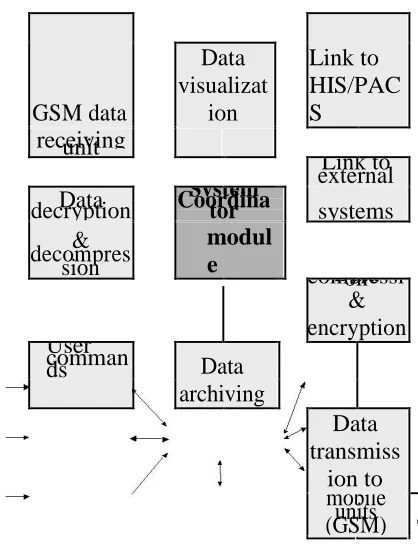
The consultation unit mainly consists of a dedicated workstation named as the Telemedicine Consultation Terminal (Figure 3) which is used as a processing terminal in the hands of the acting expert doctor, called to support an emergency case. On that station, the doctor sees the biosignals and still images received from the portable device, online from the emergency scene. Along with this extremely crucial data he has the ability to retrieve additional information on the patient’s past history provided that a HIS / PACS system is available. In
that case, the system can be customized to exchange data with them, otherwise, it handles the patient’s medical record by itself. The data received are displayed on the server screen and stored in the Ambulance Database Management System.
C. Software Implementation
The software implementation follows the client server model; the mobile site is the client and the consultation site is the server. The software was implemented on Windows 95 platform using windows API and MFC 0.0 class framework. Communication was performed using the TCP/IP protocol over GSM. Transmission rates were limited to 9600 bps which is the current maximum transmission rate for GSM. The client application is responsible for the collection and transmission of diagnostically important biosignals (3-lead ECG, Blood pressure, Oxygen saturation, Heart rate) as well as collection and transmission of series of still images of the patient. ECG data were sampled at 200 samples/sec thus resulting in a generation of
1600 bps per lead for the ECG. SpO2, HR, BP and
Temperature data were updated with a refresh rate of one per second thus adding only a small fraction of data to be transmitted. Thus, for real-time biosignal transmission, the available GSM bandwidth was adequate under normal network congestion conditions. Images were captured at 320 x 240 pixel resolution and compressed using the JPEG compression algorithm. The resulting data set was approximately 2,5-3 KB in size, thus needing 3-5 sec for transmission. The transmitted images were received at the consultation site to be viewed by the specialists, and concurrently appear on the paramedic’s display. The specialists can annotate on the image, to direct EMTs for example on how to extract a victim trapped in car wreckage. The paramedic can in real time observe these annotations on his display as these are drawn by the specialist. Thus, both sides can look at the same image simultaneously as it changes; this operation is known as “whiteboarding”. The specialist can instruct the technician to position himself in order to capture and transmit more images. During this
time, both parties (EMT and expert) observe, in real time, signals that are captured by the biosignal monitor. In order to avoid screen clutter, preference can be given to the signals that are considered more important. Switch between still image mode and biosignals mode is done remotely from the consultation unit.
recordings, like zoom-in and out, time and amplitude measurements, lead selection, and scroll into the recording to view the complete ECG. For recordings that were transmitted during previous emergency incidents, the expert doctor has also the ability to view the basic vital signs of the patient that were recorded along with the ECG. Those biosignals are the non-invasive blood pressure, (systolic and diastolic), the oxygen blood saturation, the temperature and the heart rate. All vital signs are fully synchronized with the ECG recording.
The application also allows handling and processing of medical images in a variety of formats. These images are related to previous medical examinations and can be retrieved from anywhere within the hospital or other network, provided that they are stored in a digital form. When the image is loaded into the viewer, the medical expert handling the emergency case can analyze the image for better visualization. Tools include zoom-in and out on specific image area, horizontal and vertical flip, and image rotate. Further image processing functions are available for increased functionality and can easily be added upon request.
D. Archiving Unit
All data collected by the control program and received at the consultation end of the system are archived on a dedicated DBMS. This is done both for security and legal purposes. To enhance even more the doctor’s ability for an accurate diagnosis the system is enriched with a graphical user interface enabling the display of additional clinical information of the patient. This is a friendly interface between the user and the multimedia database specially designed to work and interact with the other modules of the AMBULANCE system. Using this, the doctor has the ability to review previous emergency case related to the specific patient, older laboratory tests and other medical examinations. Having a complete view of the patient’s medical history, the doctor is able to provide specialized pre-hospital care.
Emphasis in the DBMS interface design was on the user -friendliness. For this reason, the database, which was designed within the Microsoft Access environment, was equipped with graphical user interface features built using Visual Basic 4.0. All parts of this Ambulance Database System (ADBS) were designed in compatibility with MS-Windows 95 environment.
The database is composed of four major tables. In the first, all the patient’s data, both personal and medical (name, address, blood group, allergies, long medication treatments etc.) are stored. If this information is available, better treatment can be provided in many cases (e.g. diabetic patient). Figure 6 shows the patient’s demographic data form design, containing both personal and clinical data. The second table is an archive of doctors. Each patient may have a personal doctor and it is useful for the doctor on duty to be able to contact if possible him/her for a detailed patient’s history. The third table has all information related to previous emergency cases for each patient. This is very helpful for the doctor in case the ongoing emergency case is similar to a previous one. Finally the fourth table consists of information related to previous examinations and laboratory tests of the patient. This part of the application is strongly linked to the availability of a HIS and a PACS of the hospital as presented earlier.
The ADBS system enhances the doctor’s possibilities for a more accurate and prompt diagnosis. It allows detailed queries on patients, doctors, previous emergency cases and patient laboratory examinations. Figure 7 illustrates the form used to record the emergency cases. For each emergency case, information like the incident’s code number, the date, the time, the initial and final diagnosis, the ambulance number and
personnel and the incident’s type, etc. is recorded. This information is compliant to the directive “Standard Guide for View of Emergency Medical Care in the Computerized Patient Record” (designation E-1744-95) of the American Society for Testing and Materials (ASTM).
IMPLEMENTATION OF WIRELESS COMMUNICATION TO ENHANCE THE WORKING OF EMERGENCY VEHICLESHitesh Gaba & Harsh Yadav P a g e | 764
are very critical issues to medical archiving systems. The application database is fully protected from unauthorized access; the database itself is password protected and fully encrypted whereas the whole application is password protected with a three level access (administrator, doctor, and data entry) . Access to the database’s information is possible only within the application’s environment. Both user-names and passwords are encrypted when stored with a key encapsulated into the application’s code, making it almost impossible to forge. The Administrator as a database manager has the authority and responsibility to change the database’s encryption, compact the databases and keep backup copies. For legal purposes, all users, with doctor or data entry permission, are not allowed to delete or modify any record from the database. The users with data entry access are also restricted from processing medical data such as ECG recordings or medical images.
E. System Verification
The verification phase of the project has focused primarily on compliance with both the functional and the quality specification of the system, which have been tested according to a standard protocol of procedures in order to ensure controlled conditions, that can be directly referenced to a standard level of practice. Verification concerned an experimental evaluation of the system on healthy volunteers or signal simulators and aimed to verify the systems suitability to enter into the large-scale evaluation phase, i.e. demonstration. During demonstration, a representative sample of the user-groups have evaluated the system in terms of its functionality and usability of the application and therefore have critically assessed the appropriateness and applicability of the technology under consideration. This evaluation involved a large number of users and focused on the appropriateness and domain impact of the application.
More specifically, the demonstration has focused on:
• use of the device in the field, on actual emergency cases and under routine operations
• systematic collection of data which were subsequently used for (i) the assessment of the technology under field use, (ii) the assessment of the telematic services under field use, and (iii) the assessment of the procedures applied, as they have been modified to fit the new technology
• analysis and interpretation of evaluation data towards the establishment of meaningful conclusions and useful feed-back,
• preparing the domain for the commercial exploitation and broad use of the system by emergency services throughout Europe
A brief practical and easy to fill out Data Collection Sheet (DCS) has been designed and used in order to record data for every patient with the most crucial information needed for the demonstration. The DCS was designed on the basis of the considerations that the data collected on it together with the data stored in the system for each patient should constitute a complete set, such that it would allow for retrospective evaluation and analysis. Furthermore, this type of standardization allowed the project partners to compile data from all sites as appropriate in order to increase credibility of results.
Specifically, the protocol had three sections. The first section concerned the administrative and general data concerning the management of each emergency operation. The second section handled the diagnostic data including the patient condition as perceived by the ambulance, the initial diagnosis and the final diagnosis (after the patient has undergone a complete work-up made by the physician). The third section handled the technical data and recorded the system’s behavior during usage.
III. RESULTS-SYSTEM DEMONSTRATION
adequate to establish a representative local sample and an adequate internal validity for the study. In order to be able to draw retrospectively meaningful conclusions and useful feedback, the DCS described in section II was filled-in for every investigated person. In the end of the experiment, every doctor involved filled out a questionnaire, based on the quality requirements as
30
% 27%
20 %
10 %
9%
5%
0%
GSM Connection
Lost BP/SpO2
ECG trransmission trnansmission interrupted
interrupted
Figure. Demonstration statistics on communication link robustness.
formulated in the beginning of the project.
In terms of technical issues, demonstration activities concentrated on verifying the compliance to user functional and technical specifications and assess system performance. Verification results have shown the stability and robustness of the system in real-life emergency conditions. User requirements as presented in Section II were in all cases satisfied with the exception of the bi-directional voice communication that has been implemented using a separate GSM connection. This was done to allow for maximum bandwidth availability for medical data transmission (due to the 9.6 Kbps max GSM data transfer), but also for additional security reasons since vocal communication needs to be always available in emergency case handling. The provision of auto-startup functions, connection diagnostics, and remote control functions satisfied requirements for
minimum hand operations by mobile healthcare providers. Furthermore, users considered both local and central archiving of collected data very effective to cope with legal requirements.
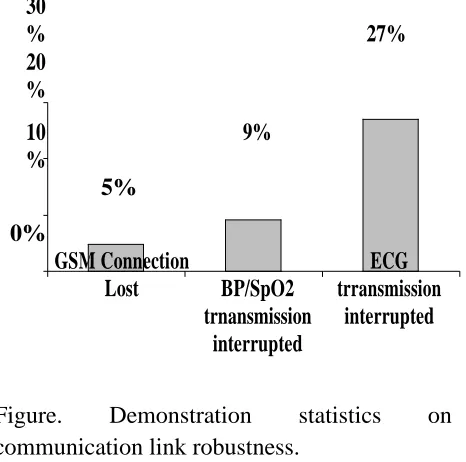
GSM communications proved considerably stable. As shown in Figure 8, from the data collected from all four pilot sites, only in 5% of the cases, GSM connections has been lost, whereas BP/SpO2 transmission has been interrupted only in
9% of the cases. Real-time ECG transmission however was interrupted in 27% of the cases treated although in most of the cases real-time transmission would be recovered shortly, through the auto-recovery procedures embedded in the system software. The increased ECG transmission interruptions can be attributed to GSM channel congestion, which enforced retransmissions for the packets lost. This of course comes as a result of the absolute requirement posed by the users for error-free medical data transmission, which is guaranteed by the TCP/IP protocol. In any case however, during transmission interruption, all collected data were locally stored in the mobile unit in order for a complete medical record to be available.
IMPLEMENTATION OF WIRELESS COMMUNICATION TO ENHANCE THE WORKING OF EMERGENCY VEHICLESHitesh Gaba & Harsh Yadav P a g e | 766
leg is repositioned immediately under expert guidance. Also, in cases of severe congestive heart failure, the CPAP-treatment could be started immediately in the Ambulance.
Recommendations by users for future system development include the integration of all systems (Biosignal monitor, mobile unit, and image acquisition device) in one module with possible less weight. Additional recommendations include the integration of the system with a GIS/GPS system for Ambulance vehicle control and management. In any case however, both user types (Mobile health care providers and experts) considered the system as being technically sound.
IV. CONCLUSIONS
We have developed a portable medical device to be used for emergency telemedicine applications. The device uses GSM mobile telephony links and allows the collection and transmission of vital biosignals, still images of the patient and bi-directional telepointing capability. The advance man-machine interface
enhances the system functionality by allowing the paramedics to operate in hands-free mode while receiving data and communicating with specialists in a hospital. The system was implemented as a part of the AMBULANCE project, and has been successfully demonstrated in four European pilot sites.
REFERENCES
[1] "Guidelines for the early management of patient with myocardial infarction", BMJ, Vol. 308, pp. 767-771, Mar 19, 1994.
[2] Heriot AG, "Delay in presentation after myocardial infarction," J-R-Soc-Med, Vol. 86, No 11, pp. 62-64, Nov 1993.
[3] Canto JG, Rogers WJ, Bowlby LJ, et al. "The prehospital Electrocardiogram in Acute Myocardial Infarction: Is its full potential being recognized?" J Am College Cardiol., Vol. 29, pp. 498-505, 1997
[4] Stults KR, Brown DD, Schug VL, Bean JA.
"Prehospital defibrillation performed by emergency medical technicians in rural communities," NEJM.;310 Vol. Jan. 26, pp.219-223, 1984.
[5] Weaver WD, Copass MK, Hill DL, Fahrenbruch C, Hallstrom AP, Cobb LA. "Cardiac arrest treated with a new automatic external defibrillator by out-of-hospital first responders," Am J Cardiol vol. 57, pp.1017-1021, 1986.
[6] Cummins RO, Eisenberg MS, Litwin PE, Graves JR, Hearne TR, Hallstrom AP "Automatic external defibrillators used by emergency medical technicians: A controlled clinical trial," JAMA, vol. 257, No. 12, pp. 1605-1610, 1987.
[7] Schrading WA, Stein S, Eitel DR, Grove L, Horner L, Stechkert G, Sabulsky NK, Ogden CS, Hess DR "An Evaluation of automated defibrillation and manual defibrillation by emergency medical technicians in a rural setting," Am J Emerg Med., Vol. 11, No. 2, pp. 125-130, 1993.
[8] Shuster M, Keller JL. Effect of fire department first-responder automated defibrillation. Annals Emerg Med., vol. 22, No. 4, pp 721-727, 1993.
[9] Sedgewick ML, Dalziel K, Watson J, Carrington DJ, Cobbe SM "Performance of an established system of first responder out-of-hospital defibrillation. The results of the second year of the Heartstart Scotland project in the utstein style," Resuscitation, vol. 26, pp. 75-88, 1993.
[10] Editorial on Emergency Telemedicine, Telemedicine Today, vol. 6, No. 1, p. 21, Feb 1998.