Available online: https://edupediapublications.org/journals/index.php/IJR/ P a g e | 1437
Video Steganography Using Lazy Wavelet Transform
Shailesh Yadav1, Prof. Abhishek Jain2, Prof. Aman Sharma3 1M. Tech. Scholar, 2,3 Assistant Professor,
Dept. of Electronics and Communication, Samrat Ashok Technological Institute, Vidisha (M.P.)-464001
ABSTARCT
Steganography is the expertise skill of secret communication, concealing the very existence of communication. It resolute the issue of network security and favor secure communication through public and private channels. The hidden message can be in any format like text, audio, image or video. Nowadays, video files are drawing more and more attention. They are transmitted frequently on internet websites such as Instagram, YouTube etc dignifying a factual significance on video steganography. Video file usually consist of some identical frames, which are selected to hide the data. When video steganography is used, the anticipation to discover the secret information by an attacker is very less as compared to the other methods to hide data in a sequential manner. In this paper a modified technique has been used to embed the data. It involves the application of transformation to hide the encrypted data in cover file comprising of group of frames in sequential manner instead of using a single frame or image unlike existing video steganography methods [1]. The performance metrics such as Peak Signal to Noise Ratio (PSNR), RGB Intensity, Mean Square Error (MSE) and Data Recovery Ratio (DRR) have also been considered for experimental verification of the study. Simulation results are performed on MATLAB R2011b.
Keywords: LWT, Lazy Wavelet Transform, Steganography, Object Processing Method, Data Recovery Ratio.
INTRODUCTION
Today, digital media and internet are getting highly popular and the revolution in digital information has created new challenges for sending messages in a safe and secure way. So, demand of secure transmission of data has also increased. Data security basically intents at preserving the confidentiality and integrity of data and protection of data from unauthorized users or hackers. For this, various techniques are proposed and employed into practice. But whatever method we choose, the most essential is its degree of security. Various approaches have been developed for approaching the issue of information security such as digital watermarking, cryptography and steganography [2].
STEGANOGRAPHY
Available online: https://edupediapublications.org/journals/index.php/IJR/ P a g e | 1438
TYPES OF STEGANOGRAPHY
There are multiple ways [3] to hide the messages using steganography like in images, word file, audio and video. All are briefly described below
Steganography in Image: Digital images are the most generally used cover objects for steganography. The availability of various file formats for different applications differs according to the algorithm used for these formats.
Steganography in Audio: Embedding secret messages into an audio file is the most assertive technique in steganography. This is why, the human auditory system (HAS) has such a dynamic range that it can listen over multiple frequencies at a time.
Steganography in Document: Steganography in documents targets on amending some of its characteristics. They can either be distinctive of text or even doc formatting.
Steganography in Video: In this method, to hide the secret messages, a video file would be enclosed with accompanying data. In this procedure, an intermediate signal would be generated which is a function of hidden message data and data of content signal. There are different approaches for video Steganography like Least Significant Bit Insertion and Real time video Steganography.
Least Significant Bit Insertion:
It is the most popular and lucid approach for all types of steganography. In this method the digital video file is estimated as separate frames and alters the exposed image of each video frame. LSB of 1 byte is used to store the encrypted data in the image.
Real time video steganography:
It hides the secret information in the frames of video and considers each one of the frame irrespectively. The image is then dissected into the blocks. If pixel colors are almost similar then change the color characteristics of these pixels of the blocks to some expanse. It would become easier to identify the missing parts of secret information by labeling each frame with a sequence number. Now the displayed image should be certified first and compatible program is used to extract the encrypted information.
In this paper, video steganography is done using a modified version of wavelet transform. This transform is termed as lazy wavelet transform. This method provides a number of benefits above other existing methods of steganography [4]. In general, the image file has a confined expanse compared to a video file as it is a collection of numerous images known as frames of video. When an image file is used as a cover medium it is easy for the attacker to recover the message. But if we use a video for cover medium then more than one frame or image can be used simultaneously to hide data and this makes it more difficult for attacker to recover message data, because as sequence of the stego frame(s) within the video is remote for the attacker.
Wavelet Transform
The continuous-time wavelet transform [5, 6] has most of its utilizations in data analysis, out turning an affine invariant time-frequency representation. The most famous version is the discrete wavelet transform (DWT). It has admirable signal compaction properties for real-world signals while being computationally very efficient. Therefore, it has been applied in almost all technical fields including image compression, denoising, numerical integration and pattern recognition.
[𝑊𝜑𝑓](𝑎, 𝑏) =
1
√|𝑎|∫ 𝜑[(𝑥 − 𝑏)/𝑎]
̅̅̅̅̅̅̅̅̅̅̅̅̅̅̅̅̅ ∞
−∞
Available online: https://edupediapublications.org/journals/index.php/IJR/ P a g e | 1439 sj[n]
So j[n]
se j[n]
sj+1[n]
ej+1[n]
LWT
P
U
Here, [𝑊𝜑𝑓](𝑎, 𝑏) is the Wavelet Coefficient,
where, ‘a’ is 2-j and ‘b’ is k2-j.
LAZY WAVELET TRANSFORM
A video be composed of many sequential frames[7]. Transformation technique is applied to these sequential frames. Wavelet transformation is usually performed to convert the spatial domain into frequency domain producing real values by most of the wavelet techniques, resulting in data loss when hid and retrieved. To overcome this lazy wavelet transform is used, by applying Integer Wavelet Transform which in turn produces integer values. Thus four sub bands are generated applying Integer Wavelet Transform.
Lazy wavelet transform divides the signal sj[n] in two new signals: the odd samples
signal designated as sjo[n] and the even samples
signal designated by sje[n]. It involves the following steps:
Prediction step is aimed to compute a prediction for the odd samples, constructed on the basis of even samples (or vice versa). This prediction gets eliminated from the odd samples by generating an error signal𝑒𝑗+1[𝑛].
Update step recalibrates the low frequency branch with some energy extracted during sub sampling. Thus, in the case of classical Lifting, it is used to prepare the signal for the upcoming prediction step. It utilizes the predicted odd samples 𝑒𝑗+1[𝑛] to generate the
even ones 𝑠𝑗𝑒[𝑛] (or vice versa) and this update gets eliminated from the even
samples
producing the signal denoted by 𝑠𝑗+1[𝑛].
Figure 1: Working of LWT
PERFORMANCE PARAMETERS
MSE (Mean Square Error)
The Mean Square Error (MSE) and the Peak Signal to Noise Ratio (PSNR) are the two error metrics used to correlate or consider image compression quality. The MSE corresponds to the cumulative squared error between the compressed and the original image, whereas PSNR represents a measure of the peak error. The lower the value of MSE, lower the error.
𝑀𝑆𝐸 =
∑
[𝐼
1(𝑀, 𝑁) − 𝐼
2(𝑀, 𝑁)]
2 𝑀𝑁
𝑀 ∗ 𝑁
Where, I1 and I2 represents the pixels of the
image, also M and N are the number of rows and columns in the input frame, respectively.
RGB Intensity
The RGB color model is a complementary color model in which red, green and blue light are added conjointly in numerous ways to develop an extensive array of colors. The RGB model gets its name from the initials of the three additive primary colors, red, green and blue.
Available online: https://edupediapublications.org/journals/index.php/IJR/ P a g e | 1440 images in electronic systems, such as computers,
televisions and many more. Although it has also been used in conventional photography. Since the electronic age, the RGB color model already had a rigid and firm theory behind it, on the basis of human perception of colors.
𝑪𝒐𝒍𝒐𝒓 𝑰𝒏𝒕𝒆𝒏𝒔𝒊𝒕𝒚 (𝑰) =
𝟏
𝟑
∗ (𝑹 + 𝑮 + 𝑩)
Here R, G, B denoted the value of Red, Green, Blue components of an image or in this instance for sequential frames of video.
PSNR (Peak Signal to Noise Ratio)
For calculating PSNR, the block first determines the mean-squared error using the following equation
PSNR = 10 log
10(𝐼
2/𝑀𝑆𝐸)
In this equation, I denote the RGB component intensity value for input data taken from sequential frames of video file. Likewise to any single frame or image, the values in this instance will also range from 1 to 255, if the sequential frame is of 8-bit data type.
PROPOSED TECHNIQUE
Hiding Procedure
A video is usually comprised of multiple frames. In this paper, some sequential frames of video are used, and each frame is used to store encrypted message in it. A steganography technique is usually used to store messages, and here the Lazy Wavelet Transform on sequential frame is applied to get four sub-bands. The data is then hidden in these sub bands.
Applying Lazy Wavelet Transform on the Video
Wavelet transformation produces real values by most of the wavelet based techniques, resulting in data loss when hide and retrieved. For overcoming this shortcoming, lazy wavelet scheme is used. LWT produces integer values applying Integer Wavelet Transform. Thus we get four sub bands after applying Integer Wavelet Transform.
Hiding bits in the Sub-bands
In the proposed work, RGB Intensity for each sub bands is calculated and encoding of data is performed in sequential order of each sub bands of frames. The data stored in the frames is sequential, maximum payload in all the frames will be fixed by the frame size. But a fewer number of bits might be hidden in the last frame in which the message is hidden. In other words we can say that the capacity of carrier data to handle message data depends on quality i.e. resolution of carrier data. In the proposed work, the number of sequential frames and the size of particular frame should be kept in consideration before deciding the size of data to be encrypted. At the receiver end, hidden data is extracted from the original message using the information like position, sequence and resolution of transmitted data provided during transmission.
Algorithm for embedding the message in video:
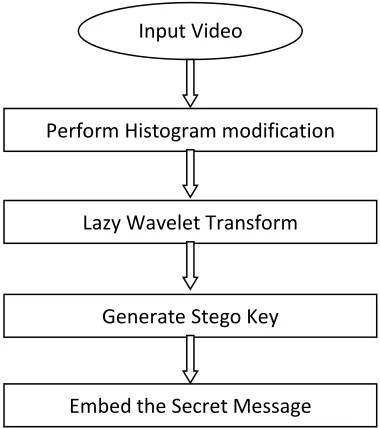
Step-1: Import video file and select no. of sequential frames to be used for performing Steganography.
Step-2: Perform Histogram modification on selected frames.
Step-3: Apply lazy wavelet transform.
Step-4: Generate key for embedding message.
Available online: https://edupediapublications.org/journals/index.php/IJR/ P a g e | 1441 data that can be selected depends on the
number of sequential frames taken from video.
Figure 2: Algorithm for embedding message
in video file
Algorithm for separating carrier and message at receiver end
Step-1: Identify the position and sequence frames containing message within the received video.
Step-2: Apply OPA to minimize the error.
Step-3: Perform Inverse Lazy Wavelet Transform.
Step-4: To extract the identified frames & perform LWT.
Step-5: You will get a text file containing the recovered data.
Figure 3: Algorithm for message retrieval at receiver end
Validation Process
The recovered message is compared to the original message and some parameters are calculated, i.e. PSNR, MSE, RGB component Intensity and Data Recovery Ration (DRR).
RESULT
The simulations were performed on different video files, with varying number of sequential frames, while the message length is also varied.
Result for Video-1: Vipmosaicking.avi
The figure 4 shows the original, embedded and recovered frames of video. After embedding data in 10-sequential frames of video high PSNR=69.3752, RGB intensity=77.9576, DRR=100% is obtained.
Original Frame
Extraction of Frames Containing DataObject Processing Method
Inverse Lazy Wavelet Transform
Extraction of Data
View Output Data Input Video
Perform Histogram modification
Lazy Wavelet Transform
Generate Stego Key
Available online: https://edupediapublications.org/journals/index.php/IJR/ P a g e | 1442
After Embeding
Recovered Frame
Figure 4: Original, Embedded and
Recovered Frames of Video
Vipmosaicking.avi.
Table-1: Showing the values of MSE, PSNR & RGB intensity and Data Recovery Ratio varies according to the number of sequential frames of used at the time of message embedding.
Figure 5: illustrating comparison between the values of PSNR, RGB intensity and sequential frames of video: Vipmosaicking.avi.
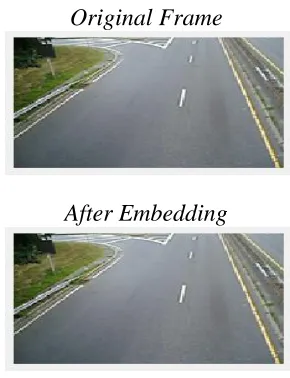
Result for Video-2: Viptraffic.avi
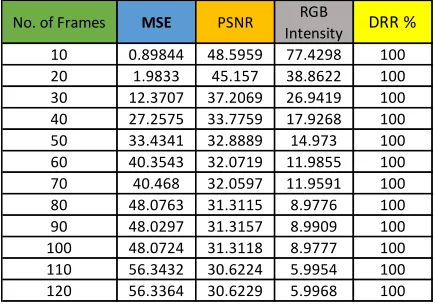
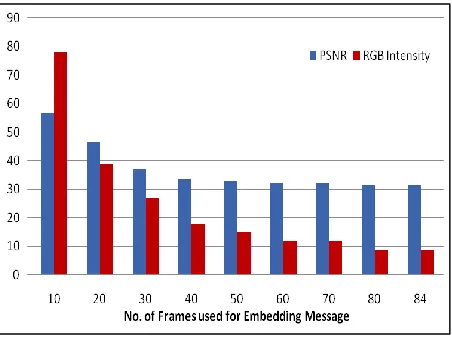
The figure 6 shows the original, embedded and recovered frames of video. After embedding data in 10-sequential frames of video high
PSNR=48.5959, RGB intensity=77.4298,
DRR=100% is obtained.
Original Frame
After Embedding
No. of Frames MSE PSNR RGBAvailable online: https://edupediapublications.org/journals/index.php/IJR/ P a g e | 1443
Recovered Frame
Figure 6: Original, Embedded and
Recovered Frames of Video Viptraffic.avi
Table-2 shows the values of MSE, PSNR & RGB intensity and Data Recovery Ratio varies according to the number of sequential frames of used at the time of message embedding.
Figure 7: illustrating comparison between the values of PSNR, RGB intensity and sequential frames of video: Vipmosaicking.avi.
Result for Video-3: Vipunmarkedroad.avi
The figure 8 shows the original, embedded and recovered frames of video. After embedding data in 10-sequential frames of video high
PSNR=56.8007, RGB intensity=77.9937,
DRR=100% is obtained.
Original Frame
\After Embedding
Recovered Frame
Figure 8: Original, Embedded and
Recovered Frames of Video
Vipunmarkedroad.avi
No. of Frames MSE PSNR RGBAvailable online: https://edupediapublications.org/journals/index.php/IJR/ P a g e | 1444 Table-3 shows the values of MSE, PSNR &
RGB intensity and Data Recovery Ratio varies according to the number of sequential frames of used at the time of message embedding.
Figure 9: illustrating comparison between the values of PSNR, RGB intensity and sequential frames of video: Vipunmarkedroad.avi.
CONCLUSION
This paper provides a good method of steganography in video by using Lazy Wavelet Scheme. In the proposed work, data is hidden in video sequence instead of few frames. Experiments were conducted to evince that video-frame stenography provides a good intervene between encryption, steganography robustness, flexibility and real-time processing.
The proposed algorithm is tested on both RGB and gray scale videos of different lengths with different types of alphanumeric messages to
hide. On the basis of different performance parameters like MSE, PSNR, RGB Intensity, DRR, simulation is carried out on three different RGB videos. Simulation results concluded that irrespective of the size of message, better PSNR and MSE values are obtained in video steganography with perfect data recovery ratio.
It has been observed that optimum MSE, PSNR and Data Recovery Ratio is attained, when lower number of possible frames is used for hiding the data. Results also show that lesser the RGB component, lower is the PSNR of the stegnographed video.
Simulation results also show that the length of message to be embedded and length of the video is directly correlated. For videos of 0.3-.10 seconds, 256 KB of data is embedded and recovered successfully. Thus, LWT provides optimum results for hiding the data providing more security and robustness to the system.
REFERENCES
[1] Mennatallah M. Sadek & Amal S. Khalifa & Mostafa G. M. Mostafa, “Video steganography: a comprehensive review”, 2014, Multimed Tools Appl
DOI 10.1007/s11042-014-1952-z.
[2] Nikita Lemos, Kavita Sonawane, & Bidisha Roy, “Secure data transmission using video”, Eighth International
Conference on Contemporary
Computing (IC3), 2015
[3] Jasleen Kaur, & Deepankar Verma, “Steganography Techniques –A Review Paper”, IJERMT, ISSN: 2278-9359
(Volume-3, Issue-5), May 2014.
[4] Abhinav Thakur, Harbinder Singh, &
Shikha Sharda, Secure Video
Steganography based on Discrete Wavelet Transform and Arnold Transform, International Journal of
No. of Frames MSE PSNR RGB
Available online: https://edupediapublications.org/journals/index.php/IJR/ P a g e | 1445 Computer Applications (0975 – 8887)
Volume 123 – No.11, August 2015
[5] P. P. Vaidyanathan, “Multirate systems and filter banks”, Prentice Hall,
Englewood Cliffs, 1993.
[6] P. P. Vaidyanathan, Igor Djokovic, “An Introduction to Wavelet Transforms”,
Caltech, Pasadena, CA 91125, August, 1994.
[7] Agrawal E., Gupta S, & Chandra M A, “Data Hiding Using LWT Strategy”,
International Journal of Computer Applications, (0975 – 8887), (ICACEA-2014) at IMSEC, GZB
[8] A.K. AL Frajat, H.A. Jalab,
Z.M.Kasirun, A.A.Zaidan & B.B.Zaidan “Data hiding in video file: An overview”, 2010, Journal of Applied
Sciences 10 (15): 1644-1649, ISSN 1812-5654.
[9] C.P.Sumathi, T.Santanam &
G.Umamaheswari, “A Study of Various Steganographic Techniques Used for Information Hiding”, 2013, IJCSES
Vol.4, No.6, December 2013.
[10] K.Parvathi Divya & K.Mahesh, “Various Techniques in Video
Steganography -A Review”,
International Journal of Computer & Organization Trends – Volume 5, ISSN: 2249-2593, 2014.
[11] K.Rosemary Euphrasi & M. Mary Shanthi Rani, “A Comparative Study On Video Steganography in Spatial and IWT Domain”, 2016, 2016 IEEE International Conference on Advances in Computer Applications (ICACA).
[12] Park J.S. “MATLAB GUI Tutorial for beginners” University of Incheon.
[13] Sudhanshi Sharma & Umesh Kumar, “Review of Transform Domain Techniques for Image Steganography”,
2013, International Journal of Science and Research (IJSR) ISSN (Online): 2319-7064.
[14] Sukhjinder Singh, Neeraj Gill, & Gagandeep Kaur, “Identical Frames Based Video Steganography”, 2014,
International Journal of Innovative Research in Electrical, Electronics,
Instrumentation and Control
Engineering, Vol. 2, Issue 7, July 2014.
[15] Tinku Acharya, Ping-Sing Tsai,
JPEG2000 Standard for Image