ISSN 2348 – 7968
Implementation of Perturb & Observe and Fuzzy Logic Control
MPPT of PV System Using SEPIC Converter
Santosh.B.R1, Vinod Kumar2 and Sumathi.S3
1
Department of Electrical & Electronics.Engg, B.N.M.Institute of Technology, Bangalore,
560070, India 2
Department of Electrical & Electronics.Engg, B.N.M.Institute of Technology, Bangalore,
560070, India 3
Assistant Professor, Department of Electrical & Electronics.Engg, B.N.M.Institute of Technology, Bangalore,
560070, India
Abstract
This paper presents the controller design of the PV system implemented with the single-ended primary inductance converter (SEPIC). The objective is to improve the efficiency of a standalone solar energy system consisting of a photovoltaic (PV) panel and a DC/DC SEPIC converter connected to a load. In this study, simulation of Perturb & Observe (P&O) and Fuzzy Logic (FL) Maximum Power Point Tracking (MPPT) are used in photovoltaic system with a direct control method are presented. In this control system, no proportional or integral control loop exists and a P&O algorithm and an adaptive FL controller generate the control. The designed and integrated system is a contribution of different aspects which includes simulation, design and programming. MATLAB/Simulink software is utilized for simulation. The obtained experimental results show the functionality and feasibility of the proposed controller.
Keywords: SEPIC Converter, Perturb & Observe (P&O,) Fuzzy Logic Controller (FLC), Maximum Power Point Tracking (MPPT), Photovoltaic (PV).
1. Introduction
Significant progress has been made over the last few years in the research and development of renewable energy systems such as wind, sea wave and solar energy systems. Among these resources, solar energy is considered nowadays as one of the most reliable, daily available, and environment friendly renewable energy source [1], [2]. However, solar energy systems generally suffer from their low efficiencies and high costs [3]. In order to overcome these drawbacks, maximum power should be extracted from the PV panel using different MPPT techniques to optimize the efficiency of overall PV system. MPPT is a real-time control scheme applied to the PV power converter in order to extract the maximum power possible from the PV panel. For a fixed load, the equivalent resistance seen by the panel can be adjusted by changing the power converter duty cycle [4]. The Fuzzy Logic (FL) and the Perturb and Observe (P&O) are most known and commercially used techniques [5]-[8]. Other modified methods have been also reported to improve the performance of these techniques.
Two common choices of DC-DC switching converters for photovoltaic system are SEPIC and buck-boost converters. An implementation of the SEPIC converters for MPPT in [1] shows a satisfactory performance. Although a buck-boost converter is simpler, its output voltage is inverted. Combining a buck converter with a boost converter eliminates the inversion, but adds complexity. So, when non-inverted output voltage is required, a SEPIC would be a better choice as observed in [2].
1.1 Overview of the Project
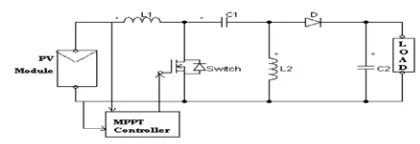
Fig. 1 Proposed converter with MPPT controller.
ISSN 2348 – 7968
MPPT technique to adaptively change voltage step-size depending on the PV system operating point and the old step-size. The proposed control scheme achieves stable operation in the entire region of the PV panel and eliminates therefore the resulting oscillations around the maximum power operating point.
2. PV System Model
The proposed standalone photovoltaic (PV) system consists of three main blocks: PV panel, power converter, and MPPT controller. The following sections will describe the modeling of the PV panel and power converter.
2.1
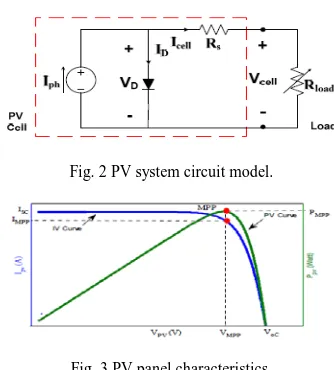
PV Panel ModelThe PV model represents the solar cell in its simplest form as a PN junction followed by a series resistance as shown in Fig. 2 [10]. The PV system equivalent circuit is described by the following equations:
s cell D
cell
V
I
R
V
=
−
(1))
1
(
( )−
−
=
−
=
KPVVpanel+IcellRso ph D ph
cell
I
I
I
I
e
I
(2)
Where Vcell is the PV cell terminal voltage, VD is the diode voltage, Icellis the PV cell terminal current, ID is the diode
current.
pKT
q
K
pv=
, q = 1.6x10⁻¹⁹
C (electron charge), K =
1.3805x10⁻²³ J/K (Boltzmann’s constant), T is the cell temperature, and p=1.3 is the ideal p-n junction characteristic factor for monocrystalline solar cells [10]. Io is the saturation current in diode reverse-biased direction and Rs is the panel series resistance: −
=
pK T T qV r rr o r ge
T
T
I
I
1 1 3 (3)Where Irr is the reverse saturation current at the reference temperature Tr. Vg is the band-gap voltage of the semiconductor making up the cell, which equals 1.12 eV for monocrystalline Si cells, and Iph is the Photocurrent
(
)
100
)
(
rλ
I sc
ph
I
K
T
T
I
=
+
−
(4)Fig. 2 PV system circuit model.
Fig. 3 PV panel characteristics.
Isc is the short-circuit cell current at reference temperature and insolation, KIin (mA/K) is the short-circuit current temperature coefficient, λ is the insolation in (MW/cm), and Io is the saturation current in diode reverse-biased direction.
The panel IV and PV characteristics curves are obtainedby plotting the PV current and PV power as a function of the PV voltage as shown in Fig. 3.[12] This figure illustratesalso the location of three important points on the Pvpanel characteristics: the short-circuit current Isc, the open-circuit voltage Voc, and the maximum power point VMPP, IMPP, PMPP.
2.2
Power ConverterFig. 4 SEPIC converter
ISSN 2348 – 7968
Fig. 5 Mode-1 of SEPIC converter when switch is ON
When the power switch is turned off, the first inductor charges the capacitor C1 and also provides current to the load, as shown in Fig. 6. The second inductor is also connected to the load during this time.
Fig. 6 Mode-2 of SEPIC converter when switch is OFF
3. Maximum Power Point Tracking
For maximizing the PV conversion efficiency, the incoming sun energy must be converted to electricity with the highest efficiency, accomplished when the photovoltaic module operates on the maximum power point. Nevertheless, since this operating point is strongly affected by the solar radiation and temperature levels [18]. Thus, in order to dynamically set the MPP as operation point for a wide range of solar radiation and temperature, specific circuits, known at the literature by Maximum Power Point Trackers (MPPT), are employed. There are many MPP algorithms, here the implementation of two such algorithms namely Perturb & Observe (P&O) and Fuzzy Logic (FL) controllers are used in the simulation.
3.1
Perturb & ObservePerturb and Observe (P&O) is one of the most diffused MPPT algorithms, whose tracking response is independent on the environmental conditions, however, its implementation requires a voltage and a current sensor, increasing the cost and complexity.
Fig. 8 Flowchart of Perturb & Observe method
3.2
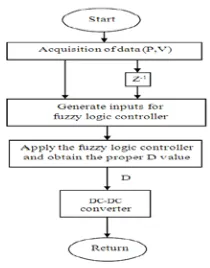
Fuzzy Logic ControlFuzzy logic control is a new addition to control theory. Its design philosophy deviates from all the previous methods by accommodating expert knowledge in controller design. The fuzzy control does not need an accurate mathematical model of a plant. Therefore, it is applicable to a process where the plant model is unknown or ill defined. To implement the FL in a problem, different steps of this algorithm must be taken which are as follows.
Fig. 6 Flowchart of Fuzzy Logic Control
3.2.1
FuzzificationThe input defined in Equations (5) and (6) need to be fuzzified by some membership functions. For each input value, the respective membership function returns a value of μ. The max-min method was applied to extract the μ from the triangle type membership function.
)
1
(
)
(
)
1
(
)
(
)
(
)
(
)
(
−
∆
−
∆
−
∆
−
∆
=
∆
∆
=
t
V
t
V
t
P
t
P
t
V
t
P
t
ISSN 2348 – 7968
)
1
(
)
(
)
(
=
−
−
∆
e
t
e
t
e
t
(6)3.2.2
Inference DiagramA rule base must be applied to the obtained membership function according to Mamdani. The rule table is designed and shown below in Table 1.
3.2.3 Defuzzification
For the Defuzzification, the centroid method is applied to return a proper value for the duty cycle variation (ΔD). The defuzzified output value of the FLC must be added to a reference value of duty cycle which is considered equal to the duty cycle for the current study [10]. The result is the optimum value of D that has to be sent to the SEPIC converter as a control signal.
(a)
(b)
(c)
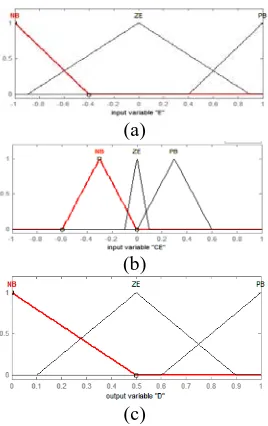
Fig. 9Membership function of (a) input e, (b) input Δe and (c) output ΔD
Figure 9 as shown above depicts the membership functions for inputs e and Δe and output ΔD which is the variation needs to beapplied to the current D value.
Table 1: Rule Table
4. Simulink Design of Proposed System
Simulation is a process in which the circuit works and verifies the output values. Figure 10 and figure 11 show the P&O and FL algorithm controller respectively. Here both algorithms output voltage waveform are compared to show which controller is best to provide an efficient system.
Fig. 10 Simulink model of closed loop system with P&O algorithm controller
Fig. 11 Simulink model of closed loop system with Fuzzy Logic algorithm controller
The parameters of the PV panel and the SEPIC converter are shown below in the Table 2 and Table 3.
Table 2: PV panel parameters
Table 3: SEPIC converter parameters Vin Vout Switching
frequency
L1 L2 C1 C2
32V 24V 500Hz 6.4mH 32mH 62.5
μ f
41.66mf
5. Simulation Results
The PV module is modeled in MATLAB/SIMULINK with the assumption that the PV module has constant temperature of 25°C, at an Insolation level of 1000W/m2. A pure resistive load is connected to the PV module through the SEPIC converter. The performance of the proposed technique has been examined e/Δe NB ZE PB
NB PB PB PB
ZE PB PB PB
PB PB PB PB
Pmax Vmax Imax Voc Isc
ISSN 2348 – 7968
for fixed solar radiance at 1000W/m2 in P&O method and variable irradiance in FL method.
(a)
(b)
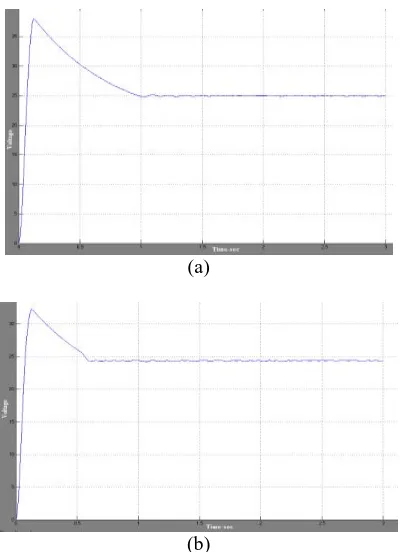
Fig. 12 P&O and Fuzzy Logic, responses for standard conditions of temperature 25 °C for irradiation 1000W/m2
Fig. 13 PV system with experimental SEPIC converter and a driver circuit
Fig. 14 Output voltage shown in CRO
Fig.12 (a) & (b) shows the results of PV operating voltage of the triangular membership functions. From this figure, it is observed that the fuzzy can track the maximum power point better than Perturb & Observe method. Hence from the investigation, it is clear that the PV power which is controlled by the proposed fuzzy controller is more stable than the conventional MPPT techniques. A photograph of the experimental converter is shown in Fig. 13, and the response to
an input voltage, the output voltage is shown in Fig. 14. From the data given in Table 4, it is observed that the fuzzy can track the maximum efficiency compared to the conventional P&O MPPT techniques.
Table 4: Comparison of MPPT technique MPPT
methods
Output voltage
Peak overshoot
Settling time
P&O 25v 38v 1sec
FLC 24v 33v 0.6sec
6. Conclusions
This paper has presented an intelligent MPPT control strategy for the PV system using fuzzy logic controller. The maximum power point tracking technique was simulated using MATLAB/Simulink. The proposed fuzzy logic based MPPT technique can track the maximum power point faster compared to the P&O based mppt technique. It has the capability of reducing the voltage fluctuation after MPP has been recognized. The simulation results show the efficiency of the fuzzy logic controller in maintaining the stable maximum power point.
References
[1] J. Applebaum, “The Quality of Load Matching in a Direct coupling Photovoltaic System ", IEEE Trans. On Energy Conversion, Vol. 2, No.4, pp.534-541, Dec. 1987.
[2] T. Kawamura, K.Hrada, Y.Ishihara, T.Todaka, T. Oshiro, H.Nakamura, M.Imataki, “Analysis of MPPT Characteristics in Photovoltaic Power System”, Solar Energy Materials & SolarCells, Vol. 47, pp.155-165, 1997.
[3] S.Mekhilef, R. Saidur and A.Safari, “A Review of Solar Energy use in Industries”, Elsevier Renewable and Sustainable Energy Reviews, Vol. 15, pp. 1777-1790, 2011.
[4] K.H. Solangi, M.R. Islam, R.Saidur, N.A. Rahim and H.Fayaz, “A Review on global Sola Energy Policy”, Elsevier, Vol.15, pp. 2149-2163, 2011.
[5] V.salas, E.Olyas, A. Barrado, A .Lazaro, “ Review of The
Maximum Power Point Tracking Algorithms for Stand-Alone Photovoltaic Systems”, Solar Energy Materials & Solar Cells, Vol. 90, pp. 1555-1578, 2006.
[6] N. Femia, D. Granozio, G. Petrone, G. Spaguuolo, and M. Vitelli, “Optimized one-cycle control in photovoltaic grid connected applications,” IEEE Trans. Aerosp. Electron. Syst., Vol. 42, pp. 954– 972, 2006.
[7] W. Wu, N. Pongratananukul, W. Qiu, K. Rustom, T. Kas-paris, and I. Batarseh, “DSP-based multiple peack power tracking for expandable power system,” in Proc. APEC, pp. 525–530, 2003. [8] C. Hua and C. Shen, “Comparative study of peak power tracking techniques for solar storage system,” in Proc. APEC, pp. 679– 685, 1998.
ISSN 2348 – 7968
[10] K. H. Hussein, I. Muta, T. Hoshino, and M. Osakada, “Maximum power point tracking: an algorithm for rapidly chancing atmospheric conditions,” IEE Proc.-Gener. Transm-Distrib., Vol. 142, pp. 59–64, 1995.
[11] X. Sun, W. Wu, X. Li, and Q. Zhao, “A research on photovoltaic energy controlling system with maximum power point tracking,” in Power Conversion Conference, pp. 822–826, 2002.
[12] T. L. Kottas, Y. S. Boutalis, and A. D. Karlis, “New maximum power point tracker for PV arrays using fuzzy controller in close cooperation with fuzzy cognitive net-work,” IEEE Trans. Energy Conv., Vol. 21, pp. 793–803, 2006.
[13] Y. T. Hsiao and C. H. Chen, “Maximum power tracking for photovoltaic power system,” in Proc. Industry Application Conference, pp. 1035–1040, 2002.
[14] G. J. Yu, Y. S. Jung, J. Y. Choi, I. Choy, J. H. Song, and G. S. Kim, “A novel two-mode MPPT control algorithm based on comparative study of existing algorithms,” in Proc. Photovoltaic Specialists Conference, pp. 1531–1534, 2002.
[15] M. Park and I. K. Yu, “A study on optimal voltage for MPPT obtained by surface temperature of solar cell,” in Proc. IECON, pp. 2040–2045, 2004.
[16] T. Takashima, T. Tanaka, M. Amano, and Y. Ando, “Maximum output control of photovoltaic (PV) array,” in Proc. 35th Intersociety Energy Convers. Eng. Conf. Ex-hib., pp. 380–383, 2000.
[17] P. C. M. de Carvalho, R. S. T. Pontes, D. S. Oliveira, D. B. Riffel, R. G. V. de Oliveira, and S. B. Mesquita, “Control method of a photovoltaic powered reverse osmosis plant without batteries based on maximum power point track-ing,” in Proc. IEEE/PES Transmiss. Distrib. Conf. Expo.: Latin America, pp. 137–142, 2004.
[18] Roberto Farada and Sonia Leve “Energy Comparison of MPPT techniques for PV Systems”, WSEA Trans. On Power Systems, pp. 446-455, 2008.
Santosh.B.R is presently pursuing his M. Tech. studies in the Department of Electrical & Electronics Engg. B.N.M.Institute of Technology, Bangalore. He received his B.E. Degree in Electrical & Electronics Engineering from Sri Bhagawan Mahaveer Jain College of Engineering, Bangalore in 2012. His area of interest includes analog and digital circuits, power system analysis, transmission and distribution, power electronics, artifial neural network and fuzzy logic.
Vinod Kumar is pursuing his M. Tech. studies in the Department of Electrical & Electronics Engg. B.N.M. Institute of Technology, Bangalore. He received his B.E. Degree in Electrical & Electronics Engineering from MVJ College of Engineering, Bangalore in 2011.