Hybrid RES with Fuzzy based Predictive
Control for Shipboard Using the IPA-SQP
AMBALA SUJITH KUMAR
M-tech Student Scholar
Department of Electrical & Electronics Engineering,
Malla Reddy Engineering College, Maisammaguda, Dhulapally RD; Kompally; Hyderabad
RR Dist. (Dt); Telangana, India.
MRS. K ANITHA REDDY
Assistant Professor
Department of Electrical & Electronics Engineering,
Malla Reddy Engineering College, Maisammaguda, Dhulapally RD; Kompally; Hyderabad
RR Dist. (Dt); Telangana, India.
Abstract – Shipboard power distribution systems and their first cousins in the terrestrial world have common fundamental characteristics. They use a variety of interconnected components to transport electrical energy, safely and reliably, from a source of supply to end users and loads. Shipboard integrated power systems, the key enablers of ship electrification, call for effective power management control (PMC) to achieve optimal and reliable operation in dynamic environments under hardware limitations and operational constraints. The design of PMC can be treated naturally in a model predictive control (MPC) framework, where a cost function is minimized over a prediction horizon subject to constraints. The power generation in ship system will include in high cost and complex. In order to reduce these problems renewable energy sources can be used with the power management with photo voltaic cell and fuel cell applications. Several operational scenarios are considered to evaluate the performance of the proposed PMC solution. Different performance attributes and their tradeoffs can be coordinated through proper tuning of the design parameters. In this paper a fuzzy based Model predictive control (MPC) is an effective control methodology that exploits the solution of a receding horizon optimal control problem to enforce constraints, such as the operational limits of the IPS, and to shape its high transient response is evaluated with Matlab/simulink analysis.
Index Terms— Integrated perturbation analysis and sequential quadratic programming (IPA-SQP), integrated power system (IPS), model predictive control (MPC), power management control (PMC), real-time optimization.
I. INTRODUCTION
Shipboard integrated power systems (IPSs) have been pursued as the key enabling technology in ship electrification for applications including warships and high-value co mmercial ships [1], [2]. They p rovide electrical power for both the propulsion system and service loads, and rely on power management control (PM C) strategies to coordinate the power sources and loads to achieve efficient and robust operation and to meet various dynamic requirements in diverse and sometimes adverse conditions. Moreover, effective PMC strategies are expected to provide improved fuel efficiency, enhanced response speed, and superior reliab ility [3]. To acco mplish this, PMC must effectively deal with nonlinear system dynamics and stringent constraints that protect system components. In addition, PMC must be simp le to tune to be able to trade off and rebalance performance attributes.
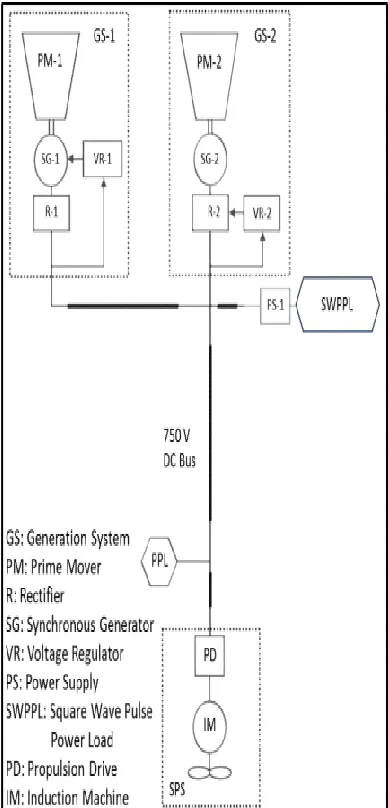
For examp le, a fast reconfiguration algorith m based on zone selection d ifferential protection schemes is reported in [7]; however, [7] provides no evidence that the algorithm can be imp lemented in real time. In other studies, real-time simulations are achieved. For example, in [8], using the small population-based particle swarm optimization method, a fast intelligent reconfiguration algorithm is implemented on a real-time simu lator. Seenu mani et al. [9] pursue a methodology that exploits time-scale separation to achieve real-time optimization of a shipboard IPS. By solving a two-level simplified optimization prob lem, the computational efficiency is improved and these improvements are validated on a real-time simu lator. In fact, studies of optimization based PMC strategies typically demonstrate implementation feasibility using only real-time simu lations. To the best of our knowledge, however, no study has demonstrated the feasibility of optimization-based PMC with test results on a physical p latform. In this paper, we design a PMC for a shipboard power system that includes multiple power sources and loads such as the ship propulsion system (SPS) and high-power electrical load (a pulsed-type load that represents an electro magnetic rail guns and/or an electro magnetic launch system). We consider the high-power electrical load as an unknown d isturbance to the shipboard power system. The PM C is developed in a real-time optimization framework where a cost function is formu lated and min imized wh ile constraints that reflect design objectives and operational limitations are enforced.
The PMC design, wh ich aims to meet load demands, save fuel, extend generator life cycle, and assure the power quality of the shipboard microgrid, is formulated as a nonlinear model predictive control (NMPC) p roblem with constraints. Model predictive control (MPC) is an effective control methodology that exploits the solution of a receding horizon optimal control problem to enforce constraints, such
The inability to co mplete the co mputations of NMPC law in real time can result in loss of stability and degraded performance. Without assured real-time capability, it is also impossible to certify and use such a controller in safety critical applications such as the shipboard power management. Efficient numerical algorith ms have been proposed to address challenges in the real-time imp lementation of MPC. Dieh l et al. [15] and Cannon [16] provide an overview of efficient numerical methods and algorith ms that have been developed for NMPC. Several algorith ms, such as the nonlinear real-time iteration scheme [17]–[20], the Newton-type solver [21], and the continuation and generalized min imu m residual [22], have a common feature that they perform one iteration of root finding in each sampling period.
the scope of this paper and is left to future work. In this paper, we report the results of applying the IPA-SQP algorith m to solve the real-time M PC problem for shipboard PMC. Toward this end, a simp lified optimization-oriented design model is derived by approximating co mponents of the transient power management model (TPMM) [33], wh ich is a low-order simulation model o f the test bed at Purdue University. We then develop the IPA-SQP-based MPC controller and analyze the performance using the TPMM as the virtual test bed through both non real-time and real-time simulations. Finally, the algorith m is imp lemented on the physical test bed to evaluate its performance in several proposed operational scenarios. The capability to perform the computations in real time, satisfy constraints, and tune the performance attributes is demonstrated.
This paper is organized as fo llo ws. In Section II, the shipboard power system and its control objectives are described, and the simulation model is introduced. The optimization-oriented design model of the TPMM is derived by approximation and model order reduction. Then, the MPC problem with constraints is formulated considering various PMC operational requirements and constraints. In Section III, the features of the IPA -SQP-based MPC are reviewed and the algorith m of the IPA-SQP is described. Test scenarios of the proposed PMC fo r simu lations and experiments are discussed in Section IV. The simu lation results with the TPMM serving as the
virtual test bed on a real-time simulator are reported and analyzed. The experimental results on the physical test bed are presented, analyzed, and compared with the simu lation results. Section V ends this paper with the conclusion.
II. SYSTEM DESCRIPTION AND MPC FORMULATION
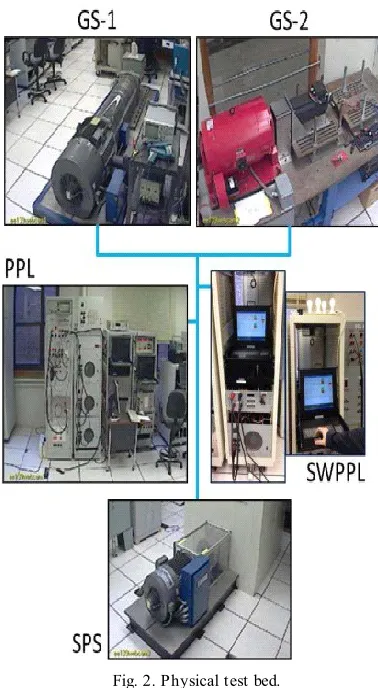
Fig. 2. Physical test bed.
connected in parallel to a 750 V dc bus. The key components and their operational parameters are listed in Table1.
B. Operational Requirements and Control Objectives For the investigation reported in this paper, we make the following assumptions that are representative of the physical system in the test bed. 1) The desired ship velocity, the SPS induction machine (IM) power and desired speed, and the target bus voltage are constant. 2) The GS-2 operates in the generation mode, has its best efficiency at 5 kW, and has a constant rotor speed.
TABLE I
Fig. 3. SWPPL on the T PMM. T he pulse starts at 0.5 s with 8 -kW amplitude and 1-s duration. T he period is 2 s.
3) The pulsed power load consists of square-wave pulses with 8-kW amplitude and 1-s duration (Fig. 3). 4) The PM C has no prior knowledge of the SWPPL, i.e., the SWPPL is an unknown disturbance. 5) The line losses are negligible.
Note that the above-listed assumptions are made to simplify the exposition of the algorith m o r to reflect the hardware limitations (such as assumption 3). They can be removed or modified without changing the nature of the problem and the proposed solution.
The control objectives of the PMC are to coordinate the power generation sources to meet the load demand and to
achieve the following performance attributes:
1) tracking the set points of bus voltage, GS-2 electrical power, SPS electrical power, and SPS rotor speed; 2) protecting and extending the life span of the machines GS-1, GS-2, and SPS;
3) Maintaining power quality of the microgrid and minimizing bus voltage variation.
We note that the GS-1 is expected to provide most of the power for SWPPL, which may cause extreme ramp ing in GS-1 power output due to the set-point tracking objective on GS-2 electrical power and, consequently, have negative impact on the gas turbine and generator life span. Therefore, some of the control objectives are competing with each other and need to be balanced by the PMC system.
C. Optimization-Oriented Design Model and Operational Constraints The TPMM is a low-order simu lation model of the physical test bed that has been established by Purdue University.
TABLE II
It represents the essential dynamics of the power system developed in [33]. Even though the TPMM is already simplified to enable fast simulation, it is still complex to be used for the IPA-SQP algorithm implementation. The optimization-oriented design model that supports analytical derivations for the IPA -SQP algorithm implementation is developed by simplifying the TPMM model. This model is represented by the follo wing nonlinear discrete-time equations:
(1)
(2)
(3)
(4)
(5) (6)
(7)
Note that the system is nonlinear with constraints that include a pure state constraint (4) and pure control constraints (5)–(7). Since the model is nonlinear, the NMPC approach is pursued to provide re -configurability to changing model parameters, requirements, and faults.
D. MPC Problem Formulation The MPC problem is formu lated by considering the control objectives and operational assumptions
(8)
(9)
for all k ∈ [t, t + N − 1], subject to (1)–(3) and (4)–(7).
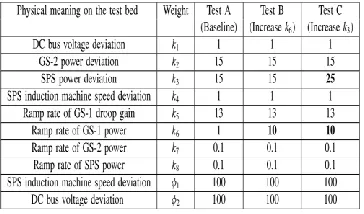
Here, P2d and P3d are the desired GS-2 electrical power and the desired SPS electrical power, respectively. xt is the state at a sampling instant t. k j, j = 1,..., 8, denote weighting factors on different terms in the cost function.
T ABLE III
WEIGHT ING FACT ORS IN T HE COST FUNCT ION ON T HE T EST BED
Each weighting factor k j assigns a relative priority to a performance aspect. The first term in L(x(k), u(k)), the error between the measured bus voltage and the desired bus voltage, is related to bus voltage tracking. Minimizing this error helps assure power quality on the microgrid.
The IPA-SQP algorith m co mb ines the complementary features of PA and SQP for solving constrained dynamic optimization problems [26], [27], [35], [37]. PA is an approach to predict a change in the optimal solution when some of the parameters, such as the initial conditions, are changed. The PA provides closed-form solutions and makes the optimization co mputationally efficient. Because of the approximate nature of the PA solution, however, it does not guarantee successive optimality when the algorith m is applied repeatedly to update a nominal solution. To correct the solution so that it satisfies the necessary conditions to a specified tolerance, an SQP update based on linearization and quadratic cost approximation can be applied. Th rough synergetic integration of these two algorith ms, the optimal control sequence at each sampling instant t with the observed state x(t) is calculated using the optimal control sequence from the previous sampling instant (t − 1). It can be shown that the IPA-SQP has a linear co mputational complexity of O(N) as compared with SQP that has complexity fro m O(N1.5) to O(N3), where N is the prediction horizon of the MPC problem [29]. Moreover, the IPA -SQP has the following features. 1)The IPA-SQP efficiently co mputes the approximation of the optimal solution by taking advantage of backward-in time recursive updates. 2) When active constraints are not changed by the perturbation, δx(t) = x(t) − x(t − 1), in the in itial state, the closed-form PA solution can be derived, thereby leading to a very efficient computation. If the variation δx(t) in the in itial state causes changes in the activity status of constraints, the variation δx(t) is divided into smaller seg ments so that the PA solution can be applied to each of these segments to sequentially update the solution. It has been shown in several applications that a good tradeoff between efficient co mputation and accurate optimization can be achieved [25], [27], [37]. Let C and C ¯ denote the mixed state-input constraints and pure state constraints
(10)
The IPA-SQP algorith m co mputes the new control sequence over the prediction horizon in the form of
(11)
(12) And i is the iteration index. For i = 0, u(0)(k) is taken as the solution sequence calculated at the previous sampling instant (t − 1). The matrices K0, Z21, C ˜ x a, and T are defined by the IPA-SQP algorith m. The detailed calcu lation steps are given in the Appendix. Hu and fu are the partial derivatives of the Hamiltonian function (13) and of the right-hand side of (1)–(3), i.e., f (k) = ( f1(k) f2(k) f3(k))T with respect to u, evaluated at u(i)(k), respectively. Note that the predictor update is integrated with a corrector update that accounts for nonzero Hu. In the IPA-SQP algorith m, we terminate the iterations if t k+ =N t −1 |Hu(k)| < Hu t for some s mall threshold H tu. A good tradeoff can be ach ieved between efficient computation and accuracy of the optimization by properly selecting Hu t, for instance, [38] where the tradeoff between co mputation time and optimality is illustrated for a spacecraft relative motion control problem in which the impact of d ifferent termination thresholds is evaluated. In this paper, Hu t was chosen as 0.01 both in the simu lations and experiments. Several iterations may be needed to satisfy the criterion t k+ =N t −1 |Hu(k)| < Hu t. The algorith m realization is based on a co mbination o f a MATLAB script function and some Simu link b locks fro m the standard Simu lin k lib rary. Fig. 4 shows the key steps of the IPA-SQP algorith m in the form of a pseudo code.
• IV INTRODUCTION TO FUZZY LOGIC CONTROLLER
simu lation model is built to study the dynamic behavior of dc-to-dc converter and performance of proposed controllers. Furthermore, design of fu zzy logic controller can provide desirable both small signal and large signal dynamic performance at same time, wh ich is not possible with linear control technique. Thus, fuzzy logic controller has been potential ability to imp rove the robustness of dc-to-dc converters. The basic scheme of a fuzzy logic controller is shown in Fig 5 and consists of four principal co mponents such as: a fu zzification
interface, which converts input data into suitable linguistic values; a knowledge base, wh ich consists of a data base with the necessary linguistic definitions and the control rule set; a decision-making logic which, simulating a hu man decision process, infer the fuzzy control action fro m the knowledge of the control rules and linguistic variable definitions; a de-fuzzification interface which y ields non fu zzy control action fro m an inferred fu zzy control action [10].
Fig.4. General Structure of the fuzzy logic controller on closed-loop system
The fuzzy control systems are based on expert knowledge that converts the human linguistic concepts into an automatic control strategy without any complicated mathematical model [10]. Simulation is performed in buck converter to verify the proposed fuzzy logic controllers.
Fig. 6.T he Membership Function plots of error
Fig.7. T he Membership Function plots of change error
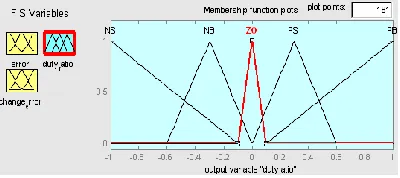
Fig.8. the Membership Function plots of duty ratio
• Fuzzy Logic Rules:
The objective of this d issertation is to control the output voltage of the boost converter. The error and change of error of the output voltage will be the inputs of fuzzy log ic controller. These 2 inputs are divided into five groups; NB: Negative Big, NS: Negative Small, ZO: Zero Area, PS: Positive small and PB: Positive Big and its parameter [10]. These fuzzy control rules for error and change of error can be referred in the table that is shown in Tab le II as per below:
Table II
V SIMULATION RESULTS
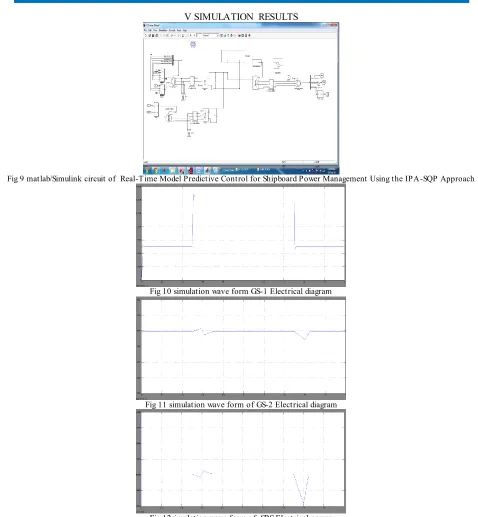
Fig 9 matlab/Simulink circuit of Real-T ime Model Predictive Control for Shipboard Power Management Using the IPA-SQP Approach
Fig 10 simulation wave form GS-1 Electrical diagram
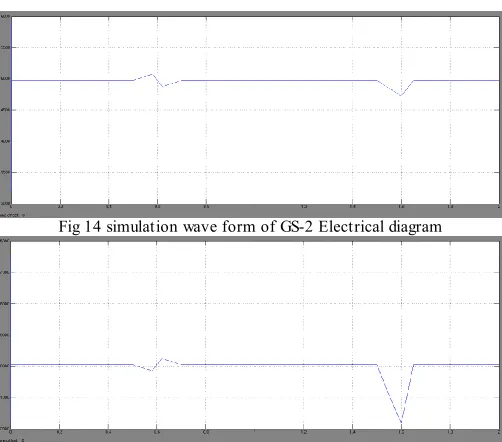
Fig 13 simulation wave form of GS-1 Electrical diagram
Fig 14 simulation wave form of GS-2 Electrical diagram
Fig 15 simulation wave form of SPS Electrical power
fig 17 simulation wave form of GS-2 Electrical diagram
Fig 18 simulation wave form of SQP base output voltage
Fig 19 simulation wave form of BLDC drive with stator current, speed and torque with fuzzy logic controller
CONCLUSION
REFERENCES
[1] N. H. Doerry and J. C. Davis, “Integrated power system for marine applications,” Naval Eng. J., vol. 106, no. 3, pp. 77–90, 1994.
[2] N. Doerry and K. McCoy, “Next generation integrated power system: NGIPS technology development roadmap,” Naval Sea Syst. Command, Washington, DC, USA, T ech. Rep. 0704-0188, 2007.
[3] G. Seenumani, “Real-time power management of hybrid power systems in all electric ship applications,” Ph.D. dissertation, Dept. Mech. Eng., Univ. Michigan, Ann Arbor, MI, USA, 2010. [4] S. Srivastava and K. L. Butler-Purry, “Expert-system method for automatic reconfiguration for restoration of shipboard power systems,”
IEE Proc.-Generat., Transmiss., Distrib., vol. 153, no. 3, pp. 253–
260, 2006.
[5] K. L. Butler-Purry and N. D. R. Sarma, “Self-healing reconfiguration for restoration of naval shipboard power systems,”
IEEE Trans. PowerSyst., vol. 19, no. 2, pp. 754–762, May 2004.
[6] J. M. Solanki and N. N. Schulz, “Using intelligent multi-agent systems for shipboard power systems reconfiguration,” in Proc.
13th Int. Conf.Intell. Syst. Appl. Power Syst., 2005, pp. 212–214.
[7] Y. Huang, “Fast reconfiguration algorithm development for shipboard power systems,” M.S. thesis, Dept. Elect. Comput. Eng., Mississippi State Univ., Starkville, MS, USA, 2005.
[8] P. Mitra and G. K. Venayagamoorthy, “Real-time
implementation of an intelligent algorithm for electric ship power system reconfiguration,” in Proc. IEEE Electr. Ship Technol.
Symp., Apr. 2009, pp. 219–226.
[9] G. Seenumani, J. Sun, and H. Peng, “Real-time power management of integrated power systems in all electric ships leveraging multi time scale property,” IEEE Trans. Control Syst.
Technol., vol. 20, no. 1, pp. 232–240, Jan. 2012.
[10] C. E. Garcia, D. M. Prett, and M. Morari, “Model predictive control: Theory and practice—A survey,” Automatica, vol. 25, no. 3,
pp. 335–348, 1989.
[11] S. J. Qin and T . A. Badgwell, “An overview of nonlinear model predictive control applications,” in Nonlinear Model
Predictive Control. Basel, Switzerland.: Birkhäuser Basel, 2000,
pp. 369–392.
[12] S. J. Qin and T . A. Badgwell, “A survey of industrial model predictive control technology,” Control Eng. Pract., vol. 11, no. 7, pp. 733–764, 2003.
[13] R. Findeisen and F. Allgöwer, “Computational delay in nonlinear model predictive control,” in Proc. Int. Symp. Adv.
Control Chem. Proces., 2004, pp. 427–432.
[14] L. Santos, P. Afonso, J. Castro, N. Oliveria, and L. Biegler, “On-line implementation of nonlinear MPC: An experimental case study,” ControlEng. Pract., vol. 9, no. 8, pp. 847–857, 2001. [15] M. Diehl, H. J. Ferreau, and N. Haverbeke, “Efficient numerical methods for nonlinear MPC and moving horizon estimation,” in NonlinearModel Predictive Control. Berlin, Germany: Springer-Verlag, 2009, pp. 391–417.
[16] M. Cannon, “Efficient nonlinear model predictive control algorithms,” Annu. Rev. Control, vol. 28, no. 2, pp. 229–237, 2004. [17] B. Houska, H. J. Ferreau, and M. Diehl, “An auto-generated realtime iteration algorithm for nonlinear MPC in the microsecond range,”
Automatica, vol. 47, no. 10, pp. 2279–2285, 2011.
[18] M. Vukov, W. Van Loock, B. Houska, H. J. Ferreau, J. Swevers, and M. Diehl, “Experimental validation of nonlinear MPC on an overhead crane using automatic code generation,” in
Proc. Amer. Control Conf., Jun. 2012, pp. 6264–6269.
[19] M. Diehl et al., “Real-time optimization for large scale processes: Nonlinear model predictive control of a high purity distillation column,” in Online Optimization of Large Scale
Systems. Berlin, Germany: Springer-Verlag, 2001, pp. 363–383.