Biometric Identification of Iris Using Image Processing
P
1
P
Niharika Yadav, P 2
P
Sunita Singh, P 3
P
Samiksha Chaudhary, P 4
P
Ashweeni Kodag
P
1
P
EXTC, Lokmanya Tilak College of Engineering, Koparkhairane,, Maharashtra, India
P
2
P
EXTC, Lokmanya Tilak College of Engineering, Koparkhairane, Maharashtra, India
P
3
P
EXTC, Lokmanya Tilak College of Engineering, Koparkhairane, Maharashtra, India
P
4
P
EXTC, Lokmanya Tilak College of Engineering, Koparkhairane, Maharashtra, India
Abstract
The Human Iris is one of the best biometrics features in the human body for pattern recognition. This paper provides a walkthrough for image preposition, image segmentation, feature extraction and pattern forming based on the Human Irisimaging.
Keywords: Iris Recognition, Biometric Identification, Image Segmentation, Feature Extraction, Haar wavelet
1. Introduction
Security and the authentication of individuals is necessary for many different areas of our lives, with most people having to authenticate their identity on a daily basis; examples include ATMs, secure access to buildings, and international travel. Biometric identification provides a valid alternative to traditional authentication mechanisms such as ID cards and passwords, whilst overcoming many of the shortfalls of these methods; it is possible to identify an individual based on \who they are" rather than\what they possess" or \what they remember" .
Iris recognition is a particular type of biometric system that can be used to reliably identify a person by analyzing the patterns found in the iris. The iris is so reliable as a form of identification because of the uniqueness of its pattern. Although there is a genetic influence, particularly on the iris' colour, the iris develops through folding of the tissue membrane and then degeneration (to create the pupil opening) which results in a random and unique iris .In comparison to
other visual recognition techniques, the iris has a great advantage in that there is huge variability of the
pattern between individuals, meaning that large databases can be searched without sending any false matches. This means that irises can be used to identify individuals rather than just conform their given identity; a property that would be useful in a situation such as border control, where it might be important to not just show that an individual is not who they say they are but also to show exactly who they are. The objective of this project was to produce a working prototype program that functions as an iris recognition tool in an accurate and useful way that is also user-friendly. Commercial iris recognition systems are available that implement similar algorithms to these; however, there does seem to be an absence of open source implementations. This is the hole that this project sets out to fill: providing a fast, usable program that can easily be extended.
2. Proposed Segmentation
We will propose a novel method in this paper that performs the task in hand in two phases. The algorithm used in the first phase uses the knowledge that a pupil is a very dark blob of a certain minimum size in the picture, and no other segment of continuous dark pixels are of the same size. This algorithm finds the center of the pupil and two radial coefficients as the pupil is not always a perfect circle. The second algorithm takes the information of the pupil center and tries to find edges on a one dimensional imaginary line to each side of the pupil.
2.1 Pupillary Boundary
Pixels with intensity greater than the empirical value of 50 are dark pixels, therefore converted to 1
Figure 1: original image
Figure 2: threshold image
Figure 3 : chain code
Figure 4 : small region elimination
Figure 5 : final result
(black). Pixels smaller than or equal to 50 are assigned to 0 (white).
G(x)= I(x)>50 : 1
G(x)= I(x)≤50 : 0
Where I is the original image and G are the thresholded image.
Next, we apply Freeman’s chain code to find regions of 8-connected pixels that are assigned with value equal 1. From Fig. 2 it is possible to see that eyelashes also satisfy the threshold condition, but have a much smaller area than the pupil area. Using this knowledge, we can cycle through all regions and apply the following condition:
for each region R
if AREA(R) < 2500
set all pixels of R to 0
Finally, we apply one last time the chain code algorithm in order to retrieve the only region in the image (hopefully the pupil).
Finding the edges of the pupil involves the creation of two imaginary orthogonal lines passing through the centroid of the region. The boundaries of the binarized pupil are defined by the first pixel with intensity zero, from the center to the extremities.
3. Iris Edge Detection
The next step towards iris segmentation is finding the contour of the iris. This may seem an easy task at first as we already have discovered the pupil location and we have the knowledge that it is concentric to the outer perimeter of the iris. The first problem comes
from the anatomy of the eye and the fact that every person is different. Sometimes the eyelid may occlude part of the iris, as it will occur often with the Asians, and no full circularity may be assumed in this case. Other times due to variation in gaze direction the iris center will not match the pupil center, and we will have to deal with strips of iris of different width around the pupil.
Figure 6: localization
Our method takes in consideration that areas of the iris at the right and left of the pupil are the ones that most often present visible to data extraction. The areas above and below the pupil also carry unique information, but it is very common that they are totally or partially occluded by eyelash or eyelid. The strategy adopted for iris detection is to trace a horizontal imaginary line that crosses the whole image passing through the center of the pupil. Starting from the edges of the pupil, we analyze the signal composed by pixel intensity from the center of the image towards the border and try to detect abrupt increases of intensity level. Although the edge between the iris disk and the sclera is most of the times smooth, it is known that it always have greater intensity than iris pixels. We intensify this difference applying a linear contrast filter.
4. Feature Extraction
So far we have performed the segmentation of the iris, first by finding the pupil and then finding the outer edge of the iris at the line that crosses the center of the pupil. The main reason for the prior segmentation is two folded. The first reason is to isolate only information that distinguishes individuals, namely the iris patterns. The second one is the attempt to reduce the size of pattern vector. For instance, the CASIA Iris Database provides images that are 320x280 pixels. If we concatenate all rows of the image into only one vector, the dimension of the problem would be to classify a vector with 89,600 elements. This dimension is too high for today’s computing power, and even though we had such capacity, satisfactory results are not guaranteed.
4.1 Haar Wavelet
Both the Gabor transform and he Haar wavelet are considered as the mother wavelet. From multi-dimensionally filtering, a feature vector with 87 dimensions is computed. Since each dimension has a real value ranging from -1.0 to +1.0, the feature vector is sign quantized so that any positive value is represented by 1, and negative value as 0. This results in a compact biometric template consisting of only 87 bits.
4.2 Implementation
Wavelet transform has been used for implementation as it allows very good approximation with just a few coefficients. Wavelet decompositions are fast and easy to compute and require very little code. Haar wavelet is used here as it requires less number of computations and easy to compute.
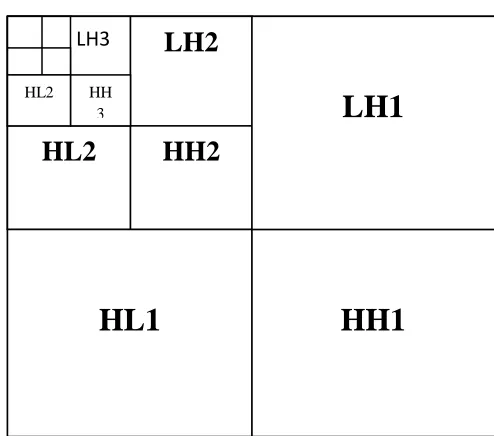
Our mapped image is of size 32×32 pixels and can be decomposed using the Haar wavelet into a maximum of five levels. These levels are:
5 horizontal coefficients
5 vertical coefficients
5 diagonal coefficients
Table 1: Haar wavelet technique
We must now pick up the coefficients that represent the core of the iris pattern. Therefore those that reveal redundant information should be eliminated. In fact, looking closely at figure it is obvious that the patterns
Hhhh LH3
LH2
HL2
HH2
HL1
HH1
LH1
HH3 HL2
in one, two, and three are almost the same and only one can be chosen to reduce redundancy. Since three repeats the same patterns as the previous levels and it is the smallest in size, then we can take it as the representative of all the information the three levels carry. The fourth, fifth level does not contain the same textures and should be selected as a whole.
Thus we can represent each image applied to the Haar wavelet as the combination of nine matrices.
All these matrices are combined to build one single vector characterizing the iris patterns. This vector is called the feature vector and is of 16 elements. The process is repeated for individual strips.
4.3 Binary Coding Scheme
It is very important to represent the obtained vector in a binary code because it is easier to find the difference between two number vectors. In fact, Boolean vectors are always easier to compare and to manipulate. In order to code the feature vector we first observed some of its characteristics. We found that all the vectors that we obtained have a maximum value that is greater than 0 and vectors varied slightly between -0.08 and 0.007 while the standard variation ranged between 0.35 and 0.5. If “coef” is the feature vector of an image then the following quantization scheme converts it to its equivalent code-word:
If coef(i) ≥0 then coef(i) = 1
If coef(i) < 0 then coef(i) = 0
The next step is to compare two code words to find out if they represent the same person or not.
5. Matching
The template that is generated in the feature encoding process will also need a corresponding matching metric, which gives a measure of similarity between two iris templates. This metric should give one range of values when comparing templates generated from
the same eye, known as intra-class comparisons, and another range of values when comparing templates created from different irises, known as inter-class comparisons. These two cases should be distinct and separate values, so that a decision can be made with high confidence as to whether two templates are from the same iris, or two different irises.
5.1 Hamming Distance
The Hamming distance gives a measure of how many bits are the same between two bit patterns. Using the Hamming distance of two bit patterns, a decision can be made as to whether the two patterns were generated from different irises or from the same one. In comparing the bit patterns X and Y, the Hamming distance, HD, is defined by eq.3. HD is the sum of disagreeing bits (sum of the exclusive-OR between X and Y) over N. where N is the total number of bits in the bit pattern.
H. D =𝑁1∑𝑁 Xj XOR Yj 𝑗=1
Since an individual iris region contains features with high degrees of freedom, each iris region will produce a bit-pattern which is independent to that produced by another iris, on the other hand, two iris codes produced from the same iris will be highly correlated. If two bits patterns are completely independent, such as iris templates generated from different irises, the Hamming distance between the two patterns should equal to 0.5. This occurs because independence implies the two bit patterns will be totally random, so there is 0.5 chance of setting any bit to 1, and vice versa. Therefore, half of the bits will agree and half will disagree between the two patterns. If two patterns are derived from the same iris, the Hamming distance between them will be close to 0.0, since they are highly correlated and the bits should agree between the two iris codes
.
6. Results
After handpicking 70 images from the CASIA database, on basis of minimum eyelash and eyelid occulation we came across following results:
Criteria Percentage
Segmentation accuracy 94.28%
False acceptance 16%
False rejection 0.02%
Figure 7: feature extraction
Total image failure 5.72%
Table 2: Results
The false rejection rate measures the probability of an enrolled individual not being identified by the system. The false accept rate measures the probability of an individual being wrongly identified as another individual.
6. Conclusion
Thus we can conclude that the above developed system of iris recognition is fairly efficient in distinguishing the individual iris patterns and thereby identify different people at a fairly fast processing speed.
We have considered three individual strips and applied Haar wavelet decomposition on each of them separately, thereby reducing the data to be analyzed quite drastically.
Use of Haar wavelet for decomposing has led to faster computing speeds.
This identification system is quite simple requiring few components and is effective enough to be integrated within security systems that require an identity check.
The errors that have occurred can be overcome by using larger strips, better and more accurate wavelet decomposition techniques.
References
[1] Daugman, J., How Iris Recognition Works, IEEE Transactions on Circuits and Systems for Video Technology, Vol. 14, Number 1, January 2004.
[2] Masek L., Recognition of Human Iris Patterns for
Biometric Identification, [http://www.csse.uwa.edu.au/~pk/studentprojects/libo
r].
[3] Prof. Dr. Roman Swiniarski, Paulo Edurado Merloti (PADU), Prepared for Neural Networks Class (CS553) of Spring Semester of 2004.
[4] G.W. Awcock, R. Thomas, “Applied Image Processing”, McGraw Hill, 1996.
[5] L. Ma, Y. Wang, T. Tan. “Iris recognition using circular symmetric filters”. National Laboratory of Pattern Recognition, Institute of Automation, Chinese Academy of Sciences, 2002.
[6] R. Wildes. Iris recognition: an emerging biometric technology. Proceedings of the IEEE, Vol. 85, No. 9, 1997.
[7] Michael Boyd, Dragos Carmaciu, Francis Giannaros , Thomas Payne, William Snell, Iris Recognition, MSc Computing Science Group Project