Scholarship@Western
Scholarship@Western
Electronic Thesis and Dissertation Repository
4-4-2012 12:00 AM
Performance of Data Transmission for mobile applications
Performance of Data Transmission for mobile applications
Md Ashrafur Rahaman
The University of Western Ontario
Supervisor Dr. Michael Bauer
The University of Western Ontario Graduate Program in Computer Science
A thesis submitted in partial fulfillment of the requirements for the degree in Master of Science © Md Ashrafur Rahaman 2012
Follow this and additional works at: https://ir.lib.uwo.ca/etd
Recommended Citation Recommended Citation
Rahaman, Md Ashrafur, "Performance of Data Transmission for mobile applications" (2012). Electronic Thesis and Dissertation Repository. 408.
https://ir.lib.uwo.ca/etd/408
This Dissertation/Thesis is brought to you for free and open access by Scholarship@Western. It has been accepted for inclusion in Electronic Thesis and Dissertation Repository by an authorized administrator of
(Thesis format: Monograph)
by
Md. Ashrafur Rahaman
Graduate Program in Computer Science
A thesis submitted in partial fulfillment of the requirements for the degree of
Master of Science
The School of Graduate and Postdoctoral Studies The University of Western Ontario
London, Ontario, Canada
ii
THE UNIVERSITY OF WESTERN ONTARIO School of Graduate and Postdoctoral Studies
CERTIFICATE OF EXAMINATION
Supervisor
______________________________ Dr. Michael Bauer
Supervisory Committee
______________________________
Examiners
______________________________ Dr. Hanan Lutfiyya
______________________________ Dr. Mike Katchabaw
______________________________ Dr. Xianbin Wang
The thesis by
Md. Ashrafur Rahaman
entitled:
Performance of Data Transmission for mobile application
is accepted in partial fulfillment of the requirements for the degree of
Master of Science
______________________ _______________________________
iii
Abstract
Mobile applications have empowered and extended the usability of mobile devices far
beyond merely supporting voice communication. The development of mobile
applications, however, must deal with a variety of unique problems: limited working
memory, limited storage, limited processing power, and small screen size. Mobile
applications which rely on remote data sources and databases are particularly challenging
given the need to transmit data through wireless media and often involve complex
business logic. Our main goal is to improve the performance of mobile applications
which rely on remote data sources and databases. In this research work, we compare
different data transmission optimization techniques, different middleware approaches and
identify combinations of approaches for improving performance of data transmission
over wireless network. The results of this research provide useful guidelines for the
development of mobile applications needing to connect to remote databases or data
sources.
Keywords
QoS of data transmission, Mobile application, Mobile data transmission models, mobile
iv
v
Acknowledgments
First of all I would like to thank my supervisor, Prof. Dr. Michael Bauer, for his guidance
and assistance. He was very helpful and encouraging in choosing the topic of this thesis
and guiding me in my research. Thanks to him for his help and inspiration. I would like
to give a nod to my fellow researchers for being an excellent sounding board for both
ideas and the venting of frustrations. I would also like to thank faculty members and staff
of the Department of Computer Science for making my stay here highly enjoyable. Many
vi
Table of Contents
CERTIFICATE OF EXAMINATION ... ii
Abstract ... iii
Acknowledgments... v
Table of Contents ... vi
List of Figures ... ix
List of Tables ... xi
Chapter 1 ... 1
1 Introduction ... 1
Chapter 2 ... 5
2 Related Work on Middleware Models and Techniques for Mobile Applications ... 5
Chapter 3 ... 11
3 Software Architectures for Mobile Application ... 11
3.1 Introduction ... 11
3.2 Client-Server (C/S) Model ... 12
3.3 Client-Agent-Server (C/A/S) Model ... 13
3.4 Client-Intercept-Server (C/I/S) Model ... 15
3.5 Peer-to-Peer Model ... 16
3.6 Mobile-Agent Model ... 16
3.7 API ... 17
Chapter 4 ... 19
vii
4.1 Introduction ... 19
4.2 Databases ... 21
4.3 Middleware and Middleware API ... 22
4.3.1 Caching ... 22
4.3.2 Compression ... 24
4.3.3 Encryption ... 25
4.3.4 Overview of the Middleware ... 26
4.4 Mobile Agent API ... 27
4.4.1 Implementation of C/A/S ... 28
4.4.2 Implementation of C/I/S ... 30
4.5 Summary ... 32
Chapter 5 ... 33
5 Experiments and Results ... 33
5.1 Experimental Setup ... 34
5.2 Experiments with Inventory System ... 35
5.3 Experiments with a Medical Information System ... 37
5.3.1 Experiment 1: Basic Experiment ... 40
5.3.2 Experiment 2: Use of caching ... 41
5.3.3 Experiment 3: Use of compression ... 43
5.3.4 Experiment 4: Experiments with encryption ... 45
5.3.5 4-Factor Analysis ... 47
5.4 Summary ... 50
Chapter 6 ... 51
6 Discussion of Results ... 51
viii
6.1.1 Caching ... 51
6.1.2 Compression ... 52
6.1.3 Encryption ... 53
6.1.4 Combination of techniques ... 53
6.1.5 Mobile software architectures ... 54
Chapter 7 ... 55
ix
List of Figures
Figure 3-1: Common rich client mobile application architecture ... 12
Figure 3-2: The Client-Agent-Server (C/A/S) model ... 13
Figure 3-3: Client-Agent-Server (C/A/S) model with remote database ... 14
Figure 3-4: The Client-Intercept-Server (C/I/S) model ... 15
Figure 3-5: Client-Intercept-Server (C/I/S) model with remote database ... 16
Figure 3-6: The Mobile Agent model ... 17
Figure 4-1: High level overview of the system ... 19
Figure 4-2: Overview of Client-Agent-Server request and response ... 20
Figure 4-3: Overview of Client-Intercept-Server request and response ... 21
Figure 4-4: Pseudo code to retrieve data from remote data sources ... 22
Figure 4-5: Middleware pseudo-code to retrieve or create cache data ... 23
Figure 4-6: Middleware pseudo-code to compress retrieved data ... 25
Figure 4-7: Middleware pseudo-code for encrypting retrieved data ... 26
Figure 4-8: Pseudo-code of service to retrieve data in middleware ... 27
Figure 4-9: J2ME libraries and third party libraries for C/A/S application ... 29
Figure 4-10: Command actions to generate mobile data ... 29
x
Figure 4-12: Client-Intercept-Server mobile application ... 31
Figure 4-13: Intercept API ... 31
xi
List of Tables
Table 5-1: List of development tools for the experimental environment ... 34
Table 5-2: Communications between the mobile application, middleware server, and remote database server. ... 35
Table 5-3: Steps of the inventory system mobile application ... 36
Table 5-4: Steps in different scenarios of inventory system ... 37
Table 5-5: Inventory system experiment result for scenario 1 and scenario 2 ... 37
Table 5-6: Medical Information System step by step ... 39
Table 5-7: Experiment 1 scenarios and data sizes ... 40
Table 5-8: Regular experiment result and analysis ... 41
Table 5-9: Results of the analysis of variance (ANOVA) for Experiment 1 ... 41
Table 5-10: Experiment with caching result and analysis ... 42
Table 5-11: Three-factor analysis on software model, scenario, and caching ... 42
Table 5-12: Results of the analysis of variance (ANOVA) of experiment with caching . 43 Table 5-13: Change of data size after data compression ... 43
Table 5-14: Experiment with compression results and analysis ... 44
Table 5-15: Experimental results for software models, scenarios, and compression ... 44
Table 5-16: Results of the analysis of variance (ANOVA) of experiments with compression. ... 45
xii
Table 5-18: Experiment with encryption result and analysis ... 46
Table 5-19: Three factor analysis on software models, scenarios, and encryption ... 46
Table 5-20: Results of the analysis of variance (ANOVA) of experiment with encryption.
... 47
Table 5-21: Experiment design of 4-factor analysis ... 48
Table 5-22: The results of the analysis of variance (ANOVA) on the large data scenario.
... 49
Table 5-23: The results of the analysis of variance (ANOVA) on small data scenario of
Chapter 1
Introduction
1
Introduction
From its original inception as an accessory for mobile phones, mobile applications have
developed into a non-trivial ubiquitous platform for social and commercial purposes [1],
[2], [3], [4]. Mobile applications have empowered and extended the usability mobile
devices far beyond merely supporting voice communications.
Apple has proven that the mobile application market should not be underestimated and
can represent an important revenue stream. The revolutionary App Store offers more than
500,000 apps to iPhone, iPod and iPad users in 90 countries around the world; more than
18 billion applications downloaded by October 2011 from the Apple Store [5]. Following
Apple's lead, Palm Inc. opened an application store for Palm devices in June, 2009,
Nokia has opened the "Ovi Store", Samsung has created Samsung Apps, and Research in
Motion (RIM) also launched its application store, BlackBerry App World. Microsoft also
launched its own version of the Application Store called SkyMarket with Windows
Mobile (WM7). The Android Marketplace developed by Google also became well known
in a short time; they started on March 2009 with 2300 applications and by January 2012
the total number of application reached to around 400,000 [6] with the record of more
than 10 billion [7] downloads.
The current mobile development market is dominated by: Google (50.9%) with Android,
a Linux-based operating system for mobile devices; Apple (23.9%) with iOS; Accenture
(11.7%) its Symbian OS; RIM (8.8%) with its Blackberry OS; Microsoft (1.9%) with its
Windows Phone Operating System; and Samsung Electronics (2.1%) with Bada Mobile
Each mobile OS offers a software development kit (SDK) which is generally composed
of an integrated development environment (IDE), an emulator, specific libraries, and
other tools. Although the development environment and programming language are
similar to that in the PC environment, the program structures are very specific for each
mobile OS.
With the popularization of mobile computing, many developers have faced problems due
to great heterogeneity of devices [9]. In a mobile environment, the wireless
communication is still intermittent, mobile devices have hardware restrictions such as:
limited working memory, limited storage, limited processing power, and small screen;
energy in mobile devices are very limited too. This means that developing large scale
mobile applications which can connect to remote data sources or databases through
wireless connections with high computational business logic must take into account these
limitations. Support for complex or extensive applications in mobile phones which make
use of data from remote sources or need remote computing capabilities still require
servers and/or middleware.
Popular mobile relational database systems like IBM's DB2 Everywhere 1.0, Oracle Lite,
Sybase's SQL etc. work on Palm top and hand held devices (Windows CE devices) and
provide local data storage for relational data acquired from enterprise relational
databases. The main constraints for such databases relate to the size of the devices’
memory and size of the program, as handheld devices have memory constraints [10].
Moreover, enterprise databases cannot be replaced by these mobile relational databases.
To support extensive applications in mobile phones that require retrieval of data from
remote data sources, middleware is needed which has the capacity to deal with mobile
agents and remote database servers, and can improve the transmission of data by
implementing caching, pre-fetching, data prioritizing and data compression techniques.
Mobile applications or agents can access the middleware through an API to make the
In our research, we investigate difference in middleware approaches to retrieve data from
remote databases or data sources and transmit data to handheld devices. To analyze the
performance of data transmission, different data transmission techniques has been used
with different middleware models. The study includes performance analysis of data
transmission in two different domains with different scenarios. Through experiments, we
identify approaches or combinations of techniques that perform best for mobile
application. We also conduct experiments on data security and large volume data transfer
techniques over wireless network.
We compare the performance of two common software architectures
(Client-Agent-Server and Client-Intercept-(Client-Agent-Server) used for the development of mobile applications
requiring access to middleware. We also examine the performance impact, in terms of
transmission time, of using caching, compression, encryption, and/or combination of
these techniques in mobile applications relying access to remote data. Our quantitative
analyses examine a mobile application running on a mobile phone, connecting to a
middleware server hosted remotely with a database server located on another remote
host. Thus, our experiments are performed in real life scenarios instead of a laboratory
setup. The experiment results provide guidelines to the mobile application developers
about the software models and techniques or combination of technologies to use for QoS
of data transmission for mobile applications.
As part of our work, we also developed a middleware API and a mobile application API
which can be used by others to help simplify the development of mobile applications that
need to access data from remote data sources. By using the API, software designers can
use the functionalities provided by the middleware and applications already developed.
In Chapter 2, we review the existing literature on some of the architectural approaches for
supporting mobile applications and then look at the middleware with data transmission
techniques. As we develop an API to simplify development of high computing mobile
application, we review API proposed for middleware and literature on qualitative and
In Chapter 3, we explain different mobile application software architectures has been
proposed last two decade, middleware techniques and importance of API for mobile
application development.
In Chapter 4, we present the system we have developed to analyze data transmission for
mobile application. We explain the pseudo codes, algorithms, tools, and software we use
to develop the middleware API and mobile application API. Also, we describe our
system architecture in this chapter.
In Chapter 6 we discuss the experiment we have conducted and the results of the
experiments. Also, we represent our findings from the experiments.
Chapter 2
Related Work on Middleware Models and Techniques for
Mobile Applications
2
Related Work on Middleware Models and Techniques
for Mobile Applications
During the last decade, several research efforts have focused on middleware and data
transmission techniques for mobile applications. We first review some of the architectural
approaches for supporting mobile applications and then look at the middleware with other
data transmission techniques.
To accommodate the new computing paradigm introduced by mobile wireless computing,
various software models have been proposed including the server (C/S),
client-agent-server (C/A/S), client-intercept-server (C/I/S), peer to peer, and mobile agent
models. In Chapter 3 we discuss these models in detail.
In [29], Spyrou et al. qualitatively and quantitatively analyzed a set of software models
built on the client/server model or mobile agents for accessing a Web server and
proposed new techniques mixing the client-server models and mobile agent techniques.
They compared the C/A/S and C/I/S models in the context of browsers and web servers
for wired network. According to their experimental results, the C/A/S model requires
considerably less time than any other client/server model. Though C/I/S model lacks in
performance due to the additional creation of the client-side agent, it supports
compatibility, since it can be built on top of existing applications. According to the
researchers, the C/I/S model provides more flexibility than C/A/S and that should have
been translated to better performance; C/I/S model performs better for heavy-weight
and C/I/S models in the context of mobile applications where there is a need to access
data sources or databases are in remote locations. In particular, we compare the
performance of the C/A/S and C/I/S models in dealing with remote data sources and
databases for mobile applications considering different data transmission techniques
(caching, encryption, and compression) in two domains (medical and general inventory)
with different scenarios (large data set and small data set).
Transmission of a large amount of data through a wireless network to a memory limited
mobile application is a real challenge. Researchers have proposed different middleware
approaches to meet these challenges. While there has been previous work on mobile
applications and supporting middleware, there has been little quantitative work
comparing different approaches and use of different techniques on the performance of
data transmission; the current research begins to fill this gap. Some of the previous
research related to middleware is described in the following.
Capra and Mascolo [11], [12] identify requirements for middleware that supports
mobility. They discuss the main characteristics and differences between wired and
wireless environments that impact mobility, and categorize and study some possible
middleware solutions. They propose the use of reflection capabilities and meta-data to
pave the way for a new generation of middleware platforms designed to support mobility.
They suggest the use of a reflexive middleware [13] in a mobile computing environment
to solve the problem of losing network connectivity during the movement of the mobile
devices. In [14], they describe a reflexive middleware for ad hoc networks named
XMIDDLE that allows data sharing and uses XML to encapsulate information but it does
not clearly distinguish the client and server applications. In [15], they present another
middleware named CARISMA which allows changes in the context based on a set of
rules. Both CARISMA and XMIDDLE middleware are based on client-server model.
Campbell et al. [16] propose a middleware, named Mobiware, to support multimedia
applications, considering QoS requirements, in a mobile environment. The platform is
built on a distributed system and Java technology and uses adaptive algorithms to support
scalable transport flows, reduce handoff dropping and improve wireless resource
utilization. Mobiware provides an adaptive transport API for the middleware which
follows client-server approach to select, dispatch, bootstrap, configure and tune
multimedia objects.
Bellavista et al. [17] present a middleware for mobile users, also based on mobile agents,
to keep services running regardless of a user’s mobility. The middleware provides
services to support a virtual environment, virtual terminal, and resource manager.
In [18], Chan and Chuang propose MobiPADS, a middleware that uses information from
the physical environment to perform self-configuration. It allows dynamic adaptation in
both the application and the middleware itself. MobiPADS has two parts: a client at a
mobile device attached to the Internet through wireless or cellular networks and a server
at the wired network. This extended server-client application is designed to support
multiple MobiPADS clients and is responsible for most of the optimization computation.
MobiPADS collects metrics about the environment such as bandwidth, latency, and
processor usage, and notifies the applications that use those data.
Middleware for mobile computing environments is discussed in [19], where the authors
addressed the problems of the heterogeneity of devices in such environments. To this
end, they present a middleware for multi-client and multi-server mobile applications,
taking into account the resource restrictions of mobile devices. At the client side,
application development is done using a lightweight, robust and portable platform. At the
server side, the middleware allows high scalability and the full use of resources of the
machines it is installed. The proposed middleware provides a transparent communication
API to develop applications for mobile environments and allows applications to divide
their work amongst server and client sides. The middleware simplifies the development
of applications for mobile computing. By using the API, software designers can use the
functionalities provided by the middleware or applications already developed. The
middleware is based on the extended C/S model (C/A/S model) and provides
communication primitives for applications to exchange messages transparently between
communication protocol. The proposed middleware simplifies the development of
applications for mobile computing, and, through the API, software designers can use the
functionalities provided by the middleware or application already developed. The
researchers, however, did not quantitatively compare the performance of the C/A/S and
C/I/S models for their applications.
Gehlen and Mavronsmatis [20] proposed a mobile web service middleware, which
supports the publishing and discovery of web services and enables the efficient usage of a
network resource through context monitoring. Here, the context awareness is realized by
a rule based data monitoring in order to minimize the communication frequency over the
mobile links and, thus, to minimize the runtime costs of the mobile application. However,
it does not support the real-time change of context.
In [21], researchers analyze the performance of the Wireless Application Protocol (WAP)
based access compared to HTTP in terms of criteria such as: latency, data transfer,
memory footprint and CPU power requirements for accessing XML Web services from
mobile clients. The analysis showed that the performance in term of latency can be
increased using a WAP binding to SOAP. With WAP it is possible to access all existing
HTTP web services. The SOAP messages are reduced by a third using Wireless Binary
XML (WBXML) encoding [22]. WBXML was developed mainly for low bandwidth
networks and restricted Central Processing Unit (CPU) power, and seems appropriate for
mobile XML messaging. The connectionless Wireless Session Protocol (WSP) avoids
TCP’s three way handshaking, header volume reduction and optional reduction of the
payload data volume; it reduces the protocol data overhead by more than a third
compared to the HTTP.
Caching and pre-fetching on the edge of the Internet has been one of the most popular
techniques to improve the scalability and efficiency of delivering dynamic web content.
Leveraging these techniques for mobile application to improve application’s data
transmission efficiency has been discussed in several research papers.
Gupta et al. [23] concentrated on the aspects of data management over mobile ad-hoc
most popular data in the hope of being able to provide it to other devices when asked by
them.
Along similar lines, Yin and Cao [24] propose a cooperative caching scheme for mobile
ad hoc networks using caching of popular data so that the availability in mobile ad hoc
networks is increased. Specifically, they propose three schemes: CachePath, CacheData
and HybridCache. In CacheData, intermediate nodes cache the data to serve future
requests instead of fetching data from the data center. In CachePath, mobile nodes cache
the data path and use it to redirect future requests to the nearby node which has the data
instead of the faraway data center. HybridCache improve the performance by taking
advantage of CacheData and CachePath while avoiding their weaknesses. According to
their simulation results, the proposed schemes can significantly improve the performance
in terms of query delay and message complexity when compared to other caching
schemes.
In [25], researchers propose anticipatory retrieval of data, and to cache data that is likely
to be requested later. Here, caching is done asynchronously in the background during
times of high bandwidth. They propose algorithms to assess the semantic relevance of the
data using semantic distances along with user priorities and availability of bandwidth,
and then prioritizes anticipatory data downloads on to the cloud’s storage based on the
relevance quotient. Here, data prioritization and reprioritization depends on data size,
priority and availability. The model provides better performance, adapts to varying
bandwidth, and pre fetches data from cloud with better accuracy and relatively little
overhead.
Data transmission in the wireless network can be vulnerable to security attacks and, thus,
ensuring data security is an important concern in some situations. In [26], researchers
introduced a security model based on message digests, encryption and decryption
technology to access remote data securely. Researchers implemented this security model
in mobile-agent architecture with large number of remote data processing tasks. The
experimental results show that the proposed model is secure and feasible for the
using encryption for delivery of data to mobile applications. Our work looks specifically
at this impact.
In our research, we will focus on the C/A/S model and C/I/S model while investigating
the impact of different technologies such as caching, encryption, and compression. Our
main goal is to analyze the effect of data transmission from remote enterprise database
Chapter 3
Software Architecture for Mobile Application
3
Software Architectures for Mobile Application
3.1 Introduction
Mobile applications are normally structured as a multi-layered application consisting of
UI, business, and data layers. When developing a mobile application, developer may
choose to develop a thin Web-based client or a rich client. In the case of building a rich
client application, the business and data services layers are likely to be located on the
device itself. On the other hand, the business and data layers will be located on the server
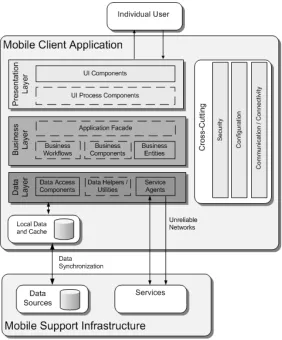
to build a thin client. Figure 3-1 illustrates common rich client mobile application
architecture with components grouped by areas of concern [30].
In our research, we focus on the client-agent-server (C/A/S) and client-intercept-server
(C/I/S) models because we are retrieving data from remote enterprise databases or data
sources and these two models seems to be the best fit for those tasks based on previous
research. Moreover, our review of middleware based on mobile browsers says that most
of the mobile browser engines were developed using either C/A/S or C/I/S model to
retrieve from websites. In this chapter we will describe different software models
Figure 3-1: Common rich client mobile application architecture
3.2 Client-Server (C/S) Model
In the client–server model, the server component provides a function or service to one or
many clients, which initiate requests for such services. The C/S model requires an
application or browser to be located on the mobile client and communicate directly with
the web server or database server via wireless communications. At the time of accessing
a specific database, the client downloads the appropriate database driver to the mobile
phone and then a connection establish between client and the database server.
In case of mobile application, the limitations of traditional C/S application are as follows:
• The main limitation of traditional C/S model is that the model suffers for
between 300-500 KB) on the client machine every time it connects to the
database; that also wastes bandwidth.
• There is no way to optimize the data before the transmission to the mobile client,
so receiving large data may not work or even if it works, it will take long time,
which will affect the quality of the application data. So, a heavy loaded agent
application may not work and regular applications will experience performance
problems.
• Due to no data optimization before data transmission over network, data security
cannot be provided to the wireless network. So, traditional C/S model based
application undergoes security issue.
3.3 Client-Agent-Server (C/A/S) Model
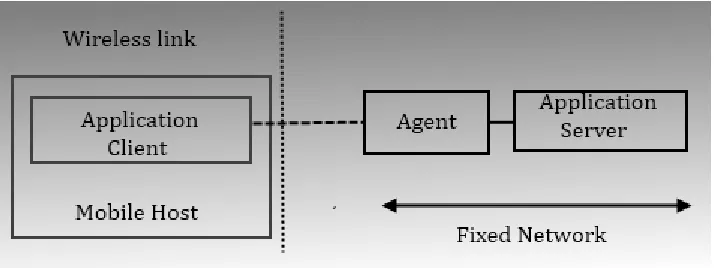
The C/A/S architecture is a popular extension of the C/S model, containing three-tier
architecture. Here, any communication goes through the mobile agent. At one extreme,
agent acts as a mobile host. At another extreme, the agent is attached to a remote database
or data source. Any client’s request and server’s response associated with this application
is communicated through this service-specific agent. In this scenario, a mobile host must
be associated with as many agents as the services it needs access to. Agents split the
interaction between mobile clients and fixed servers into two parts, one between the
client and the agent, and one between the agent and the server.
The advantages of the C/A/S model are:
• Solves the problem of initializing database driver for every query in C/S model.
• This model alleviates some of the impact of the limited bandwidth and poor
reliability of wireless links by constantly maintaining the client’s presence on the
network via the agents.
• The agent splits the interaction between the mobile client and fixed servers into
two parts, one between the client and the agent and one between the agent and the
server.
• Data transmission can be optimized in the middleware so the QoS of data
transmission improves with lower cost computation in the middleware or agent.
• A security wrapper in the middleware can provide data security over the wireless
network.
Though the client-agent-server model offers number of advantages, it fails to sustain the
current computation at the mobile client during periods of disconnection. In addition, the
agent can directly optimize only data transmission over the wireless link from the fixed
network to the mobile client but not in the opposite direction.
In our research, we focus on an enterprise database, which is located at a remote server
and connected to the middleware through the Internet.
3.4 Client-Intercept-Server (C/I/S) Model
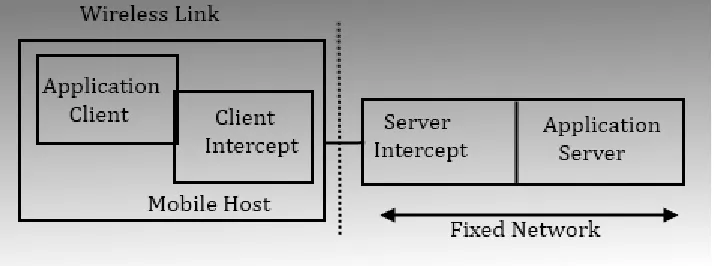
The C/I/S model proposes the deployment of an agent that will run at the mobile device
along with an agent that will run in the server side or middleware. This client-side agent
intercepts the client’s requests and together with the server-side agent performs
optimizations to reduce data transmission over the wireless link, improve data availability
and sustain the mobile computation uninterrupted. From the point of view of the client,
the client-side agent appears as the local server proxy that is co-resident with the client.
Since the pair of agents is virtually inserted in the data path between the client and the
server, the model is also called C/I/S instead of C/A/S.
Figure 3-4: The Client-Intercept-Server (C/I/S) model
This model provides separation of responsibly between the client-side and server-side
agents which facilitate highly effective data reduction and protocol optimization. In case
of database applications this model consists a client-side database agent which is specific
to the agent and serve only one agent; the server side database agent will serve many
agents at a time. The agent pair cooperates to intercept and control communication over
the wireless link for reducing network traffic and query processing. In our research, we
Figure 3-5: Client-Intercept-Server (C/I/S) model with remote database
3.5 Peer-to-Peer Model
In the peer-to-peer model, the server resides at the mobile host. In this case, mobile hosts
are equal partners in distributed computations. This network has emerged as an efficient
system, being typically used for sharing files containing audio, video, data or any
digital-format files and distributing services over fixed networks.
3.6 Mobile-Agent Model
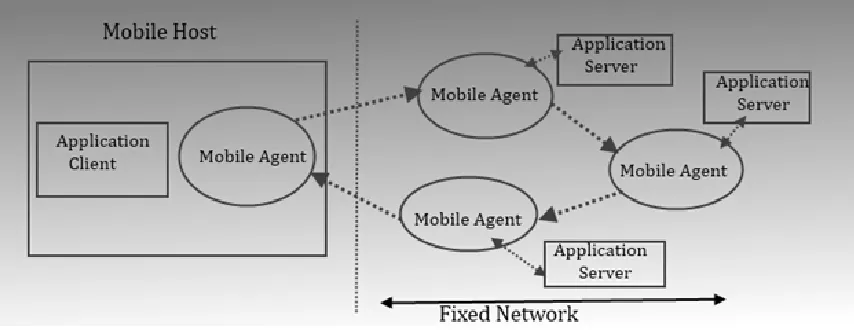
In the mobile-agent model [31], [32] an agent first lands at an object server and then is
executed to manipulate objects in the object server. If the agent finishes manipulating the
objects in the object server, the agent moves to another server which has data to be
manipulated. Here, agents manipulate objects only in local object servers without
exchanging messages in a network. In addition, an agent negotiates with the agent if
some agents manipulate objects in a conflicting manner. Through the negotiation, each
agent autonomously makes a decision on whether the agent continues to hold the objects
or gives up to hold the objects. After manipulating all or some of the servers, an agent
Figure 3-6: The Mobile Agent model
3.7 API
In this research we experiment with C/A/S and C/I/S; as we are retrieving data from
remote data source or database, these two models are supposed to behave better than
other models proposed by researches over the last two decades.
To experiment with different models and technologies for data retrieval, we developed an
API for the middleware. There are several mobile phones providers available in the
market with their own operating system; and every operating system provides a different
SDK to develop applications. Mobile application developers are facing problems due to
great heterogeneity of these devices. A common API with the flexibility to support
caching, compression, and encryption will make development of mobile application
easier and faster. We also developed an Agent API for C/I/S model which will compute
the caching data, decompression and decryption and the mobile application end.
The two APIs developed, then, are: 1) The Middleware API which provides a web
service which return data in XML format, so any mobile application can retrieve the data
and use it for the application. The API has the flexibility to retrieve data from databases
through middleware and make use of caching, compression, encryption or any
combination of these technologies. 2) The Mobile Agent API which has been developed
and decrypting data coming from the middleware API. Mobile application developers can
use this API for their J2ME or Java based mobile application.
The middleware API is a universal API providing web services and returning standard
web service data so any mobile developer can use this to retrieve data from remote
databases. Also, the mobile API will help to process the remote data for the mobile
Chapter 4
Implementation
4
Implementation
4.1 Introduction
To evaluate the different models and impact of the different techniques on data
transmission for mobile applications in a wireless network, we developed the following:
• Two Remote databases
• Middleware API
• Mobile Agent API and Mobile application for two different domains.
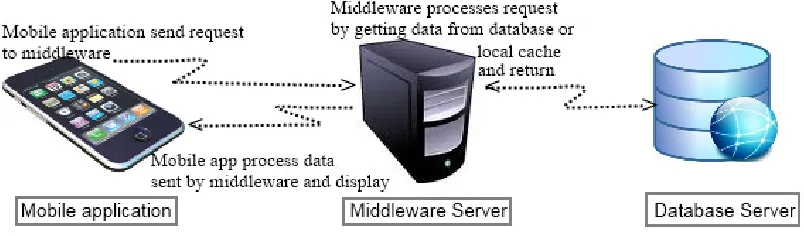
In the data transmission lifecycle, the mobile application sends a request to the
middleware; the middleware retrieves data from the cache or executes the query on the
remote database and processes the data; after processing the middleware returns data to
the mobile application. Finally, the mobile application processes the data returned from
the middleware and displays it. In Figure 4-1 we present a high level overview of the data
transmission lifecycle.
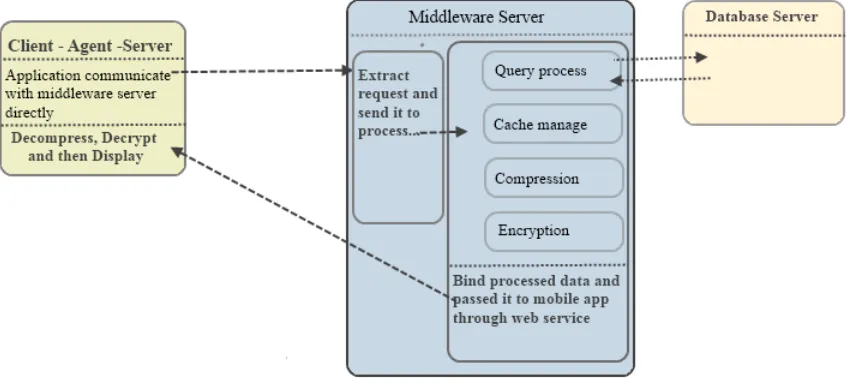
We experiment on two mobile application architectures: the C/A/S and C/I/S models. In
the C/A/S model, the mobile application sends requests to the middleware and the
middleware processes the data based on the requests from the mobile application. If the
mobile application requests cache data, the middleware searches for the data in the cache.
If the data is found, the middleware returns it back to the mobile application. If the data
is not in the cache, the middleware retrieves the data from the database, caches it and
sends it back to the mobile client. The middleware also compresses and/or encrypts data
based on the request from the mobile client. After getting the data from the middleware,
the mobile application decompresses and/or decrypts data if necessary, processes the
XML formatted data from the middleware, and then displays it on the mobile screen. In
Figure 4-2, we illustrate the request and response cycle for the C/A/S model.
Figure 4-2: Overview of Client-Agent-Server request and response
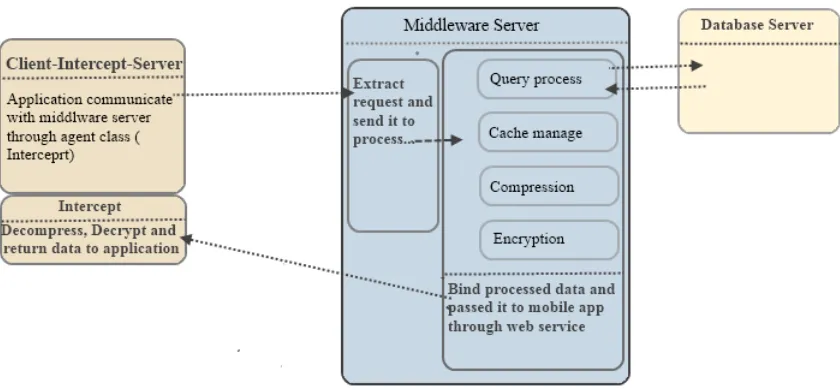
In case of C/I/S, the middleware and the database are same as in the C/A/S model.
However, the mobile application does not directly communicate with the middleware or
processes returning data from the middleware; rather, it calls the Intercept. Instead of
calling web service, processing returned data from the web service (decompress, decrypt,
or extract from XML), the mobile application calls methods of mobile API which
compute these functions and return data to the application to display it. In Figure 4-3, we
Figure 4-3: Overview of Client-Intercept-Server request and response
4.2 Databases
We experimented with two different databases. One database contains medical
information of around 10,000 patients (all fictitious) and another database is the common
test database named AdventureWorks [42], which contains inventory information of
different products.
The medical database contains several tables of hospital information (hospital), patient
information (patient), patient in hospital information (patientinhospital), and the
diagnosis results of patients (patient_data). The database contains approximately ten
thousand patient’s diagnosis result in the patient_data table. Based on the patient data in
the in the patient_data table we can do different experiments.
The adventure works database contains many tables for a complete inventory system. In
our experiments we use product, product category, product subcategory, product
description, and product photo table; these all together create a small inventory system
4.3 Middleware and Middleware API
The middleware retrieves data from the remote databases and returns it back to the
mobile application. The middleware is developed using C# programming language in an
ASP.NET platform. The pseudo code to retrieve data from a remote data source is
presented in Figure 4-4.
Function Get Data From Remote Data Source Input: Database Information, Query String
Output: Data from database
Query Encrypt Query String for Security
HttpWebRequest to send the request query to the database
HttpWebResponse to retrieve response result of the query from database StreamReader to read the return data
Return String Format of StreamReader data
Figure 4-4: Pseudo code to retrieve data from remote data sources
We experiment with caching, compression and encryption within the middleware to
understand their impact on data transmission in a wireless network. The mobile software
developer can use the API to specify whether data should be cached or compressed or
encrypted or any combination of these techniques by the middleware, just by calling the
web services provided by the API. The API provides a generic interface to a middleware
platform and the mobile application developers can customize the use of these techniques
to meet the need of their application to retrieve data.
4.3.1
Caching
In most web based application or wireless applications, caching significantly improves
the performance of applications. Instead of repeatedly fetching the same data, caching
can be used to store data in a temporary memory. Every time the application fetches data,
the data can come from the cache instead of recalculating it or fetching it from a remote
location.
In our middleware, we use the ASP.NET application cache to cache data. The application
pairs. Using the application cache is like using application state. However, unlike
application state, the data in the application cache is volatile. This means it is not stored
in memory for the life of the application. The advantage of using the application cache is
that ASP.NET manages the cache and removes items when they expire or become
invalidated, or when memory runs low.
Using a cache key the application cache determines whether an item exists in the cache or
not, and if it does, to use it. If the item does not exist, the application automatically
recreates the item and then places it back in the cache. The pattern of key/value pairs
ensures that the cache contains latest data from data source.
To retrieve data faster we pre-fetch data in the middleware. Every time the application
creates cache data we keep a record of the cache key and cache query. After a certain
time, the application automatically checks the data and pre-fetches it in files if the data
changes. We use the ASP.NET custom cache dependency feature to validate and expire
cache data. Custom cache dependency represents a logical dependency between a cached
item and a file(s), folder(s), or another cached item(s). When the dependency changes
(i.e., the file/folder/item changes), the bound cached item is removed from the cache so
the cache expires. In our middleware we create files based on cache dependency, every
time a new cache item is created, the system creates a file with the same name as the
cache key. At the time of pre-fetching, the system updates these cache dependency files
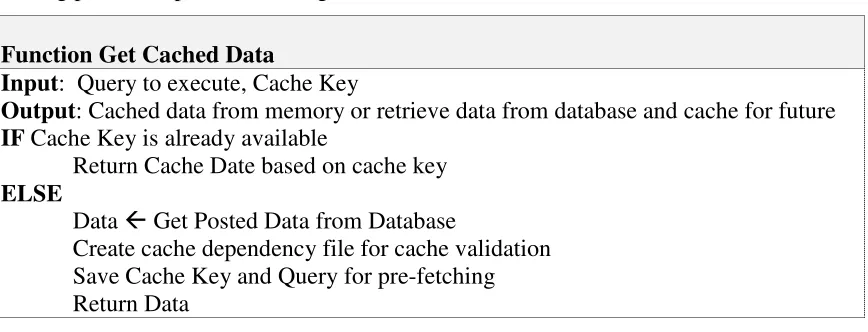
to keep the cache data update. The pseudo-code of the middleware caching and
pre-fetching process is presented in Figure 4-5.
Function Get Cached Data
Input: Query to execute, Cache Key
Output: Cached data from memory or retrieve data from database and cache for future
IF Cache Key is already available
Return Cache Date based on cache key
ELSE
Data Get Posted Data from Database
Create cache dependency file for cache validation Save Cache Key and Query for pre-fetching Return Data
This algorithm can be extended by using any other suitable caching technique instead of
using the built-in ASP.NET application caching. In the future, different caching
techniques could be implemented in order to analyze their performance for data
transmission for mobile applications.
4.3.2
Compression
Data compression is a common technology to represent information in a compact format;
data compression involves encoding information using fewer bits than the original
representation. Compression is useful because it helps reduce the consumption of
resources such as data space or transmission capacity. As the bandwidth of wireless
network is scarce, it may be advantageous to compress data to get the maximum out of
the bandwidth. Mobile applications suffer from limited memory where data compression
may help save memory and at the same time improve the speed of data transfer.
Mainly there are two types of compression techniques are available: Lossless
Compression and Lossy Compression. Lossless compression is mainly used for
spreadsheets, text and executable program compression; on the other hand Lossy
compression is mainly used for image, video, and audio compression. Lossless data
compression is used in many applications such as the ZIP file format and in the UNIX
tool gzip. Lossless compression is used in cases where it is important that the original and
the decompressed data be identical, or where deviations from the original data could be
deleterious. Typical examples are executable programs, text documents and source code.
In the middleware, we used gzip compression; it is based on the DEFLATE algorithm,
which is a combination of Lempel-Ziv (LZ77) and Huffman coding. Gzip contains:
• 10-byte header, containing a magic number, a version number and a time stamp
• optional extra headers, such as the original file name
• 8-byte footer, containing a CRC-32 checksum and the length of the original
uncompressed data.
To implement gzip compression in the middleware, we used SharpZipLib [33], an
ASP.NET compression library that supports Zip files using both stored and deflate
compression methods. The pseudo-code for the middleware data compression is
presented in Figure 4-6.
Function Get Compressed Data Input: Data from database or cache
Output: Compressed data of the original data Data Get Data from Database of Cache
CompressData Compress Data in Gzip format using SharpZipLib library CompressData Encode the CompresseData
Return CompressData
Figure 4-6: Middleware pseudo-code to compress retrieved data
Instead of SharpZipLib, we could use any other compression algorithm in the middleware
just by modifying the algorithm.
4.3.3
Encryption
Encryption is the process of transforming information using an algorithm to make it
unreadable to anyone except those possessing special knowledge, usually referred to as a
key. The result of the process is encrypted information. The reverse process (to make the
encrypted information readable again) is referred to as decryption.
Encryption is mainly used to protect data transferred via networks, mobile telephones,
wireless microphones, wireless intercom systems, Bluetooth devices and bank automatic
teller machines. Encrypting data in transit helps to secure it as it is often difficult to
physically secure all access to networks.
In the case of enterprise databases, it is often necessary to move data over networks – to
other sites or to remote desktop and mobile applications. Data transmission across
the importance of data security, we have implemented encryption in the middleware so
data transmission in the wireless network can become secured.
In our research work, we encrypt the data to Base64 data format before transmitting it to
wireless network. Instead of using a real encryption algorithm for our experiments, we
used Base64 encoding to emulate encryption processing; in reality this encoding scheme
is much less complex than a real encryption scheme. Base64 is a group of encoding
schemes that represent binary data in an ASCII string format by translating it into a
radix-64 representation. Baseradix-64 encoding schemes are commonly used when there is a need to
encode binary data that needs be stored and transferred over media that are designed to
deal with textual data. This is to ensure that the data remains intact without modification
during transport. Base64 is commonly used in a number of applications including email
via MIME, and storing complex data in XML. The pseudo-code for encryption in the
middleware is presented in Figure 4-7.
Function Get Encrypted Data Input: Data from Database or Cache
Output: Encrypted data
Data Data from Database or Cache
EncryptedData Encrypt the Data using ASP.NET text encoding library Return EncryptedData
Figure 4-7: Middleware pseudo-code for encrypting retrieved data
4.3.4
Overview of the Middleware
The middleware API is called by the mobile application through an XML based web
service. The web service call is a method named GetServiceData with parameters
specifying the technologies to be used to retrieve data.
The parameters are:
1. Database or data source;
3. Caching information;
4. Compression Information;
5. Encryption Information;
The service method retrieves data from the database using the technologies as specified
in the parameters of the method and returns it to the mobile application. The
pseudo-code of this method is depicted in Figure 4-8.
Function Get Service Data
Input: Data source, QueryString, IsCaching, IsCompression, IsEncryption
Output: Data from database with optimization Query QueryString
IF IsCaching!= FALSE
Data GetCachedData
ELSE
Data GetDataFromDatabase
IF IsCompression Equals TRUE
Data GetCompressedData of the CacheData or Data from Database
IF IsEncryption Equals TRUE
Data GetEncryptedData of the CachedData or Data from Database and/or ComrepssedData
Figure 4-8: Pseudo-code of service to retrieve data in middleware
4.4 Mobile Agent API
With the growing need to access remote web services from mobile applications, most of
the mobile SDKs provide a remote web services library. Even if any SDK does not
provide such a library, the developer can use third party open source software such as
kSOAP [35]. In our experiments, we use the J2ME Web Services API (WSA) [36]. The
API's two optional packages standardize two areas of functionality that are crucial to
clients of web services: remote service invocation and XML parsing.
To retrieve data from the web service data we used kXML [37], a lightweight Java-based
XML parser designed to run on limited, embedded systems such as personal mobile
the application drives the parser through the document by repeatedly requesting the next
piece [38].
If the web service data is compressed, we use Jazzlib [39]; a java based open source
compression decompression library, it supports compression and decompression for
J2ME application too. Jazzlib supports encryption and decryption for different data
formats such as ZIP, GZip, and Deflector. In our experiments, the middleware provide
data in GZip compressed format so we used GZIPInputStream of Jazzlib to decompress
the middleware data.
If the web service data is encrypted, we use Base64 decryption provided by bouncycastle
[40]. Bouncy Castle provides a collection of cryptography techniques for both the Java
and the C# programming languages. They also provide a cryptography library for
Android. So, all Java based mobile applications (J2ME, Blackberry java application,
Android java application) can use this library to encrypt/decrypt data in different format.
4.4.1
Implementation of C/A/S
In the case of the C/A/S model, our mobile application is implemented using J2ME. The
application itself contains all the functionalities, such as remote data fetching, either from
cached or remote database, decompression of the data, if the data is returned by the
middleware server in compressed format and decryption of the data if the data is returned
by the middleware in an encrypted format. In the case of the C/A/S architecture, the
mobile application directly communicates with the middleware agent to retrieve data,
process the retrieve data, and display it to the mobile screen. Here all the computing in
the mobile application is in one class file.
The list of the J2ME libraries and third party libraries used to develop the mobile C/A/S
javax.microedition.midlet.*; javax.microedition.lcdui.*;
org.netbeans.microedition.lcdui.SplashScreen; java.util.Vector;
liveservices.Services_Stub to retrieve data from middleware web service API org.kxml2.io and org.xmlpull.v1 to read XML formatted web service data net.sf.jazzlib.GZIPInputStream to decompress data
base64.decode to decrypt data
Figure 4-9: J2ME libraries and third party libraries for C/A/S application
In our experiments we display data in J2ME controls. The mobile application calls a web
service on command action, and loads the processed data into control; the pseudo-code of
the command action is presented in Figure 4-10.
SERVICE Initiate web service stub.
DABASE Database connection information or path SQL Query to retrieve data from database
CACHE ‘false’ if not cache data ‘cache_key’ if data from cache COMPRESS ‘true’ if compressed, ‘false’ or ‘blank’ if not compressed ENCRYPT ‘true’ if encrypted, ‘false’ or ‘blank’ if not encrypted LIST_ITEM Name of the list item to load data on mobile screen CALL FUNCTION GENERATEVIEW with parameters
SERVICE, DATABASE, CACHE, COMPRESS, ENCRYPT, LIST_ITEM
Figure 4-10: Command actions to generate mobile data
The mobile application does the following things to generate the list view from the web
service data:
1. Retrieve data from the web service by calling the web service method.
2. Check if data is encrypted, if encrypted, then it uses the Base64.Decode() method
to decrypt the data.
3. Check if the data is compressed, if compressed, then it uses GZIPInputStream to
decompress data.
4. Convert the data to byte array and pass it to KXML to extract data from the XML
Figure 4-11 provides an overview of the GENERATEVIEW function, which actually
retrieves data from web service, processes the data and displays it on the mobile screen.
DATA SERVICE.GETDATA ( DATABASE, SQL, CACHE, COMPRESS,
ENCRYPT)
XMLBYTEARRAY Initialize byte array for temporary data store
IF ENCRYPT Equals TRUE
XMLBYTEARRAY Base64.Decode(DATA)
FLAG TRUE
END IF
IF COMPRESS Equals TRUE
FLAG TRUE
DATABYTEARRAY Initialize a byte array for temporary data store
IF XMLBYTEARRAY Equals NULL
DATABYTEARRAY Base64.Decode(DATA)
ELSE
DATABYTEARRAY Base64.Decode(XMLBYTEARRAY)
END IF
XMLBYTEARRAY Get Decompress data using GZIPInputStream
END IF
IF FLAG Equals False // IF data is not compressed or encrypted
XMLBYTEARRAY DATA.GetBytes()
END IF
Read XMLBYTEARRAY using KXML and append data in LIST_ITEM
Figure 4-11: Data process and display in Client-Agent-Server
4.4.2
Implementation of C/I/S
In the case of C/I/S, we developed an Intercept API; the name of the API package is
Intercept. The Intercept API contains methods to retrieve and read XML formatted web
service data, do decompression and decryption. Here, the mobile application calls the
web service, retrieves web service data and passes the data to the Intercept API; the
Intercept API processes the data, saves it in temporary storage, and returns it back to the
mobile application to display it.
The source code for the C/I/S is pretty simple; the pseudo-code of the mobile application
SERVICE Initiate Middleware Service and Call Service Method DABASE Database connection information or path
SQL Query to retrieve data from database
CACHE ‘false’ if not cache data ‘cache_key’ if data from cache COMPRESS ‘true’ if compressed, ‘false’ or ‘blank’ if not compressed ENCRYPT ‘true’ if encrypted, ‘false’ or ‘blank’ if not encrypted
DATA (DATABASE, SQL, CACHE, COMPRESS, ENCRYPT)
RESULT CALL INTERCEPT API (DATA, CACHE, COMPRESS, ENCRYPT)
DISPLAY RESULT in the mobile screen.
Figure 4-12: Client-Intercept-Server mobile application
In the case of C/I/S, the mobile application itself becomes smaller because all the
computation has been done by the Intercept API, the mobile application just needs to call
the API and display the returned result in any display control structure. This Intercept
API can be used for any mobile application developed in Java; it makes the mobile
application development simple and faster. The pseudo-code of the Intercept API is in
Figure 4-13.
USE org.kxml2.io and org.xmlpull.v1 to read XML data
USE net.sf.jazzlib.GZIPInputStream library to decompress data USE base64.Decode to decrypt data
FUNCTION GET_DATA_TO_DISPLAY ( DATA, CACHE, COMPRESS, ENCRYPT) XMLBYTEARRAY Initialize byte array for temporary data store
IF ENCRYPT Equals TRUE
XMLBYTEARRAY Base64.Decode(DATA) ; FLAG TRUE
END IF
IF COMPRESS Equals TRUE
FLAG TRUE
DATABYTEARRAY Initialize a byte array for temporary data store
IF XMLBYTEARRAY Equals NULL
DATABYTEARRAY Base64.Decode(DATA)
ELSE DATABYTEARRAY Base64.Decode(XMLBYTEARRAY)
END IF
XMLBYTEARRAY Get Decompress data using GZIPInputStream
END IF
IF FLAG Equals False // IF data is not compressed or encrypted
XMLBYTEARRAY DATA.GETBYTES()
END IF
RESULT Read XMLBYTEARRAY using KXML and Generate a Vector
RETURN RESULT
4.5 Summary
In this Chapter we reviewed our system implementation. We developed a generic
middleware API and Java-based mobile application development API. These APIs meet
our requirements to enable us to evaluate different mobile application architectures and
technologies. These APIs can also be extended and used for further experimentation with
other mobile architectures and technologies. These APIs can be used by the mobile
Chapter 5
Experiments and Results
5
Experiments and Results
Our research focused on two extended Client/Server architectures: the C/A/S model and
the C/I/S model. Our goal was to analyze data transmission for these two mobile software
architectures in different scenarios of a mobile application with some common but
effective technologies integrated into the middleware of the system; such as middleware
data caching, data compression, and data encryption.
We experimented with data transmission in two different domains: An inventory system
and a medical information system. We first developed a mobile application for the
inventory system for use with small scale data analysis. Analysis involving larger data
sets was then done using the medical information system. Our experimental environment
consisted of the following components:
1. Two remote database server;
2. Middleware server (providing web service);
3. Mobile application (C/A/S application and C/I/S application).
In Table 5-1 we summarize the tools we used for the experimental systems.
Component Development Tool
Remote database Server 1 MySQL Database
Remote Database Server 2 MySQL Database
Mobile Application C/A/S J2ME
Mobile Application C/I/S J2ME
Table 5-1: List of development tools for the experimental environment
5.1 Experimental Setup
The following provides an overview of the experimental environment in more detail.
Database Server: The databases are hosted on a remote server (www.godaddy.com),
accessible through a public IP address; it has a Linux operating system and runs MySQL
server, version 5.0.
Middleware Server: The middleware was developed using ASP.NET web service [41]
and the C# as the programming language for the middleware. The middleware server runs
Internet Information Services (IIS) 7 server. The configuration of the server is: Windows
7 32-bit operating system, Intel core duo 2.3 GHz processor and 4 GB memory. It is
accessible through the Internet through a public IP address.
Mobile Phone: To experiment with mobile applications, we used a Nokia E72 smart
phone; configuration of the mobile phone is: Symbian OS 9.3, 600 MHz CPU, 250 MB
Internal memory, and 128 MB RAM.
In Table 5-2 we outline the communication details between the mobile application, the
middleware server and the remote databases.
Mobile Application Middleware Remote Database
The mobile application connects to the middleware services through wireless (WiFi).
The mobile application is installed on a mobile phone so application can be run
The middleware is located in a laboratory in the Computer Science Department at the University of Western Ontario; this server has a public IP.
The remote database is hosted on a server at the godaddy.com hosting service. It has public IP.
and accessed from anywhere.
Testing was done from a home residence connection which had a 2Mbps
dedicated wireless connection.
The mobile application communicates with the middleware through the middleware API using the public IP of the middleware server.
Communication to this server was from the
middleware server through the Internet.
Table 5-2: Communications between the mobile application, middleware server, and remote database server.
5.2 Experiments with Inventory System
We developed two mobile applications for accessing information from the inventory
system following the C/A/S and C/I/S models. The inventory system applications use the
product information tables of the AdventureWorks database. The application displays all
the product categories from the category table, and then enables the user to select a
category. Selecting the category causes the application to display the subcategories from
and then selecting a subcategory produces a list of the products under the category and
subcategory. When the user selects any of the products from the product list, the
application retrieves and displays all the information available in the database for the
product along with the product image. In Appendix E, we present the query involved in
each step of the application. The steps of the inventory system mobile application are
presented in Table 5-3.
Step 2: Select a product from the product category list (“Bikes”); the application retrieves the subcategories of the selected category. Selecting a subcategory
(“Mountain Bikes”) retrieves the products.
Step 3: Once a subcategory (“Mountain Bikes”) has been selected, the application retrieves the product list.
Step 4: Selecting a specific product from the product list (see Step 3 for selected product), the application retrieves and displays
information on the product and an image of the product from database.
Table 5-3: Steps of the inventory system mobile application
Our initial experitments involved two different scenations for both of the software
architectures. At every step in the application (as in Table 5-2) we measure the execution
time from the time the request is sent until the information is displayed on the moible
inventory application; the scenarios are summarized in Table 5-3. The results of the
experiements are presented in Table 5-4; each experiment was repeated 3 times.
Scenario #
Step 1 (Select Category)
Step 2 (Select Sub Category)
Step 3 (Select Product)
Step 4 (Product details)
1 Bikes Mountain Bike Product 773 Product Details
2 Accessories Bike Racks Product 876 Product Details
Table 5-4: Steps in different scenarios of inventory system
C/A/S (SD) C/I/S (SD) Data Size
Scenario 1 1662.00 ms (13.00) 1696.33 ms (9.82) ~7 KB
Scenario 2 1614.33 ms (12.66) 1643.00 ms (21.28) ~ 2.5 KB
Table 5-5: Inventory system experiment result for scenario 1 and scenario 2
In this experiment, Scenario 1 (~7 KB) loads with more data than Scenario 2 (~2.5 KB).
The experiment result shows that in case of both of the architectures, data transmission
time for Scenario 1 is larger than data transmission time of Scenario 2; standard
deviations are in parentheses. The result shows that the C/A/S performs slightly better
than the C/I/S, but given the size of the standard deviations, the relatively small amounts
of data in both scenarios, there is really little difference in performance of the mobile
software architectures.
With the inventory look-up application, we were able to test the APIs and make some
initial comparisons between the software models. We were able to evaluate the
application with modest amounts of data. For this simple look-up application, both
models functioned well.
5.3 Experiments with a Medical Information System
While the inventory application was useful, the data available was relatively limited.
Given that there was more data available in the medical information system; we chose to