Optimization the Parameters for Speech
Recognition System Using Genetic Algorithm
M. Ben Nasr1, S. Saoud2, A. Cherif3
Assistant Professor, Dep. Electronics Faculty of Sciences of Tunis, University of Tunis El-Manar, Tunisia 1
Assistant Professor, Dep. Electronics Faculty of Sciences of Tunis , University of Tunis El-Manar, Tunisia 2
Professor, Dep. Electronics Faculty of Sciences of Tunis, University of Tunis El-Manar,Tunisia 3
ABSTRACT:This paper adopted Hidden Markov Model (HMM) to recognize Arabic isolated words . The database contain eleven Arabic isolated words. We have repeated each of them twenty five times by mono –locutor. Feature extraction using Bionic Wavelet Transform (BWT) and Mel Frequency Cepstral Coefficient (MFCC) are carried over the speech frame of the input speech. This is followed by Vector Quantization (VQ) and Hidden Markov Modeling. We describe in this paper the use of Genetic Algorithm (GA) to make a global search of optimal HMM parameters. We can find that the performance of speech recognition was improved by the later method. Experimentally it is observed that recognition accuracy is 96.96%.
KEYWORDS: Arabic Speech Recognition; Hidden Markov Model (HMM); Mel Frequency Cepstral Coefficient (MFCC); Bionic Wavelet Transform (B WT); Genetic Algorithm (GA);Vector Quantization (VQ)
I. INTRODUCTION
Speech recognition or more commonly known as automatic speech recognition (ASR) is defined as the process of interpreting human speech in a computer. With the development of ASR technology, we still have problem in speech recognition system.
Various methods were developed for speech recognition and classification. Recurrent Neural Network and Dynamic Time Warping (DTW) [1], Multi-layer Perceptron (MLP) [2] and Hidden Markov Models (HMM) [3]are some common methods used to recognize the speech signal.
HMM is in fact the most popular approach for speech recognition. The hidden Markov models became the perfect solution to speech recognition problem. Indeed, HMMs are rich in mathematical structures and therefore can be used in a large range of applications. In addition, these models give outstanding results when they are properly applied. HMM is a probabilistic finite state automaton. It is constituted of states {nodes}, linked together by transitions {arcs} [4].Our work consists at using our speech database that contains Arabic isolated words that are recorded by a mono-speaker and using a HMM for speech recognition and classification. The optimization of HMM parameters is very important step in Automatic Speech Recognition (ASR) using HMM. Since, obtaining the optimal values of the model parameters will automatically raise the ASRs recognition precision. This procedure is referred to as HMM training ; we have used the speech occurrences to estimate the model parameters. The well known Baum-Welch algorithm is usually utilized to perform HMM training, an initial guess of the parameters is made randomly, then more exact parameters are computed in each iteration until the algorithm converge. [6], however the problem of optimizing model parameters of HMM is of great interest to the researchers.
II. FEATURE EXTRACTION
Feature extraction is a critical element in speech recognition since it generates the parameters on which the recognition algorithm is based and reduces the speech signal variability. In this work, we used Bionic Wavelet Transform and Mel Frequency Cepstral Coefficient for feature extraction.
II.1. BIONIC WAVELET TRANSFORM
The variable costs (fuel costs) of thermal unit are usually modeled as a nonlinear function of the unit’s power output. Thermal units have a number of steam admission valves that are opened in sequence as the power output is increased. This is particularly emphasized for combined cycle gas turbine. BWT was presented as an adaptive wavelet transform. It is conceived particularly for modeling the human auditory system [8, 9]. The adaptive nature of the Bionic Wavelet Transform (BWT) is assured by substituting the constant factor of the wavelet transform with a variable quality factor.
The expression of the mother wavelet ψ(t) is as follows:
expression of the mother waveletψ(t) is as follows:
t f j e t t ~ 20 (1)
Where
f
0 is the center frequency andψ is the envelope function of ψ(t) . So the functionψ(t) is:
2 0 ~ T t e t (2)
Where
T
0 represent the initial-support of the unscaled mother wavelet.By using a time varying function T, the mother function of the BWT is represented as follows:
j ftT e T t T t
1 ~ 2
(3)
The BWT of a given signal x(t) is expressed as follows:
dta t t x a a
BWTx T
1 ( )~
, (4) dt e T a t t x a T a t f j
2 ) ( 1From where, the adaptive nature of the BWT is taken by a time-varying factor T which represents the scaling of the cochlear filter bank quality at every scale over time . For the human auditory system, Yao and Zhang [8] have used
0
15165.4
f
Hz
. The distinction of the scale variable a is consummated using a pre-defined logarithmic spacing across the desired frequency rang .So; the center frequency at each scale is given as follows [12-14]:
1.1623
, 0,1,2,...0
f m
fm m
(5)
For this work, coefficients at 21 scales,
m
11,12, ...30
, are computed through numerical integration of the CWT. The 21 scales answer to center frequencies logarithmically varied from 166.4 Hz to 3369.7 Hz. For every time and
1 1 , 1 1 , 1 , 2 BWTsT a G
BWTs BW Ts a s
G BW Tx a
(6)
where 1
~
G is the active gain factor which represents the outer hair cell resistance function, 2
~
G designates the active gain
factor to represent the time-varying compliance of Basilar membrane,
BW T
sis a constant representing thetime-varying compliance of Basilar membrane,
BWT
x
a
,
is the Bionic Wavelet Transform at time and scale a , and
is time computation step [14].G
1andG
2are the resolution in time domain and frequency domain which can beincreased respectively. In execution, the coefficients of BWT can be readily computed by corresponding coefficients of the CWT by:
a,
K
a,
CWT
a,
BWTx x (7)
Where K is a factor which depends on T. For the Morlet wavelet
2 0 T t e t
that is evenly employed as the mother
function. K is given by:
20 / , 1 , 2 T a T dt e a K t
(8)This is roughly equal to:
1.7725 1
T
a,
/T0
2In our work, we use 0.87
~
1
G ,G~2 45 BWTs 0.8 and
T
0
0.0005
that are the same values as in the reference[8-9].Finally, the computation step
is selected to be equal to,1 fs wheref
sis the sampling frequency.II.2. MEL FREQUENCY CEPSTRAL COEFFICIENT
The MFCC is the most widely used feature parameters for speech recognition. Mel Frequency Cepstral Coefficient method is well known for its performance and relative simplicity. The calculation process of the coefficients can be described as follows [10]:
Step 1: employ Fast Fourier Transform (FFT) to get power spectrum of the speech signal. Step 2: apply a Mel-space filter-bank to the power spectrum to obtain logarithmic energy value. Step 3: conduct the discrete cosine transform (DCT) of log filter-bank energies to get MFCC.
III. VECTOR QUANTIZATION
To Feature extraction gives result as a series of vectors characteristic of the time-varying spectral properties of the speech signal. The spectral analysis has significantly reduced the required information rate. It gives the discrete representation of speech sounds. Among the various methods of designing the VQ codebook, binary split algorithm is implemented by the following procedure:
Conceive a 1-vector codebook; this is the centroïde for the entire set of training vectors.
Duplicate the size of the codebook by splitting the present codebook.
Employ the K-means iterative algorithm to obtain the best set of centroids for the divided codebook.
The output of VQ is the index of the codebook vector nearest to the input vector.
IV. HIDDEN MARKOV MODEL
Hidden Markov Model (HMM) is currently the most popular approach to speech recognition. An HMM is characterized by three matrices namely A, B and .So, the compact notation
λ = {A, B, } represents a complete parameter set of the model. Where:
A= {aij} represents the state transition probability matrix, (NxN) ,
B ={bij(k)} represents the matrix of observation probability, (NxM),
i initial state distribution vector(Nx1) , N is the states number in HMM,
M is the of distinct observations number of symbols per state To do isolated word recognition the following steps are performed.
1. For each word V in the vocabulary, an HMM model LV must be build: a model parameters (A, B, π) are to be
estimated which optimized the likelihood of the training set observations for the V the word.
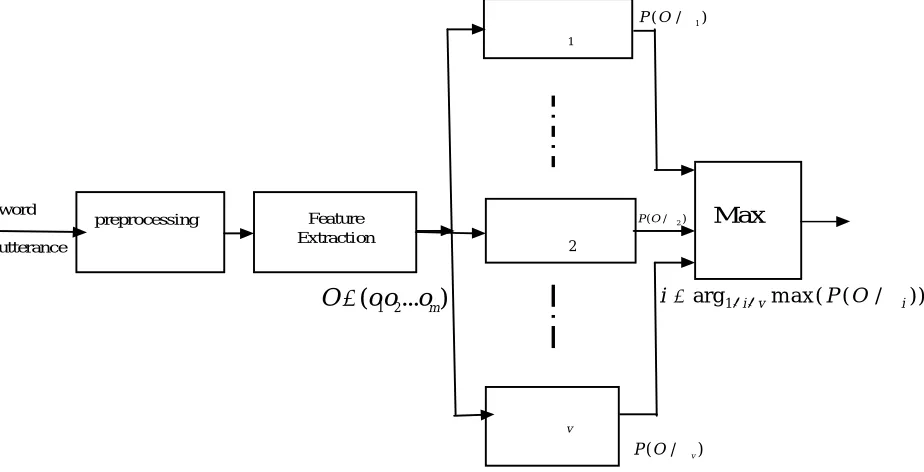
2. For each unknown word to be recognized, the procedure proven in figure 1 must be effected, that is, measurement of the observation sequence O= (o1, o2,……., oT), through feature analysis of the speech that correspond to the word; followed by calculation of model likelihoods to all possible models P (O/ LV), followed by choice of the word whose model probability is highest – that is.[11]
Fig 1: The overall block diagram of an automatic speech recognition system.
For each unknown word to be recognized we calculated the model likelihood for all possible models, and select the model with the highest likelihood.
However, for the moment we still have problem for the selection of proper HMM parameters such as the number of coefficient(the number of MFCC and the number of BWT scales), the number of discrete symbols (or equivalently codebook size) and the number of states to set up the HMM
In the following sections, we will present a Genetic Algorithm method GA for HMM training. By using the global searching capability of GA, we can find the optimal number of coefficients, the optimal number of states and the optimal size of codebook.
2
( / )
P O
1
( / )
P O
( / v)
P O
1 2
(
... )
mO
o o o
word
utterance
1
preprocessing Feature
Extraction
Max
2
v
1
a rg i v m a x ( ( / i))
Yes
Training data
Find the best chromosome
Validating data Start
Mutation Crossover Selection
i
n
Hmm training Feature extraction
(BWT/MFCC) Decode parameters for
chromosome i
Calculating the Fitness function of chromosome i
Greate initial population
New population
Yes Optimum parameters obtained
Stopping criteria? Vector quantization
No
No
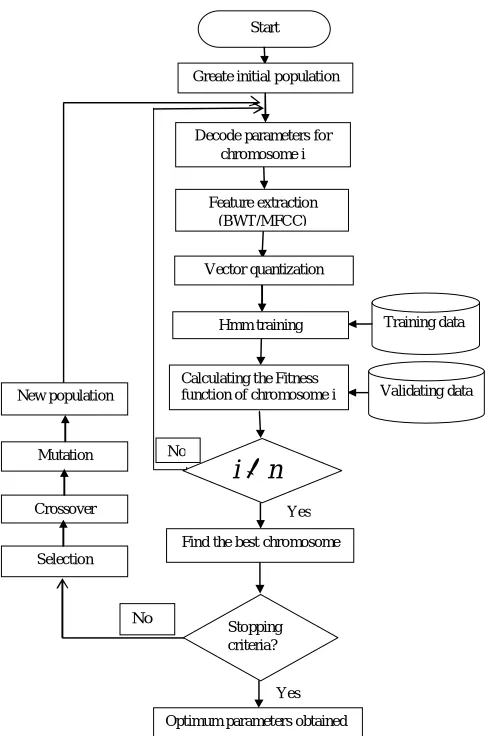
Fig 2: Flowchart of the proposed algorithm
V. THE GA FOR HMM OPTIMIZATION
The genetic algorithm (GA) [10] is a method for solving optimization problems. GA which is based on natural selection can solve a variety of optimization problems such as HMM optimization parameters. Figure 1 shows the flowchart of the genetic algorithm method applied to determine the optimal HMM parameters and to improve the recognition performance.
This figure (Fig 2) describes our system by using the GA to optimize HMM parameters and HMM training. All the parameters of the HMM are encoded form a long chromosome and tuned by the GA. Then, as a result of the GA process, the BP algorithm is used to train the network.
The different steps of the adapted GA for optimizing MLP are: 1. Create Initial population of chromosomes
2.Decode parameters for chromosome indice i
Feature extraction using MFCC and BWT
Vector quantization
HMM Training
Evaluate the Fitness function according to chromosome i. The higher fitness value reflects the chances of the chromosome to be selected in the following generation. The log likelihood represents the probability that the training observation speech have been generated by the present model parameters. It can be expressed as:
1
( log( ( / ))) /
M
n k n
k
P P O M
(9)
Repeat step 2 until the end of the size of population 3. Find the best chromosome
4. GA stop if generations number is Maximum or fitness =0, then select the optimal parameters. Otherwise GA repeats the following steps.
Selection good chromosomes : this operation consists in selecting chromosomes from the population for reproduction based on the relative fitness value of each chromosome. It can be performed by Elitist selection function: The best chromosomes of every generation are warranted to be chosen.
Crossover: to apply the crossover operator, two chromosomes are randomly selected from the population. Then the two chromosomes are chopped into two parts at the crossover point and they exchange their parts.
Mutation randomly alters each gene with a small probability, typically less than 10%. This operator introduces innovation into the population and helps prevent premature convergence on a local maximum. It exist many types of mutation, in this work, we used a Flip Bit in which a mutation operator that simply inverts the value of the chosen gene (0 goes to 1 and 1 goes to 0).
Take the place of the current population with the new population. Go to 2 the step.
VI. IMPLEMENTATION AND RESULTS
The idea in this work is to generate a speech recognizer for Arabic isolated words by implementing genetic algorithm (GA) with HMM to optimize HMM parameters and to improve the recognition performance. The database used for our approach was an Arabic isolated word spoken by a mono-speaker. Each word was uttered a twenty-five times. Ten occurrences of isolated words were reserved for training purposes and fifteen occurrences were reserved for testing purposes.
The table 1 presents the arabic words used for evaluation the proposed technical . Table 1: The used vocabulary
Pronunciation Arabic Writing English Writing
Khalfa ﻒﻠﺧ backward Amam مﺎﻣأ Forward Asraa عﺮﺳأ accelerate
Sir ﺮﺳ Walk
The table below reports all the values of the parameters used in the proposed speech recognition system.
Table 2: Parameters used for evolutionary design of HMM
Parameters Value
Coding Binary Population size 40 Size of chromosome 18 Maximum number of generations 50 Coefficients MFCC 5-20 Scales BWT 1-7
Fitness Function 100-recognition rate Selection Technique Elitist selection. Probability of selection 0.5
Method of mutation Random.
Mutation probability pmut = 1/ Size of chromosome Method of crossing One point crossover
Probability of crossover pcross =0.5
Stopping criterion Maximum number of generations or fitness =0
Results using HMM with GA
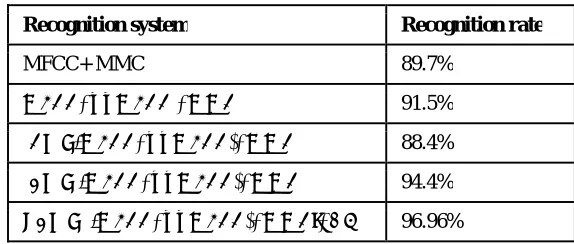
When optimizing the HMM parameters with the proposed architecture in Fig.2 we obtain the results seen in Table 3.
Table 3. reported the obtained results from the different techniques.
Table 3: Recognition rates
Recognition system Recognition rate
MFCC+ MMC 89.7%
MFCC+ΔΔMFCC +MMC 91.5%
(CWT/MFCC+ΔΔMFCC)+MMC 88.4%
(BWT /MFCC+ΔΔMFCC)+MMC 94.4%
[(BWT /MFCC+ΔΔMFCC)+MMC]+AG 96.96%
that HMM is the most popular approach for speech recognition but the slow convergence speed of the training HMM and HMM parameters optimization are the great interesting problem. As results, the GA not only overcomes the shortcoming of the slow convergence speed of the training HMM but also helps HMM parameters optimization. The proposed system shown in Table 3 is the best one for the specific problem of Speech Recognition. We can see that HMM trained by GA (with one-point crossover) is the best and HMM plays a key role in recognition performance. Moreover, from Table 3, it can be seen that the recognition rate increased up to 96.59.
VII.CONCLUSION
Thus In this paper, we describe the utilization of GA and HMM for the problem of Arabic speech recognition.GA is an effective solution used to optimize HMM parameters. Any arbitrary estimate of the initial model parameters such as the following: the number of coefficient (the number of MFCC and the number of BWT scales), the number of discrete symbols (or equivalently codebook size) and the number of states will usually lead to a sub optimal model in practice. Moreover, when the complexity of the problem domain increases and when optimized HMM parameters are desired, manual searching becomes unmanageable and quite difficult.
This paper presents a method based on optimization techniques (GA), which optimizes the HMM parameters and performance. Integrating the GA with Monrovian model can improve speech recognition rate. It can be increasing up to 96.59%. However, speech recognition rate still has room for improvement, where much effort is needed to improve GA method for accelerating the learning process in HMM model and the convergence time significantly. The results were quite encouraging but we realize that our database was mono locator and of limited vocabulary. Our goal is to ultimately design a HMM which would be able to recognize continuous speech recognition on a larger vocabulary. The work is being continued for connected speech recognition
REFERENCES
[1] V. Skorpil and J. Stastny, “ Back-Propagation and K-Means Algorithms Comparison”, in Proc. of 8 IEEE International Conference on Signal
Processing, pp. 16-20, 2006.
[2] Z. Sakka, A. Kachouri and M. Samet “Speech Denoising and Arabic Speaker Recognition System Using Subband Approach”, International
Review on Computers and Software (IRECOS), Vol. 2. n. 3, pp. 264 – 271, 2007.
[3] Peter Jančovič, Münevver Köküer“ Incorporating the voicing information into HMM-based automatic speech recognition in noisy environments” Speech Commu., Volume 51, Issue 5, pp 438–451, 2009.
[4] Lawrence Rabiner, “Tutorial on Hidden Markov Models & selected Applications in speech recognition”, Proc. IEEE,
[5] Jelinek F. “Statistical methods for speech recognition”,Language, speech and communication: a Bradford book. The MIT Press, Cambridge,
MA, January 1998.
[6] S. Kwong, C.W. Chau, K.F. Man, K.T. Ng, “GA-HMM Training for speech recognition”, IEEE Int. Conf. on Intelligent Processing System,
Australia, pp.502-505, August 1998.
[7] Kwong, S., Chau, C.W., Man, K.F., Tang, K.S., “Optimisation of HMM topology and its model parameters by genetic algorithm“, Pattern
Recognition, pp 509–522, 2001.
[8] [X. Yuan, “Auditory Model-Based Bionic Wavelet Transform for Speech Enhancement”, Master's thesis, Marquette University, Milwaukee,
WI, USA, 2003.
[9] J. Yao and Y. T. Zhang, “The application of bionic wavelet transform to speech signal processing in cochlear implants using neural network
simulations, IEEE Transactions on Biomedical Engineering, vol.49, no.11, pp.1299-1309, 2002.
[10] M. Ben Nasr, S. Saoud, A. Cherif “Optimization of MLP using Genetic Algorithms applied to Arabic speech recognition”, International
Review on Computers and Software (I.RE.CO.S.), Vol. 8, n.2, 2013
[11] Negin Najkara,, Farbod Razzazia , Hossein Sametib “A novel approach to HMM-based speech recognition systems using particle swarm